How to drive qualified traffic to your
 website utilizing SEO & PPC tactics
1. Do the proper work to ensure your website
   ranks well organically (SEO)
  •   Longer lead time
2. Buy ads on search engines to ensure you
   come to the top (PPC – AdWords)
  •   Send instant traffic to your website
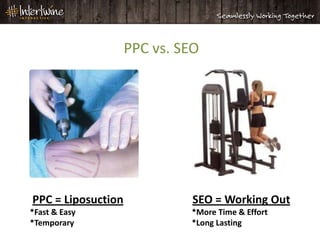
PPC vs. SEO


PPC = Liposuction             SEO = Working Out
*Fast & Easy                 *More Time & Effort
*Temporary                   *Long Lasting
Search Engine Optimization
          (SEO)
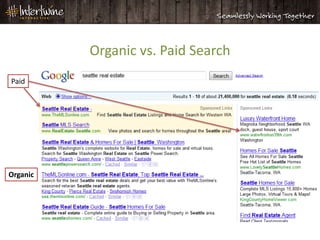
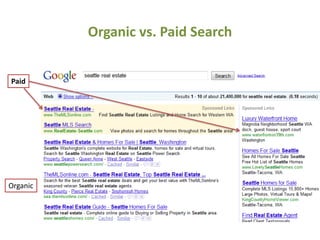
Organic vs. Paid Search
Paid


Organic
So, where does your site rank?

Page 8 – or worse yet – Page 28? If it’s not page 1, it
doesn’t really matter. Most people never look any further.
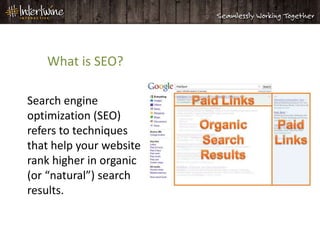
What is SEO?

Search engine
optimization (SEO)
refers to techniques
that help your website
rank higher in organic
(or “natural”) search
results.
SEO has evolved
It’s not just meta tags and other geek-
speak thingies anymore.
                                          • on-page and off-page SEO
                                          • inbound, authoritative links
                                          • social media mentions
                                          • landing page elements
                                          • lots of fresh and unique
                                            content
                                          • video and more
So how does Google rank your
       online presence?

                 Google has a well-kept secret formula
Think of it as   (algorithm) to rank websites by how
“The Google of   relevant they are to what people are
                 searching for.
Oz”
                 To get a little search engine love
with a wizard
                 from Google, Yahoo, or Bing you
behind a wall.   need to first excel at three things:
                 site architecture, content & links.
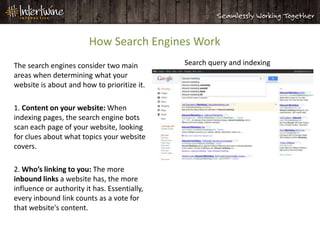
How Search Engines Work
The search engines consider two main          Search query and indexing
areas when determining what your
website is about and how to prioritize it.

1. Content on your website: When
indexing pages, the search engine bots
scan each page of your website, looking
for clues about what topics your website
covers.

2. Who’s linking to you: The more
inbound links a website has, the more
influence or authority it has. Essentially,
every inbound link counts as a vote for
that website's content.
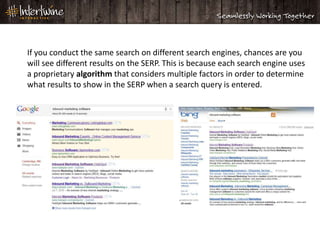
If you conduct the same search on different search engines, chances are you
will see different results on the SERP. This is because each search engine uses
a proprietary algorithm that considers multiple factors in order to determine
what results to show in the SERP when a search query is entered.
Long-Tail Concept
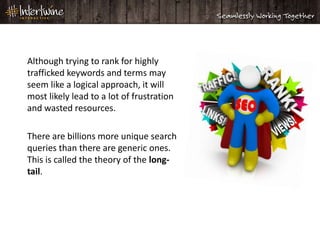
Although trying to rank for highly
trafficked keywords and terms may
seem like a logical approach, it will
most likely lead to a lot of frustration
and wasted resources.

There are billions more unique search
queries than there are generic ones.
This is called the theory of the long-
tail.
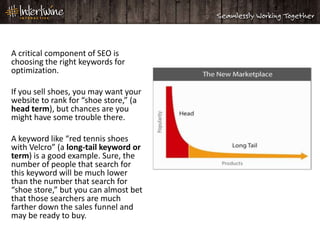
A critical component of SEO is
choosing the right keywords for
optimization.

If you sell shoes, you may want your
website to rank for “shoe store,” (a
head term), but chances are you
might have some trouble there.

A keyword like “red tennis shoes
with Velcro” (a long-tail keyword or
term) is a good example. Sure, the
number of people that search for
this keyword will be much lower
than the number that search for
“shoe store,” but you can almost bet
that those searchers are much
farther down the sales funnel and
may be ready to buy.
We’ve all heard it - when it comes to SEO, content is king.

The more content and webpages you publish, the more
chances you have at ranking on the search engines.


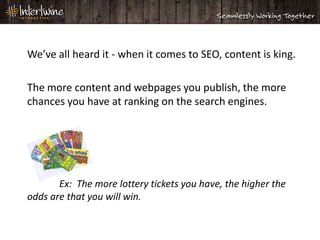
       Ex: The more lottery tickets you have, the higher the
odds are that you will win.
Duplicate Content
Local SEO

Target local keywords like “Omaha contractors” or “Omaha
chiropractors”
Ask for reviews
Include map of your location along with directions
Social sharing - Enabling your visitor to come and share your page
“NAP” – name, address, phone (local # and not 800 #)
Make sure your address is listed in your footer and contact us page. You want those search
spiders to pick up that address as much as possible and it’s important to be consistent. MUST
use same exact wording for address on all listings. This will help build credibility across the
web.

Get your business listed in local directories
Google Places, Bing Local, Yahoo Local, Merchant Circle, YellowPages, WhitePages, Local.com,
Manta, etc..
Web Analytics
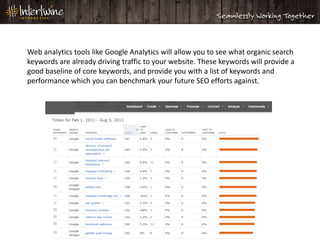
Web analytics tools like Google Analytics will allow you to see what organic search
keywords are already driving traffic to your website. These keywords will provide a
good baseline of core keywords, and provide you with a list of keywords and
performance which you can benchmark your future SEO efforts against.
Measuring Success
Traffic
Measuring overall traffic to your website from organic search is
something you should look at on a weekly basis.


Leads/ROI
Web analytics tools like Google can make it easy to see how many
conversions have occurred on your website as a result of organic
search traffic and keywords.


Indexed Pages
Measuring how many pages the search engines have indexed for your
site is an easy way to measure the growth of your SEO efforts and
your website.
How does your SEO strategy
       stack up?
You should find out if you’re on
      Google’s good side.
                 Get an SEO Audit:
                 Learn how Google is
                 ranking your presence and
                 if your site can be
                 improved to generate
                 more calls, leads, sales,
                 etc.


                 • Basic SEO Audit:
                   $500-$2,000
Like the overall marketing landscape, search engines are
ever-evolving. There are multiple online resources that
make it easy for you to stay on top of SEO news and
changes that may impact your website.

www.SEOMoz.com
www.SEOBook.com
www.SERoundTable.com
www.SearchEngineLand.com
blog.hubspot.com
inboundmarketing.com
searchenginewatch.com
Pay-Per-Click
Organic vs. Paid Search


Paid


Organic
What is Google AdWords?

• Google AdWords is a Pay-Per-Click advertising
service

•Advertisers specify
   •the keywords that should trigger their ads
   •the maximum they are willing to pay per click

•Google will rank the ads based on 2 things:
   1) The amount of money you bid
   2) Quality score (based on relevancy of keywords)
Fast Facts About AdWords
About 97% of Google’s total revenues come from advertising.

Businesses make an average of $2 in revenue for every $1 they spend on
AdWords.

The average click-through rate for an ad in the first position is 7.94%.

The finance and insurance industry spent $4 billion on AdWords in 2011. Finance
and insurance related keywords are among the most expensive in AdWords, with
some demanding costs per click (CPCs) over $50.

Amazon spent an estimated $55.2 million on AdWords advertising in 2011.
Why Use PPC?

•Get launched immediately. PPC ads are implemented very quickly.
    •Instant Traffic - no long waiting time and groups of hungry niche visitors are always
    searching for information everyday.

•Well-Targeted traffic with a broad reach
    •By reaching out to well-targeted visitors who are already interested in your products
    or services, you can ensure a higher percentage of success in your campaign.
          •Obtain specific, pre-qualified, and quality traffic.
          •Can target by geography

•Reach the masses
    •Major players: Google, Yahoo!, Bing

•Only pay when someone clicks
    •You are in control of your budget
Where are Google Ads displayed?

•Search Engine Results Pages (SERPS)
•Search Network Partners
  •Ask, Aol, Amazon
•Google Maps pages
•Google Image pages
•Google Shopping pages
•Mobile Devices
•Google Display Network
  •Ads appear within the content of other websites
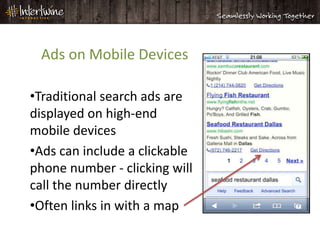
Ads on Mobile Devices

•Traditional search ads are
displayed on high-end
mobile devices
•Ads can include a clickable
phone number - clicking will
call the number directly
•Often links in with a map
Campaign Set-Up
•For every campaign you create
   •Choose a daily budget
   •Select where ads appear geographically
   •Select daypart (time of day you wish your ads to run)
   •Select where your ads appear online
   (search or display network)

•Every adgroup you create (“buckets”)
   •Must contain a targeted set of keywords (this is very
   important)
   •All keywords will share the same set of ads
   •The ads define the landing page
Campaign Set-Up: Match Type
                                            Ex: Tennis Shoes
Broad match
    “Your ads could also show for singular/plural
    forms, synonyms, and other relevant variations”
      (ads show on: buy tennis shoes, tennis racquet, running shoes, horse
      shoes, brown shoes)


Phrase match (enter keyword with quotes)
    …Ad [is] eligible to appear when a user searches
    [your phrase] with other terms before or after the
    phrase” (ads show on red tennis shoes and not on shoes for tennis,
      tennis sneakers)


Exact match (enter keyword with brackets)
    “…Ad [is] eligible to appear when a user searches
    [your phrase] without any other terms in the
    query.” (ads show on tennis shoes but not on red tennis shoes or
      buy tennis shoes)


                         **Don’t forget about adding in NEGATIVE keywords to your campaign**
Measuring Success
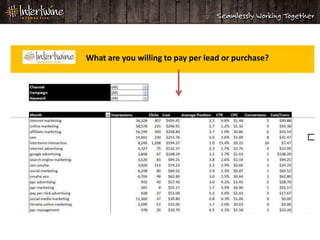
What are you willing to pay per lead or purchase?
More Tips
o The most important step when setting up a PPC campaign on any
  search engine is to analyze visitor search patterns and develop a list
  of relevant keywords that real visitors might type into the search
  engines when looking for your products and services.
    o This should go hand-in-hand with any SEO efforts
o Run multiple ads for the same words and test them against each
  other or send them to different pages to A/B split test your site or
  ad copy.
o Do not rush for position #1. Settle for positions 4/5/6 as bids will be
  lower and visibility will also be OK. This will lower your CPC and
  increase ROI.
o Don’t leave your AdWords account on autopilot (constant monitoring)
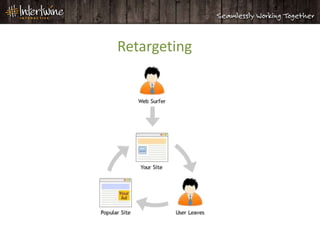
Retargeting
How to drive qualified traffic to your website utilizing SEO & PPC tactics

How to drive qualified traffic to your website utilizing SEO & PPC tactics

  • 2.
    How to drivequalified traffic to your website utilizing SEO & PPC tactics
  • 3.
    1. Do theproper work to ensure your website ranks well organically (SEO) • Longer lead time 2. Buy ads on search engines to ensure you come to the top (PPC – AdWords) • Send instant traffic to your website
  • 4.
    PPC vs. SEO PPC= Liposuction SEO = Working Out *Fast & Easy *More Time & Effort *Temporary *Long Lasting
  • 5.
  • 6.
    Organic vs. PaidSearch Paid Organic
  • 7.
    So, where doesyour site rank? Page 8 – or worse yet – Page 28? If it’s not page 1, it doesn’t really matter. Most people never look any further.
  • 8.
    What is SEO? Searchengine optimization (SEO) refers to techniques that help your website rank higher in organic (or “natural”) search results.
  • 9.
    SEO has evolved It’snot just meta tags and other geek- speak thingies anymore. • on-page and off-page SEO • inbound, authoritative links • social media mentions • landing page elements • lots of fresh and unique content • video and more
  • 10.
    So how doesGoogle rank your online presence? Google has a well-kept secret formula Think of it as (algorithm) to rank websites by how “The Google of relevant they are to what people are searching for. Oz” To get a little search engine love with a wizard from Google, Yahoo, or Bing you behind a wall. need to first excel at three things: site architecture, content & links.
  • 11.
    How Search EnginesWork The search engines consider two main Search query and indexing areas when determining what your website is about and how to prioritize it. 1. Content on your website: When indexing pages, the search engine bots scan each page of your website, looking for clues about what topics your website covers. 2. Who’s linking to you: The more inbound links a website has, the more influence or authority it has. Essentially, every inbound link counts as a vote for that website's content.
  • 12.
    If you conductthe same search on different search engines, chances are you will see different results on the SERP. This is because each search engine uses a proprietary algorithm that considers multiple factors in order to determine what results to show in the SERP when a search query is entered.
  • 13.
  • 14.
    Although trying torank for highly trafficked keywords and terms may seem like a logical approach, it will most likely lead to a lot of frustration and wasted resources. There are billions more unique search queries than there are generic ones. This is called the theory of the long- tail.
  • 15.
    A critical componentof SEO is choosing the right keywords for optimization. If you sell shoes, you may want your website to rank for “shoe store,” (a head term), but chances are you might have some trouble there. A keyword like “red tennis shoes with Velcro” (a long-tail keyword or term) is a good example. Sure, the number of people that search for this keyword will be much lower than the number that search for “shoe store,” but you can almost bet that those searchers are much farther down the sales funnel and may be ready to buy.
  • 17.
    We’ve all heardit - when it comes to SEO, content is king. The more content and webpages you publish, the more chances you have at ranking on the search engines. Ex: The more lottery tickets you have, the higher the odds are that you will win.
  • 18.
  • 19.
    Local SEO Target localkeywords like “Omaha contractors” or “Omaha chiropractors” Ask for reviews Include map of your location along with directions Social sharing - Enabling your visitor to come and share your page “NAP” – name, address, phone (local # and not 800 #) Make sure your address is listed in your footer and contact us page. You want those search spiders to pick up that address as much as possible and it’s important to be consistent. MUST use same exact wording for address on all listings. This will help build credibility across the web. Get your business listed in local directories Google Places, Bing Local, Yahoo Local, Merchant Circle, YellowPages, WhitePages, Local.com, Manta, etc..
  • 20.
  • 21.
    Web analytics toolslike Google Analytics will allow you to see what organic search keywords are already driving traffic to your website. These keywords will provide a good baseline of core keywords, and provide you with a list of keywords and performance which you can benchmark your future SEO efforts against.
  • 22.
  • 23.
    Traffic Measuring overall trafficto your website from organic search is something you should look at on a weekly basis. Leads/ROI Web analytics tools like Google can make it easy to see how many conversions have occurred on your website as a result of organic search traffic and keywords. Indexed Pages Measuring how many pages the search engines have indexed for your site is an easy way to measure the growth of your SEO efforts and your website.
  • 24.
    How does yourSEO strategy stack up?
  • 25.
    You should findout if you’re on Google’s good side. Get an SEO Audit: Learn how Google is ranking your presence and if your site can be improved to generate more calls, leads, sales, etc. • Basic SEO Audit: $500-$2,000
  • 26.
    Like the overallmarketing landscape, search engines are ever-evolving. There are multiple online resources that make it easy for you to stay on top of SEO news and changes that may impact your website. www.SEOMoz.com www.SEOBook.com www.SERoundTable.com www.SearchEngineLand.com blog.hubspot.com inboundmarketing.com searchenginewatch.com
  • 27.
  • 28.
    Organic vs. PaidSearch Paid Organic
  • 29.
    What is GoogleAdWords? • Google AdWords is a Pay-Per-Click advertising service •Advertisers specify •the keywords that should trigger their ads •the maximum they are willing to pay per click •Google will rank the ads based on 2 things: 1) The amount of money you bid 2) Quality score (based on relevancy of keywords)
  • 30.
    Fast Facts AboutAdWords About 97% of Google’s total revenues come from advertising. Businesses make an average of $2 in revenue for every $1 they spend on AdWords. The average click-through rate for an ad in the first position is 7.94%. The finance and insurance industry spent $4 billion on AdWords in 2011. Finance and insurance related keywords are among the most expensive in AdWords, with some demanding costs per click (CPCs) over $50. Amazon spent an estimated $55.2 million on AdWords advertising in 2011.
  • 31.
    Why Use PPC? •Getlaunched immediately. PPC ads are implemented very quickly. •Instant Traffic - no long waiting time and groups of hungry niche visitors are always searching for information everyday. •Well-Targeted traffic with a broad reach •By reaching out to well-targeted visitors who are already interested in your products or services, you can ensure a higher percentage of success in your campaign. •Obtain specific, pre-qualified, and quality traffic. •Can target by geography •Reach the masses •Major players: Google, Yahoo!, Bing •Only pay when someone clicks •You are in control of your budget
  • 32.
    Where are GoogleAds displayed? •Search Engine Results Pages (SERPS) •Search Network Partners •Ask, Aol, Amazon •Google Maps pages •Google Image pages •Google Shopping pages •Mobile Devices •Google Display Network •Ads appear within the content of other websites
  • 33.
    Ads on MobileDevices •Traditional search ads are displayed on high-end mobile devices •Ads can include a clickable phone number - clicking will call the number directly •Often links in with a map
  • 34.
    Campaign Set-Up •For everycampaign you create •Choose a daily budget •Select where ads appear geographically •Select daypart (time of day you wish your ads to run) •Select where your ads appear online (search or display network) •Every adgroup you create (“buckets”) •Must contain a targeted set of keywords (this is very important) •All keywords will share the same set of ads •The ads define the landing page
  • 35.
    Campaign Set-Up: MatchType Ex: Tennis Shoes Broad match “Your ads could also show for singular/plural forms, synonyms, and other relevant variations” (ads show on: buy tennis shoes, tennis racquet, running shoes, horse shoes, brown shoes) Phrase match (enter keyword with quotes) …Ad [is] eligible to appear when a user searches [your phrase] with other terms before or after the phrase” (ads show on red tennis shoes and not on shoes for tennis, tennis sneakers) Exact match (enter keyword with brackets) “…Ad [is] eligible to appear when a user searches [your phrase] without any other terms in the query.” (ads show on tennis shoes but not on red tennis shoes or buy tennis shoes) **Don’t forget about adding in NEGATIVE keywords to your campaign**
  • 36.
  • 37.
    What are youwilling to pay per lead or purchase?
  • 38.
    More Tips o Themost important step when setting up a PPC campaign on any search engine is to analyze visitor search patterns and develop a list of relevant keywords that real visitors might type into the search engines when looking for your products and services. o This should go hand-in-hand with any SEO efforts o Run multiple ads for the same words and test them against each other or send them to different pages to A/B split test your site or ad copy. o Do not rush for position #1. Settle for positions 4/5/6 as bids will be lower and visibility will also be OK. This will lower your CPC and increase ROI. o Don’t leave your AdWords account on autopilot (constant monitoring)
  • 39.

Editor's Notes

  • #3 There are many different tactics to drive traffic to your site. Today we will be talking specifically SEO & PPC
  • #4 Today we will be covering 2 tactics: SEO & PPC
  • #13 SERP: Search engine results page
  • #15 Example – someone searching for a specific product name/description Color LaserJet Enterprise CM4540 Laser MFP,...
  • #20 For many businesses in this room it is important to optimize locally
  • #30 Google is the big dog so we will focus our discussion here.
  • #35 Walk through Bank example