Topic
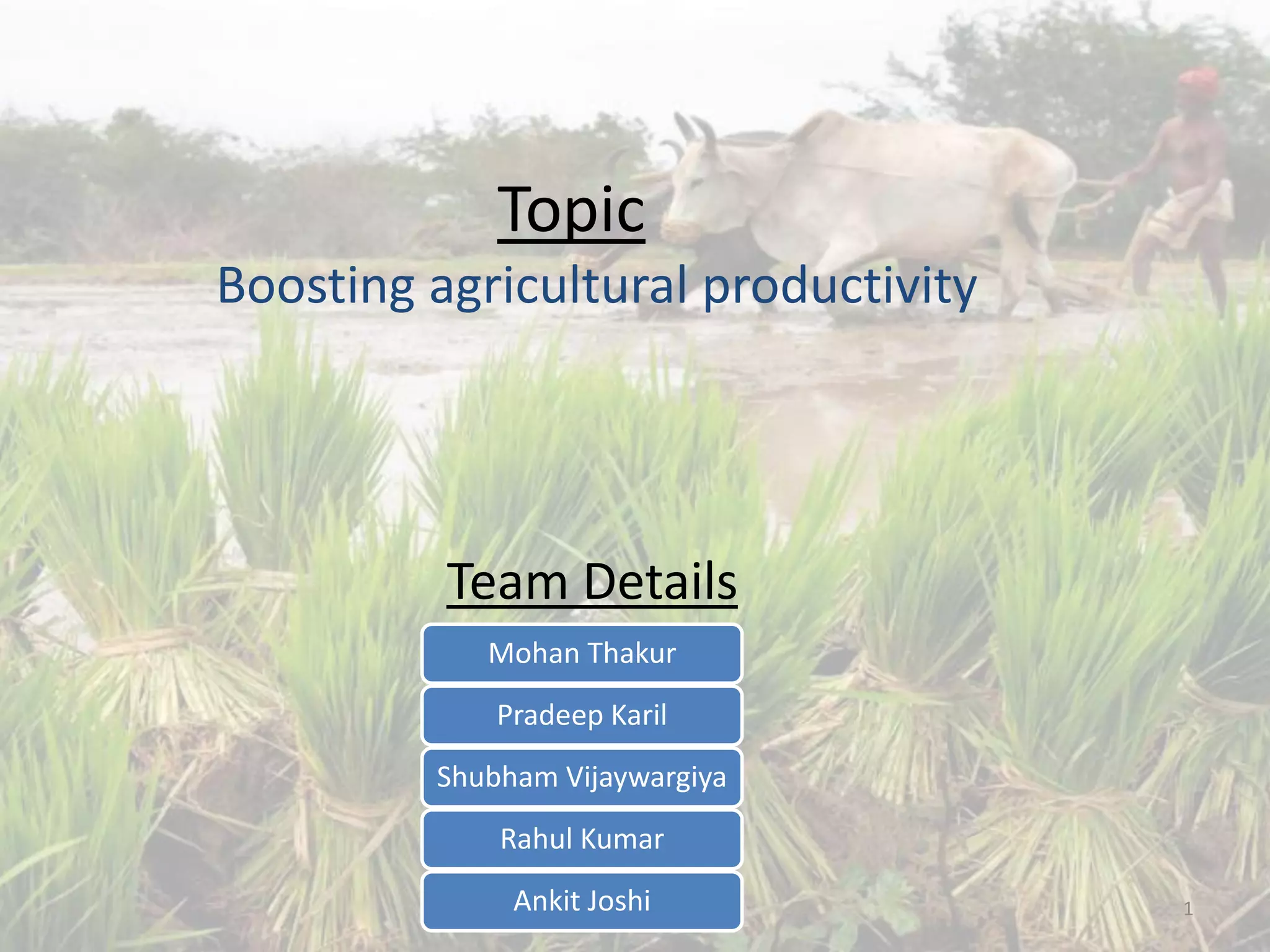
Boosting agricultural productivity
Team Details
Mohan Thakur
Pradeep Karil
Shubham Vijaywargiya
Rahul Kumar
Ankit Joshi 1
 Agriculture Sector is changing the socio-economic
environments of the population due to liberalization
and globalization.
 About 75% people are living in rural areas and are still
dependent on Agriculture. About 43% of India’s
geographical area is used for agricultural activity.
 Agriculture continues to play a major role in Indian
Economy.
INTRODUCTION
2
AGRICULTURE IN INDIA
Total Geographical Area - 328 million hectares.
Net Area sown - 142 million hectares.
Gross Cropped Area – 190.8 million hectares.
Net Irrigated Area – 56.9 million hectares.
 Provides food to more than 1 billion people.
 Produces 51 major crops.
 Contributes to 1/6th of the Export Earnings.
3
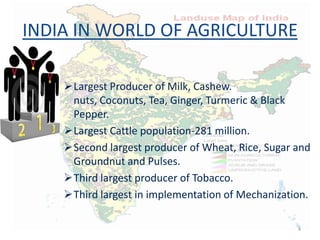
INDIA IN WORLD OF AGRICULTURE
Largest Producer of Milk, Cashew.
nuts, Coconuts, Tea, Ginger, Turmeric & Black
Pepper.
Largest Cattle population-281 million.
Second largest producer of Wheat, Rice, Sugar and
Groundnut and Pulses.
Third largest producer of Tobacco.
Third largest in implementation of Mechanization.
4
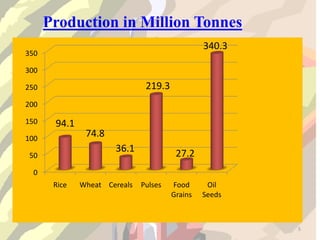
0
50
100
150
200
250
300
350
Rice Wheat Cereals Pulses Food
Grains
Oil
Seeds
94.1
74.8
36.1
Production in Million Tonnes
219.3
27.2
340.3
5
MILESTONE -THE GREEN
REVOLUTION
 Acquiring more land area for
cultivation purpose.
 Expanding irrigation facilities.
 Use of improved and advanced
variety of seeds.
 Water management.
 Protection activities.
 Implementation of better tools and
techniques as a result of research.
 Production increased 50% from 1967
to 1971 in jus four years.
6
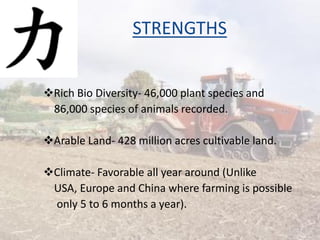
STRENGTHS
Rich Bio Diversity- 46,000 plant species and
86,000 species of animals recorded.
Arable Land- 428 million acres cultivable land.
Climate- Favorable all year around (Unlike
USA, Europe and China where farming is possible
only 5 to 6 months a year).
7
WEAKNESS
Fragmentation of lands- Division of lands through
generations lowers profit margins for farmers.
Illiteracy- Impotent seeds, approach to moneylenders than
to banks for loans.
Lack of Technological Inputs- Bullock farming still prevailing.
Poor Infrastructure-Unavailability of modern facilities to
some farmers.
8
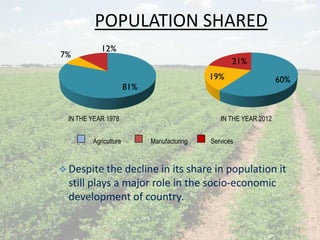
POPULATION SHARED
Agriculture Manufacturing Services
60%19%
21%
 Despite the decline in its share in population it
still plays a major role in the socio-economic
development of country.
81%
7%
12%
IN THE YEAR 1978 IN THE YEAR 2012
9
OPPORTUNITIES
Exports- Developing of Free trade
agreements between India and other
countries.
Agro Based Industries- Machineries for
Agriculture, Pesticides and Insecticides
manufacturing Industries.
Horticulture- Research and development for
hybrid plants with more productivity and
nutritional elements.
10
SUMMARY
THE LITERACY LEVEL IN FARMERS HAS TO
BE INCREASED.
WE HAVE THE INFRASTRUCTURE ONLY
LINKS ARE MISSING.
SUSTAINABLE USE OF RESOURCES.
GOVERNMENTS ROLE AS A FACILITATOR
HAS TO BE INCREASED FOR BETTER
PRODUCTION.
11

young15

  • 1.
    Topic Boosting agricultural productivity TeamDetails Mohan Thakur Pradeep Karil Shubham Vijaywargiya Rahul Kumar Ankit Joshi 1
  • 2.
     Agriculture Sectoris changing the socio-economic environments of the population due to liberalization and globalization.  About 75% people are living in rural areas and are still dependent on Agriculture. About 43% of India’s geographical area is used for agricultural activity.  Agriculture continues to play a major role in Indian Economy. INTRODUCTION 2
  • 3.
    AGRICULTURE IN INDIA TotalGeographical Area - 328 million hectares. Net Area sown - 142 million hectares. Gross Cropped Area – 190.8 million hectares. Net Irrigated Area – 56.9 million hectares.  Provides food to more than 1 billion people.  Produces 51 major crops.  Contributes to 1/6th of the Export Earnings. 3
  • 4.
    INDIA IN WORLDOF AGRICULTURE Largest Producer of Milk, Cashew. nuts, Coconuts, Tea, Ginger, Turmeric & Black Pepper. Largest Cattle population-281 million. Second largest producer of Wheat, Rice, Sugar and Groundnut and Pulses. Third largest producer of Tobacco. Third largest in implementation of Mechanization. 4
  • 5.
    0 50 100 150 200 250 300 350 Rice Wheat CerealsPulses Food Grains Oil Seeds 94.1 74.8 36.1 Production in Million Tonnes 219.3 27.2 340.3 5
  • 6.
    MILESTONE -THE GREEN REVOLUTION Acquiring more land area for cultivation purpose.  Expanding irrigation facilities.  Use of improved and advanced variety of seeds.  Water management.  Protection activities.  Implementation of better tools and techniques as a result of research.  Production increased 50% from 1967 to 1971 in jus four years. 6
  • 7.
    STRENGTHS Rich Bio Diversity-46,000 plant species and 86,000 species of animals recorded. Arable Land- 428 million acres cultivable land. Climate- Favorable all year around (Unlike USA, Europe and China where farming is possible only 5 to 6 months a year). 7
  • 8.
    WEAKNESS Fragmentation of lands-Division of lands through generations lowers profit margins for farmers. Illiteracy- Impotent seeds, approach to moneylenders than to banks for loans. Lack of Technological Inputs- Bullock farming still prevailing. Poor Infrastructure-Unavailability of modern facilities to some farmers. 8
  • 9.
    POPULATION SHARED Agriculture ManufacturingServices 60%19% 21%  Despite the decline in its share in population it still plays a major role in the socio-economic development of country. 81% 7% 12% IN THE YEAR 1978 IN THE YEAR 2012 9
  • 10.
    OPPORTUNITIES Exports- Developing ofFree trade agreements between India and other countries. Agro Based Industries- Machineries for Agriculture, Pesticides and Insecticides manufacturing Industries. Horticulture- Research and development for hybrid plants with more productivity and nutritional elements. 10
  • 11.
    SUMMARY THE LITERACY LEVELIN FARMERS HAS TO BE INCREASED. WE HAVE THE INFRASTRUCTURE ONLY LINKS ARE MISSING. SUSTAINABLE USE OF RESOURCES. GOVERNMENTS ROLE AS A FACILITATOR HAS TO BE INCREASED FOR BETTER PRODUCTION. 11