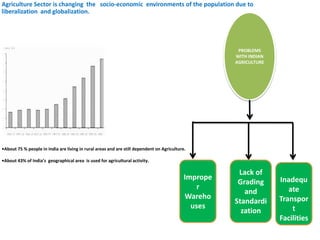
•About 75 % people in India are living in rural areas and are still dependent on Agriculture.
•About 43% of India’s geographical area is used for agricultural activity.
Agriculture Sector is changing the socio-economic environments of the population due to
liberalization and globalization.
PROBLEMS
WITH INDIAN
AGRICULTURE
Imprope
r
Wareho
uses
Lack of
Grading
and
Standardi
zation
Inadequ
ate
Transpor
t
Facilities
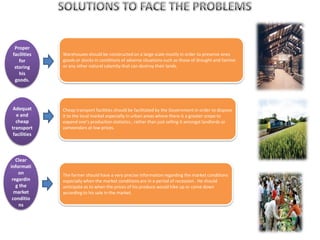
Proper
facilities
for
storing
his
goods.
Adequat
e and
cheap
transport
facilities
Clear
informati
on
regardin
g the
market
conditio
ns
Warehouses should be constructed on a large scale mostly in order to preserve ones
goods or stocks in conditions of adverse situations such as those of drought and famine
or any other natural calamity that can destroy their lands.
Cheap transport facilities should be facilitated by the Government in order to dispose
it to the local market especially in urban areas where there is a greater scope to
expand one’s production statistics ; rather than just selling it amongst landlords or
zameendars at low prices.
The farmer should have a very precise information regarding the market conditions
especially when the market conditions are in a period of recession . He should
anticipate as to when the prices of his produce would hike up or come down
according to his sale in the market.
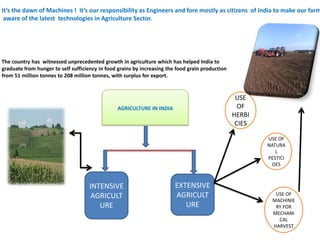
It’s the dawn of Machines ! It’s our responsibility as Engineers and fore mostly as citizens of India to make our farm
aware of the latest technologies in Agriculture Sector.
The country has witnessed unprecedented growth in agriculture which has helped India to
graduate from hunger to self sufficiency in food grains by increasing the food grain production
from 51 million tonnes to 208 million tonnes, with surplus for export.
AGRICULTURE IN INDIA
INTENSIVE
AGRICULT
URE
EXTENSIVE
AGRICULT
URE
USE
OF
HERBI
CIES
USE OF
NATURA
L
PESTICI
DES
USE OF
MACHINIE
RY FOR
MECHANI
CAL
HARVEST
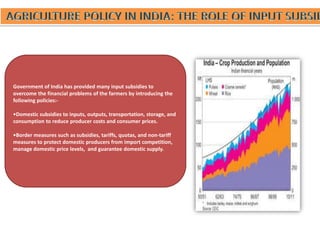
Government of India has provided many input subsidies to
overcome the financial problems of the farmers by introducing the
following policies:-
•Domestic subsidies to inputs, outputs, transportation, storage, and
consumption to reduce producer costs and consumer prices.
•Border measures such as subsidies, tariffs, quotas, and non-tariff
measures to protect domestic producers from import competition,
manage domestic price levels, and guarantee domestic supply.
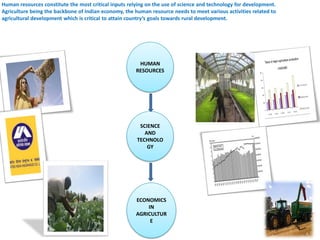
Human resources constitute the most critical inputs relying on the use of science and technology for development.
Agriculture being the backbone of Indian economy, the human resource needs to meet various activities related to
agricultural development which is critical to attain country’s goals towards rural development.
HUMAN
RESOURCES
SCIENCE
AND
TECHNOLO
GY
ECONOMICS
IN
AGRICULTUR
E
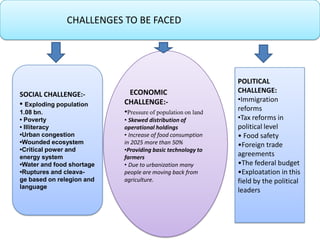
SOCIAL CHALLENGE:-
• Exploding population
1.08 bn.
• Poverty
• Illiteracy
•Urban congestion
•Wounded ecosystem
•Critical power and
energy system
•Water and food shortage
•Ruptures and cleava-
ge based on relegion and
language
CHALLENGES TO BE FACED
POLITICAL
CHALLENGE:
•Immigration
reforms
•Tax reforms in
political level
• Food safety
•Foreign trade
agreements
•The federal budget
•Exploatation in this
field by the political
leaders
ECONOMIC
CHALLENGE:-
•Pressure of population on land
• Skewed distribution of
operational holdings
• Increase of food consumption
in 2025 more than 50%
•Providing basic technology to
farmers
• Due to urbanization many
people are moving back from
agriculture.
• Green revolution: 1967 to 1978. a record grain output of 131 million tons in 1978-
79.World's biggest agricultural producers. And exporter of food grains today 212.0 million
tonnes.
• Economic: greater need for water, fertilizer, pesticides, fungicides etc. spurred growth of
manufacturing sector, created new jobs, increased country's GDP.
• Increased irrigation created need for new dams, used to create hydro-electric power.
boosted industrial growth, created jobs and improved quality of life of rural people.
• India paid back all World Bank loans for Green Revolution. improved India's
creditworthiness.
• India supplied Canada with farmers experienced in Green Revolution. Their remittances
added to our foreign exchange earnings.
• Sociological: created jobs for agricultural and industrial workers thru creation of factories
and hydro-electric power stations
• Political: India transformed itself from a starving nation to an exporter of food. This earned
admiration for India in the comity of nations, especially in the Third World.
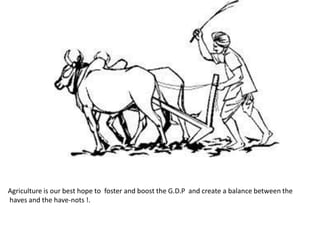
Agriculture is our best hope to foster and boost the G.D.P and create a balance between the
haves and the have-nots !.
APPENDIX
Topics
Home Issues

JPASA

  • 2.
    •About 75 %people in India are living in rural areas and are still dependent on Agriculture. •About 43% of India’s geographical area is used for agricultural activity. Agriculture Sector is changing the socio-economic environments of the population due to liberalization and globalization. PROBLEMS WITH INDIAN AGRICULTURE Imprope r Wareho uses Lack of Grading and Standardi zation Inadequ ate Transpor t Facilities
  • 3.
    Proper facilities for storing his goods. Adequat e and cheap transport facilities Clear informati on regardin g the market conditio ns Warehousesshould be constructed on a large scale mostly in order to preserve ones goods or stocks in conditions of adverse situations such as those of drought and famine or any other natural calamity that can destroy their lands. Cheap transport facilities should be facilitated by the Government in order to dispose it to the local market especially in urban areas where there is a greater scope to expand one’s production statistics ; rather than just selling it amongst landlords or zameendars at low prices. The farmer should have a very precise information regarding the market conditions especially when the market conditions are in a period of recession . He should anticipate as to when the prices of his produce would hike up or come down according to his sale in the market.
  • 4.
    It’s the dawnof Machines ! It’s our responsibility as Engineers and fore mostly as citizens of India to make our farm aware of the latest technologies in Agriculture Sector. The country has witnessed unprecedented growth in agriculture which has helped India to graduate from hunger to self sufficiency in food grains by increasing the food grain production from 51 million tonnes to 208 million tonnes, with surplus for export. AGRICULTURE IN INDIA INTENSIVE AGRICULT URE EXTENSIVE AGRICULT URE USE OF HERBI CIES USE OF NATURA L PESTICI DES USE OF MACHINIE RY FOR MECHANI CAL HARVEST
  • 5.
    Government of Indiahas provided many input subsidies to overcome the financial problems of the farmers by introducing the following policies:- •Domestic subsidies to inputs, outputs, transportation, storage, and consumption to reduce producer costs and consumer prices. •Border measures such as subsidies, tariffs, quotas, and non-tariff measures to protect domestic producers from import competition, manage domestic price levels, and guarantee domestic supply.
  • 6.
    Human resources constitutethe most critical inputs relying on the use of science and technology for development. Agriculture being the backbone of Indian economy, the human resource needs to meet various activities related to agricultural development which is critical to attain country’s goals towards rural development. HUMAN RESOURCES SCIENCE AND TECHNOLO GY ECONOMICS IN AGRICULTUR E
  • 7.
    SOCIAL CHALLENGE:- • Explodingpopulation 1.08 bn. • Poverty • Illiteracy •Urban congestion •Wounded ecosystem •Critical power and energy system •Water and food shortage •Ruptures and cleava- ge based on relegion and language CHALLENGES TO BE FACED POLITICAL CHALLENGE: •Immigration reforms •Tax reforms in political level • Food safety •Foreign trade agreements •The federal budget •Exploatation in this field by the political leaders ECONOMIC CHALLENGE:- •Pressure of population on land • Skewed distribution of operational holdings • Increase of food consumption in 2025 more than 50% •Providing basic technology to farmers • Due to urbanization many people are moving back from agriculture.
  • 8.
    • Green revolution:1967 to 1978. a record grain output of 131 million tons in 1978- 79.World's biggest agricultural producers. And exporter of food grains today 212.0 million tonnes. • Economic: greater need for water, fertilizer, pesticides, fungicides etc. spurred growth of manufacturing sector, created new jobs, increased country's GDP. • Increased irrigation created need for new dams, used to create hydro-electric power. boosted industrial growth, created jobs and improved quality of life of rural people. • India paid back all World Bank loans for Green Revolution. improved India's creditworthiness. • India supplied Canada with farmers experienced in Green Revolution. Their remittances added to our foreign exchange earnings. • Sociological: created jobs for agricultural and industrial workers thru creation of factories and hydro-electric power stations • Political: India transformed itself from a starving nation to an exporter of food. This earned admiration for India in the comity of nations, especially in the Third World.
  • 9.
    Agriculture is ourbest hope to foster and boost the G.D.P and create a balance between the haves and the have-nots !.
  • 10.