© Vinoaj Vijeyakumaar 2018 | Private & Confidential
You Are Not So Smart:
The Data Analyst's Guide
Vinoaj (Vinny) Vijeyakumaar
24 February 2018
vinoaj@vinoaj.com
© Vinoaj Vijeyakumaar 2018 | Private & Confidential
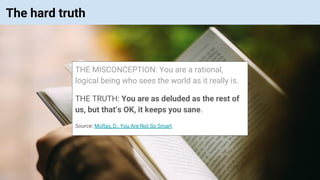
The hard truth
THE MISCONCEPTION: You are a rational,
logical being who sees the world as it really is.
THE TRUTH: You are as deluded as the rest of
us, but that’s OK, it keeps you sane.
Source: McRay, D., You Are Not So Smart
© Vinoaj Vijeyakumaar 2018 | Private & Confidential
Today
Become a better data analyst
by embracing that
You (and those around you) are not so
smart
© Vinoaj Vijeyakumaar 2018 | Private & Confidential
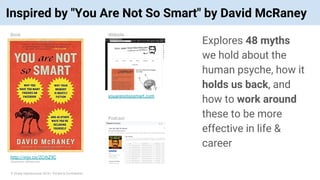
Inspired by "You Are Not So Smart" by David McRaney
Explores 48 myths
we hold about the
human psyche, how it
holds us back, and
how to work around
these to be more
effective in life &
career
http://vnjv.co/2CrhZ9C
(Disclosure: affiliate link)
Book
youarenotsosmart.com
Website
Podcast
© Vinoaj Vijeyakumaar 2018 | Private & Confidential
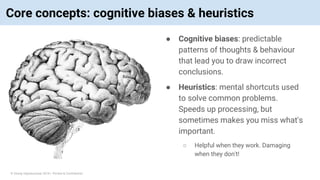
Core concepts: cognitive biases & heuristics
● Cognitive biases: predictable
patterns of thoughts & behaviour
that lead you to draw incorrect
conclusions.
● Heuristics: mental shortcuts used
to solve common problems.
Speeds up processing, but
sometimes makes you miss what's
important.
○ Helpful when they work. Damaging
when they don't!
© Vinoaj Vijeyakumaar 2018 | Private & Confidential
What problems do we face as data analysts?
● Have I done the best piece of analysis
possible?
● Am I being heard?
● Are people actioning my recommendations?
© Vinoaj Vijeyakumaar 2018 | Private & Confidential
Caveats
● YMMV
● Be ethical
© Vinoaj Vijeyakumaar 2018 | Private & Confidential
Priming
THE MISCONCEPTION: You know when you are
being influenced and how it is affecting your
behavior.
THE TRUTH: You are unaware of the constant
nudging you receive from ideas formed in your
unconscious mind.
Source: McRay, D., You Are Not So Smart
© Vinoaj Vijeyakumaar 2018 | Private & Confidential
Priming
● When a stimulus in the past affects the way
you behave and think
● Has to be unconscious for priming to work
● Well-known examples
○ Grocery stores: fanning the scent of freshly baked
bread
○ Movie trailers building up expectations
● "Businesses discovered priming before
psychologists did[!]"
© Vinoaj Vijeyakumaar 2018 | Private & Confidential
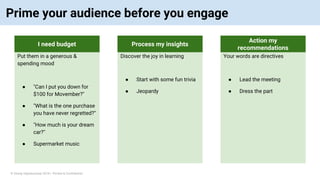
Prime your audience before you engage
Put them in a generous &
spending mood
● "Can I put you down for
$100 for Movember?"
● "What is the one purchase
you have never regretted?"
● "How much is your dream
car?"
● Supermarket music
I need budget
Discover the joy in learning
● Start with some fun trivia
● Jeopardy
Process my insights
Your words are directives
● Lead the meeting
● Dress the part
Action my
recommendations
© Vinoaj Vijeyakumaar 2018 | Private & Confidential
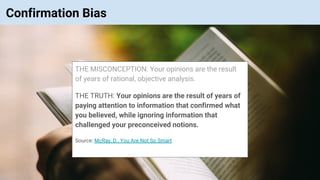
Confirmation Bias
THE MISCONCEPTION: Your opinions are the result
of years of rational, objective analysis.
THE TRUTH: Your opinions are the result of years of
paying attention to information that confirmed what
you believed, while ignoring information that
challenged your preconceived notions.
Source: McRay, D., You Are Not So Smart
© Vinoaj Vijeyakumaar 2018 | Private & Confidential
Confirmation Bias
● People look to pundits for
confirmation.
● "... you want to be right about how
you see the world, so you seek out
information that confirms your
beliefs and avoid contradictory
evidence and opinions."
© Vinoaj Vijeyakumaar 2018 | Private & Confidential
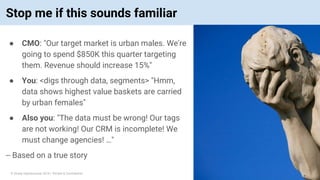
Stop me if this sounds familiar
● CMO: "Our target market is urban males. We're
going to spend $850K this quarter targeting
them. Revenue should increase 15%"
● You: <digs through data, segments> "Hmm,
data shows highest value baskets are carried
by urban females"
● Also you: "The data must be wrong! Our tags
are not working! Our CRM is incomplete! We
must change agencies! …"
-- Based on a true story
© Vinoaj Vijeyakumaar 2018 | Private & Confidential
Why bias might creep in
● Your CMO is a genius, tells great jokes, and is the obvious choice for our next
CEO. They can do no wrong!
● You paid a marketing consultant $50K for this strategy
● You don't see your female friends using your products (more confirmation
bias)
© Vinoaj Vijeyakumaar 2018 | Private & Confidential
Overcoming confirmation bias
● Identify the bias → Urban males are high-value
● Reposition the bias as a hypothesis. Better
yet, create an "anti-hypothesis" → Urban
females are high-value
● Does the data support the anti-hypothesis?
○ Yes: Time to effect change within the organisation
○ No: Carry on, BAU
© Vinoaj Vijeyakumaar 2018 | Private & Confidential
The Texas Sharpshooter Fallacy
THE MISCONCEPTION: You take randomness into
account when determining cause and effect.
THE TRUTH: You tend to ignore random chance
when the results seem meaningful or when you want
a random event to have a meaningful cause.
Source: McRay, D., You Are Not So Smart
© Vinoaj Vijeyakumaar 2018 | Private & Confidential
The Texas Sharpshooter Fallacy
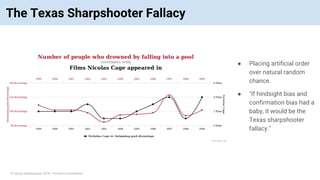
● Placing artificial order
over natural random
chance.
● "If hindsight bias and
confirmation bias had a
baby, it would be the
Texas sharpshooter
fallacy."
© Vinoaj Vijeyakumaar 2018 | Private & Confidential
Be cautious if you discover a new pattern in the data
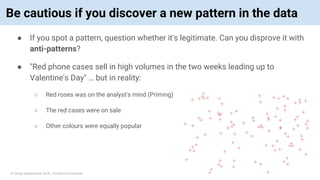
● If you spot a pattern, question whether it's legitimate. Can you disprove it with
anti-patterns?
● "Red phone cases sell in high volumes in the two weeks leading up to
Valentine's Day" … but in reality:
○ Red roses was on the analyst's mind (Priming)
○ The red cases were on sale
○ Other colours were equally popular
© Vinoaj Vijeyakumaar 2018 | Private & Confidential
The Availability Heuristic
THE MISCONCEPTION: With the advent of mass
media, you understand how the world works based on
statistics and facts culled from many examples.
THE TRUTH: You are far more likely to believe
something is commonplace if you can find just one
example of it, and you are far less likely to believe in
something you’ve never seen or heard of before.
Source: McRay, D., You Are Not So Smart
© Vinoaj Vijeyakumaar 2018 | Private & Confidential
Examples > Numbers
● This is why case studies work
● And why retargeting works. And why social proof works. And ...
● "...the more available a bit of information is, the faster you process it. The
faster you process it, the more you believe it and the less likely you become to
consider other bits of info."
© Vinoaj Vijeyakumaar 2018 | Private & Confidential
Provide examples to get your message through
● "Here's how our Hong Kong
office is handling …"
● "Here's what competitor X is
doing…"
● "Here's what pundit X is
recommending…" (also The
Argument from Authority)
I need budget
● "While the numbers show X,
let's look at the journey of one
specific user from this group"
● "Let's explore this $1000
transaction by Mrs. Y"
● "We conducted surveys and
here are the words of our
customers on issue Z"
Process my insights
● "Here's how our Hong Kong
office is handling …"
● "Here's what competitor X is
doing…"
● "Here's what pundit X is
recommending…"
Action my
recommendations
© Vinoaj Vijeyakumaar 2018 | Private & Confidential
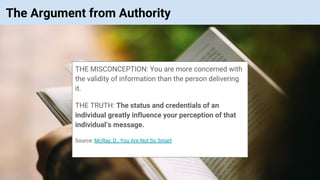
The Argument from Authority
THE MISCONCEPTION: You are more concerned with
the validity of information than the person delivering
it.
THE TRUTH: The status and credentials of an
individual greatly influence your perception of that
individual’s message.
Source: McRay, D., You Are Not So Smart
© Vinoaj Vijeyakumaar 2018 | Private & Confidential
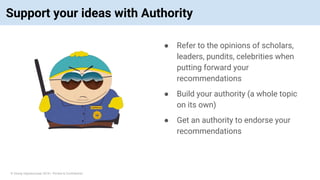
Support your ideas with Authority
● Refer to the opinions of scholars,
leaders, pundits, celebrities when
putting forward your
recommendations
● Build your authority (a whole topic
on its own)
● Get an authority to endorse your
recommendations
© Vinoaj Vijeyakumaar 2018 | Private & Confidential
Challenge Authority
● Challenge the authority of
counter-arguments
● Has the authority
provided an alternative
view before?
● Jamie Oliver is a great
cook, but is he really an
expert on 4WDs?
https://www.youtube.com/watch?v=NNJKWVmK-GM
© Vinoaj Vijeyakumaar 2018 | Private & Confidential
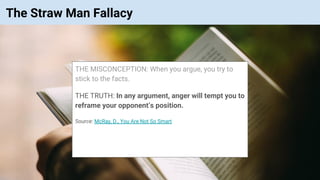
The Straw Man Fallacy
THE MISCONCEPTION: When you argue, you try to
stick to the facts.
THE TRUTH: In any argument, anger will tempt you to
reframe your opponent’s position.
Source: McRay, D., You Are Not So Smart
© Vinoaj Vijeyakumaar 2018 | Private & Confidential
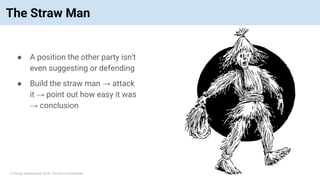
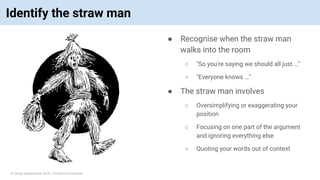
The Straw Man
● A position the other party isn't
even suggesting or defending
● Build the straw man → attack
it → point out how easy it was
→ conclusion
© Vinoaj Vijeyakumaar 2018 | Private & Confidential
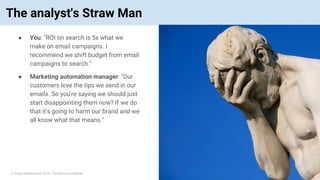
The analyst's Straw Man
● You: "ROI on search is 5x what we
make on email campaigns. I
recommend we shift budget from email
campaigns to search."
● Marketing automation manager: "Our
customers love the tips we send in our
emails. So you're saying we should just
start disappointing them now? If we do
that it's going to harm our brand and we
all know what that means."
© Vinoaj Vijeyakumaar 2018 | Private & Confidential
Identify the straw man
● Recognise when the straw man
walks into the room
○ "So you're saying we should all just …"
○ "Everyone knows …"
● The straw man involves
○ Oversimplifying or exaggerating your
position
○ Focusing on one part of the argument
and ignoring everything else
○ Quoting your words out of context
© Vinoaj Vijeyakumaar 2018 | Private & Confidential
Burn the straw man
● "We're digressing. Let's get back to
our original point …"
● "That wasn't my original point. To
reiterate I was suggesting that …"
● "That's a good point to put on our
agenda for next week's meeting.
Now let's get back to …"
© Vinoaj Vijeyakumaar 2018 | Private & Confidential
Social Loafing
THE MISCONCEPTION: When you are joined by others
in a task, you work harder and become more
accomplished.
THE TRUTH: Once part of a group, you tend to put in
less effort because you know your work will be
pooled together with others’.
Source: McRay, D., You Are Not So Smart
© Vinoaj Vijeyakumaar 2018 | Private & Confidential
How to stop social loafers
● Break down tasks so that each
individual involved is given a specific
objective
● Ensure everyone is held accountable
for an aspect of the task
● Make everyone's objectives and
progress transparent
● Single out and acknowledge individual
efforts
© Vinoaj Vijeyakumaar 2018 | Private & Confidential
Self-Handicapping
THE MISCONCEPTION: In all you do, you strive for
success.
THE TRUTH: You often create conditions for failure
ahead of time to protect your ego.
Source: McRay, D., You Are Not So Smart
© Vinoaj Vijeyakumaar 2018 | Private & Confidential
Why would someone self-handicap?
When you are about to embark on a new experience where failure can have real
ramifications, your subconscious will find ways to blame potential failures on
forces beyond your control
Examples:
● Under-dressing for an interview
● Taking a red-eye flight before an important presentation
● Picking an oversized pair of shoes at the bowling alley
● … the list goes on …
© Vinoaj Vijeyakumaar 2018 | Private & Confidential
Recognise your propensity for self-handicapping
● If you sense nervousness about a new project / job / social event / etc
chances are you're going to self-handicap
● Set a roadmap to success
○ Identify what success is
○ List out all the steps that you will need to take to get to success
● Are any choices you have to make on the roadmap journey prone to
handicapping?
○ Why are you trying to do something in R when you always use Python?
○ Now is not the time to switch from Powerpoint to Keynote
○ Have you selected the right training course?
© Vinoaj Vijeyakumaar 2018 | Private & Confidential
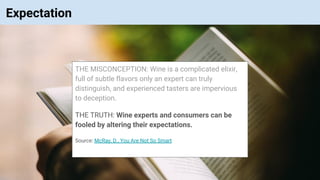
Expectation
THE MISCONCEPTION: Wine is a complicated elixir,
full of subtle flavors only an expert can truly
distinguish, and experienced tasters are impervious
to deception.
THE TRUTH: Wine experts and consumers can be
fooled by altering their expectations.
Source: McRay, D., You Are Not So Smart
© Vinoaj Vijeyakumaar 2018 | Private & Confidential
Expectation creates joy (or dissatisfaction)
● "18 percent of people who own high-definition
televisions are still watching standard definition
programming on the set, but they think they are
getting a better picture." (2012)
● When we can't decide whether something is better
or worse, we look for cues around us to help us
decide
● Presentation, price, marketing, service all
contribute to expectation. The actual experience at
the end is less important as long as it's not totally
disappointing.
© Vinoaj Vijeyakumaar 2018 | Private & Confidential
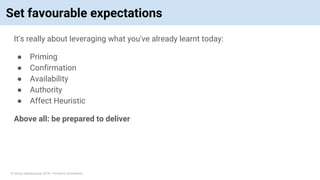
Set favourable expectations
It's really about leveraging what you've already learnt today:
● Priming
● Confirmation
● Availability
● Authority
● Affect Heuristic
Above all: be prepared to deliver
© Vinoaj Vijeyakumaar 2018 | Private & Confidential
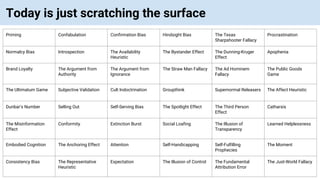
Today is just scratching the surface
Priming Confabulation Confirmation Bias Hindsight Bias The Texas
Sharpshooter Fallacy
Procrastination
Normalcy Bias Introspection The Availability
Heuristic
The Bystander Effect The Dunning-Kruger
Effect
Apophenia
Brand Loyalty The Argument from
Authority
The Argument from
Ignorance
The Straw Man Fallacy The Ad Hominem
Fallacy
The Public Goods
Game
The Ultimatum Game Subjective Validation Cult Indoctrination Groupthink Supernormal Releasers The Affect Heuristic
Dunbar's Number Selling Out Self-Serving Bias The Spotlight Effect The Third Person
Effect
Catharsis
The Misinformation
Effect
Conformity Extinction Burst Social Loafing The Illusion of
Transparency
Learned Helplessness
Embodied Cognition The Anchoring Effect Attention Self-Handicapping Self-Fulfilling
Prophecies
The Moment
Consistency Bias The Representative
Heuristic
Expectation The Illusion of Control The Fundamental
Attribution Error
The Just-World Fallacy
© Vinoaj Vijeyakumaar 2018 | Private & Confidential
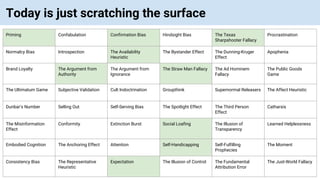
Today is just scratching the surface
Priming Confabulation Confirmation Bias Hindsight Bias The Texas
Sharpshooter Fallacy
Procrastination
Normalcy Bias Introspection The Availability
Heuristic
The Bystander Effect The Dunning-Kruger
Effect
Apophenia
Brand Loyalty The Argument from
Authority
The Argument from
Ignorance
The Straw Man Fallacy The Ad Hominem
Fallacy
The Public Goods
Game
The Ultimatum Game Subjective Validation Cult Indoctrination Groupthink Supernormal Releasers The Affect Heuristic
Dunbar's Number Selling Out Self-Serving Bias The Spotlight Effect The Third Person
Effect
Catharsis
The Misinformation
Effect
Conformity Extinction Burst Social Loafing The Illusion of
Transparency
Learned Helplessness
Embodied Cognition The Anchoring Effect Attention Self-Handicapping Self-Fulfilling
Prophecies
The Moment
Consistency Bias The Representative
Heuristic
Expectation The Illusion of Control The Fundamental
Attribution Error
The Just-World Fallacy
© Vinoaj Vijeyakumaar 2018 | Private & Confidential
You Are Not So Smart:
The Data Analyst's Guide
Vinoaj (Vinny) Vijeyakumaar
vinoaj@vinoaj.com
https://www.linkedin.com/in/vinoaj

You are Not So Smart: The Data Analyst's Guide

  • 1.
    © Vinoaj Vijeyakumaar2018 | Private & Confidential You Are Not So Smart: The Data Analyst's Guide Vinoaj (Vinny) Vijeyakumaar 24 February 2018 vinoaj@vinoaj.com
  • 2.
    © Vinoaj Vijeyakumaar2018 | Private & Confidential The hard truth THE MISCONCEPTION: You are a rational, logical being who sees the world as it really is. THE TRUTH: You are as deluded as the rest of us, but that’s OK, it keeps you sane. Source: McRay, D., You Are Not So Smart
  • 3.
    © Vinoaj Vijeyakumaar2018 | Private & Confidential Today Become a better data analyst by embracing that You (and those around you) are not so smart
  • 4.
    © Vinoaj Vijeyakumaar2018 | Private & Confidential Inspired by "You Are Not So Smart" by David McRaney Explores 48 myths we hold about the human psyche, how it holds us back, and how to work around these to be more effective in life & career http://vnjv.co/2CrhZ9C (Disclosure: affiliate link) Book youarenotsosmart.com Website Podcast
  • 5.
    © Vinoaj Vijeyakumaar2018 | Private & Confidential Core concepts: cognitive biases & heuristics ● Cognitive biases: predictable patterns of thoughts & behaviour that lead you to draw incorrect conclusions. ● Heuristics: mental shortcuts used to solve common problems. Speeds up processing, but sometimes makes you miss what's important. ○ Helpful when they work. Damaging when they don't!
  • 6.
    © Vinoaj Vijeyakumaar2018 | Private & Confidential What problems do we face as data analysts? ● Have I done the best piece of analysis possible? ● Am I being heard? ● Are people actioning my recommendations?
  • 7.
    © Vinoaj Vijeyakumaar2018 | Private & Confidential Caveats ● YMMV ● Be ethical
  • 8.
    © Vinoaj Vijeyakumaar2018 | Private & Confidential Priming THE MISCONCEPTION: You know when you are being influenced and how it is affecting your behavior. THE TRUTH: You are unaware of the constant nudging you receive from ideas formed in your unconscious mind. Source: McRay, D., You Are Not So Smart
  • 9.
    © Vinoaj Vijeyakumaar2018 | Private & Confidential Priming ● When a stimulus in the past affects the way you behave and think ● Has to be unconscious for priming to work ● Well-known examples ○ Grocery stores: fanning the scent of freshly baked bread ○ Movie trailers building up expectations ● "Businesses discovered priming before psychologists did[!]"
  • 10.
    © Vinoaj Vijeyakumaar2018 | Private & Confidential Prime your audience before you engage Put them in a generous & spending mood ● "Can I put you down for $100 for Movember?" ● "What is the one purchase you have never regretted?" ● "How much is your dream car?" ● Supermarket music I need budget Discover the joy in learning ● Start with some fun trivia ● Jeopardy Process my insights Your words are directives ● Lead the meeting ● Dress the part Action my recommendations
  • 11.
    © Vinoaj Vijeyakumaar2018 | Private & Confidential Confirmation Bias THE MISCONCEPTION: Your opinions are the result of years of rational, objective analysis. THE TRUTH: Your opinions are the result of years of paying attention to information that confirmed what you believed, while ignoring information that challenged your preconceived notions. Source: McRay, D., You Are Not So Smart
  • 12.
    © Vinoaj Vijeyakumaar2018 | Private & Confidential Confirmation Bias ● People look to pundits for confirmation. ● "... you want to be right about how you see the world, so you seek out information that confirms your beliefs and avoid contradictory evidence and opinions."
  • 13.
    © Vinoaj Vijeyakumaar2018 | Private & Confidential Stop me if this sounds familiar ● CMO: "Our target market is urban males. We're going to spend $850K this quarter targeting them. Revenue should increase 15%" ● You: <digs through data, segments> "Hmm, data shows highest value baskets are carried by urban females" ● Also you: "The data must be wrong! Our tags are not working! Our CRM is incomplete! We must change agencies! …" -- Based on a true story
  • 14.
    © Vinoaj Vijeyakumaar2018 | Private & Confidential Why bias might creep in ● Your CMO is a genius, tells great jokes, and is the obvious choice for our next CEO. They can do no wrong! ● You paid a marketing consultant $50K for this strategy ● You don't see your female friends using your products (more confirmation bias)
  • 15.
    © Vinoaj Vijeyakumaar2018 | Private & Confidential Overcoming confirmation bias ● Identify the bias → Urban males are high-value ● Reposition the bias as a hypothesis. Better yet, create an "anti-hypothesis" → Urban females are high-value ● Does the data support the anti-hypothesis? ○ Yes: Time to effect change within the organisation ○ No: Carry on, BAU
  • 16.
    © Vinoaj Vijeyakumaar2018 | Private & Confidential The Texas Sharpshooter Fallacy THE MISCONCEPTION: You take randomness into account when determining cause and effect. THE TRUTH: You tend to ignore random chance when the results seem meaningful or when you want a random event to have a meaningful cause. Source: McRay, D., You Are Not So Smart
  • 17.
    © Vinoaj Vijeyakumaar2018 | Private & Confidential The Texas Sharpshooter Fallacy ● Placing artificial order over natural random chance. ● "If hindsight bias and confirmation bias had a baby, it would be the Texas sharpshooter fallacy."
  • 18.
    © Vinoaj Vijeyakumaar2018 | Private & Confidential Be cautious if you discover a new pattern in the data ● If you spot a pattern, question whether it's legitimate. Can you disprove it with anti-patterns? ● "Red phone cases sell in high volumes in the two weeks leading up to Valentine's Day" … but in reality: ○ Red roses was on the analyst's mind (Priming) ○ The red cases were on sale ○ Other colours were equally popular
  • 19.
    © Vinoaj Vijeyakumaar2018 | Private & Confidential The Availability Heuristic THE MISCONCEPTION: With the advent of mass media, you understand how the world works based on statistics and facts culled from many examples. THE TRUTH: You are far more likely to believe something is commonplace if you can find just one example of it, and you are far less likely to believe in something you’ve never seen or heard of before. Source: McRay, D., You Are Not So Smart
  • 20.
    © Vinoaj Vijeyakumaar2018 | Private & Confidential Examples > Numbers ● This is why case studies work ● And why retargeting works. And why social proof works. And ... ● "...the more available a bit of information is, the faster you process it. The faster you process it, the more you believe it and the less likely you become to consider other bits of info."
  • 21.
    © Vinoaj Vijeyakumaar2018 | Private & Confidential Provide examples to get your message through ● "Here's how our Hong Kong office is handling …" ● "Here's what competitor X is doing…" ● "Here's what pundit X is recommending…" (also The Argument from Authority) I need budget ● "While the numbers show X, let's look at the journey of one specific user from this group" ● "Let's explore this $1000 transaction by Mrs. Y" ● "We conducted surveys and here are the words of our customers on issue Z" Process my insights ● "Here's how our Hong Kong office is handling …" ● "Here's what competitor X is doing…" ● "Here's what pundit X is recommending…" Action my recommendations
  • 22.
    © Vinoaj Vijeyakumaar2018 | Private & Confidential The Argument from Authority THE MISCONCEPTION: You are more concerned with the validity of information than the person delivering it. THE TRUTH: The status and credentials of an individual greatly influence your perception of that individual’s message. Source: McRay, D., You Are Not So Smart
  • 23.
    © Vinoaj Vijeyakumaar2018 | Private & Confidential Support your ideas with Authority ● Refer to the opinions of scholars, leaders, pundits, celebrities when putting forward your recommendations ● Build your authority (a whole topic on its own) ● Get an authority to endorse your recommendations
  • 24.
    © Vinoaj Vijeyakumaar2018 | Private & Confidential Challenge Authority ● Challenge the authority of counter-arguments ● Has the authority provided an alternative view before? ● Jamie Oliver is a great cook, but is he really an expert on 4WDs? https://www.youtube.com/watch?v=NNJKWVmK-GM
  • 25.
    © Vinoaj Vijeyakumaar2018 | Private & Confidential The Straw Man Fallacy THE MISCONCEPTION: When you argue, you try to stick to the facts. THE TRUTH: In any argument, anger will tempt you to reframe your opponent’s position. Source: McRay, D., You Are Not So Smart
  • 26.
    © Vinoaj Vijeyakumaar2018 | Private & Confidential The Straw Man ● A position the other party isn't even suggesting or defending ● Build the straw man → attack it → point out how easy it was → conclusion
  • 27.
    © Vinoaj Vijeyakumaar2018 | Private & Confidential The analyst's Straw Man ● You: "ROI on search is 5x what we make on email campaigns. I recommend we shift budget from email campaigns to search." ● Marketing automation manager: "Our customers love the tips we send in our emails. So you're saying we should just start disappointing them now? If we do that it's going to harm our brand and we all know what that means."
  • 28.
    © Vinoaj Vijeyakumaar2018 | Private & Confidential Identify the straw man ● Recognise when the straw man walks into the room ○ "So you're saying we should all just …" ○ "Everyone knows …" ● The straw man involves ○ Oversimplifying or exaggerating your position ○ Focusing on one part of the argument and ignoring everything else ○ Quoting your words out of context
  • 29.
    © Vinoaj Vijeyakumaar2018 | Private & Confidential Burn the straw man ● "We're digressing. Let's get back to our original point …" ● "That wasn't my original point. To reiterate I was suggesting that …" ● "That's a good point to put on our agenda for next week's meeting. Now let's get back to …"
  • 30.
    © Vinoaj Vijeyakumaar2018 | Private & Confidential Social Loafing THE MISCONCEPTION: When you are joined by others in a task, you work harder and become more accomplished. THE TRUTH: Once part of a group, you tend to put in less effort because you know your work will be pooled together with others’. Source: McRay, D., You Are Not So Smart
  • 31.
    © Vinoaj Vijeyakumaar2018 | Private & Confidential How to stop social loafers ● Break down tasks so that each individual involved is given a specific objective ● Ensure everyone is held accountable for an aspect of the task ● Make everyone's objectives and progress transparent ● Single out and acknowledge individual efforts
  • 32.
    © Vinoaj Vijeyakumaar2018 | Private & Confidential Self-Handicapping THE MISCONCEPTION: In all you do, you strive for success. THE TRUTH: You often create conditions for failure ahead of time to protect your ego. Source: McRay, D., You Are Not So Smart
  • 33.
    © Vinoaj Vijeyakumaar2018 | Private & Confidential Why would someone self-handicap? When you are about to embark on a new experience where failure can have real ramifications, your subconscious will find ways to blame potential failures on forces beyond your control Examples: ● Under-dressing for an interview ● Taking a red-eye flight before an important presentation ● Picking an oversized pair of shoes at the bowling alley ● … the list goes on …
  • 34.
    © Vinoaj Vijeyakumaar2018 | Private & Confidential Recognise your propensity for self-handicapping ● If you sense nervousness about a new project / job / social event / etc chances are you're going to self-handicap ● Set a roadmap to success ○ Identify what success is ○ List out all the steps that you will need to take to get to success ● Are any choices you have to make on the roadmap journey prone to handicapping? ○ Why are you trying to do something in R when you always use Python? ○ Now is not the time to switch from Powerpoint to Keynote ○ Have you selected the right training course?
  • 35.
    © Vinoaj Vijeyakumaar2018 | Private & Confidential Expectation THE MISCONCEPTION: Wine is a complicated elixir, full of subtle flavors only an expert can truly distinguish, and experienced tasters are impervious to deception. THE TRUTH: Wine experts and consumers can be fooled by altering their expectations. Source: McRay, D., You Are Not So Smart
  • 36.
    © Vinoaj Vijeyakumaar2018 | Private & Confidential Expectation creates joy (or dissatisfaction) ● "18 percent of people who own high-definition televisions are still watching standard definition programming on the set, but they think they are getting a better picture." (2012) ● When we can't decide whether something is better or worse, we look for cues around us to help us decide ● Presentation, price, marketing, service all contribute to expectation. The actual experience at the end is less important as long as it's not totally disappointing.
  • 37.
    © Vinoaj Vijeyakumaar2018 | Private & Confidential Set favourable expectations It's really about leveraging what you've already learnt today: ● Priming ● Confirmation ● Availability ● Authority ● Affect Heuristic Above all: be prepared to deliver
  • 38.
    © Vinoaj Vijeyakumaar2018 | Private & Confidential Today is just scratching the surface Priming Confabulation Confirmation Bias Hindsight Bias The Texas Sharpshooter Fallacy Procrastination Normalcy Bias Introspection The Availability Heuristic The Bystander Effect The Dunning-Kruger Effect Apophenia Brand Loyalty The Argument from Authority The Argument from Ignorance The Straw Man Fallacy The Ad Hominem Fallacy The Public Goods Game The Ultimatum Game Subjective Validation Cult Indoctrination Groupthink Supernormal Releasers The Affect Heuristic Dunbar's Number Selling Out Self-Serving Bias The Spotlight Effect The Third Person Effect Catharsis The Misinformation Effect Conformity Extinction Burst Social Loafing The Illusion of Transparency Learned Helplessness Embodied Cognition The Anchoring Effect Attention Self-Handicapping Self-Fulfilling Prophecies The Moment Consistency Bias The Representative Heuristic Expectation The Illusion of Control The Fundamental Attribution Error The Just-World Fallacy
  • 39.
    © Vinoaj Vijeyakumaar2018 | Private & Confidential Today is just scratching the surface Priming Confabulation Confirmation Bias Hindsight Bias The Texas Sharpshooter Fallacy Procrastination Normalcy Bias Introspection The Availability Heuristic The Bystander Effect The Dunning-Kruger Effect Apophenia Brand Loyalty The Argument from Authority The Argument from Ignorance The Straw Man Fallacy The Ad Hominem Fallacy The Public Goods Game The Ultimatum Game Subjective Validation Cult Indoctrination Groupthink Supernormal Releasers The Affect Heuristic Dunbar's Number Selling Out Self-Serving Bias The Spotlight Effect The Third Person Effect Catharsis The Misinformation Effect Conformity Extinction Burst Social Loafing The Illusion of Transparency Learned Helplessness Embodied Cognition The Anchoring Effect Attention Self-Handicapping Self-Fulfilling Prophecies The Moment Consistency Bias The Representative Heuristic Expectation The Illusion of Control The Fundamental Attribution Error The Just-World Fallacy
  • 40.
    © Vinoaj Vijeyakumaar2018 | Private & Confidential You Are Not So Smart: The Data Analyst's Guide Vinoaj (Vinny) Vijeyakumaar vinoaj@vinoaj.com https://www.linkedin.com/in/vinoaj