YOGA SE HOGA
By Praveen Garg
Asst. Prof.
VITS, Satna
Pranayam
Kapal Bhanti
Anulom Vilom
Bhramari
YOGA ASAN
The Sun Salutation (Surya Namaskar)
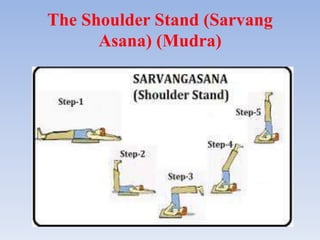
The Shoulder Stand (Sarvang Asana)
Vajrasana
The Lotus (Padma Asana)
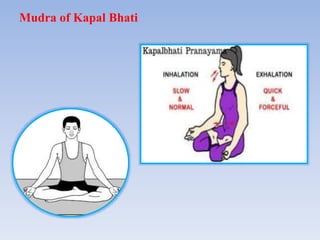
Mudra of Kapal Bhati
Q. How long should do Kapal Bhati?
๏ƒ˜A healthy and even slightly sick person should
do kapalabhati for 15 minutes. In three rounds in
15 minutes kapalabhati is done 900 times.
Q. How many time Kapal Bhati should be done in a
day?
๏ƒ˜ Normally, people perform Kapalbhati one time in
a day, but if someone wants to cure critical disease
with Kapalbhati, can do this pranayama 2 or 3 time in
a day with empty stomach.
Q. Who should not do Kapal Bhati?
๏ƒ˜ Pregnant women should also avoid doing
Kapalbhati as forcefully contracting the abdominal
muscles can harm the unborn baby. If you suffer from
heart diseases, exhale really slow. People who have
high blood pressure should not increase their rate
of Kapalbhati. Stick with a lower rate, like one
stroke per second
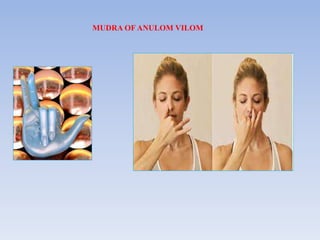
MUDRA OF ANULOM VILOM
Q. Why AnUlom Vilom are beneficial?
๏ƒ˜ Anulom Vilom Pranayama are really very helpful. It is
very effective for body purification. ... Releases
accumulated stress in the mind and body effectively and
helps relax.
๏ƒ˜ It help in calmimg your mind and relieving you off the
stresses of the daily routine.
๏ƒ˜ It can help in reduce depression.
๏ƒ˜ It may enhance your skin health.
๏ƒ˜ It has potential to improve vision.
๏ƒ˜ It helpful in reducing blood pressure.
๏ƒ˜ It can enhance oxygeon supply of the body.
๏ƒ˜ It can help to reduce mental depression. improves heart
health, and helps in curing other diseases such as asthma,
depression, migraine, high blood pressure, arthritis, and
many other
Q. How do anulom vilom pranayam?
๏ƒ˜ Firstly sit in Mudra. Then, breathe in from right
nostril closing left nostril with middle finger and ring
finger and breathe out from left nostril closing right
nostril with thumb. Do it continously and it is known
as Anulom Vilom Pranayam. Initially do it for 1-3
minutes. With a practice, you can do it continuously
for 5-15 minutes
Q. Why should not do Anulom Vilom Pranayam?
๏ƒ˜ Cardiac, Blood pressure patients and pregnant
women should not hold their breath while doing this
pranayama just keep inhaling and exhaling.) Keep the
left nostril blocked and release the right nostril.
Exhale through the right nostril for 2 seconds.
Q. How many times we should do Anulom Vilom
pranayam?
๏ƒ˜You must do it at least 60 times, divided
throughout the day. The technique is excellent
for healing, chakra balancing and getting rid of
breathing or respiratory problems. This can be
done even after meals.
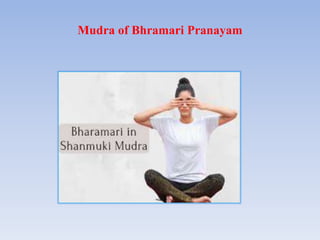
Mudra of Bhramari Pranayam
Q. What are benefit of Bhramari Pranayam?
โ€ข Calms and quiets the mind.
โ€ข Releases cerebral tension.
โ€ข Stimulates the pineal and pituitary glands,
supporting their proper functioning.
โ€ข It can balance the Thyroid gland and Thymus
gland and also improve functioning of different
parts of body.
โ€ข Relieves stress and anxiety.
โ€ข Dissipates anger.
โ€ข Lowers blood pressure.
โ€ข Bolsters the health of the throat.
Q. What does Bhramari means?
โ€ข Bhramari is a Hindu Goddess. She is an
incarnation of the Goddess Shakti. Bhramari
means 'the Goddess of bees' or 'the Goddess of
black bees'. She is associated with bees,
hornets and wasps, which cling to her body.
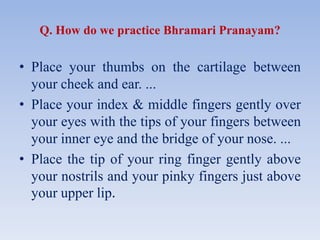
Q. How do we practice Bhramari Pranayam?
โ€ข Place your thumbs on the cartilage between
your cheek and ear. ...
โ€ข Place your index & middle fingers gently over
your eyes with the tips of your fingers between
your inner eye and the bridge of your nose. ...
โ€ข Place the tip of your ring finger gently above
your nostrils and your pinky fingers just above
your upper lip.
Q. Can we do Bhramari asan after meals?
โ€ข Bhramari Pranayama should be practiced
with an empty stomach or at least four to five
hours after your meal.
Q. Duration of Bhramari?
โ€ข Once you start doing it you can do this for
up to 30 minutes.
๏ƒ˜Bhramari Pranayama is contraindicated for
people suffering from epilepsy, high blood
pressure, heart problems, chest pains or some
kind of active ear infection. Menstruating or
pregnant women should never practice
Bhramari Pranayama.
Q. Who should not to do Bhramari Pranayam?
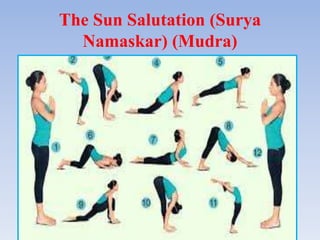
The Sun Salutation (Surya
Namaskar) (Mudra)
Q. It is necessary to do Surya Namaskar in front of
Sun?
๏ƒ˜Surya Namaskar is one of the most complete
practices of hatha yoga. ... Therefore, Surya
Namaskar or Sun Salutation is ideally best
to do in the morning during sunrise, facing the
rising sun. Most important is that you can also
practice these asanas/poses during sunset,
facing the setting sun.
Q. What are the benefit of Surya Namaskar?
โ€ข Helps lose weight.
โ€ข Glowing skin.
โ€ข Better digestive system.
โ€ข Ensures regular menstrual cycle.
โ€ข Brings down blood sugar level.
โ€ข Improves anxiety.
โ€ข Helps your body detox.
โ€ข Battles insomnia.
Q. What happened if you do Surya namaskar daily?
๏ƒ˜Surya Namaskar is a one-stop solution for all
your health problems. It helps to tone your
body, improve flexibility, improve body
posture, improves skin complexion, strengthen
muscles, fight depression as well as a nip in
your waistline. ... It helps to achieve a mind &
body balance.
Q. Who should not do Surya namskar?
๏ƒ˜Who should NOT do Surya Namaskar?
Pregnant women should not practice this after
third month of pregnancy. Patients of Hernia
and high blood pressure are warned against
this practice. People suffering from back
conditions should seek proper advice before
commencing Surya Namaskar.
The Shoulder Stand (Sarvang
Asana) (Mudra)
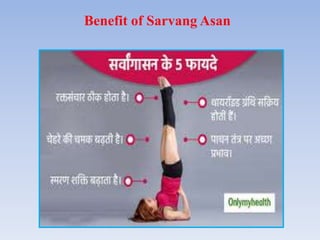
Benefit of Sarvang Asan
Q. How long Sarvang Asan should be done?
๏ƒ˜Gaze softly at your chest. As a beginning
practitioner stay in the pose for about 30
seconds. Gradually add 5 to 10 seconds to
your stay every day or so until you can
comfortably hold the pose for 3 minutes. Then
continue for 3 minutes each day for a week or
two, until you feel relatively comfortable in the
pose.
Q. How can we practice Sarvang Asan?
โ€ข Exhaling, draw the feet close to the hips and
fold the legs against the thighs.
โ€ข Gently raise the lower part of the body
vertically, with a pull of the abdominal
muscles, supported by the hands.
Q. When should you not do Sarvang Asan?
โ€ข If you have High Blood Pressure the posture is
better to avoid.
โ€ข Anyone who has Cervical Spondylities should
not attempt to practice this pose because as
you hold the pose the weight of the body is
taken through the neck.
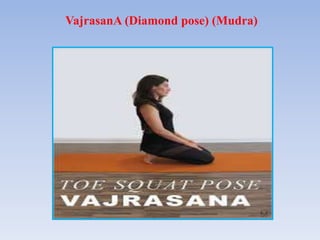
VajrasanA (Diamond pose) (Mudra)
Q. How to do Vajrasana?
๏ƒ˜ Kneel down with lower legs stretched straight
backwards and toes crossing each other.
๏ƒ˜Sit over the heels โ€“ your buttocks should sit on
the heels and thighs on the calf muscles.
๏ƒ˜Sit straight with head facing forward and hands
on your knees.
๏ƒ˜Close your eyes (optional) and focus on breath
observing inhalation and exhalation.
๏ƒ˜Practice this position for 5 โ€“ 10 minutes in initial
days and increase gradually up to 20 โ€“ 30
minutes.
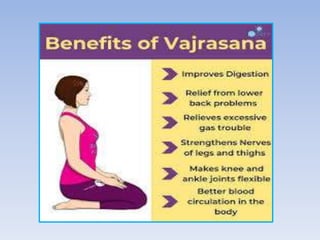
Q. When should we do Vajrasana?
๏ƒ˜In Vajrasana the body becomes upright and
straight with no effort. Slow and rhythmic
breathing in this position can help you go into
the meditative state very easily. This is the
only asana you can do immediately after meal,
ideally you should do this asana everyday for
10 minutes after lunch or dinner.
Q. What are the Precautions of Vajrasana?
โ€ข Kneel on your yoga mat keeping the knees
close together.
โ€ข Big toes must be touching each other while
heel remains separate.
โ€ข Lower the body placing your buttocks in the
space between both of your feet.
โ€ข Heels must be touching the sides of your hips.
The Lotus (Padma Asana) (mudra)
Benefits of Padmasana
โ€ข Stretches the ankles and knees.
โ€ข Calms the brain.
โ€ข Increases awareness and attentiveness.
โ€ข Keeps the spine straight.
โ€ข Helps develop good posture.
โ€ข Eases menstrual discomfort and sciatica.
โ€ข Helps keeps joints and ligaments flexible.
Q. How long one can sit in Padmasana?
๏ƒ˜Maintain this position for as long as
comfortable. Those who wish to use this pose
for meditation should sit for at least 20
minutes. Slowly increase it so that your
duration of meditation too can increase. At
some point the legs may start to pain.
Q. Who should not to do Padmasana?
โ€ข If you have weak or injured knees avoid doing
this posture as it places lots of strain on the
knees.
โ€ข If you suffer from sciatica it is preferable to
not attempt this yoga posture.
โ€ข In the case of ankle injury do not practice this
posture.
THANK YOU

Yoga se hoga

  • 1.
    YOGA SE HOGA ByPraveen Garg Asst. Prof. VITS, Satna
  • 2.
    Pranayam Kapal Bhanti Anulom Vilom Bhramari YOGAASAN The Sun Salutation (Surya Namaskar) The Shoulder Stand (Sarvang Asana) Vajrasana The Lotus (Padma Asana)
  • 3.
  • 5.
    Q. How longshould do Kapal Bhati? ๏ƒ˜A healthy and even slightly sick person should do kapalabhati for 15 minutes. In three rounds in 15 minutes kapalabhati is done 900 times. Q. How many time Kapal Bhati should be done in a day? ๏ƒ˜ Normally, people perform Kapalbhati one time in a day, but if someone wants to cure critical disease with Kapalbhati, can do this pranayama 2 or 3 time in a day with empty stomach.
  • 6.
    Q. Who shouldnot do Kapal Bhati? ๏ƒ˜ Pregnant women should also avoid doing Kapalbhati as forcefully contracting the abdominal muscles can harm the unborn baby. If you suffer from heart diseases, exhale really slow. People who have high blood pressure should not increase their rate of Kapalbhati. Stick with a lower rate, like one stroke per second
  • 7.
  • 8.
    Q. Why AnUlomVilom are beneficial? ๏ƒ˜ Anulom Vilom Pranayama are really very helpful. It is very effective for body purification. ... Releases accumulated stress in the mind and body effectively and helps relax. ๏ƒ˜ It help in calmimg your mind and relieving you off the stresses of the daily routine. ๏ƒ˜ It can help in reduce depression. ๏ƒ˜ It may enhance your skin health. ๏ƒ˜ It has potential to improve vision. ๏ƒ˜ It helpful in reducing blood pressure. ๏ƒ˜ It can enhance oxygeon supply of the body. ๏ƒ˜ It can help to reduce mental depression. improves heart health, and helps in curing other diseases such as asthma, depression, migraine, high blood pressure, arthritis, and many other
  • 9.
    Q. How doanulom vilom pranayam? ๏ƒ˜ Firstly sit in Mudra. Then, breathe in from right nostril closing left nostril with middle finger and ring finger and breathe out from left nostril closing right nostril with thumb. Do it continously and it is known as Anulom Vilom Pranayam. Initially do it for 1-3 minutes. With a practice, you can do it continuously for 5-15 minutes
  • 10.
    Q. Why shouldnot do Anulom Vilom Pranayam? ๏ƒ˜ Cardiac, Blood pressure patients and pregnant women should not hold their breath while doing this pranayama just keep inhaling and exhaling.) Keep the left nostril blocked and release the right nostril. Exhale through the right nostril for 2 seconds.
  • 11.
    Q. How manytimes we should do Anulom Vilom pranayam? ๏ƒ˜You must do it at least 60 times, divided throughout the day. The technique is excellent for healing, chakra balancing and getting rid of breathing or respiratory problems. This can be done even after meals.
  • 12.
  • 13.
    Q. What arebenefit of Bhramari Pranayam? โ€ข Calms and quiets the mind. โ€ข Releases cerebral tension. โ€ข Stimulates the pineal and pituitary glands, supporting their proper functioning. โ€ข It can balance the Thyroid gland and Thymus gland and also improve functioning of different parts of body. โ€ข Relieves stress and anxiety. โ€ข Dissipates anger. โ€ข Lowers blood pressure. โ€ข Bolsters the health of the throat.
  • 14.
    Q. What doesBhramari means? โ€ข Bhramari is a Hindu Goddess. She is an incarnation of the Goddess Shakti. Bhramari means 'the Goddess of bees' or 'the Goddess of black bees'. She is associated with bees, hornets and wasps, which cling to her body.
  • 15.
    Q. How dowe practice Bhramari Pranayam? โ€ข Place your thumbs on the cartilage between your cheek and ear. ... โ€ข Place your index & middle fingers gently over your eyes with the tips of your fingers between your inner eye and the bridge of your nose. ... โ€ข Place the tip of your ring finger gently above your nostrils and your pinky fingers just above your upper lip.
  • 16.
    Q. Can wedo Bhramari asan after meals? โ€ข Bhramari Pranayama should be practiced with an empty stomach or at least four to five hours after your meal. Q. Duration of Bhramari? โ€ข Once you start doing it you can do this for up to 30 minutes.
  • 17.
    ๏ƒ˜Bhramari Pranayama iscontraindicated for people suffering from epilepsy, high blood pressure, heart problems, chest pains or some kind of active ear infection. Menstruating or pregnant women should never practice Bhramari Pranayama. Q. Who should not to do Bhramari Pranayam?
  • 18.
    The Sun Salutation(Surya Namaskar) (Mudra)
  • 19.
    Q. It isnecessary to do Surya Namaskar in front of Sun? ๏ƒ˜Surya Namaskar is one of the most complete practices of hatha yoga. ... Therefore, Surya Namaskar or Sun Salutation is ideally best to do in the morning during sunrise, facing the rising sun. Most important is that you can also practice these asanas/poses during sunset, facing the setting sun.
  • 20.
    Q. What arethe benefit of Surya Namaskar? โ€ข Helps lose weight. โ€ข Glowing skin. โ€ข Better digestive system. โ€ข Ensures regular menstrual cycle. โ€ข Brings down blood sugar level. โ€ข Improves anxiety. โ€ข Helps your body detox. โ€ข Battles insomnia.
  • 21.
    Q. What happenedif you do Surya namaskar daily? ๏ƒ˜Surya Namaskar is a one-stop solution for all your health problems. It helps to tone your body, improve flexibility, improve body posture, improves skin complexion, strengthen muscles, fight depression as well as a nip in your waistline. ... It helps to achieve a mind & body balance.
  • 22.
    Q. Who shouldnot do Surya namskar? ๏ƒ˜Who should NOT do Surya Namaskar? Pregnant women should not practice this after third month of pregnancy. Patients of Hernia and high blood pressure are warned against this practice. People suffering from back conditions should seek proper advice before commencing Surya Namaskar.
  • 23.
    The Shoulder Stand(Sarvang Asana) (Mudra)
  • 24.
  • 25.
    Q. How longSarvang Asan should be done? ๏ƒ˜Gaze softly at your chest. As a beginning practitioner stay in the pose for about 30 seconds. Gradually add 5 to 10 seconds to your stay every day or so until you can comfortably hold the pose for 3 minutes. Then continue for 3 minutes each day for a week or two, until you feel relatively comfortable in the pose.
  • 26.
    Q. How canwe practice Sarvang Asan? โ€ข Exhaling, draw the feet close to the hips and fold the legs against the thighs. โ€ข Gently raise the lower part of the body vertically, with a pull of the abdominal muscles, supported by the hands.
  • 27.
    Q. When shouldyou not do Sarvang Asan? โ€ข If you have High Blood Pressure the posture is better to avoid. โ€ข Anyone who has Cervical Spondylities should not attempt to practice this pose because as you hold the pose the weight of the body is taken through the neck.
  • 28.
  • 30.
    Q. How todo Vajrasana? ๏ƒ˜ Kneel down with lower legs stretched straight backwards and toes crossing each other. ๏ƒ˜Sit over the heels โ€“ your buttocks should sit on the heels and thighs on the calf muscles. ๏ƒ˜Sit straight with head facing forward and hands on your knees. ๏ƒ˜Close your eyes (optional) and focus on breath observing inhalation and exhalation. ๏ƒ˜Practice this position for 5 โ€“ 10 minutes in initial days and increase gradually up to 20 โ€“ 30 minutes.
  • 31.
    Q. When shouldwe do Vajrasana? ๏ƒ˜In Vajrasana the body becomes upright and straight with no effort. Slow and rhythmic breathing in this position can help you go into the meditative state very easily. This is the only asana you can do immediately after meal, ideally you should do this asana everyday for 10 minutes after lunch or dinner.
  • 32.
    Q. What arethe Precautions of Vajrasana? โ€ข Kneel on your yoga mat keeping the knees close together. โ€ข Big toes must be touching each other while heel remains separate. โ€ข Lower the body placing your buttocks in the space between both of your feet. โ€ข Heels must be touching the sides of your hips.
  • 33.
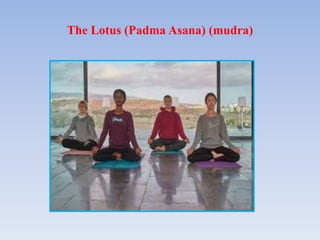
    The Lotus (PadmaAsana) (mudra)
  • 34.
    Benefits of Padmasana โ€ขStretches the ankles and knees. โ€ข Calms the brain. โ€ข Increases awareness and attentiveness. โ€ข Keeps the spine straight. โ€ข Helps develop good posture. โ€ข Eases menstrual discomfort and sciatica. โ€ข Helps keeps joints and ligaments flexible.
  • 35.
    Q. How longone can sit in Padmasana? ๏ƒ˜Maintain this position for as long as comfortable. Those who wish to use this pose for meditation should sit for at least 20 minutes. Slowly increase it so that your duration of meditation too can increase. At some point the legs may start to pain.
  • 36.
    Q. Who shouldnot to do Padmasana? โ€ข If you have weak or injured knees avoid doing this posture as it places lots of strain on the knees. โ€ข If you suffer from sciatica it is preferable to not attempt this yoga posture. โ€ข In the case of ankle injury do not practice this posture.
  • 37.