Introduction
Sun Salutation, also called Surya Namaskar or Salute to the Sun, is a practice in yoga as exercise
incorporating a flow sequence of some twelve gracefully linked asanas. Surya Namaskar or Sun
Salutation is a technique of vitalization via solar energy. Invocation and worship of the Sun were
one of the first and most natural forms of expression of awe and gratitude.
Surya Namaskar described in Hatha Yoga is the traditional and the most ancient form. It’s
performed at a slow pace with long stays in each posture; so it’s considered an easy approach for
a student who finds sun salutation uncomfortable as a fast-flowing series. 12 poses of Hatar Surya
Namaskar are
Importants
◦ Suryanamaskar is one of the best yogic exercises, as it alone gives us the benefits of different
asanas and the pranayamas.
◦ It is more beneficial when it is practised at sun rise and sun set, facing the sun with minimum
clothes.
◦ It is like warm up of yoga. It is recommended to be performed on an empty stomach.
◦ Suryanamaskar (Sun salutation) is combination of few asanas. Its roots can be found in yoga
philosophy of vedic traditions.
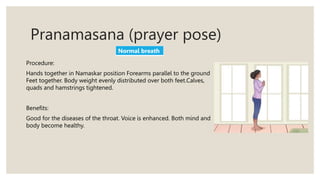
Pranamasana (prayer pose)
Procedure:
Hands together in Namaskar position Forearms parallel to the ground
Feet together. Body weight evenly distributed over both feet.Calves,
quads and hamstrings tightened.
Benefits:
Good for the diseases of the throat. Voice is enhanced. Both mind and
body become healthy.
Normal breath
Hastauttanasana (Raised Arms Pose)
Procedure:
Palms joined and pushed up and back. Biceps touching ears. Maintain
sight on wrists.Leg and Abdominal muscles remain tight.
Benefits:
Both the shoulders and the food pipe (Esophagus) get exercise and
diseases related to them are corrected. Eyesight is also improved.
Inhale
Hasta Padmasana (Hand to Foot
pose)
Procedure:
From previous asana keep arms straight Keep back straight and bend
from hips. Maintain sight on wrists. Try to put palms flat on ground. Try
to touch forehead to knees. Do not bend the knees.
Benefits:
The chest and hands become stronger and you become well balanced,
beautiful and good looking. Diseases of the feet and fingers are also
corrected.
Exhale
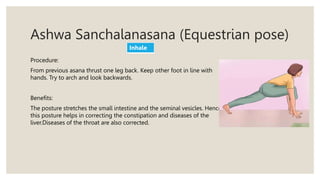
Ashwa Sanchalanasana (Equestrian pose)
Procedure:
From previous asana thrust one leg back. Keep other foot in line with
hands. Try to arch and look backwards.
Benefits:
The posture stretches the small intestine and the seminal vesicles. Hence
this posture helps in correcting the constipation and diseases of the
liver.Diseases of the throat are also corrected.
Inhale
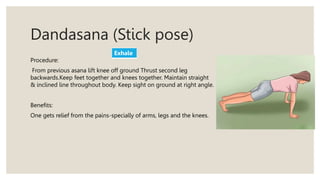
Dandasana (Stick pose)
Procedure:
From previous asana lift knee off ground Thrust second leg
backwards.Keep feet together and knees together. Maintain straight
& inclined line throughout body. Keep sight on ground at right angle.
Benefits:
One gets relief from the pains-specially of arms, legs and the knees.
Exhale
Ashtanga Namaskar
(Salute with Eight Parts points)
Procedure:
Lower entire body to the ground slowly. Only forehead, chest, knees
and toes touch ground. Keep hands and elbows close to the body.
Keep feet together and knees together.
Benefits:
This posture makes the arms strong.perform this saved from the
attacks of many diseases.
Inhale
Bhujangasana (cobra Pose)
Procedure:
From previous asana push body forwards and upwards. Keep feet
together and knees together. Tighten abdominal muscles. Arch back
and look backwards.
Benefits:
Tones up the body and the back muscles and improves the eyesight.
Blood circulation is also improved.
Exhale
Parvatasana (Mountain Pose)
Procedure:
Keep lower body straight. Keep upper body straight. Create the
“mountain”shape. Keep feet together and knees together. Try to
keep feet flat on the ground.
Benefits:
One gets relief from the pains-specially of arms, legs and the knees.
Bulging waist is trimmed and it is good for the abdominal disorders.
Inhale
Ashwa Sanchalanasana (Equestrian pose)
Procedure:
From previous asana thrust one leg forward. Keep forward foot in line
with hands. Try to arch and look backwards.
Benefits:
The posture stretches the small intestine and the seminal vesicles.
Hence this posture helps in correcting the constipation and diseases
of the liver. Thinness of the semen is also corrected.
Exhale
Hasta Padmasana (Hand to Foot
pose)
Procedure:
From previous asana keep palms flat fixed on ground. Bring right
foot forward in original position. Keep legs and arms straight. Try
to touch forehead to knees. Do not bend the knees.
Benefits:
Disorders of the belly and digestive system are corrected. The
chest and hands become stronger and you become well
balanced, beautiful and good looking.
Inhale
Hastauttanasana (Raised Arms Pose)
Procedure:
Palms joined and pushed up and back. Biceps touching ears. Leg
and Abdominal muscles remain tight.
Benefits:
Both the shoulders and the food pipe (Esophagus) get exercise
and diseases related to them are corrected. Eyesight is also
improved.
Exhale
Tadasana (Relaxation of the body )
Procedure:
Hands together in Namaskar position Forearms parallel to the
ground Feet together. Body weight evenly distributed over both
feet. Calves, quads and hamstrings tightened. Abdominal muscles
tightened.
Benefits:
Good for the diseases of the throat. Both mind and body become
healthy.
Normal breath
Precautions to be taken
◦ Don’t eat or drink immediately before and after doing Surya Namaskar.
◦ Before practicing Surya Namaskar, an adequate warm-up should be done.
◦ It should be properly synchronized with breathing.
◦ If you have any medical problem, please consult your doctor.
◦ It should be performed in a peaceful place with fresh air.
◦ Do practice on a daily basis to help your body get used to the process.
◦ Don’t try to hold complicated postures for too long as it could result in an injury.
Surya Namaskar

Surya Namaskar

  • 2.
    Introduction Sun Salutation, alsocalled Surya Namaskar or Salute to the Sun, is a practice in yoga as exercise incorporating a flow sequence of some twelve gracefully linked asanas. Surya Namaskar or Sun Salutation is a technique of vitalization via solar energy. Invocation and worship of the Sun were one of the first and most natural forms of expression of awe and gratitude. Surya Namaskar described in Hatha Yoga is the traditional and the most ancient form. It’s performed at a slow pace with long stays in each posture; so it’s considered an easy approach for a student who finds sun salutation uncomfortable as a fast-flowing series. 12 poses of Hatar Surya Namaskar are
  • 3.
    Importants ◦ Suryanamaskar isone of the best yogic exercises, as it alone gives us the benefits of different asanas and the pranayamas. ◦ It is more beneficial when it is practised at sun rise and sun set, facing the sun with minimum clothes. ◦ It is like warm up of yoga. It is recommended to be performed on an empty stomach. ◦ Suryanamaskar (Sun salutation) is combination of few asanas. Its roots can be found in yoga philosophy of vedic traditions.
  • 4.
    Pranamasana (prayer pose) Procedure: Handstogether in Namaskar position Forearms parallel to the ground Feet together. Body weight evenly distributed over both feet.Calves, quads and hamstrings tightened. Benefits: Good for the diseases of the throat. Voice is enhanced. Both mind and body become healthy. Normal breath
  • 5.
    Hastauttanasana (Raised ArmsPose) Procedure: Palms joined and pushed up and back. Biceps touching ears. Maintain sight on wrists.Leg and Abdominal muscles remain tight. Benefits: Both the shoulders and the food pipe (Esophagus) get exercise and diseases related to them are corrected. Eyesight is also improved. Inhale
  • 6.
    Hasta Padmasana (Handto Foot pose) Procedure: From previous asana keep arms straight Keep back straight and bend from hips. Maintain sight on wrists. Try to put palms flat on ground. Try to touch forehead to knees. Do not bend the knees. Benefits: The chest and hands become stronger and you become well balanced, beautiful and good looking. Diseases of the feet and fingers are also corrected. Exhale
  • 7.
    Ashwa Sanchalanasana (Equestrianpose) Procedure: From previous asana thrust one leg back. Keep other foot in line with hands. Try to arch and look backwards. Benefits: The posture stretches the small intestine and the seminal vesicles. Hence this posture helps in correcting the constipation and diseases of the liver.Diseases of the throat are also corrected. Inhale
  • 8.
    Dandasana (Stick pose) Procedure: Fromprevious asana lift knee off ground Thrust second leg backwards.Keep feet together and knees together. Maintain straight & inclined line throughout body. Keep sight on ground at right angle. Benefits: One gets relief from the pains-specially of arms, legs and the knees. Exhale
  • 9.
    Ashtanga Namaskar (Salute withEight Parts points) Procedure: Lower entire body to the ground slowly. Only forehead, chest, knees and toes touch ground. Keep hands and elbows close to the body. Keep feet together and knees together. Benefits: This posture makes the arms strong.perform this saved from the attacks of many diseases. Inhale
  • 10.
    Bhujangasana (cobra Pose) Procedure: Fromprevious asana push body forwards and upwards. Keep feet together and knees together. Tighten abdominal muscles. Arch back and look backwards. Benefits: Tones up the body and the back muscles and improves the eyesight. Blood circulation is also improved. Exhale
  • 11.
    Parvatasana (Mountain Pose) Procedure: Keeplower body straight. Keep upper body straight. Create the “mountain”shape. Keep feet together and knees together. Try to keep feet flat on the ground. Benefits: One gets relief from the pains-specially of arms, legs and the knees. Bulging waist is trimmed and it is good for the abdominal disorders. Inhale
  • 12.
    Ashwa Sanchalanasana (Equestrianpose) Procedure: From previous asana thrust one leg forward. Keep forward foot in line with hands. Try to arch and look backwards. Benefits: The posture stretches the small intestine and the seminal vesicles. Hence this posture helps in correcting the constipation and diseases of the liver. Thinness of the semen is also corrected. Exhale
  • 13.
    Hasta Padmasana (Handto Foot pose) Procedure: From previous asana keep palms flat fixed on ground. Bring right foot forward in original position. Keep legs and arms straight. Try to touch forehead to knees. Do not bend the knees. Benefits: Disorders of the belly and digestive system are corrected. The chest and hands become stronger and you become well balanced, beautiful and good looking. Inhale
  • 14.
    Hastauttanasana (Raised ArmsPose) Procedure: Palms joined and pushed up and back. Biceps touching ears. Leg and Abdominal muscles remain tight. Benefits: Both the shoulders and the food pipe (Esophagus) get exercise and diseases related to them are corrected. Eyesight is also improved. Exhale
  • 15.
    Tadasana (Relaxation ofthe body ) Procedure: Hands together in Namaskar position Forearms parallel to the ground Feet together. Body weight evenly distributed over both feet. Calves, quads and hamstrings tightened. Abdominal muscles tightened. Benefits: Good for the diseases of the throat. Both mind and body become healthy. Normal breath
  • 16.
    Precautions to betaken ◦ Don’t eat or drink immediately before and after doing Surya Namaskar. ◦ Before practicing Surya Namaskar, an adequate warm-up should be done. ◦ It should be properly synchronized with breathing. ◦ If you have any medical problem, please consult your doctor. ◦ It should be performed in a peaceful place with fresh air. ◦ Do practice on a daily basis to help your body get used to the process. ◦ Don’t try to hold complicated postures for too long as it could result in an injury.