Pranayama is an ancient part of Perform
Yoga Postures practice, the fourth part of the
eight-fold Yoga described in the ""Yoga Sutra of
Patanjali". Pranayama is concerned with breathing
and posture. Research has shown that that
practicing of the Pranayama can relieve symptoms
of asthma. It is also beneficial in treating stress
related disorders, such as anxiety and depression.
Pranayam supplies oxygen to the entire body, and
exercises the lungs, the stomach and its
surrounding organs.
There are six types of pranayama –
Bhastrika Pranayam:
Sit in comfortable position, you may sit even on a chair. Breathe in until the
lungs are full through your nostrils. Feel the diaphragm move down to
allow the lungs to expand and forcing the abdomen out, followed by the
mid section of your chest expanding and finally your collar bone rising.
Breath out forcefully and uniformly, again through your nostrils. Again feel
the collar bone dropping, chest deflating and the diaphragm moving up as
the lungs collapse allowing the abdomen to be sucked in. This process of
exhaling should be much faster than the process of inhaling. Repeat the
process. When correctly done, your chest will expand when you breathe in
and deflate when you breathe out. Continue doing this for 5 minutes.
Kapalbhati Pranayam:
Sit erect. Inhale through your nostrils a little and exhale through both
nostrils forcefully. Inhale again a little and follow with another forceful
exhalation passively and effortlessly. Continue these cycles. The frequency
should be about 60 strokes/minute. Continue doing this for 15 minutes.
You may take a minutes rest after every five minutes.
Anulom Vilom Pranayam:
Sit comfortably. Close your eyes. Close the right nostril with the right
thumb. Inhale slowly through the left nostril and fill your lungs with air.
Close your left nostril with the ring and middle fingers of the right hand
and open the right nostril. Exhale slowly and completely with the right
nostril. Again inhale through the right nostril and fill your lungs. Close
the right nostril by pressing it with the right thumb. Open the left nostril,
breathe out slowly. (This process is one round of Anulom Vilom
Pranayam.) Continue for 15 minutes. You may take a minutes rest after
every five minutes of exercise.
Bahya Pranayam: Breathe air out, touch chin to chest, squeeze
stomach completely and hold for a while. then release chin, breathe in
slowly. Duration : 3 times to 5 times normally.
Bhramari Pranayam: Close ears with thumb, index finger on forehead,
and rest three on base of nose touching eyes. Breathe in. And now
breathe out through nose while humming like a bee. Do this three
times.
Udgeeth Pranayam: Breathe in deeply, and chant 'Om'kar.
Depending on the intensity of the ailment a person doing regular Pranayam
starts getting good results from day one. However it can take from one week
to approximately nine months to get the complete benefits of Pranayam.
Health changes can include:
1 Respiratory troubles clearing up, in addition to improvements to allergies,
High blood pressure and diseases pertaining to the kidneys.
2 A calming of excitement, anxiety, fear, anger, disappointment and other
mental states.
3 The digestive system improves.
4 Memory improves.
5 Pain in the joints vanishes.
6 Falling of the hair or the appearance of wrinkles on the face at young age,
diminution of
eyesight etc. are all minimized.
7 The face becomes bright, luminous and calm.
Pranayam cures or improves the following chronic
diseases:
1 Diabetes
2 Blockages in Arteries
3 Obesity
4 Asthma
5 Depression
6 Thyroid problems
7 Hepatitis
8 Cancer
9 Gas
10 Acidity
1 Do Pranayam preferably in the morning with an empty
stomach.
2 If you prefer to do Pranayam in the evening, do it on an
empty
stomach and keep a gap of at least 5 hours between your
meal
and Pranayam.
3 Those who cannot sit in Asanas can sit on the chair and do
Pranayam.
4 Never hold your breath while doing Pranayam.
5 Do about 1 to 5 minutes of jogging after Pranayam exercises
as per
your physical ability.
• Suryanamaskar (Sun salutation ) is combination of few
asanas. Its roots can be found in yoga philosophy of
vedic traditions.
• It is practiced in more than 40 different types all over
India. There are set of well balanced movements that
will stretch all the muscles in the body. Thus keeping
the body and mind healthy.
• Many yogis, great personalities have performed 1000+
suryanamaskaras everyday.
• This exercise should be done everyday by everyone
Let us practice suryanamaskaras everyday and derive
the immense benefits that are offered.
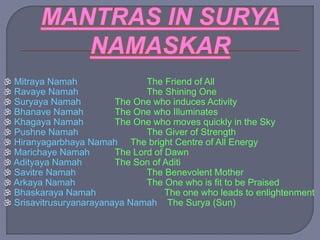
 Mitraya Namah The Friend of All
 Ravaye Namah The Shining One
 Suryaya Namah The One who induces Activity
 Bhanave Namah The One who Illuminates
 Khagaya Namah The One who moves quickly in the Sky
 Pushne Namah The Giver of Strength
 Hiranyagarbhaya Namah The bright Centre of All Energy
 Marichaye Namah The Lord of Dawn
 Adityaya Namah The Son of Aditi
 Savitre Namah The Benevolent Mother
 Arkaya Namah The One who is fit to be Praised
 Bhaskaraya Namah The one who leads to enlightenment
 Srisavitrusuryanarayanaya Namah The Surya (Sun)
Beginning Shloka
DHYEYAH SADA SAVITRU MANDALA MADHYAVARTI
NARAYANAH SARSIJA SANA SANNI VISHTHAH ||
KEYURVAN MAKAR KUNDALAVAN KIRITI
HARI HIRANYA MAYA VAPUR DHRUTA SHANKHA
CHAKRAH ||
Meaning : Always worship the Sun [ Our Energy Source ] sitting at the centre of galaxy, on
lotus, wearing Keyur, Makarkundal Crown, holding Conch and Chakra and having glittering
golden body
Ending Shloka
ADITYASYA NAMASKARAN YE KURVANTI DINE DINE
AYUH PRADNYA BALAM VIRYAM TEJAS TESHAM
CHAJAYATE ||
Meaning : Those who regularly perform Suryanamaskaras attain healthy long life. They
become strong, knowledgeable and have courage to fight with valour. They posses
There are 7 types of surya namaskar –
1) Pranamasan
2) Urdhvasan
3) Uttanasan
3) Eka pad prasaranasan
4) Chaturang dandasan
5) Sashtang pranipatasan
6) Urdhvamukh shawanasan
7) Adhomukh shawanasan
Procedure : Hands together in Namaskar
position
Forearms parallel to the ground Feet
together. Body weight evenly distributed
over both feet. Calves, quads and
hamstrings tightened. Abdominal muscles
tightened.
Benefits : Good for the diseases of the
throat. Voice is enhanced. Both mind and
body become healthy.
Procedure : Palms joined and pushed
up and back. Biceps touching ears.
Maintain sight on wrists. Leg and
Abdominal muscles remain tight.
Benefits : Both the shoulders and the
food pipe (Esophagus) get exercise and
diseases related to them are corrected.
Eyesight is also improved
Procedure : From previous asana keep
arms straight Keep back straight and
bend from hips. Maintain sight on wrists.
Try to put palms flat on ground. Try to
touch forehead to knees. Do not bend
the knees.
Benefits : Disorders of the belly and
digestive system are corrected. The
chest and hands become stronger and
you become well balanced, beautiful and
good looking. Diseases of the feet and
fingers are also corrected.
Procedure : From previous asana thrust
one leg back. Keep other foot in line
with hands. Try to arch and look
backwards.
Benefits : The posture stretches the
small intestine and the seminal vesicles.
Hence this posture helps in correcting
the constipation and diseases of the
liver. Thinness of the semen is also
corrected. Diseases of the throat are
also corrected.
Procedure : From previous asana lift
knee off ground Thrust second leg
backwards. Keep feet together and
knees together. Maintain straight &
inclined line throughout body. Keep
sight on ground at right angle.
Benefits : One gets relief from the
pains - specially of arms, legs and the
knees. Bulging waist is trimmed and it
is good for the abdominal disorders.
Procedure : Lower entire body to the
ground slowly. Only forehead, chest,
knees and toes touch ground. Keep hands
and elbows close to the body. Keep feet
together and knees together.
Benefits : This posture makes the arms
strong. If ladies perform this Asana before
getting pregnant, the breast fed babies
could be saved from the attacks of many
diseases.
Procedure : From previous asana push body
forwards and upwards. Keep feet together and
knees together. Tighten forearms, biceps and
triceps. Tighten abdominal muscles. Arch back
and look backwards.
Benefits : Tones up the body and the back
muscles and improves the eyesight. Corrects
all kinds of disorders related to the
reproductive system, corrects the irregularities
in females menstrual cycles. Blood circulation
is also improved.
Procedure : Keep lower body straight. Keep
upper body straight. Create the “mountain”
shape. Keep feet together and knees
together. Try to keep feet flat on the
ground. Tuck head in between arms. Push
chin towards the chest.
Benefits : One gets relief from the pains -
specially of arms, legs and the knees.
Bulging waist is trimmed and it is good for
the abdominal disorders.
PRANAYAMA AND SURYA NAMASKAR

PRANAYAMA AND SURYA NAMASKAR

  • 2.
    Pranayama is anancient part of Perform Yoga Postures practice, the fourth part of the eight-fold Yoga described in the ""Yoga Sutra of Patanjali". Pranayama is concerned with breathing and posture. Research has shown that that practicing of the Pranayama can relieve symptoms of asthma. It is also beneficial in treating stress related disorders, such as anxiety and depression. Pranayam supplies oxygen to the entire body, and exercises the lungs, the stomach and its surrounding organs.
  • 3.
    There are sixtypes of pranayama – Bhastrika Pranayam: Sit in comfortable position, you may sit even on a chair. Breathe in until the lungs are full through your nostrils. Feel the diaphragm move down to allow the lungs to expand and forcing the abdomen out, followed by the mid section of your chest expanding and finally your collar bone rising. Breath out forcefully and uniformly, again through your nostrils. Again feel the collar bone dropping, chest deflating and the diaphragm moving up as the lungs collapse allowing the abdomen to be sucked in. This process of exhaling should be much faster than the process of inhaling. Repeat the process. When correctly done, your chest will expand when you breathe in and deflate when you breathe out. Continue doing this for 5 minutes. Kapalbhati Pranayam: Sit erect. Inhale through your nostrils a little and exhale through both nostrils forcefully. Inhale again a little and follow with another forceful exhalation passively and effortlessly. Continue these cycles. The frequency should be about 60 strokes/minute. Continue doing this for 15 minutes. You may take a minutes rest after every five minutes.
  • 4.
    Anulom Vilom Pranayam: Sitcomfortably. Close your eyes. Close the right nostril with the right thumb. Inhale slowly through the left nostril and fill your lungs with air. Close your left nostril with the ring and middle fingers of the right hand and open the right nostril. Exhale slowly and completely with the right nostril. Again inhale through the right nostril and fill your lungs. Close the right nostril by pressing it with the right thumb. Open the left nostril, breathe out slowly. (This process is one round of Anulom Vilom Pranayam.) Continue for 15 minutes. You may take a minutes rest after every five minutes of exercise. Bahya Pranayam: Breathe air out, touch chin to chest, squeeze stomach completely and hold for a while. then release chin, breathe in slowly. Duration : 3 times to 5 times normally. Bhramari Pranayam: Close ears with thumb, index finger on forehead, and rest three on base of nose touching eyes. Breathe in. And now breathe out through nose while humming like a bee. Do this three times. Udgeeth Pranayam: Breathe in deeply, and chant 'Om'kar.
  • 5.
    Depending on theintensity of the ailment a person doing regular Pranayam starts getting good results from day one. However it can take from one week to approximately nine months to get the complete benefits of Pranayam. Health changes can include: 1 Respiratory troubles clearing up, in addition to improvements to allergies, High blood pressure and diseases pertaining to the kidneys. 2 A calming of excitement, anxiety, fear, anger, disappointment and other mental states. 3 The digestive system improves. 4 Memory improves. 5 Pain in the joints vanishes. 6 Falling of the hair or the appearance of wrinkles on the face at young age, diminution of eyesight etc. are all minimized. 7 The face becomes bright, luminous and calm.
  • 6.
    Pranayam cures orimproves the following chronic diseases: 1 Diabetes 2 Blockages in Arteries 3 Obesity 4 Asthma 5 Depression 6 Thyroid problems 7 Hepatitis 8 Cancer 9 Gas 10 Acidity
  • 7.
    1 Do Pranayampreferably in the morning with an empty stomach. 2 If you prefer to do Pranayam in the evening, do it on an empty stomach and keep a gap of at least 5 hours between your meal and Pranayam. 3 Those who cannot sit in Asanas can sit on the chair and do Pranayam. 4 Never hold your breath while doing Pranayam. 5 Do about 1 to 5 minutes of jogging after Pranayam exercises as per your physical ability.
  • 8.
    • Suryanamaskar (Sunsalutation ) is combination of few asanas. Its roots can be found in yoga philosophy of vedic traditions. • It is practiced in more than 40 different types all over India. There are set of well balanced movements that will stretch all the muscles in the body. Thus keeping the body and mind healthy. • Many yogis, great personalities have performed 1000+ suryanamaskaras everyday. • This exercise should be done everyday by everyone Let us practice suryanamaskaras everyday and derive the immense benefits that are offered.
  • 9.
     Mitraya NamahThe Friend of All  Ravaye Namah The Shining One  Suryaya Namah The One who induces Activity  Bhanave Namah The One who Illuminates  Khagaya Namah The One who moves quickly in the Sky  Pushne Namah The Giver of Strength  Hiranyagarbhaya Namah The bright Centre of All Energy  Marichaye Namah The Lord of Dawn  Adityaya Namah The Son of Aditi  Savitre Namah The Benevolent Mother  Arkaya Namah The One who is fit to be Praised  Bhaskaraya Namah The one who leads to enlightenment  Srisavitrusuryanarayanaya Namah The Surya (Sun)
  • 10.
    Beginning Shloka DHYEYAH SADASAVITRU MANDALA MADHYAVARTI NARAYANAH SARSIJA SANA SANNI VISHTHAH || KEYURVAN MAKAR KUNDALAVAN KIRITI HARI HIRANYA MAYA VAPUR DHRUTA SHANKHA CHAKRAH || Meaning : Always worship the Sun [ Our Energy Source ] sitting at the centre of galaxy, on lotus, wearing Keyur, Makarkundal Crown, holding Conch and Chakra and having glittering golden body Ending Shloka ADITYASYA NAMASKARAN YE KURVANTI DINE DINE AYUH PRADNYA BALAM VIRYAM TEJAS TESHAM CHAJAYATE || Meaning : Those who regularly perform Suryanamaskaras attain healthy long life. They become strong, knowledgeable and have courage to fight with valour. They posses
  • 11.
    There are 7types of surya namaskar – 1) Pranamasan 2) Urdhvasan 3) Uttanasan 3) Eka pad prasaranasan 4) Chaturang dandasan 5) Sashtang pranipatasan 6) Urdhvamukh shawanasan 7) Adhomukh shawanasan
  • 12.
    Procedure : Handstogether in Namaskar position Forearms parallel to the ground Feet together. Body weight evenly distributed over both feet. Calves, quads and hamstrings tightened. Abdominal muscles tightened. Benefits : Good for the diseases of the throat. Voice is enhanced. Both mind and body become healthy.
  • 13.
    Procedure : Palmsjoined and pushed up and back. Biceps touching ears. Maintain sight on wrists. Leg and Abdominal muscles remain tight. Benefits : Both the shoulders and the food pipe (Esophagus) get exercise and diseases related to them are corrected. Eyesight is also improved
  • 14.
    Procedure : Fromprevious asana keep arms straight Keep back straight and bend from hips. Maintain sight on wrists. Try to put palms flat on ground. Try to touch forehead to knees. Do not bend the knees. Benefits : Disorders of the belly and digestive system are corrected. The chest and hands become stronger and you become well balanced, beautiful and good looking. Diseases of the feet and fingers are also corrected.
  • 15.
    Procedure : Fromprevious asana thrust one leg back. Keep other foot in line with hands. Try to arch and look backwards. Benefits : The posture stretches the small intestine and the seminal vesicles. Hence this posture helps in correcting the constipation and diseases of the liver. Thinness of the semen is also corrected. Diseases of the throat are also corrected.
  • 16.
    Procedure : Fromprevious asana lift knee off ground Thrust second leg backwards. Keep feet together and knees together. Maintain straight & inclined line throughout body. Keep sight on ground at right angle. Benefits : One gets relief from the pains - specially of arms, legs and the knees. Bulging waist is trimmed and it is good for the abdominal disorders.
  • 17.
    Procedure : Lowerentire body to the ground slowly. Only forehead, chest, knees and toes touch ground. Keep hands and elbows close to the body. Keep feet together and knees together. Benefits : This posture makes the arms strong. If ladies perform this Asana before getting pregnant, the breast fed babies could be saved from the attacks of many diseases.
  • 18.
    Procedure : Fromprevious asana push body forwards and upwards. Keep feet together and knees together. Tighten forearms, biceps and triceps. Tighten abdominal muscles. Arch back and look backwards. Benefits : Tones up the body and the back muscles and improves the eyesight. Corrects all kinds of disorders related to the reproductive system, corrects the irregularities in females menstrual cycles. Blood circulation is also improved.
  • 19.
    Procedure : Keeplower body straight. Keep upper body straight. Create the “mountain” shape. Keep feet together and knees together. Try to keep feet flat on the ground. Tuck head in between arms. Push chin towards the chest. Benefits : One gets relief from the pains - specially of arms, legs and the knees. Bulging waist is trimmed and it is good for the abdominal disorders.