LADY GAGA
POSTMODERN
   ARTIST
HYPERREALITY
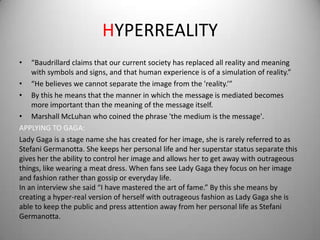
•   “Baudrillard claims that our current society has replaced all reality and meaning
    with symbols and signs, and that human experience is of a simulation of reality.”
• “He believes we cannot separate the image from the 'reality.’”
• By this he means that the manner in which the message is mediated becomes
    more important than the meaning of the message itself.
• Marshall McLuhan who coined the phrase 'the medium is the message'.
APPLYING TO GAGA:
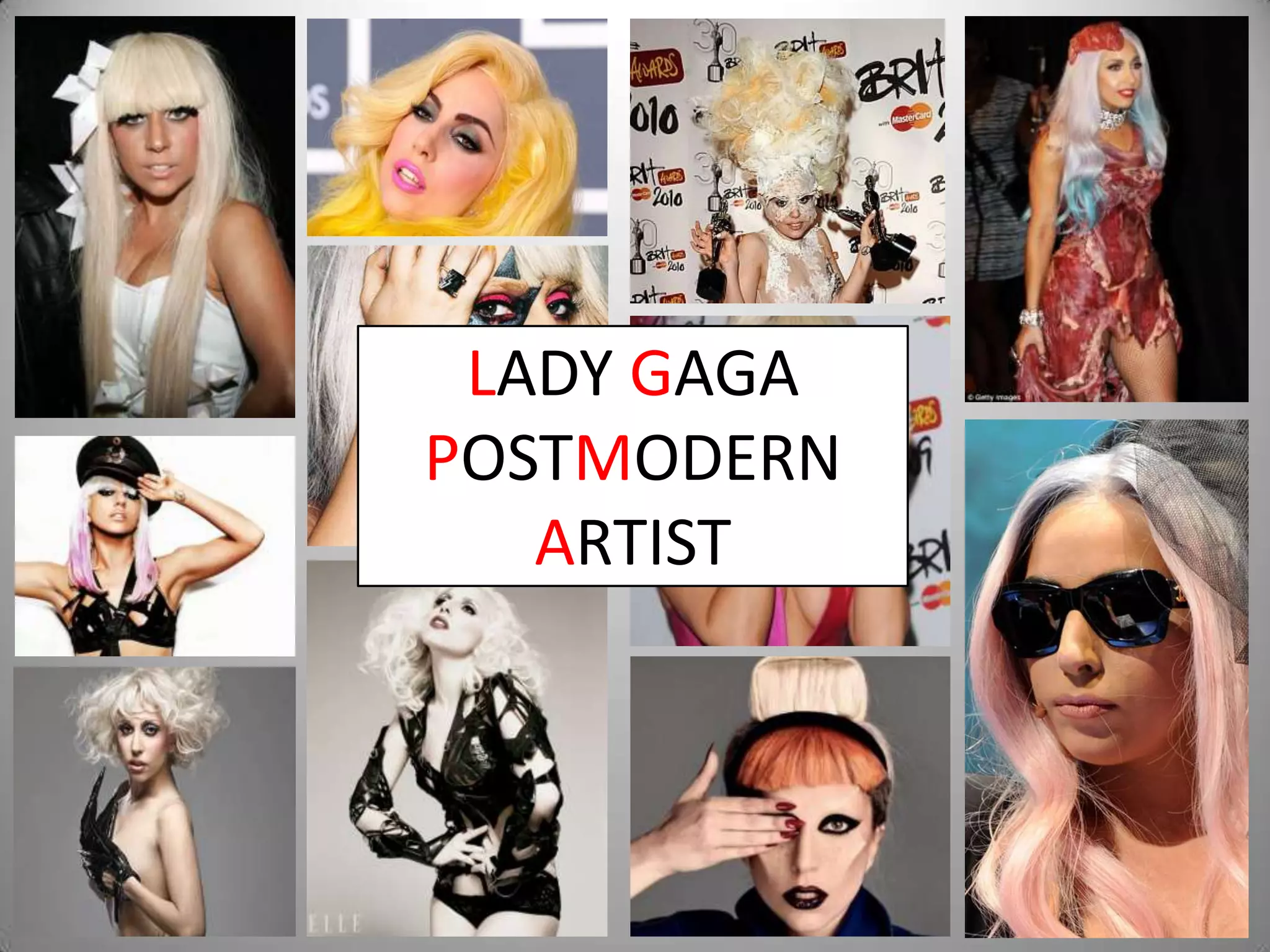
Lady Gaga is a stage name she has created for her image, she is rarely referred to as
Stefani Germanotta. She keeps her personal life and her superstar status separate this
gives her the ability to control her image and allows her to get away with outrageous
things, like wearing a meat dress. When fans see Lady Gaga they focus on her image
and fashion rather than gossip or everyday life.
In an interview she said “I have mastered the art of fame.” By this she means by
creating a hyper-real version of herself with outrageous fashion as Lady Gaga she is
able to keep the public and press attention away from her personal life as Stefani
Germanotta.
INTERTEXTUAL REFERENCING
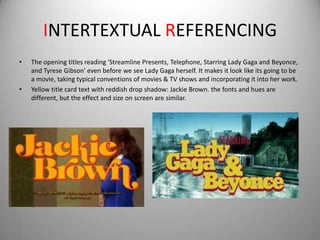
•   The opening titles reading 'Streamline Presents, Telephone, Starring Lady Gaga and Beyonce,
    and Tyrese Gibson' even before we see Lady Gaga herself. It makes it look like its going to be
    a movie, taking typical conventions of movies & TV shows and incorporating it into her work.
•   Yellow title card text with reddish drop shadow: Jackie Brown. the fonts and hues are
    different, but the effect and size on screen are similar.
INTERTEXTUAL REFERENCING
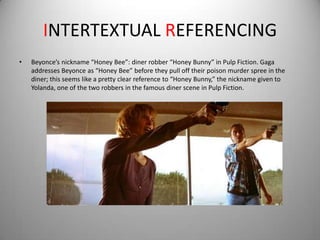
•   Beyonce’s nickname “Honey Bee”: diner robber “Honey Bunny” in Pulp Fiction. Gaga
    addresses Beyonce as “Honey Bee” before they pull off their poison murder spree in the
    diner; this seems like a pretty clear reference to “Honey Bunny,” the nickname given to
    Yolanda, one of the two robbers in the famous diner scene in Pulp Fiction.
INTERTEXTUAL REFERENCING
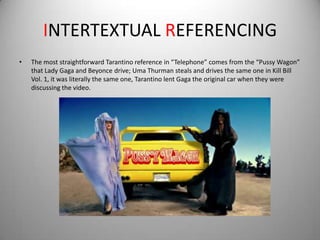
•   The most straightforward Tarantino reference in “Telephone” comes from the “Pussy Wagon”
    that Lady Gaga and Beyonce drive; Uma Thurman steals and drives the same one in Kill Bill
    Vol. 1, it was literally the same one, Tarantino lent Gaga the original car when they were
    discussing the video.
BRICOLAGE
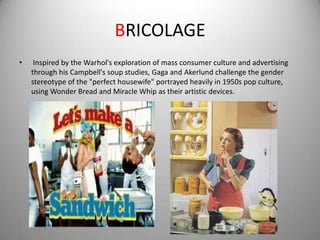
•    Inspired by the Warhol's exploration of mass consumer culture and advertising
    through his Campbell's soup studies, Gaga and Akerlund challenge the gender
    stereotype of the "perfect housewife" portrayed heavily in 1950s pop culture,
    using Wonder Bread and Miracle Whip as their artistic devices.
BRICOLAGE


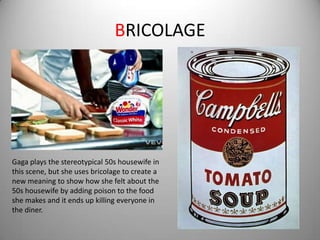
Gaga plays the stereotypical 50s housewife in
this scene, but she uses bricolage to create a
new meaning to show how she felt about the
50s housewife by adding poison to the food
she makes and it ends up killing everyone in
the diner.
EVERYTHING IS A REMIX
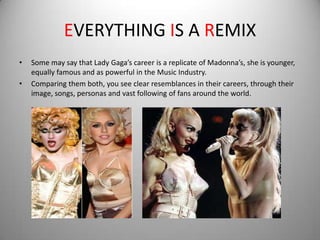
•   Some may say that Lady Gaga’s career is a replicate of Madonna’s, she is younger,
    equally famous and as powerful in the Music Industry.
•   Comparing them both, you see clear resemblances in their careers, through their
    image, songs, personas and vast following of fans around the world.
EVERYTHING IS A REMIX
• When ‘Born This Way’ came out, there was a lot of speculation that it was
  ‘Express Yourself’ 2.0. She follows the rules of a postmodernist, she takes
  influences from the past and incorporates it into her work.


http://www.youtube.com/watch?v=AUDSX9vyG
20
MIXING GENRES
• Fame Monster has quite a 70’s disco influence
  with a modern sound. By mixing modern club
  sounds like faders and heavy beats with disco,
  she has made disco cool for a modern audience
  and something that young people would dance
  to. A good example of this is Disco Heaven. Fame
  Monster can be seen as postmodern because she
  has taken disco that is not cool by today’s
  standards and made it popular selling over 15
  million copies worldwide.
UNCONVENTIONAL POPSTAR
• Her live shows are known for their outrageous and
  controversial content, like most mainstream pop stars she
  puts on a show, it’s about the whole performance, the
  dancing, the music, the fashion and the visuals together to
  amplify the meaning of the lyrics. However unusually for
  pop stars she does not mime during her performances and
  will also play instruments e.g. the piano as well as dancing.
• The visuals and story of her dances during her
  performances will amplify the meaning of the lyrics for
  example at the MTV music awards for the song Paparazzi
  she symbolised the death of the blonde icon by hanging
  from the roof covered in blood. This signified the way the
  press look for faults in celebrities and like to see how they
  fall from the top.

Lady Gaga - Postmodern Artist

  • 1.
  • 2.
    HYPERREALITY • “Baudrillard claims that our current society has replaced all reality and meaning with symbols and signs, and that human experience is of a simulation of reality.” • “He believes we cannot separate the image from the 'reality.’” • By this he means that the manner in which the message is mediated becomes more important than the meaning of the message itself. • Marshall McLuhan who coined the phrase 'the medium is the message'. APPLYING TO GAGA: Lady Gaga is a stage name she has created for her image, she is rarely referred to as Stefani Germanotta. She keeps her personal life and her superstar status separate this gives her the ability to control her image and allows her to get away with outrageous things, like wearing a meat dress. When fans see Lady Gaga they focus on her image and fashion rather than gossip or everyday life. In an interview she said “I have mastered the art of fame.” By this she means by creating a hyper-real version of herself with outrageous fashion as Lady Gaga she is able to keep the public and press attention away from her personal life as Stefani Germanotta.
  • 3.
    INTERTEXTUAL REFERENCING • The opening titles reading 'Streamline Presents, Telephone, Starring Lady Gaga and Beyonce, and Tyrese Gibson' even before we see Lady Gaga herself. It makes it look like its going to be a movie, taking typical conventions of movies & TV shows and incorporating it into her work. • Yellow title card text with reddish drop shadow: Jackie Brown. the fonts and hues are different, but the effect and size on screen are similar.
  • 4.
    INTERTEXTUAL REFERENCING • Beyonce’s nickname “Honey Bee”: diner robber “Honey Bunny” in Pulp Fiction. Gaga addresses Beyonce as “Honey Bee” before they pull off their poison murder spree in the diner; this seems like a pretty clear reference to “Honey Bunny,” the nickname given to Yolanda, one of the two robbers in the famous diner scene in Pulp Fiction.
  • 5.
    INTERTEXTUAL REFERENCING • The most straightforward Tarantino reference in “Telephone” comes from the “Pussy Wagon” that Lady Gaga and Beyonce drive; Uma Thurman steals and drives the same one in Kill Bill Vol. 1, it was literally the same one, Tarantino lent Gaga the original car when they were discussing the video.
  • 6.
    BRICOLAGE • Inspired by the Warhol's exploration of mass consumer culture and advertising through his Campbell's soup studies, Gaga and Akerlund challenge the gender stereotype of the "perfect housewife" portrayed heavily in 1950s pop culture, using Wonder Bread and Miracle Whip as their artistic devices.
  • 7.
    BRICOLAGE Gaga plays thestereotypical 50s housewife in this scene, but she uses bricolage to create a new meaning to show how she felt about the 50s housewife by adding poison to the food she makes and it ends up killing everyone in the diner.
  • 8.
    EVERYTHING IS AREMIX • Some may say that Lady Gaga’s career is a replicate of Madonna’s, she is younger, equally famous and as powerful in the Music Industry. • Comparing them both, you see clear resemblances in their careers, through their image, songs, personas and vast following of fans around the world.
  • 9.
    EVERYTHING IS AREMIX • When ‘Born This Way’ came out, there was a lot of speculation that it was ‘Express Yourself’ 2.0. She follows the rules of a postmodernist, she takes influences from the past and incorporates it into her work. http://www.youtube.com/watch?v=AUDSX9vyG 20
  • 10.
    MIXING GENRES • FameMonster has quite a 70’s disco influence with a modern sound. By mixing modern club sounds like faders and heavy beats with disco, she has made disco cool for a modern audience and something that young people would dance to. A good example of this is Disco Heaven. Fame Monster can be seen as postmodern because she has taken disco that is not cool by today’s standards and made it popular selling over 15 million copies worldwide.
  • 11.
    UNCONVENTIONAL POPSTAR • Herlive shows are known for their outrageous and controversial content, like most mainstream pop stars she puts on a show, it’s about the whole performance, the dancing, the music, the fashion and the visuals together to amplify the meaning of the lyrics. However unusually for pop stars she does not mime during her performances and will also play instruments e.g. the piano as well as dancing. • The visuals and story of her dances during her performances will amplify the meaning of the lyrics for example at the MTV music awards for the song Paparazzi she symbolised the death of the blonde icon by hanging from the roof covered in blood. This signified the way the press look for faults in celebrities and like to see how they fall from the top.