The Coming Storm: 
Antimicrobial Resistance and Selection
Objectives 
• Describe the role of antibiotic use in the 
development of resistance 
• Review toxicity of commonly used antibiotics 
• Understand the prevalence and clinical impact 
of carbapenem resistant enterobacteriaceae 
• State the prognosis antimicrobial resistant 
Staph aureus infections
Which of the following are indications to 
treat asymptomatic bacteriuria? 
Choose all that apply 
A. Pyuria 
B. Pregnancy 
C. Preparation for transurethral resection of the 
prostate 
D. Diabetes
3.5 
3 
2.5 
2 
1.5 
1 
0.5 
0 
1995 1996 1997 1998 1999 2000 2001 2002 2003 2004 2005 2006 2007 2008 2009 2010 2011 2012 
New Systemic Antibacterial Agents 
Approved
Why has the antibiotic pipeline failed? 
• All the easy ones have been discovered 
• Antibiotics are not a good investment for drug 
companies 
• FDA regulatory system is outdated
Society expects antibiotics to be cheap 
• Cost of Trastuzumab for breast cancer = 
$54,000 per year 
• Cost of Ipilimumab for melanoma = $240,000 
for induction course 
• Cost of ceftriaxone x 4 weeks for viridans 
streptococcal endocarditis=$1600
Clinical Impact of Antimicrobial 
Resistance 
• Resistance is rising 
• Resistance increases mortality 
• Decreasing antimicrobial use reduces 
resistance
Clinical Impact of Antimicrobial 
Resistance 
• Resistance is rising 
• Resistance increases mortality 
• Decreasing antimicrobial use reduces 
resistance
Klebsiella pneumoniae resistant to carbapenems 
NHSN Data 
14 
12 
10 
8 
6 
4 
2 
0 
2000 2007 2010
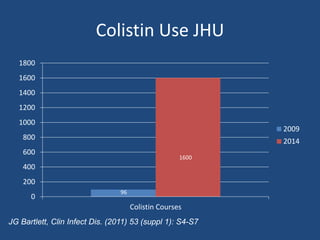
Colistin Use JHU 
1800 
1600 
1400 
1200 
1000 
800 
600 
400 
200 
0 
Colistin Courses 
2009 
2014 
96 
1600 
JG Bartlett, Clin Infect Dis. (2011) 53 (suppl 1): S4-S7
Clinical Impact of Antimicrobial 
Resistance 
• Resistance is rising 
• Resistance increases mortality 
• Decreasing antimicrobial use reduces 
resistance
Mortality of resistant (MRSA) vs. 
susceptible (MSSA) S. aureus 
• Mortality risk associated with MRSA 
bacteremia, relative to MSSA bacteremia: 
OR: 1.93; p < 0.001.1 
• Mortality of MRSA infections was higher than 
MSSA: relative risk [RR]: 1.7; 95% confidence 
interval: 1.3–2.4).2 
1. Clin. Infect. Dis.36(1),53–59 (2003). 
2. Infect. Control Hosp. Epidemiol.28(3),273–279 (2007).
Mortality associated with carbapenem resistant 
(CR) vs susceptible (CS) Klebsiella 
pneumoniae (KP) 
60 
50 
40 
30 
20 
10 
0 
p<0.001 
Overall Mortality Attributable 
Mortality 
Percent of subjects 
CRKP 
CSKP 
OR 3.71 (1.97-7.01) OR 4.5 (2.16-9.35) 
Patel G et al. Infect Control Hosp Epidemiol 2008;29:1099-1106 
p<0.001
Mortality Associated with CRE 
• Crude mortality 48%-61% 
• Infection-related mortality = 33%-40% 
Patel G, ICHE 29:1099-1106, 2008; Snitkin ES, Science Translational Medicine 4:1-9, 2012 
Munoz-Price LS ICHE 31:1074-7, 2010
Gram Negative Resistance Mechanisms 
• Beta-lactamases-ESBL 
• Multi-drug efflux pumps 
• Porin changes-reduce permeability of outer 
membrane (imipenem)
Gram Negative Resistance Mechanisms 
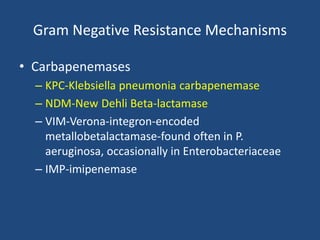
• Carbapenemases 
– KPC-Klebsiella pneumonia carbapenemase 
– NDM-New Dehli Beta-lactamase 
– VIM-Verona-integron-encoded 
metallobetalactamase-found often in P. 
aeruginosa, occasionally in Enterobacteriaceae 
– IMP-imipenemase
What’s the big deal about KPC? 
• It confers resistance to all beta-lactams, and is 
frequently associated with resistance to other 
drug classes 
• Many isolates are sensitive only to 
aminoglycosides, colistin, and tigecycline.
What’s the big deal about KPC? 
• It is coded by blaKPC gene, which is plasmid 
mediated and can be transferred from one 
organism to another, facilitating rapid spread 
of resistance
Clinical Impact of Antimicrobial 
Resistance 
• Resistance is rising 
• Resistance increases mortality 
• Decreasing antimicrobial use reduces 
resistance
Annual prevalence of imipenem 
resistance in P. aeruginosa vs. 
carbapenem use rate 
80 
70 
60 
50 
40 
30 
20 
10 
0 
r = 0.41, p = .004 
(Pearson correlation coefficient) 
0 20 40 60 80 100 
% Imipenem-resistant 
P. aeruginosa 
Carbapenem Use Rate 
45 LTACHs, 2002-03 (59 LTACH years) Gould et al. ICHE 2006;27:923-5
P. aeruginosa susceptibilities before and after 
implementation of antibiotic restrictions 
(CID 1997;25:230) 
100 
80 
60 
40 
20 
0 
Ticar/clav Imipenem Aztreonam Ceftaz Cipro 
Percent susceptible 
Before After 
P<0.01 for all increases
Impact of Improving Antibiotic Use on 
Rates of Resistant Enterobacteriaceae 
Carling P et al. Infect Control Hosp Epidemiol. 2003;24(9):699-706.
Impact of fluoroquinolone restriction 
on rates of C. difficle infection 
2.5 
2 
1.5 
1 
0.5 
0 
2005 2006 
Month and Year 
HO-CDAD cases/1,000 pd 
2007 
Infect Control Hosp Epidemiol. 2009 Mar;30(3):264-72.
Targeted antibiotic consumption and 
nosocomial C. difficile disease 
Tertiary care hospital; Quebec, 2003-2006 
Valiquette, et al. Clin Infect Dis 2007;45:S112.
What Can I Do? 
• Ensure antimicrobial resistance is recognized 
• Control nosocomial transmission of resistant 
pathogens 
• Reduce overall use of antimicrobial agents
What Can I Do? 
• Ensure antimicrobial resistance is recognized 
– Proper laboratory test protocols 
– Identify patients at risk for colonization 
• Control transmission of resistant pathogens 
• Reduce overall use of antimicrobial agents 
– Urinary tract 
– Skin and soft tissue 
– Respiratory tract
Resistance Definition 
• Nonsusceptible to one of the 3 carbapenems-imipenem, 
meropenem, or doripenem by 
2012 CLSI breakpoints 
AND 
• Resistant to all of the third generation 
cephalosporins tested-ceftriaxone, 
cefotaxime, ceftazidime 
*Morganella morganii, Proteus spp and Providencia spp. Are intrinsically 
resistant to imipenem-look for resistance to another carbapenem
Resistance-A Simplified Approach 
Old Breakpoints 
CLSA M100 S19 
Revised Breakpoints 
January 2012 
CLSI M-100 S22 
Agent S I R S I R 
Doripenem < 1 2 > 4 
Ertapenem < 2 4 > 8 < 0.5 1 > 2 
Imipenem < 4 8 > 16 < 1 2 > 4 
Meropenem < 4 8 > 16 < 1 2 > 4
What Can I Do? 
• Ensure antimicrobial resistance is recognized 
– Proper laboratory test protocols 
– Identify patients at risk for colonization 
• Control transmission of resistant pathogens 
• Reduce overall use of antimicrobial agents 
– Urinary tract 
– Skin and soft tissue 
– Respiratory tract
KPC Klebsiella pneumoniae 
colonization 
35 
30 
25 
20 
15 
10 
5 
0 
KPC Prevalence 
ICUs LTACHs 
KPC Prevalence 
Lin M Y et al. Clin Infect Dis. 2013;57:1246-1252
What Can I Do? 
• Ensure antimicrobial resistance is recognized 
• Control transmission of resistant pathogens 
• Reduce overall use of antimicrobial agents
CRE-Florida SICU Outbreak 
• Daily CHG baths 
• Cohorting during shifts-RTs, nurses, nurse aids 
• Monitoring of environmental cleaning-black 
light and culture 
• Active surveillance cultures 
Munoz-Price LS ICHE 31:1074-7, 2010
CDC Guidance-Core Measures 
1. Hand Hygiene 
2. Contact Precautions for all patients who are 
colonized or infected with CRE 
3. HCW Education 
4. Minimize use of devices, e.g. CVCs, 
endotracheal tubes, urinary catheters
CDC Guidance-Core Measures 
5. Cohort patients and staff 
6. Notification system for lab to promptly 
inform Infection Control of all CRE 
7. Antimicrobial stewardship 
8. Screen contacts of patients colonized or 
infected with CRE
Contact Precautions-Starting and 
Stopping 
• Micro lab should inform Infection Control of all 
CRE 
• Flag chart to identify patient for precautions on 
re-admission 
• Colonization may persist for 6 months or longer 
• If screening for persistent colonization is used to 
DC precautions, must screen > once 
• CRE should not preclude transfer to another 
facility
Contact Precautions for Long Term 
Care 
• Patients who are dependent on caregivers for 
ADLs should be nursed in precautions 
• For long term care residents who are able to 
perform hand hygiene, are continent of stool, 
are independent in ADLs and without draining 
wounds contact precautions might be relaxed
Risk Factors for Mortality from CRE 
• Age 
• Mechanical ventilation 
• Malignancy 
• Heart disease 
• ICU stay
But-removal of the primary focus of 
infection (incision and drainage or 
device removal) is independently 
associated with survival
What Can I Do? 
• Ensure antimicrobial resistance is recognized 
• Control transmission of resistant pathogens 
• Reduce overall use of antimicrobial agents 
– Is an antibiotic truly needed? 
– Discontinue or narrow therapy when data return 
– Minimize duration of therapy
Antibiotic Assumptions 
• Antibiotics are well tolerated insurance 
against a bad outcome 
• Treating longer is better 
• My duty is to the patient in my care-if treating 
him with an antibiotic increases societal risk, 
that is secondary
Antibiotic Assumptions 
• Antibiotics are well tolerated insurance 
against a bad outcome 
• Treating longer is better 
• My duty is to the patient in my care-if treating 
him with an antibiotic increases societal risk, 
that is secondary
Case presentation 
• 28 year-old male with no past medical history 
admitted with fever and rash. 
• On morning of admission: Red, bumpy, itchy 
rash on right arm, pt thought possibly due to 
bed bugs 
• Rash progressed over course of the day to 
involve chest, back, other arm, neck, face. 
• Also c/o fever, malaise, sore throat, blurry 
vision.
Case presentation 
• Past medical history: kidney stone 
• Past surgical history: none 
• Medications: none on admission; recent Cipro 
use for kidney stone, ?pyelonephritis 
• Allergies: NKDA 
• Family history: DM in mother and father
Clinical course 
• Persistent high fever, tachycardia 
• Rapidly progressive rash (vesicles  large bullae) and 
generalized facial edema 
• Transferred to ICU on HD #3 due to concern for airway 
compromise, intubated 
• Derm evaluation: 
– Clinical findings c/w toxic epidermal necrolysis 
– SJS/TEN confirmed by shave biopsy 
• Dx: SJS/TEN due to ciprofloxacin
Antibiotic Assumptions 
• Antibiotics are well tolerated insurance 
against a bad outcome 
• Treating longer is better 
• My duty is to the patient in my care-if treating 
him with an antibiotic increases societal risk, 
that is secondary
Stewardship optimizes patient safety: 
decreased patient-level resistance 
Cipro Standard 
Antibiotic 
duration 
3 days 10 days 
LOS ICU 9 days 15 days 
Antibiotic 
resistance/ 
superinfection 
14% 38% 
Study terminated early because attending 
physicians began to treat standard care group 
with 3 days of therapy 
Singh N et al. Am J Respir Crit Care Med. 2000;162:505-11.
Pneumonia Scoring Systems 
PSI Score-outpatients 
http://pda.ahrq.gov/clinic/psi/psicalc.asp 
CPIS Score-VAP 
http://www.surgicalcriticalcare.net/Resources/CPIS.php 
Curb 65 Score: One point per factor, score > 2 warrants hospitalization 
Parameter Criteria 
Confusion Disoriented to time/place/person or by other objective test 
Uremia >20 mg/dL. Our normal range is 10-26 mg/dL so I think 
above normal is an appropriate cutoff. Also, not everyone 
includes this as it requires having completed labs. 
Respiratory rate > 30 breaths/minute 
Low Blood pressure < 90 mm Hg systolic or > 60 mm Hg diastolic 
Age > 65 years
Comparison of 8 vs 15 Days of Antibiotic Therapy for Ventilator- 
Associated Pneumonia in Adults 
JAMA. 2003;290(19):2588-2598. doi:10.1001/jama.290.19.2588 
Probability of survival is for the 60 days after ventilator-associated pneumonia onset as a function of the duration of antibiotic 
administration. 
Date of download: 9/23/2014 
Copyright © 2014 American Medical 
Association. All rights reserved. 
Figure Legend:
Pulmonary Infection Recurrence 
50 
45 
40 
35 
30 
25 
20 
15 
10 
5 
0 
Non-fermenters MRSA Other bacteria 
8 day 
15 day 
* NS NS
Antibiotic Assumptions 
• Antibiotics are well tolerated insurance 
against a bad outcome 
• Treating longer is better 
• My duty is to the patient in my care-if treating 
him with an antibiotic increases societal risk, 
that is secondary 
– But…treating a patient with an antibiotic increases 
that patient’s risk of resistance
Effect of antibiotic prescribing in primary care on 
antimicrobial resistance in individual patients: 
systematic review and meta-analysis 
Costelloe C et al. BMJ. 
2010;340:c2096.
What Can I Do? 
• Ensure antimicrobial resistance is recognized 
• Control transmission of resistant pathogens 
• Reduce overall use of antimicrobial agents 
– Urinary tract 
– Respiratory tract 
– Skin and soft tissue
Case 1 
• 79 y/o man admitted for left foot gangrene 
• Surgeons plan amputation 
• PMHx chronic foley for urinary retention 
• ROS negative 
• Pre-op UA 
– Dipstick + leukocyte esterase 
– Microscopy > 50 WBC/hpf
How should the team respond to this 
UA? 
A. Order urine culture and treat empirically with 
ciprofloxacin 
B. Order urine culture and await results 
C. Change the foley catheter 
D. Watchful waiting
Case 2 
• 81 y/o man admitted with fever, hypotension, 
confusion 
• PMHx DM, HTN, dementia, prostatism with a 
chronic foley 
• ROS unable to provide due to confusion 
• Exam suprapubic tenderness, no flank 
tenderness
Case 2 
• Lab WBC 14,000 12% bands 75% segs 
• UA 
– Positive Leukocyte esterase 
– > 50 WBCs/hpf, 3+ bacteria
What empiric therapy would you 
select? 
A. Vancomycin + pipracillin-tazobactam 
B. Vancomycin + cefepime 
C. Meropenem 
D. Ciprofloxacin
Case 2 
• Hospital course: treated with vancomycin + 
pipracillin-tazobactam, defervesces, appears 
pleasantly demented on day 2 
• Blood and urine growing lactose fermenting 
gram negative rods
How should therapy be altered? 
A. Continue current management-he is 
responding 
B. Discontinue vancomycin-there is no evidence 
of gram positive infection 
C. Discontine vanc + pip-tazo and substitute 
ceftriaxone 
D. Discontinue vanc + pip-tazo and substitute 
oral ciprofloxacin
Case 2 
• C & S shows E. coli, resistant to cipro and 
sensitive to the following agents. Which one 
would you choose? 
A. Ampicillin 
B. Ampicillin-sulbactam 
C. Cefazolin 
D. TMP-SMX
Case 2 
• What is the recommended duration of 
therapy? 
A. 3 days 
B. 7 days 
C. 10 days 
D. 14 days

Antimicrobial Stewardship 2014

  • 1.
    The Coming Storm: Antimicrobial Resistance and Selection
  • 2.
    Objectives • Describethe role of antibiotic use in the development of resistance • Review toxicity of commonly used antibiotics • Understand the prevalence and clinical impact of carbapenem resistant enterobacteriaceae • State the prognosis antimicrobial resistant Staph aureus infections
  • 3.
    Which of thefollowing are indications to treat asymptomatic bacteriuria? Choose all that apply A. Pyuria B. Pregnancy C. Preparation for transurethral resection of the prostate D. Diabetes
  • 4.
    3.5 3 2.5 2 1.5 1 0.5 0 1995 1996 1997 1998 1999 2000 2001 2002 2003 2004 2005 2006 2007 2008 2009 2010 2011 2012 New Systemic Antibacterial Agents Approved
  • 5.
    Why has theantibiotic pipeline failed? • All the easy ones have been discovered • Antibiotics are not a good investment for drug companies • FDA regulatory system is outdated
  • 6.
    Society expects antibioticsto be cheap • Cost of Trastuzumab for breast cancer = $54,000 per year • Cost of Ipilimumab for melanoma = $240,000 for induction course • Cost of ceftriaxone x 4 weeks for viridans streptococcal endocarditis=$1600
  • 7.
    Clinical Impact ofAntimicrobial Resistance • Resistance is rising • Resistance increases mortality • Decreasing antimicrobial use reduces resistance
  • 8.
    Clinical Impact ofAntimicrobial Resistance • Resistance is rising • Resistance increases mortality • Decreasing antimicrobial use reduces resistance
  • 9.
    Klebsiella pneumoniae resistantto carbapenems NHSN Data 14 12 10 8 6 4 2 0 2000 2007 2010
  • 10.
    Colistin Use JHU 1800 1600 1400 1200 1000 800 600 400 200 0 Colistin Courses 2009 2014 96 1600 JG Bartlett, Clin Infect Dis. (2011) 53 (suppl 1): S4-S7
  • 11.
    Clinical Impact ofAntimicrobial Resistance • Resistance is rising • Resistance increases mortality • Decreasing antimicrobial use reduces resistance
  • 12.
    Mortality of resistant(MRSA) vs. susceptible (MSSA) S. aureus • Mortality risk associated with MRSA bacteremia, relative to MSSA bacteremia: OR: 1.93; p < 0.001.1 • Mortality of MRSA infections was higher than MSSA: relative risk [RR]: 1.7; 95% confidence interval: 1.3–2.4).2 1. Clin. Infect. Dis.36(1),53–59 (2003). 2. Infect. Control Hosp. Epidemiol.28(3),273–279 (2007).
  • 13.
    Mortality associated withcarbapenem resistant (CR) vs susceptible (CS) Klebsiella pneumoniae (KP) 60 50 40 30 20 10 0 p<0.001 Overall Mortality Attributable Mortality Percent of subjects CRKP CSKP OR 3.71 (1.97-7.01) OR 4.5 (2.16-9.35) Patel G et al. Infect Control Hosp Epidemiol 2008;29:1099-1106 p<0.001
  • 14.
    Mortality Associated withCRE • Crude mortality 48%-61% • Infection-related mortality = 33%-40% Patel G, ICHE 29:1099-1106, 2008; Snitkin ES, Science Translational Medicine 4:1-9, 2012 Munoz-Price LS ICHE 31:1074-7, 2010
  • 15.
    Gram Negative ResistanceMechanisms • Beta-lactamases-ESBL • Multi-drug efflux pumps • Porin changes-reduce permeability of outer membrane (imipenem)
  • 16.
    Gram Negative ResistanceMechanisms • Carbapenemases – KPC-Klebsiella pneumonia carbapenemase – NDM-New Dehli Beta-lactamase – VIM-Verona-integron-encoded metallobetalactamase-found often in P. aeruginosa, occasionally in Enterobacteriaceae – IMP-imipenemase
  • 17.
    What’s the bigdeal about KPC? • It confers resistance to all beta-lactams, and is frequently associated with resistance to other drug classes • Many isolates are sensitive only to aminoglycosides, colistin, and tigecycline.
  • 18.
    What’s the bigdeal about KPC? • It is coded by blaKPC gene, which is plasmid mediated and can be transferred from one organism to another, facilitating rapid spread of resistance
  • 19.
    Clinical Impact ofAntimicrobial Resistance • Resistance is rising • Resistance increases mortality • Decreasing antimicrobial use reduces resistance
  • 20.
    Annual prevalence ofimipenem resistance in P. aeruginosa vs. carbapenem use rate 80 70 60 50 40 30 20 10 0 r = 0.41, p = .004 (Pearson correlation coefficient) 0 20 40 60 80 100 % Imipenem-resistant P. aeruginosa Carbapenem Use Rate 45 LTACHs, 2002-03 (59 LTACH years) Gould et al. ICHE 2006;27:923-5
  • 21.
    P. aeruginosa susceptibilitiesbefore and after implementation of antibiotic restrictions (CID 1997;25:230) 100 80 60 40 20 0 Ticar/clav Imipenem Aztreonam Ceftaz Cipro Percent susceptible Before After P<0.01 for all increases
  • 22.
    Impact of ImprovingAntibiotic Use on Rates of Resistant Enterobacteriaceae Carling P et al. Infect Control Hosp Epidemiol. 2003;24(9):699-706.
  • 23.
    Impact of fluoroquinolonerestriction on rates of C. difficle infection 2.5 2 1.5 1 0.5 0 2005 2006 Month and Year HO-CDAD cases/1,000 pd 2007 Infect Control Hosp Epidemiol. 2009 Mar;30(3):264-72.
  • 24.
    Targeted antibiotic consumptionand nosocomial C. difficile disease Tertiary care hospital; Quebec, 2003-2006 Valiquette, et al. Clin Infect Dis 2007;45:S112.
  • 25.
    What Can IDo? • Ensure antimicrobial resistance is recognized • Control nosocomial transmission of resistant pathogens • Reduce overall use of antimicrobial agents
  • 26.
    What Can IDo? • Ensure antimicrobial resistance is recognized – Proper laboratory test protocols – Identify patients at risk for colonization • Control transmission of resistant pathogens • Reduce overall use of antimicrobial agents – Urinary tract – Skin and soft tissue – Respiratory tract
  • 27.
    Resistance Definition •Nonsusceptible to one of the 3 carbapenems-imipenem, meropenem, or doripenem by 2012 CLSI breakpoints AND • Resistant to all of the third generation cephalosporins tested-ceftriaxone, cefotaxime, ceftazidime *Morganella morganii, Proteus spp and Providencia spp. Are intrinsically resistant to imipenem-look for resistance to another carbapenem
  • 28.
    Resistance-A Simplified Approach Old Breakpoints CLSA M100 S19 Revised Breakpoints January 2012 CLSI M-100 S22 Agent S I R S I R Doripenem < 1 2 > 4 Ertapenem < 2 4 > 8 < 0.5 1 > 2 Imipenem < 4 8 > 16 < 1 2 > 4 Meropenem < 4 8 > 16 < 1 2 > 4
  • 29.
    What Can IDo? • Ensure antimicrobial resistance is recognized – Proper laboratory test protocols – Identify patients at risk for colonization • Control transmission of resistant pathogens • Reduce overall use of antimicrobial agents – Urinary tract – Skin and soft tissue – Respiratory tract
  • 31.
    KPC Klebsiella pneumoniae colonization 35 30 25 20 15 10 5 0 KPC Prevalence ICUs LTACHs KPC Prevalence Lin M Y et al. Clin Infect Dis. 2013;57:1246-1252
  • 32.
    What Can IDo? • Ensure antimicrobial resistance is recognized • Control transmission of resistant pathogens • Reduce overall use of antimicrobial agents
  • 33.
    CRE-Florida SICU Outbreak • Daily CHG baths • Cohorting during shifts-RTs, nurses, nurse aids • Monitoring of environmental cleaning-black light and culture • Active surveillance cultures Munoz-Price LS ICHE 31:1074-7, 2010
  • 34.
    CDC Guidance-Core Measures 1. Hand Hygiene 2. Contact Precautions for all patients who are colonized or infected with CRE 3. HCW Education 4. Minimize use of devices, e.g. CVCs, endotracheal tubes, urinary catheters
  • 35.
    CDC Guidance-Core Measures 5. Cohort patients and staff 6. Notification system for lab to promptly inform Infection Control of all CRE 7. Antimicrobial stewardship 8. Screen contacts of patients colonized or infected with CRE
  • 36.
    Contact Precautions-Starting and Stopping • Micro lab should inform Infection Control of all CRE • Flag chart to identify patient for precautions on re-admission • Colonization may persist for 6 months or longer • If screening for persistent colonization is used to DC precautions, must screen > once • CRE should not preclude transfer to another facility
  • 37.
    Contact Precautions forLong Term Care • Patients who are dependent on caregivers for ADLs should be nursed in precautions • For long term care residents who are able to perform hand hygiene, are continent of stool, are independent in ADLs and without draining wounds contact precautions might be relaxed
  • 38.
    Risk Factors forMortality from CRE • Age • Mechanical ventilation • Malignancy • Heart disease • ICU stay
  • 39.
    But-removal of theprimary focus of infection (incision and drainage or device removal) is independently associated with survival
  • 40.
    What Can IDo? • Ensure antimicrobial resistance is recognized • Control transmission of resistant pathogens • Reduce overall use of antimicrobial agents – Is an antibiotic truly needed? – Discontinue or narrow therapy when data return – Minimize duration of therapy
  • 41.
    Antibiotic Assumptions •Antibiotics are well tolerated insurance against a bad outcome • Treating longer is better • My duty is to the patient in my care-if treating him with an antibiotic increases societal risk, that is secondary
  • 42.
    Antibiotic Assumptions •Antibiotics are well tolerated insurance against a bad outcome • Treating longer is better • My duty is to the patient in my care-if treating him with an antibiotic increases societal risk, that is secondary
  • 43.
    Case presentation •28 year-old male with no past medical history admitted with fever and rash. • On morning of admission: Red, bumpy, itchy rash on right arm, pt thought possibly due to bed bugs • Rash progressed over course of the day to involve chest, back, other arm, neck, face. • Also c/o fever, malaise, sore throat, blurry vision.
  • 44.
    Case presentation •Past medical history: kidney stone • Past surgical history: none • Medications: none on admission; recent Cipro use for kidney stone, ?pyelonephritis • Allergies: NKDA • Family history: DM in mother and father
  • 45.
    Clinical course •Persistent high fever, tachycardia • Rapidly progressive rash (vesicles  large bullae) and generalized facial edema • Transferred to ICU on HD #3 due to concern for airway compromise, intubated • Derm evaluation: – Clinical findings c/w toxic epidermal necrolysis – SJS/TEN confirmed by shave biopsy • Dx: SJS/TEN due to ciprofloxacin
  • 46.
    Antibiotic Assumptions •Antibiotics are well tolerated insurance against a bad outcome • Treating longer is better • My duty is to the patient in my care-if treating him with an antibiotic increases societal risk, that is secondary
  • 47.
    Stewardship optimizes patientsafety: decreased patient-level resistance Cipro Standard Antibiotic duration 3 days 10 days LOS ICU 9 days 15 days Antibiotic resistance/ superinfection 14% 38% Study terminated early because attending physicians began to treat standard care group with 3 days of therapy Singh N et al. Am J Respir Crit Care Med. 2000;162:505-11.
  • 48.
    Pneumonia Scoring Systems PSI Score-outpatients http://pda.ahrq.gov/clinic/psi/psicalc.asp CPIS Score-VAP http://www.surgicalcriticalcare.net/Resources/CPIS.php Curb 65 Score: One point per factor, score > 2 warrants hospitalization Parameter Criteria Confusion Disoriented to time/place/person or by other objective test Uremia >20 mg/dL. Our normal range is 10-26 mg/dL so I think above normal is an appropriate cutoff. Also, not everyone includes this as it requires having completed labs. Respiratory rate > 30 breaths/minute Low Blood pressure < 90 mm Hg systolic or > 60 mm Hg diastolic Age > 65 years
  • 49.
    Comparison of 8vs 15 Days of Antibiotic Therapy for Ventilator- Associated Pneumonia in Adults JAMA. 2003;290(19):2588-2598. doi:10.1001/jama.290.19.2588 Probability of survival is for the 60 days after ventilator-associated pneumonia onset as a function of the duration of antibiotic administration. Date of download: 9/23/2014 Copyright © 2014 American Medical Association. All rights reserved. Figure Legend:
  • 50.
    Pulmonary Infection Recurrence 50 45 40 35 30 25 20 15 10 5 0 Non-fermenters MRSA Other bacteria 8 day 15 day * NS NS
  • 51.
    Antibiotic Assumptions •Antibiotics are well tolerated insurance against a bad outcome • Treating longer is better • My duty is to the patient in my care-if treating him with an antibiotic increases societal risk, that is secondary – But…treating a patient with an antibiotic increases that patient’s risk of resistance
  • 52.
    Effect of antibioticprescribing in primary care on antimicrobial resistance in individual patients: systematic review and meta-analysis Costelloe C et al. BMJ. 2010;340:c2096.
  • 53.
    What Can IDo? • Ensure antimicrobial resistance is recognized • Control transmission of resistant pathogens • Reduce overall use of antimicrobial agents – Urinary tract – Respiratory tract – Skin and soft tissue
  • 54.
    Case 1 •79 y/o man admitted for left foot gangrene • Surgeons plan amputation • PMHx chronic foley for urinary retention • ROS negative • Pre-op UA – Dipstick + leukocyte esterase – Microscopy > 50 WBC/hpf
  • 55.
    How should theteam respond to this UA? A. Order urine culture and treat empirically with ciprofloxacin B. Order urine culture and await results C. Change the foley catheter D. Watchful waiting
  • 56.
    Case 2 •81 y/o man admitted with fever, hypotension, confusion • PMHx DM, HTN, dementia, prostatism with a chronic foley • ROS unable to provide due to confusion • Exam suprapubic tenderness, no flank tenderness
  • 57.
    Case 2 •Lab WBC 14,000 12% bands 75% segs • UA – Positive Leukocyte esterase – > 50 WBCs/hpf, 3+ bacteria
  • 58.
    What empiric therapywould you select? A. Vancomycin + pipracillin-tazobactam B. Vancomycin + cefepime C. Meropenem D. Ciprofloxacin
  • 59.
    Case 2 •Hospital course: treated with vancomycin + pipracillin-tazobactam, defervesces, appears pleasantly demented on day 2 • Blood and urine growing lactose fermenting gram negative rods
  • 60.
    How should therapybe altered? A. Continue current management-he is responding B. Discontinue vancomycin-there is no evidence of gram positive infection C. Discontine vanc + pip-tazo and substitute ceftriaxone D. Discontinue vanc + pip-tazo and substitute oral ciprofloxacin
  • 61.
    Case 2 •C & S shows E. coli, resistant to cipro and sensitive to the following agents. Which one would you choose? A. Ampicillin B. Ampicillin-sulbactam C. Cefazolin D. TMP-SMX
  • 62.
    Case 2 •What is the recommended duration of therapy? A. 3 days B. 7 days C. 10 days D. 14 days

Editor's Notes

  • #6 More than 1oo antibiotics have been discovered since sulfonamides. Each new antibiotic must be better than the last, making it difficult to improve. Antibiotics are used for short periods, making them much less lucrative than drugs taken by large numbers of people for many years These factors interact-the regulatory burden increases the cost of drug development
  • #10 Note that this increase occurred prior to the change in breakpoints
  • #15 i.e. What are the outcomes associated with CRE? Whenever a resistant pathogen is newly identified we hope that the fitness cost of expressing resistance mutation will make the organism less virulent. We are usually disappointed.
  • #16 Beta-lactamases were first discovered in the 1950s, when our old friend Staph aureus learned to hydrolyze penicillin. ESBLs emerged ~20 years ago, and conferred resistance to all penicillins and 1st-3rd gen cephalosporins. Carbapenems were our last line of defense. In the 1990s a few CRE were described that had porin mutations combined with the AmpC betalactamase. That was bad, but did not become widespread.
  • #17 KPC-found first in Klebs in North Carolina, but can be seen in other enterobacteriaceae, has spread rapidly and is now endemic in many New York hospitals. Others are mostly seen in patients who have received care outside the U.S.
  • #18 Use of tigecycline for serious infections is hampered by inability to achieve high serum levels. In one study, mortality was higher in patients treated with tigecycline.
  • #39 None of these are modifiable
  • #40 So here is something positive we can do to improve survival. Physicians who grew up in the antibiotic era-virtually everyone practicing today-have forgotten the importance of a surgical approach to infection. We must remind them.