Year 9 Rubric – “” Assignment
Name:__________________________________________________ Assignment Grade: _________
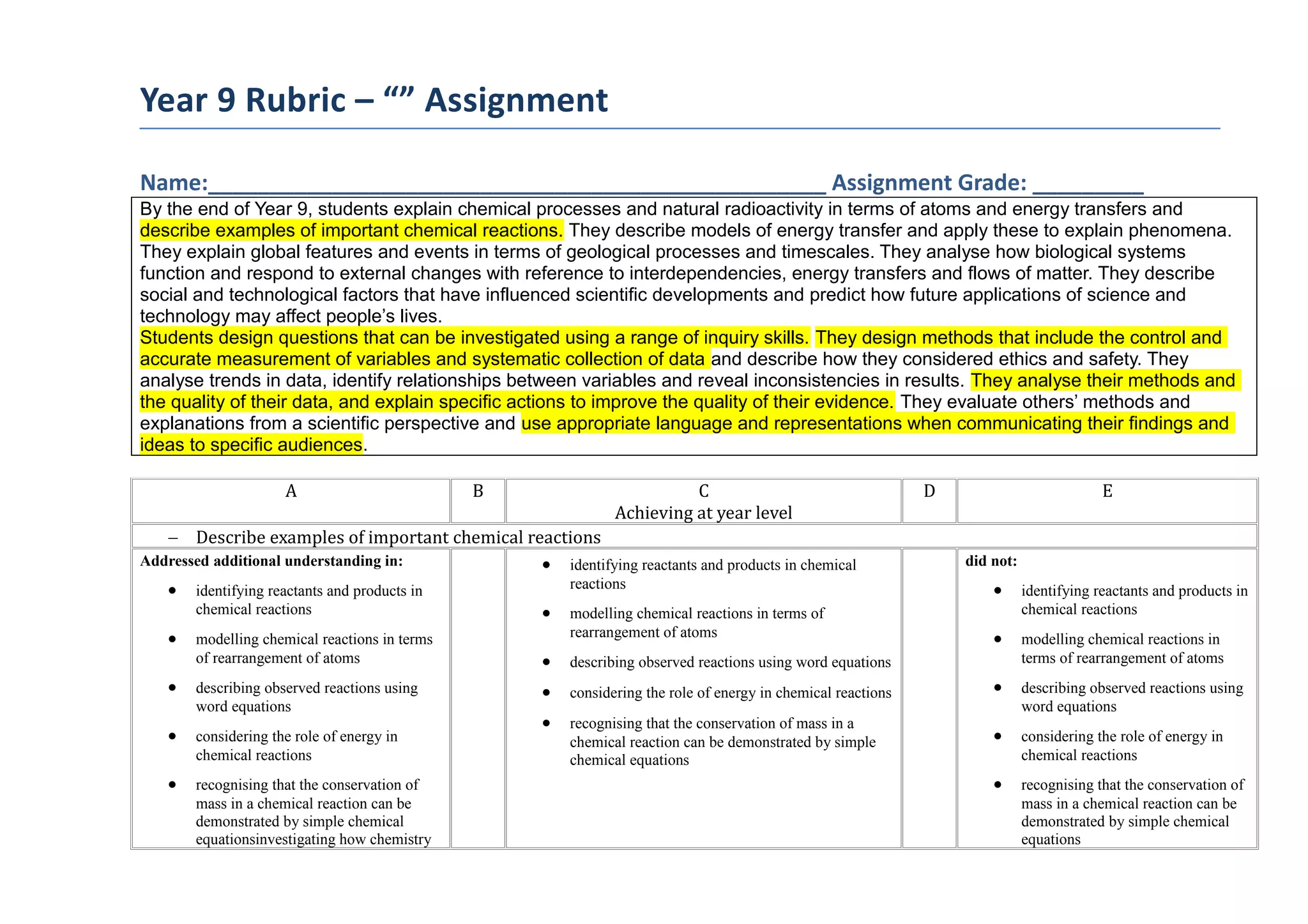
By the end of Year 9, students explain chemical processes and natural radioactivity in terms of atoms and energy transfers and
describe examples of important chemical reactions. They describe models of energy transfer and apply these to explain phenomena.
They explain global features and events in terms of geological processes and timescales. They analyse how biological systems
function and respond to external changes with reference to interdependencies, energy transfers and flows of matter. They describe
social and technological factors that have influenced scientific developments and predict how future applications of science and
technology may affect people’s lives.
Students design questions that can be investigated using a range of inquiry skills. They design methods that include the control and
accurate measurement of variables and systematic collection of data and describe how they considered ethics and safety. They
analyse trends in data, identify relationships between variables and reveal inconsistencies in results. They analyse their methods and
the quality of their data, and explain specific actions to improve the quality of their evidence. They evaluate others’ methods and
explanations from a scientific perspective and use appropriate language and representations when communicating their findings and
ideas to specific audiences.
A B C
Achieving at year level
D E
 Describe examples of important chemical reactions
Addressed additional understanding in:
 identifying reactants and products in
chemical reactions
 modelling chemical reactions in terms
of rearrangement of atoms
 describing observed reactions using
word equations
 considering the role of energy in
chemical reactions
 recognising that the conservation of
mass in a chemical reaction can be
demonstrated by simple chemical
equationsinvestigating how chemistry
 identifying reactants and products in chemical
reactions
 modelling chemical reactions in terms of
rearrangement of atoms
 describing observed reactions using word equations
 considering the role of energy in chemical reactions
 recognising that the conservation of mass in a
chemical reaction can be demonstrated by simple
chemical equations
did not:
 identifying reactants and products in
chemical reactions
 modelling chemical reactions in
terms of rearrangement of atoms
 describing observed reactions using
word equations
 considering the role of energy in
chemical reactions
 recognising that the conservation of
mass in a chemical reaction can be
demonstrated by simple chemical
equations
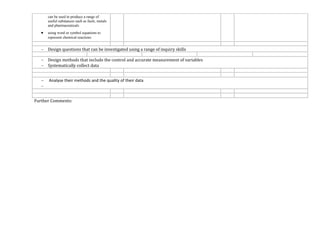
can be used to produce a range of
useful substances such as fuels, metals
and pharmaceuticals
 using word or symbol equations to
represent chemical reactions
 Design questions that can be investigated using a range of inquiry skills
 Design methods that include the control and accurate measurement of variables
 Systematically collect data
 Analyse their methods and the quality of their data

Further Comments:

Year 9 rubric eg

  • 1.
    Year 9 Rubric– “” Assignment Name:__________________________________________________ Assignment Grade: _________ By the end of Year 9, students explain chemical processes and natural radioactivity in terms of atoms and energy transfers and describe examples of important chemical reactions. They describe models of energy transfer and apply these to explain phenomena. They explain global features and events in terms of geological processes and timescales. They analyse how biological systems function and respond to external changes with reference to interdependencies, energy transfers and flows of matter. They describe social and technological factors that have influenced scientific developments and predict how future applications of science and technology may affect people’s lives. Students design questions that can be investigated using a range of inquiry skills. They design methods that include the control and accurate measurement of variables and systematic collection of data and describe how they considered ethics and safety. They analyse trends in data, identify relationships between variables and reveal inconsistencies in results. They analyse their methods and the quality of their data, and explain specific actions to improve the quality of their evidence. They evaluate others’ methods and explanations from a scientific perspective and use appropriate language and representations when communicating their findings and ideas to specific audiences. A B C Achieving at year level D E  Describe examples of important chemical reactions Addressed additional understanding in:  identifying reactants and products in chemical reactions  modelling chemical reactions in terms of rearrangement of atoms  describing observed reactions using word equations  considering the role of energy in chemical reactions  recognising that the conservation of mass in a chemical reaction can be demonstrated by simple chemical equationsinvestigating how chemistry  identifying reactants and products in chemical reactions  modelling chemical reactions in terms of rearrangement of atoms  describing observed reactions using word equations  considering the role of energy in chemical reactions  recognising that the conservation of mass in a chemical reaction can be demonstrated by simple chemical equations did not:  identifying reactants and products in chemical reactions  modelling chemical reactions in terms of rearrangement of atoms  describing observed reactions using word equations  considering the role of energy in chemical reactions  recognising that the conservation of mass in a chemical reaction can be demonstrated by simple chemical equations
  • 2.
    can be usedto produce a range of useful substances such as fuels, metals and pharmaceuticals  using word or symbol equations to represent chemical reactions  Design questions that can be investigated using a range of inquiry skills  Design methods that include the control and accurate measurement of variables  Systematically collect data  Analyse their methods and the quality of their data  Further Comments: