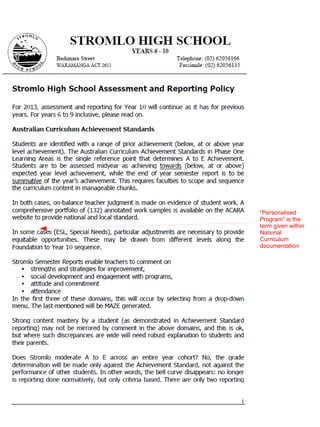
“Personalised
Program” is the
term given within
National
Curriculum
documentation
We cannot assign
percentages for a grade
that is determined
holistically.
Suggestion: We will
move away from a
model in which grades
are 'calculated' towards
a model in which grades
are pictures that form
from multiple pieces of
evidence.
Given that student grades
are assigned holistically
on basis of any evidence,
if students later show that
they can achieve the
outcomes of an
assessment task
(regardless of plagiarism)
we are required to
acknowledge it.
Suggestion: We need to
find other ways of
acknowledging student
effort than solely in their
grade.
We have no scope to
penalise students for
late work against the
achievement standard.
Suggestion: we must
find other ways of
acknowledging student
effort than solely in
their grade.
The department
supplied
documentation of new
grade descriptors for
National Curriculum
subjects.
A indicates that a
student has
demonstrated
excellent achievement
of what is expected.
B indicates that a student
has demonstrated high
achievement of what is
expected.
C indicates that a student
has demonstrated
satisfactory achievement
of what is expected.
D indicates that a student
has demonstrated partial
achievement of what is
expected.
E indicates that a student
has demonstrated limited
achievement of what is
expected.
They will receive 'P' on
their reports indicating that
student received a
Personalised Program
based around a modified
version of the Australian
Curriculum.
We no longer have
scope to award a
'Consideration' grade –
the student must be
assessed A-E holistically
based upon the evidence
obtained of their
achievement. We do
have scope to alter the
nature of that evidence.
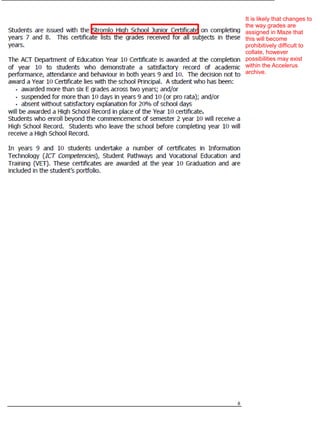
It is likely that changes to
the way grades are
assigned in Maze that
this will become
prohibitively difficult to
collate, however
possibilities may exist
within the Accelerus
archive.

Assessment policy annotated

  • 1.
    “Personalised Program” is the termgiven within National Curriculum documentation
  • 2.
    We cannot assign percentagesfor a grade that is determined holistically. Suggestion: We will move away from a model in which grades are 'calculated' towards a model in which grades are pictures that form from multiple pieces of evidence.
  • 3.
    Given that studentgrades are assigned holistically on basis of any evidence, if students later show that they can achieve the outcomes of an assessment task (regardless of plagiarism) we are required to acknowledge it. Suggestion: We need to find other ways of acknowledging student effort than solely in their grade.
  • 4.
    We have noscope to penalise students for late work against the achievement standard. Suggestion: we must find other ways of acknowledging student effort than solely in their grade. The department supplied documentation of new grade descriptors for National Curriculum subjects. A indicates that a student has demonstrated excellent achievement of what is expected.
  • 5.
    B indicates thata student has demonstrated high achievement of what is expected. C indicates that a student has demonstrated satisfactory achievement of what is expected. D indicates that a student has demonstrated partial achievement of what is expected. E indicates that a student has demonstrated limited achievement of what is expected. They will receive 'P' on their reports indicating that student received a Personalised Program based around a modified version of the Australian Curriculum. We no longer have scope to award a 'Consideration' grade – the student must be assessed A-E holistically based upon the evidence obtained of their achievement. We do have scope to alter the nature of that evidence.
  • 6.
    It is likelythat changes to the way grades are assigned in Maze that this will become prohibitively difficult to collate, however possibilities may exist within the Accelerus archive.