Year 9 Science
Term 3 2013
Ecosystem Case Study: Mud Creek
Due Date: Thursday the 17th of October, 2013
Teacher: Ms Lawrence
Length: 1 A4 page double sided (maximum)
Task Description
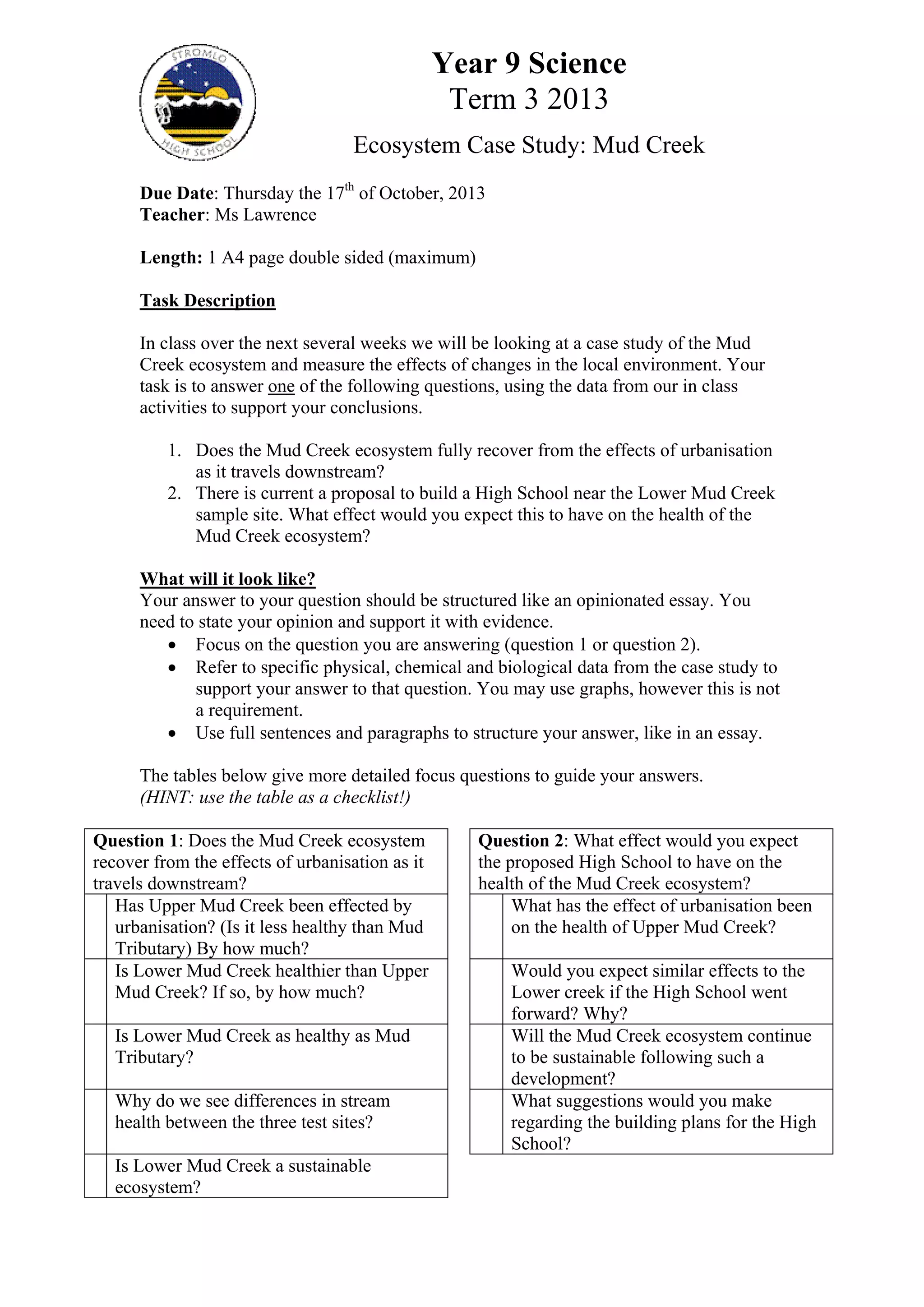
In class over the next several weeks we will be looking at a case study of the Mud
Creek ecosystem and measure the effects of changes in the local environment. Your
task is to answer one of the following questions, using the data from our in class
activities to support your conclusions.
1. Does the Mud Creek ecosystem fully recover from the effects of urbanisation
as it travels downstream?
2. There is current a proposal to build a High School near the Lower Mud Creek
sample site. What effect would you expect this to have on the health of the
Mud Creek ecosystem?
What will it look like?
Your answer to your question should be structured like an opinionated essay. You
need to state your opinion and support it with evidence.
 Focus on the question you are answering (question 1 or question 2).
 Refer to specific physical, chemical and biological data from the case study to
support your answer to that question. You may use graphs, however this is not
a requirement.
 Use full sentences and paragraphs to structure your answer, like in an essay.
The tables below give more detailed focus questions to guide your answers.
(HINT: use the table as a checklist!)
Question 1: Does the Mud Creek ecosystem
recover from the effects of urbanisation as it
travels downstream?
Has Upper Mud Creek been effected by
urbanisation? (Is it less healthy than Mud
Tributary) By how much?
Is Lower Mud Creek healthier than Upper
Mud Creek? If so, by how much?
Is Lower Mud Creek as healthy as Mud
Tributary?
Why do we see differences in stream
health between the three test sites?
Is Lower Mud Creek a sustainable
ecosystem?

Question 2: What effect would you expect
the proposed High School to have on the
health of the Mud Creek ecosystem?
What has the effect of urbanisation been
on the health of Upper Mud Creek?
Would you expect similar effects to the
Lower creek if the High School went
forward? Why?
Will the Mud Creek ecosystem continue
to be sustainable following such a
development?
What suggestions would you make
regarding the building plans for the High
School?
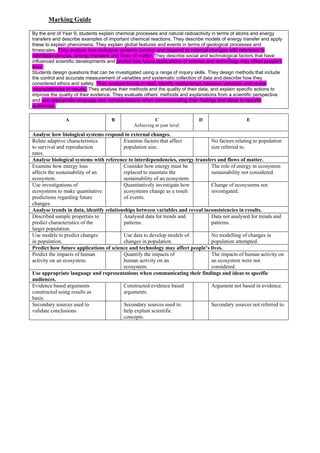
Marking Guide
By the end of Year 9, students explain chemical processes and natural radioactivity in terms of atoms and energy
transfers and describe examples of important chemical reactions. They describe models of energy transfer and apply
these to explain phenomena. They explain global features and events in terms of geological processes and
timescales. They analyse how biological systems function and respond to external changes with reference to
interdependencies, energy transfers and flows of matter. They describe social and technological factors that have
influenced scientific developments and predict how future applications of science and technology may affect people’s
lives.
Students design questions that can be investigated using a range of inquiry skills. They design methods that include
the control and accurate measurement of variables and systematic collection of data and describe how they
considered ethics and safety. They analyse trends in data, identify relationships between variables and reveal
inconsistencies in results. They analyse their methods and the quality of their data, and explain specific actions to
improve the quality of their evidence. They evaluate others’ methods and explanations from a scientific perspective
and use appropriate language and representations when communicating their findings and ideas to specific
audiences.
A

B

C
Achieving at year level.

D

E

Analyse how biological systems respond to external changes.
Relate adaptive characteristics
Examine factors that affect
No factors relating to population
to survival and reproduction
population size.
size referred to.
rates.
Analyse biological systems with reference to interdependencies, energy transfers and flows of matter.
Examine how energy loss
Consider how energy must be
The role of energy in ecosystem
affects the sustainability of an
replaced to maintain the
sustainability not considered.
ecosystem.
sustainability of an ecosystem.
Use investigations of
Quantitatively investigate how
Change of ecosystems not
ecosystems to make quantitative
ecosystems change as a result
investigated.
predictions regarding future
of events.
changes.
Analyse trends in data, identify relationships between variables and reveal inconsistencies in results.
Described sample properties to
Analysed data for trends and
Data not analysed for trends and
predict characteristics of the
patterns.
patterns.
larger population.
Use models to predict changes
Use data to develop models of
No modelling of changes in
in population.
changes in population.
population attempted.
Predict how future applications of science and technology may affect people’s lives.
Predict the impacts of human
Quantify the impacts of
The impacts of human activity on
activity on an ecosystem.
human activity on an
an ecosystem were not
ecosystem.
considered.
Use appropriate language and representations when communicating their findings and ideas to specific
audiences.
Evidence based arguments
Constructed evidence based
Argument not based in evidence.
constructed using results as
arguments.
basis.
Secondary sources used to
Secondary sources not referred to.
validate conclusions.
help explain scientific
concepts.

Assignment ecosystem case study

  • 1.
    Year 9 Science Term3 2013 Ecosystem Case Study: Mud Creek Due Date: Thursday the 17th of October, 2013 Teacher: Ms Lawrence Length: 1 A4 page double sided (maximum) Task Description In class over the next several weeks we will be looking at a case study of the Mud Creek ecosystem and measure the effects of changes in the local environment. Your task is to answer one of the following questions, using the data from our in class activities to support your conclusions. 1. Does the Mud Creek ecosystem fully recover from the effects of urbanisation as it travels downstream? 2. There is current a proposal to build a High School near the Lower Mud Creek sample site. What effect would you expect this to have on the health of the Mud Creek ecosystem? What will it look like? Your answer to your question should be structured like an opinionated essay. You need to state your opinion and support it with evidence.  Focus on the question you are answering (question 1 or question 2).  Refer to specific physical, chemical and biological data from the case study to support your answer to that question. You may use graphs, however this is not a requirement.  Use full sentences and paragraphs to structure your answer, like in an essay. The tables below give more detailed focus questions to guide your answers. (HINT: use the table as a checklist!) Question 1: Does the Mud Creek ecosystem recover from the effects of urbanisation as it travels downstream? Has Upper Mud Creek been effected by urbanisation? (Is it less healthy than Mud Tributary) By how much? Is Lower Mud Creek healthier than Upper Mud Creek? If so, by how much? Is Lower Mud Creek as healthy as Mud Tributary? Why do we see differences in stream health between the three test sites? Is Lower Mud Creek a sustainable ecosystem? Question 2: What effect would you expect the proposed High School to have on the health of the Mud Creek ecosystem? What has the effect of urbanisation been on the health of Upper Mud Creek? Would you expect similar effects to the Lower creek if the High School went forward? Why? Will the Mud Creek ecosystem continue to be sustainable following such a development? What suggestions would you make regarding the building plans for the High School?
  • 2.
    Marking Guide By theend of Year 9, students explain chemical processes and natural radioactivity in terms of atoms and energy transfers and describe examples of important chemical reactions. They describe models of energy transfer and apply these to explain phenomena. They explain global features and events in terms of geological processes and timescales. They analyse how biological systems function and respond to external changes with reference to interdependencies, energy transfers and flows of matter. They describe social and technological factors that have influenced scientific developments and predict how future applications of science and technology may affect people’s lives. Students design questions that can be investigated using a range of inquiry skills. They design methods that include the control and accurate measurement of variables and systematic collection of data and describe how they considered ethics and safety. They analyse trends in data, identify relationships between variables and reveal inconsistencies in results. They analyse their methods and the quality of their data, and explain specific actions to improve the quality of their evidence. They evaluate others’ methods and explanations from a scientific perspective and use appropriate language and representations when communicating their findings and ideas to specific audiences. A B C Achieving at year level. D E Analyse how biological systems respond to external changes. Relate adaptive characteristics Examine factors that affect No factors relating to population to survival and reproduction population size. size referred to. rates. Analyse biological systems with reference to interdependencies, energy transfers and flows of matter. Examine how energy loss Consider how energy must be The role of energy in ecosystem affects the sustainability of an replaced to maintain the sustainability not considered. ecosystem. sustainability of an ecosystem. Use investigations of Quantitatively investigate how Change of ecosystems not ecosystems to make quantitative ecosystems change as a result investigated. predictions regarding future of events. changes. Analyse trends in data, identify relationships between variables and reveal inconsistencies in results. Described sample properties to Analysed data for trends and Data not analysed for trends and predict characteristics of the patterns. patterns. larger population. Use models to predict changes Use data to develop models of No modelling of changes in in population. changes in population. population attempted. Predict how future applications of science and technology may affect people’s lives. Predict the impacts of human Quantify the impacts of The impacts of human activity on activity on an ecosystem. human activity on an an ecosystem were not ecosystem. considered. Use appropriate language and representations when communicating their findings and ideas to specific audiences. Evidence based arguments Constructed evidence based Argument not based in evidence. constructed using results as arguments. basis. Secondary sources used to Secondary sources used to Secondary sources not referred to. validate conclusions. help explain scientific concepts.