Updated 24/10/04
Trigonometric and hyberbolic functions & the spiral concatenation unfolding
operator - , by Yaron Dayan
Abstract
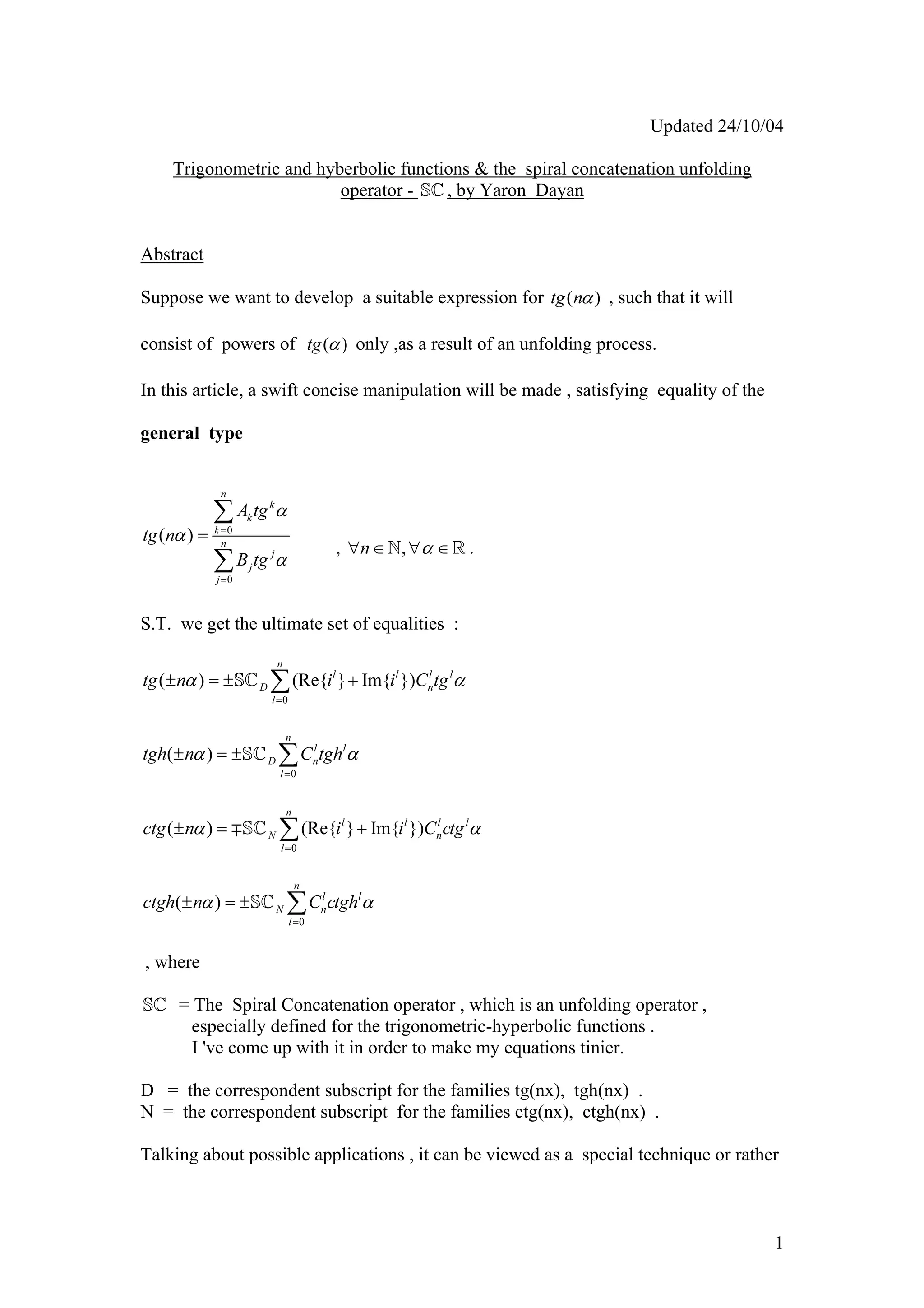
Suppose we want to develop a suitable expression for ( )tg n , such that it will
consist of powers of ( )tg only ,as a result of an unfolding process.
In this article, a swift concise manipulation will be made , satisfying equality of the
general type
0
0
( )
n
k
k
k
n
j
j
j
A tg
tg n
B tg
, ,n .
S.T. we get the ultimate set of equalities :
0
( ) (Re{ } Im{ })
n
l l l
D n
l
tg n i i C tgl
0
( )
n
l l
D n
l
tgh n C tgh
0
( ) (Re{ } Im{ })
n
l l l
N n
l
ctg n i i C ctgl
0
( )
n
l l
N n
l
ctgh n C ctgh
, where
= The Spiral Concatenation operator , which is an unfolding operator ,
especially defined for the trigonometric-hyperbolic functions .
I 've come up with it in order to make my equations tinier.
D = the correspondent subscript for the families tg(nx), tgh(nx) .
N = the correspondent subscript for the families ctg(nx), ctgh(nx) .
Talking about possible applications , it can be viewed as a special technique or rather
1
mnemonics , of developing the equation above. It may also offer a simpler
way of calculating integrals (if we’re given the right hand of the equation with few
modifications … ) .
Shortening the running time of the tg(nx) computer evaluation, raises here an
interesting point to make . We should compare it to the well known recursion
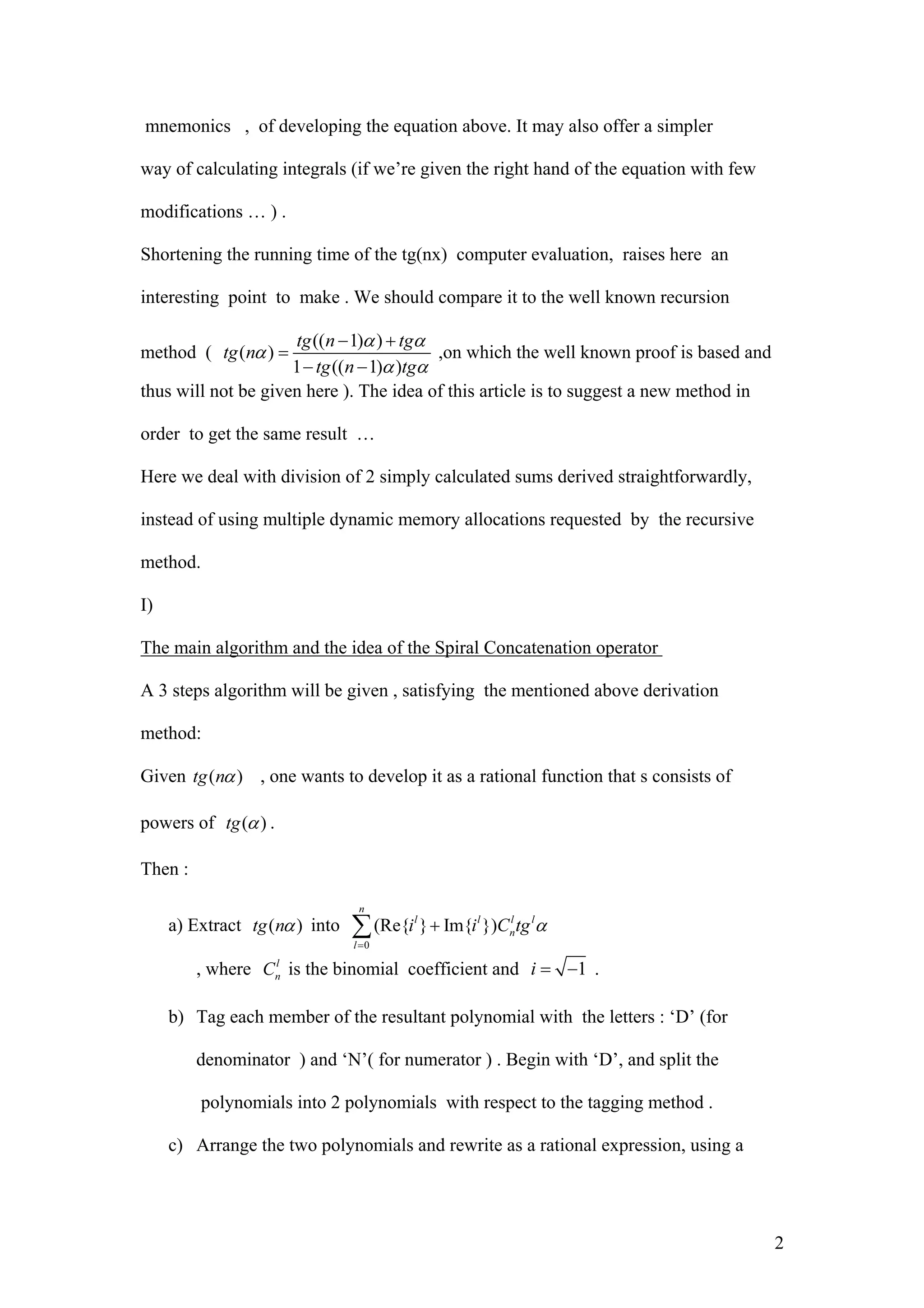
method (
(( 1) )
( )
1 (( 1) )
tg n tg
tg n
tg n tg
,on which the well known proof is based and
thus will not be given here ). The idea of this article is to suggest a new method in
order to get the same result …
Here we deal with division of 2 simply calculated sums derived straightforwardly,
instead of using multiple dynamic memory allocations requested by the recursive
method.
I)
The main algorithm and the idea of the Spiral Concatenation operator
A 3 steps algorithm will be given , satisfying the mentioned above derivation
method:
Given ( )tg n , one wants to develop it as a rational function that s consists of
powers of ( )tg .
Then :
a) Extract ( )tg n into
0
(Re{ } Im{ })
n
l l l
n
l
i i C tgl
, where is the binomial coefficient andl
nC 1i .
b) Tag each member of the resultant polynomial with the letters : ‘D’ (for
denominator ) and ‘N’( for numerator ) . Begin with ‘D’, and split the
polynomials into 2 polynomials with respect to the tagging method .
c) Arrange the two polynomials and rewrite as a rational expression, using a
2
‘spiral’ concatenation .
II) The same idea can be implemented on functions like ( ), ( ), ( )ctg n tgh n ctgh n
As for (ctg n ) , changes will be made in phases a,b ,as below:
Phase a: Extract (ctg n ) into
0
(Re{ } Im{ })
n
l l l
n
l
i i C ctgl
Phase b: Begin taggin the expressions with N instead of D .
III) If we deal with hyberbolic funcion like (tgh n ) , then summing the real and
imaginary part of { (in phase a) is needless .}l
i
The tagging method is similar to the one used for ( )tg n .
IV) For hyberbolic functions like ( )ctgh n , the same idea of III is used.
The tagging method is similar to the one used for ( )ctg n .
Examples
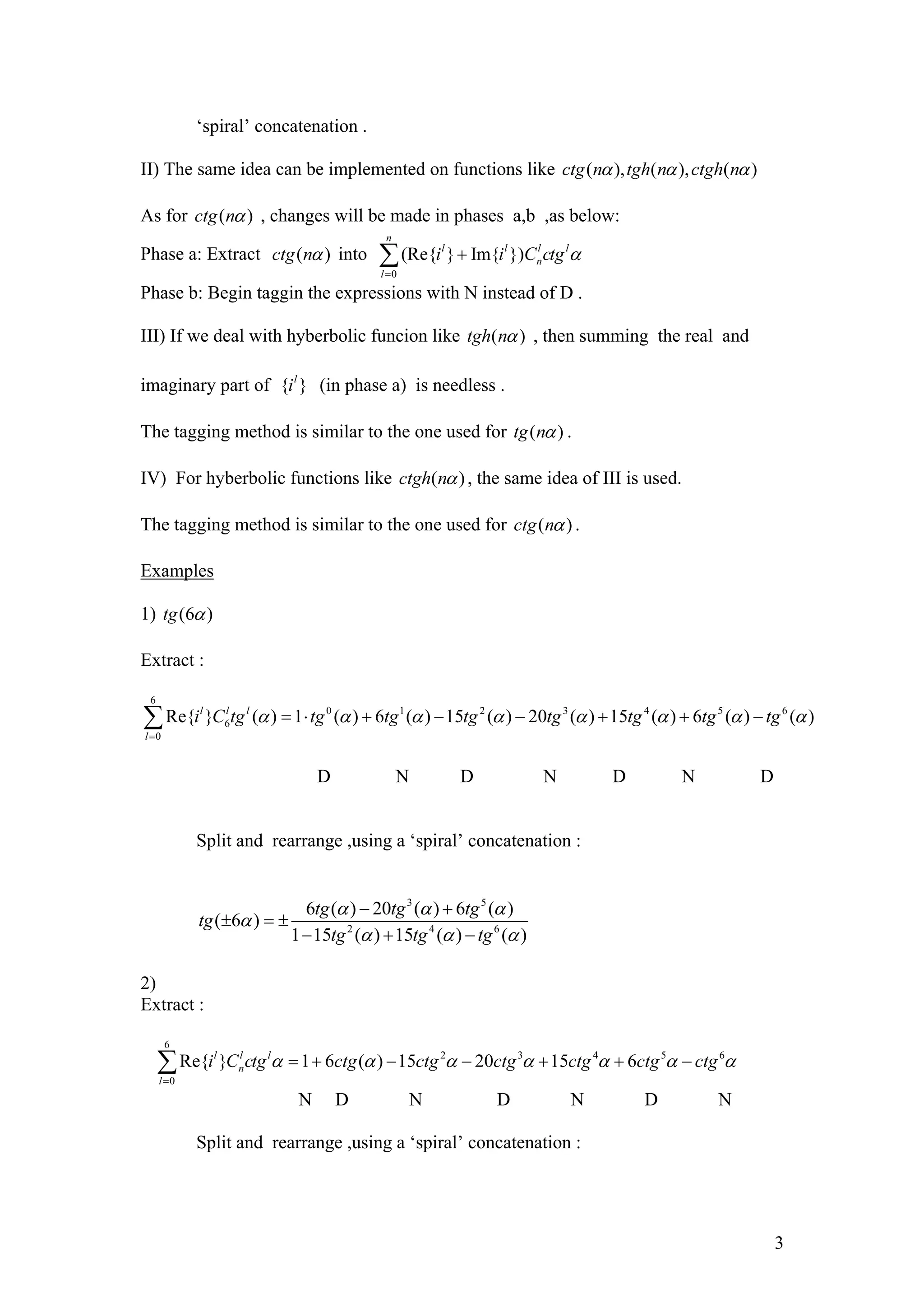
1) (6 )tg
Extract :
6
0 1 2 3 4 5 6
6
0
Re{ } ( ) 1 ( ) 6 ( ) 15 ( ) 20 ( ) 15 ( ) 6 ( ) ( )l l l
l
i C tg tg tg tg tg tg tg tg
D N D N D N D
Split and rearrange ,using a ‘spiral’ concatenation :
3 5
2 4 6
6 ( ) 20 ( ) 6 ( )
( 6 )
1 15 ( ) 15 ( ) ( )
tg tg tg
tg
tg tg tg
2)
Extract :
6
2 3 4 5
0
Re{ } 1 6 ( ) 15 20 15 6l l l
n
l
i C ctg ctg ctg ctg ctg ctg ctg6
N D N D N D N
Split and rearrange ,using a ‘spiral’ concatenation :
3
2 4
3 5
1 15 15
( 6 )
6 ( ) 20 6
ctg ctg ctg
ctg
ctg ctg ctg
6
3) (5 )tgh
Extract :
5
1 2 3 4
0
1 5 10 10 5l l
n
l
C tgh tgh tgh tgh tgh tgh5
D N D N D N
Split and rearrange ,using a ‘spiral’ concatenation :
1 3
2 4
5 10
(5 )
1 10 5
tgh tgh tgh
tgh
tgh tgh
5
4) (5 )ctgh
Extract:
5
1 2 3 4
0
1 5 10 10 5l l
n
l
C ctgh ctgh ctgh ctgh ctgh ctgh5
N D N D N D
Split and rearrange ,using a ‘spiral’ concatenation :
2 4
1 3
1 10 5
(5 )
5 10
ctgh ctgh
ctgh
ctgh ctgh ctgh5
Written by
Yaron Dayan ,
4
Bsc. ECE student , BGU , Beer Sheva , Israel
Mail : yaronday@ee.bgu.ac.il
Mobile : 052 4736143
*You're strongly encouraged to submit your comments

yaron_eurika_

  • 1.
    Updated 24/10/04 Trigonometric andhyberbolic functions & the spiral concatenation unfolding operator - , by Yaron Dayan Abstract Suppose we want to develop a suitable expression for ( )tg n , such that it will consist of powers of ( )tg only ,as a result of an unfolding process. In this article, a swift concise manipulation will be made , satisfying equality of the general type 0 0 ( ) n k k k n j j j A tg tg n B tg , ,n . S.T. we get the ultimate set of equalities : 0 ( ) (Re{ } Im{ }) n l l l D n l tg n i i C tgl 0 ( ) n l l D n l tgh n C tgh 0 ( ) (Re{ } Im{ }) n l l l N n l ctg n i i C ctgl 0 ( ) n l l N n l ctgh n C ctgh , where = The Spiral Concatenation operator , which is an unfolding operator , especially defined for the trigonometric-hyperbolic functions . I 've come up with it in order to make my equations tinier. D = the correspondent subscript for the families tg(nx), tgh(nx) . N = the correspondent subscript for the families ctg(nx), ctgh(nx) . Talking about possible applications , it can be viewed as a special technique or rather 1
  • 2.
    mnemonics , ofdeveloping the equation above. It may also offer a simpler way of calculating integrals (if we’re given the right hand of the equation with few modifications … ) . Shortening the running time of the tg(nx) computer evaluation, raises here an interesting point to make . We should compare it to the well known recursion method ( (( 1) ) ( ) 1 (( 1) ) tg n tg tg n tg n tg ,on which the well known proof is based and thus will not be given here ). The idea of this article is to suggest a new method in order to get the same result … Here we deal with division of 2 simply calculated sums derived straightforwardly, instead of using multiple dynamic memory allocations requested by the recursive method. I) The main algorithm and the idea of the Spiral Concatenation operator A 3 steps algorithm will be given , satisfying the mentioned above derivation method: Given ( )tg n , one wants to develop it as a rational function that s consists of powers of ( )tg . Then : a) Extract ( )tg n into 0 (Re{ } Im{ }) n l l l n l i i C tgl , where is the binomial coefficient andl nC 1i . b) Tag each member of the resultant polynomial with the letters : ‘D’ (for denominator ) and ‘N’( for numerator ) . Begin with ‘D’, and split the polynomials into 2 polynomials with respect to the tagging method . c) Arrange the two polynomials and rewrite as a rational expression, using a 2
  • 3.
    ‘spiral’ concatenation . II)The same idea can be implemented on functions like ( ), ( ), ( )ctg n tgh n ctgh n As for (ctg n ) , changes will be made in phases a,b ,as below: Phase a: Extract (ctg n ) into 0 (Re{ } Im{ }) n l l l n l i i C ctgl Phase b: Begin taggin the expressions with N instead of D . III) If we deal with hyberbolic funcion like (tgh n ) , then summing the real and imaginary part of { (in phase a) is needless .}l i The tagging method is similar to the one used for ( )tg n . IV) For hyberbolic functions like ( )ctgh n , the same idea of III is used. The tagging method is similar to the one used for ( )ctg n . Examples 1) (6 )tg Extract : 6 0 1 2 3 4 5 6 6 0 Re{ } ( ) 1 ( ) 6 ( ) 15 ( ) 20 ( ) 15 ( ) 6 ( ) ( )l l l l i C tg tg tg tg tg tg tg tg D N D N D N D Split and rearrange ,using a ‘spiral’ concatenation : 3 5 2 4 6 6 ( ) 20 ( ) 6 ( ) ( 6 ) 1 15 ( ) 15 ( ) ( ) tg tg tg tg tg tg tg 2) Extract : 6 2 3 4 5 0 Re{ } 1 6 ( ) 15 20 15 6l l l n l i C ctg ctg ctg ctg ctg ctg ctg6 N D N D N D N Split and rearrange ,using a ‘spiral’ concatenation : 3
  • 4.
    2 4 3 5 115 15 ( 6 ) 6 ( ) 20 6 ctg ctg ctg ctg ctg ctg ctg 6 3) (5 )tgh Extract : 5 1 2 3 4 0 1 5 10 10 5l l n l C tgh tgh tgh tgh tgh tgh5 D N D N D N Split and rearrange ,using a ‘spiral’ concatenation : 1 3 2 4 5 10 (5 ) 1 10 5 tgh tgh tgh tgh tgh tgh 5 4) (5 )ctgh Extract: 5 1 2 3 4 0 1 5 10 10 5l l n l C ctgh ctgh ctgh ctgh ctgh ctgh5 N D N D N D Split and rearrange ,using a ‘spiral’ concatenation : 2 4 1 3 1 10 5 (5 ) 5 10 ctgh ctgh ctgh ctgh ctgh ctgh5 Written by Yaron Dayan , 4
  • 5.
    Bsc. ECE student, BGU , Beer Sheva , Israel Mail : yaronday@ee.bgu.ac.il Mobile : 052 4736143 *You're strongly encouraged to submit your comments