TRAVELING SEEDS 
Grade Level: Grade 3 
Description 
In this activity students will learn that plants disperse their seeds away from the parent plants in In 
this activity students will learn that plants disperse their seeds away from the parent plants in different 
ways. They will observe some of the mechanisms that are used to disperse seeds and observe how the 
seeds travels. Students will then develop a new strategy for seed dispersal and test their method of 
release and travel. 
Guiding Question 
What are some of the different adaptation strategies that plants have developed to help them move 
their seeds away from the parent plant to a new location where the seeds will have a better chance to 
grow without competition. 
Big Idea 
Seeds stand a better chance of growing if they do not have to compete with the parent plant for light, 
water and nutrients. Since plants do not move, fruits and seeds have developed unique structures to 
help them move to a new place where there is less competition and the growing conditions are more 
favorable for growth and survival. The main way seeds are dispersed are by wind, by hitchhiking a 
ride on a passing animal, by floating in water, by being eaten by an animal and then moved through the 
animal’s gut or by being moved by an animal or insect for other purposes. A few seeds can even move 
themselves. Within these strategies there is a huge number of adaptations to increase the success of 
the seed’s dispersal. 
Learning Objectives 
To understand that plants have developed a number of strategies to help them move their seeds away 
from the parent plant to a location where they can grown without competition. 
Materials 
* Examples of fruits and seeds that exhibit a variety of different seed dispersal mechanism, including 
wind blown, helicopters, hitchhikers, salt shakers, exploders, water floaters, edible fruits and nuts. 
* Variety of seeds such as nasturtiums, marigolds, beans, peas, corn 
* Paper bags and scissors for collecting seeds in the school yard 
* Old wool socks or mittens 
* Various Materials for building a new dispersal method including, paper, tissue paper, crepe paper, 
feathers, cotton, wool, yarn, string, toothpicks, rubber bands, springs, pipe cleaners, glue, tape, 
paperclips, etc., etc. 
* 6 inch pots, buckets or large bowls 
Lesson supported by a Specialty Crops Grant from the Massachusetts 
Department of Agricultural Resources
Preparation 
Gather together examples of various seed dispersal mechanism and fasten them to posters. You can 
also use the photo images included in this lesson. Bring in additional seed examples for students to 
observe. 
Assemble a large number of materials that students can use to construct their new seed strategies. 
Introducing the Lesson 
Activate prior knowledge: Ask students what would happen if all the seeds that a plant produces 
fell on the ground around the plant. What would it look like next year, when all the seeds grew up 
underneath the mother plant. Would there be enough water, light, and nutrients. 
Tell them plants are unable to move on their own. Yet their seed have developed wonderful ways to 
move away from the parent plant so they will have a better chance of survival. 
Ask them to think of ways that these seeds might travel. Have they ever seen a seed travel. On the 
wind; on their socks or dogs fur; on water; by a bird or animal? 
What might be some hazards of this as a means of transportation? Where might some of these seeds 
be planted? 
Discuss how seeds are formed: As the ovules in the ovary of the flower develop into seeds, the ovary 
swells and becomes fleshy or hardens to protect the developing seeds. The part of the plant containing 
the seeds is called the fruit. In addition to protecting the seeds, many fruits are designed to help seeds 
ultimately disperse, as described below. 
Fruits take many forms. The two general categories used to categorize fruits are fleshy and dry. 
Fleshy fruits include apples and berries. They usually have sweet, fleshy ovaries surrounding the 
seeds They are enticing for birds and animals who, in turn, scatter seeds away from the parent plant. 
Dry fruits. The ovaries of dry fruits also contain the seeds, but the ovary walls are thin and dry, rather 
than fleshy. Some dry fruits like pods spilt open, letting the seeds drop out. Some dry fruits have 
fluffy or feathery parts on the outer coat, which help the fruit float on the wind. Other dry fruits, like 
those of the maple tree, consist of stiff, wing-like parts that allow the fruit to twist or flutter to the 
ground. 
Engage Student Interest: Tell students that they are going to be seed scientists and study some of 
the ways that seeds travel away from their parent plant to a more favorable location for growing. As 
they study different seed adaptations, each team will develop a new technique that a seed might use for 
traveling. Then we will set up an experiment to test the success of each method. 
Procedure Total Time: two class sessions of forty-five minutes to an hour 
Lesson supported by a Specialty Crops Grant from the Massachusetts 
Department of Agricultural Resources.
Part 1 
In the Garden: 
If a garden or outdoor space is available take the students outside to explore and seek out seeds and 
fruits. If no space is available, collect a variety of fruits and seeds and bring them to the class. 
1. Ask the group to explore the garden or schoolyard to look for fruits and seeds. Observe where the 
seeds are located on the plant. What methods might they be using to travel? Find dandelions, asters 
or other wind-blown seeds and ask students to disperse them by blowing on them, throwing the fluff 
in the air, etc. How far to they travel? Use mittens or old wool socks to gather hitchhikers. Bring 
along paper bags and scissors to collect different fruits and seeds to bring back into the classroom. (20 
minutes) 
In the Classroom: 
1. Introduce each method of seed travel included in this lesson: Parachutes, helicopters, grasses, 
hitchhikers, water floaters, exploding pods, salt shakers and fruits and seeds that would be attractive 
to birds and animals. Bring in samples of each method or use pictures to show each strategy. Let the 
students explore the plants and pictures to understand how the seeds might move. What questions to 
they have about each. (20 minutes) 
2. Divide the class into small groups and give each group a number of the seeds and fruits collected 
from the garden or schoolyard, or that you brought in for them. Ask each group to predict the method 
of travel these seeds might have used. Invite the groups to show their seeds and then demonstrate how 
the seeds might travel. (10 Minutes 
Part 2: 
In the Classroom 
1. Divide the class into small groups. Review seed dispersal strategies. Challenge each team to 
invent a strategy for seed dispersal. The seed might float on wind, explode, hitchhike, be thrown 
from the plant, float, be eaten by a bird or animal, or some other mechanism that they develop. (10 
Minutes) 
2. Supply students with the a variety of miscellaneous materials to help them create the new seed 
dispersal. These materials should be used to modify seeds. Provide a number of different seeds for 
them to use. Let them know that they will have a half hour to build their seed dispersal mechanism. 
Suggest that each team draw their separate design and then the group should decide on one strategy to 
build. (25 minutes) 
3. Ask teams to develop and write a story for how their seed will travel (10 minutes). 
Lesson supported by a Specialty Crops Grant from the Massachusetts 
Department of Agricultural Resources.
Wrap Up 
Ask each group to demonstrate their seed dispersal mechanisms by launching it towards a six inch pot. 
Give each team three try to reach the pot. Offer teams a chance to modify their design to improve 
success. (15 minutes) 
Assessing Student Knowledge: 
Ask students to identify one plant that travels by each of the following methods: wind blown, 
helicopters, hitchkikers, salt shakers, exploders, water floaters, fruits, nuts. Invite students to act out 
each seed dispersal mechanism. 
Extensions 
Research how the seeds of different fruits are naturally dispersed. 
Write creative travel stories from the perspective of a seed that has left its parent with the help of a 
natural force. 
Find pictures to compare seeds to human made objects, e.g. maple seeds and helicopters; burdock and 
velcro. 
* MA Department of Education Standards in this lesson * 
Life Cycles 
Standard 3. Recognize that plants and animals go though life cycles. 
Standard 9. Recognize plant behaviors 
Books and Resources 
Massachusetts Agriculture in the Classroom Newsletter on Seeds 
http://aginclassroom.org/Newsletter/spring2006.html 
A Handful of Seeds: Seed Saving and Seed Study for Educators 
Lessons linked to California Educational Standards Practical Information on Seed Saving for School 
Gardens History and Lore. On the web at: www.oaec.org/school-garden/handful-of- ?seeds 
Botany for All Ages: Discovering Nature Through Activities for Children and Adults by Jorie 
Hunken and the New England Wildflower Society (The Globe Pequot Press) 1994. 
Hands-On Nature: Information and Activities for Exploring the Environment with Children edited 
by Jenepher Lingelbach 1986. 
Grow Lab Activities for Growing Minds from the National Gardening Association, 1990. 
Please visit the Massachusetts Agriculture in the Classroom website at www.aginclassroom.org 
to tell us how you used this Seeds Garden-Based Lesson 
Lesson supported by a Specialty Crops Grant from the Massachusetts 
Department of Agricultural Resources.
Seed Dispersal Strategies 
Wind Blown Seeds 
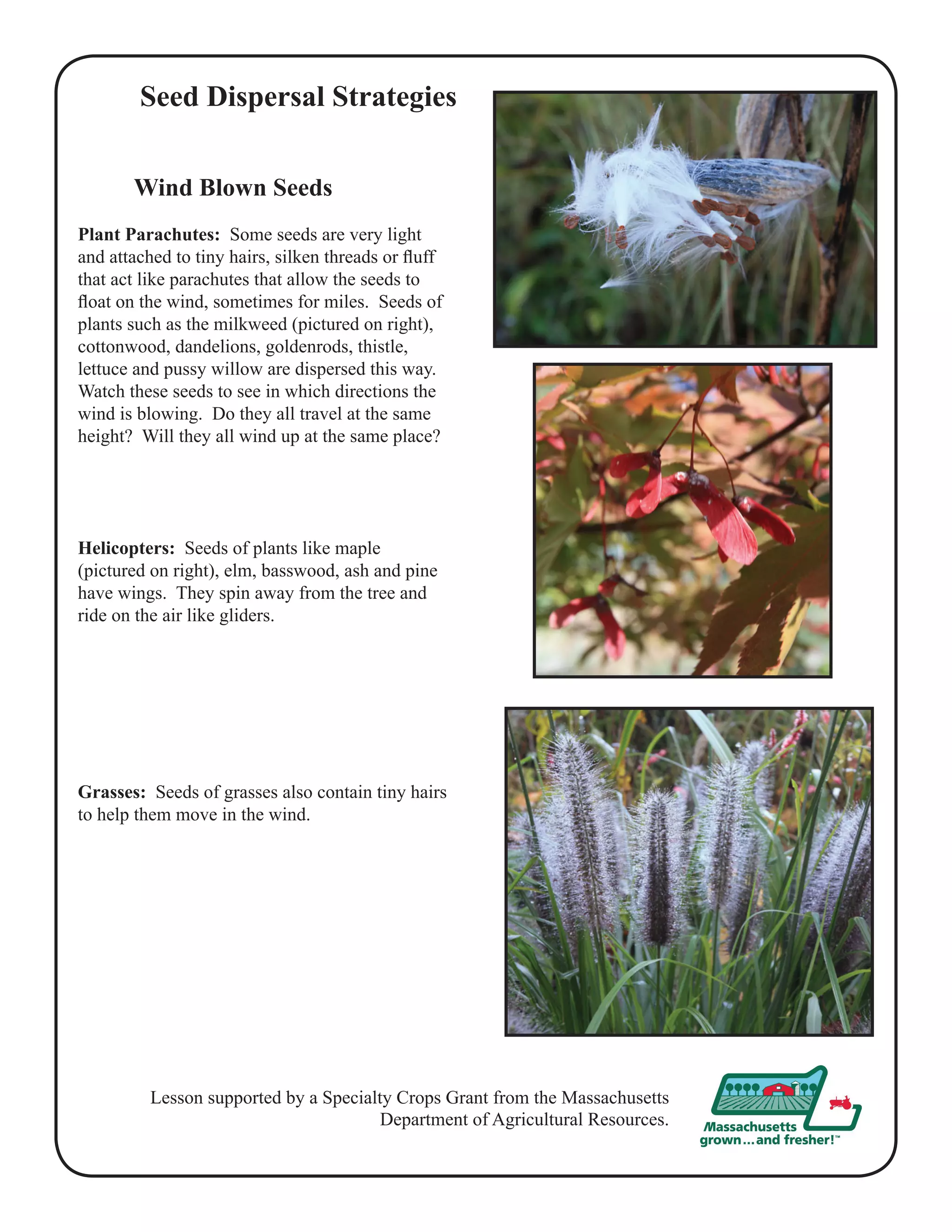
Plant Parachutes: Some seeds are very light 
and attached to tiny hairs, silken threads or fluff 
that act like parachutes that allow the seeds to 
float on the wind, sometimes for miles. Seeds of 
plants such as the milkweed (pictured on right), 
cottonwood, dandelions, goldenrods, thistle, 
lettuce and pussy willow are dispersed this way. 
Watch these seeds to see in which directions the 
wind is blowing. Do they all travel at the same 
height? Will they all wind up at the same place? 
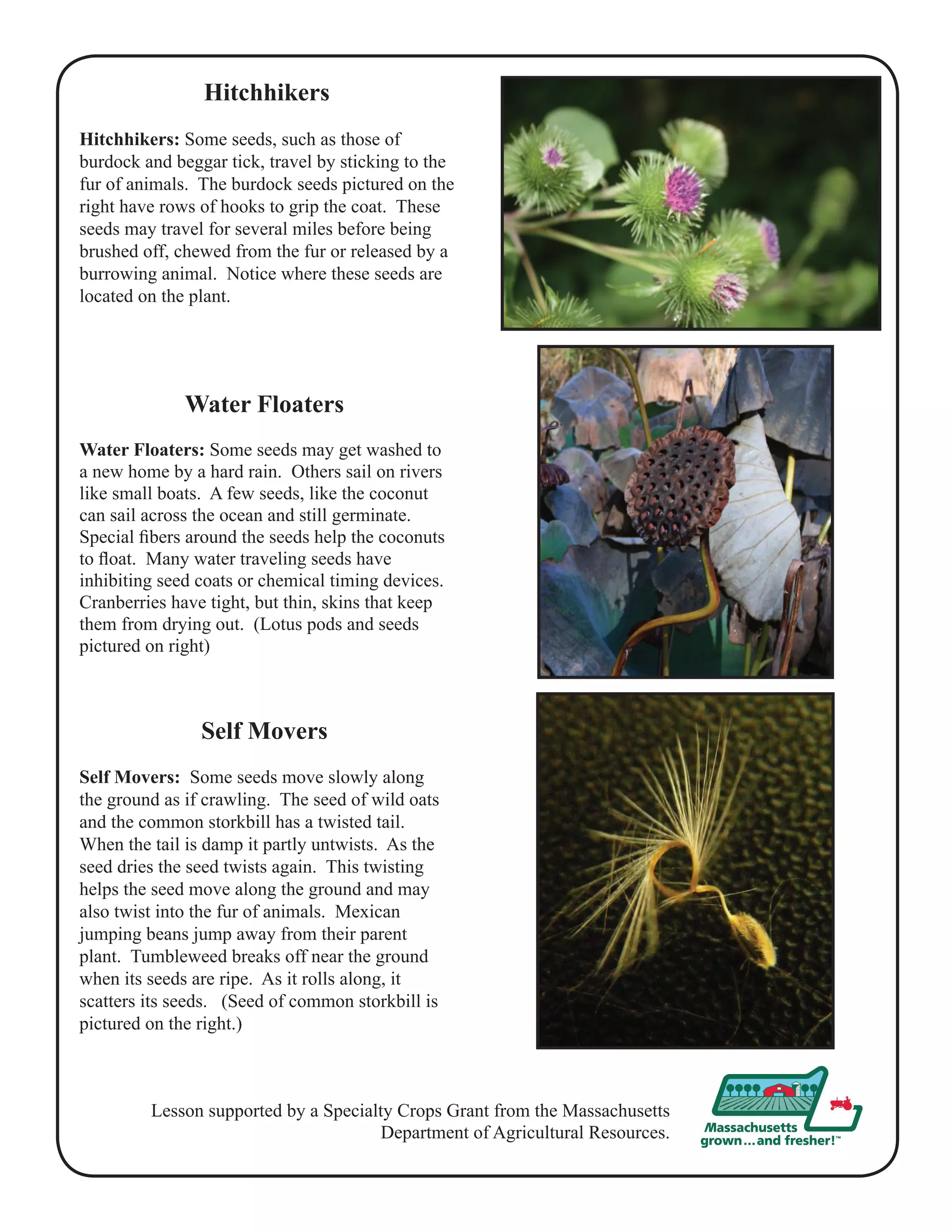
Helicopters: Seeds of plants like maple 
(pictured on right), elm, basswood, ash and pine 
have wings. They spin away from the tree and 
ride on the air like gliders. 
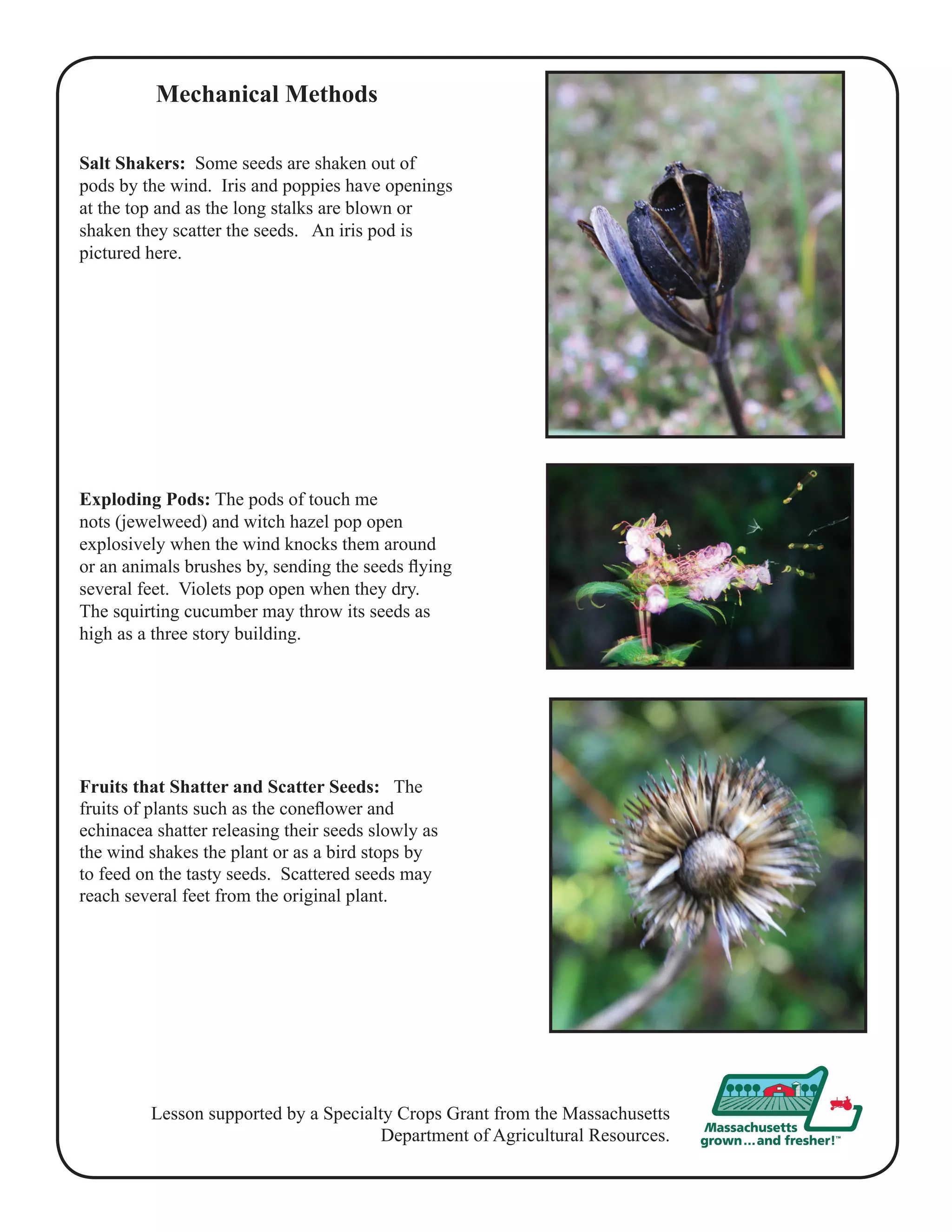
Grasses: Seeds of grasses also contain tiny hairs 
to help them move in the wind. 
Lesson supported by a Specialty Crops Grant from the Massachusetts 
Department of Agricultural Resources.
Hitchhikers 
Hitchhikers: Some seeds, such as those of 
burdock and beggar tick, travel by sticking to the 
fur of animals. The burdock seeds pictured on the 
right have rows of hooks to grip the coat. These 
seeds may travel for several miles before being 
brushed off, chewed from the fur or released by a 
burrowing animal. Notice where these seeds are 
located on the plant. 
Water Floaters 
Water Floaters: Some seeds may get washed to 
a new home by a hard rain. Others sail on rivers 
like small boats. A few seeds, like the coconut 
can sail across the ocean and still germinate. 
Special fibers around the seeds help the coconuts 
to float. Many water traveling seeds have 
inhibiting seed coats or chemical timing devices. 
Cranberries have tight, but thin, skins that keep 
them from drying out. (Lotus pods and seeds 
pictured on right) 
Self Movers 
Self Movers: Some seeds move slowly along 
the ground as if crawling. The seed of wild oats 
and the common storkbill has a twisted tail. 
When the tail is damp it partly untwists. As the 
seed dries the seed twists again. This twisting 
helps the seed move along the ground and may 
also twist into the fur of animals. Mexican 
jumping beans jump away from their parent 
plant. Tumbleweed breaks off near the ground 
when its seeds are ripe. As it rolls along, it 
scatters its seeds. (Seed of common storkbill is 
pictured on the right.) 
Lesson supported by a Specialty Crops Grant from the Massachusetts 
Department of Agricultural Resources.
Mechanical Methods 
Salt Shakers: Some seeds are shaken out of 
pods by the wind. Iris and poppies have openings 
at the top and as the long stalks are blown or 
shaken they scatter the seeds. An iris pod is 
pictured here. 
Exploding Pods: The pods of touch me 
nots (jewelweed) and witch hazel pop open 
explosively when the wind knocks them around 
or an animals brushes by, sending the seeds flying 
several feet. Violets pop open when they dry. 
The squirting cucumber may throw its seeds as 
high as a three story building. 
Fruits that Shatter and Scatter Seeds: The 
fruits of plants such as the coneflower and 
echinacea shatter releasing their seeds slowly as 
the wind shakes the plant or as a bird stops by 
to feed on the tasty seeds. Scattered seeds may 
reach several feet from the original plant. 
Lesson supported by a Specialty Crops Grant from the Massachusetts 
Department of Agricultural Resources.
Birds, Animals & Insects 
Food for Birds: Many seeds are scattered 
because of the fruit or pulp around them which 
is attractive to birds. When the seeds are green 
the fruit is sour. When they are ripe the fruit is 
sweet. The birds may eat the fruit and drop the 
seeds while eating or eat both the fruit and seeds, 
which are protected by the seed coat and past 
through the digestive system unharmed. (Image 
of Viburnum fruit pictured ion right.) 
Food for Animals: Acorns, hickory and other 
nuts may be collected by squirrels. They bury 
the nuts in the fall and may forget where some 
are planted. Some seeds are shaken out of pods 
by the wind. Iris and poppies have openings at 
the top and as the long stalks are blown or shaken 
they scatter the seeds. (Image of an acorn seed 
on an oak.) 
Ant Ferries: Almost one third of the woodland 
wild flowers of the eastern forest, such as the 
bloodroot, depend on ants to disperse their seeds. 
Some seeds have a special, edible appendage 
called an elaiosome, which is rich in sugar, oils, 
amino acids and aromatic compounds attractive 
to ants. They take the seeds to their nest, remove 
the elalosome and feed it to their young. The 
“useless” seed is moved to their compost heap, an 
underground chamber containing decomposting 
food scraps and other organic materials, perfect 
for keeping seeds moist and supplying nutrients 
to young seedlings. 
Lesson supported by a Specialty Crops Grant from the Massachusetts 
Department of Agricultural Resources.

Grade 3 School Garden Lesson Plan - Seeds Lesson; Seed Dispersal ~ Massachusetts

  • 1.
    TRAVELING SEEDS GradeLevel: Grade 3 Description In this activity students will learn that plants disperse their seeds away from the parent plants in In this activity students will learn that plants disperse their seeds away from the parent plants in different ways. They will observe some of the mechanisms that are used to disperse seeds and observe how the seeds travels. Students will then develop a new strategy for seed dispersal and test their method of release and travel. Guiding Question What are some of the different adaptation strategies that plants have developed to help them move their seeds away from the parent plant to a new location where the seeds will have a better chance to grow without competition. Big Idea Seeds stand a better chance of growing if they do not have to compete with the parent plant for light, water and nutrients. Since plants do not move, fruits and seeds have developed unique structures to help them move to a new place where there is less competition and the growing conditions are more favorable for growth and survival. The main way seeds are dispersed are by wind, by hitchhiking a ride on a passing animal, by floating in water, by being eaten by an animal and then moved through the animal’s gut or by being moved by an animal or insect for other purposes. A few seeds can even move themselves. Within these strategies there is a huge number of adaptations to increase the success of the seed’s dispersal. Learning Objectives To understand that plants have developed a number of strategies to help them move their seeds away from the parent plant to a location where they can grown without competition. Materials * Examples of fruits and seeds that exhibit a variety of different seed dispersal mechanism, including wind blown, helicopters, hitchhikers, salt shakers, exploders, water floaters, edible fruits and nuts. * Variety of seeds such as nasturtiums, marigolds, beans, peas, corn * Paper bags and scissors for collecting seeds in the school yard * Old wool socks or mittens * Various Materials for building a new dispersal method including, paper, tissue paper, crepe paper, feathers, cotton, wool, yarn, string, toothpicks, rubber bands, springs, pipe cleaners, glue, tape, paperclips, etc., etc. * 6 inch pots, buckets or large bowls Lesson supported by a Specialty Crops Grant from the Massachusetts Department of Agricultural Resources
  • 2.
    Preparation Gather togetherexamples of various seed dispersal mechanism and fasten them to posters. You can also use the photo images included in this lesson. Bring in additional seed examples for students to observe. Assemble a large number of materials that students can use to construct their new seed strategies. Introducing the Lesson Activate prior knowledge: Ask students what would happen if all the seeds that a plant produces fell on the ground around the plant. What would it look like next year, when all the seeds grew up underneath the mother plant. Would there be enough water, light, and nutrients. Tell them plants are unable to move on their own. Yet their seed have developed wonderful ways to move away from the parent plant so they will have a better chance of survival. Ask them to think of ways that these seeds might travel. Have they ever seen a seed travel. On the wind; on their socks or dogs fur; on water; by a bird or animal? What might be some hazards of this as a means of transportation? Where might some of these seeds be planted? Discuss how seeds are formed: As the ovules in the ovary of the flower develop into seeds, the ovary swells and becomes fleshy or hardens to protect the developing seeds. The part of the plant containing the seeds is called the fruit. In addition to protecting the seeds, many fruits are designed to help seeds ultimately disperse, as described below. Fruits take many forms. The two general categories used to categorize fruits are fleshy and dry. Fleshy fruits include apples and berries. They usually have sweet, fleshy ovaries surrounding the seeds They are enticing for birds and animals who, in turn, scatter seeds away from the parent plant. Dry fruits. The ovaries of dry fruits also contain the seeds, but the ovary walls are thin and dry, rather than fleshy. Some dry fruits like pods spilt open, letting the seeds drop out. Some dry fruits have fluffy or feathery parts on the outer coat, which help the fruit float on the wind. Other dry fruits, like those of the maple tree, consist of stiff, wing-like parts that allow the fruit to twist or flutter to the ground. Engage Student Interest: Tell students that they are going to be seed scientists and study some of the ways that seeds travel away from their parent plant to a more favorable location for growing. As they study different seed adaptations, each team will develop a new technique that a seed might use for traveling. Then we will set up an experiment to test the success of each method. Procedure Total Time: two class sessions of forty-five minutes to an hour Lesson supported by a Specialty Crops Grant from the Massachusetts Department of Agricultural Resources.
  • 3.
    Part 1 Inthe Garden: If a garden or outdoor space is available take the students outside to explore and seek out seeds and fruits. If no space is available, collect a variety of fruits and seeds and bring them to the class. 1. Ask the group to explore the garden or schoolyard to look for fruits and seeds. Observe where the seeds are located on the plant. What methods might they be using to travel? Find dandelions, asters or other wind-blown seeds and ask students to disperse them by blowing on them, throwing the fluff in the air, etc. How far to they travel? Use mittens or old wool socks to gather hitchhikers. Bring along paper bags and scissors to collect different fruits and seeds to bring back into the classroom. (20 minutes) In the Classroom: 1. Introduce each method of seed travel included in this lesson: Parachutes, helicopters, grasses, hitchhikers, water floaters, exploding pods, salt shakers and fruits and seeds that would be attractive to birds and animals. Bring in samples of each method or use pictures to show each strategy. Let the students explore the plants and pictures to understand how the seeds might move. What questions to they have about each. (20 minutes) 2. Divide the class into small groups and give each group a number of the seeds and fruits collected from the garden or schoolyard, or that you brought in for them. Ask each group to predict the method of travel these seeds might have used. Invite the groups to show their seeds and then demonstrate how the seeds might travel. (10 Minutes Part 2: In the Classroom 1. Divide the class into small groups. Review seed dispersal strategies. Challenge each team to invent a strategy for seed dispersal. The seed might float on wind, explode, hitchhike, be thrown from the plant, float, be eaten by a bird or animal, or some other mechanism that they develop. (10 Minutes) 2. Supply students with the a variety of miscellaneous materials to help them create the new seed dispersal. These materials should be used to modify seeds. Provide a number of different seeds for them to use. Let them know that they will have a half hour to build their seed dispersal mechanism. Suggest that each team draw their separate design and then the group should decide on one strategy to build. (25 minutes) 3. Ask teams to develop and write a story for how their seed will travel (10 minutes). Lesson supported by a Specialty Crops Grant from the Massachusetts Department of Agricultural Resources.
  • 4.
    Wrap Up Askeach group to demonstrate their seed dispersal mechanisms by launching it towards a six inch pot. Give each team three try to reach the pot. Offer teams a chance to modify their design to improve success. (15 minutes) Assessing Student Knowledge: Ask students to identify one plant that travels by each of the following methods: wind blown, helicopters, hitchkikers, salt shakers, exploders, water floaters, fruits, nuts. Invite students to act out each seed dispersal mechanism. Extensions Research how the seeds of different fruits are naturally dispersed. Write creative travel stories from the perspective of a seed that has left its parent with the help of a natural force. Find pictures to compare seeds to human made objects, e.g. maple seeds and helicopters; burdock and velcro. * MA Department of Education Standards in this lesson * Life Cycles Standard 3. Recognize that plants and animals go though life cycles. Standard 9. Recognize plant behaviors Books and Resources Massachusetts Agriculture in the Classroom Newsletter on Seeds http://aginclassroom.org/Newsletter/spring2006.html A Handful of Seeds: Seed Saving and Seed Study for Educators Lessons linked to California Educational Standards Practical Information on Seed Saving for School Gardens History and Lore. On the web at: www.oaec.org/school-garden/handful-of- ?seeds Botany for All Ages: Discovering Nature Through Activities for Children and Adults by Jorie Hunken and the New England Wildflower Society (The Globe Pequot Press) 1994. Hands-On Nature: Information and Activities for Exploring the Environment with Children edited by Jenepher Lingelbach 1986. Grow Lab Activities for Growing Minds from the National Gardening Association, 1990. Please visit the Massachusetts Agriculture in the Classroom website at www.aginclassroom.org to tell us how you used this Seeds Garden-Based Lesson Lesson supported by a Specialty Crops Grant from the Massachusetts Department of Agricultural Resources.
  • 5.
    Seed Dispersal Strategies Wind Blown Seeds Plant Parachutes: Some seeds are very light and attached to tiny hairs, silken threads or fluff that act like parachutes that allow the seeds to float on the wind, sometimes for miles. Seeds of plants such as the milkweed (pictured on right), cottonwood, dandelions, goldenrods, thistle, lettuce and pussy willow are dispersed this way. Watch these seeds to see in which directions the wind is blowing. Do they all travel at the same height? Will they all wind up at the same place? Helicopters: Seeds of plants like maple (pictured on right), elm, basswood, ash and pine have wings. They spin away from the tree and ride on the air like gliders. Grasses: Seeds of grasses also contain tiny hairs to help them move in the wind. Lesson supported by a Specialty Crops Grant from the Massachusetts Department of Agricultural Resources.
  • 6.
    Hitchhikers Hitchhikers: Someseeds, such as those of burdock and beggar tick, travel by sticking to the fur of animals. The burdock seeds pictured on the right have rows of hooks to grip the coat. These seeds may travel for several miles before being brushed off, chewed from the fur or released by a burrowing animal. Notice where these seeds are located on the plant. Water Floaters Water Floaters: Some seeds may get washed to a new home by a hard rain. Others sail on rivers like small boats. A few seeds, like the coconut can sail across the ocean and still germinate. Special fibers around the seeds help the coconuts to float. Many water traveling seeds have inhibiting seed coats or chemical timing devices. Cranberries have tight, but thin, skins that keep them from drying out. (Lotus pods and seeds pictured on right) Self Movers Self Movers: Some seeds move slowly along the ground as if crawling. The seed of wild oats and the common storkbill has a twisted tail. When the tail is damp it partly untwists. As the seed dries the seed twists again. This twisting helps the seed move along the ground and may also twist into the fur of animals. Mexican jumping beans jump away from their parent plant. Tumbleweed breaks off near the ground when its seeds are ripe. As it rolls along, it scatters its seeds. (Seed of common storkbill is pictured on the right.) Lesson supported by a Specialty Crops Grant from the Massachusetts Department of Agricultural Resources.
  • 7.
    Mechanical Methods SaltShakers: Some seeds are shaken out of pods by the wind. Iris and poppies have openings at the top and as the long stalks are blown or shaken they scatter the seeds. An iris pod is pictured here. Exploding Pods: The pods of touch me nots (jewelweed) and witch hazel pop open explosively when the wind knocks them around or an animals brushes by, sending the seeds flying several feet. Violets pop open when they dry. The squirting cucumber may throw its seeds as high as a three story building. Fruits that Shatter and Scatter Seeds: The fruits of plants such as the coneflower and echinacea shatter releasing their seeds slowly as the wind shakes the plant or as a bird stops by to feed on the tasty seeds. Scattered seeds may reach several feet from the original plant. Lesson supported by a Specialty Crops Grant from the Massachusetts Department of Agricultural Resources.
  • 8.
    Birds, Animals &Insects Food for Birds: Many seeds are scattered because of the fruit or pulp around them which is attractive to birds. When the seeds are green the fruit is sour. When they are ripe the fruit is sweet. The birds may eat the fruit and drop the seeds while eating or eat both the fruit and seeds, which are protected by the seed coat and past through the digestive system unharmed. (Image of Viburnum fruit pictured ion right.) Food for Animals: Acorns, hickory and other nuts may be collected by squirrels. They bury the nuts in the fall and may forget where some are planted. Some seeds are shaken out of pods by the wind. Iris and poppies have openings at the top and as the long stalks are blown or shaken they scatter the seeds. (Image of an acorn seed on an oak.) Ant Ferries: Almost one third of the woodland wild flowers of the eastern forest, such as the bloodroot, depend on ants to disperse their seeds. Some seeds have a special, edible appendage called an elaiosome, which is rich in sugar, oils, amino acids and aromatic compounds attractive to ants. They take the seeds to their nest, remove the elalosome and feed it to their young. The “useless” seed is moved to their compost heap, an underground chamber containing decomposting food scraps and other organic materials, perfect for keeping seeds moist and supplying nutrients to young seedlings. Lesson supported by a Specialty Crops Grant from the Massachusetts Department of Agricultural Resources.