


Notes about moving
from Python to C++
Yung-Yu Chen (@yungyuc)

PyConTW 2020, Tainan, Taiwan
1
Why move?
• Numerical software: Computer programs to solve scientific or
mathematic problems.

• Other names: Mathematical software, scientific software, technical
software.

• Python is a popular language for application experts to describe the
problems and solutions, because it is easy to use.

• Most of the computing systems (the numerical software) are designed in
a hybrid architecture.

• The computing kernel uses C++.

• Python is chosen for the user-level API.
2
What I do
• By training, I am a computational scientist, focusing on
applications of continuum mechanics. (I am not a
computer scientist.)

• In my day job, I write high-performance code for
semiconductor applications of computational geometry
and photolithography.

• In my spare time, I am teaching a course ‘numerical
software development’ in the department of computer
science in NCTU.
3
twitter: https://twitter.com/yungyuc

linkedin: https://www.linkedin.com/in/yungyuc/.
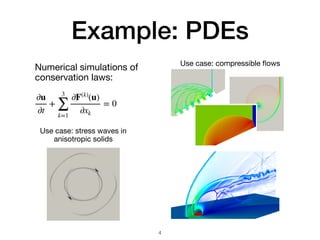
Example: PDEs
4
Numerical simulations of
conservation laws:

∂u
∂t
+
3
∑
k=1
∂F(k)
(u)
∂xk
= 0
Use case: stress waves in 

anisotropic solids
Use case: compressible flows
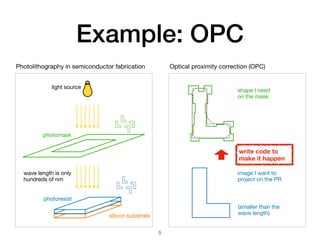
Example: OPC
5
photoresist
silicon substrate
photomask
light source
Photolithography in semiconductor fabrication
wave length is only
hundreds of nm
image I want to
project on the PR
shape I need
on the mask
Optical proximity correction (OPC)
(smaller than the
wave length)
write code to
make it happen
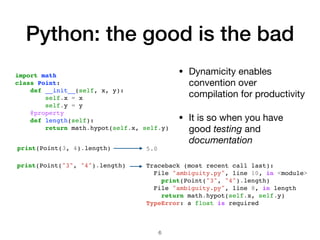
Python: the good is the bad
• Dynamicity enables
convention over
compilation for productivity

• It is so when you have
good testing and
documentation
import math
class Point:
def __init__(self, x, y):
self.x = x
self.y = y
@property
def length(self):
return math.hypot(self.x, self.y)
5.0print(Point(3, 4).length)
print(Point("3", "4").length) Traceback (most recent call last):
File "ambiguity.py", line 10, in <module>
print(Point("3", "4").length)
File "ambiguity.py", line 8, in length
return math.hypot(self.x, self.y)
TypeError: a float is required
6
What is fast?
worker(Data&, unsigned long, int):
mov DWORD PTR [rdi+rsi*4], edx
mov rax, rdi
ret
class Data {
int m_storage[1024];
public:
int & operator[] (size_t it) { return m_storage[it]; }
};
Data & worker(Data & data, size_t idx, int value) {
data[idx] = value;
return data;
}
High-level language
Machine code
7
Dynamic typing is slow
• Python trades runtime for convenience; everything is
indirect and incurs runtime overhead
def work(data, key, name, value):
# Assign value to the data as a container with key.
data[key] = value
# Assign value to the data as an object with name.
setattr(data, name, value)
return data
8
• The innocent-looking Python code uses many checking
functions under the hood
int PyObject_SetItem(PyObject *o, PyObject *key, PyObject *value)
{
PyMappingMethods *m;
if (o == NULL || key == NULL || value == NULL) {
null_error();
return -1;
}
m = o->ob_type->tp_as_mapping;
if (m && m->mp_ass_subscript)
return m->mp_ass_subscript(o, key, value);
if (o->ob_type->tp_as_sequence) {
if (PyIndex_Check(key)) {
Py_ssize_t key_value;
key_value = PyNumber_AsSsize_t(key, PyExc_IndexError);
if (key_value == -1 && PyErr_Occurred())
return -1;
return PySequence_SetItem(o, key_value, value);
}
else if (o->ob_type->tp_as_sequence->sq_ass_item) {
type_error(/* ... omit ... */);
return -1;
}
}
type_error(/* ... omit ... */);
return -1;
}
int PyObject_SetAttr(PyObject *v, PyObject *name, PyObject *value)
{
PyTypeObject *tp = Py_TYPE(v);
int err;
if (!PyUnicode_Check(name)) {
PyErr_Format(PyExc_TypeError, /* ... omit ... */);
return -1;
}
Py_INCREF(name);
PyUnicode_InternInPlace(&name);
if (tp->tp_setattro != NULL) {
err = (*tp->tp_setattro)(v, name, value);
Py_DECREF(name);
return err;
}
if (tp->tp_setattr != NULL) {
const char *name_str = PyUnicode_AsUTF8(name);
if (name_str == NULL) {
Py_DECREF(name);
return -1;
}
err = (*tp->tp_setattr)(v, (char *)name_str, value);
Py_DECREF(name);
return err;
}
Py_DECREF(name);
_PyObject_ASSERT(name, name->ob_refcnt >= 1);
if (tp->tp_getattr == NULL && tp->tp_getattro == NULL)
PyErr_Format(PyExc_TypeError, /* ... omit ... */);
else
PyErr_Format(PyExc_TypeError, /* ... omit ... */);
return -1;
}
data[key] = value setattr(data, name, value)
(in Objects/abstract.c) (in Objects/object.c)
static PyObject *__pyx_pf_6simple_work(
PyObject *__pyx_v_data, PyObject *__pyx_v_key
, PyObject *__pyx_v_name, PyObject *__pyx_v_value
) {
PyObject_SetItem(__pyx_v_data, __pyx_v_key, __pyx_v_value);
PyObject_SetAttr(__pyx_v_data, __pyx_v_name, __pyx_v_value);
return __pyx_v_data;
}
def work(data, key, name, value):
data[key] = value
setattr(data, name, value)
return data
mapping
sequence
attribute name check
check to set
9
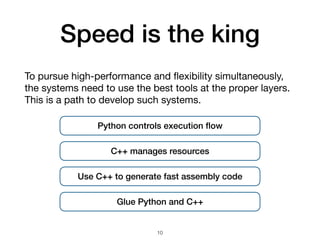
Speed is the king
To pursue high-performance and flexibility simultaneously,
the systems need to use the best tools at the proper layers.
This is a path to develop such systems.
10
Python controls execution flow
C++ manages resources
Use C++ to generate fast assembly code
Glue Python and C++
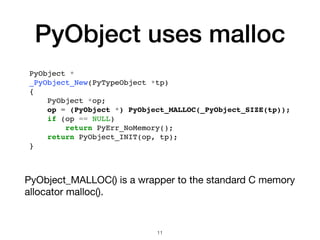
PyObject uses malloc
PyObject_MALLOC() is a wrapper to the standard C memory
allocator malloc().
11
PyObject *
_PyObject_New(PyTypeObject *tp)
{
PyObject *op;
op = (PyObject *) PyObject_MALLOC(_PyObject_SIZE(tp));
if (op == NULL)
return PyErr_NoMemory();
return PyObject_INIT(op, tp);
}
Python call stack
• Python maintains its
own stack

• It’s different from that of
the ‘real machine’

• The two (C/C++ and
Python) call stacks work
very differently
12
#0 line 11: show_stack
#1 line 23: caller
#2 line 25: <module>: top-level module
local_val is: defined outside
import inspect
def show_stack():
# Print calling stacks.
f = inspect.currentframe()
i = 0
while f:
name = f.f_code.co_name
if '<module>' == name:
name += ': top-level module'
print("#%d line %d: %s" % (i, f.f_lineno, name))
f = f.f_back
i += 1
# Obtain a local variable defined in an outside stack.
f = inspect.currentframe().f_back
print('local_val is:', f.f_locals['local_var'])
del f
def caller():
local_var = "defined outside"
show_stack()
caller()
Best practice: glue
• For performance and compile-time checking, we do not want to use
Python

• For flow control and configuration, we do not want to use C++

• Glue tools:

• Python C API : https://docs.python.org/3/c-api/index.html

• Cython : https://cython.org/

• Boost.Python : https://www.boost.org/doc/libs/1_74_0/libs/python/
doc/html/index.html

• Pybind11 : https://github.com/pybind/pybind11
13
I only listed tools that require manual generation of wrapping code and compilation.
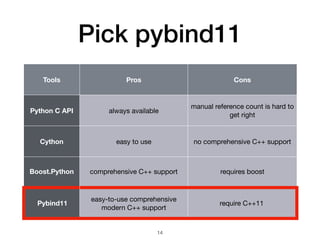
Pick pybind11
14
Tools Pros Cons
Python C API always available
manual reference count is hard to
get right
Cython easy to use no comprehensive C++ support
Boost.Python comprehensive C++ support requires boost
Pybind11
easy-to-use comprehensive
modern C++ support
require C++11
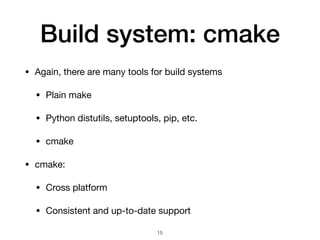
Build system: cmake
• Again, there are many tools for build systems

• Plain make

• Python distutils, setuptools, pip, etc.

• cmake

• cmake:

• Cross platform

• Consistent and up-to-date support
15
How cmake works
16
#include <pybind11/pybind11.h>
#include <pybind11/stl.h>
#include <cmath>
std::vector<double> distance(
std::vector<double> const & x
, std::vector<double> const & y) {
std::vector<double> r(x.size());
for (size_t i = 0 ; i < x.size() ; ++i)
{
r[i] = std::hypot(x.at(i), y.at(i));
}
return r;
}
PYBIND11_MODULE(_pybmod, mod) {
namespace py = pybind11;
mod.doc() = "simple pybind11 module";
mod.def("distance", &distance);
}
cmake_minimum_required(VERSION 3.9)
project(pybmod)
find_package(pybind11 REQUIRED)
include_directories(${pybind11_INCLUDE_DIRS})
pybind11_add_module(
_pybmod
pybmod.cpp
)
target_link_libraries(_pybmod
PRIVATE ${MKL_LINKLINE})
set_target_properties(_pybmod
PROPERTIES CXX_VISIBILITY_PRESET "default")
add_custom_target(_pybmod_py
COMMAND ${CMAKE_COMMAND} -E
copy $<TARGET_FILE:_pybmod>
${PROJECT_SOURCE_DIR}
DEPENDS _pybmod)
$ mkdir -p build ; cd build
$ cmake .. -DCMAKE_BUILD_TYPE=Release
$ make -C build _pybmod_py
$ python3 -c 'import _pybmod ; print(_pybmod.distance([3, 8], [4, 6]))'
[5.0, 10.0]
CMakeLists.txt pybmod.cpp
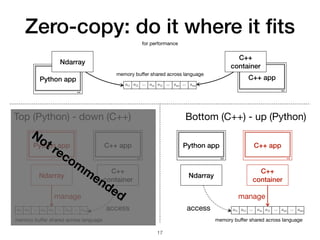
Zero-copy: do it where it fits
Python app C++ app
C++
container
Ndarray
manage
access
Python app C++ app
C++
container
Ndarray
manage
accessa11 a12 ⋯ a1n a21 ⋯ am1 ⋯ amn a11 a12 ⋯ a1n a21 ⋯ am1 ⋯ amn
memory buffer shared across language memory buffer shared across language
Top (Python) - down (C++) Bottom (C++) - up (Python)
Python app C++ app
a11 a12 ⋯ a1n a21 ⋯ am1 ⋯ amn
memory buffer shared across language
Ndarray
C++
container
17
Not recom
m
ended
for performance
Share buffer from C++
Two handy approaches by pybind11
18
cls
.def_buffer
(
[](wrapped_type & self)
{
namespace py = pybind11;
return py::buffer_info
(
self.data() /* Pointer to buffer */
, sizeof(int8_t) /* Size of one scalar */
, py::format_descriptor<char>::format()
/* Python struct-style format descriptor */
, 1 /* Number of dimensions */
, { self.size() } /* Buffer dimensions */
, { 1 } /* Strides (in bytes) for each index */
);
}
)
cls
.def_property_readonly
(
"ndarray"
, [](wrapped_type & self)
{
namespace py = pybind11;
return py::array
(
py::detail::npy_format_descriptor<int8_t>::dtype()
/* Numpy dtype */
, { self.size() } /* Buffer dimensions */
, { 1 } /* Strides (in bytes) for each index */
, self.data() /* Pointer to buffer */
, py::cast(self.shared_from_this())
/* Owning Python object */
);
}
)
.def_property_readonly(“ndarray2”, /* ... */)
Return a distinct numpy ndarray:

• The C++ class can return multiple
buffers
Python buffer protocol:

• The C++ class itself is turned into an
array description
Check assembly
• Make sure compilers generate good code for
performance hotspot

• Checking instead of writing: we don’t
have time to use assembly for everything

• If compilers don’t do a good job, before
jumping into hand-written assembly, consider
to use intrinsics: https://software.intel.com/
sites/landingpage/IntrinsicsGuide/
19
vmovupd ymm0, ymmword [rsi + r9*8]
vmulpd ymm0, ymm0, ymm0
vmovupd ymm1, ymmword [rdx + r9*8]
vmulpd ymm1, ymm1, ymm1
vaddpd ymm0, ymm0, ymm1
vsqrtpd ymm0, ymm0
void calc_distance(
size_t const n
, double const * x
, double const * y
, double * r) {
for (size_t i = 0 ; i < n ; ++i)
{
r[i] = std::sqrt(x[i]*x[i] + y[i]*y[i]);
}
}
movupd xmm0, xmmword [rsi + r8*8]
mulpd xmm0, xmm0
movupd xmm1, xmmword [rdx + r8*8]
mulpd xmm1, xmm1
addpd xmm1, xmm0
sqrtpd xmm0, xmm1
-O3 -mavx2 -O3
# Use redare2 to print the assembly.
r2 -Aqc "e scr.color=0 ; s sym.calc_distance_unsignedlong_doubleconst__doubleconst__double ; pdf" 
_pybmod.cpython-37m-darwin.so
AVX: 256-bit-wide vectorization SSE: 128-bit-wide vectorization
Manage resources
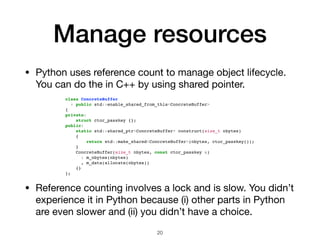
• Python uses reference count to manage object lifecycle.
You can do the in C++ by using shared pointer.
20
• Reference counting involves a lock and is slow. You didn’t
experience it in Python because (i) other parts in Python
are even slower and (ii) you didn’t have a choice.
class ConcreteBuffer
: public std::enable_shared_from_this<ConcreteBuffer>
{
private:
struct ctor_passkey {};
public:
static std::shared_ptr<ConcreteBuffer> construct(size_t nbytes)
{
return std::make_shared<ConcreteBuffer>(nbytes, ctor_passkey());
}
ConcreteBuffer(size_t nbytes, const ctor_passkey &)
: m_nbytes(nbytes)
, m_data(allocate(nbytes))
{}
};
Translate reference count
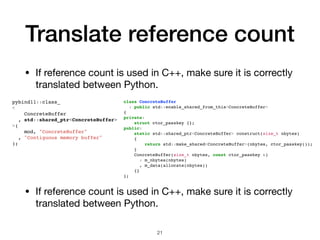
• If reference count is used in C++, make sure it is correctly
translated between Python.
21
pybind11::class_
<
ConcreteBuffer
, std::shared_ptr<ConcreteBuffer>
>(
mod, "ConcreteBuffer"
, "Contiguous memory buffer"
);
class ConcreteBuffer
: public std::enable_shared_from_this<ConcreteBuffer>
{
private:
struct ctor_passkey {};
public:
static std::shared_ptr<ConcreteBuffer> construct(size_t nbytes)
{
return std::make_shared<ConcreteBuffer>(nbytes, ctor_passkey());
}
ConcreteBuffer(size_t nbytes, const ctor_passkey &)
: m_nbytes(nbytes)
, m_data(allocate(nbytes))
{}
};
• If reference count is used in C++, make sure it is correctly
translated between Python.
Run Python in C++
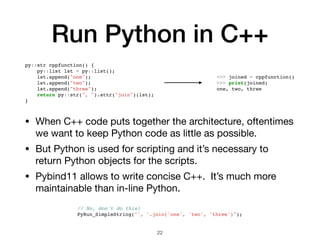
• When C++ code puts together the architecture, oftentimes
we want to keep Python code as little as possible.

• But Python is used for scripting and it’s necessary to
return Python objects for the scripts.

• Pybind11 allows to write concise C++. It’s much more
maintainable than in-line Python.
22
>>> joined = cppfunction()
>>> print(joined)
one, two, three
py::str cppfunction() {
py::list lst = py::list();
lst.append("one");
lst.append("two");
lst.append("three");
return py::str(", ").attr("join")(lst);
}
// No, don't do this!
PyRun_SimpleString("', '.join('one', 'two', 'three')");
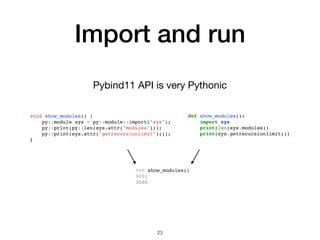
Import and run
Pybind11 API is very Pythonic
23
>>> show_modules()
1101
3000
void show_modules() {
py::module sys = py::module::import("sys");
py::print(py::len(sys.attr("modules")));
py::print(sys.attr("getrecursionlimit")());
}
def show_modules():
import sys
print(len(sys.modules))
print(sys.getrecursionlimit())
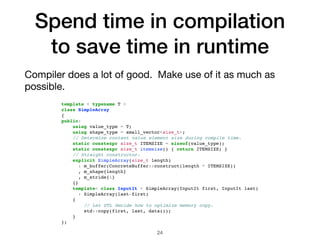
Spend time in compilation
to save time in runtime
Compiler does a lot of good. Make use of it as much as
possible.
24
template < typename T >
class SimpleArray
{
public:
using value_type = T;
using shape_type = small_vector<size_t>;
// Determine content value element size during compile time.
static constexpr size_t ITEMSIZE = sizeof(value_type);
static constexpr size_t itemsize() { return ITEMSIZE; }
// Straight constructor.
explicit SimpleArray(size_t length)
: m_buffer(ConcreteBuffer::construct(length * ITEMSIZE))
, m_shape{length}
, m_stride{1}
{}
template< class InputIt > SimpleArray(InputIt first, InputIt last)
: SimpleArray(last-first)
{
// Let STL decide how to optimize memory copy.
std::copy(first, last, data());
}
};
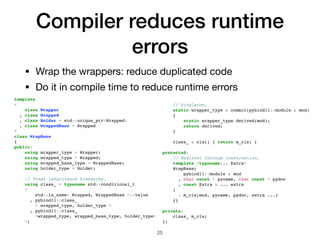
Compiler reduces runtime
errors
• Wrap the wrappers: reduce duplicated code

• Do it in compile time to reduce runtime errors
25
template
<
class Wrapper
, class Wrapped
, class Holder = std::unique_ptr<Wrapped>
, class WrappedBase = Wrapped
>
class WrapBase
{
public:
using wrapper_type = Wrapper;
using wrapped_type = Wrapped;
using wrapped_base_type = WrappedBase;
using holder_type = Holder;
// Treat inheritance hierarchy.
using class_ = typename std::conditional_t
<
std::is_same< Wrapped, WrappedBase >::value
, pybind11::class_
< wrapped_type, holder_type >
, pybind11::class_
<wrapped_type, wrapped_base_type, holder_type>
>;
// Singleton.
static wrapper_type & commit(pybind11::module & mod)
{
static wrapper_type derived(mod);
return derived;
}
class_ & cls() { return m_cls; }
protected:
// Register through construction.
template <typename... Extra>
WrapBase(
pybind11::module & mod
, char const * pyname, char const * pydoc
, const Extra & ... extra
)
: m_cls(mod, pyname, pydoc, extra ...)
{}
private:
class_ m_cls;
};
Decouple resource
management from algorithms
26
• Fixed-size
contiguous data
buffer
template < typename T >
class SimpleArray
{
public:
using value_type = T;
using shape_type = small_vector<size_t>;
static constexpr size_t ITEMSIZE = sizeof(value_type);
explicit SimpleArray(size_t length)
: m_buffer(ConcreteBuffer::construct(length * ITEMSIZE))
, m_shape{length}
, m_stride{1}
{}
private:
std::shared_ptr<ConcreteBuffer> m_buffer;
shape_type m_shape;
shape_type m_stride;
};
class ConcreteBuffer
: public std::enable_shared_from_this<ConcreteBuffer>
{
private:
struct ctor_passkey {};
public:
static std::shared_ptr<ConcreteBuffer> construct(size_t nbytes)
{ return std::make_shared<ConcreteBuffer>(nbytes, ctor_passkey()); }
ConcreteBuffer(size_t nbytes, const ctor_passkey &)
: m_nbytes(nbytes), m_data(allocate(nbytes))
{}
private:
using unique_ptr_type =
std::unique_ptr<int8_t, std::default_delete<int8_t[]>>;
size_t m_nbytes;
unique_ptr_type m_data;
};
• Descriptive data
object owning the
data buffer
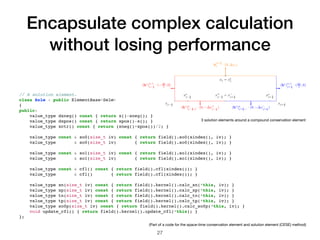
Encapsulate complex calculation
without losing performance
27
// A solution element.
class Selm : public ElementBase<Selm>
{
public:
value_type dxneg() const { return x()-xneg(); }
value_type dxpos() const { return xpos()-x(); }
value_type xctr() const { return (xneg()+xpos())/2; }
value_type const & so0(size_t iv) const { return field().so0(xindex(), iv); }
value_type & so0(size_t iv) { return field().so0(xindex(), iv); }
value_type const & so1(size_t iv) const { return field().so1(xindex(), iv); }
value_type & so1(size_t iv) { return field().so1(xindex(), iv); }
value_type const & cfl() const { return field().cfl(xindex()); }
value_type & cfl() { return field().cfl(xindex()); }
value_type xn(size_t iv) const { return field().kernel().calc_xn(*this, iv); }
value_type xp(size_t iv) const { return field().kernel().calc_xp(*this, iv); }
value_type tn(size_t iv) const { return field().kernel().calc_tn(*this, iv); }
value_type tp(size_t iv) const { return field().kernel().calc_tp(*this, iv); }
value_type so0p(size_t iv) const { return field().kernel().calc_so0p(*this, iv); }
void update_cfl() { return field().kernel().update_cfl(*this); }
};
xj− 1
2
xs
j− 1
2
xj+ 1
2
xs
j+ 1
2
x+
j− 1
2
= x−
j+ 1
2
xj = xs
j
(h∗
)n
j− 1
2 ,+
· (0, −∆x+
j− 1
2
) (h∗
)n
j+ 1
2 ,−
· (0, −∆x−
j+ 1
2
)
h
n+ 1
2
j · (0, ∆xj)
(h∗
)n,+
j− 1
2
· (−∆t
2 , 0) (h∗
)n,+
j+ 1
2
· (∆t
2 , 0)
3 solution elements around a compound conservation element
(Part of a code for the space-time conservation element and solution element (CESE) method)
Conclusion
• Speed is the king for numerical calculation

• Use Python for configuration and C++ for number
crunching: glue them

• Keep in mind: Software engineering, zero-copy data
buffer, read assembly, manage resources, use compiler
for speed and safety

• More information: https://github.com/yungyuc/nsd
28
Thank you
29

Notes about moving from python to c++ py contw 2020

  • 1.
    Notes about moving fromPython to C++ Yung-Yu Chen (@yungyuc) PyConTW 2020, Tainan, Taiwan 1
  • 2.
    Why move? • Numericalsoftware: Computer programs to solve scientific or mathematic problems. • Other names: Mathematical software, scientific software, technical software. • Python is a popular language for application experts to describe the problems and solutions, because it is easy to use. • Most of the computing systems (the numerical software) are designed in a hybrid architecture. • The computing kernel uses C++. • Python is chosen for the user-level API. 2
  • 3.
    What I do •By training, I am a computational scientist, focusing on applications of continuum mechanics. (I am not a computer scientist.) • In my day job, I write high-performance code for semiconductor applications of computational geometry and photolithography. • In my spare time, I am teaching a course ‘numerical software development’ in the department of computer science in NCTU. 3 twitter: https://twitter.com/yungyuc
 linkedin: https://www.linkedin.com/in/yungyuc/.
  • 4.
    Example: PDEs 4 Numerical simulationsof conservation laws: ∂u ∂t + 3 ∑ k=1 ∂F(k) (u) ∂xk = 0 Use case: stress waves in 
 anisotropic solids Use case: compressible flows
  • 5.
    Example: OPC 5 photoresist silicon substrate photomask lightsource Photolithography in semiconductor fabrication wave length is only hundreds of nm image I want to project on the PR shape I need on the mask Optical proximity correction (OPC) (smaller than the wave length) write code to make it happen
  • 6.
    Python: the goodis the bad • Dynamicity enables convention over compilation for productivity • It is so when you have good testing and documentation import math class Point: def __init__(self, x, y): self.x = x self.y = y @property def length(self): return math.hypot(self.x, self.y) 5.0print(Point(3, 4).length) print(Point("3", "4").length) Traceback (most recent call last): File "ambiguity.py", line 10, in <module> print(Point("3", "4").length) File "ambiguity.py", line 8, in length return math.hypot(self.x, self.y) TypeError: a float is required 6
  • 7.
    What is fast? worker(Data&,unsigned long, int): mov DWORD PTR [rdi+rsi*4], edx mov rax, rdi ret class Data { int m_storage[1024]; public: int & operator[] (size_t it) { return m_storage[it]; } }; Data & worker(Data & data, size_t idx, int value) { data[idx] = value; return data; } High-level language Machine code 7
  • 8.
    Dynamic typing isslow • Python trades runtime for convenience; everything is indirect and incurs runtime overhead def work(data, key, name, value): # Assign value to the data as a container with key. data[key] = value # Assign value to the data as an object with name. setattr(data, name, value) return data 8 • The innocent-looking Python code uses many checking functions under the hood
  • 9.
    int PyObject_SetItem(PyObject *o,PyObject *key, PyObject *value) { PyMappingMethods *m; if (o == NULL || key == NULL || value == NULL) { null_error(); return -1; } m = o->ob_type->tp_as_mapping; if (m && m->mp_ass_subscript) return m->mp_ass_subscript(o, key, value); if (o->ob_type->tp_as_sequence) { if (PyIndex_Check(key)) { Py_ssize_t key_value; key_value = PyNumber_AsSsize_t(key, PyExc_IndexError); if (key_value == -1 && PyErr_Occurred()) return -1; return PySequence_SetItem(o, key_value, value); } else if (o->ob_type->tp_as_sequence->sq_ass_item) { type_error(/* ... omit ... */); return -1; } } type_error(/* ... omit ... */); return -1; } int PyObject_SetAttr(PyObject *v, PyObject *name, PyObject *value) { PyTypeObject *tp = Py_TYPE(v); int err; if (!PyUnicode_Check(name)) { PyErr_Format(PyExc_TypeError, /* ... omit ... */); return -1; } Py_INCREF(name); PyUnicode_InternInPlace(&name); if (tp->tp_setattro != NULL) { err = (*tp->tp_setattro)(v, name, value); Py_DECREF(name); return err; } if (tp->tp_setattr != NULL) { const char *name_str = PyUnicode_AsUTF8(name); if (name_str == NULL) { Py_DECREF(name); return -1; } err = (*tp->tp_setattr)(v, (char *)name_str, value); Py_DECREF(name); return err; } Py_DECREF(name); _PyObject_ASSERT(name, name->ob_refcnt >= 1); if (tp->tp_getattr == NULL && tp->tp_getattro == NULL) PyErr_Format(PyExc_TypeError, /* ... omit ... */); else PyErr_Format(PyExc_TypeError, /* ... omit ... */); return -1; } data[key] = value setattr(data, name, value) (in Objects/abstract.c) (in Objects/object.c) static PyObject *__pyx_pf_6simple_work( PyObject *__pyx_v_data, PyObject *__pyx_v_key , PyObject *__pyx_v_name, PyObject *__pyx_v_value ) { PyObject_SetItem(__pyx_v_data, __pyx_v_key, __pyx_v_value); PyObject_SetAttr(__pyx_v_data, __pyx_v_name, __pyx_v_value); return __pyx_v_data; } def work(data, key, name, value): data[key] = value setattr(data, name, value) return data mapping sequence attribute name check check to set 9
  • 10.
    Speed is theking To pursue high-performance and flexibility simultaneously, the systems need to use the best tools at the proper layers. This is a path to develop such systems. 10 Python controls execution flow C++ manages resources Use C++ to generate fast assembly code Glue Python and C++
  • 11.
    PyObject uses malloc PyObject_MALLOC()is a wrapper to the standard C memory allocator malloc(). 11 PyObject * _PyObject_New(PyTypeObject *tp) { PyObject *op; op = (PyObject *) PyObject_MALLOC(_PyObject_SIZE(tp)); if (op == NULL) return PyErr_NoMemory(); return PyObject_INIT(op, tp); }
  • 12.
    Python call stack •Python maintains its own stack • It’s different from that of the ‘real machine’ • The two (C/C++ and Python) call stacks work very differently 12 #0 line 11: show_stack #1 line 23: caller #2 line 25: <module>: top-level module local_val is: defined outside import inspect def show_stack(): # Print calling stacks. f = inspect.currentframe() i = 0 while f: name = f.f_code.co_name if '<module>' == name: name += ': top-level module' print("#%d line %d: %s" % (i, f.f_lineno, name)) f = f.f_back i += 1 # Obtain a local variable defined in an outside stack. f = inspect.currentframe().f_back print('local_val is:', f.f_locals['local_var']) del f def caller(): local_var = "defined outside" show_stack() caller()
  • 13.
    Best practice: glue •For performance and compile-time checking, we do not want to use Python • For flow control and configuration, we do not want to use C++ • Glue tools: • Python C API : https://docs.python.org/3/c-api/index.html • Cython : https://cython.org/ • Boost.Python : https://www.boost.org/doc/libs/1_74_0/libs/python/ doc/html/index.html • Pybind11 : https://github.com/pybind/pybind11 13 I only listed tools that require manual generation of wrapping code and compilation.
  • 14.
    Pick pybind11 14 Tools ProsCons Python C API always available manual reference count is hard to get right Cython easy to use no comprehensive C++ support Boost.Python comprehensive C++ support requires boost Pybind11 easy-to-use comprehensive modern C++ support require C++11
  • 15.
    Build system: cmake •Again, there are many tools for build systems • Plain make • Python distutils, setuptools, pip, etc. • cmake • cmake: • Cross platform • Consistent and up-to-date support 15
  • 16.
    How cmake works 16 #include<pybind11/pybind11.h> #include <pybind11/stl.h> #include <cmath> std::vector<double> distance( std::vector<double> const & x , std::vector<double> const & y) { std::vector<double> r(x.size()); for (size_t i = 0 ; i < x.size() ; ++i) { r[i] = std::hypot(x.at(i), y.at(i)); } return r; } PYBIND11_MODULE(_pybmod, mod) { namespace py = pybind11; mod.doc() = "simple pybind11 module"; mod.def("distance", &distance); } cmake_minimum_required(VERSION 3.9) project(pybmod) find_package(pybind11 REQUIRED) include_directories(${pybind11_INCLUDE_DIRS}) pybind11_add_module( _pybmod pybmod.cpp ) target_link_libraries(_pybmod PRIVATE ${MKL_LINKLINE}) set_target_properties(_pybmod PROPERTIES CXX_VISIBILITY_PRESET "default") add_custom_target(_pybmod_py COMMAND ${CMAKE_COMMAND} -E copy $<TARGET_FILE:_pybmod> ${PROJECT_SOURCE_DIR} DEPENDS _pybmod) $ mkdir -p build ; cd build $ cmake .. -DCMAKE_BUILD_TYPE=Release $ make -C build _pybmod_py $ python3 -c 'import _pybmod ; print(_pybmod.distance([3, 8], [4, 6]))' [5.0, 10.0] CMakeLists.txt pybmod.cpp
  • 17.
    Zero-copy: do itwhere it fits Python app C++ app C++ container Ndarray manage access Python app C++ app C++ container Ndarray manage accessa11 a12 ⋯ a1n a21 ⋯ am1 ⋯ amn a11 a12 ⋯ a1n a21 ⋯ am1 ⋯ amn memory buffer shared across language memory buffer shared across language Top (Python) - down (C++) Bottom (C++) - up (Python) Python app C++ app a11 a12 ⋯ a1n a21 ⋯ am1 ⋯ amn memory buffer shared across language Ndarray C++ container 17 Not recom m ended for performance
  • 18.
    Share buffer fromC++ Two handy approaches by pybind11 18 cls .def_buffer ( [](wrapped_type & self) { namespace py = pybind11; return py::buffer_info ( self.data() /* Pointer to buffer */ , sizeof(int8_t) /* Size of one scalar */ , py::format_descriptor<char>::format() /* Python struct-style format descriptor */ , 1 /* Number of dimensions */ , { self.size() } /* Buffer dimensions */ , { 1 } /* Strides (in bytes) for each index */ ); } ) cls .def_property_readonly ( "ndarray" , [](wrapped_type & self) { namespace py = pybind11; return py::array ( py::detail::npy_format_descriptor<int8_t>::dtype() /* Numpy dtype */ , { self.size() } /* Buffer dimensions */ , { 1 } /* Strides (in bytes) for each index */ , self.data() /* Pointer to buffer */ , py::cast(self.shared_from_this()) /* Owning Python object */ ); } ) .def_property_readonly(“ndarray2”, /* ... */) Return a distinct numpy ndarray: • The C++ class can return multiple buffers Python buffer protocol: • The C++ class itself is turned into an array description
  • 19.
    Check assembly • Makesure compilers generate good code for performance hotspot • Checking instead of writing: we don’t have time to use assembly for everything • If compilers don’t do a good job, before jumping into hand-written assembly, consider to use intrinsics: https://software.intel.com/ sites/landingpage/IntrinsicsGuide/ 19 vmovupd ymm0, ymmword [rsi + r9*8] vmulpd ymm0, ymm0, ymm0 vmovupd ymm1, ymmword [rdx + r9*8] vmulpd ymm1, ymm1, ymm1 vaddpd ymm0, ymm0, ymm1 vsqrtpd ymm0, ymm0 void calc_distance( size_t const n , double const * x , double const * y , double * r) { for (size_t i = 0 ; i < n ; ++i) { r[i] = std::sqrt(x[i]*x[i] + y[i]*y[i]); } } movupd xmm0, xmmword [rsi + r8*8] mulpd xmm0, xmm0 movupd xmm1, xmmword [rdx + r8*8] mulpd xmm1, xmm1 addpd xmm1, xmm0 sqrtpd xmm0, xmm1 -O3 -mavx2 -O3 # Use redare2 to print the assembly. r2 -Aqc "e scr.color=0 ; s sym.calc_distance_unsignedlong_doubleconst__doubleconst__double ; pdf" _pybmod.cpython-37m-darwin.so AVX: 256-bit-wide vectorization SSE: 128-bit-wide vectorization
  • 20.
    Manage resources • Pythonuses reference count to manage object lifecycle. You can do the in C++ by using shared pointer. 20 • Reference counting involves a lock and is slow. You didn’t experience it in Python because (i) other parts in Python are even slower and (ii) you didn’t have a choice. class ConcreteBuffer : public std::enable_shared_from_this<ConcreteBuffer> { private: struct ctor_passkey {}; public: static std::shared_ptr<ConcreteBuffer> construct(size_t nbytes) { return std::make_shared<ConcreteBuffer>(nbytes, ctor_passkey()); } ConcreteBuffer(size_t nbytes, const ctor_passkey &) : m_nbytes(nbytes) , m_data(allocate(nbytes)) {} };
  • 21.
    Translate reference count •If reference count is used in C++, make sure it is correctly translated between Python. 21 pybind11::class_ < ConcreteBuffer , std::shared_ptr<ConcreteBuffer> >( mod, "ConcreteBuffer" , "Contiguous memory buffer" ); class ConcreteBuffer : public std::enable_shared_from_this<ConcreteBuffer> { private: struct ctor_passkey {}; public: static std::shared_ptr<ConcreteBuffer> construct(size_t nbytes) { return std::make_shared<ConcreteBuffer>(nbytes, ctor_passkey()); } ConcreteBuffer(size_t nbytes, const ctor_passkey &) : m_nbytes(nbytes) , m_data(allocate(nbytes)) {} }; • If reference count is used in C++, make sure it is correctly translated between Python.
  • 22.
    Run Python inC++ • When C++ code puts together the architecture, oftentimes we want to keep Python code as little as possible. • But Python is used for scripting and it’s necessary to return Python objects for the scripts. • Pybind11 allows to write concise C++. It’s much more maintainable than in-line Python. 22 >>> joined = cppfunction() >>> print(joined) one, two, three py::str cppfunction() { py::list lst = py::list(); lst.append("one"); lst.append("two"); lst.append("three"); return py::str(", ").attr("join")(lst); } // No, don't do this! PyRun_SimpleString("', '.join('one', 'two', 'three')");
  • 23.
    Import and run Pybind11API is very Pythonic 23 >>> show_modules() 1101 3000 void show_modules() { py::module sys = py::module::import("sys"); py::print(py::len(sys.attr("modules"))); py::print(sys.attr("getrecursionlimit")()); } def show_modules(): import sys print(len(sys.modules)) print(sys.getrecursionlimit())
  • 24.
    Spend time incompilation to save time in runtime Compiler does a lot of good. Make use of it as much as possible. 24 template < typename T > class SimpleArray { public: using value_type = T; using shape_type = small_vector<size_t>; // Determine content value element size during compile time. static constexpr size_t ITEMSIZE = sizeof(value_type); static constexpr size_t itemsize() { return ITEMSIZE; } // Straight constructor. explicit SimpleArray(size_t length) : m_buffer(ConcreteBuffer::construct(length * ITEMSIZE)) , m_shape{length} , m_stride{1} {} template< class InputIt > SimpleArray(InputIt first, InputIt last) : SimpleArray(last-first) { // Let STL decide how to optimize memory copy. std::copy(first, last, data()); } };
  • 25.
    Compiler reduces runtime errors •Wrap the wrappers: reduce duplicated code • Do it in compile time to reduce runtime errors 25 template < class Wrapper , class Wrapped , class Holder = std::unique_ptr<Wrapped> , class WrappedBase = Wrapped > class WrapBase { public: using wrapper_type = Wrapper; using wrapped_type = Wrapped; using wrapped_base_type = WrappedBase; using holder_type = Holder; // Treat inheritance hierarchy. using class_ = typename std::conditional_t < std::is_same< Wrapped, WrappedBase >::value , pybind11::class_ < wrapped_type, holder_type > , pybind11::class_ <wrapped_type, wrapped_base_type, holder_type> >; // Singleton. static wrapper_type & commit(pybind11::module & mod) { static wrapper_type derived(mod); return derived; } class_ & cls() { return m_cls; } protected: // Register through construction. template <typename... Extra> WrapBase( pybind11::module & mod , char const * pyname, char const * pydoc , const Extra & ... extra ) : m_cls(mod, pyname, pydoc, extra ...) {} private: class_ m_cls; };
  • 26.
    Decouple resource management fromalgorithms 26 • Fixed-size contiguous data buffer template < typename T > class SimpleArray { public: using value_type = T; using shape_type = small_vector<size_t>; static constexpr size_t ITEMSIZE = sizeof(value_type); explicit SimpleArray(size_t length) : m_buffer(ConcreteBuffer::construct(length * ITEMSIZE)) , m_shape{length} , m_stride{1} {} private: std::shared_ptr<ConcreteBuffer> m_buffer; shape_type m_shape; shape_type m_stride; }; class ConcreteBuffer : public std::enable_shared_from_this<ConcreteBuffer> { private: struct ctor_passkey {}; public: static std::shared_ptr<ConcreteBuffer> construct(size_t nbytes) { return std::make_shared<ConcreteBuffer>(nbytes, ctor_passkey()); } ConcreteBuffer(size_t nbytes, const ctor_passkey &) : m_nbytes(nbytes), m_data(allocate(nbytes)) {} private: using unique_ptr_type = std::unique_ptr<int8_t, std::default_delete<int8_t[]>>; size_t m_nbytes; unique_ptr_type m_data; }; • Descriptive data object owning the data buffer
  • 27.
    Encapsulate complex calculation withoutlosing performance 27 // A solution element. class Selm : public ElementBase<Selm> { public: value_type dxneg() const { return x()-xneg(); } value_type dxpos() const { return xpos()-x(); } value_type xctr() const { return (xneg()+xpos())/2; } value_type const & so0(size_t iv) const { return field().so0(xindex(), iv); } value_type & so0(size_t iv) { return field().so0(xindex(), iv); } value_type const & so1(size_t iv) const { return field().so1(xindex(), iv); } value_type & so1(size_t iv) { return field().so1(xindex(), iv); } value_type const & cfl() const { return field().cfl(xindex()); } value_type & cfl() { return field().cfl(xindex()); } value_type xn(size_t iv) const { return field().kernel().calc_xn(*this, iv); } value_type xp(size_t iv) const { return field().kernel().calc_xp(*this, iv); } value_type tn(size_t iv) const { return field().kernel().calc_tn(*this, iv); } value_type tp(size_t iv) const { return field().kernel().calc_tp(*this, iv); } value_type so0p(size_t iv) const { return field().kernel().calc_so0p(*this, iv); } void update_cfl() { return field().kernel().update_cfl(*this); } }; xj− 1 2 xs j− 1 2 xj+ 1 2 xs j+ 1 2 x+ j− 1 2 = x− j+ 1 2 xj = xs j (h∗ )n j− 1 2 ,+ · (0, −∆x+ j− 1 2 ) (h∗ )n j+ 1 2 ,− · (0, −∆x− j+ 1 2 ) h n+ 1 2 j · (0, ∆xj) (h∗ )n,+ j− 1 2 · (−∆t 2 , 0) (h∗ )n,+ j+ 1 2 · (∆t 2 , 0) 3 solution elements around a compound conservation element (Part of a code for the space-time conservation element and solution element (CESE) method)
  • 28.
    Conclusion • Speed isthe king for numerical calculation • Use Python for configuration and C++ for number crunching: glue them • Keep in mind: Software engineering, zero-copy data buffer, read assembly, manage resources, use compiler for speed and safety • More information: https://github.com/yungyuc/nsd 28
  • 29.