Page 1
BEST PRACTICES FOR
ENVIRONMENTAL DETECTION
AND MONITORING OF AIRBORNE
VIRUSES WITH CORIOLIS AIR
SAMPLERS
Page 2
Dr. Martin Serrano Sanchez, Field Application Scientist
at Bertin Technologies (AM session)
Dr. Floriane Cohen, Field Application Scientist at Bertin
Technologies (PM session)
Sophie Dubacq, Product Manager at Bertin
Technologies
I. INTRODUCTION: PRESENTATION OF
CORIOLIS AIR SAMPLERS
II. TIPS & TRICKS TO COLLECT VIRUS
III. CASE STUDIES: CORIOLIS FOR AIRBORNE
VIRUS DETECTION
Q&A SESSION
AGENDA OF THE SESSION
Page 3
WEBINAR RULES
Your microphone will be muted
during the presentation to minimize
the interferences and back ground
noises.
If you have questions or remarks
during the presentation, please write
it in the question box.
After the presentation, speakers will
answer to your questions.
Page 4
INTRODUCTION: PRESENTATION OF
CORIOLIS AIR SAMPLERS
Page 5
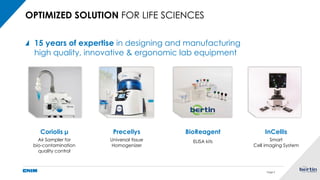
OPTIMIZED SOLUTION FOR LIFE SCIENCES
15 years of expertise in designing and manufacturing
high quality, innovative & ergonomic lab equipment
Precellys
Universal tissue
Homogenizer
InCellis
Smart
Cell imaging System
BioReagent
ELISA kits
Coriolis µ
Air Sampler for
bio-contamination
quality control
Page 6
CORIOLIS® µ
SINCE 2009
Air Sampler for bio-contamination
quality control
FRENCH ARMY PROJECT
SINCE 2006
Portable Air Sampler for airborne
pathogens detection
MONALISA PROJECTS
2006-2009
Validation of a new method for
pollen and allergen detection
10 YEARS OF WET CYCLONE TECHNOLOGY IMPLEMENTATION
CORIOLIS COMPACT
SINCE 2020
Compact and lightweight Air
Sampler for bio-contamination
quality control
Page 7
CORIOLIS: APPROVED BY KOL WORLDWIDE
Page 8
CORIOLIS µ PRODUCT DESCRIPTION
Dimensions: 220 x330 x 360 mm
Weight: 2,8 kg
Noise: 70 dBa at 300 L/min
Usage temperature: between + 5 /+ 40 ° C
Autonomy : 1h on battery, up to 6h with Long Time Monitoring
Battery: NiMH
Air Flow: 100-300 L/min
Collect any biological sample
Use: indoor & outdoor
Page 9
CORIOLIS WET CYCLONE TECHNOLOGY
Air
Collection liquid
Particles
Bacteria, fungi, spores,
viruses, pollens, allergens,
endotoxins...
Pre-filled sterile cone with
adapted collection liquid
Air & particles enter into the cone
and form a vortex: aspirated
particles are centrifuged with the
collection liquid on the wall
Particles are concentrated into
the collection liquid
Page 10
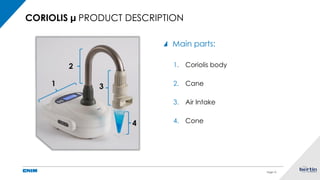
CORIOLIS µ PRODUCT DESCRIPTION
Main parts:
1. Coriolis body
2. Cane
3. Air Intake
4. Cone
Page 11
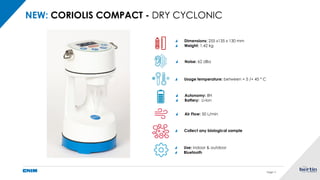
NEW: CORIOLIS COMPACT - DRY CYCLONIC
Dimensions: 255 x135 x 130 mm
Weight: 1,42 kg
Noise: 62 dBa
Usage temperature: between + 5 /+ 45 ° C
Autonomy: 8H
Battery: Li-Ion
Air Flow: 50 L/min
Collect any biological sample
Use: indoor & outdoor
Bluetooth
Page 12
CORIOLIS COMPACT: DRY CYCLONIC TECHNOLOGY
Aspirated air
goes through the
cone
Particles are
retained in the
cone wall
Collected particles
can be recovered by
rinsing the cone.
Cone is placed
on the device.
Page 13
CORIOLIS COMPACT HIGHLIGHTS
Collect more particles with up to 8h hours
straight sampling.
Sample compatible with rapid analysis
methods (qPCR).
No need of concentrate sample.
Easy to transport, can be put in strategic
places or even on a drone.
Page 14
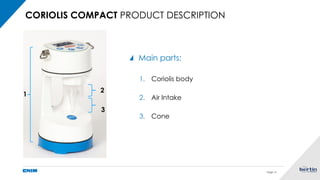
CORIOLIS COMPACT PRODUCT DESCRIPTION
Main parts:
1. Coriolis body
2. Air Intake
3. Cone
1
2
3
Page 15
COMPATIBLE WITH BIOLOGICAL ANALYSIS
Culturing methods
 Based on the study of the main phenotypic
characteristics of bacteria
Immunological methods
 Based on the recognition of a specific antigen of
the agent
Genetic methods
 Based on the recognition of a specific nucleic
acid sequence of the agent
Spectrometry methods
 Physical methods based on the recognition of
molecular structures by their mass
Page 16
ENVIRONMENTAL MONITORING OF AIRBORNE VIRUSES
HEALTH
VIRUS DETECTION IN
HOSPITALS AND
NURSING HOMES
FOOD INDUSTRY
SARS-CoV-2,
BACTERIOPHAGES
AFFECTING PRODUCTION
VETERINARY
MONITOR VIRAL
CONTAMINATION OF
LIVESTOCK IN FARMS
OFFICE SPACES
DECONTAMINATION
CONTROL DURING
PANDEMICS
Page 17
TIPS AND TRICKS SESSIONS TO COLLECT
VIRUS IN THE AIR
Page 18
WORKFLOW: FROM SAMPLING TO ANALYSIS
SAMPLING
STRATEGY
SAMPLE
COLLECTION
SAMPLE
STORAGE
SAMPLE
PROCESSING
SAMPLE
ANALYSIS
DECONTAMI-
NATION
PROCEDURES
Choose
a sampling
strategy adapted
to the
environment
(sampling room
size, air flow
patterns..)
Use
appropriate
parameters for
airflow rate
and sampling
cycles duration
Store
and transport
samples in
appropriate
conditions to avoid
RNA degradation
Optional
reconcentration
step
Get
reliable results in
hours with rapid
microbiology
techniques
Decontaminate
the Coriolis after
each experiment
Page 19
BEST PRACTICES
SAMPLING STRATEGY
 Air flow rates: Bertin recommends an airflow rate of 200 L/min but we have
ran 300 L/min using the Coriolis µ, 50L/min with the Coriolis Compact
 Sampling Duration: Minimum sampling time is 20-30 min
 Device Position: Start from the furthest distance away and move closer to
the patient. The device should always be placed on the trajectory of the
airflow in the room.
 Sampling Liquid: The optimal collection liquid for virus-laden aerosols
sampling is Phosphate Buffer Saline buffer. A culture medium such as DMEM
or MEM is also a suitable alternative. On the other hand, most RNA shields
should be avoided due to high evaporation speeds. The recommended
starting sampling volume liquid range is between 5 and 15mL.
Page 20
BEST PRACTICES (2)
SAMPLE STORAGE
 Before transportation, samples should be transferred from the cones into
appropriate storage tubes. Samples can be stored for up to 24h at 4°C. For
long term storage, they can be frozen in cryotubes at -20°C or -80°C.
SAMPLE PROCESSING
 Coriolis µ:
• Reconcentration step with a tangential flow filtration device, such as the Amicon
100 kDa Amicon Ultra-15 (Millipore)
• Or choose a small starting volume of collection liquid (such as 5mL), then taking a
small aliquot of around 150 μL for DNA or RNA extraction.
 Coriolis Compact
• Resuspend in the desired volume by using a swab or vortexing the cone
Page 21
BEST PRACTICES (3)
SAMPLE ANALYSIS
 Before transportation, samples should be transferred from the cones into
appropriate storage tubes. Samples can be stored for up to 24h at 4°C. For
long term storage they can be frozen in cryotubes at -20°C or -80°C.
DECONTAMINATION
 Cane, air intake and sampling cone
• Autoclave (except cone for Coriolis Compact)
• Soak in commercial bleach solution
• Ethanol 70%
 Instrument
• H2O2 vapor
• Run them with an ethanol-filled cone for 15min at maximum speed
* All references are available on the White paper called best practices for environmental detection and monitoring of airborne viruses with Coriolis® air samplers
Page 22
CASES STUDIES
Page 23
VIRUS DETECTION WITH CORIOLIS AIR SAMPLERS
CASE STUDIES
SARS-CoV-2 DETECTION with Coriolis® µ air sampler
NOROVIRUS DETECTION IN HOSPITALS with Coriolis® µ
SWINE INFLUENZA A VIRUS DETECTION IN PIG FARMS with Coriolis® μ
EVALUATION OF DECONTAMINATION PROCEDURE IMPACT IN
DAIRY FACTORIES with Coriolis® Compact
Page 24
Thanks to Jie Zhou to share the results and authorize us to present it.
SARS-COV-2 DETECTION WITH CORIOLIS µ AIR SAMPLER
Page 25
Objective of the study: To evaluate SARS-CoV-2 surface and air contamination during
the peak of the COVID-19 pandemic in London.
Sampling design: Surface and air samples were collected in 8 different sites including 7
clinical areas and 1 public area at a North Western London hospital. In each area, 4 air
samples were collected Surface samples were collected by swabbing 25 cm2 of items
Collection protocol: Sampling was carried out with the Coriolis μ air sampler (Bertin
Technologies, France) at 100L/min for 10 min (corresponding to 1m3 of air), with 5 mL
DMEM
Analysis: RT-qPCR and viral culture
SARS-COV-2 DETECTION WITH CORIOLIS µ AIR SAMPLER
Page 26
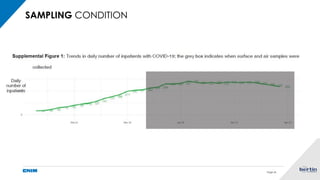
SAMPLING CONDITION
Page 27
RESULTS
Viral RNA detected in 114/218 (52.3%) of
surface samples
Viral RNA detected in 14/31 (38.7%) air
samples
PCR results showed viral RNA concentration too
low for the virus to be cultivable
Viral RNA detected in public areas of the
hospital
PCR results from air samples.
From: Zhou, J. (2020). Investigating SARS-CoV-2 surface and air contamination in an
acute healthcare setting during the peak of the COVID-19 pandemic in London.
Medrxiv.
Page 28
NOROVIRUS DETECTION IN HOSPITALS
Bonifait, Laetitia, et al. "Detection and quantification of airborne norovirus during outbreaks in healthcare
facilities." Clinical infectious diseases 61.3 (2015): 299-304.
Motivation: Noroviruses are a risk for patients in
hospitals: responsible for 50%of gastroenteritis
outbreaks worldwide
Goal: Investigate the presence of norovirus GII
bioaerosols during gastroenteritis outbreaks in
healthcare facilities
Page 29
NOROVIRUS DETECTION IN HOSPITALS: PROTOCOL
Bonifait, Laetitia, et al. "Detection and quantification of airborne norovirus during outbreaks in healthcare
facilities." Clinical infectious diseases 61.3 (2015): 299-304.
Sampling strategy: 48 samples in 8 hospitals during outbreaks
 1m from each patient
 in front of patient’s room
 at the nurses’station
Collection: Coriolis μ, 200L/min during 10min in 15mL PBS
Sample processing: Filtration and concentration of the sample with
Amicon device (Millipore)
Sample analysis: viral RNA extraction , RT-qPCR
Page 30
NOROVIRUS DETECTION IN HOSPITALS: RESULTS
Bonifait, Laetitia, et al. "Detection and quantification of airborne norovirus during outbreaks in healthcare
facilities." Clinical infectious diseases 61.3 (2015): 299-304.
Page 31
SWINE INFLUENZA A VIRUS DETECTION IN PIG FARMS
Cador, C. Hervé, S. Andraud, M. Gorin, S. Paboeuf, F. Barbier, N. Quéguiner, S. Deblanc, C. Simon, G. Rose,
N. (2016). Maternally-derived antibodies do not prevent transmission of swine influenza A virus between
pigs. Veterinary Research 47:86.
Motivation: Understanding Swine influenza A virus (swIAV)
transmission through aerosols
Goal: Determine the relationship between airborne swIAV
detection and the number of infected pigs in pig farms
swIAV detection in air samples collected in experimental
rooms housing specific-pathogen-free (SPF) pigs without or
with maternally-derived antibodies (MDA)
Page 32
SWINE INFLUENZA A VIRUS DETECTION IN PIG FARMS
Experimental design:
33 MDA- piglets were assigned to 3 independent rooms (rooms 1 to 3)
33 MDA+ piglets to 3 independent rooms (rooms 4 to 6)
In each room :
- 2 seeder pigs (inoculated with swIAV)
- 4 pigs in direct contact with seeder
pigs (same pen)
- 5 pigs in indirect contact with seeder
pigs ( different pen 30cm apart)
Page 33
SWINE INFLUENZA A VIRUS DETECTION IN PIG FARMS:
PROTOCOL
Sampling strategy:
Coriolis μ air sampling between 2 pens, 70 cm
away from the ground at the height of pigs but
without direct contact with them
Nasal swabs
Collection: 300L/min during 10min in 15mL PBS with 0.005% Triton
3 times a week for 25 days post-infection
Sample processing: Filtration and concentration of the sample with
Amicon device (Millipore)
Sample analysis: viral RNA extraction , RT-qPCR
Page 34
SWINE INFLUENZA A VIRUS DETECTION IN PIG FARMS:
RESULTS
swIAV genome was detected in aerosols from all rooms, peak at DPI 9
all indirect-contact (IC) pigs shown to be infected
Page 35
EVALUATION OF DECONTAMINATION PROCEDURE IMPACT
IN DAIRY FACTORIES
Motivation: phage infection of lactococcal bacteria can
hinder fermentation processes > delay in cheese
production, variation in taste and texture
Goal: Evaluate the impact of ozone decontamination
treatment on the bacteriophages present in the air in a
dairy factory.
Page 36
EVALUATION OF DECONTAMINATION PROCEDURE IMPACT
IN DAIRY FACTORIES: PROTOCOL
Decontamination: Alphatech Mobil disinfection unit C28 N°439
Ozone (O3) concentration target 2ppm/2h during 8h
Sampling strategy: 4 sampling times + control sample
 before ozone treatment
 just after ozone treatment
 2 days after ozone treatment
 after 2nd ozone treatment
Collection: Coriolis Compact 50L/min during 5 hours
Analysis: DNA extraction, simplex PCR specific for Lactococcus
lactis phages (limit of detection 101 to 102 phages / ml)
Coriolis Compact on dairy plant facilities.
5h at 50 l/min
Page 37
EVALUATION OF DECONTAMINATION PROCEDURE IMPACT
IN DAIRY FACTORIES: RESULTS
C2 phages /ml SK1phages /ml PP35 phages /ml
Control 0 0 0
Before O3 treatment 1000 100000 1000
Just after O3 treatment 10 1000 10
2 days after O3 treatment 100000 100000 1000
After second O3 treatment 10 100000 0
important impact of ozone treatment on C2 bacteriophages
SK1 bacteriophages population harder to reduce, 2nd treatment has no impact
Page 38
CONCLUSION
Innovative and comprehensive systems
 Coriolis μ air sampler
• High Air Flow Rate
• LTM Platform
• Liquid sampling & Molecular analysis
 Coriolis Compact air sampler
• Easy to use and to transport on the field
• Dry sampling, no resuspension step before molecular analysis
Ideal instruments for airborne viruses detection
Page 39
YOUR POINT OF CONTACT
Your sales representative:
 Sophie DUBACQ
 sophie.dubacq@bertin.fr
 +33 (0) 139 306 133
Customer service:
 Order-life@bertin.fr
 +33 (0) 139 306 036
Product manager:
sophie.dubacq@bertin.fr
Page 40

Micro Coriolis air sampler

  • 1.
    Page 1 BEST PRACTICESFOR ENVIRONMENTAL DETECTION AND MONITORING OF AIRBORNE VIRUSES WITH CORIOLIS AIR SAMPLERS
  • 2.
    Page 2 Dr. MartinSerrano Sanchez, Field Application Scientist at Bertin Technologies (AM session) Dr. Floriane Cohen, Field Application Scientist at Bertin Technologies (PM session) Sophie Dubacq, Product Manager at Bertin Technologies I. INTRODUCTION: PRESENTATION OF CORIOLIS AIR SAMPLERS II. TIPS & TRICKS TO COLLECT VIRUS III. CASE STUDIES: CORIOLIS FOR AIRBORNE VIRUS DETECTION Q&A SESSION AGENDA OF THE SESSION
  • 3.
    Page 3 WEBINAR RULES Yourmicrophone will be muted during the presentation to minimize the interferences and back ground noises. If you have questions or remarks during the presentation, please write it in the question box. After the presentation, speakers will answer to your questions.
  • 4.
    Page 4 INTRODUCTION: PRESENTATIONOF CORIOLIS AIR SAMPLERS
  • 5.
    Page 5 OPTIMIZED SOLUTIONFOR LIFE SCIENCES 15 years of expertise in designing and manufacturing high quality, innovative & ergonomic lab equipment Precellys Universal tissue Homogenizer InCellis Smart Cell imaging System BioReagent ELISA kits Coriolis µ Air Sampler for bio-contamination quality control
  • 6.
    Page 6 CORIOLIS® µ SINCE2009 Air Sampler for bio-contamination quality control FRENCH ARMY PROJECT SINCE 2006 Portable Air Sampler for airborne pathogens detection MONALISA PROJECTS 2006-2009 Validation of a new method for pollen and allergen detection 10 YEARS OF WET CYCLONE TECHNOLOGY IMPLEMENTATION CORIOLIS COMPACT SINCE 2020 Compact and lightweight Air Sampler for bio-contamination quality control
  • 7.
    Page 7 CORIOLIS: APPROVEDBY KOL WORLDWIDE
  • 8.
    Page 8 CORIOLIS µPRODUCT DESCRIPTION Dimensions: 220 x330 x 360 mm Weight: 2,8 kg Noise: 70 dBa at 300 L/min Usage temperature: between + 5 /+ 40 ° C Autonomy : 1h on battery, up to 6h with Long Time Monitoring Battery: NiMH Air Flow: 100-300 L/min Collect any biological sample Use: indoor & outdoor
  • 9.
    Page 9 CORIOLIS WETCYCLONE TECHNOLOGY Air Collection liquid Particles Bacteria, fungi, spores, viruses, pollens, allergens, endotoxins... Pre-filled sterile cone with adapted collection liquid Air & particles enter into the cone and form a vortex: aspirated particles are centrifuged with the collection liquid on the wall Particles are concentrated into the collection liquid
  • 10.
    Page 10 CORIOLIS µPRODUCT DESCRIPTION Main parts: 1. Coriolis body 2. Cane 3. Air Intake 4. Cone
  • 11.
    Page 11 NEW: CORIOLISCOMPACT - DRY CYCLONIC Dimensions: 255 x135 x 130 mm Weight: 1,42 kg Noise: 62 dBa Usage temperature: between + 5 /+ 45 ° C Autonomy: 8H Battery: Li-Ion Air Flow: 50 L/min Collect any biological sample Use: indoor & outdoor Bluetooth
  • 12.
    Page 12 CORIOLIS COMPACT:DRY CYCLONIC TECHNOLOGY Aspirated air goes through the cone Particles are retained in the cone wall Collected particles can be recovered by rinsing the cone. Cone is placed on the device.
  • 13.
    Page 13 CORIOLIS COMPACTHIGHLIGHTS Collect more particles with up to 8h hours straight sampling. Sample compatible with rapid analysis methods (qPCR). No need of concentrate sample. Easy to transport, can be put in strategic places or even on a drone.
  • 14.
    Page 14 CORIOLIS COMPACTPRODUCT DESCRIPTION Main parts: 1. Coriolis body 2. Air Intake 3. Cone 1 2 3
  • 15.
    Page 15 COMPATIBLE WITHBIOLOGICAL ANALYSIS Culturing methods  Based on the study of the main phenotypic characteristics of bacteria Immunological methods  Based on the recognition of a specific antigen of the agent Genetic methods  Based on the recognition of a specific nucleic acid sequence of the agent Spectrometry methods  Physical methods based on the recognition of molecular structures by their mass
  • 16.
    Page 16 ENVIRONMENTAL MONITORINGOF AIRBORNE VIRUSES HEALTH VIRUS DETECTION IN HOSPITALS AND NURSING HOMES FOOD INDUSTRY SARS-CoV-2, BACTERIOPHAGES AFFECTING PRODUCTION VETERINARY MONITOR VIRAL CONTAMINATION OF LIVESTOCK IN FARMS OFFICE SPACES DECONTAMINATION CONTROL DURING PANDEMICS
  • 17.
    Page 17 TIPS ANDTRICKS SESSIONS TO COLLECT VIRUS IN THE AIR
  • 18.
    Page 18 WORKFLOW: FROMSAMPLING TO ANALYSIS SAMPLING STRATEGY SAMPLE COLLECTION SAMPLE STORAGE SAMPLE PROCESSING SAMPLE ANALYSIS DECONTAMI- NATION PROCEDURES Choose a sampling strategy adapted to the environment (sampling room size, air flow patterns..) Use appropriate parameters for airflow rate and sampling cycles duration Store and transport samples in appropriate conditions to avoid RNA degradation Optional reconcentration step Get reliable results in hours with rapid microbiology techniques Decontaminate the Coriolis after each experiment
  • 19.
    Page 19 BEST PRACTICES SAMPLINGSTRATEGY  Air flow rates: Bertin recommends an airflow rate of 200 L/min but we have ran 300 L/min using the Coriolis µ, 50L/min with the Coriolis Compact  Sampling Duration: Minimum sampling time is 20-30 min  Device Position: Start from the furthest distance away and move closer to the patient. The device should always be placed on the trajectory of the airflow in the room.  Sampling Liquid: The optimal collection liquid for virus-laden aerosols sampling is Phosphate Buffer Saline buffer. A culture medium such as DMEM or MEM is also a suitable alternative. On the other hand, most RNA shields should be avoided due to high evaporation speeds. The recommended starting sampling volume liquid range is between 5 and 15mL.
  • 20.
    Page 20 BEST PRACTICES(2) SAMPLE STORAGE  Before transportation, samples should be transferred from the cones into appropriate storage tubes. Samples can be stored for up to 24h at 4°C. For long term storage, they can be frozen in cryotubes at -20°C or -80°C. SAMPLE PROCESSING  Coriolis µ: • Reconcentration step with a tangential flow filtration device, such as the Amicon 100 kDa Amicon Ultra-15 (Millipore) • Or choose a small starting volume of collection liquid (such as 5mL), then taking a small aliquot of around 150 μL for DNA or RNA extraction.  Coriolis Compact • Resuspend in the desired volume by using a swab or vortexing the cone
  • 21.
    Page 21 BEST PRACTICES(3) SAMPLE ANALYSIS  Before transportation, samples should be transferred from the cones into appropriate storage tubes. Samples can be stored for up to 24h at 4°C. For long term storage they can be frozen in cryotubes at -20°C or -80°C. DECONTAMINATION  Cane, air intake and sampling cone • Autoclave (except cone for Coriolis Compact) • Soak in commercial bleach solution • Ethanol 70%  Instrument • H2O2 vapor • Run them with an ethanol-filled cone for 15min at maximum speed * All references are available on the White paper called best practices for environmental detection and monitoring of airborne viruses with Coriolis® air samplers
  • 22.
  • 23.
    Page 23 VIRUS DETECTIONWITH CORIOLIS AIR SAMPLERS CASE STUDIES SARS-CoV-2 DETECTION with Coriolis® µ air sampler NOROVIRUS DETECTION IN HOSPITALS with Coriolis® µ SWINE INFLUENZA A VIRUS DETECTION IN PIG FARMS with Coriolis® μ EVALUATION OF DECONTAMINATION PROCEDURE IMPACT IN DAIRY FACTORIES with Coriolis® Compact
  • 24.
    Page 24 Thanks toJie Zhou to share the results and authorize us to present it. SARS-COV-2 DETECTION WITH CORIOLIS µ AIR SAMPLER
  • 25.
    Page 25 Objective ofthe study: To evaluate SARS-CoV-2 surface and air contamination during the peak of the COVID-19 pandemic in London. Sampling design: Surface and air samples were collected in 8 different sites including 7 clinical areas and 1 public area at a North Western London hospital. In each area, 4 air samples were collected Surface samples were collected by swabbing 25 cm2 of items Collection protocol: Sampling was carried out with the Coriolis μ air sampler (Bertin Technologies, France) at 100L/min for 10 min (corresponding to 1m3 of air), with 5 mL DMEM Analysis: RT-qPCR and viral culture SARS-COV-2 DETECTION WITH CORIOLIS µ AIR SAMPLER
  • 26.
  • 27.
    Page 27 RESULTS Viral RNAdetected in 114/218 (52.3%) of surface samples Viral RNA detected in 14/31 (38.7%) air samples PCR results showed viral RNA concentration too low for the virus to be cultivable Viral RNA detected in public areas of the hospital PCR results from air samples. From: Zhou, J. (2020). Investigating SARS-CoV-2 surface and air contamination in an acute healthcare setting during the peak of the COVID-19 pandemic in London. Medrxiv.
  • 28.
    Page 28 NOROVIRUS DETECTIONIN HOSPITALS Bonifait, Laetitia, et al. "Detection and quantification of airborne norovirus during outbreaks in healthcare facilities." Clinical infectious diseases 61.3 (2015): 299-304. Motivation: Noroviruses are a risk for patients in hospitals: responsible for 50%of gastroenteritis outbreaks worldwide Goal: Investigate the presence of norovirus GII bioaerosols during gastroenteritis outbreaks in healthcare facilities
  • 29.
    Page 29 NOROVIRUS DETECTIONIN HOSPITALS: PROTOCOL Bonifait, Laetitia, et al. "Detection and quantification of airborne norovirus during outbreaks in healthcare facilities." Clinical infectious diseases 61.3 (2015): 299-304. Sampling strategy: 48 samples in 8 hospitals during outbreaks  1m from each patient  in front of patient’s room  at the nurses’station Collection: Coriolis μ, 200L/min during 10min in 15mL PBS Sample processing: Filtration and concentration of the sample with Amicon device (Millipore) Sample analysis: viral RNA extraction , RT-qPCR
  • 30.
    Page 30 NOROVIRUS DETECTIONIN HOSPITALS: RESULTS Bonifait, Laetitia, et al. "Detection and quantification of airborne norovirus during outbreaks in healthcare facilities." Clinical infectious diseases 61.3 (2015): 299-304.
  • 31.
    Page 31 SWINE INFLUENZAA VIRUS DETECTION IN PIG FARMS Cador, C. Hervé, S. Andraud, M. Gorin, S. Paboeuf, F. Barbier, N. Quéguiner, S. Deblanc, C. Simon, G. Rose, N. (2016). Maternally-derived antibodies do not prevent transmission of swine influenza A virus between pigs. Veterinary Research 47:86. Motivation: Understanding Swine influenza A virus (swIAV) transmission through aerosols Goal: Determine the relationship between airborne swIAV detection and the number of infected pigs in pig farms swIAV detection in air samples collected in experimental rooms housing specific-pathogen-free (SPF) pigs without or with maternally-derived antibodies (MDA)
  • 32.
    Page 32 SWINE INFLUENZAA VIRUS DETECTION IN PIG FARMS Experimental design: 33 MDA- piglets were assigned to 3 independent rooms (rooms 1 to 3) 33 MDA+ piglets to 3 independent rooms (rooms 4 to 6) In each room : - 2 seeder pigs (inoculated with swIAV) - 4 pigs in direct contact with seeder pigs (same pen) - 5 pigs in indirect contact with seeder pigs ( different pen 30cm apart)
  • 33.
    Page 33 SWINE INFLUENZAA VIRUS DETECTION IN PIG FARMS: PROTOCOL Sampling strategy: Coriolis μ air sampling between 2 pens, 70 cm away from the ground at the height of pigs but without direct contact with them Nasal swabs Collection: 300L/min during 10min in 15mL PBS with 0.005% Triton 3 times a week for 25 days post-infection Sample processing: Filtration and concentration of the sample with Amicon device (Millipore) Sample analysis: viral RNA extraction , RT-qPCR
  • 34.
    Page 34 SWINE INFLUENZAA VIRUS DETECTION IN PIG FARMS: RESULTS swIAV genome was detected in aerosols from all rooms, peak at DPI 9 all indirect-contact (IC) pigs shown to be infected
  • 35.
    Page 35 EVALUATION OFDECONTAMINATION PROCEDURE IMPACT IN DAIRY FACTORIES Motivation: phage infection of lactococcal bacteria can hinder fermentation processes > delay in cheese production, variation in taste and texture Goal: Evaluate the impact of ozone decontamination treatment on the bacteriophages present in the air in a dairy factory.
  • 36.
    Page 36 EVALUATION OFDECONTAMINATION PROCEDURE IMPACT IN DAIRY FACTORIES: PROTOCOL Decontamination: Alphatech Mobil disinfection unit C28 N°439 Ozone (O3) concentration target 2ppm/2h during 8h Sampling strategy: 4 sampling times + control sample  before ozone treatment  just after ozone treatment  2 days after ozone treatment  after 2nd ozone treatment Collection: Coriolis Compact 50L/min during 5 hours Analysis: DNA extraction, simplex PCR specific for Lactococcus lactis phages (limit of detection 101 to 102 phages / ml) Coriolis Compact on dairy plant facilities. 5h at 50 l/min
  • 37.
    Page 37 EVALUATION OFDECONTAMINATION PROCEDURE IMPACT IN DAIRY FACTORIES: RESULTS C2 phages /ml SK1phages /ml PP35 phages /ml Control 0 0 0 Before O3 treatment 1000 100000 1000 Just after O3 treatment 10 1000 10 2 days after O3 treatment 100000 100000 1000 After second O3 treatment 10 100000 0 important impact of ozone treatment on C2 bacteriophages SK1 bacteriophages population harder to reduce, 2nd treatment has no impact
  • 38.
    Page 38 CONCLUSION Innovative andcomprehensive systems  Coriolis μ air sampler • High Air Flow Rate • LTM Platform • Liquid sampling & Molecular analysis  Coriolis Compact air sampler • Easy to use and to transport on the field • Dry sampling, no resuspension step before molecular analysis Ideal instruments for airborne viruses detection
  • 39.
    Page 39 YOUR POINTOF CONTACT Your sales representative:  Sophie DUBACQ  sophie.dubacq@bertin.fr  +33 (0) 139 306 133 Customer service:  Order-life@bertin.fr  +33 (0) 139 306 036 Product manager: sophie.dubacq@bertin.fr
  • 40.