XML & Scripting
BY:SURBHI SAROHA
XML
 XML stands for eXtensible Markup Language
 XML is a markup language much like HTML
 XML was designed to store and transport data
 XML was designed to be self-descriptive
 XML is a W3C Recommendation
The Difference Between XML and HTML
 XML and HTML were designed with different goals:
 XML was designed to carry data - with focus on what data is.
 HTML was designed to display data - with focus on how data looks.
 XML tags are not predefined like HTML tags are.
XML Does Not Use Predefined Tags
 The XML language has no predefined tags.
 The tags in the example above (like <to> and <from>) are not defined in any
XML standard. These tags are "invented" by the author of the XML document.
 HTML works with predefined tags like <p>, <h1>, <table>, etc.
 With XML, the author must define both the tags and the document structure.
PROGRAM
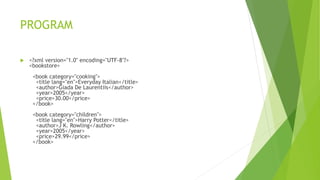
 <?xml version="1.0" encoding="UTF-8"?>
<bookstore>
<book category="cooking">
<title lang="en">Everyday Italian</title>
<author>Giada De Laurentiis</author>
<year>2005</year>
<price>30.00</price>
</book>
<book category="children">
<title lang="en">Harry Potter</title>
<author>J K. Rowling</author>
<year>2005</year>
<price>29.99</price>
</book>
CONT…..
 <book category="web">
<title lang="en">XQuery Kick Start</title>
<author>James McGovern</author>
<author>Per Bothner</author>
<author>Kurt Cagle</author>
<author>James Linn</author>
<author>Vaidyanathan Nagarajan</author>
<year>2003</year>
<price>49.99</price>
</book>
<book category="web" cover="paperback">
<title lang="en">Learning XML</title>
<author>Erik T. Ray</author>
<year>2003</year>
<price>39.95</price>
</book>
</bookstore>
Scripting
 All scripting languages are programming languages.
 The scripting language is basically a language where instructions are written
for a run time environment.
 They do not require the compilation step and are rather interpreted.
 It brings new functions to applications and glue complex system together.
 A scripting language is a programming language designed for integrating and
communicating with other programming languages.
There are many scripting languages
some of them are discussed below:
 bash: It is a scripting language to work in the Linux interface. It is a lot easier
to use bash to create scripts than other programming languages. It describes
the tools to use and code in the command line and create useful reusable
scripts and conserve documentation for other people to work with.
 Node js: It is a framework to write network applications using JavaScript.
Corporate users of Node.js include IBM, LinkedIn, Microsoft, Netflix, PayPal,
Yahoo for real-time web applications.
 Ruby: There are a lot of reasons to learn Ruby programming language. Ruby’s
flexibility has allowed developers to create innovative software. It is a
scripting language which is great for web development.
CONT…..
 Python: It is easy, free and open source. It supports procedure-oriented
programming and object-oriented programming. Python is an interpreted
language with dynamic semantics and huge lines of code are scripted and is
currently the most hyped language among developers.
 Perl: A scripting language with innovative features to make it different and
popular. Found on all windows and Linux servers. It helps in text manipulation
tasks. High traffic websites that use Perl extensively include priceline.com,
IMDB.
Advantages of scripting languages:
 Easy learning: The user can learn to code in scripting languages quickly, not
much knowledge of web technology is required.
 Fast editing: It is highly efficient with the limited number of data structures
and variables to use.
 Interactivity: It helps in adding visualization interfaces and combinations in
web pages. Modern web pages demand the use of scripting languages. To
create enhanced web pages, fascinated visual description which includes
background and foreground colors and so on.
 Functionality: There are different libraries which are part of different
scripting languages. They help in creating new applications in web browsers
and are different from normal programming languages.
THANK YOU

Xml & scripting

  • 1.
  • 2.
    XML  XML standsfor eXtensible Markup Language  XML is a markup language much like HTML  XML was designed to store and transport data  XML was designed to be self-descriptive  XML is a W3C Recommendation
  • 3.
    The Difference BetweenXML and HTML  XML and HTML were designed with different goals:  XML was designed to carry data - with focus on what data is.  HTML was designed to display data - with focus on how data looks.  XML tags are not predefined like HTML tags are.
  • 4.
    XML Does NotUse Predefined Tags  The XML language has no predefined tags.  The tags in the example above (like <to> and <from>) are not defined in any XML standard. These tags are "invented" by the author of the XML document.  HTML works with predefined tags like <p>, <h1>, <table>, etc.  With XML, the author must define both the tags and the document structure.
  • 5.
    PROGRAM  <?xml version="1.0"encoding="UTF-8"?> <bookstore> <book category="cooking"> <title lang="en">Everyday Italian</title> <author>Giada De Laurentiis</author> <year>2005</year> <price>30.00</price> </book> <book category="children"> <title lang="en">Harry Potter</title> <author>J K. Rowling</author> <year>2005</year> <price>29.99</price> </book>
  • 6.
    CONT…..  <book category="web"> <titlelang="en">XQuery Kick Start</title> <author>James McGovern</author> <author>Per Bothner</author> <author>Kurt Cagle</author> <author>James Linn</author> <author>Vaidyanathan Nagarajan</author> <year>2003</year> <price>49.99</price> </book> <book category="web" cover="paperback"> <title lang="en">Learning XML</title> <author>Erik T. Ray</author> <year>2003</year> <price>39.95</price> </book> </bookstore>
  • 7.
    Scripting  All scriptinglanguages are programming languages.  The scripting language is basically a language where instructions are written for a run time environment.  They do not require the compilation step and are rather interpreted.  It brings new functions to applications and glue complex system together.  A scripting language is a programming language designed for integrating and communicating with other programming languages.
  • 8.
    There are manyscripting languages some of them are discussed below:  bash: It is a scripting language to work in the Linux interface. It is a lot easier to use bash to create scripts than other programming languages. It describes the tools to use and code in the command line and create useful reusable scripts and conserve documentation for other people to work with.  Node js: It is a framework to write network applications using JavaScript. Corporate users of Node.js include IBM, LinkedIn, Microsoft, Netflix, PayPal, Yahoo for real-time web applications.  Ruby: There are a lot of reasons to learn Ruby programming language. Ruby’s flexibility has allowed developers to create innovative software. It is a scripting language which is great for web development.
  • 9.
    CONT…..  Python: Itis easy, free and open source. It supports procedure-oriented programming and object-oriented programming. Python is an interpreted language with dynamic semantics and huge lines of code are scripted and is currently the most hyped language among developers.  Perl: A scripting language with innovative features to make it different and popular. Found on all windows and Linux servers. It helps in text manipulation tasks. High traffic websites that use Perl extensively include priceline.com, IMDB.
  • 10.
    Advantages of scriptinglanguages:  Easy learning: The user can learn to code in scripting languages quickly, not much knowledge of web technology is required.  Fast editing: It is highly efficient with the limited number of data structures and variables to use.  Interactivity: It helps in adding visualization interfaces and combinations in web pages. Modern web pages demand the use of scripting languages. To create enhanced web pages, fascinated visual description which includes background and foreground colors and so on.  Functionality: There are different libraries which are part of different scripting languages. They help in creating new applications in web browsers and are different from normal programming languages.
  • 11.