Web 2.0 for Nonprofits :  An introduction to the new tools and rules Jocelyn Harmon, NPower Greater DC Region Kari Dunn, Case Foundation
Agenda What is it? Why should nonprofits care? Who’s online? The Tools Case Studies Resources
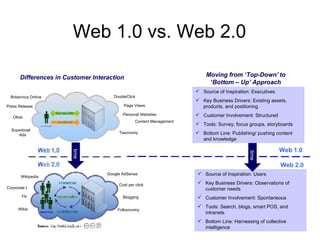
Web 1.0 vs. Web 2.0 Flickr Corporate Blogs Content Management Web 1.0 Web 2.0 Moving from ‘Top-Down’ to ‘Bottom – Up’ Approach Source of Inspiration: Executives Key Business Drivers: Existing assets, products, and positioning Customer Involvement: Structured Tools: Survey, focus groups, storyboards Bottom Line: Publishing/ pushing content and knowledge Source of Inspiration: Users Key Business Drivers: Observations of customer needs Customer Involvement: Spontaneous Tools: Search, blogs, smart POS, and intranets Bottom Line: Harnessing of collective intelligence time DoubleClick Google AdSense Ofoto Press Release Britannica Online Wikipedia Personal Websites Blogging  Superbowl Ads Page Views Cost per click Wikis Taxonomy Folksonomy Differences in Customer Interaction time
What is it? "Web 2.0" or  two-way dialogue  is more about the culture of an organization than its' tools. In a Web 1.0 organization, decision making is hierarchical. A few senior staffers go off on THE ANNUAL RETREAT and return with marching orders. Conversely, in a Web 2.0 environment an organization OPENS the door for staff, volunteers, donors, clients and other key stakeholders to be a part of the decision-making process.  Source: Nonprofit Technology Blog - Inspired by Alison Fine author of  Social Momentum: Igniting Change in the Connected Age.
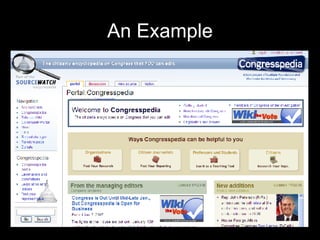
An Example
Why nonprofits (your grantees) should care Web 2.0 tools can help you  expand your reach  and may   be a great complement to existing marketing and media. The “viral” nature of the tools can lead to  an increase in donations, participation, and sales for the smart charity.
Why nonprofits (your grantees) should care Web 2.0 tools can help you  expand your audience especially of young people. Note:  87% of 18 – 29 year olds are online!  Source: Pew Internet and American Life Project
Why nonprofits (your grantees) should care Web 2.0 tools can enhance your brand and make it more visible. Now even the smallest and poorest groups have the opportunity  to talk and be heard.
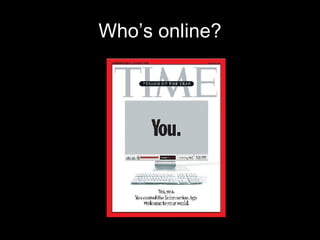
Who’s online?
The Stats 71% of American adults are online 91% of online adults send or read e-mail 57% of online adults have used the internet to watch or download video 54% of online adults look online for news or information about politics or the upcoming campaigns
The Stats 39% of internet users, or  57 million American adults, read blogs 32% of online adults rate a product, service or person using an online rating system 170 million MySpace members Source: Pew Internet & American Life Project
The Tools
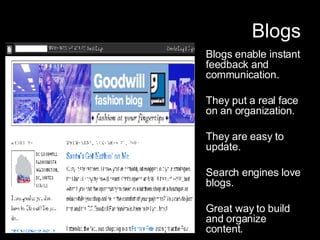
Blogs Blogs enable instant feedback and communication. They put a real face on an organization. They are easy to update. Search engines love blogs. Great way to build and organize content.
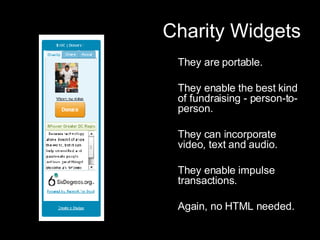
Charity Widgets They are portable.  They enable the best kind of fundraising - person-to-person. They can incorporate video, text and audio. They enable impulse transactions. Again, no HTML needed.
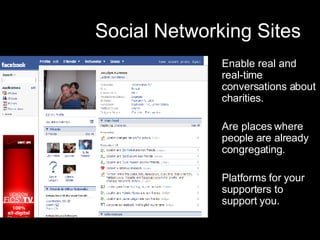
Social Networking Sites Enable real and real-time conversations about charities. Are places where people are already congregating.  Platforms for your supporters to support you.
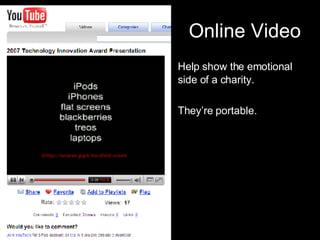
Online Video Help show the emotional side of a charity. They’re portable.
Don’t Forget the Back End You’ll still need a way to  track and communicate  with stakeholders and  collect cash!
Learn from the Best Alison Fine Beth Kanter’s Blog Case Foundation Facebook Kiva NetSquared Nonprofit Marketing Blog  Razoo Seth Godin
Summary “ The Internet's major innovation continues to be the power that it puts into the hands of the people who have traditionally stood outside the process.” USE IT! (my edition) Source: Democracy in ACTION.org
Democratizing Philanthropy - 2.0 Meyer Foundation - 01.09.08
LANDSCAPE Billions of dollars invested  in Civic Engagement  & Increase in programs that “do good” –  1.5 million nonprofits   but … Incremental gains in volunteering  – 1/3 of the nation and falling since September 11. Increased social isolation –  A  quarter of Americans feel isolated , more than double since 1985. Decline in civic participation –  Civic health at all time low.
WHAT TO DO? Has civic engagement become a cultural ethos?  Interviews and research show:  Service is a cultural ethos but  civic engagement is not . What needs to happen? People need to have  more chances to connect  with one another and  figure out how they can work together for the common good .
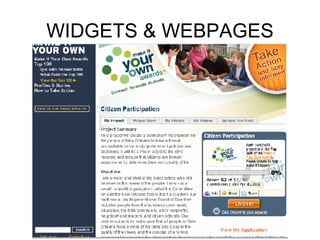
Make It Your Own Awards™ An initiative of the Case Foundation to inspire people to join together to  discuss what matters  most, determine  common issues ,  create a vision ,  form solutions , and  take action  as a community.
THE PROCESS •  YOU HAVE A VOICE :  This new program is part of an exciting trend  –  a “citizen-centered” approach that involves the public in nearly every aspect of the program.  Short applications  accepted online Community-based reviewers  select top 100 100 pitch ideas as a  full proposal Judges choose  20 $10,000 grant  recipients  •  YOU  VOTE :  The online community selects  four $25,000  grant recipients from the Top 20 finalists.
TIMING IS EVERYTHING Cultural changes and  powerful new tools  are  empowering individuals at unprecedented levels. Web 2.0 enables organizations, products, etc., be  “spread” across the Internet  on a  large scale, quickly and efficiently .  Profile is “hub” through which  friends can connect , interests extended, applications resident, etc.  A personal online service , integrating all aspects of daily tasks, outreach and communication.
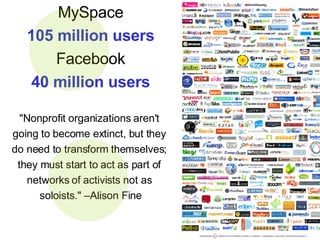
MySpace 105 million users Facebook 40 million users "Nonprofit organizations aren't  going to become extinct, but they  do need to transform themselves;  they must start to act as part of  networks of activists not as  soloists." –Alison Fine
REACHING GEN Y A Marketing Approach Living the “Cliffs Notes” version of life Long lists of interests, but no specialty in any one area Demands VIP Treatment Social networking dominates lifestyle Create anti-social behavior because they hide behind made-up worlds Only 24% feel they are as happy as they should be – spurred by competitiveness and high expectations.  Being financially secure (88%) and making families proud (82%) are most important life expectations. Education is the most important issue for Gen X & Y (87%) GenY needs a sense of urgency: NEED specificity! Tell them what to do and how to do it! Corporations are more effective than government Taken from the Cassandra Report, The Intelligence Group, CAA
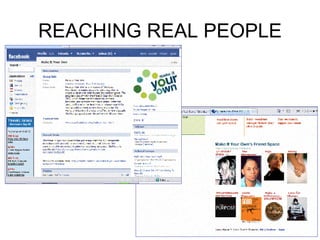
REACHING REAL PEOPLE
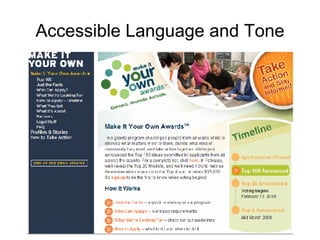
Accessible Language and Tone
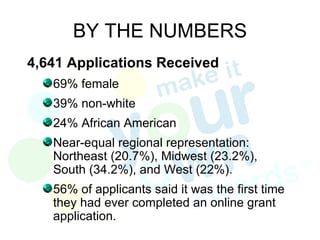
BY THE NUMBERS 4,641 Applications Received 69% female 39% non-white  24% African American Near-equal regional representation: Northeast (20.7%), Midwest (23.2%), South (34.2%), and West (22%). 56% of applicants said it was the first time they had ever completed an online grant application.
WIDGETS & WEBPAGES
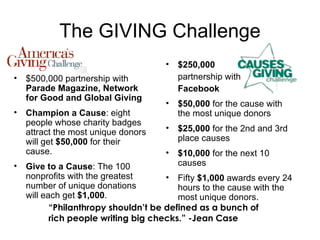
The GIVING Challenge $500,000 partnership with  Parade Magazine, Network for Good and Global Giving Champion a Cause : eight people whose charity badges attract the most unique donors will get  $50,000  for their cause.  Give to a Cause : The 100 nonprofits with the greatest number of unique donations will each get  $1,000 .  $250,000  partnership with   Facebook $50,000  for the cause with the most unique donors  $25,000  for the 2nd and 3rd place causes  $10,000  for the next 10 causes  Fifty  $1,000  awards every 24 hours to the cause with the most unique donors.  “ Philanthropy shouldn’t be defined as a bunch of rich people writing big checks.” -Jean Case
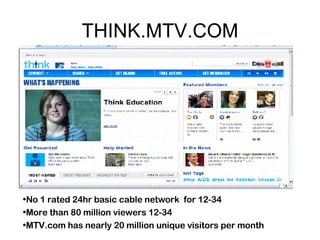
THINK.MTV.COM No 1 rated 24hr basic cable network  for 12-34 More than 80 million viewers 12-34  MTV.com has nearly 20 million unique visitors per month
THE NEXT 5 The Next 5 is comprised of three main components:  Release of white paper that highlights how Millennials are finding the intersection between new social media and social networking – and leveraging it for good.  On and Offline discussions and convenings to help inform and set stage for grant competition (guidelines, grant amounts, structure)  and a series of online interviews with some of the most influential Millennials in this space.  Competitive Grant Competition – recognizing Millennials in each of five categories who are demonstrating new and effective ways they are leveraging technology for social change.

Web 2

  • 1.
    Web 2.0 forNonprofits : An introduction to the new tools and rules Jocelyn Harmon, NPower Greater DC Region Kari Dunn, Case Foundation
  • 2.
    Agenda What isit? Why should nonprofits care? Who’s online? The Tools Case Studies Resources
  • 3.
    Web 1.0 vs.Web 2.0 Flickr Corporate Blogs Content Management Web 1.0 Web 2.0 Moving from ‘Top-Down’ to ‘Bottom – Up’ Approach Source of Inspiration: Executives Key Business Drivers: Existing assets, products, and positioning Customer Involvement: Structured Tools: Survey, focus groups, storyboards Bottom Line: Publishing/ pushing content and knowledge Source of Inspiration: Users Key Business Drivers: Observations of customer needs Customer Involvement: Spontaneous Tools: Search, blogs, smart POS, and intranets Bottom Line: Harnessing of collective intelligence time DoubleClick Google AdSense Ofoto Press Release Britannica Online Wikipedia Personal Websites Blogging Superbowl Ads Page Views Cost per click Wikis Taxonomy Folksonomy Differences in Customer Interaction time
  • 4.
    What is it?"Web 2.0" or two-way dialogue is more about the culture of an organization than its' tools. In a Web 1.0 organization, decision making is hierarchical. A few senior staffers go off on THE ANNUAL RETREAT and return with marching orders. Conversely, in a Web 2.0 environment an organization OPENS the door for staff, volunteers, donors, clients and other key stakeholders to be a part of the decision-making process. Source: Nonprofit Technology Blog - Inspired by Alison Fine author of Social Momentum: Igniting Change in the Connected Age.
  • 5.
  • 6.
    Why nonprofits (yourgrantees) should care Web 2.0 tools can help you expand your reach and may be a great complement to existing marketing and media. The “viral” nature of the tools can lead to an increase in donations, participation, and sales for the smart charity.
  • 7.
    Why nonprofits (yourgrantees) should care Web 2.0 tools can help you expand your audience especially of young people. Note: 87% of 18 – 29 year olds are online! Source: Pew Internet and American Life Project
  • 8.
    Why nonprofits (yourgrantees) should care Web 2.0 tools can enhance your brand and make it more visible. Now even the smallest and poorest groups have the opportunity to talk and be heard.
  • 9.
  • 10.
    The Stats 71%of American adults are online 91% of online adults send or read e-mail 57% of online adults have used the internet to watch or download video 54% of online adults look online for news or information about politics or the upcoming campaigns
  • 11.
    The Stats 39%of internet users, or 57 million American adults, read blogs 32% of online adults rate a product, service or person using an online rating system 170 million MySpace members Source: Pew Internet & American Life Project
  • 12.
  • 13.
    Blogs Blogs enableinstant feedback and communication. They put a real face on an organization. They are easy to update. Search engines love blogs. Great way to build and organize content.
  • 14.
    Charity Widgets Theyare portable. They enable the best kind of fundraising - person-to-person. They can incorporate video, text and audio. They enable impulse transactions. Again, no HTML needed.
  • 15.
    Social Networking SitesEnable real and real-time conversations about charities. Are places where people are already congregating. Platforms for your supporters to support you.
  • 16.
    Online Video Helpshow the emotional side of a charity. They’re portable.
  • 17.
    Don’t Forget theBack End You’ll still need a way to track and communicate with stakeholders and collect cash!
  • 18.
    Learn from theBest Alison Fine Beth Kanter’s Blog Case Foundation Facebook Kiva NetSquared Nonprofit Marketing Blog Razoo Seth Godin
  • 19.
    Summary “ TheInternet's major innovation continues to be the power that it puts into the hands of the people who have traditionally stood outside the process.” USE IT! (my edition) Source: Democracy in ACTION.org
  • 20.
    Democratizing Philanthropy -2.0 Meyer Foundation - 01.09.08
  • 21.
    LANDSCAPE Billions ofdollars invested in Civic Engagement & Increase in programs that “do good” – 1.5 million nonprofits but … Incremental gains in volunteering – 1/3 of the nation and falling since September 11. Increased social isolation – A quarter of Americans feel isolated , more than double since 1985. Decline in civic participation – Civic health at all time low.
  • 22.
    WHAT TO DO?Has civic engagement become a cultural ethos? Interviews and research show: Service is a cultural ethos but civic engagement is not . What needs to happen? People need to have more chances to connect with one another and figure out how they can work together for the common good .
  • 23.
    Make It YourOwn Awards™ An initiative of the Case Foundation to inspire people to join together to discuss what matters most, determine common issues , create a vision , form solutions , and take action as a community.
  • 24.
    THE PROCESS • YOU HAVE A VOICE : This new program is part of an exciting trend – a “citizen-centered” approach that involves the public in nearly every aspect of the program. Short applications accepted online Community-based reviewers select top 100 100 pitch ideas as a full proposal Judges choose 20 $10,000 grant recipients • YOU VOTE : The online community selects four $25,000 grant recipients from the Top 20 finalists.
  • 25.
    TIMING IS EVERYTHINGCultural changes and powerful new tools are empowering individuals at unprecedented levels. Web 2.0 enables organizations, products, etc., be “spread” across the Internet on a large scale, quickly and efficiently . Profile is “hub” through which friends can connect , interests extended, applications resident, etc. A personal online service , integrating all aspects of daily tasks, outreach and communication.
  • 26.
    MySpace 105 millionusers Facebook 40 million users "Nonprofit organizations aren't going to become extinct, but they do need to transform themselves; they must start to act as part of networks of activists not as soloists." –Alison Fine
  • 27.
    REACHING GEN YA Marketing Approach Living the “Cliffs Notes” version of life Long lists of interests, but no specialty in any one area Demands VIP Treatment Social networking dominates lifestyle Create anti-social behavior because they hide behind made-up worlds Only 24% feel they are as happy as they should be – spurred by competitiveness and high expectations. Being financially secure (88%) and making families proud (82%) are most important life expectations. Education is the most important issue for Gen X & Y (87%) GenY needs a sense of urgency: NEED specificity! Tell them what to do and how to do it! Corporations are more effective than government Taken from the Cassandra Report, The Intelligence Group, CAA
  • 28.
  • 29.
  • 30.
  • 31.
    BY THE NUMBERS4,641 Applications Received 69% female 39% non-white 24% African American Near-equal regional representation: Northeast (20.7%), Midwest (23.2%), South (34.2%), and West (22%). 56% of applicants said it was the first time they had ever completed an online grant application.
  • 32.
  • 33.
    The GIVING Challenge$500,000 partnership with Parade Magazine, Network for Good and Global Giving Champion a Cause : eight people whose charity badges attract the most unique donors will get $50,000 for their cause. Give to a Cause : The 100 nonprofits with the greatest number of unique donations will each get $1,000 . $250,000 partnership with Facebook $50,000 for the cause with the most unique donors $25,000 for the 2nd and 3rd place causes $10,000 for the next 10 causes Fifty $1,000 awards every 24 hours to the cause with the most unique donors. “ Philanthropy shouldn’t be defined as a bunch of rich people writing big checks.” -Jean Case
  • 34.
    THINK.MTV.COM No 1rated 24hr basic cable network for 12-34 More than 80 million viewers 12-34 MTV.com has nearly 20 million unique visitors per month
  • 35.
    THE NEXT 5The Next 5 is comprised of three main components: Release of white paper that highlights how Millennials are finding the intersection between new social media and social networking – and leveraging it for good. On and Offline discussions and convenings to help inform and set stage for grant competition (guidelines, grant amounts, structure) and a series of online interviews with some of the most influential Millennials in this space. Competitive Grant Competition – recognizing Millennials in each of five categories who are demonstrating new and effective ways they are leveraging technology for social change.