

Todd Deshane, Ph.D. Student, Clarkson University Xen Summit, June 23-24, 2008, Boston, MA, USA.
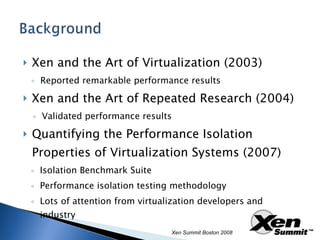
Xen and the Art of Virtualization (2003) Reported remarkable performance results Xen and the Art of Repeated Research (2004) Validated performance results Quantifying the Performance Isolation Properties of Virtualization Systems (2007) Isolation Benchmark Suite Performance isolation testing methodology Lots of attention from virtualization developers and industry Xen Summit Boston 2008
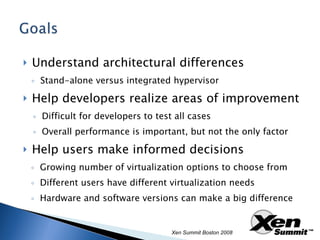
Understand architectural differences Stand-alone versus integrated hypervisor Help developers realize areas of improvement Difficult for developers to test all cases Overall performance is important, but not the only factor Help users make informed decisions Growing number of virtualization options to choose from Different users have different virtualization needs Hardware and software versions can make a big difference Xen Summit Boston 2008
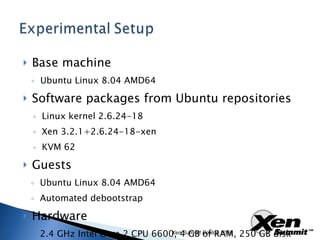
Base machine Ubuntu Linux 8.04 AMD64 Software packages from Ubuntu repositories Linux kernel 2.6.24-18 Xen 3.2.1+2.6.24-18-xen KVM 62 Guests Ubuntu Linux 8.04 AMD64 Automated debootstrap Hardware 2.4 GHz Intel Core 2 CPU 6600, 4 GB of RAM, 250 GB disk Xen Summit Boston 2008
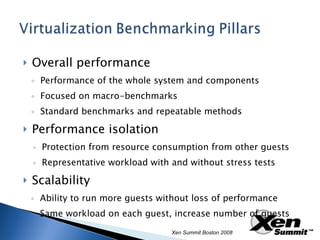
Overall performance Performance of the whole system and components Focused on macro-benchmarks Standard benchmarks and repeatable methods Performance isolation Protection from resource consumption from other guests Representative workload with and without stress tests Scalability Ability to run more guests without loss of performance Same workload on each guest, increase number of guests Xen Summit Boston 2008
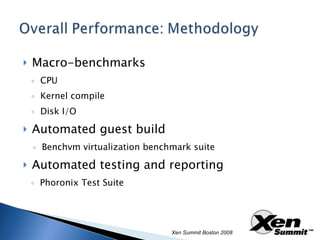
Macro-benchmarks CPU Kernel compile Disk I/O Automated guest build Benchvm virtualization benchmark suite Automated testing and reporting Phoronix Test Suite Xen Summit Boston 2008
Xen Summit Boston 2008
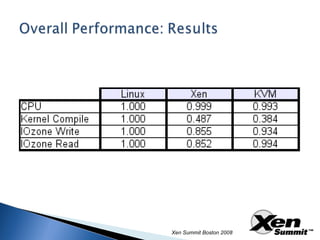
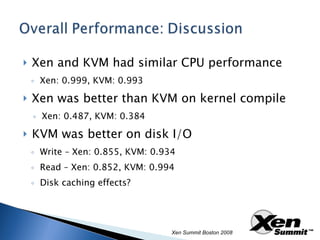
Xen and KVM had similar CPU performance Xen: 0.999, KVM: 0.993 Xen was better than KVM on kernel compile Xen: 0.487, KVM: 0.384 KVM was better on disk I/O Write – Xen: 0.855, KVM: 0.934 Read – Xen: 0.852, KVM: 0.994 Disk caching effects? Xen Summit Boston 2008
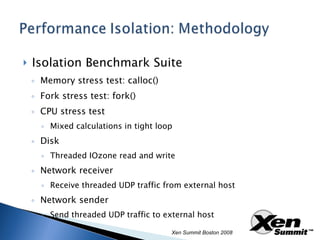
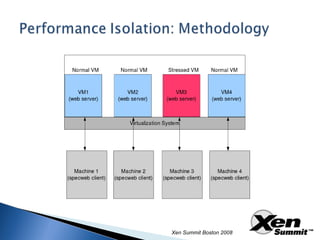
Isolation Benchmark Suite Memory stress test: calloc() Fork stress test: fork() CPU stress test Mixed calculations in tight loop Disk Threaded IOzone read and write Network receiver Receive threaded UDP traffic from external host Network sender Send threaded UDP traffic to external host Xen Summit Boston 2008
Xen Summit Boston 2008
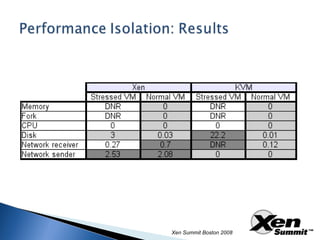
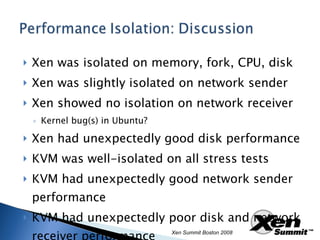
Xen was isolated on memory, fork, CPU, disk Xen was slightly isolated on network sender Xen showed no isolation on network receiver Kernel bug(s) in Ubuntu? Xen had unexpectedly good disk performance KVM was well-isolated on all stress tests KVM had unexpectedly good network sender performance KVM had unexpectedly poor disk and network receiver performance Xen Summit Boston 2008
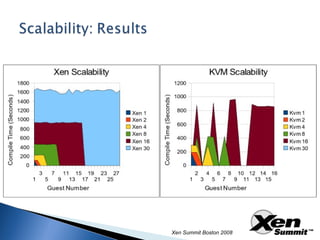
Ran Apache compile in 1, 2, 4, 16, and 30 guests Measured compile time and number of guests that ran to completion Xen Summit Boston 2008
Xen Summit Boston 2008
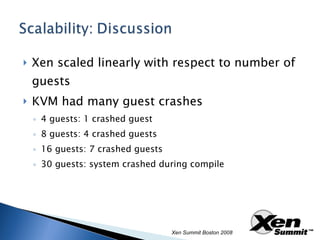
Xen scaled linearly with respect to number of guests KVM had many guest crashes 4 guests: 1 crashed guest 8 guests: 4 crashed guests 16 guests: 7 crashed guests 30 guests: system crashed during compile Xen Summit Boston 2008
Virtualization benchmarking is still difficult Testing on multiple categories is crucial Automated testing is important and useful Transparency in testing methods Repeatability is needed, yet challenging Always more cases to test Challenging to adequately benchmark rapidly evolving technologies Xen Summit Boston 2008
Extend testing to include Xen HVM, and KVM with paravirt I/O More complete automation of testing process with benchvm Port benchvm to Python Add support for more distros in benchvm Use Phoronix Test Suite-like functionality Test profiles, test suites, batch benchmarking Automated results parsing Graphing/uploading of results Automated system and test config collection and publishing Xen Summit Boston 2008
Benchmarking co-researchers Zachary Shepherd, Jeanna Neefe Matthews, Muli Ben-Yehuda, Amit Shah, and Balaji Rao Performance isolation and scalability researchers Wenjin Hu and Madhujith Hapuarachchi Early developers and testers of benchvm Cyrus Katrak and Martin McDermott Members of the Xen and KVM communities Feedback and support Xen Summit Boston 2008
Xen Summit Boston 2008
 

Xen versus kvm_20080623

  • 1.
    Todd Deshane, Ph.D.Student, Clarkson University Xen Summit, June 23-24, 2008, Boston, MA, USA.
  • 2.
    Xen and theArt of Virtualization (2003) Reported remarkable performance results Xen and the Art of Repeated Research (2004) Validated performance results Quantifying the Performance Isolation Properties of Virtualization Systems (2007) Isolation Benchmark Suite Performance isolation testing methodology Lots of attention from virtualization developers and industry Xen Summit Boston 2008
  • 3.
    Understand architectural differencesStand-alone versus integrated hypervisor Help developers realize areas of improvement Difficult for developers to test all cases Overall performance is important, but not the only factor Help users make informed decisions Growing number of virtualization options to choose from Different users have different virtualization needs Hardware and software versions can make a big difference Xen Summit Boston 2008
  • 4.
    Base machine UbuntuLinux 8.04 AMD64 Software packages from Ubuntu repositories Linux kernel 2.6.24-18 Xen 3.2.1+2.6.24-18-xen KVM 62 Guests Ubuntu Linux 8.04 AMD64 Automated debootstrap Hardware 2.4 GHz Intel Core 2 CPU 6600, 4 GB of RAM, 250 GB disk Xen Summit Boston 2008
  • 5.
    Overall performance Performanceof the whole system and components Focused on macro-benchmarks Standard benchmarks and repeatable methods Performance isolation Protection from resource consumption from other guests Representative workload with and without stress tests Scalability Ability to run more guests without loss of performance Same workload on each guest, increase number of guests Xen Summit Boston 2008
  • 6.
    Macro-benchmarks CPU Kernelcompile Disk I/O Automated guest build Benchvm virtualization benchmark suite Automated testing and reporting Phoronix Test Suite Xen Summit Boston 2008
  • 7.
  • 8.
    Xen and KVMhad similar CPU performance Xen: 0.999, KVM: 0.993 Xen was better than KVM on kernel compile Xen: 0.487, KVM: 0.384 KVM was better on disk I/O Write – Xen: 0.855, KVM: 0.934 Read – Xen: 0.852, KVM: 0.994 Disk caching effects? Xen Summit Boston 2008
  • 9.
    Isolation Benchmark SuiteMemory stress test: calloc() Fork stress test: fork() CPU stress test Mixed calculations in tight loop Disk Threaded IOzone read and write Network receiver Receive threaded UDP traffic from external host Network sender Send threaded UDP traffic to external host Xen Summit Boston 2008
  • 10.
  • 11.
  • 12.
    Xen was isolatedon memory, fork, CPU, disk Xen was slightly isolated on network sender Xen showed no isolation on network receiver Kernel bug(s) in Ubuntu? Xen had unexpectedly good disk performance KVM was well-isolated on all stress tests KVM had unexpectedly good network sender performance KVM had unexpectedly poor disk and network receiver performance Xen Summit Boston 2008
  • 13.
    Ran Apache compilein 1, 2, 4, 16, and 30 guests Measured compile time and number of guests that ran to completion Xen Summit Boston 2008
  • 14.
  • 15.
    Xen scaled linearlywith respect to number of guests KVM had many guest crashes 4 guests: 1 crashed guest 8 guests: 4 crashed guests 16 guests: 7 crashed guests 30 guests: system crashed during compile Xen Summit Boston 2008
  • 16.
    Virtualization benchmarking isstill difficult Testing on multiple categories is crucial Automated testing is important and useful Transparency in testing methods Repeatability is needed, yet challenging Always more cases to test Challenging to adequately benchmark rapidly evolving technologies Xen Summit Boston 2008
  • 17.
    Extend testing toinclude Xen HVM, and KVM with paravirt I/O More complete automation of testing process with benchvm Port benchvm to Python Add support for more distros in benchvm Use Phoronix Test Suite-like functionality Test profiles, test suites, batch benchmarking Automated results parsing Graphing/uploading of results Automated system and test config collection and publishing Xen Summit Boston 2008
  • 18.
    Benchmarking co-researchers ZacharyShepherd, Jeanna Neefe Matthews, Muli Ben-Yehuda, Amit Shah, and Balaji Rao Performance isolation and scalability researchers Wenjin Hu and Madhujith Hapuarachchi Early developers and testers of benchvm Cyrus Katrak and Martin McDermott Members of the Xen and KVM communities Feedback and support Xen Summit Boston 2008
  • 19.
  • 20.

Editor's Notes

  • #2 5/14/2008 ‹ #›
  • #3 5/14/2008 ‹ #›
  • #4 5/14/2008 ‹ #›
  • #5 5/14/2008 ‹ #›
  • #6 5/14/2008 ‹ #›
  • #7 5/14/2008 ‹ #›
  • #8 5/14/2008 ‹ #›
  • #9 5/14/2008 ‹ #›
  • #10 5/14/2008 ‹ #›
  • #11 5/14/2008 ‹ #›
  • #12 5/14/2008 ‹ #›
  • #13 5/14/2008 ‹ #›
  • #14 5/14/2008 ‹ #›
  • #15 5/14/2008 ‹ #›
  • #16 5/14/2008 ‹ #›
  • #17 5/14/2008 ‹ #›
  • #18 5/14/2008 ‹ #›
  • #19 5/14/2008 ‹ #›
  • #20 5/14/2008 ‹ #›
  • #21 5/14/2008 ‹ #›