
Why Learning Organization
is Important...

Created by Metanoia Corp
2013
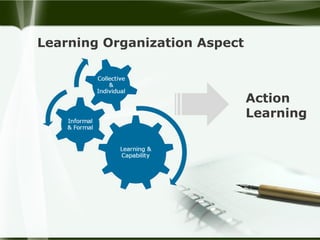
Informal & Formal
self directed learning :
have its goal the development to be self-directed
understanding of the historical, cultural, and biographical reasons for
one's needs, wants, and interests
promotion of emancipotory learning and social actions
Collective & Individual
Shared knowledge, including a common language, provide the basis
for a response to the problem of co-ordination.
Its a precondition for organizational member to be able to
communicate with one another.
The process by which information becomes usable knowledge
Learning & Capability
the process by which adult learners become aware of and increasingly
in control of habits of perception, inquiry, learning and growth
(Maudsley, 1979)
each domain has its own learning goal (namely, learning for taskrelated competence, learning for interpersonal understanding and
learning for perspective transformation), learning needs, approaches
for facilitating learning, methods of research and program evaluation
Learning Organization Aspect

Action
Learning
Referensi
Maudsley, Donald B. (1979) ‘ A Theory of Meta-Learning and
Principles of Facilitation: An Organismic Perspective’, Doctoral
dissertion, University of Toronto, Toronto
Thank You

Salam Metanoia
Oct 2013

Why Learning Organization is Important

  • 1.
    Why Learning Organization isImportant... Created by Metanoia Corp 2013
  • 2.
    Informal & Formal selfdirected learning : have its goal the development to be self-directed understanding of the historical, cultural, and biographical reasons for one's needs, wants, and interests promotion of emancipotory learning and social actions
  • 3.
    Collective & Individual Sharedknowledge, including a common language, provide the basis for a response to the problem of co-ordination. Its a precondition for organizational member to be able to communicate with one another. The process by which information becomes usable knowledge
  • 4.
    Learning & Capability theprocess by which adult learners become aware of and increasingly in control of habits of perception, inquiry, learning and growth (Maudsley, 1979) each domain has its own learning goal (namely, learning for taskrelated competence, learning for interpersonal understanding and learning for perspective transformation), learning needs, approaches for facilitating learning, methods of research and program evaluation
  • 5.
  • 6.
    Referensi Maudsley, Donald B.(1979) ‘ A Theory of Meta-Learning and Principles of Facilitation: An Organismic Perspective’, Doctoral dissertion, University of Toronto, Toronto
  • 7.