Jayanarayan Jayakumar
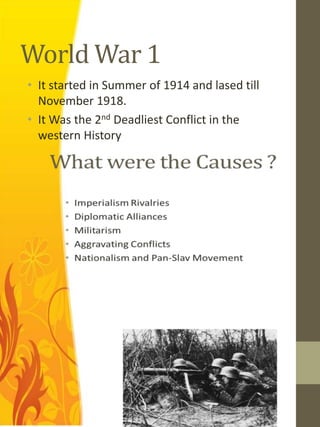
World War 1
• It started in Summer of 1914 and lased till
  November 1918.
• It Was the 2nd Deadliest Conflict in the
  western History
Imperialist Rivalries
Formation Of Alliances-
E.g.-
• 1881-Austro-Serbian alliance to stop Russia
  gaining control.
• 1882-Triple alliance:
  Austria,Hungary,Germany, Italy
• 1894-Franco-Russia Alliance signed to protest
  against Germany and Austria-Hungary.

France,Germany,Italy,Belgium tried to conquer
African countries. France tried to conquer
South Africa through Red Sea.

• ‘The Entente Cordiale’=Friendly relationship
• Triple Entente=France, Russia,UK alarmed
  Germany.
Imperialism
• Imperialism is when a country takes over new
  lands or countries and make them subject to
  their rule.
• Imperialism is when a country increases its
  power and wealth by origining additional
  territories under their control
• The Competition Led To WWI
• In the middle east the ottoman empire
  attacked Austria-Hungary because it had
  plenty of wealth (oil)
• In Asia European Countries like England
  attacked India.
Alliances and 28 June 1914
  •   European Alliances were loose and unstable.
  •   Germany-Austrian
  •   Italy
  •   Franco-Russian
  •   Neutral Belgium
  •   On 28 June 1914, Archduke Franz Ferdinand
      of Austria, heir apparent to the Austro-
      Hungarian throne, and his
      wife, Sophie, Duchess of Hohenberg, were
      shot dead in Sarajevo, by Gavrilo Princip, one
      of a group of six Bosnian Serb assassins
      coordinated by Danilo Ilić. The political
      objective of the assassination was to break
      off Austria-Hungary's south-Slav provinces so
      they could be combined into a Greater
      Serbia or Yugoslavia. The assassins' motives
      were consistent with the movement that
      later became known as Young Bosnia. Serbian
      military officers stood behind the attack.
Nationalism and Pan-Slavism

  • Nationalism is a political ideology that
    involves a strong identification of a group of
    individuals with a political entity defined in
    national terms, i.e. a nation. In the
    'modernist' image of the nation, it is
    nationalism that creates national identity.
  • Pan-Slavism was a movement in the mid-
    19th century aimed at unity of all the Slavic
    peoples. The main focus was in
    the Balkans where the South Slavs had been
    ruled for centuries by other
    empires, Byzantine Empire, Austria-
    Hungary, the Ottoman Empire, and Venice. It
    was also used as a political tool by both
    the Russian Empire and the Soviet
    Union, which gained political-military
    influence and control over all Slavic-majority
    nations between 1945 and 1948.
Competition and arms race
 • There was tough competition between
   Germany and Britain.
 • The "Weltpolitik" (world policy) strategy was
   adopted by Germany in the late 19th century,
   replacing the earlier "Realpolitik" approach.
 • The start of this policy was signaled in 1897
   with then Foreign Minister Bernhard von
   Bülow stating that Germany now pursued
   such a policy.
 • This was a more aggressive policy which
   resulted in conflict between Germany and
   foreign nations, being held to be significantly
   responsible for a series of Great Power
   diplomatic crises in the lead up to the First
   World War.
Austria-Hungary
• Austria-
• Population-8.4 million (app.)
• Area-83,855 sq.km.


• Hungary
• Hungary is a member of OECD, NATO, EU, and
  theVisegrád Group and is a Schengen state.
• Lang-Hungarian
LOSS
• area-325,111 Sq.km -93,073sq.km
• Pop-64% Loss
• 5 cities were lost
Loss in WWI
•   Causalities
•   Central Powers Military-22%
•   Civilians-21%
•   Entente military-36%
•   Civilians-20%

• Causalities (due to technological advancements)
• Properties

• Virus killed about 50 million people exact amount is
  Unknown.

• Landscape changes was another Change that
  Occurred
Trench Warfare
• Trench warfare is a form of occupied fighting
  lines, consisting largely of trenches, in which
  troops are largely immune to the
  enemy's small arms fire and are substantially
  sheltered from artillery. It has become a
  byword for attrition warfare, for stalemate in
  conflict, with a slow wearing down of
  opposing forces.

• Trenching-
Entrenching
Sapping
Tunneling
Trench warfare
• Trench warfare occurred when a military
  revolution in firepower was not matched by similar
  advances in mobility, resulting in a grueling form of
  warfare in which the defense held the advantage. In
  World War I, both sides constructed elaborate
  trench and dugout systems opposing each other
  along a front, protected from assault by barbed
  wire.
• Usually 12 ft. long. The banked earth on the lip of
  the trench facing the enemy was called
  the parapet and had a fire step. The embanked rear
  lip of the trench was called the parados. The parados
  protected the soldier's back from shells falling
  behind the trench. The sides of the trench were
  often revetted with sandbags, wooden frames and
  wire mesh. The floor of the trench was usually
  covered by wooden duckboards. In later designs the
  floor might be raised on a wooden frame to provide
  a drainage channel underneath.
• Dugouts of varying degrees of luxury would be built
  in the rear of the support trench. British dugouts
  were usually 8 to 16 feet (2.4 to 4.9 m) deep,
  whereas German dugouts were typically much
  deeper, usually a minimum of 12 feet (3.7 m) deep
  and sometimes dug three stories down, with
  concrete staircases to reach the upper levels.
Trench warfare
• One Could see a max. of 10 Yards(9m)from
  the trenches.
• The common infantry soldier had four
  weapons to use in the trenches:
  the rifle, bayonet, shotgun, and hand
  grenade.
• Tanks were introduced by British to break the
  deadlock of trench warfare.

• The Germans embraced the machine gun
  from the outset—in 1904, sixteen units were
  equipped with 'Maschinengewehr'—and the
  machine gun crews were the elite infantry
  units.
• The Germans
  employed Flammenwerfer (flamethrowers)
  during the war for the first time against the
  French on 25 June 1915, then against the
  British 30 July in Hooge.
The End

Wwi text book

  • 1.
  • 2.
    World War 1 •It started in Summer of 1914 and lased till November 1918. • It Was the 2nd Deadliest Conflict in the western History
  • 3.
    Imperialist Rivalries Formation OfAlliances- E.g.- • 1881-Austro-Serbian alliance to stop Russia gaining control. • 1882-Triple alliance: Austria,Hungary,Germany, Italy • 1894-Franco-Russia Alliance signed to protest against Germany and Austria-Hungary. France,Germany,Italy,Belgium tried to conquer African countries. France tried to conquer South Africa through Red Sea. • ‘The Entente Cordiale’=Friendly relationship • Triple Entente=France, Russia,UK alarmed Germany.
  • 4.
    Imperialism • Imperialism iswhen a country takes over new lands or countries and make them subject to their rule. • Imperialism is when a country increases its power and wealth by origining additional territories under their control • The Competition Led To WWI • In the middle east the ottoman empire attacked Austria-Hungary because it had plenty of wealth (oil) • In Asia European Countries like England attacked India.
  • 5.
    Alliances and 28June 1914 • European Alliances were loose and unstable. • Germany-Austrian • Italy • Franco-Russian • Neutral Belgium • On 28 June 1914, Archduke Franz Ferdinand of Austria, heir apparent to the Austro- Hungarian throne, and his wife, Sophie, Duchess of Hohenberg, were shot dead in Sarajevo, by Gavrilo Princip, one of a group of six Bosnian Serb assassins coordinated by Danilo Ilić. The political objective of the assassination was to break off Austria-Hungary's south-Slav provinces so they could be combined into a Greater Serbia or Yugoslavia. The assassins' motives were consistent with the movement that later became known as Young Bosnia. Serbian military officers stood behind the attack.
  • 6.
    Nationalism and Pan-Slavism • Nationalism is a political ideology that involves a strong identification of a group of individuals with a political entity defined in national terms, i.e. a nation. In the 'modernist' image of the nation, it is nationalism that creates national identity. • Pan-Slavism was a movement in the mid- 19th century aimed at unity of all the Slavic peoples. The main focus was in the Balkans where the South Slavs had been ruled for centuries by other empires, Byzantine Empire, Austria- Hungary, the Ottoman Empire, and Venice. It was also used as a political tool by both the Russian Empire and the Soviet Union, which gained political-military influence and control over all Slavic-majority nations between 1945 and 1948.
  • 7.
    Competition and armsrace • There was tough competition between Germany and Britain. • The "Weltpolitik" (world policy) strategy was adopted by Germany in the late 19th century, replacing the earlier "Realpolitik" approach. • The start of this policy was signaled in 1897 with then Foreign Minister Bernhard von Bülow stating that Germany now pursued such a policy. • This was a more aggressive policy which resulted in conflict between Germany and foreign nations, being held to be significantly responsible for a series of Great Power diplomatic crises in the lead up to the First World War.
  • 8.
    Austria-Hungary • Austria- • Population-8.4million (app.) • Area-83,855 sq.km. • Hungary • Hungary is a member of OECD, NATO, EU, and theVisegrád Group and is a Schengen state. • Lang-Hungarian LOSS • area-325,111 Sq.km -93,073sq.km • Pop-64% Loss • 5 cities were lost
  • 9.
    Loss in WWI • Causalities • Central Powers Military-22% • Civilians-21% • Entente military-36% • Civilians-20% • Causalities (due to technological advancements) • Properties • Virus killed about 50 million people exact amount is Unknown. • Landscape changes was another Change that Occurred
  • 10.
    Trench Warfare • Trenchwarfare is a form of occupied fighting lines, consisting largely of trenches, in which troops are largely immune to the enemy's small arms fire and are substantially sheltered from artillery. It has become a byword for attrition warfare, for stalemate in conflict, with a slow wearing down of opposing forces. • Trenching- Entrenching Sapping Tunneling
  • 11.
    Trench warfare • Trenchwarfare occurred when a military revolution in firepower was not matched by similar advances in mobility, resulting in a grueling form of warfare in which the defense held the advantage. In World War I, both sides constructed elaborate trench and dugout systems opposing each other along a front, protected from assault by barbed wire. • Usually 12 ft. long. The banked earth on the lip of the trench facing the enemy was called the parapet and had a fire step. The embanked rear lip of the trench was called the parados. The parados protected the soldier's back from shells falling behind the trench. The sides of the trench were often revetted with sandbags, wooden frames and wire mesh. The floor of the trench was usually covered by wooden duckboards. In later designs the floor might be raised on a wooden frame to provide a drainage channel underneath. • Dugouts of varying degrees of luxury would be built in the rear of the support trench. British dugouts were usually 8 to 16 feet (2.4 to 4.9 m) deep, whereas German dugouts were typically much deeper, usually a minimum of 12 feet (3.7 m) deep and sometimes dug three stories down, with concrete staircases to reach the upper levels.
  • 12.
    Trench warfare • OneCould see a max. of 10 Yards(9m)from the trenches. • The common infantry soldier had four weapons to use in the trenches: the rifle, bayonet, shotgun, and hand grenade. • Tanks were introduced by British to break the deadlock of trench warfare. • The Germans embraced the machine gun from the outset—in 1904, sixteen units were equipped with 'Maschinengewehr'—and the machine gun crews were the elite infantry units. • The Germans employed Flammenwerfer (flamethrowers) during the war for the first time against the French on 25 June 1915, then against the British 30 July in Hooge.
  • 13.