Is the Web Dead?
-orWhat does the fragmentation of the internet
mean for design and usability?

Panel Discussion
World Usability Day
November 11, 2010
LexisNexis Dayton
Lyman Casey, Centralis
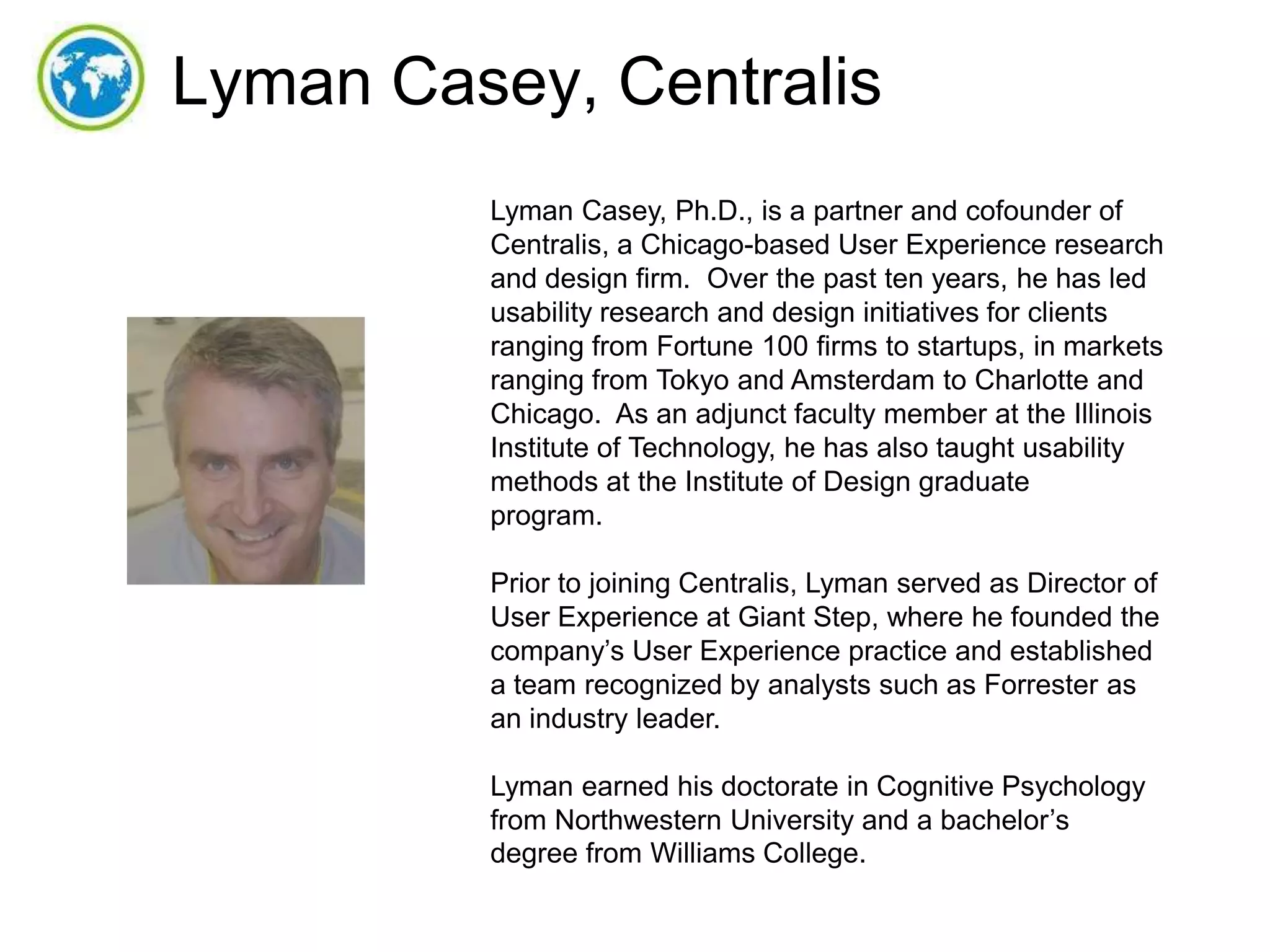
Lyman Casey, Ph.D., is a partner and cofounder of
Centralis, a Chicago-based User Experience research
and design firm. Over the past ten years, he has led
usability research and design initiatives for clients
ranging from Fortune 100 firms to startups, in markets
ranging from Tokyo and Amsterdam to Charlotte and
Chicago. As an adjunct faculty member at the Illinois
Institute of Technology, he has also taught usability
methods at the Institute of Design graduate
program.
Prior to joining Centralis, Lyman served as Director of
User Experience at Giant Step, where he founded the
company’s User Experience practice and established
a team recognized by analysts such as Forrester as
an industry leader.
Lyman earned his doctorate in Cognitive Psychology
from Northwestern University and a bachelor’s
degree from Williams College.
Ray Daley, LexisNexis
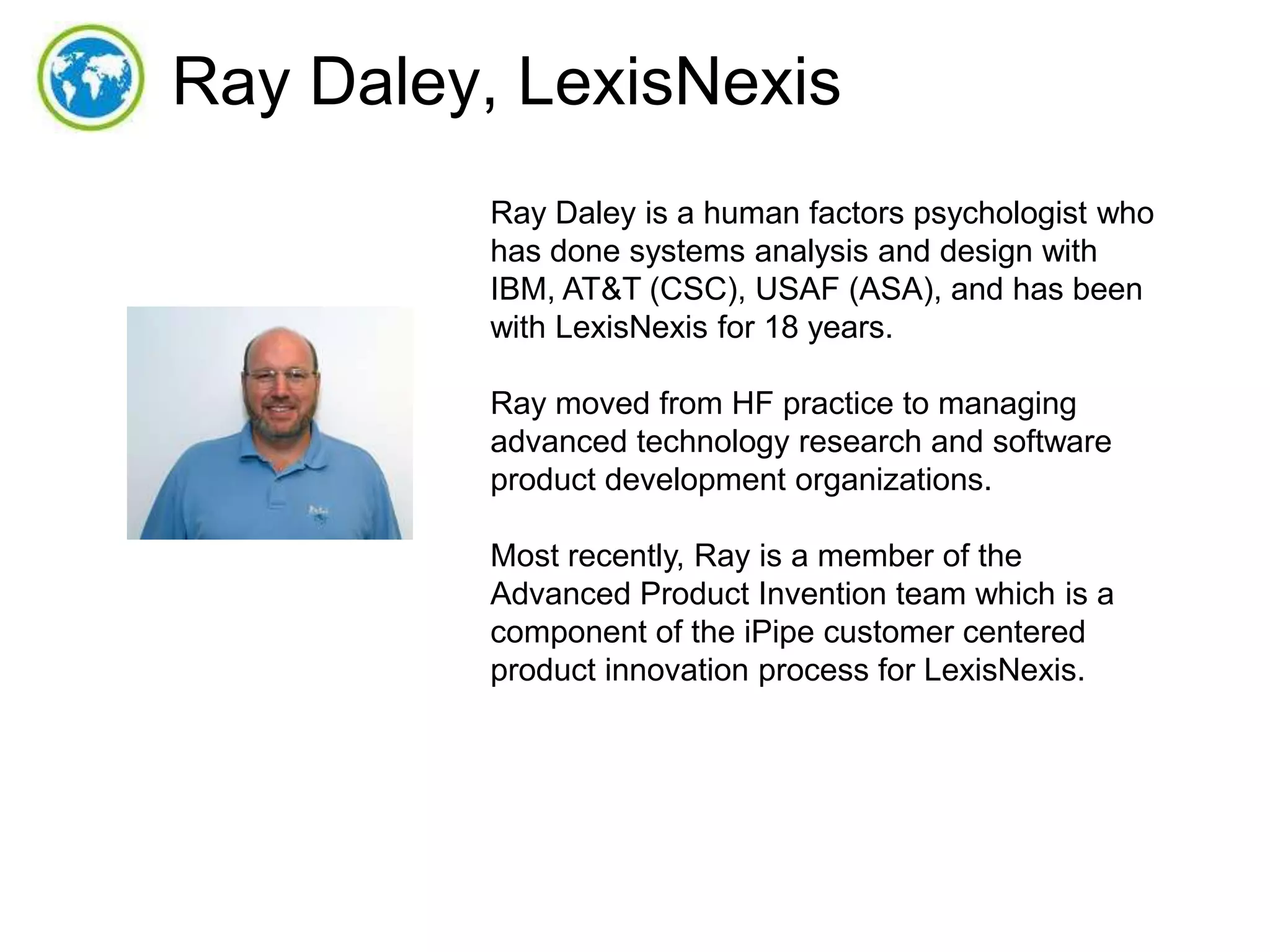
Ray Daley is a human factors psychologist who
has done systems analysis and design with
IBM, AT&T (CSC), USAF (ASA), and has been
with LexisNexis for 18 years.
Ray moved from HF practice to managing
advanced technology research and software
product development organizations.
Most recently, Ray is a member of the
Advanced Product Invention team which is a
component of the iPipe customer centered
product innovation process for LexisNexis.
Jason Loehr, Mad*Pow
A results-driven marketer with over sixteen
years of major media experience, Jason is the
SVP, Strategy & Development for Mad*Pow, a
leading User Experience firm.
He has worked with a diverse background of
organizations in leadership roles to focus and
grow their digital footprint. His experience
crosses startups, mid-size and Fortune 100
organizations across industries including
recreation, retail, healthcare and software.
Jason earned a bachelor’s degree from WKU
and MBA from Indiana University. Outside the
office, he volunteers with non-profits, including
the Louisville Zoo, WKU, and the First Tee, on
their marketing and strategy.
Dan Rockwell, Lextant
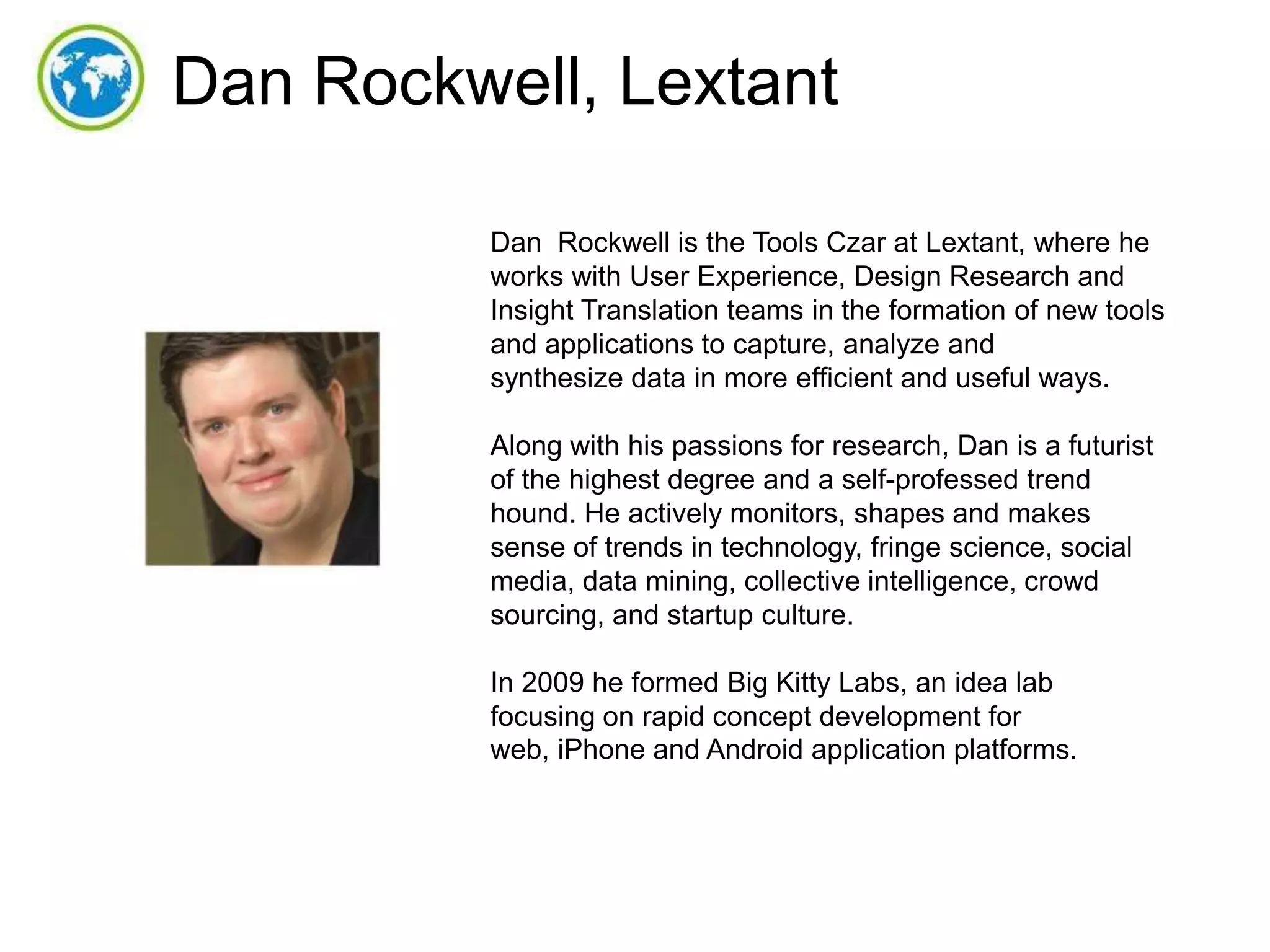
Dan Rockwell is the Tools Czar at Lextant, where he
works with User Experience, Design Research and
Insight Translation teams in the formation of new tools
and applications to capture, analyze and
synthesize data in more efficient and useful ways.
Along with his passions for research, Dan is a futurist
of the highest degree and a self-professed trend
hound. He actively monitors, shapes and makes
sense of trends in technology, fringe science, social
media, data mining, collective intelligence, crowd
sourcing, and startup culture.
In 2009 he formed Big Kitty Labs, an idea lab
focusing on rapid concept development for
web, iPhone and Android application platforms.
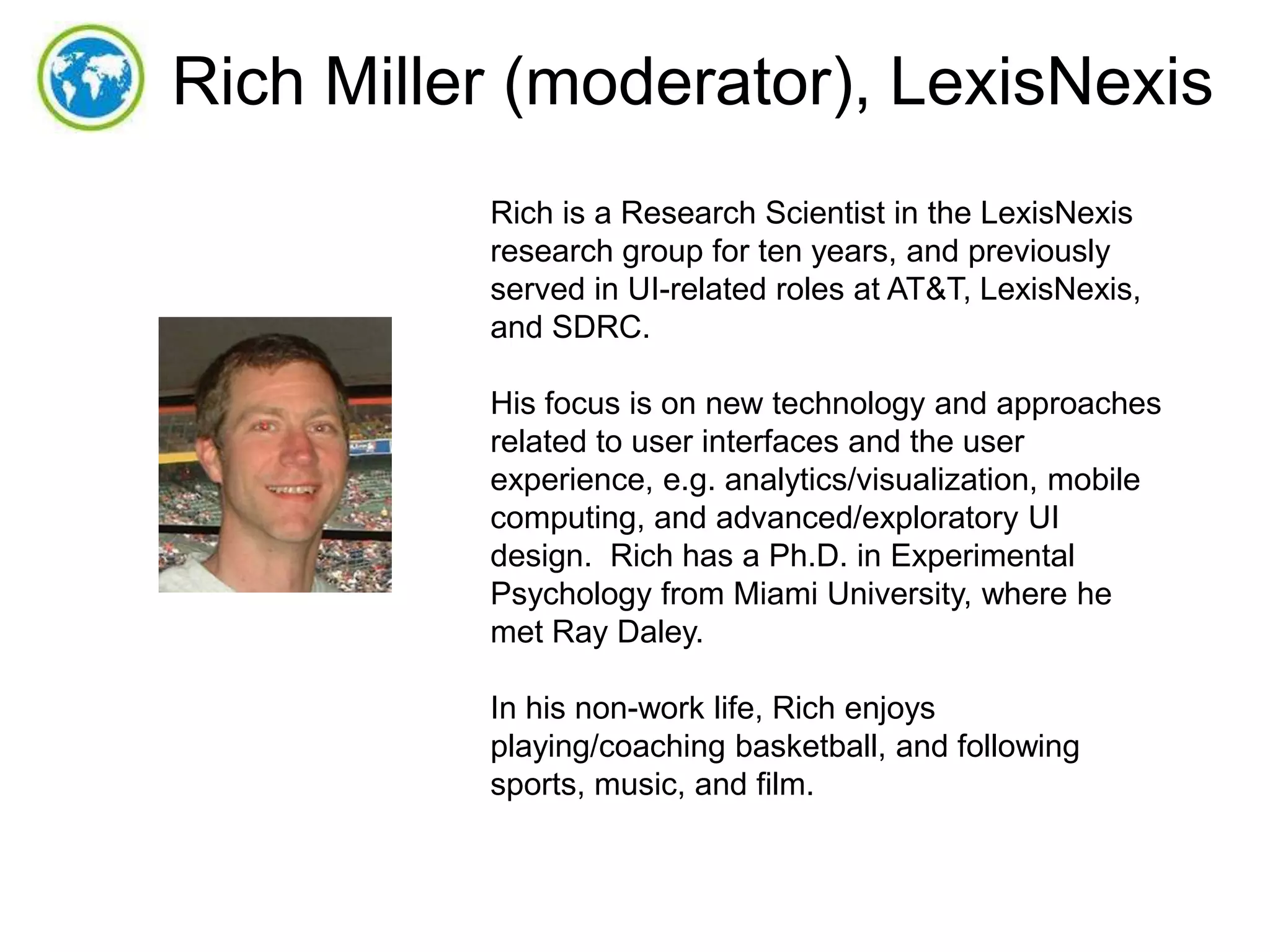
Rich Miller (moderator), LexisNexis
Rich is a Research Scientist in the LexisNexis
research group for ten years, and previously
served in UI-related roles at AT&T, LexisNexis,
and SDRC.
His focus is on new technology and approaches
related to user interfaces and the user
experience, e.g. analytics/visualization, mobile
computing, and advanced/exploratory UI
design. Rich has a Ph.D. in Experimental
Psychology from Miami University, where he
met Ray Daley.
In his non-work life, Rich enjoys
playing/coaching basketball, and following
sports, music, and film.
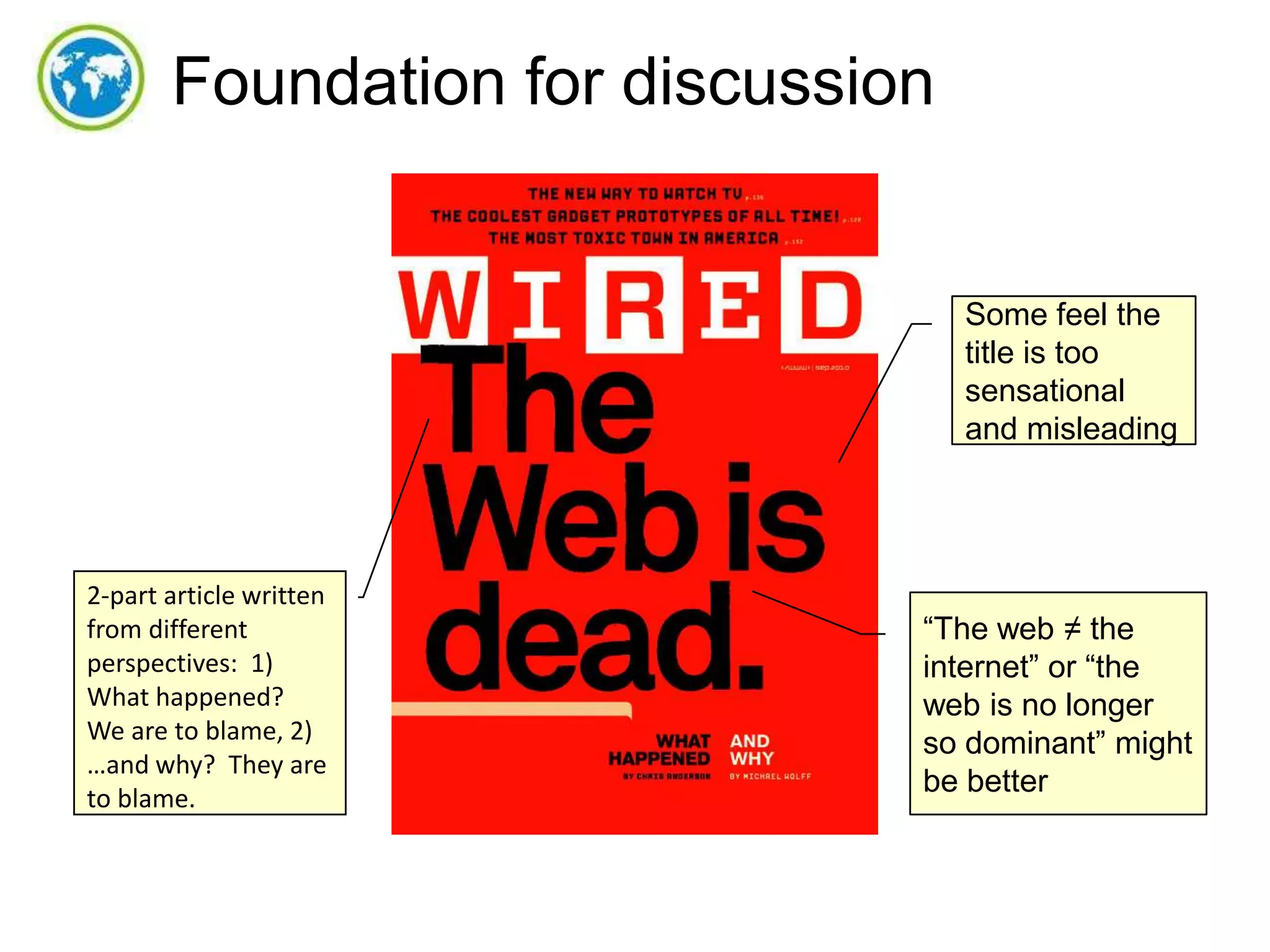
Foundation for discussion

Some feel the
title is too
sensational
and misleading

2-part article written
from different
perspectives: 1)
What happened?
We are to blame, 2)
…and why? They are
to blame.

“The web ≠ the
internet” or “the
web is no longer
so dominant” might
be better
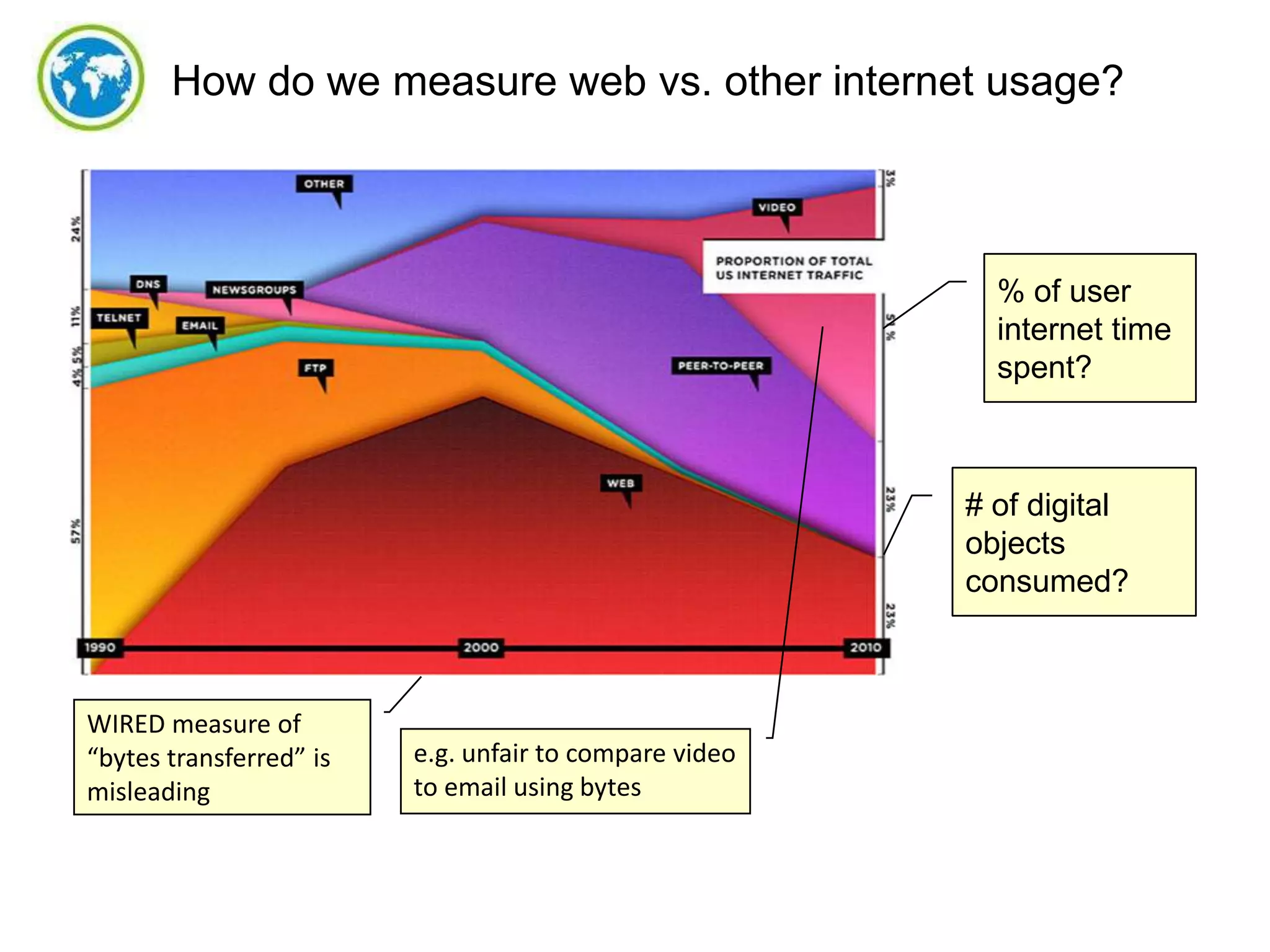
How do we measure web vs. other internet usage?

% of user
internet time
spent?

# of digital
objects
consumed?

WIRED measure of
“bytes transferred” is
misleading

e.g. unfair to compare video
to email using bytes
The web vs. the internet
 It is not uncommon now to spend a day on the
internet but not on the web
 Google and HTML do not rule the “non-web”
 The web is “not a culmination of the digital
revolution”
 The “splinternet” is used increasingly to support
non-web user interfaces
 e.g. iphones/smartphones, ipads/tablets

 Push technology has made a comeback and
works well with the non-web
Browser vs. device-based UIs
 Some say within 5 years mobile devices will
surpass PCs as the primary means of accessing
the internet
 It is “a mistake to think of the web browser as
the apex of the PC’s revolution”
Jonathan Zittrain – author, The Future of the Internet

 The web is now 18 years old, so an entire
generation has grown up in front a browser
They have already absorbed it into their
experience, and are not overwhelmed by (and are
perhaps hungry for) new alternatives
The web is not all it was cracked up to be
 Became less open and full of opportunity
 Facebook’s 500M users accounting for big % of
traffic and does not really integrate with the web
 Google became so impossible to compete with that it
started controlling the openness of the web
 Once Google so dominant, others started trying web
alternatives

 Not such a great avenue for making money
 Bad economy sped abandonment of the web model
 Steve Jobs and Apple spawned a non-web model
that makes money
 Entertainment (e.g. netflix) is a big non-web driver
Capitalism and consumerism are to blame
 Like any industrial revolution, it’s all about the
battle for control
Technology invented, someone finds a way to own it,
and locks out others
e.g. railroads, telephones, and electricity

 Natural path of industrialization = invention,
adoption, and control
 Openness is great but our tolerance for
unbridled competition finds its limits
 Metcalfe’s law – the big get bigger
Our discussion will focus on…
How the trends affect design and usability
Browser-based vs. device-based apps
The pseudo-demise of web 2.0
 the fall and rise of the “walled garden”
 why can’t we all just share stuff?

New user models for the internet
The proliferation of web avenues/tools/devices
The tenuous co-existence of multiple platforms
Questions for panelists
How is the volatility of the internet
affecting design and usability?
 Which product models lead to better design and
user experience?
 browser-based vs. proprietary/device-based

 Do we really all need a
desktop, laptop, tablet, and a smartphone?
 is it an embarrassment of digital device riches?
 will this continuum condense?

 How does all this affect product strategy?
 What should the UI/UX voice be saying?
How are proprietary apps
affecting the user experience?
 Is a proprietary app always superior?
 If so, is it significantly better than what a mobileenabled site can offer?
 In what contexts is a web site a better UX than a
proprietary app?
 What can we learn about the ipad UX?
What is it about the ipad UX that makes it work?
What drawbacks are we seeing?
Is social computing helping or
hurting our ability to make our
users more productive?
 Do work and play mix well?
 When will the “social computing hangover” hit
enough users to effect a mass behavior
change?
 How is facebook changing user behavior and
expectations? What is good and bad about
facebook in terms of UX?
Is web 2.0 dead? naïve?
 Is “web as computer” that is shared and
leveraged across multiple beneficiaries just for
the small and/or non-profitmaking?
 What of web 2.0 will survive?
The “nimble” nature of product creation?
 The focus on UI simplicity?
 What of web 2.0 has been leveraged by device
apps?
What companies will have the most
influence in shaping the future
internet? …in optimizing
productivity and usability?

What does the fragmentation of the internet mean for design and usability?

  • 1.
    Is the WebDead? -orWhat does the fragmentation of the internet mean for design and usability? Panel Discussion World Usability Day November 11, 2010 LexisNexis Dayton
  • 2.
    Lyman Casey, Centralis LymanCasey, Ph.D., is a partner and cofounder of Centralis, a Chicago-based User Experience research and design firm. Over the past ten years, he has led usability research and design initiatives for clients ranging from Fortune 100 firms to startups, in markets ranging from Tokyo and Amsterdam to Charlotte and Chicago. As an adjunct faculty member at the Illinois Institute of Technology, he has also taught usability methods at the Institute of Design graduate program. Prior to joining Centralis, Lyman served as Director of User Experience at Giant Step, where he founded the company’s User Experience practice and established a team recognized by analysts such as Forrester as an industry leader. Lyman earned his doctorate in Cognitive Psychology from Northwestern University and a bachelor’s degree from Williams College.
  • 3.
    Ray Daley, LexisNexis RayDaley is a human factors psychologist who has done systems analysis and design with IBM, AT&T (CSC), USAF (ASA), and has been with LexisNexis for 18 years. Ray moved from HF practice to managing advanced technology research and software product development organizations. Most recently, Ray is a member of the Advanced Product Invention team which is a component of the iPipe customer centered product innovation process for LexisNexis.
  • 4.
    Jason Loehr, Mad*Pow Aresults-driven marketer with over sixteen years of major media experience, Jason is the SVP, Strategy & Development for Mad*Pow, a leading User Experience firm. He has worked with a diverse background of organizations in leadership roles to focus and grow their digital footprint. His experience crosses startups, mid-size and Fortune 100 organizations across industries including recreation, retail, healthcare and software. Jason earned a bachelor’s degree from WKU and MBA from Indiana University. Outside the office, he volunteers with non-profits, including the Louisville Zoo, WKU, and the First Tee, on their marketing and strategy.
  • 5.
    Dan Rockwell, Lextant DanRockwell is the Tools Czar at Lextant, where he works with User Experience, Design Research and Insight Translation teams in the formation of new tools and applications to capture, analyze and synthesize data in more efficient and useful ways. Along with his passions for research, Dan is a futurist of the highest degree and a self-professed trend hound. He actively monitors, shapes and makes sense of trends in technology, fringe science, social media, data mining, collective intelligence, crowd sourcing, and startup culture. In 2009 he formed Big Kitty Labs, an idea lab focusing on rapid concept development for web, iPhone and Android application platforms.
  • 6.
    Rich Miller (moderator),LexisNexis Rich is a Research Scientist in the LexisNexis research group for ten years, and previously served in UI-related roles at AT&T, LexisNexis, and SDRC. His focus is on new technology and approaches related to user interfaces and the user experience, e.g. analytics/visualization, mobile computing, and advanced/exploratory UI design. Rich has a Ph.D. in Experimental Psychology from Miami University, where he met Ray Daley. In his non-work life, Rich enjoys playing/coaching basketball, and following sports, music, and film.
  • 7.
    Foundation for discussion Somefeel the title is too sensational and misleading 2-part article written from different perspectives: 1) What happened? We are to blame, 2) …and why? They are to blame. “The web ≠ the internet” or “the web is no longer so dominant” might be better
  • 8.
    How do wemeasure web vs. other internet usage? % of user internet time spent? # of digital objects consumed? WIRED measure of “bytes transferred” is misleading e.g. unfair to compare video to email using bytes
  • 9.
    The web vs.the internet  It is not uncommon now to spend a day on the internet but not on the web  Google and HTML do not rule the “non-web”  The web is “not a culmination of the digital revolution”  The “splinternet” is used increasingly to support non-web user interfaces  e.g. iphones/smartphones, ipads/tablets  Push technology has made a comeback and works well with the non-web
  • 10.
    Browser vs. device-basedUIs  Some say within 5 years mobile devices will surpass PCs as the primary means of accessing the internet  It is “a mistake to think of the web browser as the apex of the PC’s revolution” Jonathan Zittrain – author, The Future of the Internet  The web is now 18 years old, so an entire generation has grown up in front a browser They have already absorbed it into their experience, and are not overwhelmed by (and are perhaps hungry for) new alternatives
  • 11.
    The web isnot all it was cracked up to be  Became less open and full of opportunity  Facebook’s 500M users accounting for big % of traffic and does not really integrate with the web  Google became so impossible to compete with that it started controlling the openness of the web  Once Google so dominant, others started trying web alternatives  Not such a great avenue for making money  Bad economy sped abandonment of the web model  Steve Jobs and Apple spawned a non-web model that makes money  Entertainment (e.g. netflix) is a big non-web driver
  • 12.
    Capitalism and consumerismare to blame  Like any industrial revolution, it’s all about the battle for control Technology invented, someone finds a way to own it, and locks out others e.g. railroads, telephones, and electricity  Natural path of industrialization = invention, adoption, and control  Openness is great but our tolerance for unbridled competition finds its limits  Metcalfe’s law – the big get bigger
  • 13.
    Our discussion willfocus on… How the trends affect design and usability Browser-based vs. device-based apps The pseudo-demise of web 2.0  the fall and rise of the “walled garden”  why can’t we all just share stuff? New user models for the internet The proliferation of web avenues/tools/devices The tenuous co-existence of multiple platforms
  • 14.
  • 15.
    How is thevolatility of the internet affecting design and usability?  Which product models lead to better design and user experience?  browser-based vs. proprietary/device-based  Do we really all need a desktop, laptop, tablet, and a smartphone?  is it an embarrassment of digital device riches?  will this continuum condense?  How does all this affect product strategy?  What should the UI/UX voice be saying?
  • 16.
    How are proprietaryapps affecting the user experience?  Is a proprietary app always superior?  If so, is it significantly better than what a mobileenabled site can offer?  In what contexts is a web site a better UX than a proprietary app?  What can we learn about the ipad UX? What is it about the ipad UX that makes it work? What drawbacks are we seeing?
  • 17.
    Is social computinghelping or hurting our ability to make our users more productive?  Do work and play mix well?  When will the “social computing hangover” hit enough users to effect a mass behavior change?  How is facebook changing user behavior and expectations? What is good and bad about facebook in terms of UX?
  • 18.
    Is web 2.0dead? naïve?  Is “web as computer” that is shared and leveraged across multiple beneficiaries just for the small and/or non-profitmaking?  What of web 2.0 will survive? The “nimble” nature of product creation?  The focus on UI simplicity?  What of web 2.0 has been leveraged by device apps?
  • 19.
    What companies willhave the most influence in shaping the future internet? …in optimizing productivity and usability?