Approaches to Treatment and Therapy chapter 12
Overview Biological treatments Kinds of psychotherapy Evaluating psychotherapy chapter 12
Antipsychotic drugs Many block or reduce sensitivity of dopamine receptors. Some increase levels of serotonin, a neurotransmitter that inhibits dopamine activity Can relieve positive symptoms of schizophrenia, but ineffective—or even worsen—negative symptoms chapter 12
Antidepressant drugs Monoamine oxidase inhibitors (MAOI’s) Elevate norepinephrine and serotonin in brain by blocking an enzyme that deactivates these neurotransmitters Tricyclic antidepressants Boost norepinephrine and serotonin by preventing reuptake Selective serotonin reuptake inhibitors (SSRI’s) Boost serotonin by preventing reuptake Herbs such as St. John’s Wort have also been used. chapter 12
Tranquilizers Increase the activity of GABA Developed for treatment of mild anxiety Often prescribed inappropriately by general practitioners for any patient with mood complaints chapter 12
Lithium carbonate Used to treat bipolar disorder Moderates levels of norepinephrine by protecting cells from being overstimulated by neurotransmitter glutamate Must be given in right dose, bloodstream levels monitored Newer treatments include Tegetrol and Depakote. chapter 12
Your turn Your friend has largely withdrawn from social activities, and has stopped maintaining her appearance or apartment.  If she goes to see a doctor, what do you expect her doctor to prescribe? 1.  An MAOI 2.  An SSRI (e.g., Prozac) 3.  A tranquilizer (e.g., Valium) 4.  Lithium carbonate chapter 12
Placebo effect The apparent success of a treatment due to patient’s expectation rather than the treatment itself Meta-analysis indicates that clinicians consider medication helpful, yet patient ratings in treatment groups were no greater than those in placebo groups. chapter 12
High relapse and dropout rate There may be short-term success, but 50–66% of patients stop taking medication due to side effects. Individuals who take antidepressants without learning to cope with problems are more likely to relapse. chapter 12
Dosage problems Finding the therapeutic window, the dosage that is enough but not too much Drugs may be metabolized differently in Men and women Old and young Different ethnic groups Appropriate dosage also affected by metabolic rates, amount of body fat, number and type of drug receptors in the brain, smoking, and eating habits. chapter 12
Long-term risks Antipsychotic drugs can be dangerous, even fatal if taken for many years. Tardive dyskinesia Antidepressants are assumed to be safe, but no long-term studies have been conducted. chapter 12
Direct brain intervention Psychosurgery Any surgical procedure that destroys selected areas of the brain believed to be involved in emotional disorders or violent, impulsive behavior. Electroconvulsive therapy (ECT) Procedure used in cases of prolonged and severe major depression Brief brain seizure is induced chapter 12
Transcranial magnetic stimulation Involves use of pulsing magnetic coil held to a person’s skull over the left prefrontal cortex This area is less active in those with depression. Treatment does not result in pain or memory problems, controlled studies have suggested positive results. chapter 12
Psychodynamic therapy Psychoanalysis A method of psychotherapy developed by Freud, emphasizes the exploration of unconscious motives and conflicts Free association In psychoanalysis, a method of uncovering unconscious conflicts by saying freely whatever comes to mind chapter 12
Psychodynamic therapy Other psychodynamic therapies also explore unconscious dynamics, but differ from Freudian analysis. Transference In psychodynamic therapies, a critical step in which the client transfers unconscious emotions or reactions, such as conflicts with parents, onto the therapist chapter 12
Behavior therapy A form of therapy that applies classical and operant conditioning to help people change own defeating or problematic behaviors chapter 12
Graduated exposure In behavior therapy, a method in which a person suffering from an anxiety disorder, such as a phobia, is gradually taken into the feared situation or exposed to a traumatic memory, until the anxiety subsides chapter 12
Flooding A technique whereby a person suffering from an anxiety disorder, such as a phobia, is taken directly into the feared situation until the anxiety subsides chapter 12
Systematic desensitization A step-by-step process of desensitizing a client to a feared object or experience Based on counter conditioning chapter 12
Behavioral self-monitoring A method of keeping careful data on the frequency and consequences of a behavior to be changed chapter 12
Skills training An effort to teach a client skills or new more constructive behaviors to replace self-defeating ones chapter 12
Cognitive techniques Examine the evidence for beliefs. Consider other explanations for the behavior of other people. Identify assumptions and biases. chapter 12
Rational emotive therapy A form of cognitive therapy devised by Albert Ellis, designed to challenge the client’s unrealistic or irrational thoughts chapter 12
Humanist therapy Humanist therapy Based on assumption that people seek self-actualization, self-fulfillment Emphasized people’s free will to change, not past conflicts Client-centered therapy Developed by Carl Rogers, emphasizes therapist’s empathy with client, and communication of  unconditional positive regard chapter 12
Existential therapy Helps clients explore the meaning of existence and face with courage the great issues of life such as death, freedom, free will, alienation, and loneliness chapter 12
Family and couples therapy Assumes that problems develop in the context of family, that they are sustained by family dynamics, and that any changes will affect whole family Can look for patterns of behavior across generations and create a family tree of psychologically significant events chapter 12
Family-systems perspective Therapy with individuals or families that focuses on how each member forms part of a larger interacting system chapter 12
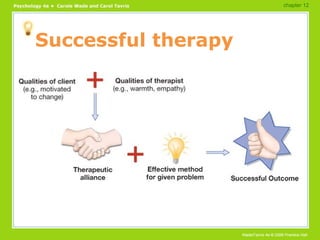
Common ingredients in successful therapy Therapeutic alliance:  bond between therapist and client When clients want to be helped When therapists distinguish normal cultural patterns from individual psychological problems chapter 12
Successful therapy chapter 12
The scientist-practitioner gap Some psychotherapists believe that evaluating therapy using research methods is futile. Scientists find that therapists who do not keep up with empirical findings are less effective and can even harm clients. Economic pressures require empirical assessment of therapies. chapter 12
Which therapy? Depression Cognitive therapy Anxiety disorders Exposure techniques Anger and impulsive violence Cognitive therapy Health problems Cognitive and behavior therapies Childhood and adolescent behavior problems Behavior therapy chapter 12
Your turn You have arachnophobia, an intense fear of spiders.  What kind of therapy should you seek out for the best chance of resolving your problem? 1.  Direct brain intervention 2.  Cognitive therapy 3.  Psychodynamic therapy 4.  Behavioral therapy chapter 12
When therapy harms Use of empirically unsupported, potentially dangerous therapeutic techniques Inappropriate or coercive influence, which can create new problems for the client Prejudice or cultural ignorance on the part of the therapist Unethical behavior, especially sexual intimacy, on the part of the therapist chapter 12

Treatment PowerPoint

  • 1.
    Approaches to Treatmentand Therapy chapter 12
  • 2.
    Overview Biological treatmentsKinds of psychotherapy Evaluating psychotherapy chapter 12
  • 3.
    Antipsychotic drugs Manyblock or reduce sensitivity of dopamine receptors. Some increase levels of serotonin, a neurotransmitter that inhibits dopamine activity Can relieve positive symptoms of schizophrenia, but ineffective—or even worsen—negative symptoms chapter 12
  • 4.
    Antidepressant drugs Monoamineoxidase inhibitors (MAOI’s) Elevate norepinephrine and serotonin in brain by blocking an enzyme that deactivates these neurotransmitters Tricyclic antidepressants Boost norepinephrine and serotonin by preventing reuptake Selective serotonin reuptake inhibitors (SSRI’s) Boost serotonin by preventing reuptake Herbs such as St. John’s Wort have also been used. chapter 12
  • 5.
    Tranquilizers Increase theactivity of GABA Developed for treatment of mild anxiety Often prescribed inappropriately by general practitioners for any patient with mood complaints chapter 12
  • 6.
    Lithium carbonate Usedto treat bipolar disorder Moderates levels of norepinephrine by protecting cells from being overstimulated by neurotransmitter glutamate Must be given in right dose, bloodstream levels monitored Newer treatments include Tegetrol and Depakote. chapter 12
  • 7.
    Your turn Yourfriend has largely withdrawn from social activities, and has stopped maintaining her appearance or apartment. If she goes to see a doctor, what do you expect her doctor to prescribe? 1. An MAOI 2. An SSRI (e.g., Prozac) 3. A tranquilizer (e.g., Valium) 4. Lithium carbonate chapter 12
  • 8.
    Your turn Yourfriend has largely withdrawn from social activities, and has stopped maintaining her appearance or apartment. If she goes to see a doctor, what do you expect her doctor to prescribe? 1. An MAOI 2. An SSRI (e.g., Prozac) 3. A tranquilizer (e.g., Valium) 4. Lithium carbonate chapter 12
  • 9.
    Placebo effect Theapparent success of a treatment due to patient’s expectation rather than the treatment itself Meta-analysis indicates that clinicians consider medication helpful, yet patient ratings in treatment groups were no greater than those in placebo groups. chapter 12
  • 10.
    High relapse anddropout rate There may be short-term success, but 50–66% of patients stop taking medication due to side effects. Individuals who take antidepressants without learning to cope with problems are more likely to relapse. chapter 12
  • 11.
    Dosage problems Findingthe therapeutic window, the dosage that is enough but not too much Drugs may be metabolized differently in Men and women Old and young Different ethnic groups Appropriate dosage also affected by metabolic rates, amount of body fat, number and type of drug receptors in the brain, smoking, and eating habits. chapter 12
  • 12.
    Long-term risks Antipsychoticdrugs can be dangerous, even fatal if taken for many years. Tardive dyskinesia Antidepressants are assumed to be safe, but no long-term studies have been conducted. chapter 12
  • 13.
    Direct brain interventionPsychosurgery Any surgical procedure that destroys selected areas of the brain believed to be involved in emotional disorders or violent, impulsive behavior. Electroconvulsive therapy (ECT) Procedure used in cases of prolonged and severe major depression Brief brain seizure is induced chapter 12
  • 14.
    Transcranial magnetic stimulationInvolves use of pulsing magnetic coil held to a person’s skull over the left prefrontal cortex This area is less active in those with depression. Treatment does not result in pain or memory problems, controlled studies have suggested positive results. chapter 12
  • 15.
    Psychodynamic therapy PsychoanalysisA method of psychotherapy developed by Freud, emphasizes the exploration of unconscious motives and conflicts Free association In psychoanalysis, a method of uncovering unconscious conflicts by saying freely whatever comes to mind chapter 12
  • 16.
    Psychodynamic therapy Otherpsychodynamic therapies also explore unconscious dynamics, but differ from Freudian analysis. Transference In psychodynamic therapies, a critical step in which the client transfers unconscious emotions or reactions, such as conflicts with parents, onto the therapist chapter 12
  • 17.
    Behavior therapy Aform of therapy that applies classical and operant conditioning to help people change own defeating or problematic behaviors chapter 12
  • 18.
    Graduated exposure Inbehavior therapy, a method in which a person suffering from an anxiety disorder, such as a phobia, is gradually taken into the feared situation or exposed to a traumatic memory, until the anxiety subsides chapter 12
  • 19.
    Flooding A techniquewhereby a person suffering from an anxiety disorder, such as a phobia, is taken directly into the feared situation until the anxiety subsides chapter 12
  • 20.
    Systematic desensitization Astep-by-step process of desensitizing a client to a feared object or experience Based on counter conditioning chapter 12
  • 21.
    Behavioral self-monitoring Amethod of keeping careful data on the frequency and consequences of a behavior to be changed chapter 12
  • 22.
    Skills training Aneffort to teach a client skills or new more constructive behaviors to replace self-defeating ones chapter 12
  • 23.
    Cognitive techniques Examinethe evidence for beliefs. Consider other explanations for the behavior of other people. Identify assumptions and biases. chapter 12
  • 24.
    Rational emotive therapyA form of cognitive therapy devised by Albert Ellis, designed to challenge the client’s unrealistic or irrational thoughts chapter 12
  • 25.
    Humanist therapy Humanisttherapy Based on assumption that people seek self-actualization, self-fulfillment Emphasized people’s free will to change, not past conflicts Client-centered therapy Developed by Carl Rogers, emphasizes therapist’s empathy with client, and communication of unconditional positive regard chapter 12
  • 26.
    Existential therapy Helpsclients explore the meaning of existence and face with courage the great issues of life such as death, freedom, free will, alienation, and loneliness chapter 12
  • 27.
    Family and couplestherapy Assumes that problems develop in the context of family, that they are sustained by family dynamics, and that any changes will affect whole family Can look for patterns of behavior across generations and create a family tree of psychologically significant events chapter 12
  • 28.
    Family-systems perspective Therapywith individuals or families that focuses on how each member forms part of a larger interacting system chapter 12
  • 29.
    Common ingredients insuccessful therapy Therapeutic alliance: bond between therapist and client When clients want to be helped When therapists distinguish normal cultural patterns from individual psychological problems chapter 12
  • 30.
  • 31.
    The scientist-practitioner gapSome psychotherapists believe that evaluating therapy using research methods is futile. Scientists find that therapists who do not keep up with empirical findings are less effective and can even harm clients. Economic pressures require empirical assessment of therapies. chapter 12
  • 32.
    Which therapy? DepressionCognitive therapy Anxiety disorders Exposure techniques Anger and impulsive violence Cognitive therapy Health problems Cognitive and behavior therapies Childhood and adolescent behavior problems Behavior therapy chapter 12
  • 33.
    Your turn Youhave arachnophobia, an intense fear of spiders. What kind of therapy should you seek out for the best chance of resolving your problem? 1. Direct brain intervention 2. Cognitive therapy 3. Psychodynamic therapy 4. Behavioral therapy chapter 12
  • 34.
    Your turn Youhave arachnophobia, an intense fear of spiders. What kind of therapy should you seek out for the best chance of resolving your problem? 1. Direct brain intervention 2. Cognitive therapy 3. Psychodynamic therapy 4. Behavioral therapy chapter 12
  • 35.
    When therapy harmsUse of empirically unsupported, potentially dangerous therapeutic techniques Inappropriate or coercive influence, which can create new problems for the client Prejudice or cultural ignorance on the part of the therapist Unethical behavior, especially sexual intimacy, on the part of the therapist chapter 12