Mutual Social Responsibility –  Where is green going?
An evolving social business landscape Consumers move from viewers to collaborators Consumer citizens & citizen brands emerge – only some will survive the downturn Interest in social purpose works across all demographics, women especially Social purpose is a new “benefit” to build employee engagement and loyalty We see consumers  [willing to pay] up to a 10% premium for ethical brands. The issue is that organic, fair trade, etc. were charging an average of 45% or more... we still see growth.
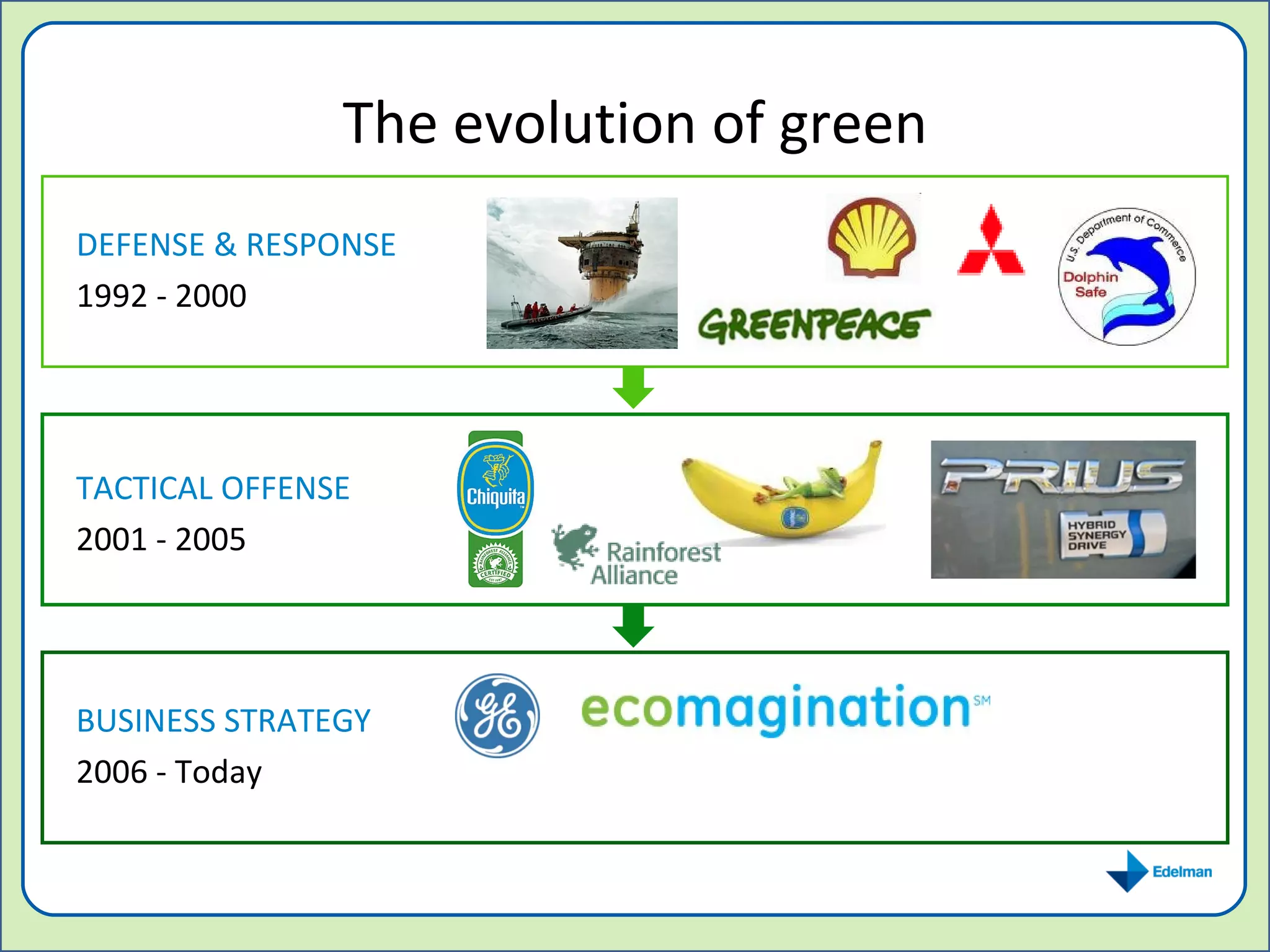
The evolution of green DEFENSE & RESPONSE 1992 - 2000 BUSINESS STRATEGY 2006 - Today TACTICAL OFFENSE 2001 - 2005
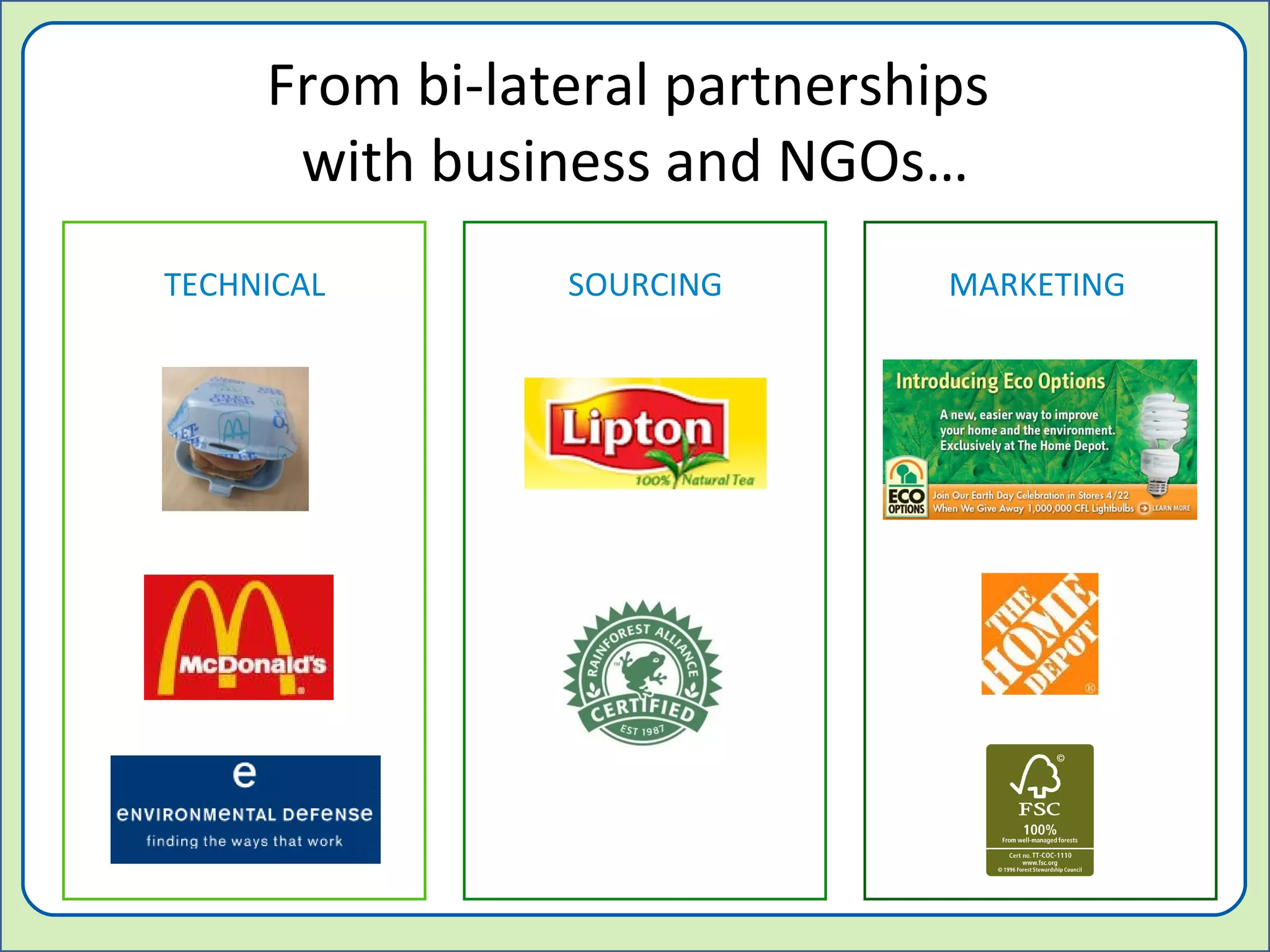
From bi-lateral partnerships  with business and NGOs… TECHNICAL   MARKETING SOURCING
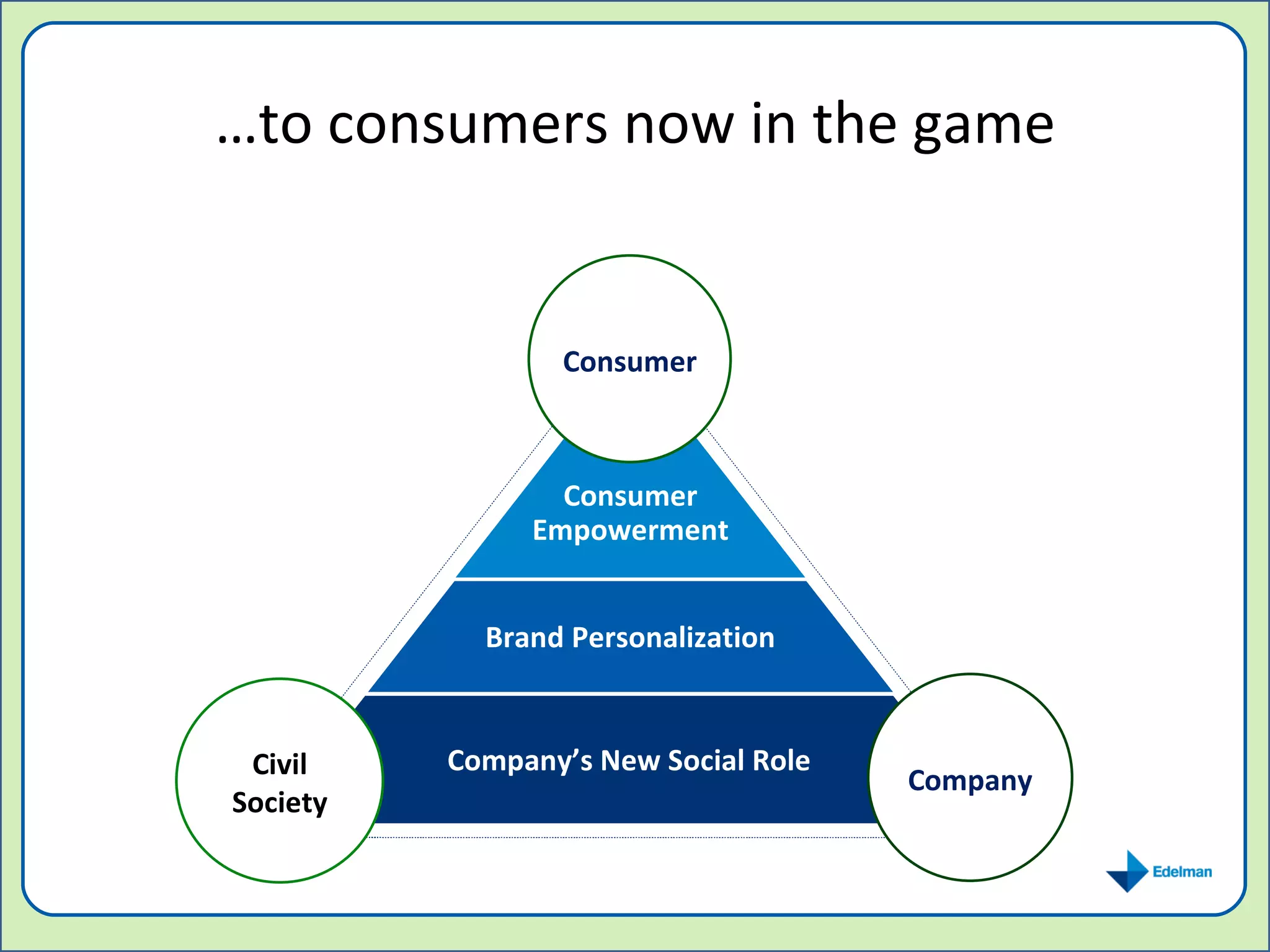
… to consumers now in the game Brand Personalization Civil Society Company Consumer Consumer Empowerment Company’s New Social Role
Key questions Q:  Is green a new minimum standard or a premium offer?  Q:  What is the role of NGO partnerships, today? Q:  How best to market?
Consumer behavior:  Aspiration vs. Reality ASPIRATION   58%  of  Americans intent to purchase is positively impacted by information about a brand’s support of social causes , versus  47%   by information regarding new product features Nearly seven in 10 globally  ( 69% )  say they would be prepared to pay more  for eco-friendly products 2 nd  Annual goodpurpose Global Consumer Study, 2009 REALITY When times are good, people are  eco-conscience. When times are difficult, final decisions are made on bottom-line cost. - Professor John Gourville,  Harvard Business School We do not think [environmental sustainability] is optional… we’re not sure how much of a premium consumers will pay for it, but consumers will punish ‘bad actors’. - Mike White, PepsiCo
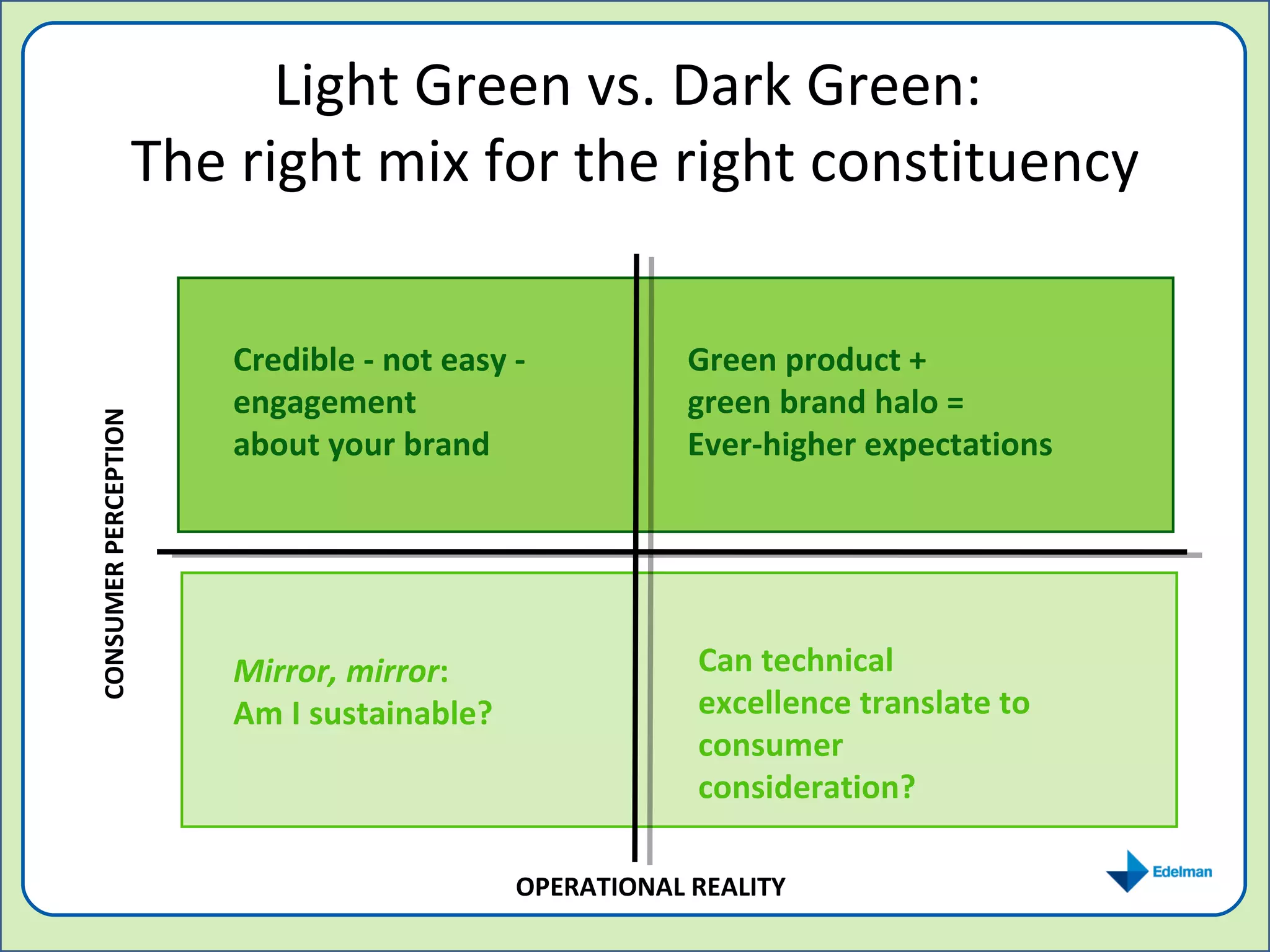
Light Green vs. Dark Green:  The right mix for the right constituency OPERATIONAL REALITY CONSUMER PERCEPTION Credible - not easy -  engagement  about your brand Mirror, mirror :  Am I sustainable?  Green product +  green brand halo = Ever-higher expectations Can technical excellence translate to consumer consideration?
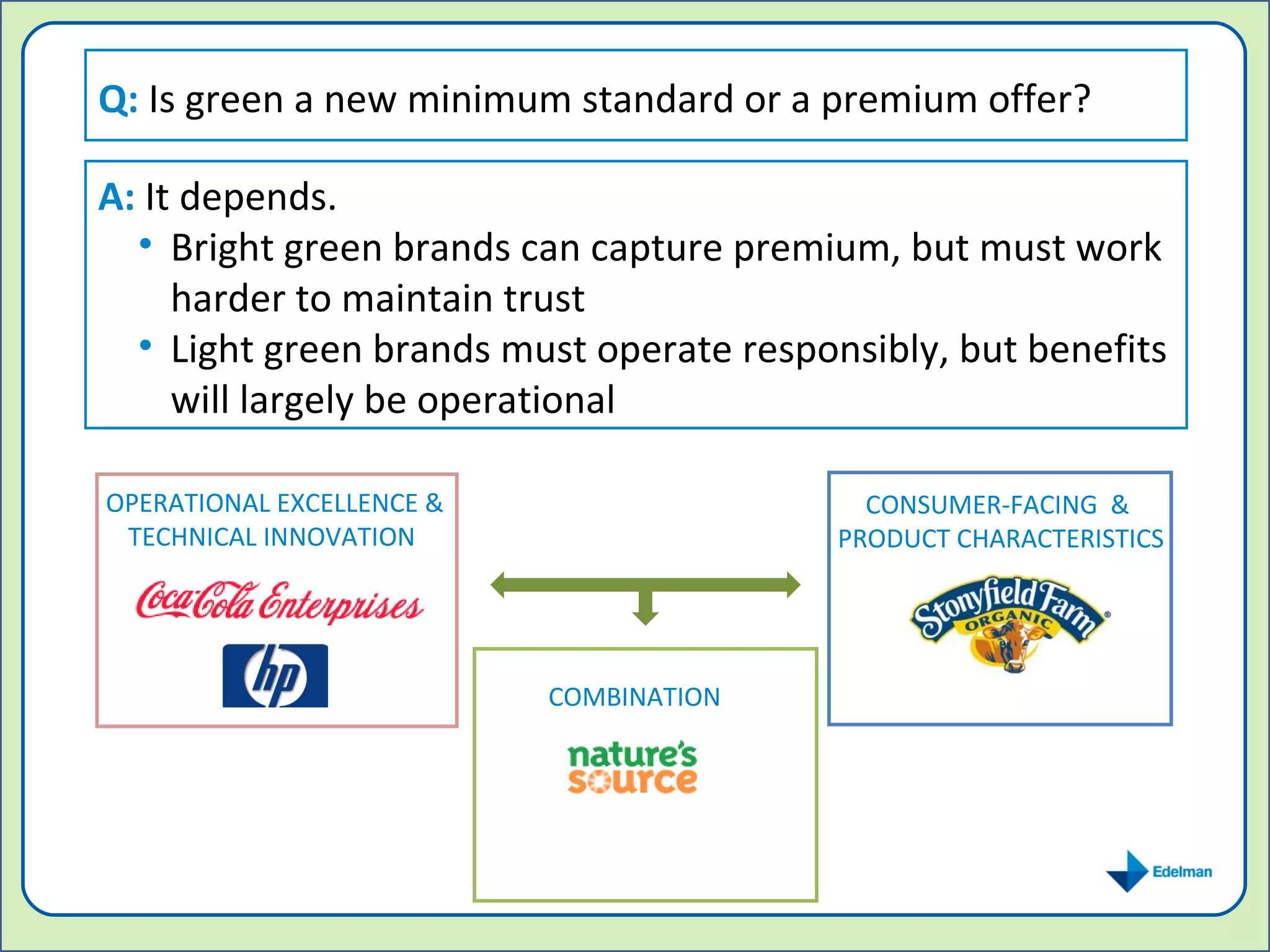
Q:  Is green a new minimum standard or a premium offer?  A:  It depends. Bright green brands can capture premium, but must work harder to maintain trust Light green brands must operate responsibly, but benefits will largely be operational  OPERATIONAL EXCELLENCE & TECHNICAL INNOVATION  CONSUMER-FACING  &  PRODUCT CHARACTERISTICS COMBINATION
Q:  What is the role of NGO partnerships, today? A:  Partnerships still provide technical expertise and social license  fixes for business .  Now the expectation is for  business to fix society’s problem . “ … Come together—government, NGOs and business—in new approach to solving big problems facing our country. … This can work.”  Lee Scott, Wal-mart Lipton Tea consumers perceive ethical sourcing  [Rainforest Alliance certification] to positively impact the quality of the tea, therefore they are willing to pay more. - Unilever TRADITIONAL  PARTNERSHIPS WHAT’S NEXT?
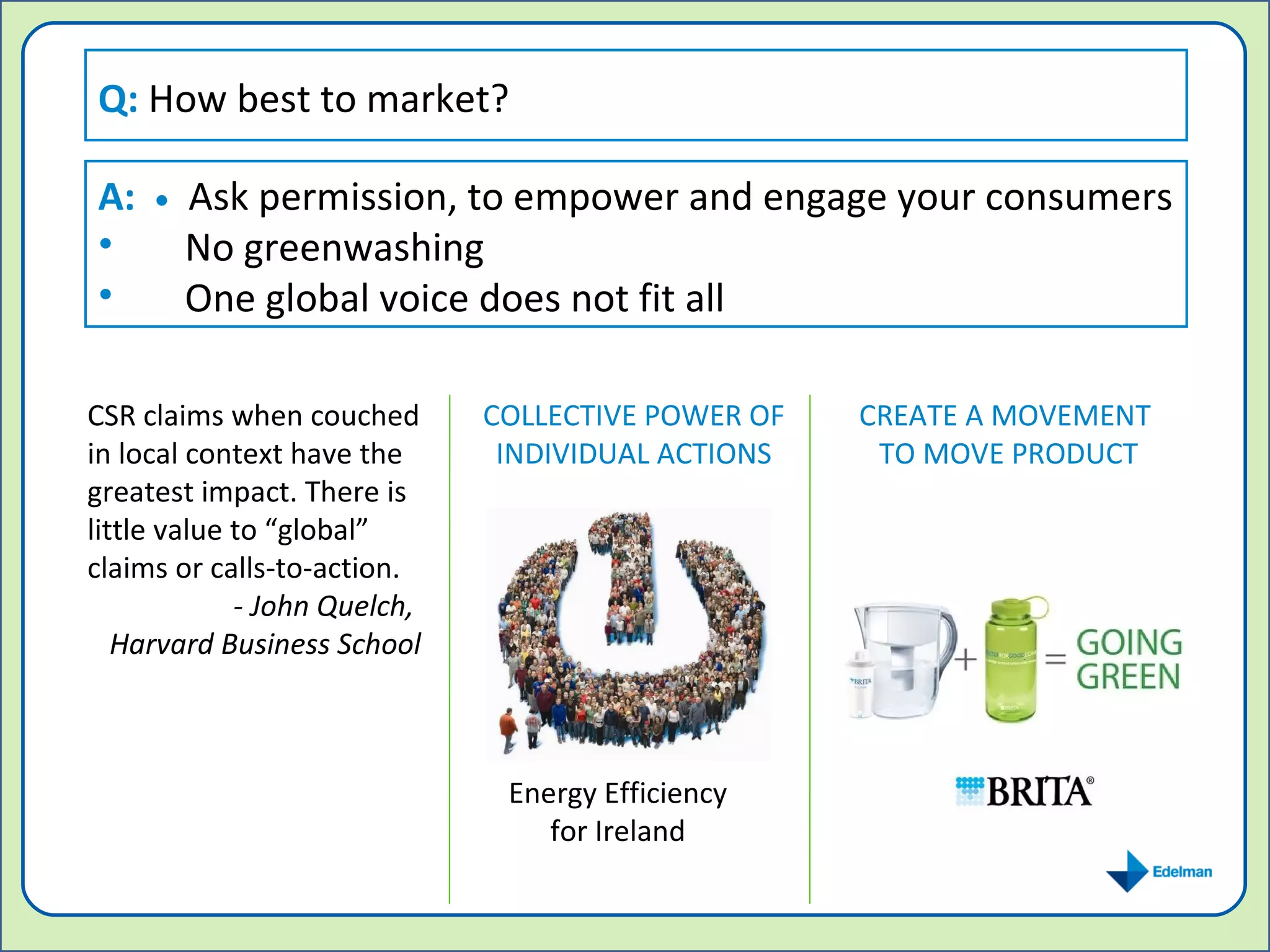
A:  •   Ask permission, to empower and engage your consumers  No greenwashing One global voice does not fit all Q:  How best to market? COLLECTIVE POWER OF INDIVIDUAL ACTIONS CREATE A MOVEMENT  TO MOVE PRODUCT CSR claims when couched in local context have the greatest impact. There is little value to “global” claims or calls-to-action. - John Quelch,  Harvard Business School Energy Efficiency for Ireland
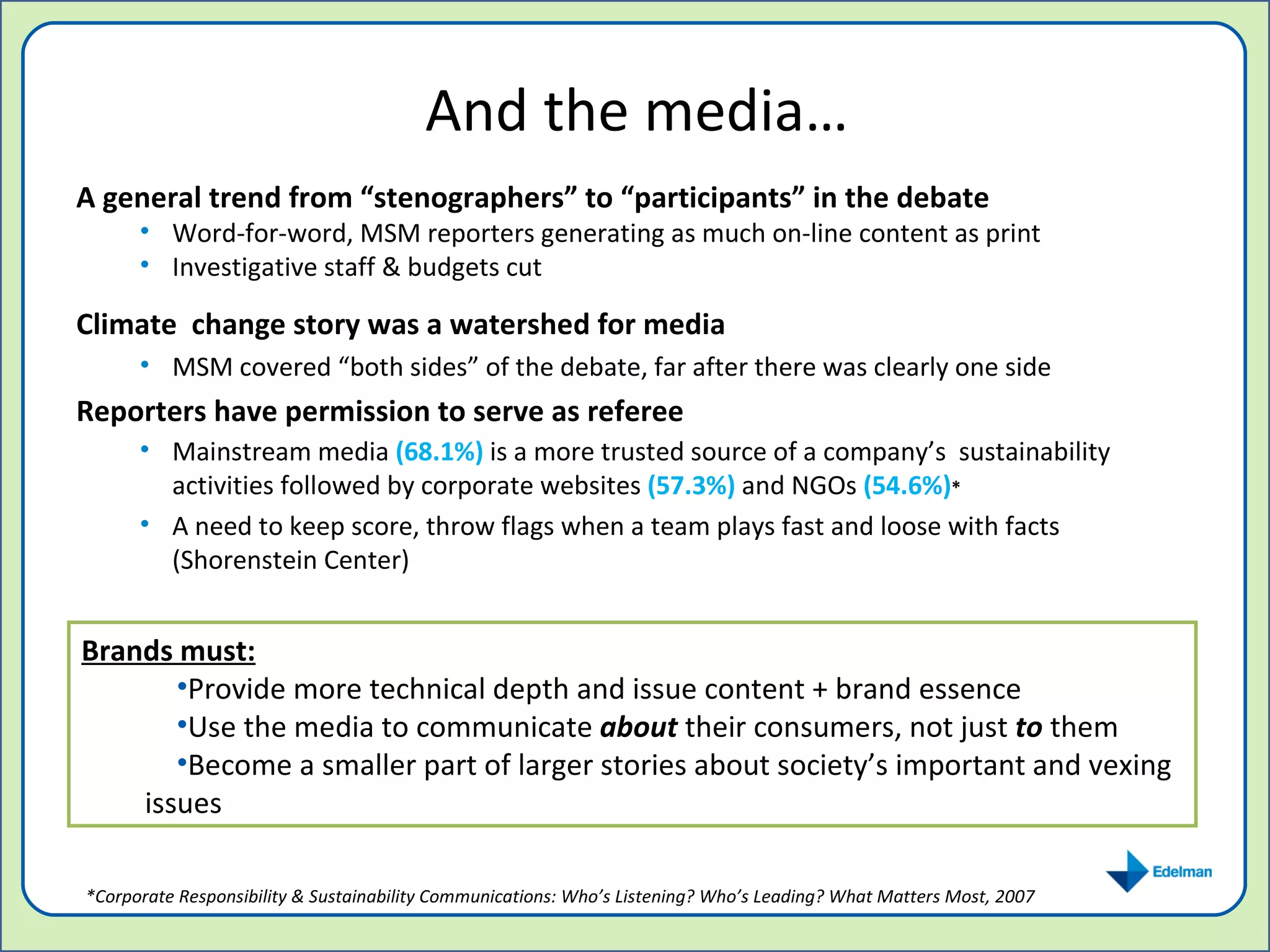
And the media… A   general trend from “stenographers” to “participants” in the debate Word-for-word, MSM reporters generating as much on-line content as print Investigative staff & budgets cut Climate  change story was a watershed for media MSM covered “both sides” of the debate, far after there was clearly one side Reporters have permission to serve as referee  Mainstream media  (68.1%)  is a more trusted source of a company’s  sustainability activities followed by corporate websites   (57.3%)   and NGOs  (54.6%) * A need to keep score, throw flags when a team plays fast and loose with facts (Shorenstein Center) Brands must: Provide more technical depth and issue content + brand essence Use the media to communicate  about  their consumers, not just  to  them Become a smaller part of larger stories about society’s important and vexing issues *Corporate Responsibility & Sustainability Communications: Who’s Listening? Who’s Leading? What Matters Most, 2007
The era of Mutual Social Responsibility Combine corporate reputation & brand marketing  Operate Differently Continual improvement;  like quality Today’s bright green is tomorrow’s light green Partner Differently Go beyond the technical Share consumer relationships and trust Market Differently Give up control Co-create brands; share values

Wsj Eco Conference

  • 1.
    Mutual Social Responsibility– Where is green going?
  • 2.
    An evolving socialbusiness landscape Consumers move from viewers to collaborators Consumer citizens & citizen brands emerge – only some will survive the downturn Interest in social purpose works across all demographics, women especially Social purpose is a new “benefit” to build employee engagement and loyalty We see consumers [willing to pay] up to a 10% premium for ethical brands. The issue is that organic, fair trade, etc. were charging an average of 45% or more... we still see growth.
  • 3.
    The evolution ofgreen DEFENSE & RESPONSE 1992 - 2000 BUSINESS STRATEGY 2006 - Today TACTICAL OFFENSE 2001 - 2005
  • 4.
    From bi-lateral partnerships with business and NGOs… TECHNICAL MARKETING SOURCING
  • 5.
    … to consumersnow in the game Brand Personalization Civil Society Company Consumer Consumer Empowerment Company’s New Social Role
  • 6.
    Key questions Q: Is green a new minimum standard or a premium offer? Q: What is the role of NGO partnerships, today? Q: How best to market?
  • 7.
    Consumer behavior: Aspiration vs. Reality ASPIRATION 58% of Americans intent to purchase is positively impacted by information about a brand’s support of social causes , versus 47% by information regarding new product features Nearly seven in 10 globally ( 69% ) say they would be prepared to pay more for eco-friendly products 2 nd Annual goodpurpose Global Consumer Study, 2009 REALITY When times are good, people are eco-conscience. When times are difficult, final decisions are made on bottom-line cost. - Professor John Gourville, Harvard Business School We do not think [environmental sustainability] is optional… we’re not sure how much of a premium consumers will pay for it, but consumers will punish ‘bad actors’. - Mike White, PepsiCo
  • 8.
    Light Green vs.Dark Green: The right mix for the right constituency OPERATIONAL REALITY CONSUMER PERCEPTION Credible - not easy - engagement about your brand Mirror, mirror : Am I sustainable? Green product + green brand halo = Ever-higher expectations Can technical excellence translate to consumer consideration?
  • 9.
    Q: Isgreen a new minimum standard or a premium offer? A: It depends. Bright green brands can capture premium, but must work harder to maintain trust Light green brands must operate responsibly, but benefits will largely be operational OPERATIONAL EXCELLENCE & TECHNICAL INNOVATION CONSUMER-FACING & PRODUCT CHARACTERISTICS COMBINATION
  • 10.
    Q: Whatis the role of NGO partnerships, today? A: Partnerships still provide technical expertise and social license fixes for business . Now the expectation is for business to fix society’s problem . “ … Come together—government, NGOs and business—in new approach to solving big problems facing our country. … This can work.” Lee Scott, Wal-mart Lipton Tea consumers perceive ethical sourcing  [Rainforest Alliance certification] to positively impact the quality of the tea, therefore they are willing to pay more. - Unilever TRADITIONAL PARTNERSHIPS WHAT’S NEXT?
  • 11.
    A: • Ask permission, to empower and engage your consumers No greenwashing One global voice does not fit all Q: How best to market? COLLECTIVE POWER OF INDIVIDUAL ACTIONS CREATE A MOVEMENT TO MOVE PRODUCT CSR claims when couched in local context have the greatest impact. There is little value to “global” claims or calls-to-action. - John Quelch, Harvard Business School Energy Efficiency for Ireland
  • 12.
    And the media…A general trend from “stenographers” to “participants” in the debate Word-for-word, MSM reporters generating as much on-line content as print Investigative staff & budgets cut Climate change story was a watershed for media MSM covered “both sides” of the debate, far after there was clearly one side Reporters have permission to serve as referee Mainstream media (68.1%) is a more trusted source of a company’s sustainability activities followed by corporate websites (57.3%) and NGOs (54.6%) * A need to keep score, throw flags when a team plays fast and loose with facts (Shorenstein Center) Brands must: Provide more technical depth and issue content + brand essence Use the media to communicate about their consumers, not just to them Become a smaller part of larger stories about society’s important and vexing issues *Corporate Responsibility & Sustainability Communications: Who’s Listening? Who’s Leading? What Matters Most, 2007
  • 13.
    The era ofMutual Social Responsibility Combine corporate reputation & brand marketing Operate Differently Continual improvement; like quality Today’s bright green is tomorrow’s light green Partner Differently Go beyond the technical Share consumer relationships and trust Market Differently Give up control Co-create brands; share values