PMA Board Meeting Corporate Social Responsibility October 7, 2008
What’s Our Agenda? What’s Their Agenda? What’s PMA’s Agenda? AGENDA
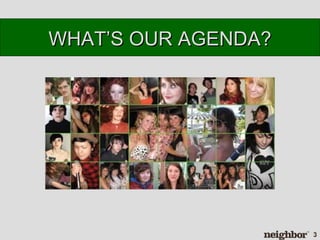
WHAT’S OUR AGENDA?
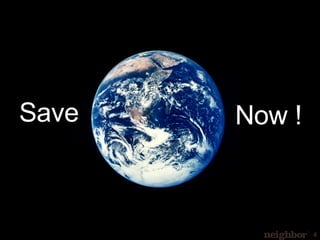
Save Now !
we want to feel more confident about the economy we are concerned and want accountability for food, health,  products, environment we want green products that are real solutions  we don’t want to be guilty we don’t want to leave a mess for our kids ‘ Our’ Agenda is….
50 million Americans Strongly aware/deeply concerned about issues facing planet Taking action to address them Focus on health, well-being Wiser consumption Who are ‘we’? Source:  Cultural Creatives , by Paul Ray/Sherry Anderson, culturalcreatives.org “ Cultural Creatives”
Lifestyles of Health and Sustainability (LOHAS) Who are ‘we’? Source: LOHAS, lohas.com Integrate social, political and economic  values with their actions in the marketplace Roughly 1 in every 3 people in U.S. –  58 million adults •  Authenticity and transparency key
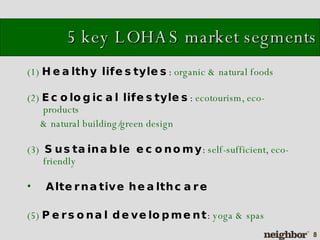
5 key LOHAS market segments (1)   Healthy lifestyles :  organic & natural foods (2)   Ecological lifestyles :  ecotourism, eco-products  & natural building/green design (3)   Sustainable economy :  self-sufficient, eco-friendly Alternative   healthcare (5)   Personal development :  yoga & spas
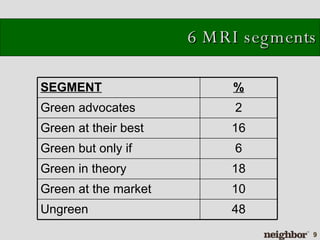
6 MRI segments 48 Ungreen 10 Green at the market 18 Green in theory 6 Green but only if 16 Green at their best 2 Green advocates % SEGMENT
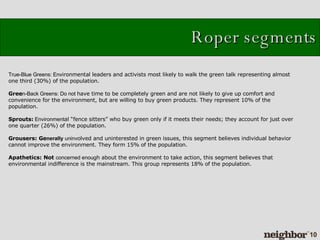
Roper segments True-Blue Greens: Env ironmental leaders and activists most likely to walk the green talk representing almost one third (30%) of the population.  Gree n-Back Greens: Do not  have time to be completely green and are not likely to give up comfort and convenience for the environment, but are willing to buy green products. They represent 10% of the population.  Sprouts:  Environment al “fence sitters” who buy green only if it meets their needs; they account for just over one quarter (26%) of the population.  Grousers: Ge nerally  uninv olved and uninterested in green issues, this segment believes individual behavior cannot improve the environment. They form 15% of the population.  Apathetics: Not   concerned enoug h about the environment to take action, this segment believes that environmental indifference is the mainstream. This group represents 18% of the population.
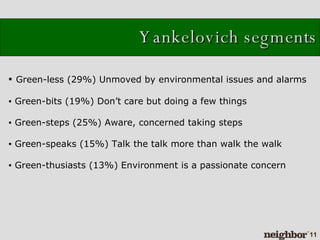
Yankelovich segments ▪  Green-less (29%) Unmoved by environmental issues and alarms ▪  Green-bits (19%) Don’t   care but doing a few things ▪  Green-steps (25%) Aware, concerned taking steps ▪  Green-speaks (15%) Talk the talk more than walk the walk ▪  Green-thusiasts (13%) Environment is a passionate concern
 
 
but….


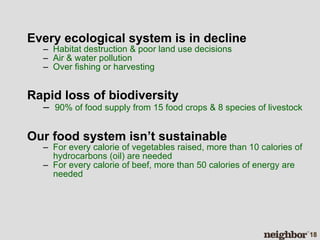
Every ecological system is in decline –  Habitat destruction & poor land use decisions –  Air & water pollution –  Over fishing or harvesting Rapid loss of biodiversity –  90% of food supply from 15 food crops & 8 species of livestock Our food system isn’t sustainable –  For every calorie of vegetables raised, more than 10 calories of hydrocarbons (oil) are needed –   For every calorie of beef, more than 50 calories of energy are needed
 
WHAT’S THEIR AGENDA? (how do you perceive these efforts?)
?
 
 
Bank of America: Green Bank or Greenwash? posted by Nell in  Global Finance  on April 3rd, 2008 Or at least that was the question on the mind of Fortune Magazine’s Marc Gunther, in his  “Black, White or Green?”  blog post yesterday. On the same day as we awarded Bank of America CEO Ken Lewis the Fossil Fool of the Year award for being a lead financier of new coal-fired powerplants and mountaintop removal, he was in NY to accept an award from NRDC for the Bank’s new “green” skyscraper and their $20 billion commitment to renewable energy. The coincidence compelled Gunther to ask: “So is the Bank of America an environmental hero? A villain? Both? Or neither?” As corporations and financial institutions begin to respond to the demand for action on climate change, it seems we are always in a state of wondering where a company stands on the green line. How can we tell with Bank of America? Well, just as Bank of America measures their bottom-line with ones and zeros, we’re measuring their environmental impact by where their money is. As of 2006, every $1 Bank of America invested in renewable energy was matched by another $100 spent on dirty energy. To use an appropriate cliché, perhaps its time they put their money where their mouth is. Rainforest Action Network blog:
 
BMW  brought its not-for-sale-in-America  118d  five-door to New York City to claim the 2008 World Green Car award... and that's probably the only time we'll ever see the thing on US soil. Immediately following the event, BMW packed up the car and put it on the boat back to Deutschland.
 
 
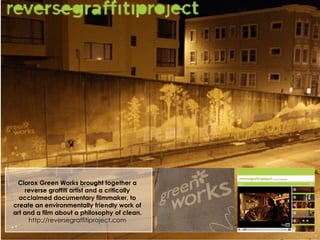
Clorox Green Works brought together a reverse graffiti artist and a critically acclaimed documentary filmmaker, to create an environmentally friendly work of art and a film about a philosophy of clean. http://reversegraffitiproject.com
 
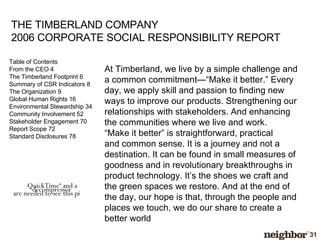
Table of Contents From the CEO 4 The Timberland Footprint 6 Summary of CSR Indicators 8 The Organization 9 Global Human Rights 16 Environmental Stewardship 34 Community Involvement 52 Stakeholder Engagement 70 Report Scope 72 Standard Disclosures 78 At Timberland, we live by a simple challenge and a common commitment—“Make it better.” Every day, we apply skill and passion to finding new ways to improve our products. Strengthening our relationships with stakeholders. And enhancing the communities where we live and work. “ Make it better” is straightforward, practical and common sense. It is a journey and not a destination. It can be found in small measures of goodness and in revolutionary breakthroughs in product technology. It’s the shoes we craft and the green spaces we restore. And at the end of the day, our hope is that, through the people and places we touch, we do our share to create a better world THE TIMBERLAND COMPANY 2006 CORPORATE SOCIAL RESPONSIBILITY REPORT
 
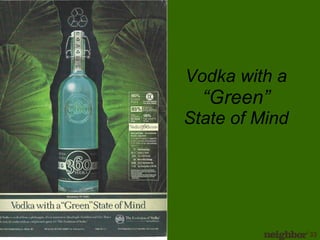
Vodka with a  “Green”  State of Mind
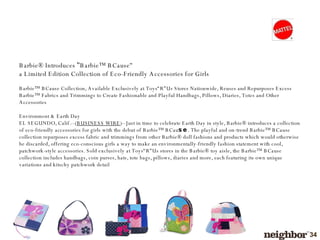
Barbie® Introduces  '‘ Barbie™ BCause''  a Limited Edition Collection of Eco-Friendly Accessories for Girls Barbie™ BCause Collection, Available Exclusively at Toys“R”Us Stores Nationwide, Reuses and Repurposes Excess Barbie™ Fabrics and Trimmings to Create Fashionable and Playful Handbags, Pillows, Diaries, Totes and Other Accessories Environment & Earth Day EL SEGUNDO, Calif .--( BUSINESS WIRE )-- Just in time to celebrate Earth Day in style, Barbie® introduces a collection of eco-friendly accessories for girls with the debut of Barbie™ BCau se . The playful and on-trend Barbie™ BCause collection repurposes excess fabric and trimmings from other Barbie® doll fashions and products which would otherwise be discarded, offering eco-conscious girls a way to make an environmentally-friendly fashion statement with cool, patchwork-style accessories. Sold exclusively at Toys“R”Us stores in the Barbie® toy aisle, the Barbie™ BCause collection includes handbags, coin purses, hats, tote bags, pillows, diaries and more, each featuring its own unique variations and kitschy patchwork detail
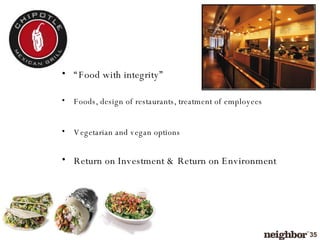
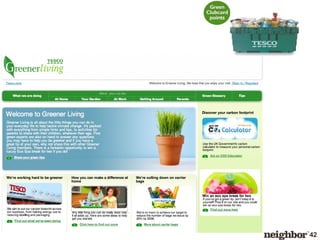
“ Food with integrity” Foods, design of restaurants, treatment of employees Vegetarian and vegan options Return on Investment & Return on Environment


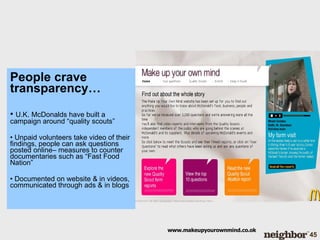
People crave transparency… U.K. McDonalds have built a campaign around “quality scouts” Unpaid volunteers take video of their findings, people can ask questions posted online– measures to counter documentaries such as “Fast Food Nation” Documented on website & in videos, communicated through ads & in blogs www.makeupyourownmind.co.ok
 
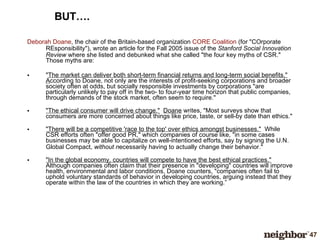
Deborah Doane , the chair of the Britain-based organization  CORE Coalition  (for "COrporate REsponsibility"), wrote an article for the Fall 2005 issue of the  Stanford Social Innovation Review  where she listed and debunked what she called "the four key myths of CSR." Those myths are: " The market can deliver both short-term financial returns and long-term social benefits." A ccording to Doane, not only are the interests of profit-seeking corporations and broader society often at odds, but socially responsible investments by corporations "are particularly unlikely to pay off in the two- to four-year time horizon that public companies, through demands of the stock market, often seem to require." "The ethical consumer will drive change."   Doane  writes, "Most surveys show that consumers are more concerned about things like price, taste, or sell-by date than ethics." "There will be a competitive 'race to the top' over ethics amongst businesses."   While CSR efforts often "offer good PR," which companies of course like, "in some cases businesses may be able to capitalize on well-intentioned efforts, say by signing the U.N. Global Compact,  without n ecessarily having to actually change their behavior." "In the global economy, countries will compete to have the best ethical practices."  Although companies often claim that their presence in "developing" countries will improve health, environmental and labor conditions, Doane counters, "companies often fail to uphold voluntary standards of behavior in developing countries, arguing instead that they operate within the law of the countries in which they are working.” BUT….
How about these #’s?
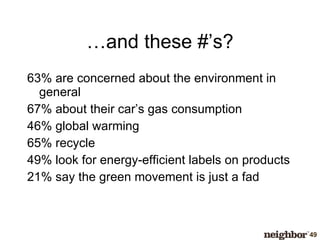
… and these #’s? 63% are concerned about the environment in general 67% about their car’s gas consumption 46% global warming 65% recycle 49% look for energy-efficient labels on products 21% say the green movement is just a fad
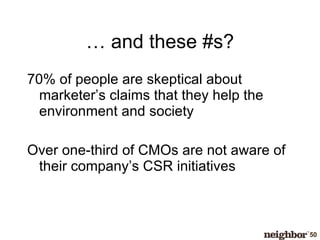
… and these #s? 70% of people are skeptical about marketer’s claims that they help the environment and society Over one-third of CMOs are not aware of their company’s CSR initiatives
A Few Questions? Who’s doing it right? Who’s doing it right in the mainstream? Is it ‘marketing’ or something else?
WHAT’S PMA’s AGENDA?
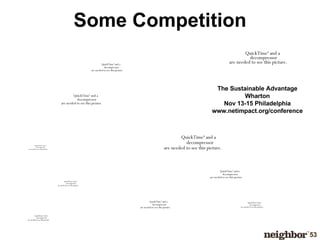
Some Competition The Sustainable Advantage Wharton Nov 13-15 Philadelphia www.netimpact.org/conference
AGENDA OPTION #1: IGNORE
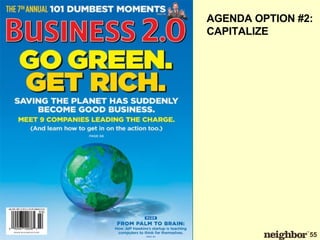
AGENDA OPTION #2: CAPITALIZE
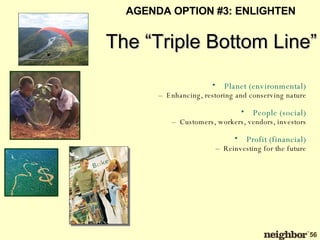
Planet (environmental) –  Enhancing, restoring and conserving nature People (social) –  Customers, workers, vendors, investors Profit (financial) –  Reinvesting for the future The “Triple Bottom Line” AGENDA OPTION #3: ENLIGHTEN
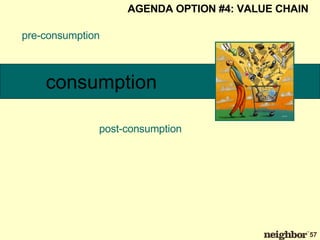
consumption pre-consumption post-consumption AGENDA OPTION #4: VALUE CHAIN
Energy Efficiency,Conservation & Renewable Water Efficiency & Conservation Recycling & Composting Sustainable Food Pollution Prevention Green Building & Construction Stakeholders Sustainability Agenda AGENDA OPTION #5: DO IT ALL!
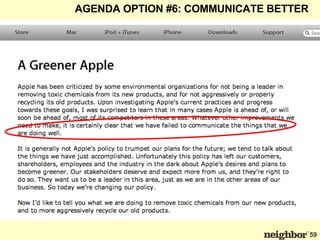
AGENDA OPTION #6: COMMUNICATE BETTER
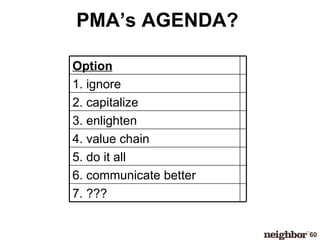
PMA’s AGENDA? 7. ??? 6. communicate better 5. do it all 4. value chain 3. enlighten 2. capitalize 1. ignore Option
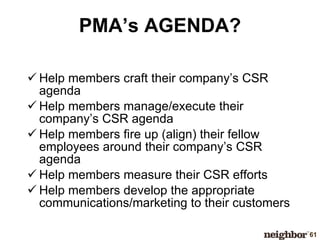
PMA’s AGENDA? Help members craft their company’s CSR agenda Help members manage/execute their company’s CSR agenda Help members fire up (align) their fellow employees around their company’s CSR agenda Help members measure their CSR efforts Help members develop the appropriate communications/marketing to their customers
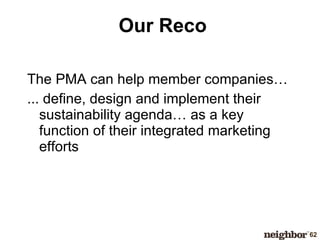
Our Reco The PMA can help member companies… ... define, design and implement their sustainability agenda… as a key function of their integrated marketing efforts
Our Reco: Webinar Schedule January  13, 2009: Contributing positively as a competitive advantage- Setting Your Agenda - Ben Packard, Environmental Affairs Manager at Starbucks March  03, 2009: Sustainability equals corporate social responsibility- Being Realistically Bold - Sarah Severn, Global Director, Corporate Responsibility Horizons at Nike May  05, 2009: Changing the game: Movement marketing- How Consumers Are Thinking/Acting - Alex Petrov, SVP, General Manager at Lucerne Foods July  07, 2009: Brands and their impact: Practical approaches to changing the way we think and operate - William McDonough, Activist, visionary, author, consultant September  01, 2009: The concept of Sustainable Value Networks- Inside-out Agenda - Susan Chambers, Executive Vice President - People Division at Wal-Mart November  03, 2009: Open communication culture inside-out - a case study of the Patagonia Footprint Chronicles - Rick Ridgeway, VP Environmental Programs & Communications at Patagonia
Our Reco: Specifics Turnkey chapter meeting materials from the webinars A way to assemble a virtual resource center (?) Trend research specific to CSR/marketing Of consumers and their reactions to company/brand efforts Of marketers and what they’re doing/seeing and how it’s working
Next Steps Board Approval to a ‘hybrid’ CSR CoE Build out the webinar series speakers Ensure the materials, recordings etc are available to the chapters Determine the feasibility of an online resource center for CSR Determine how best to do trend research
Thank You [email_address]

CSR presentation

  • 1.
    PMA Board MeetingCorporate Social Responsibility October 7, 2008
  • 2.
    What’s Our Agenda?What’s Their Agenda? What’s PMA’s Agenda? AGENDA
  • 3.
  • 4.
  • 5.
    we want tofeel more confident about the economy we are concerned and want accountability for food, health, products, environment we want green products that are real solutions we don’t want to be guilty we don’t want to leave a mess for our kids ‘ Our’ Agenda is….
  • 6.
    50 million AmericansStrongly aware/deeply concerned about issues facing planet Taking action to address them Focus on health, well-being Wiser consumption Who are ‘we’? Source: Cultural Creatives , by Paul Ray/Sherry Anderson, culturalcreatives.org “ Cultural Creatives”
  • 7.
    Lifestyles of Healthand Sustainability (LOHAS) Who are ‘we’? Source: LOHAS, lohas.com Integrate social, political and economic values with their actions in the marketplace Roughly 1 in every 3 people in U.S. – 58 million adults • Authenticity and transparency key
  • 8.
    5 key LOHASmarket segments (1) Healthy lifestyles : organic & natural foods (2) Ecological lifestyles : ecotourism, eco-products & natural building/green design (3) Sustainable economy : self-sufficient, eco-friendly Alternative healthcare (5) Personal development : yoga & spas
  • 9.
    6 MRI segments48 Ungreen 10 Green at the market 18 Green in theory 6 Green but only if 16 Green at their best 2 Green advocates % SEGMENT
  • 10.
    Roper segments True-BlueGreens: Env ironmental leaders and activists most likely to walk the green talk representing almost one third (30%) of the population. Gree n-Back Greens: Do not have time to be completely green and are not likely to give up comfort and convenience for the environment, but are willing to buy green products. They represent 10% of the population. Sprouts: Environment al “fence sitters” who buy green only if it meets their needs; they account for just over one quarter (26%) of the population. Grousers: Ge nerally uninv olved and uninterested in green issues, this segment believes individual behavior cannot improve the environment. They form 15% of the population. Apathetics: Not concerned enoug h about the environment to take action, this segment believes that environmental indifference is the mainstream. This group represents 18% of the population.
  • 11.
    Yankelovich segments ▪ Green-less (29%) Unmoved by environmental issues and alarms ▪ Green-bits (19%) Don’t care but doing a few things ▪ Green-steps (25%) Aware, concerned taking steps ▪ Green-speaks (15%) Talk the talk more than walk the walk ▪ Green-thusiasts (13%) Environment is a passionate concern
  • 12.
  • 13.
  • 14.
  • 15.
  • 16.
  • 17.
  • 18.
    Every ecological systemis in decline – Habitat destruction & poor land use decisions – Air & water pollution – Over fishing or harvesting Rapid loss of biodiversity – 90% of food supply from 15 food crops & 8 species of livestock Our food system isn’t sustainable – For every calorie of vegetables raised, more than 10 calories of hydrocarbons (oil) are needed – For every calorie of beef, more than 50 calories of energy are needed
  • 19.
  • 20.
    WHAT’S THEIR AGENDA?(how do you perceive these efforts?)
  • 21.
  • 22.
  • 23.
  • 24.
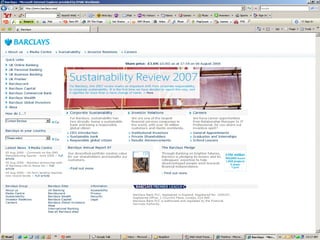
    Bank of America:Green Bank or Greenwash? posted by Nell in Global Finance on April 3rd, 2008 Or at least that was the question on the mind of Fortune Magazine’s Marc Gunther, in his “Black, White or Green?” blog post yesterday. On the same day as we awarded Bank of America CEO Ken Lewis the Fossil Fool of the Year award for being a lead financier of new coal-fired powerplants and mountaintop removal, he was in NY to accept an award from NRDC for the Bank’s new “green” skyscraper and their $20 billion commitment to renewable energy. The coincidence compelled Gunther to ask: “So is the Bank of America an environmental hero? A villain? Both? Or neither?” As corporations and financial institutions begin to respond to the demand for action on climate change, it seems we are always in a state of wondering where a company stands on the green line. How can we tell with Bank of America? Well, just as Bank of America measures their bottom-line with ones and zeros, we’re measuring their environmental impact by where their money is. As of 2006, every $1 Bank of America invested in renewable energy was matched by another $100 spent on dirty energy. To use an appropriate cliché, perhaps its time they put their money where their mouth is. Rainforest Action Network blog:
  • 25.
  • 26.
    BMW broughtits not-for-sale-in-America 118d five-door to New York City to claim the 2008 World Green Car award... and that's probably the only time we'll ever see the thing on US soil. Immediately following the event, BMW packed up the car and put it on the boat back to Deutschland.
  • 27.
  • 28.
  • 29.
    Clorox Green Worksbrought together a reverse graffiti artist and a critically acclaimed documentary filmmaker, to create an environmentally friendly work of art and a film about a philosophy of clean. http://reversegraffitiproject.com
  • 30.
  • 31.
    Table of ContentsFrom the CEO 4 The Timberland Footprint 6 Summary of CSR Indicators 8 The Organization 9 Global Human Rights 16 Environmental Stewardship 34 Community Involvement 52 Stakeholder Engagement 70 Report Scope 72 Standard Disclosures 78 At Timberland, we live by a simple challenge and a common commitment—“Make it better.” Every day, we apply skill and passion to finding new ways to improve our products. Strengthening our relationships with stakeholders. And enhancing the communities where we live and work. “ Make it better” is straightforward, practical and common sense. It is a journey and not a destination. It can be found in small measures of goodness and in revolutionary breakthroughs in product technology. It’s the shoes we craft and the green spaces we restore. And at the end of the day, our hope is that, through the people and places we touch, we do our share to create a better world THE TIMBERLAND COMPANY 2006 CORPORATE SOCIAL RESPONSIBILITY REPORT
  • 32.
  • 33.
    Vodka with a “Green” State of Mind
  • 34.
    Barbie® Introduces '‘ Barbie™ BCause'' a Limited Edition Collection of Eco-Friendly Accessories for Girls Barbie™ BCause Collection, Available Exclusively at Toys“R”Us Stores Nationwide, Reuses and Repurposes Excess Barbie™ Fabrics and Trimmings to Create Fashionable and Playful Handbags, Pillows, Diaries, Totes and Other Accessories Environment & Earth Day EL SEGUNDO, Calif .--( BUSINESS WIRE )-- Just in time to celebrate Earth Day in style, Barbie® introduces a collection of eco-friendly accessories for girls with the debut of Barbie™ BCau se . The playful and on-trend Barbie™ BCause collection repurposes excess fabric and trimmings from other Barbie® doll fashions and products which would otherwise be discarded, offering eco-conscious girls a way to make an environmentally-friendly fashion statement with cool, patchwork-style accessories. Sold exclusively at Toys“R”Us stores in the Barbie® toy aisle, the Barbie™ BCause collection includes handbags, coin purses, hats, tote bags, pillows, diaries and more, each featuring its own unique variations and kitschy patchwork detail
  • 35.
    “ Food withintegrity” Foods, design of restaurants, treatment of employees Vegetarian and vegan options Return on Investment & Return on Environment
  • 36.
  • 37.
  • 38.
  • 39.
  • 40.
  • 41.
  • 42.
  • 43.
  • 44.
  • 45.
    People crave transparency…U.K. McDonalds have built a campaign around “quality scouts” Unpaid volunteers take video of their findings, people can ask questions posted online– measures to counter documentaries such as “Fast Food Nation” Documented on website & in videos, communicated through ads & in blogs www.makeupyourownmind.co.ok
  • 46.
  • 47.
    Deborah Doane ,the chair of the Britain-based organization CORE Coalition (for "COrporate REsponsibility"), wrote an article for the Fall 2005 issue of the Stanford Social Innovation Review where she listed and debunked what she called "the four key myths of CSR." Those myths are: " The market can deliver both short-term financial returns and long-term social benefits." A ccording to Doane, not only are the interests of profit-seeking corporations and broader society often at odds, but socially responsible investments by corporations "are particularly unlikely to pay off in the two- to four-year time horizon that public companies, through demands of the stock market, often seem to require." "The ethical consumer will drive change." Doane writes, "Most surveys show that consumers are more concerned about things like price, taste, or sell-by date than ethics." "There will be a competitive 'race to the top' over ethics amongst businesses." While CSR efforts often "offer good PR," which companies of course like, "in some cases businesses may be able to capitalize on well-intentioned efforts, say by signing the U.N. Global Compact, without n ecessarily having to actually change their behavior." "In the global economy, countries will compete to have the best ethical practices." Although companies often claim that their presence in "developing" countries will improve health, environmental and labor conditions, Doane counters, "companies often fail to uphold voluntary standards of behavior in developing countries, arguing instead that they operate within the law of the countries in which they are working.” BUT….
  • 48.
  • 49.
    … and these#’s? 63% are concerned about the environment in general 67% about their car’s gas consumption 46% global warming 65% recycle 49% look for energy-efficient labels on products 21% say the green movement is just a fad
  • 50.
    … and these#s? 70% of people are skeptical about marketer’s claims that they help the environment and society Over one-third of CMOs are not aware of their company’s CSR initiatives
  • 51.
    A Few Questions?Who’s doing it right? Who’s doing it right in the mainstream? Is it ‘marketing’ or something else?
  • 52.
  • 53.
    Some Competition TheSustainable Advantage Wharton Nov 13-15 Philadelphia www.netimpact.org/conference
  • 54.
  • 55.
  • 56.
    Planet (environmental) – Enhancing, restoring and conserving nature People (social) – Customers, workers, vendors, investors Profit (financial) – Reinvesting for the future The “Triple Bottom Line” AGENDA OPTION #3: ENLIGHTEN
  • 57.
    consumption pre-consumption post-consumptionAGENDA OPTION #4: VALUE CHAIN
  • 58.
    Energy Efficiency,Conservation &Renewable Water Efficiency & Conservation Recycling & Composting Sustainable Food Pollution Prevention Green Building & Construction Stakeholders Sustainability Agenda AGENDA OPTION #5: DO IT ALL!
  • 59.
    AGENDA OPTION #6:COMMUNICATE BETTER
  • 60.
    PMA’s AGENDA? 7.??? 6. communicate better 5. do it all 4. value chain 3. enlighten 2. capitalize 1. ignore Option
  • 61.
    PMA’s AGENDA? Helpmembers craft their company’s CSR agenda Help members manage/execute their company’s CSR agenda Help members fire up (align) their fellow employees around their company’s CSR agenda Help members measure their CSR efforts Help members develop the appropriate communications/marketing to their customers
  • 62.
    Our Reco ThePMA can help member companies… ... define, design and implement their sustainability agenda… as a key function of their integrated marketing efforts
  • 63.
    Our Reco: WebinarSchedule January 13, 2009: Contributing positively as a competitive advantage- Setting Your Agenda - Ben Packard, Environmental Affairs Manager at Starbucks March 03, 2009: Sustainability equals corporate social responsibility- Being Realistically Bold - Sarah Severn, Global Director, Corporate Responsibility Horizons at Nike May 05, 2009: Changing the game: Movement marketing- How Consumers Are Thinking/Acting - Alex Petrov, SVP, General Manager at Lucerne Foods July 07, 2009: Brands and their impact: Practical approaches to changing the way we think and operate - William McDonough, Activist, visionary, author, consultant September 01, 2009: The concept of Sustainable Value Networks- Inside-out Agenda - Susan Chambers, Executive Vice President - People Division at Wal-Mart November 03, 2009: Open communication culture inside-out - a case study of the Patagonia Footprint Chronicles - Rick Ridgeway, VP Environmental Programs & Communications at Patagonia
  • 64.
    Our Reco: SpecificsTurnkey chapter meeting materials from the webinars A way to assemble a virtual resource center (?) Trend research specific to CSR/marketing Of consumers and their reactions to company/brand efforts Of marketers and what they’re doing/seeing and how it’s working
  • 65.
    Next Steps BoardApproval to a ‘hybrid’ CSR CoE Build out the webinar series speakers Ensure the materials, recordings etc are available to the chapters Determine the feasibility of an online resource center for CSR Determine how best to do trend research
  • 66.