Aligning Promise with Practice Corporate Reputation  and  Sustainable Marketing Chris Tang Managing Director, Asia Pacific The Hoffman Agency
What is sustainability? It is a business approach  where companies consider not  only economical needs in their strategies and practices but also environmental and social needs.
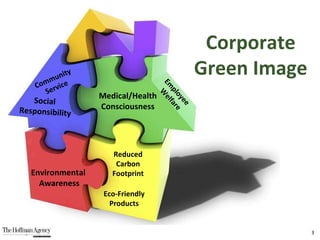
Corporate Green Image Environmental  Awareness Social  Responsibility Medical/Health Consciousness Eco-Friendly Products Reduced Carbon Footprint Employee  Welfare Community Service
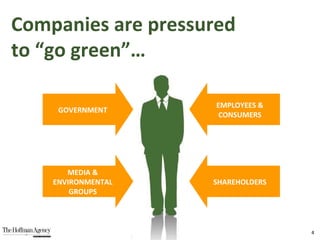
Companies are pressured  to “go green”… MEDIA & ENVIRONMENTAL GROUPS GOVERNMENT EMPLOYEES & CONSUMERS SHAREHOLDERS
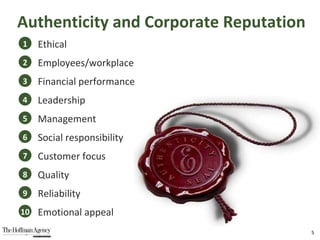
Authenticity and Corporate Reputation 1 Ethical 2 Employees/workplace 3 Financial performance 4 Leadership 5 Management 6 Social responsibility 7 Customer focus 8 Quality 9 Reliability 10 Emotional appeal
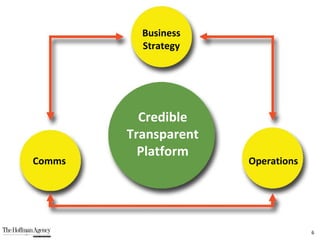
Credible Transparent Platform Comms Operations Business Strategy
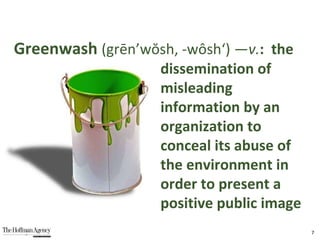
Greenwash  (grēn’wŏsh, -w ô sh‘)  —v. :  the dissemination of misleading information by an organization to conceal its abuse of the environment in order to present a positive public image
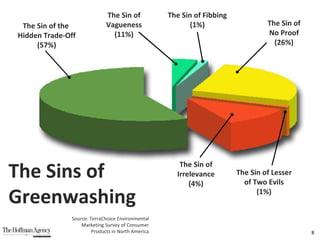
The Sin of the  Hidden Trade-Off (57%) The Sin of Vagueness (11%) The Sin of Fibbing (1%) The Sin of No Proof (26%) The Sin of Irrelevance (4%) The Sin of Lesser of Two Evils (1%) The Sins of  Greenwashing Source: TerraChoice Environmental Marketing Survey of Consumer Products in North America
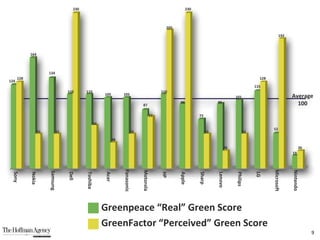
Sony Nokia Samsung Dell Toshiba Acer Panasonic Motorola HP Apple Sharp Lenovo Philips LG Microsoft Nintendo 124 128 164 134 51 51 110 230 110 64 105 38 105 51 87 77 110 205 230 192 96 73 51 96 26 101 51 115 128 52 19 26 Average 100 Greenpeace “Real” Green Score GreenFactor “Perceived” Green Score
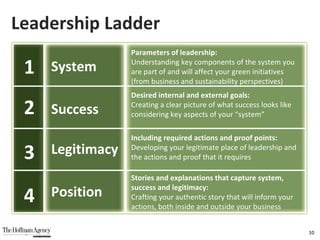
Leadership Ladder 1 2 3 4 Legitimacy Position Success System Parameters of leadership: Understanding key components of the system you are part of and will affect your green initiatives (from business and sustainability perspectives) Desired internal and external goals: Creating a clear picture of what success looks like considering key aspects of your “system” Including required actions and proof points: Developing your legitimate place of leadership and the actions and proof that it requires Stories and explanations that capture system, success and legitimacy: Crafting your authentic story that will inform your actions, both inside and outside your business
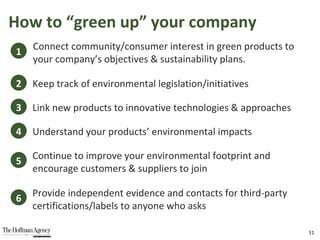
1 3 2 Connect community/consumer interest in green products to your company’s objectives & sustainability plans. Keep track of environmental legislation/initiatives Link new products to innovative technologies & approaches 4 Understand your products’ environmental impacts  5 Continue to improve your environmental footprint and encourage customers & suppliers to join 6 Provide independent evidence and contacts for third-party certifications/labels to anyone who asks How to “green up” your company
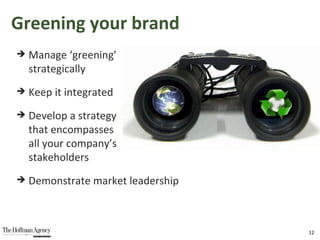
Greening your brand Manage ‘greening’  strategically Keep it integrated Develop a strategy  that encompasses  all your company’s  stakeholders Demonstrate market leadership
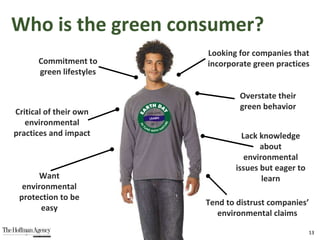
Who is the green consumer? Commitment to green lifestyles Critical of their own environmental practices and impact Looking for companies that incorporate green practices Overstate their green behavior Want environmental protection to be easy Tend to distrust companies’ environmental claims Lack knowledge about environmental issues but eager to learn
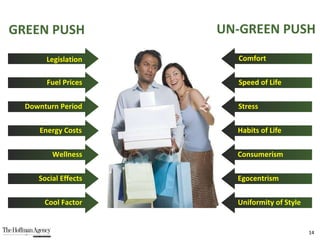
Legislation Fuel Prices Downturn Period Energy Costs Wellness Social Effects Cool Factor Comfort Speed of Life Stress Habits of Life Consumerism Egocentrism Uniformity of Style GREEN PUSH UN-GREEN PUSH
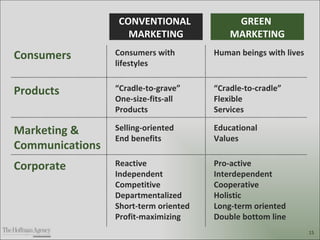
CONVENTIONAL  MARKETING GREEN  MARKETING Pro-active Interdependent Cooperative Holistic Long-term oriented Double bottom line Reactive Independent Competitive Departmentalized Short-term oriented Profit-maximizing Corporate Educational Values Selling-oriented End benefits Marketing & Communications “ Cradle-to-cradle” Flexible Services “ Cradle-to-grave” One-size-fits-all Products Products Human beings with lives Consumers with lifestyles Consumers
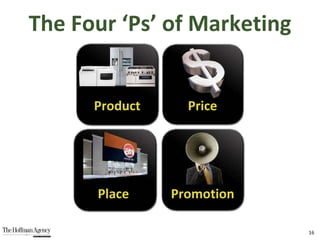
The Four ‘Ps’ of Marketing Product Price Place Promotion
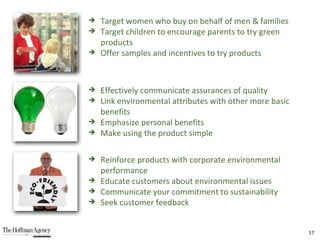
Target women who buy on behalf of men & families Target children to encourage parents to try green products Offer samples and incentives to try products Effectively communicate assurances of quality Link environmental attributes with other more basic benefits Emphasize personal benefits Make using the product simple Reinforce products with corporate environmental performance Educate customers about environmental issues Communicate your commitment to sustainability Seek customer feedback
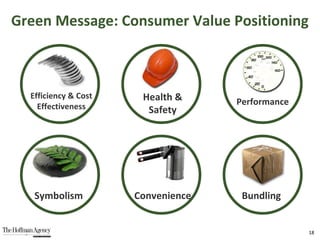
Green Message: Consumer Value Positioning Efficiency & Cost Effectiveness Health & Safety Performance Symbolism Convenience Bundling
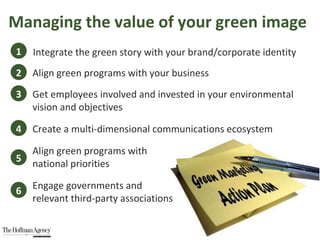
Managing the value of your green image 1 3 2 Integrate the green story with your brand/corporate identity Align green programs with your business Get employees involved and invested in your environmental vision and objectives 4 Create a multi-dimensional communications ecosystem 5 Align green programs with  national priorities 6 Engage governments and  relevant third-party associations
Enlist employees to develop your strategy Clearly communicate your vision, goals and priorities  Develop organizational structures Educate employees and provide  participation programs Measure progress and  recognize accomplishments Employees are your best ambassadors
Research the  environmental attitudes  and purchasing criteria of your  customers Communicate through sources that  people trust Communicate simply Publicize employees’ green initiatives Communicate your green message
Pursue alliances with governments, other companies and environmental groups Partner with corporate customers  on programs specific to  their industries  Develop community  outreach programs Form green alliances
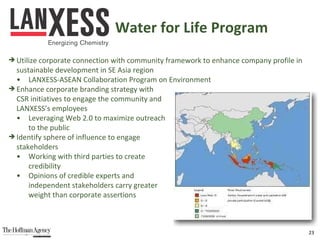
Utilize corporate connection with community framework to enhance company profile in sustainable development in SE Asia region • LANXESS-ASEAN Collaboration Program on Environment Enhance corporate branding strategy with  CSR initiatives to engage the community and  LANXESS’s employees • Leveraging Web 2.0 to maximize outreach  to the public Identify sphere of influence to engage  stakeholders • Working with third parties to create  credibility • Opinions of credible experts and  independent stakeholders carry greater  weight than corporate assertions Water for Life Program
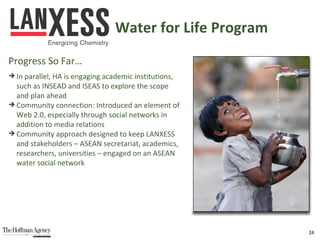
In parallel, HA is engaging academic institutions,  such as INSEAD and ISEAS to explore the scope  and plan ahead Community connection: Introduced an element of  Web 2.0, especially through social networks in  addition to media relations Community approach designed to keep LANXESS  and stakeholders – ASEAN secretariat, academics,  researchers, universities – engaged on an ASEAN  water social network Water for Life Program Progress So Far…
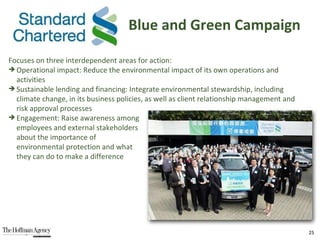
Focuses on three interdependent areas for action: Operational impact: Reduce the environmental impact of its own operations and activities Sustainable lending and financing: Integrate environmental stewardship, including climate change, in its business policies, as well as client relationship management and risk approval processes Engagement: Raise awareness among  employees and external stakeholders  about the importance of  environmental protection and what  they can do to make a difference Blue and Green Campaign
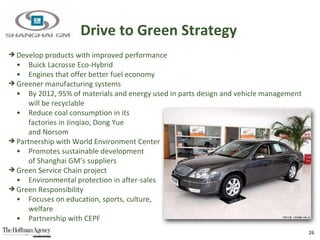
Drive to Green Strategy Develop products with improved performance • Buick Lacrosse Eco-Hybrid • Engines that offer better fuel economy Greener manufacturing systems • By 2012, 95% of materials and energy used in parts design and vehicle management  will be recyclable • Reduce coal consumption in its  factories in Jinqiao, Dong Yue  and Norsom Partnership with World Environment Center • Promotes sustainable development  of Shanghai GM’s suppliers Green Service Chain project • Environmental protection in after-sales Green Responsibility • Focuses on education, sports, culture,  welfare  • Partnership with CEPF
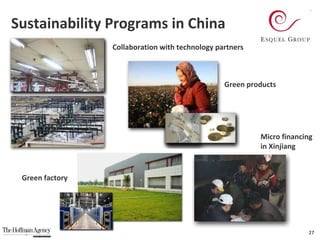
Sustainability Programs in China Green factory Collaboration with technology partners Green products Micro financing  in Xinjiang

Aligning Promise with Practice

  • 1.
    Aligning Promise withPractice Corporate Reputation and Sustainable Marketing Chris Tang Managing Director, Asia Pacific The Hoffman Agency
  • 2.
    What is sustainability?It is a business approach where companies consider not only economical needs in their strategies and practices but also environmental and social needs.
  • 3.
    Corporate Green ImageEnvironmental Awareness Social Responsibility Medical/Health Consciousness Eco-Friendly Products Reduced Carbon Footprint Employee Welfare Community Service
  • 4.
    Companies are pressured to “go green”… MEDIA & ENVIRONMENTAL GROUPS GOVERNMENT EMPLOYEES & CONSUMERS SHAREHOLDERS
  • 5.
    Authenticity and CorporateReputation 1 Ethical 2 Employees/workplace 3 Financial performance 4 Leadership 5 Management 6 Social responsibility 7 Customer focus 8 Quality 9 Reliability 10 Emotional appeal
  • 6.
    Credible Transparent PlatformComms Operations Business Strategy
  • 7.
    Greenwash (grēn’wŏsh,-w ô sh‘) —v. : the dissemination of misleading information by an organization to conceal its abuse of the environment in order to present a positive public image
  • 8.
    The Sin ofthe Hidden Trade-Off (57%) The Sin of Vagueness (11%) The Sin of Fibbing (1%) The Sin of No Proof (26%) The Sin of Irrelevance (4%) The Sin of Lesser of Two Evils (1%) The Sins of Greenwashing Source: TerraChoice Environmental Marketing Survey of Consumer Products in North America
  • 9.
    Sony Nokia SamsungDell Toshiba Acer Panasonic Motorola HP Apple Sharp Lenovo Philips LG Microsoft Nintendo 124 128 164 134 51 51 110 230 110 64 105 38 105 51 87 77 110 205 230 192 96 73 51 96 26 101 51 115 128 52 19 26 Average 100 Greenpeace “Real” Green Score GreenFactor “Perceived” Green Score
  • 10.
    Leadership Ladder 12 3 4 Legitimacy Position Success System Parameters of leadership: Understanding key components of the system you are part of and will affect your green initiatives (from business and sustainability perspectives) Desired internal and external goals: Creating a clear picture of what success looks like considering key aspects of your “system” Including required actions and proof points: Developing your legitimate place of leadership and the actions and proof that it requires Stories and explanations that capture system, success and legitimacy: Crafting your authentic story that will inform your actions, both inside and outside your business
  • 11.
    1 3 2Connect community/consumer interest in green products to your company’s objectives & sustainability plans. Keep track of environmental legislation/initiatives Link new products to innovative technologies & approaches 4 Understand your products’ environmental impacts 5 Continue to improve your environmental footprint and encourage customers & suppliers to join 6 Provide independent evidence and contacts for third-party certifications/labels to anyone who asks How to “green up” your company
  • 12.
    Greening your brandManage ‘greening’ strategically Keep it integrated Develop a strategy that encompasses all your company’s stakeholders Demonstrate market leadership
  • 13.
    Who is thegreen consumer? Commitment to green lifestyles Critical of their own environmental practices and impact Looking for companies that incorporate green practices Overstate their green behavior Want environmental protection to be easy Tend to distrust companies’ environmental claims Lack knowledge about environmental issues but eager to learn
  • 14.
    Legislation Fuel PricesDownturn Period Energy Costs Wellness Social Effects Cool Factor Comfort Speed of Life Stress Habits of Life Consumerism Egocentrism Uniformity of Style GREEN PUSH UN-GREEN PUSH
  • 15.
    CONVENTIONAL MARKETINGGREEN MARKETING Pro-active Interdependent Cooperative Holistic Long-term oriented Double bottom line Reactive Independent Competitive Departmentalized Short-term oriented Profit-maximizing Corporate Educational Values Selling-oriented End benefits Marketing & Communications “ Cradle-to-cradle” Flexible Services “ Cradle-to-grave” One-size-fits-all Products Products Human beings with lives Consumers with lifestyles Consumers
  • 16.
    The Four ‘Ps’of Marketing Product Price Place Promotion
  • 17.
    Target women whobuy on behalf of men & families Target children to encourage parents to try green products Offer samples and incentives to try products Effectively communicate assurances of quality Link environmental attributes with other more basic benefits Emphasize personal benefits Make using the product simple Reinforce products with corporate environmental performance Educate customers about environmental issues Communicate your commitment to sustainability Seek customer feedback
  • 18.
    Green Message: ConsumerValue Positioning Efficiency & Cost Effectiveness Health & Safety Performance Symbolism Convenience Bundling
  • 19.
    Managing the valueof your green image 1 3 2 Integrate the green story with your brand/corporate identity Align green programs with your business Get employees involved and invested in your environmental vision and objectives 4 Create a multi-dimensional communications ecosystem 5 Align green programs with national priorities 6 Engage governments and relevant third-party associations
  • 20.
    Enlist employees todevelop your strategy Clearly communicate your vision, goals and priorities Develop organizational structures Educate employees and provide participation programs Measure progress and recognize accomplishments Employees are your best ambassadors
  • 21.
    Research the environmental attitudes and purchasing criteria of your customers Communicate through sources that people trust Communicate simply Publicize employees’ green initiatives Communicate your green message
  • 22.
    Pursue alliances withgovernments, other companies and environmental groups Partner with corporate customers on programs specific to their industries Develop community outreach programs Form green alliances
  • 23.
    Utilize corporate connectionwith community framework to enhance company profile in sustainable development in SE Asia region • LANXESS-ASEAN Collaboration Program on Environment Enhance corporate branding strategy with CSR initiatives to engage the community and LANXESS’s employees • Leveraging Web 2.0 to maximize outreach to the public Identify sphere of influence to engage stakeholders • Working with third parties to create credibility • Opinions of credible experts and independent stakeholders carry greater weight than corporate assertions Water for Life Program
  • 24.
    In parallel, HAis engaging academic institutions, such as INSEAD and ISEAS to explore the scope and plan ahead Community connection: Introduced an element of Web 2.0, especially through social networks in addition to media relations Community approach designed to keep LANXESS and stakeholders – ASEAN secretariat, academics, researchers, universities – engaged on an ASEAN water social network Water for Life Program Progress So Far…
  • 25.
    Focuses on threeinterdependent areas for action: Operational impact: Reduce the environmental impact of its own operations and activities Sustainable lending and financing: Integrate environmental stewardship, including climate change, in its business policies, as well as client relationship management and risk approval processes Engagement: Raise awareness among employees and external stakeholders about the importance of environmental protection and what they can do to make a difference Blue and Green Campaign
  • 26.
    Drive to GreenStrategy Develop products with improved performance • Buick Lacrosse Eco-Hybrid • Engines that offer better fuel economy Greener manufacturing systems • By 2012, 95% of materials and energy used in parts design and vehicle management will be recyclable • Reduce coal consumption in its factories in Jinqiao, Dong Yue and Norsom Partnership with World Environment Center • Promotes sustainable development of Shanghai GM’s suppliers Green Service Chain project • Environmental protection in after-sales Green Responsibility • Focuses on education, sports, culture, welfare • Partnership with CEPF
  • 27.
    Sustainability Programs inChina Green factory Collaboration with technology partners Green products Micro financing in Xinjiang

Editor's Notes

  • #5 Governments and society pressure companies to “go green”. Governments: Set more stringent controls over energy and water consumption, greenhouse gas emissions, the use of hazardous substances and the disposal of both standard and hazardous waste. Shareholders: Differentiate between corporations whose stocks just make money and corporations that both make money and have strong environmental policies Employees and consumers: Are increasingly choosing to work for or buy from companies that have a strong sense of environmental stewardship and overall corporate social responsibility Media and environmental groups: Track companies for environmental performance and quickly uncover enterprises that “greenwash” themselves
  • #6 Governments and society pressure companies to “go green”. Governments: Set more stringent controls over energy and water consumption, greenhouse gas emissions, the use of hazardous substances and the disposal of both standard and hazardous waste. Shareholders: Differentiate between corporations whose stocks just make money and corporations that both make money and have strong environmental policies Employees and consumers: Are increasingly choosing to work for or buy from companies that have a strong sense of environmental stewardship and overall corporate social responsibility Media and environmental groups: Track companies for environmental performance and quickly uncover enterprises that “greenwash” themselves
  • #7 Governments and society pressure companies to “go green”. Governments: Set more stringent controls over energy and water consumption, greenhouse gas emissions, the use of hazardous substances and the disposal of both standard and hazardous waste. Shareholders: Differentiate between corporations whose stocks just make money and corporations that both make money and have strong environmental policies Employees and consumers: Are increasingly choosing to work for or buy from companies that have a strong sense of environmental stewardship and overall corporate social responsibility Media and environmental groups: Track companies for environmental performance and quickly uncover enterprises that “greenwash” themselves