Mainstream Green
Graceann Bennett &
Freya Williams


The Red Papers:


Ogilvy & Mather
Mainstream Green:
Moving sustainability
from niche to normal
Graceann Bennett &
Freya Williams


The Red Papers:


Ogilvy & Mather
The Red Papers:


Contents                                April 2011, No. 4


  6 About the Green Gap project   34    Adventures along the
                                        green continuum
  8 Introduction
                                  64    Turning the corner
12 Closing the
   Green Gap                      74    12 ways we propose
                                        to close the gap
18 Researching the
   Green Gap                      92    Comparing the US
                                        and China
20 Normal behavior is
   sustainable behavior           112   Conclusion

24 The massive                    116   Research methodology
   Middle Green
                                  120   Key takeaways
30 The far ends of the
   continuum
The Red Papers:                                                                    Mainstream Green


About the Green Gap project   The United States and China arms of OgilvyEarth
                              collaborated on a project that aimed to help crack the code
                              on one of marketing’s thorniest problems. We choose those
                              countries as they are the two largest consuming markets
                              on earth. The problem, dubbed the Green Gap, describes
                              the gap between consumers’ green intentions and green
                              actions. Plenty of research observes that it exists; we set
                              out to understand why, and to discover ways to close it.
                              Bridging the Green Gap is critical to corporate bottom
                              lines and climate trend lines.


                              Kunal Sinha and Michael Griffiths led the China part of
                              this project, and their findings are presented in Get Going
                              with Green — the companion piece to this work.


                              Graceann Bennett and Freya Williams led the United
                              States project.


                              Both teams collaborated on the comparison section that
                              closes this volume.

6                                                                                                7
Mainstream Green


Introduction   An all-star cast of green luminaries flocked to December’s
               World Climate Summit in Cancun, Mexico: CEOs,
               corporate sustainability officers, clean energy consultants,
               Hollywood producers and even a few of us from
               OgilvyEarth. The very presence of such a broad spectrum
               of people at this event was a major coup from a climate
               standpoint. The pretext for the gathering was the UN
               climate summit COP16, the follow-up to the now-
               infamous COP15 (which is viewed by many as having
               fallen short of the “ambitious and binding” global treaty
               it set out to achieve). This year, the heavy hitters from the
               private sector were taking matters into their own hands,
               sending a clear signal to the UN delegates that business
               wants progress on climate and is ready to roll up its
               sleeves to collaborate on solutions.


                                                                                  9
The Red Papers:                                                                                                    Mainstream Green


Introduction   Nestled among the more technical topics on the table (policies,
               procurement, new financing mechanisms) was a particularly encouraging
               agenda item: public engagement. It is unusual, in these rarified circles, to
               hear talk of creating a mass movement on everyone’s lips. But this elite
               cadre knows that to achieve our goals we must motivate a mass green
               movement, shifting mainstream consumers to a more sustainable way of
               living. The public engagement session opened with media mogul and
               climate guru Ted Turner talking about how we are losing precious time
               and can’t afford to keep failing at motivating the masses. “When will
               the world understand that we are right and they are wrong?” he intoned
               from the stage. We nodded our heads in furious agreement and in his
               frustration, Turner spoke for the room. The mainstream has completely
               confounded us when it comes to green. They have evaded every rational
               and emotion argument we’ve thrown their way. To us, it seems they’re just
               not getting it.

               But maybe Ted Turner’s remark revealed our problem. Maybe we’re the
               ones not getting it. If we are to motivate a mass green movement, perhaps         The mainstream has completely
               those of us most committed to the green movement need to stop trying to
               get the masses to see things our way and instead get better at seeing things      confounded us when it comes to green.
               their way. To get from here to there, a radical shift in perspective is needed.
               So far, despite the best intentions, the discussion has largely focused on
               the two ends of the spectrum — the committed Greens talking to their
               fellow green converts or, alternatively, doing battle with the fervent Anti-
               Greens, who seem more determined than ever to evade conversion. What
               we’ve been missing in the process is the massive Middle, the group that
               offers the biggest opportunity to create the change the world so needs.

               It is on the Middle that this report will focus, and more specifically on
               the gap between the Green Middle’s intentions and their actions when
               it comes to sustainability. Our goal is to provide insight into the things
               keeping the gap open and practical, pragmatic, actionable suggestions for
               closing it, once and for all. We hope you’ll join us.


               10                                                                                                                              11
The Red Papers:                                                                                            Mainstream Green


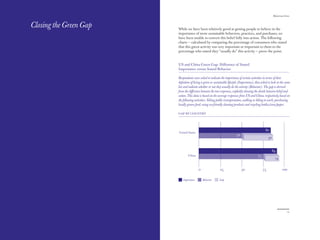
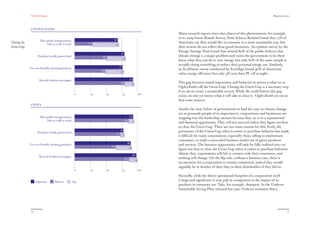
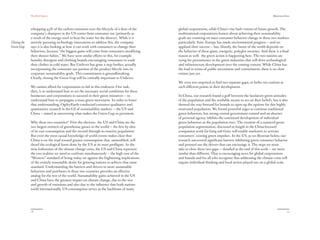
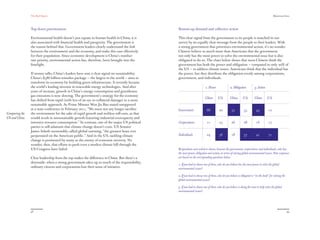
Closing the Green Gap   While we have been relatively good at getting people to believe in the
                        importance of more sustainable behaviors, practices, and purchases, we
                        have been unable to convert this belief fully into action. The following
                        charts — calculated by comparing the percentage of consumers who stated
                        that this green activity was very important or important to them to the
                        percentage who stated they “usually do” this activity — prove the point.


                        US and China Green Gap: Difference of Stated
                        Importance versus Stated Behavior

                        Respondents were asked to indicate the importance of certain activities in terms of their
                        definition of living a green or sustainable lifestyle (Importance), then asked to look at the same
                        list and indicate whether or not they usually do the activity (Behavior). The gap is derived
                        from the difference between the two responses, explicitly showing the divide between belief and
                        action. This data is based on the average responses from US and China, respectively, based on
                        the following activities: Taking public transportation, walking or biking to work; purchasing
                        locally grown food; using eco-friendly cleaning products and recycling bottles/cans/paper.

                        GAP BY COUNTRY


                                                                                                   80
                        United States
                                                                          50
                                                                                                      30


                                                                                                           89
                                China                                                       75
                                                                                                            14


                                         0                  25                 50                75                100


                            Importance       Behavior      Gap


12                                                                                                                      13
The Red Papers:                                                                                                                                                        Mainstream Green


              UNITED STATES
                                                                                                                   Many research reports have also observed this phenomenon; for example,
                                                                                                                   in its 2009 Green Brands Survey, Penn Schoen Berland found that 77% of
                      Take public transportation,                          68
Closing the                 bike or walk to work         27                                                        Americans say they would like to consume in a more sustainable way, but
                                                                               41
Green Gap                                                                                                          their actions do not reflect these good intentions. An opinion survey by the
                                                                                                                   Energy Savings Trust found that around 80% of the public believes that
                                                                                     81
                    Purchase locally grown food                 49                                                 climate change is a major problem and wants the government to let them
                                                                                         32
                                                                                                                   know what they can do to save energy, but only 60% of the same sample is
                                                                                                                   actually doing something to reduce their personal energy use. Similarly,
                                                                                    77
              Use eco-friendly cleaning products                                                                   an EcoPinion survey conducted by EcoAlign found 90% of Americans
                                                               45
                                                                                     32
                                                                                                                   value energy efficiency but only 3% turn their PC off at night.
                                                                                                   93
                      Recycle bottles/cans/paper
                                                                                    79
                                                                                                       14
                                                                                                                   This gap between stated importance and behavior or action is what we at
                                                                                                                   OgilvyEarth call the Green Gap. Closing the Green Gap is a necessary step
                                                                                                                   if we are to create a sustainable society. While the world knows this gap
                                                    0     25         50              75                      100
                                                                                                                   exists, no one yet knows what it will take to close it. OgilvyEarth set out to
                                                                                                                   find some answers.
              CHINA
                                                                                                                   Amidst the clear failure of governments to lead the way on climate change
                                                                                                                   (or to persuade people of its importance), corporations and businesses are
                      Take public transportation,                                                  93
                                                                                                                   stepping into the leadership vacuum because they see it as a reputational
                            bike or walk to work                                             84         9          and financial opportunity. They will not succeed unless they figure out how
                                                                                                                   to close the Green Gap. There are two main reasons for this: firstly, the
                                                                                    78                             persistence of the Green Gap when it comes to purchase behavior has made
                    Purchase locally grown food                                71
                                                                                         7                         it difficult for many corporations, especially those selling to mainstream
                                                                                                                   consumers, to make a successful business model out of green products
                                                                                                  88
              Use eco-friendly cleaning products
                                                                          63
                                                                                                                   and services. The business opportunity will only be fully realized once we
                                                                                                   25
                                                                                                                   figure out how to close the Green Gap when it comes to purchase behavior.
                                                                                                        98         Absent that, corporations will fail to connect with their consumers, and
                      Recycle bottles/cans/paper
                                                                                             84                    nothing will change. On the flip side, without a business case, there is
                                                                                                            14
                                                                                                                   no incentive for a corporation to remain committed; indeed they would
                                                                                                                   arguably be in derelict of their duty to their shareholders if they did so.
                                                    0     25         50              75                      100

                                                                                                                   Secondly, while the direct operational footprint of a corporation itself
                   Importance     Behavior         Gap
                                                                                                                   is large and significant, it may pale in comparison to the impact of its
                                                                                                                   products in consumer use. Take, for example, shampoo. In the Unilever
                                                                                                                   Sustainable Living Plan, released last year, Unilever estimates that a


              14                                                                                                                                                                                  15
The Red Papers:                                                                                                                                  Mainstream Green


              whopping 93% of the carbon emissions over the lifecycle of a dose of the      global corporations, while China’s rise fuels visions of future growth. The
              company’s shampoo in the US comes from consumer use (primarily as             multinational corporations honest about achieving their sustainability
              a result of the energy used to heat the water for the shower). While it is    goals are counting on mass consumer behavior change in these two markets
Closing the   actively pursuing technology innovations to address this, the company         particularly. Sure, Europe has made environmental progress — and we
Green Gap     says it is also looking at how it can work with consumers to change their     applaud their success — but, bluntly, the future of the world depends on
              behaviors, because “the biggest gains will come from consumers modifying      the behavior of these giant, energetic, polyglot societies. And there is a final
              their shower habits.” We have seen similar efforts to this, for example        reason as well: the green action is happening here. The two nations are
              laundry detergent and clothing brands encouraging consumers to wash           vying for preeminence in the green industries that will drive technological
              their clothes in cold water. But Unilever has gone a step further, actually   and infrastructure development over the coming century. While China has
              incorporating the consumer use portion of the product lifecyle into its       the lead in terms of public investment and commitment, there is no clear
              corporate sustainability goals. This commitment is groundbreaking.            winner just yet.
              Clearly, closing the Green Gap will be critically important to Unilever.
                                                                                            We were not surprised to find two separate gaps, as befits two nations at
              We cannot afford for corporations to fail in this endeavor. Our task,          such different points in their development.
              then, is to understand how to set the necessary social conditions for these
              businesses and corporations to succeed in their green initiatives — to        In China, our research found a gulf between the laudatory green attitudes
              understand how to propagate a mass green movement. In order to foster         of the population and the available means to act on their beliefs, but it also
              that understanding, OgilvyEarth conducted extensive qualitative and           showed the way forward for brands to open up the options for this highly
              quantitative research in the G2 of sustainability markets — the US and        motivated population. We found powerful urges to continue traditional
              China — aimed at uncovering what makes the Green Gap so persistent.           green behaviors, but strong central government control and an absence
                                                                                            of personal agency inhibits the continued development of individual
              Why these two countries? First the obvious: the US and China are the          green behaviors as the population rises. The creation of a nuanced green
              two largest emitters of greenhouse gasses in the world — the first by dint     population segmentation, discussed at length in the China-focused
              of its vast consumption and the second through its massive population.        companion work Get Going with Green, will enable marketers to activate
              But even the most casual knowledge of world events makes clear that           consumers’ existing green impulses. In the US, as we illustrate below, our
              China is on the road toward greater consumption that, unmodified, will         research uncovered significant barriers inhibiting green consumer behavior
              dwarf the ecological harm done by the US at its most profligate. As the        and pointed out the drivers that can encourage it. The steps we must
              twin lodestones of the climate change crisis, the US and China represent      take to close these two gaps — detailed at the end of this work — are more
              the two realities we need to confront simultaneously — the high cost of the   similar than different. That is encouraging news for global corporations
              “Western” standard of living today set against the frightening implications   and brands and for all who recognize that addressing the climate crisis will
              of the entirely reasonable desire for growing nations to achieve that same    require individual thinking and local action played out on a global scale.
              standard. Understanding the barriers and drivers to more sustainable
              behaviors and purchases in these two countries provides an effective
              analog for the rest of the world. Sustainability gains achieved in the US
              and China have the greatest impact on climate change, due to the size
              and growth of emissions and also due to the influence that both nations
              wield internationally. US consumption serves as the backbone of many


              16                                                                                                                                                            17
The Red Papers:                                                                               Mainstream Green


Researching the Green Gap   We approached our research in a way that helped us triangulate to the
                            truth. The very premise for this study is that people’s stated values and
                            intentions do not mirror their actions. Thus, we needed to come at the
                            issue from all angles, pulling together insights from industry experts and
                            secondary research, as well as our direct questioning and observation of
                            consumers, all the while keeping these four major questions in mind:

                            Who’s Green and who’s not?
                            We segmented the population into groups from Super Greens to Green
                            Rejecters to understand how the population breaks down with regards to
                            issues of sustainability. What do age, geography, upbringing and other
                            factors have to do with all of this?

                            What separates the doers from the mere believers and the skeptics?
                            We explored what drives some people to more sustainable behavior
                            and what are the barriers holding others back from either believing or
                            taking action.

                            Why does the gap exist?
                            In order to close the gap, we need to understand why the gap exists — what
                            is holding the masses back from adopting a more sustainable lifestyle?
                            How do issues of trust, efficacy, price, and knowledge factor into the gap?

                            What are the secrets to closing the gap?
                            What are some of the things that lead to the behavior change we are
                            looking for? How can brands and marketers credibly tap into some of
                            these insights to promote more sustainable lifestyles? Which issues can
                            governments and legislators take on? How do social stigma and guilt factor
                            in versus rituals and rewards? How does our desire for individuality tug at
                            our desire for social acceptance?


18                                                                                                         19
The Red Papers:                                                        Mainstream Green


Normal behavior is     Our research shows us the path to closing the
sustainable behavior   Green Gap is through popularizing and normalizing
                       the desired behavior. Normal is sustainable.
                       Abnormal or exceptional beliefs and behaviors
                       will remain abnormal and exceptional and not
                       successfully cross over to mass adoption.


20                                                                                  21
The Red Papers:                                                                                                                                Mainstream Green


               Our research confirmed what neuroscientists and behavioral economists         anti-social and green behavior as normal and inclusive. The smart brands
               have shown: that attitudes and beliefs are shaped by behaviors; behaviors    and marketers who can drive this positive behavior change will benefit
               drive belief systems more than the other way around. We are social           their own bottom lines while helping the planet.
               creatures and look to others around us to help us make decisions on how
               we live our lives. We may not fully understand what’s best and what we       The insights our research developed will enable marketers to do
    Normal     really want, but we can follow what others are doing and act accordingly.    the following:
 behavior is   And then, to make sense of our lives, we often adopt new values and
sustainable    beliefs that make our behaviors all make sense.                                 • create products and services that better meet consumer needs
   behavior
               This simple shift in emphasis suggests a radical change of approach             • change consumers’ perceptions of the value of green products and
               when it comes to messaging and marketing around sustainability. We                inspire them to take action
               have been expending a disproportionate amount of our energy and
               marketing dollars trying to change people’s beliefs, values and attitudes.      • target communication more effectively
               Our study indicates that we should turn this on its head and shift the
               emphasis to changing behavior. It suggests we embrace a simple truth            • establish their leadership on the journey to a more sustainable world
               about human behavior — people want to fit in and be normal. Simply
               put, we need to stop worrying about people’s attitudes and start paying      The marketing communications community knows how to do this.
               attention to shaping their behaviors.                                        We popularize things; that’s what we do best. But we need to embrace
                                                                                            the simple fact that if we want green behaviors to be widespread, then we
               Take smoking. Despite decades of clear public service messages about         need to treat them as mass ideas with mass communications, not elite
               its dangers, attitudes toward cigarette consumption did not significantly     ideas with niche communications.
               change until corporations and government worked together to make
               smoking abnormal. Once smokers had to stand shivering outside or
               cluster in depressing lounges, looking like outcasts, people started to
               believe and to act on the idea that smoking is unusual and dangerous.

               While we have a similar deluge of public information — you’d have
               to be under a rock to miss An Inconvenient Truth, Copenhagen, The
               Intergovernmental Panel on Climate Change and the rest of the doomsday
               messages flowing like trade winds across the globe — we haven’t yet
               succeeded in making green or sustainable behaviors normal. In fact, as
               our research shows, we’re doing far too many things to make it seem just
               the opposite. We believe that the green movement can build toward mass
               adoption — honestly, we thought we’d be there by now — but we’ll never
               get there unless we drive the changes ourselves. The information is out
               there, and the public is primed. Now we need to dismantle the barriers
               to green behavior, reframing heedless consumption as abnormal and


               22                                                                                                                                                          23
The Red Papers:
THE RED PAPERS                                                                     Mainstream Green


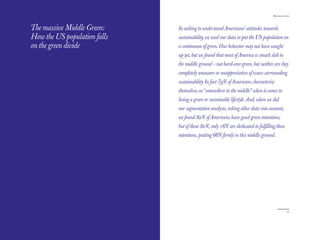
The massive Middle Green:     In seeking to understand Americans’ attitudes towards
How the US population falls   sustainability, we used our data to put the US population on
on the green divide           a continuum of green. Our behavior may not have caught
                              up yet, but we found that most of America is smack dab in
                              the middle ground – not hard-core green, but neither are they
                              completely unaware or unappreciative of issues surrounding
                              sustainability. In fact 79% of Americans characterize
                              themselves as “somewhere in the middle” when it comes to
                              living a green or sustainable lifestyle. And, when we did
                              our segmentation analysis, taking other data into account,
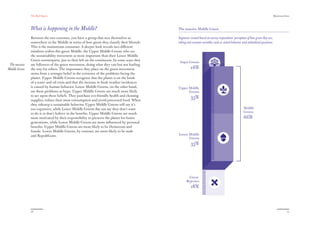
                              we found 82% of Americans have good green intentions,
                              but of those 82%, only 16% are dedicated to fulfilling these
                              intentions, putting 66% firmly in this middle ground.


24                                                                                              25
The Red Papers:                                                                                                                                                   Mainstream Green


               What is happening in the Middle?                                               The massive Middle Green

               Between the two extremes, you have a group that sees themselves as             Segments created based on survey respondents’ perception of how green they are,
               somewhere in the Middle in terms of how green they classify their lifestyle.   taking into account variables such as stated behavior and attitudinal questions.
               This is the mainstream consumer. A deeper look reveals two different
               mindsets within this green Middle: the Upper Middle Greens who see
               the sustainability movement as more important than their Lower Middle
               Green counterparts, just to their left on the continuum. In some ways they
                                                                                               Super Greens
 The massive   are followers of the green movement, doing what they can but not leading
Middle Green   the way for others. The importance they place on the green movement                     16%
               stems from a stronger belief in the existence of the problems facing the
               planet. Upper Middle Greens recognize that the planet is on the brink
               of a water and oil crisis and that the increase in freak weather incidences
               is caused by human behavior. Lower Middle Greens, on the other hand,           Upper Middle
               see these problems as hype. Upper Middle Greens are much more likely                 Greens
               to act upon these beliefs. They purchase eco-friendly health and cleaning
                                                                                                        33%
               supplies, reduce their meat consumption and avoid processed food. When
               they sidestep a sustainable behavior, Upper Middle Greens will say it’s
               too expensive, while Lower Middle Greens flat out say they don’t want                                                                   Middle
               to do it or don’t believe in the benefits. Upper Middle Greens are much                                                                 Greens
               more motivated by their responsibility to preserve the planet for future                                                               66%
               generations, while Lower Middle Greens are more influenced by personal
               benefits. Upper Middle Greens are more likely to be Democrats and
               female. Lower Middle Greens, by contrast, are more likely to be male
               and Republicans.                                                               Lower Middle
                                                                                                    Greens
                                                                                                        33%


                                                                                                      Green
                                                                                                    Rejectors
                                                                                                        18%


               26                                                                                                                                                                             27
The Red Papers:                                                                                                                               Mainstream Green


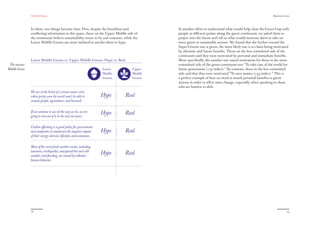
               In short, two things become clear. First, despite the breathless and           In another effort to understand what would help close the Green Gap with
               conflicting information in this space, those on the Upper Middle side of        people at different points along the green continuum, we asked them to
               the continuum believe sustainability issues to be real concerns, while the     project into the future and tell us what would motivate them to take on
               Lower Middle Greens are more inclined to ascribe them to hype.                 more green or sustainable actions. We found that the further toward the
                                                                                              Super Greens one is green, the more likely one is to claim being motivated
                                                                                              by altruistic and future benefits. Those on the less committed side of the
                                                                                              continuum said they were motivated by personal and immediate benefits.
               Lower Middle Greens vs. Upper Middle Greens: Hype vs. Real                     More specifically, the number one stated motivation for those in the more
 The massive                                                                                  committed side of the green continuum was “To take care of the world for
Middle Green                                                         Lower           Upper    future generations (132 index).” By contrast, those in the less committed
                                                                     Middle          Middle   side said that they were motivated “To save money (159 index).” This is
                                                                     Greens          Greens   a perfect example of how we need to attach personal benefits to green
                                                                                              actions in order to affect mass change, especially when speaking to those
                                                                                              who are hardest to shift.
               We are at the brink of a serious water crisis
               where pretty soon the world won’t be able to          Hype       Real
               sustain people, agriculture, and livestock.


               If we continue to use oil the way we do, we are       Hype       Real
               going to run out of it in the next ten years.


               Carbon offsetting is a good policy for governments
               and companies to counteract the negative impact       Hype       Real
               of their energy intensive lifestyles and economies.


               Most of the recent freak weather events, including
               tsunamis, earthquakes, unexpected hot and cold
               weather, and flooding, are caused by collective
                                                                     Hype       Real
               human behavior.


               28                                                                                                                                                         29
The Red Papers:                                                                                  Mainstream Green


The far ends of the continuum   Green Rejecters: Isolation. Pessimism. Cynicism.
                                Green Rejecters seem to be fairly antisocial lot, and most striking among
                                the many things characterizing this group is just how disconnected they
                                are. They are distant from their community, indifferent to social activities,
                                and generally lack regard for how they are viewed in the social sphere or
                                how their actions impact others. They seem impervious to the influence of
                                those around them who may be exhibiting greener values and behaviors.
                                Not surprisingly, they are more likely to be single (122 index) making it
                                less necessary for them to view themselves and their actions in the context
                                of others or the society at large.

                                Along with isolation, pessimism is a key characteristic of this group.
                                They tend to think their sustainable efforts don’t amount to anything
                                (133 index) and feel it is too difficult to get through today to have time
                                worrying about tomorrow (11 index). They are most likely to say green
                                options are too expensive.

                                The Green Rejecters are cynical about the green movement. They see it
                                as superficial and geared for certain types of people, but not them. They
                                use words like “wealthy” and “trendy” to describe the green movement,
                                driving home the wedge that exists between “us” and “them.” Marketing
                                to convert them is fruitless. We need to spend our time neutralizing their
                                impact and preventing them from distracting or influencing the more
                                malleable middle, our green “swing voters.”


30                                                                                                            31
The Red Papers:                                                                                                                               Mainstream Green


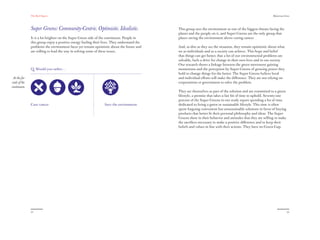
              Super Greens: Community-Centric. Optimistic. Idealistic.                      This group sees the environment as one of the biggest threats facing the
                                                                                            planet and the people on it, and Super Greens are the only group that
              It is a lot brighter on the Super Green side of the continuum. People in      places saving the environment above curing cancer.
              this group enjoy a positive energy fueling their lives. They understand the
              problems the environment faces yet remain optimistic about the future and     And, as dire as they see the situation, they remain optimistic about what
              are willing to lead the way in solving some of these issues.                  we as individuals and as a society can achieve. This hope and belief
                                                                                            that things can get better, that a lot of our environmental problems are
                                                                                            solvable, fuels a drive for change in their own lives and in our society.
                                                                                            Our research shows a linkage between the green movement gaining
              Q: Would you rather…                                                          momentum and the perception by Super Greens of growing power they
                                                                                            hold to change things for the better. The Super Greens believe local
 At the far                                                                                 and individual efforts will make the difference. They are not relying on
ends of the                                                                                 corporations or government to solve the problem.
continuum
                                                                                            They see themselves as part of the solution and are committed to a green
                                                                                            lifestyle, a promise that takes a fair bit of time to uphold. Seventy-one
                                                                                            percent of the Super Greens in our study report spending a lot of time
              Cure cancer                                       Save the environment        dedicated to living a green or sustainable lifestyle. This time is often
                                                                                            spent forgoing convenient but unsustainable solutions in favor of buying
                                                                                            products that better fit their personal philosophy and ideas. The Super
                                                                                            Greens show in their behavior and attitudes that they are willing to make
                                                                                            the sacrifices necessary to make a positive difference and to keep their
                                                                                            beliefs and values in line with their actions. They have no Green Gap.


              32                                                                                                                                                         33
The Red Papers:                                                           Mainstream Green


Adventures along      Although attitudes and actions vary along the green
the green continuum   continuum, Lower Middle Greens, Upper Middle Greens,
                      and Super Greens all face a similar set of barriers on their
                      path to a more sustainable lifestyle. The path towards
                      sustainability is by no means clear, straightforward, or
                      easy. It’s full of obstacles, discouragement, and potholes
                      that can stop you in your tracks and even send you
                      backwards toward lighter shades of green.


                      This section maps out the adventures along the green
                      continuum – starting with the barriers to green behavior
                      – the gap-wideners that reinforce unsustainable behavior.
                      But knowing what keeps the Green Gap open is key to
                      understanding how to close it. Armed with this knowledge,
                      we turn at the end of this section to how we can start to
                      close the Green Gap.


34                                                                                     35
The Red Papers:                                                                                                                        Mainstream Green


                  Paradise lost: the curse of consciousness                                  Nearly half of Americans claim to feel guiltier “the more they
                                                                                             know” about how to live a sustainable lifestyle. And, the more green
                  Cody, a young vet tech trainee in Chicago, wanted eggs for breakfast.      committed the American, the more intense the reported guilt. Super
                  Finding the refrigerator empty, she strolled to her local store to pick    Greens feel twice as much guilt of the average American. The guilt
                  up eggs. They only had eggs in Styrofoam boxes. Cody wrestled              is wide-ranging and self-propelling. First people may start talking
                  with herself for a while. She’d developed a keen green consciousness       about the occasional use of a plastic water bottle and then get going
                  while living with a family in France after college (“They don’t waste      to the point where they were ready to cancel their next vacation and
                  anything. They think of us Americans as terribly wasteful.”) and           bulldoze over their backyard swimming pool.
                  among her new behaviors was avoiding Styrofoam. In the end, the
                  lure of brunch was too strong, and she bought the eggs anyway. She
                  paid, picked up her eggs, walked to the end of the block and stopped.
                  Then she turned around, walked back to the store to return the eggs
                  and argued with the storekeeper until he agreed to refund her money.
                  “I just couldn’t do it,” she says, “the guilt was too much.”
   Adventures
along the green   Cody has bitten the “green” apple, lost her innocence and gained
    continuum     a heightened consciousness of her behaviors and their impact on
                  our shared eco-system. She provides a sophisticated analysis of this       Super Greens feel twice as much guilt
                  feeling: “Just being a human being consuming all the time, I feel
                  guilt. I know that I don’t give back as much as I take. I guess it’s the   as the average American.
                  same kind of thing people probably feel with original sin: ‘I was born
                  into it and I’m always going to feel guilty, I might as well do some
                  things to try to feel less guilty.’”

                  And once you’ve lost your innocence, you can’t go back. Guilt
                  will always be there; we are all human, and nobody can be 100%
                  environmentally responsible. Cody and others like her just move
                  ahead and try to do the best they can. It seems the more conscious
                  they are and the more positive behavior they exhibit, the more their
                  eyes are opened to all the other sustainability steps they could be
                  taking. Every day, they create an ever-longer list of things to feel
                  guilty about, and we saw this conundrum show up clearly in both our
                  quantitative and ethnographic research.


                  36                                                                                                                                                  37
The Red Papers:                                                                                                                               Mainstream Green


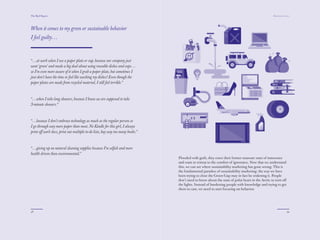
When it comes to my green or sustainable behavior
I feel guilty…


“…at work when I use a paper plate or cup, because our company just
went ‘green’ and made a big deal about using reusable dishes and cups…
so I’m even more aware of it when I grab a paper plate, but sometimes I
just don’t have the time or feel like washing my dishes! Even though the
paper plates are made from recycled material, I still feel terrible.”


“…when I take long showers, because I know we are supposed to take
3-minute showers.”


“…because I don’t embrace technology as much as the regular person so
I go through way more paper than most. No Kindle for this girl, I always
print off work docs, print out multiple to-do list, buy way too many books.”


“…giving up on natural cleaning supplies because I’m selfish and more
health driven than environmental.”
                                                                              Flooded with guilt, they crave their former unaware state of innocence
                                                                              and want to retreat to the comfort of ignorance. Now that we understand
                                                                              this, we can see where sustainability marketing has gone wrong. This is
                                                                              the fundamental paradox of sustainability marketing: the way we have
                                                                              been trying to close the Green Gap may in fact be widening it. People
                                                                              don’t need to know about the state of polar bears in the Arctic to turn off
                                                                              the lights. Instead of burdening people with knowledge and trying to get
                                                                              them to care, we need to start focusing on behavior.


38                                                                                                                                                         39
The Red Papers:                                                                                                    Mainstream Green


                  It’s not easy being green
                  It isn’t easy being green, and it should come as no surprise that this
                  difficulty keeps America’s Green Gap as wide as it is. While we knew it
                  wasn’t easy from a practical standpoint, we also found it difficult on the
                  social level. The valiant minority that venture into the green space, actively
                  working on changing their lifestyles and behavior, do so with a relatively
                  high social and emotional cost. In our ethnographies, many Upper
                  Middle Greens and Super Greens we talked to told us about how they
                  felt ostracized from their neighbors, families, and friends, as if they joined
                  a crazy cult or religion. They no longer felt normal and commented on
                  feeling both marginalized and besieged by unwanted attention at parties
                  or get-togethers.

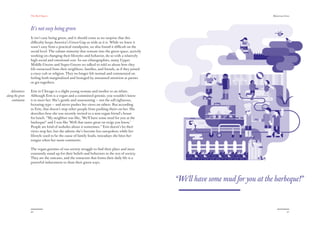
   Adventures     Erin in Chicago is a slight young woman and mother to an infant.
along the green   Although Erin is a vegan and a committed greenie, you wouldn’t know
    continuum     it to meet her. She’s gentle and unassuming — not the self-righteous,
                  lecturing type — and never pushes her views on others. But according
                  to Erin, that doesn’t stop other people from pushing theirs on her. She
                  describes how she was recently invited to a non-vegan friend’s house
                  for lunch. “My neighbor was like, ‘We’ll have some mud for you at the
                  barbeque!’ and I was like ‘Well that tastes great on twigs you know.’
                  People are kind of assholes about it sometimes.” Erin doesn’t let their
                  views stop her, but she admits she’s become less outspoken; while her
                  lifestyle used to be the cause of family feuds, nowadays she bites her
                  tongue when her mom comments.

                  The vegan greenies of our society struggle to find their place and must
                  constantly stand up for their beliefs and behaviors to the rest of society.
                  They are the outcasts, and the ostracism that forms their daily life is a
                  powerful inducement to shun their green ways.


                                                                                                   “We’ll have some mud for you at the barbeque!”


                  40                                                                                                                              41
The Red Papers:                                                                                                                                                      Mainstream Green


Eye rolls & asides                                                             And, when we asked Americans in our quantitative survey to tell us more
                                                                               about why they felt this way, we found no shortage of color commentary:
Listen to how almost every one of our self-identifying Super Greens in our
ethnographies distanced themselves and downplayed their praiseworthy           “Al Gore thinks being green is for Joe Citizen, not him — he has the money to buy and sell
sustainable behavior and you’ll hear just how hard it is to be green            carbon credits (a big joke). He’s got no idea it isn’t easy or cheap to be ‘green.’”
in our society. We looked through the hours of videotape and saw an
amazing pattern of eye rolls and asides preceding any discussion around        “Buying so-called green products is expensive and hard to find. Those who do it feel ‘Elitist.’”
the respondent’s greener habits. Even in the company of a sympathetic,
non-judgmental ethnographer, people were intent on diverting any of the        “I really do think ‘being green’ these days is more of a lifestyle statement for people...I see many
expected scorn they felt sure would come their way. And, being human,          ‘granola hippies’ and ‘elitist snobs’ shoving their green lifestyles in people’s faces and it makes
they wanted to be accepted — to feel normal. Obviously, their green             them seem on the fringes of society.”
behavior made them feel manifestly “not normal.”
                                                                               “The people I know of who are actively green either have tons of money or live a hippie lifestyle.”
As you might expect, the eye rolls and asides were much less common
in the San Francisco area, a place where it is a lot more normal —
and therefore a lot easier — to be green. The culture, government,
infrastructure, and mindset are already on the super side of the green
continuum. When Darya moved to San Francisco from New York, she
experienced the relative norms first hand: “When I moved out here I
thought I was kind of crunchy, then I realized that I was soooo not.”

Others told us how they don’t want to be seen as outsiders and distanced
themselves from the holier-than-thou stigma that has affixed itself to
greener behavior. Super Green herself, Susan in the Chicago area takes
pains to hold others with similar beliefs at arm’s length: “There’s a pocket
of people in this community, they’re sort of ‘holier than thou.’ One woman
never colors her hair. She is very like ‘natural,’ she wears Birkenstocks
(laughs)…I look at her in annoyance, cause I think she’s looking at me…”
Similarly, Amy, a stylish young Brooklyn mom who grew up in southern
Oregon, does her best to repudiate the very behavior she considers
laudable: “My cousins called me a ‘crunchy granola’ once and I was really
offended, because I am decidedly not a hippie.”                                  Consumers believe green products are targeting somebody else,
                                                                                specifically the fringy hippies and not people like “them.” Even motivated
Sad though it may be, their feelings of ostracism have a basis in fact.         consumers fear attracting the negative judgment of their peers if they go
When we asked Americans to whom they thought green products were                out on a limb and purchase green products; instead they embrace the
generally marketed, half our respondents thought green products are             comfort of conformity. So until green products and services feel normal,
targeted to “Crunchy Granola Hippies” or “Rich/Elitist Snobs.”                  the Middle is unlikely to change behavior.


42                                                                                                                                                                                43
The Red Papers:                                                                                                                                                   Mainstream Green


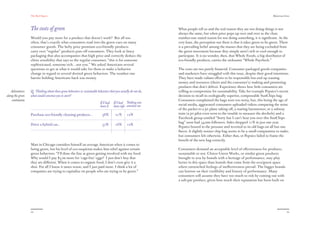
                  The costs of green                                                                             What people tell us and the real reason they are not doing things is not
                                                                                                                 always the same, but when price pops up over and over as the clear,
                  Would you pay more for a product that doesn’t work? But all too                                number-one stated reason for not doing something, it is significant. At the
                  often, that’s exactly what consumers read into the green cues on many                          very least, the perception out there is that it takes green to be green. There
                  consumer goods. The hefty price premium eco-friendly products                                  is a prevailing belief among the masses that they are being excluded from
                  carry over “regular” products puts off consumers. They look at fancy                            the green movement because they simply aren’t rich or cool enough to
                  packaging that also accompanies that high price and correctly deduce the                       participate. It is no wonder, then, that Whole Foods, a big distributor of
                  elitist sensibility that says to the regular consumer, “this is for someone                    eco-friendly products, carries the nickname “Whole Paycheck.”
                  sophisticated, someone rich…not you.” We asked Americans several
                  questions to get at what it would take for them to make a behavior                             The costs are not purely financial. Consumer packaged goods companies
                  change in regard to several desired green behaviors. The number one                            and marketers have struggled with this issue, despite their good intentions.
                  barrier holding Americans back was money.                                                      They have made valiant efforts to be responsible but end up wasting
                                                                                                                 money and resources (theirs and the consumer’s) making and promoting
                                                                                                                 products that don’t deliver. Experience shows how little consumers are
   Adventures     Q: Thinking about those green behaviors or sustainable behaviors that you usually do not do,   willing to compromise for sustainability. Take for example Pepsico’s recent
along the green   what would convince you to start?                                                              decision to recall its ecologically superior, compostable SunChips bag.
    continuum                                                                                                    Consumers complained the bags were too noisy, but, this being the age of
                                                                           If I had   If I had Nothing can
                                                                           more $     more info convince me      social media, aggravated consumers uploaded videos comparing the noise
                                                                                                                 of the packet to a jet plane taking off, a roaring lawnmower, or a subway
                  Purchase eco-friendly cleaning products...                 36%        21%      12%             train (a jet pilot even went to the trouble to measure the decibels) and a
                                                                                                                 Facebook group entitled “Sorry but I can’t hear you over this SunChips
                                                                                                                 bag” soon had 54,000 followers. Sales dropped 11% in just one year.
                  Drive a hybrid car...                                      37%        16%      12%
                                                                                                                 Pepsico bowed to the pressure and reverted to its old bags on all but one
                                                                                                                 flavor. A slightly noisier chip bag seems to be a small compromise to make,
                                                                                                                 but consumers felt otherwise. Either that, or Pepsico failed to frame the
                                                                                                                 benefit of the new bag correctly.
                  Matt in Chicago considers himself an average American when it comes to
                  being green, but his level of eco-suspicion makes him rebel against certain                    Consumers demand an acceptable level of effectiveness for products,
                  green behaviors: “I’ll draw the line at green getting involved with my food.                   sustainable or not. Clorox Green Works, or similar green products
                  Why would I pay $3.00 more for ‘cage-free’ eggs? I just don’t buy that                         brought to you by brands with a heritage of performance, may play
                  they are different. When it comes to organic food, I don’t even give it a                       better in this space than brands that come from the eco/green space
                  shot. For all I know it tastes worse, and I just paid more. I think a lot of                   where entrenched feelings of ineffectiveness prevail. The bigger brands
                  companies are trying to capitalize on people who are trying to be green.”                      can borrow on their credibility and history of performance. Many
                                                                                                                 consumers will assume they have too much to risk by coming out with
                                                                                                                 a sub-par product, given how much their reputation has been built on


                  44                                                                                                                                                                             45
The Red Papers:                                                                                                                                                           Mainstream Green


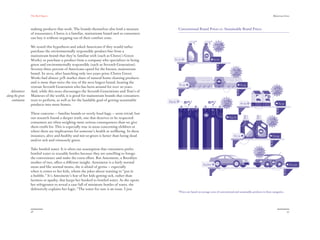
                  making products that work. The brands themselves also lend a measure                 Conventional Brand Prices vs. Sustainable Brand Prices
                  of reassurance; Clorox is a familiar, mainstream brand and so consumers
                  can buy it without stepping out of their comfort zone.
                                                                                                                                        100%
                  We tested this hypothesis and asked Americans if they would rather                                                      price
                                                                                                                                        premium
                  purchase the environmentally responsible product-line from a
                  mainstream brand that they’re familiar with (such as Clorox’s Green
                  Works) or purchase a product from a company who specializes in being             $2.30                               $4.60

                  green and environmentally responsible (such as Seventh Generation).
                  Seventy-three percent of Americans opted for the known, mainstream                                                                        60%
                                                                                                                                                              price
                  brand. In 2010, after launching only two years prior, Clorox Green                                                                        premium
                  Works had almost 50% market share of natural home cleaning products
                  and is more than twice the size of the next largest brand, beating the
                                                                                                       $2.49                                                          $3.99
                  veteran Seventh Generation who has been around for over 20 years.                                                                                                           48%
   Adventures     And, while this news discourages the Seventh Generations and Tom’s of                                                                                                         price
                                                                                                                                                                                              premium
along the green   Maineses of the world, it is good for mainstream brands that consumers
    continuum     trust to perform, as well as for the laudable goal of getting sustainable   $59.95                                              32%
                                                                                                                                                    price             $2.29                        $4.39
                  products into more homes.                                                                                                       premium


                  These concerns — familiar brands or overly loud bags — seem trivial, but
                  our research found a deeper truth, one that deserves to be respected:                                                                 $79.00
                                                                                                                                                                                         17%
                  consumers are often weighing more serious consequences than we give                                                                                                      price
                                                                                                                                                                                         premium
                  them credit for. This is especially true in areas concerning children or
                  where there are implications for someone’s health or wellbeing. In these
                  instances, alive and healthy and not-so-green is better than being dead                                                                   $17.05                          $19.99
                  and/or sick and virtuously green.

                  Take bottled water. It is often our assumption that consumers prefer                                                                                        16%
                                                                                                                                                                                price
                  bottled water to reusable bottles because they are unwilling to forego                                                                                      premium
                  the convenience and make the extra effort. But Antoinette, a Brooklyn
                  mother of two, offers a different insight. Antoinette is a fairly normal
                                                                                                                             $19,820                                                                        $23,050
                  mom and like normal moms, she is afraid of germs — especially
                  when it comes to her kids, whom she jokes about wanting to “put in
                  a bubble.” It’s Antoinette’s fear of her kids getting sick, rather than
                  laziness or apathy, that keeps her hooked to bottled water. As she opens
                  her refrigerator to reveal a case full of miniature bottles of water, she
                  defensively explains her logic: “The water for sure is an issue. I just
                                                                                                       *Prices are based on average costs of conventional and sustainable products in these categories.


                  46                                                                                                                                                                                       47
The Red Papers:                                                                                                                                  Mainstream Green


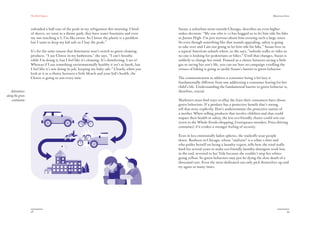
                  unloaded a half case of the pods in my refrigerator this morning. I kind          Susan, a suburban mom outside Chicago, describes an even higher-
                  of skeeve, we went to a theme park, they have water fountains and even            stakes decision: “My son who is 12 has begged us to let him ride his bike
                  my son touching it I, I’m like ewww. So I know the plastic is a problem           to Junior High. I’m just nervous about him crossing such a large street.
                  but I want to keep my kid safe so I buy the pods.”                                So even though something like that sounds appealing, safety is going
                                                                                                    to take over and I am not going to let him ride his bike.” Susan lives in
                  It’s for the same reason that Antoinette won’t switch to green cleaning           a typical American suburb where, as she says, “nobody walks or rides so
                  products. “I use Clorox in my bathroom,” she says. “I can’t breathe               no one is looking for pedestrians or bikes.” Until that changes, Susan is
                  while I’m doing it, but I feel like it’s cleaning. It’s disinfecting. I see it!   unlikely to change her mind. Framed as a choice between saving a little
                  Whereas if I use something environmentally healthy it isn’t as harsh, but         gas or saving her son’s life, you can see how no campaign extolling the
                  I feel like it’s not doing its job, keeping my baby safe.” Clearly, when you      virtues of biking is going to tackle Susan’s barrier to green behavior.
                  look at it as a choice between a little bleach and your kid’s health, the
                  Clorox is going to win every time.                                                The communication to address a consumer being a bit lazy is
                                                                                                    fundamentally different from one addressing a consumer fearing for her
                                                                                                    child’s life. Understanding the fundamental barrier to green behavior is,
   Adventures                                                                                       therefore, crucial.
along the green
    continuum                                                                                       Marketers must find ways to allay the fears their consumers have about
                                                                                                    green behaviors. If a product has a protective benefit that’s strong,
                                                                                                    tell that story explicitly. Don’t underestimate the protective nature of
                                                                                                    a mother. When selling products that involve children and that could
                                                                                                    impact their health or safety, the less eco-friendly choice could win out
                                                                                                    (even to the Whole Foods-shopping, Greenpeace-member, Prius-driving
                                                                                                    consumer) if it evokes a stronger feeling of security.

                                                                                                    Even in less emotionally laden spheres, the tradeoffs wear people
                                                                                                    down. Rosheen in Chicago, whose “uniform” is a white t-shirt and
                                                                                                    who prides herself on being a laundry expert, tells how she tried really
                                                                                                    hard for several years to make eco-friendly laundry detergent work but,
                                                                                                    in the end, reverted to her Tide because she couldn’t stop her whites
                                                                                                    going yellow. So green behaviors may just be dying the slow death of a
                                                                                                    thousand cuts. Even the most dedicated can only pick themselves up and
                                                                                                    try again so many times.


                  48                                                                                                                                                            49
The Red Papers:                                                                                                Mainstream Green


                  Consumers don’t trust green products to perform, we’ve seen, and they
                  are particularly unwilling to invest in the often more expensive option
                  for this reason. But the barrier may be lower if those products come from
                  familiar trusted brands, creating an unexpected opportunity for trusted
                  brands in the green space.

                  The irony of course is that this consumer barrier is self-defeating. In
                  many cases, as business has realized, green products and services have
                  the potential to be major money-savers. Examples include Energy Star
                  appliances, compact fluorescent lightbulbs, low-flow showerheads,             There is a need to reclaim the notion
                  hybrid vehicles, and reusable beverage or food containers. These
                  products often carry a higher sticker price, but over a lifetime of use     of value, redefining it around the
                  they can pay for themselves many times over in savings on energy, water,
                  fuel, and even grocery bills. The same is true of healthier products that   broader notion of lifetime value.
   Adventures     ultimately increase life expectancy and lower healthcare costs. The issue
along the green   is that in our instant-gratification society, where “value” has become
    continuum     synonymous with “cheap,” lifetime savings are abstract and much less
                  motivating than the immediate callout of the sticker price. They are also
                  pretty invisible, showing up as they do as small increments on monthly
                  bills, or in even more abstract and hard-to-measure notions of improved
                  wellbeing, with no direct link back to the purchase decision made
                  months earlier. There is a need to reclaim the notion of value, redefining
                  it around the broader notion of lifetime value, asking consumers
                  questions like: Are inexpensive appliances really a good value if they
                  guzzle energy and drive up our utility bills? Are conventional cleaning
                  products really a good value if they make our homes unhealthy? Not
                  to mention pollute our lungs, our communities, and our planet. Is
                  inexpensive fast food really a value if it makes our children sick? This
                  will require a major shift in thinking but is a huge opportunity for the
                  brands that get it right.


                  50                                                                                                                          51
The Red Papers:                                                                 Mainstream Green


                  Green is the new pink
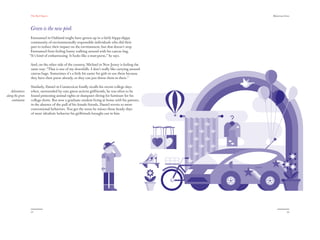
                   Emmanuel in Oakland might have grown up in a fairly hippy-dippy
                   community of environmentally responsible individuals who did their
                   part to reduce their impact on the environment, but that doesn’t stop
                   Emmanuel from feeling funny walking around with his canvas bag.
                  “It’s kind of embarrassing. It looks like a man-purse,” he says.

                  And, on the other side of the country, Michael in New Jersey is feeling the
                  same way: “That is one of my downfalls. I don’t really like carrying around
                  canvas bags. Sometimes it’s a little bit easier for girls to use them because
                  they have their purse already, so they can just throw them in there.”

                  Similarly, Daniel in Connecticut fondly recalls his recent college days
   Adventures     when, surrounded by cute green activist girlfriends, he was often to be
along the green   found protesting animal rights or dumpster diving for furniture for his
    continuum     college dorm. But now a graduate student living at home with his parents,
                  in the absence of the pull of his female friends, Daniel reverts to more
                  conventional behaviors. You get the sense he misses those heady days
                  of more idealistic behavior his girlfriends brought out in him.


                  52                                                                                           53
The Red Papers:                                                                                                            Mainstream Green


                  And when you look at the numbers, we see that women tend to lean green
                  while men lean anti-green.

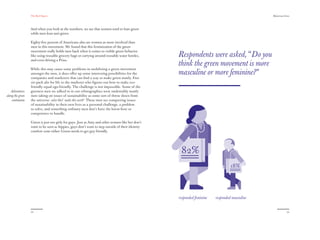
                  Eighty-five percent of Americans also see women as more involved than
                  men in this movement. We found that this feminization of the green
                  movement really holds men back when it comes to visible green behavior
                  like using reusable grocery bags or carrying around reusable water bottles,     Respondents were asked, “Do you
                  and even driving a Prius.
                                                                                                  think the green movement is more
                  While this may cause some problems in mobilizing a green movement
                  amongst the men, it does offer up some interesting possibilities for the         masculine or more feminine?”
                  companies and marketers that can find a way to make green manly. Free
                  six-pack abs for life to the marketer who figures out how to make eco-
                  friendly equal ego-friendly. The challenge is not impossible. Some of the
   Adventures     greenist men we talked to in our ethnographies were undeniably manly
along the green   men taking on issues of sustainability as some sort of throw down from
    continuum     the universe: solve this! make this work! These men see conquering issues
                  of sustainability in their own lives as a personal challenge, a problem
                  to solve, and something ordinary men don’t have the know-how or
                  competence to handle.

                  Green is just too girly for guys. Just as Amy and other women like her don’t
                  want to be seen as hippies, guys don’t want to step outside of their identity
                  comfort zone either. Green needs to get guy friendly.


                                                                                                   82%
                                                                                                                                18%


                                                                                                  responded feminine   responded masculine


                  54                                                                                                                                      55
The Red Papers:                                                                                                                                   Mainstream Green


                  Eco-suspicion & Eco-confusion                                                  correlation between dire messages and belief in the issues of climate
                                                                                                 change. From their study they concluded that, “dire messages warning
                  Much of our motivation for positive change has been unwisely based             of the severity of global warming and its presumed dangers can backfire,
                  on negative message of, “What will happen if we don’t act now?” As             paradoxically increasing skepticism about global warming by individuals’
                  research has shown, this doom and gloom drive by those trying hardest to       deeply held beliefs that the world is fundamentally just. In addition, we
                  mobilize positive change has the unfortunate effect of inducing paralysis       found evidence that this dire messaging led to reduced intentions among
                  and skepticism, emotions only fostered by the array of confusing and           participants to reduce their carbon footprint — an effect driven by their
                  contradictory media coverage.                                                  increased global warming skepticism.”

                  This has led to an epidemic of eco-suspicion and eco-confusion in those        Even if you muster the gumption to act, how do you figure out if you are
                  Americans who find themselves anywhere to the left of the Super Greens.         doing any good at all? Is that separate trip to the farmer’s market for local
                  And, as we stated upfront in our segmentation of Americans on the green        veggies better than just buying the shipped-in lettuce at the supermarket?
                  continuum, one of the big factors separating the greens from the masses        And sure, your old SUV may be horribly inefficient, but is it better for the
                  was their belief that the issues around climate change and sustainability      environment to hold onto it for a few years more or to trade in for a brand
   Adventures     are in fact real and not hype.                                                 new Prius? Illinois resident Susan feels this confusion keenly: “I used to
along the green                                                                                  think that farmers’ markets were a good value and I don’t think it is such
    continuum                                                                                    a good value anymore. But it does make me feel good to know that I’m
                  Carbon footprint calculus vs. the power of one                                 helping the little farmers that have come all this way…but then I think of
                                                                                                 all the fuel they burned getting to the city and think it may not be the
                  Telling consumers that, “Each day, humanity pumps 3 million metric tons        best choice.”
                  (mmt) of carbon dioxide (CO2) into the air. Every year, the atmospheric
                  concentration of CO2 increases and the global thermometer rises                 It is not easy for Americans to calculate the net impact on the planet
                  accordingly,” as the Sierra Club recently did in its paper, “Climate Change,    of their actions (or lack thereof). “I can’t tell you exactly what the term
                  The Challenge of our Time,” keeps the focus squarely on the mind-              ‘carbon footprint’ means. I understand the detrimental effects of leaving
                  boggling enormity of the problem and impedes action. It makes people            a carbon footprint, and I understand the ways that we need to prevent
                  feel powerless to make a tangible difference. We should heed the words of        doing so. But scientifically I don’t know what that means,” says Daniel
                  Mother Theresa: “If I look at the masses, I will never act; if I look at the    in Connecticut. He’s not alone; 82% of Americans from our survey don't
                  one, I will.”                                                                   have a clue on how to calculate their carbon footprint.

                  There’s another problem with the overheated rhetoric on climate change.        People talked to us about how they don’t truly understand the cost/benefit
                  The mind-blowing numbers thrown around by well-meaning climate                 of cloth diapers versus disposable diapers since cloth diapers require a
                  activists have the paradoxical effect of lowering people’s motivation to act.   lot of water to wash them. Others couldn’t figure out if the benefit of all
                  Matthew Feinberg and Robb Willer from the Department of Sociology              their use of public transportation was wiped out due to the fact that they
                  at UC Berkeley showed, in their November 2010 study, a negative                traveled around the globe for vacations. And others still were confounded


                  56                                                                                                                                                             57
The Red Papers:                                                               Mainstream Green


                  by the math that it would take to calculate the impact of their eliminating
                  meat consumption while factoring in their long drives in their SUV to out
                  of the way vegetarian restaurants. And the carbon footprint calculus just
                  gets more complicated every moment another factor is added into the mix.

                   People like concrete ideas. They also can relate to “one” much more than
                  “one million” or “billion.” They get things on a personal level much easier
                   than they can wrap their heads around the hype and hyperbole often
                   found in pro-green rhetoric.

                  Asking people to compute their footprint leaves them floundering in the
                  purgatory of carbon calculus. It drives greater confusion, which leads
                  to frustration and lack of action. Messages motivating all of us to more
                  sustainable behavior need to adhere to another 3Ps beyond people, profit,
   Adventures     and planet. They will be most successful if they are personal, positive,
along the green   and plausible.
    continuum


                  82% percent of Americans from
                  our survey don’t have a clue how to
                  calculate their carbon footprint.


                  58                                                                                         59
The Red Papers:                                                                                              Mainstream Green


A cure for cancer and our new 3Ps of green marketing
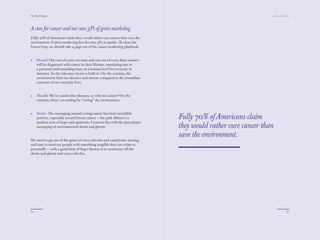
Fully 70% of Americans claim they would rather cure cancer than save the
environment. Cancer marketing has the new 3Ps in spades. To close the
Green Gap, we should take a page out of the cancer marketing playbook.


•    Personal: One out of every two men and one out of every three women
     will be diagnosed with cancer in their lifetime, translating into in
     a personal understanding issue on a human level for everyone in
     America. So the relevance factor is built in. On the contrary, the
     environment feels too abstract and remote compared to the immediate
     concerns of our everyday lives.


•    Plausible: We’ve cured other diseases, so why not cancer? On the
     contrary, there’s no analog for “curing” the environment.


•    Positive: The messaging around curing cancer has been incredibly
     positive, especially around breast cancer — the pink ribbon is a       Fully 70% of Americans claim
     modern icon of hope and optimism. Contrast this with the apocalyptic
     messaging of environmental doom and gloom.                             they would rather cure cancer than
                                                                            save the environment.
We need to get out of the game of crazy calculus and cataclysmic inciting
and start to motivate people with something tangible they can relate to
personally — with a good dose of hope thrown in to counteract all the
doom and gloom and crazy calculus.


60                                                                                                                        61
The Red Papers:                                                                 Mainstream Green


                  Sea of green labels

                  The red flags on green were everywhere when we went into homes of
                  Americans all across the country, and as with the unintended effect of doom
                  and gloom messaging, the problem was an excess of good intentions.
                  Marketers are using the terms and catch phrases they think consumers
                  want to hear to feel better about their purchase, but because we don’t have
                  standardized systems or labels to help consumers evaluate these claims,
                  consumers don’t know how to separate the hype from the better products.
                  Despite food marketing that uses “healthy,” “natural,” “light,” and other
                  buzzwords with abandon, we do not have a nationally recognized and
                  regulated food label that helps consumers evaluate their choices, with
                  predictable results: “Every time I go to the grocery store everything is
                  always ‘eco-friendly,’ and everything is ‘green’ and you just don’t know what
   Adventures     that even means anymore. ‘Eco-friendly’ and ‘green’ have just had the crap
along the green   used out of them,” complains Chicago resident Erin.
    continuum
                  According to research by the World Resources Institute, Duke University,
                  and the green analyst Big Room Inc., 600 labels worldwide dispatch
                  some sort of eco-benchmark. With 90 labels in food categories alone, it’s
                  impossible to navigate the sea of green and determine which labels are
                  best. There are few rules and guidelines to give these labels some real
                  meaning to consumers. The government just hasn’t gotten it together
                  yet. Moreover, these labels all connote the special or unique nature of the
                  underlying products.

                  The good news is that the Federal Trade Commission last year reissued
                  its Green Guides, requiring more honest and detailed labeling of green
                  claims. By one estimate, this revision will make more than 300 current
                  green labels obsolete. The questions are how to make good labeling easy
                  for consumers to understand, and how we motivate them to look at the
                  labels in the first place.

                  We need a verifiable, understandable, and authoritative “nutrition label” for
                  green. Until the appearance of the nutrition label on store shelves, you’d
                  rarely find shoppers poring over the back of that box of cereal trying to
                  figure out if it was good for little Timmy’s tummy. But once the standards
                  were put in place, consumer behavior changed to accommodate the new
                  trustworthy comparative data. The same thing will happen with green.


                  62                                                                                           63
The Red Papers:                                                            Mainstream Green


Turning the corner   With all these barriers keeping the Green Gap propped
                     wide open, it is hard to imagine how to begin to close it.
                     However, through our research, we started to see a few
                     positive drivers of consumer behavior that just might begin
                     to shrink the gap. Amidst all the suspicion, confusion,
                     and doubt, there are some promising trends that may help
                     normalize green behavior.


64                                                                                      65
The Red Papers:                                                                                                                                      Mainstream Green


                  The pleasure principle: hitting the G-spot                                        Susan in Chicagoland isn’t a Super Green by any stretch, yet she gets
                                                                                                    a sparkle in her eye when she takes out her Ziploc bag of plastic caps,
                  Often when a green behavior shift really takes hold, it does so because it        recycled separately from the bottles. She is a diligent (and competitive)
                  taps into a preexisting condition of sorts — an element of our character that     housekeeper; so finding a further refinement to standard recycling
                  is already a source of pleasure, validation, or self-worth. To wit, many of       procedures —and developing the requisite sorting system to manage it —
                  our Super Greens play out their green commitments in ways that dovetail           appealed instantly to her domestic ethos of orderliness and organization.
                  with other elements of their personalities: they may have been crafters,          Ad Council researchers have long maintained that the successful uptake
                  scavengers, thrift store fashionistas, inventors, Zen simplifiers, pack-rats, or   of national recycling in the 1990s succeeded in part because it appealed to
                  neatniks, long before green ideas showed up on their radar. And then once         precisely these impulses: neatness, sorting, systematizing.
                  Green arrives, it brings with it so many options to choose from, people will
                  naturally gravitate toward ones that reinforce long-established threads of        Boris in Jackson Heights, Queens derives green pleasure in a different but
                  pleasure, in time finding their own G-spot to sustain the behavior over            related way. In asking him about his green efforts, we unwittingly provided
                  the long haul.                                                                    him a platform for bragging: he told us how his sister admired him and
                                                                                                    wasn't herself able to be as mindful about the planet as he was. He glowed
   Adventures     When we talked to the ardent Super Greens, we found they were driven              as he described the ways in which she and others looked up to him for his
along the green   by much more than their altruistic do-gooder tendencies. It seems they got        heightened level of conscientiousness.
    continuum     pleasure out of their positive actions — both those focused on the future
                  and, to our surprise, also benefits they realized in the here and now.             Humans are drawn to doing things we like. This might seem like a “no,
                                                                                                    duh!” statement, but we seem to have overlooked it when it comes to
                  Chicagoan Erin got her kicks out of finding new ways of using old produce          inspiring green actions. Many diets don’t work because they are predicated
                  bags, tapping into her creativity and showing off her ingenuity. When we           on unpleasant deprivation, and we will go to great lengths to avoid things
                  visited her, she rooted round under her sink to bring out her stash of mesh       that cause discomfort. We’ve missed this essential truth in the messages that
                  vegetable bags. “I turn these into dish scrubbies,” she said. “I fold a bunch     have gone out to consumers about sustainability. We have ignored the basic
                  up and then I tie a knot.”                                                        fact that deprivation is itself unsustainable. Sustaining something that is
                                                                                                    pleasurable, however, is much easier because it is something we want.
                  Similarly, Amy in Brooklyn proudly showed us her spray bottle of vinegar
                  and water solution that she uses to clean everything, including — judging         Although seemingly insignificant, daily activities of the sort Erin and Alan
                  from the smile on her face — her mood.                                            enjoy so much are the moments of truth for the green movement. Once
                                                                                                    people begin to experience everyday green activities in a positive way,
                  Alan in San Francisco took the macho approach and proudly displayed his           they begin to form favorable opinions of the green movement. It becomes
                  elaborate self-made eco-friendly home energy system. His creative problem-        personal and enjoyable, and they begin to integrate it into their lives. This
                  solving skills were pushed to the max, and he got immense pleasure from           is the first step to closing the Green Gap.
                  tinkering with new ways to save energy. For Alan, green has become a
                  badge of manly mastery.


                  66                                                                                                                                                                67
The Red Papers:                                                                                                                                     Mainstream Green


                  Guilt offsets                                                                       Amy took it upon herself to come up with her own Kyoto treaty. Of
                                                                                                     course, this treaty can change day to day and is really a creative head game
                  People don’t like feeling guilty, and we already know that the green               she plays with herself. “I use disposable diapers,” she admits, “but I’m
                  movement comes with a heavy load of guilt. Guilt is no fun. It is no               probably way more conscious about everything else I do.”
                  wonder the Catholic Church did a pretty good business in the 15th
                  Century selling indulgences. We value the relief we get from feeling like          Consumers are starting to recognize and verbalize this trade-off and are
                  we are netting out on the positive side of things.                                 experiencing the peace of mind benefits that come with more sustainable
                                                                                                     choices. That they know the right way to do the math or justify their
                  In any lifestyle area where self-deprivation plays a role (or a perceived role),   decisions is doubtful, but even rationalizing their green or non-green
                  people will start to calculate tradeoffs. I went to the gym, so I can have          behavior is a step. It brings the dialogue of sustainability into their
                  this cupcake; I can buy this $500 handbag because it’s 50% off; since I             everyday decision process and can offset guilt, not just create it.
                  subscribe to the New York Review of Books, it’s OK if I watch Top Model.

                  It’s a natural cognitive habit to set up a system of comparables and to
   Adventures     balance credits and debits according to loose criteria of our own devising.
along the green   And the good news, for those who are already making these calculations,
    continuum     is that we know green credits have acquired real meaning in their own
                  personal universe of value.

                  This definitely goes for how we calculate our impact on the environment.
                  Of course, as we’ve already seen, it is impossible to do the math. So, we
                  all develop our own personal Kyoto Protocols to sort out our carbon
                  footprints, with a fairly large margin of error built in so as not to make
                  ourselves feel too guilty.

                   Erin started to experience the psychic relief born out of her more
                   sustainable lifestyle choices. She and her husband recently decided to
                   become vegan to lower their carbon footprint and improve their overall
                   health, but they still love to travel and see the world. Now all their plane
                   trips come with a bit less guilt than they did before they became vegan:
                  “We still go on a plane and then I just think ‘well, we’ve been vegan for a
                   year so we can go on a couple plane trips.’”


                  68                                                                                                                                                               69
The Red Papers:                                                                                                               Mainstream Green


                  Part of the club
                  Many of the messages trying to motivate us all to be green haven’t worked.
                  We’ve been talking to ourselves and thinking that what motivates the            Would you rather?
                  converted Super Greens will be the same message and strategy that works
                  for everyone else. The marketing approach to selling Budweiser to the
                  masses is much different than how we would go about selling the more
                  rarefied and niche beer Stella Artois or Guinness. So why would we sell
                  the green movement to the Walmart shopper the same way we would
                  appeal to Whole Foods shoppers? This may seem perplexing to the Super
                  Greens. For them, green is a badge of honor; and feeling a little special,
                  outside the norm, or, dare we say it, elite, hits their G-spot. That’s their
                  social norm, and they keenly desire being a part of it. (Plus we marketers
                  and ad industry-types are fixated on making things cool, special, and                                                                    85%
   Adventures     different, and can have a hard time believing anybody would want to be
along the green   just “normal.”) Other consumers have their own social norm — their zone
    continuum     where they can feel they are a contributing and valued part of society.         be given guidelines on how to live a green and
                  Only in a few corners of America are we starting to normalize green             sustainable life but do it yourself
                  behavior for the mass audience.

                  With that comes the normalizing of green behavior in the infrastructures
                  and societies we create. In San Francisco, green is just a normal way
                  of being. If you are not recycling, reducing your fossil fuel usage, and
                  conserving energy, you are a social outcast. Not normal. Not accepted. It
                  is no wonder that the people we talked to in the San Francisco area were
                  more comfortable with a more sustainable lifestyle. It was second nature.        15%
                  The city’s infrastructure supported it, the neighbors all reinforced it, and
                  it has become just the way the world works. Once green behaviors were
                  normalized, a sustainable system became, well, self-sustaining.                 not worry about it and have it legislated through
                                                                                                  government rules and policies
                  When we asked Americans if they wanted laws or norms, to no one’s
                  surprise, they chose norms. They don’t want to be told what to do, but
                  they do want to be told what is the normal and acceptable behavior that
                  they should strive for. In other words, they want society to agree upon a
                  set of cultural guidelines rather than submit to the imposition of strictures
                  from government or some other “elitist” constituency.


                  70                                                                                                                                         71
The Red Papers:                                                                                                                             Mainstream Green


                  Generation S                                                                   Gen S doesn’t just exist in the US; teens all over the world are
                                                                                                 concerned about sustainability. According to The Futures Company,
                  As we consider how to move green from niche to normal, we need to              70% of teens across the world believe that “climate change is the
                  pay attention to a group we didn’t survey, but to whom we pay close            biggest single problem facing the world today” and 93% of teens
                  attention: teens, or what we at OgilvyEarth refer to as Gen S                  around the globe “want to preserve the world for future generations.”
                  (Generation Sustainability).
                                                                                                 Just as the members of this generation are digital natives, they are
                  The members of Gen S are the mainstream consumers of tomorrow. They            green natives. An awareness of the importance of sustainability has
                  are growing up in an eco-conscious world. They were born long after Earth      been a part of Generation S’s reality for as long as they can remember.
                  Day was established (1970), and began learning about environmentalism          It is more than just a social norm for them; it is an expectation they
                  at age 3. They bring in their lunch in a reusable sack, slug their tap water   have for the things and organizations they love and buy into. Their
                  out of a signature Sigg bottle, and wear their TOMS shoes proudly to a         movement into the mass consumer population may just be the tipping
                  school where they learn about social entrepreneurship and sustainable          point needed to significantly shrink the Green Gap.
                  agriculture. They’ve grown up with green superhero cartoons like Captain
   Adventures     Planet and supermodel Gisele Bündchen’s “Gisele and the Green Team.”
along the green   And for them, that’s just normal.
    continuum
                  According to the TRU Study, 70% of US teens cite “caring about the
                  environment” as the top trending issue amongst their peers. They rank
                  “helping make the world a better place” as very important to them,
                  and there’s evidence that they are more proactive about that than the
                  generations that came before them: According to the US Census Bureau,
                  they are almost twice as likely as the previous generation to volunteer.
                  Moreover, unlike older members of society, their concern was gender-
                  balanced, with only a 4% lead among females. For Gen S guys, green
                  doesn’t carry the feminine association that it does for prior generations.


                  72                                                                                                                                                       73
The Red Papers:                                                             Mainstream Green


12 ways we propose on   We have explored the Green Gap; we know that it is
closing the gap         there, why it exists and persists, and have unlocked some
                        insights on how to start closing it. We also know that as
                        Generation S moves into the mainstream, these consumers
                        will expect answers and solutions, and they will be the
                        new normal we have to contend with. As marketers, we
                        must anticipate our consumers’ needs rather than reacting
                        after the fact. Now is the moment to start talking to our
                        consumers about co-creating the new green normal. We
                        need to snap ourselves out of our often narrow-minded,
                        clichéd, niche marketing approaches and get into populist
                        and popular thinking that is relevant to the mass
                        consumer. We also need to shift from an over-emphasis
                        on changing attitudes to working on normalizing green
                        behaviors. Essentially, we need to mainstream green.


74                                                                                       75
The Red Papers:                                                                                                                                                  Mainstream Green


              1. Make it normal                                                                 trickled in, much more slowly than we wanted. The counter got stuck at
                                                                                                around 350,000 and wouldn’t budge. We partnered with another group to
              Normal is sustainable. Normal drives the popularity needed for a mass movement.   push the number to 1 million. And suddenly sign-up hockey-sticked, and
                                                                                                we found ourselves at 6 million, 70% of whom were mainstream citizens
              As marketers, our predominant instincts in the sustainability space have          who had never joined a climate movement before. All our metrics showed
              been to market green products as cool or different and to confer early             this same hockey-stick effect. Among other factors, the larger numbers
              adopter status on those enlightened consumers who join in, helping                allowed the mainstream audience to feel safe in joining Hopenhagen.
              them stand apart from the masses. Most of those who want to go out on
              a green limb and self-identify as green leaders have likely already done          It’s the same psychology the state of Montana employed when seeking
              so, but the great green middle isn’t looking for things to set it apart from      to bring down drunk driving rates. When they shifted from the wooly
              everyone else. It wants to fit in. When it comes to driving mass behavior          message “Don’t let Montana be your last best place” to “Most of us don’t
              change, we need to make it normal. And we now know that even the                  drink and drive,” the incidence of drunk driving dropped by 14%. When
              bona fide greenies want to fit in more than we had thought, so as to                people can see that a positive behavior is normal and that everyone is
              avoid the social stigma often associated with being an environmentally            doing it, they are likely to jump on in and trust in the wisdom of the group.
              conscious consumer. Ogilvy’s Rory Sutherland describes it this way,

  12 ways     “Most people, in most fields of consumption, most of the time are                  2. Make it personal
we propose     Satisficers. They are simply trying to avoid making a decision that is
 on closing    actually bad or which might cause them to look or feel foolish. The vast         Ask not what the consumer can do for sustainability; ask what sustainability can do for them
   the gap     bulk of money in any market at any time is in the hands of Satisficers.”          — and then show them.

              So how can brands market their sustainable product and service offerings           OgilvyEarth has long said that we need to shift sustainability marketing
              in a way that makes them feel normal? The first principle: make people             from polar bears to people. Messages that are personal resonate more
              feel like everybody’s doing it. In 2008 behavioral economist Robert               deeply with people than messages that are abstract, lofty and remote — as
              Cialdini founded company OPOWER which set out to shift consumers                  our earlier comparison between cancer and the environment demonstrated.
              to more energy-efficient behaviors based on a simple principle: “We
              can move people to environmentally friendly behavior by simply telling            Companies that can link their products to highly personal benefits are
              people what those around them are doing.” OPOWER adds a very                      better positioned to succeed. This accounts for the success of certain
              simple graphic to people’s utility bills that shows them how their behavior       sustainability product categories such as organic foods. According to the
              compares to others in terms of energy efficiency. The lure of the Darker            Organic Trade Association, the organic market grew 8% in 2010 while
              is powerful: Participation rates in most energy-efficiency programs are             the rest of the food industry grew only 1%. Consumers understand the
              typically less than 5%, but OPOWER’s Home Energy Reporting program                importance of organic food because it is something that they put into
              triggers energy-saving actions in up to 80% of targeted households.               their bodies and is perceived to have direct personal benefits — improved
                                                                                                quality and taste and greater “purity” owing to the absence of synthetic
              Likewise when OgilvyEarth ran the Hopenhagen campaign to create a                 hormones and pesticides.
              movement of citizens calling for action on climate at COP15, our goal was
              to get a huge number of citizens signed up on our site. At first, sign-ups


              76                                                                                                                                                                            77
The Red Papers:                                                                                                                                               Mainstream Green


              Consumers used to pay little heed to what was in the products they           bag shopping. The little English town of Modbury, population 1,533,
              slathered on their body and hair, but as with organics, the natural beauty   showed the way. It had the foresight to ban plastic bags in 2007. US towns
              products category is booming today. The Natural Marketing Institute          are catching on to this initiative. Telluride, Colorado has banned the use
              shows sales of natural and organic personal care products totaled            of plastic bags; Santa Monica, California passed a ban on plastic bags that
              $10 billion in 2009, representing an 8% growth from the previous year.       will take effect September 2011; and many other cities are following suit.
              Seven hundred fifty-five new natural and/or organic personal care
              products were introduced in the US since January 2010, including natural     Defaults can be a potent way to make sustainable behaviors normal. The
              lines from many mainstream brands. Garnier Fructis’ new Pure Clean           Environmental Protection Agency’s (EPA) Energy Star Program, Green
              shampoo and conditioner, for example, are made with 92% biodegradable        Seal and the Forest Stewardship Council (FSC) partnered with UMB
              formulas and do not use silicone, paraben, or dye. Secret’s Natural          Financial, a large Midwest regional bank that defaults their customers
              Mineral deodorant launched in March 2011, demonstrating that demand          to an Eco Reward VISA Platinum credit card. Using the card earns
              for natural beauty options has hit the mainstream; when consumers are        customers double rewards points on green purchases like Energy Star
              prepared to take a chance on their deo, you know something has shifted.      appliances and FSC certified paper. Through a default card and built-in
                                                                                           incentives, UMB made it easy for consumers to be green. Sometimes the
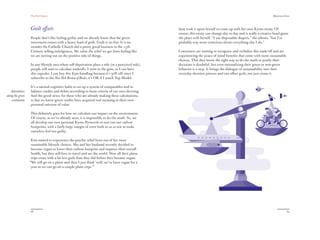
              There’s nothing more personally relevant than the health of a newborn        best thing to do in the sustainability space is to remove the burden of
              baby. This same insight accounts for the phenomenal rise of the natural,     complex choices from our overburdened consumers. Convenience has
  12 ways     organic, and eco-friendly baby products category. Once the preserve          always sold, and making green convenient is a powerful inducement.
we propose    of Whole Foods and neighborhood health food stores, modern, jazzy-
 on closing   looking, “green” baby foods, diapers, wipes, bed linens, cribs, lotions,
   the gap    onesies, and toys are slowly but surely invading every corner of the most    4. Eliminate the sustainability tax
              mainstream baby retailers from Babies ‘R’ Us to Target.
                                                                                           Sin tax is one thing, but consumers shouldn’t have to pay a tax for their virtuous behavior.

              3. Create better defaults                                                    Governments use taxes to change behavior. Since they want fewer people
                                                                                           to smoke, they put a hefty tax on smoking. More people should own their
              If green is the default, people don’t have to decide to be green.            own homes? Here’s a tax break on mortgage interest paid. In Russia and
                                                                                           other low birth rate countries, the governments encourage procreation by
              Being green in a society where green is abnormal is hard, even for someone   bestowing generous tax breaks to those willing to do their part to bring
              deeply rooted in the cause. Being green often means being faced with         children (future taxpayers) into the world.
              complex choices and trade-offs in what often becomes an exhausting effort
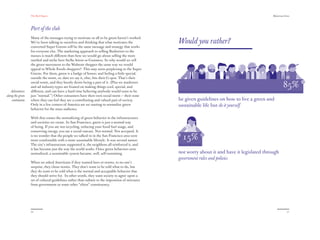
              to do the right thing.                                                       In the green products market, we’ve got the opposite incentive going
                                                                                           on. We’re taxing people’s virtuous behavior. The high prices of many
              But what happens if you do the hard work for people? What if you make        of the greener products on store shelves suggests that we are trying to
              it normal by making the better choice the default? Retailer IKEA started     limit or discourage more sustainable choices. More generous government
              charging for plastic bags in 2006, eventually banning them by 2008, about    subsidies for carbon-intensive coal and oil than for clean solar and
              the same time as China took the same action. At IKEA and in the country      wind energy offer the same impression. And, when we look at our data,
              of China, the normal thing quickly became to bring your own reusable         Americans on the lower half of the green continuum state saving money


              78                                                                                                                                                                          79
The Red Papers:                                                                                                                                                Mainstream Green


              as the number one motivator for making more green actions and buying            standard product may have to come up in price for their eco-friendly
              more sustainable products in the future. If we can shrink prices, we believe,   product to come down in price, but to the consumer the prices have been
              we can shrink the Green Gap correspondingly.                                    normalized, making the more sustainable choice easier to make. This
                                                                                              could give the pricing experts and accountants a huge headache, but if it
              In 2001, two young men launched Method, a line of stylish and eco-              could be pulled off, it would signal to consumers a real commitment for
              friendly cleaning and personal care products. At the time, the easy             driving positive behavior change and create a virtuous default option.
              decision would have been to take this niche idea and sell to the small,
              but wealthy, population of eco-trendsetters, where they could get away
              with substantially marking up the price. However, they took the product         5. Bribe shamelessly
              mainstream to the shelves of Target. In 2006, Method ranked 7th on the
              INC 500 list of the fastest growing private companies in America. Method        Gold stars, cash, kudos, treats — we all love rewards for our good behavior.
              has continued to innovate and recently earned Cradle to Cradle (C2C)
              certification for twenty of its cleaning products, putting C2C products in       Those new to this brave new world of greener choices may find themselves
              many stores nationwide for the first time.                                       launched into a maelstrom of conflicting emotions, feeling they can never
                                                                                              do enough and burdened with the curse of consciousness that comes
              As the leading provider of groceries in the US, Walmart is in prime             with the first bite into the green apple. We can lighten this burden by
  12 ways     position to impact the price of healthy, sustainably produced foods. The        offering them incremental, ongoing rewards for what they do accomplish,
we propose    retail giant is working to reduce the price of foods made with whole grains     creating a framework which rewards individuals as they move up the green
 on closing   as well as fresh fruits and vegetables, and they are even willing to cut into   continuum. Incentivize progress, not perfection. Since this is an imperfect
   the gap    their own profits to do so. While they hope that volume of sales will make       journey we are all taking together, why not make it more enjoyable with
              up for the reduced profits, they stand by their belief that the customer         treats along the way?
              should not have to sacrifice healthier or more sustainable options based on
              limits of affordability.                                                         RecycleBank, for example, rewards consumers for recycling on an ongoing
                                                                                              basis with “points” redeemable for a range of free or discounted products —
              Eliminating the price barrier eliminates the notion that these products         from sundries to sunglasses to soda.
              are not for normal citizens. It eviscerates the effective luxury tax placed
              on these products by the high price, and with that premium goes the             When designing their rewards program, they made sure not to confuse
              destructive notion that only the rich or the righteous deserve these choices.   the desired behavior (greener energy use) with the reward. RecycleBank
                                                                                              isn’t rewarding eco-friendly behavior solely with eco-friendly rewards. It is
              We are waiting for the first brave company to do some creative pricing           rewarding good behavior with normal things we all want and enjoy.
              in the short term to tear down the price premiums put on these greener
              products. Imagine this scenario: A company making laundry detergent             This kind of approach has been so successful that new entrants are rushing
              has one eco-friendly detergent that, for now, is more expensive to              to attach rewards to other everyday sustainable acts like saving energy and
              manufacture than their standard laundry detergent which costs less to           water. Emerging platforms such as EarthAid, EcoBonus and Greenopolis
              make but costs more to the environment. Instead of basing their shelf           all partner with businesses to put money back into consumer hands for
              price on their manufacturing costs, they price their eco-friendly laundry       choosing more sustainable behaviors or purchasing more sustainable
              detergent at the same price as their standard laundry detergent. Their          products. Coupons will be a big part of this, and green may be the catalyst
                                                                                              that gets the good old coupon reimagined. There are opportunities for


              80                                                                                                                                                                          81
The Red Papers:                                                                                                                                                Mainstream Green


              brands to weave themselves into these reward programs as incentive                Sustainability can use some of the smart shaming strategies tried for other
              providers, but can they go further?                                               high-desire, low-compliance problems. Stivoro, a Dutch anti-smoking
                                                                                                organization, encouraged people to blackmail themselves. Snap an
              A more sophisticated rewards program, such as the Citi Forward credit             incriminating photo, they advised, and give it to a buddy with instructions
              card, can. This card not only rewards you each time you pay your credit           to post it on Facebook or in some other public sphere if you fail to live
              card on time and stay under your credit line but also lowers your APR if          up to your goal. The founders of a new gym membership plan, Gym-Pact,
              you pay your credit card on time three billing periods in a row. How might        figured that even social stigma wouldn’t keep people working out. So they
              we emulate smart finance in smart sustainability?                                  upped the financial stakes, charging you more the less you use the gym.

              Back in the Depression, S&H Green Stamps kept customers loyal through             But marketers must be careful. Sometimes, the wrong punishment can
              the lines of nasty-tasting stamps that customers received along with their        have unintended — even opposite — consequences. For example, daycare
              receipt at the checkout counter. Maybe it is time for a new Green Stamps          centers have started to punish parents with fees for every minute they
              program — a Really Green Stamps program, perhaps — to keep consumers              are late picking up their children. Studies have found, however, that this
              loyal to sustainability.                                                          punishment makes the tardy parent less guilty about being late since they
                                                                                                feel they are now paying for the extra time daycare is spending with their
                                                                                                children. Paying a social price for being late (dirty looks, judgment from
  12 ways     6. Punish wisely                                                                  other parents) is more effective.
we propose
 on closing   Shame, stigma, and guilt are powerful motivators unless they are used too much.   The conscience is a wonderful thing, and sometimes it is a far sterner
   the gap                                                                                      disciplinarian than we could ever be. Stickk.com, a website engineered
              There are ways you can shame people into good behavior, but we found              by Yale economists to help people achieve their goals, takes advantage
              rewards to be much more powerful on a regular basis. As any parent                of this trait. By setting up your own contract to achieve a personal goal,
              knows, sometimes you simply have to correct behavior directly. Our                you commit to a self-inflicted punishment — some loss of privilege or a
              research shows that guilt and shame worked best on those who were the             donation to charity — if you fail to achieve your goal.
              worst offenders in the green space, while for those trying their best, more
              guilt can push them over the edge or force them back into denial mode.
              Now nobody likes to feel guilty, and if you give consumers ways to offset          7. Don’t stop innovating. Make better stuff.
              their guilt, they will be grateful. But you still have to inculcate a sense of
              right and wrong. That is what happened in Washington DC in the wake of            We don’t like going backwards. High performing sustainable choices are key for
              a study that forced consumers who wanted a plastic bag to ask for one in          mass adoption.
              front of their fellow shoppers. In the first quarter of that study, plastic bag
              use dropped from 68 million to just 11 million. Once this usually private         Consumers are unwilling to sacrifice performance for sustainability. And
              decision became public, guilt avoidance became a powerful motivator to            rightfully so. For some marketers, the challenge of overcoming the
              behavior change. So bringing private sustainability decisions out into the        performance barrier, real or perceived, will come easily. Unilever’s Persil
              open can help with compliance.                                                    Small & Mighty concentrated laundry detergent saves 35 million liters
                                                                                                of water a year in Europe — and comes with a trusted brand name. Levi’s,
                                                                                                on the back of a legacy advertising campaign, successfully brought to


              82                                                                                                                                                                          83
The Red Papers:                                                                                                                                              Mainstream Green


              market a Water<Less jeans collection, that reduced Levi’s’ water usage by         8. Lose the crunch
              an average of 28% per pair — and up to 96% for some styles. Levi’s spring
              2011 product lines will contain more than 1.5 million pairs of jeans with the     Green marketing needs to be more mainstream hip than off-the-grid hippie.
              Water<Less method, thereby saving approximately 16 million liters of water.
              In these cases, sustainability rode through on the backs of credible brands.      Picture someone who is green. What do you see? A granola-eating,
                                                                                                Birkenstock-wearing, hairy-legged hippie? Just because a product is green
               But borrowing on brand credibility isn’t always enough. Thanks to a long         doesn’t mean it must be packaged in burlap. We need to ditch the crunch
               history of premium pricing for green, the bar for sustainable products is        factor of green and liberate ourselves from the stereotypes. And the best
               higher. It’s not enough to perform just as well; products have to perform        way to do it may be not to mention the “G” word at all.
               better. Companies like Nike and GE saw the performance challenge as an
               innovation opportunity. Sustainable materials for shoes increased comfort        Julie Gilhart, former Fashion Director for the uber-trendy Manhattan
               and performance, and an $18 billion a year business has been made out of         department store Barneys NY and a sustainability change-agent, describes
              “ecomagination” product innovations — the size of a Fortune 150 company.          how she couldn’t understand why the first, fabulous, eco-friendly goods
                                                                                                she brought into the store weren’t selling as well as other items. She
              Plus we have to think beyond what’s in the bottle (or box, or bag) to             decided to try a different approach and removed all reference to “eco-
              the impact of our products in use to ensure we truly are problem solving,         friendly” from the labels. Sure enough, sales of the premium-priced
  12 ways     not just problem switching (some point to biofuels as an example of the           garments picked up. She realized her discerning shopper had been
we propose    latter). Unilever is seeking to do this in its formerly referenced Unilever       turned off by the crunchy image and inferior quality the eco-friendly label
 on closing   Sustainable Living Plan. Levi’s is doing it with its Eco Care label. But why      cued. But in its absence, the benefits of the eco-friendly materials and
   the gap    are some eco-friendly laundry detergents or organic dairy products still sold     production process spoke for themselves: softer, more luxurious fabrics
              in packaging the consumer can’t recycle? Why aren’t more home cleaning            for a more premium garment. Since then, eco creds are often
              products sold in reduced-packaging refills? We need to think about the             merchandised in a more low-key way.
              entire picture, not our self-evident piece of sustainability, to offer consumers
              all-round better choices. In an era when opportunities to differentiate our        It may also be a question of positioning green further down the benefit
              products and brands are increasingly hard to come by, sustainability can          hierarchy as a secondary or tertiary benefit. Method is a brand that really
              provide fertile ground for breakthrough innovation for those marketers            nails it. The founders of Method (see Eliminate the sustainability tax,
              brave enough to turn green into gold.                                             earlier) didn’t just set out to make green cleaning products; they set out
                                                                                                to make better cleaning products, reassessing everything from packaging
              As Unilever and their sustainability initiatives around cleaning and              design, supply chain and fragrance to formulation and marketing. Their
              personal care associated water usage has shown, innovation needs to go            mission is “To create a happy, healthy home revolution.” Method’s groovy
              beyond the products we make. It needs to extend to inventing creative             curved packaging and candy colors leap out at you on the shelf and
              ideas that also change the way consumers use the products we make.                demand to be proudly displayed in the home. Their communication is
              Companies need to think about the entire picture, not just their self-evident     human and quirky, not dry and preachy. Their Smarty Dish dishwasher
              piece of global sustainability.                                                   detergent tabs has the tagline, “Sparkling clean dishes and friendly to
                                                                                                fishes.” The result? A truly modern brand of cleaning products. Oh, and,
                                                                                                by the way, they’re much better for the environment, too.


              84                                                                                                                                                                        85
The Red Papers:                                                                                                                                                 Mainstream Green


              Similarly, Chevy hits the right note in its new Volt campaign which             if we viewed sustainability as the trigger to invent the next generation of
              positions the Volt as a high performing, functioning car that just happens      Ultimate Driving Machines?” In other words, it approaches sustainability
              to be sustainable. Its tagline says it all: It’s more car than electric.        exactly the way BMW should.

              We call this messaging hierarchy “P.S.: We’re sustainable.”                     The EfficientDynamics cars look like quintessential BMW cars, if not
              Communication should embrace the fact that sustainability is a deal-            slightly sleeker. The ads look like, well, car ads, with glossy cars driving
              maker, not a deal-breaker, for the mainstream consumer.                         much too fast around precipitous, hairpin bends. Danger, speed, and
                                                                                              status: this is eco-friendly driving for the Top Gear set. (Not to be
                                                                                              overlooked: BMW has the eco-credentials to back up its story in spades).
              9. Turn eco-friendly into male ego-friendly                                     And it’s an approach we’d do well to emulate in other categories.

              Girly green is not a sustainable proposition for the manly man.                 Other marketers have attempted to target the testosterone. Patagonia and
                                                                                              Cliff Bar tapped into masculine interests in their campaigns targeting
              Carry a tote, give up your 4WD truck, wear hemp t-shirts, compost…              surfers and snowboarders with appeals about compromised surf and snow.
              It’s true that the everyday domestic choices we need to make in favor of        Hunters and fishermen got engaged on sustainability when climate change
              sustainability do not make the Nascar fan’s heart race.                         began to threaten their ability to pursue their sports. Farming and DIY
  12 ways                                                                                     brands also offer fertile ground for stories rooted in the masculine.
we propose    Marlboro famously cracked this code when it replaced “Mild May” in its
 on closing   ads with the now-iconic Marlboro man. This strong, silent type turned
   the gap    smoking filtered cigarettes from girly to guy-thing almost overnight.            10. Make it tangible
              Sustainability could use its Marlboro Man moment.
                                                                                              Sustainability is harder to follow when you can’t see the trail. Find ways to help consumers
              So how can we make green macho? It can be done. A comparison between            see the unseeable and calculate the crazy calculus.
              the Prius and BMW’s eco-friendly car line, EfficientDynamics, is an
              edifying exercise. The Prius targets early adopters with its quirky shape       The line from shopping cart to the Arctic is a long one. And if the carbon
              and ads featuring kids dressed as flowers standing smiling in fields. Now,        footprint calculation isn’t easy even for scientists, then what should
              if you’re targeting early adopters looking to telegraph their green             we expect from consumers at the point-of-sale? We need to simplify
              credentials, this approach is perfect. But inherent in this campaign is the     mental accounting and translate the murky benefits of sustainability into
              message that cars are bad and must be neutered. That approach will never        something immediate and concrete. DIY Kyoto, a UK startup, tried to
              win over more mainstream men who want their car to tell the world how           do just that when it brought the Wattson to market. By changing color
              manly and successful they are. And it would never have rung true from a         according to a home’s current energy use, Wattson provides instantaneous
              brand like BMW.                                                                 feedback on energy use to consumers.

              The Prius, let’s be honest, does not rev a real gearhead’s engine. The Real     Automobiles are the other major source of consumer greenhouse emissions.
              Man turns up his nose at it. So, BMW’s EfficientDynamics says, enough.            Whether you drive 50 miles a week or 500 miles, the invisible carbon
              It’s not the car that’s bad, just the old technology. It asks not “How do you   you spew out is still carbon. But when you peel away from the stoplight,
              make the car less bad?”, but “How can you make it better?” It says, “What       that carbon is left unseen behind you — out of sight and out of mind.


              86                                                                                                                                                                             87
The Red Papers:                                                                                                                                               Mainstream Green


              Calculating that abstract invisible isn’t on the agenda for most American      11. Make it easy to navigate
              drivers, primarily because the consequences are far-off, indistinct, and
              indirect. But what if the impact of driving could be felt immediately —        Eco-suspicion and eco-confusion need to be addressed with truth, transparency, and a very
              say, on the wallets of drivers? Currently, car insurance costs the same        good road map.
              irrespective of mileage. But what if insurance were tied to how much
              you drive?                                                                     Unintended effects plague packaging as much as they do promotion.
                                                                                             Buying green because it’s the norm is one thing; believing in the truth
              The Brookings Institution found that, nationally, driving would likely         behind the green — well, that’s another. The plethora of labeling and
              decrease by 8%; and in New York state alone, by 11.5%. Moreover, only          certifying organizations was intended to help green-conscious consumers
              those who drove most — one-third of drivers — would be “penalized.” The        make better choices, but instead it has caused eco-confusion and eco-
              other two-thirds would be rewarded. In New York, Progressive has begun         distrust. Sustainability champions have come a long way in changing
              to experiment with a pay-as-you-drive insurance policy, while California       attitudes and beliefs, but marketers risk diluting the value consumers place
              and Massachusetts are taking the lead as part of major climate initiatives.    in their green products through reliance on a bankrupt batch of symbols.
              By closing the feedback loop, the connection between an action — driving
              — and its dual impacts — on the climate and your wallet — become               Certain companies have tried to counter this impression, giving consumers
              immediate and direct. The Prius came at it another way, giving drivers         the tools to make simple and still educated decisions. Timberland has
  12 ways     real-time, on-the-dashboard visibility into and feedback on the impact of      attempted to measure the carbon footprint of each shoe, displaying that
we propose    their driving decisions on MPG, along with bar charts for feedback over        score on each box. The label measures the environmental impact and
 on closing   time. This is reckoned to be a significant contributor to the Prius’ success.   community impact, giving specifics such as kWh energy used. While this
   the gap    Tying this to dollars saved could make the tool even more motivating.          is a good first attempt, it does not succeed. Absent a sphere of comparison,
              These tangible signals — financial, visible, or felt in some other way — can    the average consumer does not know what the measurements mean.
              help consumers close the feedback loop on their purchasing decisions.
                                                                                             Retailers are starting to create a navigation system for green. Whole Foods
                                                                                             has launched a sustainability rating program that color codes seafood,
                                                                                             enabling shoppers to make informed decisions. Tesco recently joined forces
                                                                                             with the Carbon Trust to apply a new label to their products designed to
                                                                                             show the total carbon footprint of the product’s journey to the shelf space.
                                                                                             How much is 300mg of sodium? A lot? Adequate? Too little? And 3g
                                                                                             of fiber? Enough for the day? Numbers alone, the UK’s Food Standard
                                                                                             Agency decided, are too abstract to be of use in aiding consumer’s
                                                                                             purchasing decisions. Mental accounting, the agency found, instead works
                                                                                             better with colors. So the high-fat label became red; the medium orange;
                                                                                             and the low green. (Saturates, sugar, and salt, too.) In food purchasing
                                                                                             decisions, mental accounting has become as easy as referencing three colors.


              88                                                                                                                                                                         89
The Red Papers:                                                                              Mainstream Green


              12. Tap into hedonism over altruism
              The green space can seem full of self-righteous killjoy moments and people. Help consumers
              see all the fun they can have on the green side of life.

              Driving behavior change doesn’t have to be complicated. Humans
              respond strongly to a few common motivators — most notable pleasure
              and fun. Volkswagen tapped into this to change people’s behavior for the
              better. The company experimented with different ways to decrease littering
              and increase exercise: first, it turned a bottle deposit bin into an arcade
              game and drastically increased deposit rates. Throwing trash away became
              a stimulating activity. And by converting a staircase into musical piano
              keys — with each emulating a note — it increased stairway use by 66%. Fun
              has most definitely been on the agenda for green marketing already, but if
              we are to make sustainability self-sustaining, it must take center stage.

  12 ways     Making energy saving “fun” might not seem intuitive, but Energy
we propose    Smackdown, an innovation of the BrainShift Foundation, found a way
 on closing   to inject some recreation into energy savings. Energy Smackdown pits
   the gap    community teams against one another to see which one can reduce energy
              use the most over the course of twelve months. Two households from each
              community are filmed for an Energy Smackdown television series.

              As Americans, we’re good at entertainment and competition,” Donald
              Kelly, executive director of the BrainShift Foundation said. “It’s why on
              American Idol they get 40 million voters. It’s the part of this culture that
              people really understand, and we should be harnessing it.”

              Be it for yourself, for the environment, or for something entirely different,
              the only thing that matters is that it’s change for the better. It doesn’t
              matter why you change, how you change, only that you change. As VW
              says on its website, www.thefuntheory.com, as long as green is the outcome,
              it doesn’t matter how you get there.


              90                                                                                                        91
The Red Papers:                                                                 Mainstream Green


Comparing the US and China   We chose to compare the United States and China
                             because as the G2 of sustainability markets, they are twin
                             lodestones of green consumer behavior. As the two largest
                             consuming populations, the actions that consumers take
                             in these markets will have the largest implications for
                             sustainability globally. What did we find?


92                                                                                           93
The Red Papers:                                                                                                            Mainstream Green


                The grass is greener in China
                                                                                                  UNITED STATES                CHINA
                While the big story for the US is the need to motivate the great Green
                Middle to change their behavior, China has no such middle. Our analysis
                puts 48% of Chinese consumers in the Super Green segment, the largest
                one by far. This segment is proportionally three times larger in China than
                it is in the US. By contrast, the Green Rejecters — nearly one-fifth the US    Super Greens
                constituency — are barely a blip in China. The Super Greens are already             16%
                the norm in Chinese society; green is the mainstream default.

                                                                                                                           Super Greens
                                                                                              Upper Middle                       48%
                                                                                                    Greens
                                                                                                     33%

                                                                                                                  Middle
                                                                                                                  Greens
                                                                                                                  66%
                                                                                                                           Upper Middle
Comparing the                                                                                                                    Greens
US and China                                                                                                                      19%
                                                                                              Lower Middle
                                                                                                    Greens
                                                                                                     33%

                                                                                                                           Lower Middle
                                                                                                                                 Greens
                                                                                                                                  31%

                                                                                                    Green
                                                                                                  Rejectors
                                                                                                                                 Green
                                                                                                     18%                       Rejectors
                                                                                                                                   2%


                94                                                                                                                                      95
The Red Papers:                                                                                                                                     Mainstream Green


                Comparing the Green Gaps                                                          Why the difference? Our research points to five major reasons:

                As you’d expect, given their greener tendencies, our data show that while         Environmental health = Human health
                there is a Green Gap in China, on almost all measures the Gap is narrower,
                often significantly so, in China than in the US.                                   As we showed earlier, 70% of Americans would rather cure cancer than save
                                                                                                  the environment. We were surprised to see that in China, those proportions
                Take, for example, alternative sustainable transportation; while more than        are completely reversed. Seventy-eight percent of Chinese consumers place
                two thirds of Americans say it’s important to use public transportation, walk     saving the environment over curing cancer.
                or bike to work, less than a third of them actually do so. In China, 93% say                                                                U.S.    China
                it’s important, and 84% of them follow through. That makes for gaps of 41%
                and 9% respectively. Similarly, while 81% of Americans says it’s important to     Would rather cure cancer than save the environment          70%        22%
                buy local food, only 49% of them do. In China the figures are 78% and 71%,
                a gap of only 7% to the US’ 32%. Overall in China, most green behaviors           Would rather save the environment than cure cancer          30%        78%
                are seen as more important and there’s much more follow-through.

                Why are the Chinese so much greener and their Green Gap narrower?
                While factors like infrastructure certainly account for some of the               Why should saving the environment trump curing cancer for so many
                differences, they do not account for them all. There are other factors in play.    Chinese? To us in America, where we fear cancer, we’ve seen its ravages
                                                                                                  up close, and most of us personally know someone who has been afflicted,
Comparing the                                                                                     this is hard to fathom. And no wonder: while Americans are constantly
US and China                                                                                      reminded of cancer’s toll on our bodies, in the US we breathe clean air
                GAP BY COUNTRY                                                                    and drink clean water, so the correlation between environment and health
                                                                                                  is an abstract notion. In China, it is all too tangible. Fouled rivers and
                                                                                                  sooty skies are an everyday sight for most Chinese. The harm done by
                                                                                      89          tainted water isn’t a fear; it’s a reality that has likely befallen someone
                         China
                                                                       75                         they know. The sight of smog isn’t eyesore; it’s a clutch felt in the chest.
                                                                                       14         China is now where parts of the US were in the 70s, when you couldn’t
                                                                                                  jog in LA because of the smog and the Environmental Protection Agency
                                                                                                  was easy for the government to approve. But because we no longer feel a
                United States
                                                                             80                   direct environmental impact on our health, solving this remote problem
                                                        50                                        gets viewed as luxury and is pushed far down on our priority list. In
                                                                                 30               China, by contrast, environmental health equals human health. We know
                                                                                                  from our research and from experience that where there is a clear link
                                  0              25          50             75              100   between sustainability and human health, people are highly motivated.
                                                                                                  Sustainability is experienced as a matter of life and death in China today,
                                                                                                  and that’s a major reason they care.
                     Importance       Behavior   Gap


                96                                                                                                                                                               97
The Red Papers:                                                                                                                                                           Mainstream Green


                Top down prioritization                                                        Bottom-up demand and collective action

                Environmental health doesn’t just equate to human health in China; it is       This clear signal from the government to its people is matched in our
                also associated with financial health and prosperity. The government is         survey by an equally clear message from the people to their leaders. With
                the reason behind that. Government leaders clearly understand the link         a strong government that prioritizes environmental action, it’s no wonder
                between the environment and the economy, and make this case effectively         Chinese believe so much more than Americans that the government
                for their population. Since economic development is China’s number             not only has the most power to solve the environmental issue but is also
                one priority, environmental action has, therefore, been brought into the       obligated to do so. The chart below shows that most Chinese think the
                limelight.                                                                     government has both the power and obligation — compared to only 20% of
                                                                                               the US — to address climate issues. Americans think that the individual has
                If money talks, China’s leaders have sent a clear signal on sustainability.    the power, but they distribute the obligation evenly among corporations,
                China’s $586 billion stimulus package — the largest in the world — aims to     government, and individuals.
                transform its economy by building green infrastructure. It recently became
                the world’s leading investor in renewable energy technologies. And after                                1. Power                2. Obligation          3. Action
                years of increase, growth in China’s energy consumption and greenhouse
                gas emissions is now slowing. The government’s strategy for the economy
                                                                                                                        China       U.S.        China       U.S.       China       U.S.
                has shifted from rapid (with less of an eye to collateral damage) to a more
                sustainable approach. As Prime Minster Wen Jia Bao stated unopposed
                at a state conference in February 2011, “We must not any longer sacrifice       Government                 66         20          57          35          43          12
Comparing the   the environment for the sake of rapid growth and reckless roll-outs, as that
US and China    would result in unsustainable growth featuring industrial overcapacity and
                intensive resource consumption.” In contrast, one of the major US political    Corporations               11         25          26          28          16          17
                parties is still adamant that climate change doesn’t exist. US Senator
                James Inhofe memorably called global warming, “the greatest hoax ever
                perpetrated on the American public.” And in the US, tackling climate           Individuals                24         56          18          37          41          71
                change is positioned by many as the enemy of economic recovery. No
                wonder, then, that efforts to push even a modest climate bill through the
                US Congress have failed.                                                       Respondents were asked to choose, between the government, corporations and individuals, who has
                                                                                               the most power, obligation and action, in terms of solving global environmental issues. Note responses
                Clear leadership from the top makes the difference in China. But there’s a      are based on the corresponding questions below:
                downside: when a strong government takes up so much of the responsibility,
                                                                                               1. If you had to choose one of three, who do you believe has the most power to solve the global
                ordinary citizens and corporations lose their sense of initiative.             environmental issues?

                                                                                               2. If you had to choose one of three, who do you believe is obligated or “on the hook” for solving the
                                                                                               global environmental issues?

                                                                                               3. If you had to choose one of three, who do you believe is doing the most to help solve the global
                                                                                               environmental issues?


                98                                                                                                                                                                                      99
The Red Papers:                                                                                                                                                       Mainstream Green


                Further, the Chinese think the government and individuals are splitting                              Not yet the land of plenty
                the work. Even though Chinese consumers see the government and
                corporations as being ultimately responsible for tackling sustainability,                            We’ve saved perhaps the biggest reason for the narrower gap till last. If
                consumers believe their individual actions amount to something. This                                 you compare the footage of the ethnographies we conducted in people’s
                belief is founded upon a fundamental faith in the power of collective                                homes in the US and China, what you quickly come to notice is this: the
                action. If the Chinese could build The Great Wall of China by hand                                   Green Gap itself is largely a luxury of the somewhat affluent, middle class
                thousands of years ago, then surely they can solve the environmental issue                           consumer, whether in the US or China. In those Chinese homes where
                today. But in the US, as is no surprise considering our political paralysis,                         families cannot yet afford to waste a morsel of food, a piece of paper
                consumers feel that individuals are doing all of the heavy lifting and that                          or a drop of water, thrift, conservation, and reuse are innate values and
                their efforts make no difference. Al Gore has said on climate action, “No                              behaviors. Many Chinese consumers were born prior to the 1980s, during
                change will happen unless the people demand it.” Our data suggests that                              a time when China’s economy was still fragile. Raised in an environment
                in China, the people demand it whereas in the US, very few of them do.                               where conservation and prudence were a necessity, not a choice, these
                                                                                                                     consumers naturally developed green lifestyles. Economic circumstances
                                                                                                                     have led Chinese to be green by default. In the US, the World War II
                Respondents were asked to what level they agree or disagree with the statement: I feel my green or   generation was the last to know scarcity. Their offspring, raised in plenty,
                sustainable efforts amount to nothing.                                                                form the current majority of the American middle class, manifesting the
                                                                                                                     uniquely American cultural ideal of a life without limits.
                                                                                              U.S.        China

                Feel their individual efforts amount to nothing                                44%        12%
Comparing the
US and China

                Cultural reinforcement

                The Chinese understanding of sustainability is driven by the importance
                of harmony entrenched in the philosophical legacies of Confucianism,
                Buddhism, and Taoism. Though slightly varied, these schools of thought
                all emphasize the importance of humans living in harmony with nature,
                and this belief in harmony and balance still remains an integral part of
                Chinese culture.

                Similarly the Chinese tradition of Feng Shui is about the art of clearing
                spaces and revitalizing the energies in buildings, living and work spaces. It
                may also account for the differences in the homes we entered in our US and
                China research, with Feng Shui contributing to the emptier, neater homes
                we saw in China. Feng Shui is at odds with the accumulation of excess stuff.
                In China, leveraging such proud cultural traditions is a way the government
                can seek to stem the rise of Western-style overconsumption.


                100                                                                                                                                                                               101
The Red Papers:                                                                                                                                                                          Mainstream Green


                Window of opportunity                                                                                        Why does this matter so much? Because when you ladder this up
                                                                                                                             to a national level, this is how growth in consumption impacts
                                                                                                                             carbon emissions:
                In the emerging middle class homes, where the families are consuming
                more like the predominant US middle-class, we saw from our
                ethnographies that the waste and excess begins to creep in. For the first                                     Carbon Dioxide Emissions from Consumption in China, 1980-2009
                time in the nation’s history, the majority of Chinese citizens are enjoying a
                middle class lifestyle. Many families are buying their first car. Twenty years                                8,000
                ago, only one in 300 urban families had an air conditioner. Now, every
                urban family owns one, on average. Soon, they will have two, or three,                                       7,000
                because they can afford to. As they will tell you, if homes in Japan can
                have two or three air conditioners, and those in the US, four or five — and                                   6,000


                                                                                                Million Metric Tons of CO2
                some families even heated driveways — why shouldn’t they? China has
                already overtaken the US as the world’s largest auto market, and that is                                     5,000

                just the first of the consumption benchmarks to fall. More will soon follow.
                                                                                                                             4,000

                So while the Chinese population is significantly greener for now, this
                                                                                                                             3,000
                doesn’t mean that marketers in China can rest on their laurels, nor that
                the need to market the sustainable option as the mainstream option is
                                                                                                                             2,000
Comparing the   irrelevant here. As the Chinese population migrates to a middle-class
US and China    lifestyle modeled on the West, marketers will need to work hard to ensure                                    1,000
                the sustainable choice continues to be the preferred and/or default choice.
                Otherwise, as China’s economy continues to grow and its people consume                                          0
                more, China’s currently moderate Green Gap could widen to rival the
                                                                                                                                     1980 1982 1984 1986 1988 1990 1992 1994 1996 1998 2000 2002 2004 2006    2009
                gaping chasm we see in the US.

                                                                                                                             Consumption-related carbon dioxide emissions nearly tripled in China
                                                                                                                             over the last ten years. That’s with a relatively modest Green Gap. If we
                                                                                                                             can entice Chinese consumers to retain some of their virtuous habits even
                                                                                                                             as they grow into more middle-class lifestyles and can create the products,
                                                                                                                             services, transportation, buildings, and cities to allow them to leapfrog
                                                                                                                             our unsustainable model of consumption completely, we may just manage
                                                                                                                             to keep the Green Gap from widening in China. We may succeed in
                                                                                                                             uncoupling consumption growth from growth in carbon emissions.

                                                                                                                             We have a brief but critical window of opportunity to try and make that
                                                                                                                             happen. We now turn our thoughts to how to do it.


                102                                                                                                                                                                                                  103
The Red Papers:                                                                          Mainstream Green


Different contexts and continents,   The context and the reality of the Green Gaps in the US
similar solutions                   and China are literally worlds apart. And yet despite very
                                    different contexts, when it comes to closing the Green Gap
                                    in the US and keeping the Green Gap closed in China, our
                                    teams in both markets, working independently, came to a
                                    surprisingly similar set of solutions. These are the overlaps:


104                                                                                                  105
The Red Papers:                                                                                                                                        Mainstream Green


                Create better choices                                                                   We saw earlier that rewards (aka bribes) work with the US consumer.
                                                                                                        The same goes for the Chinese consumer. The success of a solar heater
                Whether it is offering real choices or just the illusion of choice – choices are good.   giveaway program in rural Yunnan province bears this out. The local
                                                                                                        government gave away a free solar water heater to anyone who installed a
                Regardless of very different systems of government, we are all drawn                     proper toilet. Not only did this incentive improve sanitation dramatically,
                toward freedom and a desire to make our own choices. While we have                      the site of the rooftop heaters became a status symbol — a badge of
                evidence that government legislation does work in affecting behavior                     modernity that everyone wanted. In one step, this innovative program
                change through creating new rules and regulations, we are more                          tackled energy use and sanitation without any increase in emissions.
                personally motivated when we feel we are making our own choices.                        Rewards should be chosen with an eye to what people want where you
                                                                                                        live, but the principle works in both places.
                When we looked at the answer to an either/or question we posed to
                both US and Chinese consumers about whether they would rather (1)
                Be given guidelines on how to live a green and sustainable lifestyle, but               Make it personal
                do it yourself; or (2) Not worry about it and have it legislated through
                government rules and policies, 78% of Chinese citizens and 85% of                       People will always trump the planet.
                Americans chose the free agency option.
                                                                                                        Rewards work because they offer people a direct benefit. And as noted
                As marketers, we can tap into this desire by implementing choice                        earlier, the more personal the benefit, the more motivating it becomes.
                architecture and offering greener options for consumers. Just as in the                  Finding the relevance factor is the key to motivating people to act.
                US, IKEA nudged the consumer by banning plastic bags, in China,                         This is true in both the US and China. There are few more personally
                Midea introduced an “Eco button” on their air conditioners which                        galvanizing life events than the birth of a first child. No wonder then
                consumers could press to set their air conditioner automatically to the                 that this moment emerged as a key trigger to a re-evaluation of the
   Different     WWF-recommended level of 2 degrees C, making the green behavior                         sustainability of one’s choices in both markets. The impact seems to
contexts and    ridiculously simply to do. Nudging consumers in the right direction is a                ripple beyond directly relevant behavior (e.g., green diapers or wipes);
  continents,   more powerful way to create behavior change than mandating rules.                       Chinese informant Zhu Xin’s family took to reusing scrap paper after
      similar                                                                                           their baby came along. Every year there are 16,030,800 births in China.
    solutions                                                                                           That’s over 1 million opportunities to drive sustainable behaviors
                                                                                                        through a relevance moment of truth. Our companion work, Get Going
                Reward good behavior                                                                    with Green, has more ideas for aligning sustainability with different
                                                                                                        Chinese consumers’ personal goals. In both markets, we need to stop
                Treats are more motivating than punishment.                                             kidding ourselves that altruism will work. By acknowledging human
                                                                                                        nature and focusing on what’s in it for me, we can motivate the mass
                Offering the right choices is only one part of changing behavior. In order               change which will ultimately benefit the planet without ever mentioning
                to ensure long-term behavior change, it’s important to reward good                      the planet in our message.
                behavior with tangible treats.


                106                                                                                                                                                                107
The Red Papers:                                                                                                                           Mainstream Green


                Move forward, not backward                                                  Stress social acceptance
                Sacrifice isn’t a sustainable proposition.                                   We all want to be normal and belong.

                Just as consumers in the US don’t want to go backward, consumers in         Throughout our ethnographies in both the US and China, we found
                China don’t want to give up on the still-new benefits of the middle class    people didn’t identify with the Eco Warriors, hippies, idealists, and
                world. It is in our human nature to want to progress and keep things        elitists and that they instead want to align themselves with average,
                moving forward, and once we’ve moved forward we have a hard time            mainstream citizens. In both the US and China, mainstreaming green,
                going back. So we expect things like the products we use, the homes we      or greenstreaming, is marketers’ job #1. In the US this is tricky because
                live in, and how we get around to get better and better. When it comes      most of these behaviors are decidedly not normal right now; most
                to gauging issues of sustainability, we won’t tolerate a backwards move     people aren’t taking public transportation or riding their bikes to work.
                in quality or lifestyle. We want products that perform well — even better   And labeling those actions green is only going to make them even less
                than conventional products — and we don’t want to pay a premium for it.     desirable. In China, there are many existing mainstream behaviors
                                                                                            which are, as mentioned earlier, sustainable by default and warrant
                The good news is that, while many Americans associate poorer quality        encouragement — the use of straw mats for sleeping during hot summers,
                and performance with green goods, for the most part, the Chinese            riding bikes, refilling one’s own water flask to name a few. However,
                view green products with perceptions of high quality. However, in both      some of these behaviors, because of their heritage, carry the stigma of
                countries consumers complain about what we call the “sustainability         being for the economically challenged. So the trick is a little different
                tax” often associated with these greener products. Both struggle to         — we need to keep these mainstream behaviors going by labeling, let’s
                understand why they need to pay more for a product that is better for       say bicycle riders, as smart green adopters rather than as economically
                the environment.                                                            challenged. We therefore change the frame and add cachet. Since
                                                                                            green is already much more mainstream, green is a safer place to be in
   Different     In order to ensure consumers continue to make sustainable choices, we       China. The need to belong is a fundamental driver of human behavior,
contexts and    need to make sure that the sustainable products out in the marketplace      no matter where you live. Indeed, 92% of Chinese agree that “if more
  continents,   are high performing and cost efficient. As marketers it is our job to make    people acted green, they would too.”
      similar   sure consumers associate green with quality, affordability, and progress.
    solutions


                108                                                                                                                                                   109
The Red Papers:                                                       Mainstream Green


We’re all human   So why are we confident that, in spite of the striking
                  differences between the two nations in terms of culture,
                  government, economic development, and physical
                  environment, large parts of the approach are the same?
                  That, while the need in the US is to focus on closing the
                  Green Gap and in China it is to prevent it from opening,
                  many solutions can be shared?


                  All of these overlaps have one thing in common: they are all
                  grounded in an understanding of human psychology and
                  human nature. At the end of the day, we are all human.
                  Cultural contexts may differ tremendously, but we are all
                  driven by the same desires and needs. We all value freedom
                  and choice, we all desire progress, we find pleasure in
                  rewards, we’re selfish, and we care the most about what’s
                  personal to us. These human drivers transcend time,
                  geography, and technology, and it is our understanding
                  of them that will enable marketers to be so successful in
                  shaping greener, more sustainable consumer behavior.


110                                                                               111
The Red Papers:
        Papers                                                      Mainstream Green


Conclusion        We set out to uncover an explanation for the gap between
                  consumers’ stated intentions and their actions when it
                  comes to sustainability, and to uncover a range of ways
                  that we can begin closing the gap.


112                                                                             113
The Red Papers:                                                                                                                             Mainstream Green


             Our research identified the fundamental problem with green marketing          Yes, in today’s world consumers do care more about the companies
             today, and that is perhaps the most important takeaway for marketers.        behind the products they are buying. They do want reassurance that
             Namely, we have been trying to motivate mainstream consumer behavior         environmental and social damage is not being done in service of the
             with what is essentially niche marketing. We threw decades of knowledge      contents of their shopping cart. And marketing around sustainability
             of what works when marketing to mainstream consumers out the window          does carry its own unique, complex, and highly nuanced set of
             and began speaking to them in a way that simply isn’t relevant. It is as     challenges. It is hard to do well and must be handled extremely carefully.
             though, when it comes to green, we somehow decided consumers park
             human nature at the supermarket door.                                        But ultimately, the mainstream consumer is still the mainstream
                                                                                          consumer. It’s time to forge a new era of sustainability marketing in
             We missed the point that at heart, we are all human creatures with human     which we marketers come to realize that “normal” is not a dirty word.
             motivations and concerns. So we’ve been positioning our messages,            Normal is mainstream, normal is popular and above all, normal is the
             products, and services around environmental benefits, not human benefits.      key to sustainability.
             This reduces our potential audience for our message from “all humans”
             to the subset “humans who care about the environment” — which is to
             say only about 20% of us. And we’ve been positioning these products
             and services as special, edgy, and different, when what the mainstream
             consumer really needs to know is: are they normal?

             Maslow’s hierarchy of needs is much over-quoted in marketing
             presentations, but in this case it is instructive: we’ve been busy telling
             consumers how sustainability can get them to self-actualization without
             helping them understand how it can meet their more basic needs of
             safety, love, and belonging.

             These insights suggest that if we are to drive sustainability beyond the
Conclusion   Super Green niche to propel a truly mainstream movement, we need to
             revisit our Marketing 101 textbooks and get back in touch with what
             we know works when marketing to the mainstream. We need to stop
             trying to argue consumers into agreeing that sustainability is important.
             Instead, we must immediately shift our attention to identifying the
             behaviors with the greatest potential impact and to understanding
             the best ways to get consumers to embrace them. Sustainability is the
             outcome, not the communications strategy.


             114                                                                                                                                                     115
The Red Papers:                                                                                       Mainstream Green


Research methodology   Expert interviews
                       Several ideas were inspired by conversations over the past year with
                       behavioral economists, environmental experts, and creative thinkers:

                       •   Marc Alt, President, Marc Alt+Partners

                       •   Bill Becker, Senior Climate Policy Advisor, Natural Capitalism Solutions

                       •   Aimee Christensen, Founder & Chief Executive Officer, Christensen Global Strategies

                       •   Seth Farbman, Chief Marketing Officer, Gap Inc.

                       •   Tom Feegel, Creator, GreenMyParents

                       •   Julie Gilhart, Former Fashion Director, Barneys New York

                       •   Adam Lowry, Co-Founder & Chief Greenskeeper, Method Products

                       •   Todd Rogers, Founding Executive Director, The Analyst Institute

                       •   Rory Sutherland, Vice Chairman, Ogilvy Group UK

                       •   Andrew Winston, Author, Green to Gold and Green Recovery

                       •   Ian Yolles, Chief Marketing Officer, RecycleBank


116                                                                                                               117
The Red Papers:                                                              Mainstream Green


Ethnographies
Between September 2010 and February 2011, we spent time in the homes
and neighborhoods of 15 subjects across three markets: San Francisco,
Chicago, and the New York Metro area. These three markets were chosen
for geographic diversity and as a way to explore markets with a significant
incidence of green behavior (San Francisco) in comparison to a moderate
green market (NY Metro) and one that is fairly representative of the US
population (Chicago).

In order to explore green systems of meaning and behavior, we
sampled across a spectrum from Lower Middle Greens to Super Greens
representing various lifestyles and life stages:


• Married, no kids

• Married with kids

• Single

• City dwellers

• Suburbanites


Conversational quantitative research
We talked to 1,800 Americans using MarketTools True Sample, over two
phases of research September 2010 and February 2011. The sample was
chosen to be representative of the US adult population based on age,
gender, and geography.


118                                                                                      119
The Red Papers:                                                                             Mainstream Green


Key takeaways     •   There is a broad Green Gap — a gulf between consumers’ stated
                      beliefs about sustainability and their real-world behavior in both
                      the United States and China.

                  •   OgilvyEarth fielded original quantitative and qualitative research
                      in both the US and China to better understand this Green Gap
                      and discover ways to close it.

                  •   We focused on the US and China (the G2 of sustainability
                      markets) because of the following reasons:

                      o They are the world’s largest emitters of CO2.

                      o They are effective analogs for sustainability behavior in the developed and rapidly
                      developing world alike.

                      o Consumer behavior in these two countries has the most impact on
                      global sustainability.

                  •   The US consumer market is the main focus of Mainstream Green.
                      China is covered in depth by a companion work, Get Going
                      with Green.

                  •   Our research enables us to segment the US population along
                      a green continuum which showed that two-thirds of the US
                      population falls into a vast center class we call the Green Middle.

                  •   It will be more effective to induce sustainability behavior
                      changes among this population than to convert the outright
                      Green Rejecters.

                  •   Closing the Green Gap will require popularizing and normalizing
                      sustainable behaviors among the Middle Greens.

                  •   There are several barriers to green behavior in the US:

                      o The curse of consciousness — Consumers are suffering from the loss of blissful
                      ignorance about the impact of everyday behaviors on the planet.

                      o There are effective analogs for sustainability behavior in the developed and
                      rapidly developing world alike.

                      o It’s not easy being green — There are significant practical and social impediments
                      to practicing sustainable behaviors.


120                                                                                                     121
The Red Papers:                                                                                                                                                                  Mainstream Green


          o The high cost of being green — Sustainable products frequently carry a price               o Don’t stop innovating — High performing sustainable options are required for
          premium and/or a performance and trustworthiness trade-off.                                   mass acceptance.

          o Green is the new pink — The green movement has a distinctly feminine cast to it,           o Lose the crunch — Green marketing needs to be mainstream hip, not hippie.
          making participations more difficult for me.
                                                                                                       o Turn eco-friendly into ego-friendly — Girly green needs a manly counterpart.
          o Eco-suspicion and eco-confusion — Doom and gloom proclamations coupled with
          muddled, impersonal messaging, and meaningless standards leave consumers cold                o Make it tangible — Sustainability is easier to follow when the trail is visible.
          and confused.
                                                                                                       o Make it easy to navigate — Truth, transparency, and a clear road map are
•         However, there are a few trends that may help normalize                                      bulwarks against consumer confusion and suspicion.
          green behaviors:
                                                                                                       o Tap into hedonism over altruism — Show how much fun is to be had on the green
          o The pleasure principle — Once consumers experience green behaviors in a positive           side of life.
          way, a self-reinforcing cycle of green pleasure (what we call the G-spot) takes root.
                                                                                                   •   In comparing the US and China, we found that while both
          o Guilt offsets — Awareness of green behaviors engenders peace of mind in                     countries have Green Gaps, the gap is narrower in China and the
          consumers, allowing them to engage in a few less sustainable practices without               population is greener for these reasons:
          crushing guilt.
                                                                                                       o Make it normal — Normal is sustainable.
          o Part of the club — The emerging social norms surrounding sustainable behavior
                                                                                                       o Make it personal — Focus on what sustainability can do for consumers, not the
          allow consumers to act sustainably and still feel like a normal, mainstream part
                                                                                                       other way around.
          of society.
                                                                                                       o Environmental health is equivalent to human health.
          o Generation S — The teens of today are the sustainability consumers of the future,
          and green behaviors are already normal for them.                                             o China’s government sends clear top-down signals on the importance of
                                                                                                       sustainability.
•         We propose 12 ways that will help close the Green Gap:
                                                                                                       o China’s consumers demand action and work collectively.
          o Make it normal — Normal is sustainable.
                                                                                                       o Chinese cultural influences prioritize harmony with nature and deemphasize the
          o Make it personal — Focus on what sustainability can do for consumers, not the
                                                                                                       accumulation of stuff.
          other way around.
                                                                                                       o China’s emerging middle class does not yet have the luxury of overconsumption.
          o Create better defaults — With better default options, people don’t have to decide to
          be green.                                                                                •   To keep China’s Green Gap from widening, we have a brief
                                                                                                       window of opportunity in which to decouple a rising economic tide
          o Eliminate the sustainability tax — Consumers shouldn’t have to pay a higher price
                                                                                                       from growth in carbon emissions.
          for virtuous behavior.
                                                                                                   •   The means we discovered to close China’s Green Gap are strikingly
          o Bribe shamelessly — Everyone loves to be rewarded for good behavior.
                                                                                                       similar to those for the US. Despite our different contexts, we have
          o Punish wisely — Used with care, shame and guilt are powerful motivators.                   shared solutions.


122                                                                                                                                                                                          123
The Red Papers:                                                                         Mainstream Green


About the authors   Graceann I. Bennett

                    Managing Partner, Director of Strategic Planning
                    Ogilvy & Mather Chicago

                    Graceann joined Ogilvy in 2006 to lead Chicago’s strategic planning
                    department and share leadership duties for the Ogilvy Chicago office.
                    She leads the broader strategic community — encompassing consulting,
                    analytics, digital strategy, and planning — across the PR, Activation, and
                    Advertising divisions in Chicago. In addition, Graceann serves on Ogilvy’s
                    Global Planning Council. Prior to joining Ogilvy, she headed up the
                    strategic planning departments of Leo Burnett and Arnold Worldwide.
                    Graceann’s experience extends beyond advertising, however. Before she
                    joined the industry, Graceann did stints in a variety of industries including
                    global marketing consulting, design, and media channel planning and
                    research. She has lived and worked in New York, London, and Boston.

                    Dedicated to thought leadership throughout her career, Graceann recently
                    conceived and led two significant consumer study initiatives. Women in Their
                    Digital Domain is a proprietary study created in collaboration with Mindshare
                    and Microsoft Advertising. It explores the digital paths that women use to
                    seek, share, and shop. Eyes Wide Open, Wallet Half Shut, Graceann’s other recent
                    study, is an in-depth study she did with Communispace to explore the post-
                    recession consumer.

                    Graceann is a contributing strategist in OgilvyEarth’s sustainability practice
                    where she developed the global sustainability platform for UPS and will
                    now be applying her expertise to sustainability efforts for Unilever and
                    other clients.

                    During her career, Graceann has worked in several business sectors and
                    on many famous brands with award winning work: Dove, Volkswagen,
                    Guinness, Pepsi, Suave, Truvía, and Wonderbra.

                    Graceann is a graduate of Brigham Young University and has spent time
                    studying at the Jerusalem Center for Near Eastern Studies. She lives in
                    downtown Chicago with her husband and three children.


124                                                                                                 125
The Red Papers:                                                                Mainstream Green


          Freya Williams

          Co-Founder and Head of Strategy
          OgilvyEarth

          In 2007, after 10 years with Ogilvy New York, Freya saw an opportunity
          to create a practice dedicated to helping some of the world’s biggest
          corporations become leaders in sustainability and sustainable branding.
          Today that practice has grown into a global network, with outposts in over
          twenty countries, helping organizations like Coca-Cola, Unilever, Siemens,
          DuPont and Kraft harness the opportunity in sustainability for the benefit
          of their businesses and the world. A strategic planner by trade, Freya leads
          strategy for OgilvyEarth’s client engagements. She grounds her approach
          in the view that brands and marketing have the power to change the world
          and will be a critical component of achieving a sustainable society. Hers
          is the strategic mind behind brand initiatives and campaigns including
          Coca Cola’s PlantBottle, Hellmanns’ switch to free range eggs, and the
          award-winning Hopenhagen campaign in support of the UN at COP15
          (which recruited 6 million supporters, 70% of whom had never joined a
          climate movement before). Freya’s mission, as those efforts showcase, is to
          move sustainable behaviors into the mainstream.

          Freya is the author of thought leadership pieces on sustainability,
          including OgilvyEarth’s Greenwash to Great: a Guide to Great Green Marketing
          Without the Greenwash and 2009: A Pivotal Year. She speaks on brands
          and sustainability at conferences including Opportunity Green and
          Columbia’s Responsible Business Summit. During her career, Freya has
          had the opportunity to work with some of the world’s biggest brands
 About    including Dove, Kimberly-Clark, American Express, Goldman Sachs,
    the   and Thomson Reuters. An occasional contributor to magazines including
authors   Glamour and Cosmopolitan, Freya is a native Brit who has been in the US
          for ten years where she, her husband, and two children split their time
          between Manhattan and Milanville, PA.


          126                                                                                        127
The Red Papers:                                                                 Mainstream Green


References        Ariely, Dan. Predictably Irrational. HarperCollins, 2009.

                  Green Brands Survey, Penn, Schoen & Berland, 2009.

                  EcoPinion Survey Report, EcoAlign, 2007.

                  Gauging the Green Gap, The Energy Savings Trust, 2007.

                  Jacobs, Andrew. China Issues Warning on Climate and Growth.
                  New York Times, February 28, 2011.

                  Thaler, Richard and Sunstein, Cass. Nudge. Penguin, 2008.

                  The TRU Study, U.S. TRU Global Teen Insights Program, TNS, 2011.

                  The Futures Company 2010 Global Monitor Survey.

                  US Energy Information Administration. Carbon Dioxide Emissions
                  from Consumption, 2009.

                  Organic Trade Association. Organic Industry Survey, 2010.

                  Corporation for National and Community Service.
                  Youth Helping America, 2005.


128                                                                                         129
The Red Papers:                                                                 Mainstream Green


                  Colophon


                  Authors                            Special thanks to additional
                  Graceann Bennett                   OgilvyEarth contributors.
                  Freya Williams
                                                     April 2011
                  Contributing authors               Issue 4
                  Meghan Campbell
                  Rei Wang                           The Red Papers are published by
                                                     Ogilvy & Mather
                  Editor
                  Jeremy Katz                        No article may be reproduced or
                                                     transmitted in any form without the
                  Ethnographic research              written permission of the publisher.
                  Alison Demos
                                                     Copyright © 2011
                  Quantitative research              Ogilvy & Mather
                  Nicole Friedman
                                                     Edition 1:
                  China research                     5,350
                  Kunal Sinha
                  Michael Griffiths

                  Creative director
                  Gabe Usadel

                  Art director
                  Allie Armstrong

                  Illustration
                  Always with Honor

                  Design
                  485 Brand Design, Ogilvy Chicago


130                                                                                         131

Mainstream Green

  • 1.
    Mainstream Green Graceann Bennett& Freya Williams The Red Papers: Ogilvy & Mather
  • 2.
    Mainstream Green: Moving sustainability fromniche to normal Graceann Bennett & Freya Williams The Red Papers: Ogilvy & Mather
  • 3.
    The Red Papers: Contents April 2011, No. 4 6 About the Green Gap project 34 Adventures along the green continuum 8 Introduction 64 Turning the corner 12 Closing the Green Gap 74 12 ways we propose to close the gap 18 Researching the Green Gap 92 Comparing the US and China 20 Normal behavior is sustainable behavior 112 Conclusion 24 The massive 116 Research methodology Middle Green 120 Key takeaways 30 The far ends of the continuum
  • 4.
    The Red Papers: Mainstream Green About the Green Gap project The United States and China arms of OgilvyEarth collaborated on a project that aimed to help crack the code on one of marketing’s thorniest problems. We choose those countries as they are the two largest consuming markets on earth. The problem, dubbed the Green Gap, describes the gap between consumers’ green intentions and green actions. Plenty of research observes that it exists; we set out to understand why, and to discover ways to close it. Bridging the Green Gap is critical to corporate bottom lines and climate trend lines. Kunal Sinha and Michael Griffiths led the China part of this project, and their findings are presented in Get Going with Green — the companion piece to this work. Graceann Bennett and Freya Williams led the United States project. Both teams collaborated on the comparison section that closes this volume. 6 7
  • 5.
    Mainstream Green Introduction An all-star cast of green luminaries flocked to December’s World Climate Summit in Cancun, Mexico: CEOs, corporate sustainability officers, clean energy consultants, Hollywood producers and even a few of us from OgilvyEarth. The very presence of such a broad spectrum of people at this event was a major coup from a climate standpoint. The pretext for the gathering was the UN climate summit COP16, the follow-up to the now- infamous COP15 (which is viewed by many as having fallen short of the “ambitious and binding” global treaty it set out to achieve). This year, the heavy hitters from the private sector were taking matters into their own hands, sending a clear signal to the UN delegates that business wants progress on climate and is ready to roll up its sleeves to collaborate on solutions. 9
  • 6.
    The Red Papers: Mainstream Green Introduction Nestled among the more technical topics on the table (policies, procurement, new financing mechanisms) was a particularly encouraging agenda item: public engagement. It is unusual, in these rarified circles, to hear talk of creating a mass movement on everyone’s lips. But this elite cadre knows that to achieve our goals we must motivate a mass green movement, shifting mainstream consumers to a more sustainable way of living. The public engagement session opened with media mogul and climate guru Ted Turner talking about how we are losing precious time and can’t afford to keep failing at motivating the masses. “When will the world understand that we are right and they are wrong?” he intoned from the stage. We nodded our heads in furious agreement and in his frustration, Turner spoke for the room. The mainstream has completely confounded us when it comes to green. They have evaded every rational and emotion argument we’ve thrown their way. To us, it seems they’re just not getting it. But maybe Ted Turner’s remark revealed our problem. Maybe we’re the ones not getting it. If we are to motivate a mass green movement, perhaps The mainstream has completely those of us most committed to the green movement need to stop trying to get the masses to see things our way and instead get better at seeing things confounded us when it comes to green. their way. To get from here to there, a radical shift in perspective is needed. So far, despite the best intentions, the discussion has largely focused on the two ends of the spectrum — the committed Greens talking to their fellow green converts or, alternatively, doing battle with the fervent Anti- Greens, who seem more determined than ever to evade conversion. What we’ve been missing in the process is the massive Middle, the group that offers the biggest opportunity to create the change the world so needs. It is on the Middle that this report will focus, and more specifically on the gap between the Green Middle’s intentions and their actions when it comes to sustainability. Our goal is to provide insight into the things keeping the gap open and practical, pragmatic, actionable suggestions for closing it, once and for all. We hope you’ll join us. 10 11
  • 7.
    The Red Papers: Mainstream Green Closing the Green Gap While we have been relatively good at getting people to believe in the importance of more sustainable behaviors, practices, and purchases, we have been unable to convert this belief fully into action. The following charts — calculated by comparing the percentage of consumers who stated that this green activity was very important or important to them to the percentage who stated they “usually do” this activity — prove the point. US and China Green Gap: Difference of Stated Importance versus Stated Behavior Respondents were asked to indicate the importance of certain activities in terms of their definition of living a green or sustainable lifestyle (Importance), then asked to look at the same list and indicate whether or not they usually do the activity (Behavior). The gap is derived from the difference between the two responses, explicitly showing the divide between belief and action. This data is based on the average responses from US and China, respectively, based on the following activities: Taking public transportation, walking or biking to work; purchasing locally grown food; using eco-friendly cleaning products and recycling bottles/cans/paper. GAP BY COUNTRY 80 United States 50 30 89 China 75 14 0 25 50 75 100 Importance Behavior Gap 12 13
  • 8.
    The Red Papers: Mainstream Green UNITED STATES Many research reports have also observed this phenomenon; for example, in its 2009 Green Brands Survey, Penn Schoen Berland found that 77% of Take public transportation, 68 Closing the bike or walk to work 27 Americans say they would like to consume in a more sustainable way, but 41 Green Gap their actions do not reflect these good intentions. An opinion survey by the Energy Savings Trust found that around 80% of the public believes that 81 Purchase locally grown food 49 climate change is a major problem and wants the government to let them 32 know what they can do to save energy, but only 60% of the same sample is actually doing something to reduce their personal energy use. Similarly, 77 Use eco-friendly cleaning products an EcoPinion survey conducted by EcoAlign found 90% of Americans 45 32 value energy efficiency but only 3% turn their PC off at night. 93 Recycle bottles/cans/paper 79 14 This gap between stated importance and behavior or action is what we at OgilvyEarth call the Green Gap. Closing the Green Gap is a necessary step if we are to create a sustainable society. While the world knows this gap 0 25 50 75 100 exists, no one yet knows what it will take to close it. OgilvyEarth set out to find some answers. CHINA Amidst the clear failure of governments to lead the way on climate change (or to persuade people of its importance), corporations and businesses are Take public transportation, 93 stepping into the leadership vacuum because they see it as a reputational bike or walk to work 84 9 and financial opportunity. They will not succeed unless they figure out how to close the Green Gap. There are two main reasons for this: firstly, the 78 persistence of the Green Gap when it comes to purchase behavior has made Purchase locally grown food 71 7 it difficult for many corporations, especially those selling to mainstream consumers, to make a successful business model out of green products 88 Use eco-friendly cleaning products 63 and services. The business opportunity will only be fully realized once we 25 figure out how to close the Green Gap when it comes to purchase behavior. 98 Absent that, corporations will fail to connect with their consumers, and Recycle bottles/cans/paper 84 nothing will change. On the flip side, without a business case, there is 14 no incentive for a corporation to remain committed; indeed they would arguably be in derelict of their duty to their shareholders if they did so. 0 25 50 75 100 Secondly, while the direct operational footprint of a corporation itself Importance Behavior Gap is large and significant, it may pale in comparison to the impact of its products in consumer use. Take, for example, shampoo. In the Unilever Sustainable Living Plan, released last year, Unilever estimates that a 14 15
  • 9.
    The Red Papers: Mainstream Green whopping 93% of the carbon emissions over the lifecycle of a dose of the global corporations, while China’s rise fuels visions of future growth. The company’s shampoo in the US comes from consumer use (primarily as multinational corporations honest about achieving their sustainability a result of the energy used to heat the water for the shower). While it is goals are counting on mass consumer behavior change in these two markets Closing the actively pursuing technology innovations to address this, the company particularly. Sure, Europe has made environmental progress — and we Green Gap says it is also looking at how it can work with consumers to change their applaud their success — but, bluntly, the future of the world depends on behaviors, because “the biggest gains will come from consumers modifying the behavior of these giant, energetic, polyglot societies. And there is a final their shower habits.” We have seen similar efforts to this, for example reason as well: the green action is happening here. The two nations are laundry detergent and clothing brands encouraging consumers to wash vying for preeminence in the green industries that will drive technological their clothes in cold water. But Unilever has gone a step further, actually and infrastructure development over the coming century. While China has incorporating the consumer use portion of the product lifecyle into its the lead in terms of public investment and commitment, there is no clear corporate sustainability goals. This commitment is groundbreaking. winner just yet. Clearly, closing the Green Gap will be critically important to Unilever. We were not surprised to find two separate gaps, as befits two nations at We cannot afford for corporations to fail in this endeavor. Our task, such different points in their development. then, is to understand how to set the necessary social conditions for these businesses and corporations to succeed in their green initiatives — to In China, our research found a gulf between the laudatory green attitudes understand how to propagate a mass green movement. In order to foster of the population and the available means to act on their beliefs, but it also that understanding, OgilvyEarth conducted extensive qualitative and showed the way forward for brands to open up the options for this highly quantitative research in the G2 of sustainability markets — the US and motivated population. We found powerful urges to continue traditional China — aimed at uncovering what makes the Green Gap so persistent. green behaviors, but strong central government control and an absence of personal agency inhibits the continued development of individual Why these two countries? First the obvious: the US and China are the green behaviors as the population rises. The creation of a nuanced green two largest emitters of greenhouse gasses in the world — the first by dint population segmentation, discussed at length in the China-focused of its vast consumption and the second through its massive population. companion work Get Going with Green, will enable marketers to activate But even the most casual knowledge of world events makes clear that consumers’ existing green impulses. In the US, as we illustrate below, our China is on the road toward greater consumption that, unmodified, will research uncovered significant barriers inhibiting green consumer behavior dwarf the ecological harm done by the US at its most profligate. As the and pointed out the drivers that can encourage it. The steps we must twin lodestones of the climate change crisis, the US and China represent take to close these two gaps — detailed at the end of this work — are more the two realities we need to confront simultaneously — the high cost of the similar than different. That is encouraging news for global corporations “Western” standard of living today set against the frightening implications and brands and for all who recognize that addressing the climate crisis will of the entirely reasonable desire for growing nations to achieve that same require individual thinking and local action played out on a global scale. standard. Understanding the barriers and drivers to more sustainable behaviors and purchases in these two countries provides an effective analog for the rest of the world. Sustainability gains achieved in the US and China have the greatest impact on climate change, due to the size and growth of emissions and also due to the influence that both nations wield internationally. US consumption serves as the backbone of many 16 17
  • 10.
    The Red Papers: Mainstream Green Researching the Green Gap We approached our research in a way that helped us triangulate to the truth. The very premise for this study is that people’s stated values and intentions do not mirror their actions. Thus, we needed to come at the issue from all angles, pulling together insights from industry experts and secondary research, as well as our direct questioning and observation of consumers, all the while keeping these four major questions in mind: Who’s Green and who’s not? We segmented the population into groups from Super Greens to Green Rejecters to understand how the population breaks down with regards to issues of sustainability. What do age, geography, upbringing and other factors have to do with all of this? What separates the doers from the mere believers and the skeptics? We explored what drives some people to more sustainable behavior and what are the barriers holding others back from either believing or taking action. Why does the gap exist? In order to close the gap, we need to understand why the gap exists — what is holding the masses back from adopting a more sustainable lifestyle? How do issues of trust, efficacy, price, and knowledge factor into the gap? What are the secrets to closing the gap? What are some of the things that lead to the behavior change we are looking for? How can brands and marketers credibly tap into some of these insights to promote more sustainable lifestyles? Which issues can governments and legislators take on? How do social stigma and guilt factor in versus rituals and rewards? How does our desire for individuality tug at our desire for social acceptance? 18 19
  • 11.
    The Red Papers: Mainstream Green Normal behavior is Our research shows us the path to closing the sustainable behavior Green Gap is through popularizing and normalizing the desired behavior. Normal is sustainable. Abnormal or exceptional beliefs and behaviors will remain abnormal and exceptional and not successfully cross over to mass adoption. 20 21
  • 12.
    The Red Papers: Mainstream Green Our research confirmed what neuroscientists and behavioral economists anti-social and green behavior as normal and inclusive. The smart brands have shown: that attitudes and beliefs are shaped by behaviors; behaviors and marketers who can drive this positive behavior change will benefit drive belief systems more than the other way around. We are social their own bottom lines while helping the planet. creatures and look to others around us to help us make decisions on how we live our lives. We may not fully understand what’s best and what we The insights our research developed will enable marketers to do Normal really want, but we can follow what others are doing and act accordingly. the following: behavior is And then, to make sense of our lives, we often adopt new values and sustainable beliefs that make our behaviors all make sense. • create products and services that better meet consumer needs behavior This simple shift in emphasis suggests a radical change of approach • change consumers’ perceptions of the value of green products and when it comes to messaging and marketing around sustainability. We inspire them to take action have been expending a disproportionate amount of our energy and marketing dollars trying to change people’s beliefs, values and attitudes. • target communication more effectively Our study indicates that we should turn this on its head and shift the emphasis to changing behavior. It suggests we embrace a simple truth • establish their leadership on the journey to a more sustainable world about human behavior — people want to fit in and be normal. Simply put, we need to stop worrying about people’s attitudes and start paying The marketing communications community knows how to do this. attention to shaping their behaviors. We popularize things; that’s what we do best. But we need to embrace the simple fact that if we want green behaviors to be widespread, then we Take smoking. Despite decades of clear public service messages about need to treat them as mass ideas with mass communications, not elite its dangers, attitudes toward cigarette consumption did not significantly ideas with niche communications. change until corporations and government worked together to make smoking abnormal. Once smokers had to stand shivering outside or cluster in depressing lounges, looking like outcasts, people started to believe and to act on the idea that smoking is unusual and dangerous. While we have a similar deluge of public information — you’d have to be under a rock to miss An Inconvenient Truth, Copenhagen, The Intergovernmental Panel on Climate Change and the rest of the doomsday messages flowing like trade winds across the globe — we haven’t yet succeeded in making green or sustainable behaviors normal. In fact, as our research shows, we’re doing far too many things to make it seem just the opposite. We believe that the green movement can build toward mass adoption — honestly, we thought we’d be there by now — but we’ll never get there unless we drive the changes ourselves. The information is out there, and the public is primed. Now we need to dismantle the barriers to green behavior, reframing heedless consumption as abnormal and 22 23
  • 13.
    The Red Papers: THERED PAPERS Mainstream Green The massive Middle Green: In seeking to understand Americans’ attitudes towards How the US population falls sustainability, we used our data to put the US population on on the green divide a continuum of green. Our behavior may not have caught up yet, but we found that most of America is smack dab in the middle ground – not hard-core green, but neither are they completely unaware or unappreciative of issues surrounding sustainability. In fact 79% of Americans characterize themselves as “somewhere in the middle” when it comes to living a green or sustainable lifestyle. And, when we did our segmentation analysis, taking other data into account, we found 82% of Americans have good green intentions, but of those 82%, only 16% are dedicated to fulfilling these intentions, putting 66% firmly in this middle ground. 24 25
  • 14.
    The Red Papers: Mainstream Green What is happening in the Middle? The massive Middle Green Between the two extremes, you have a group that sees themselves as Segments created based on survey respondents’ perception of how green they are, somewhere in the Middle in terms of how green they classify their lifestyle. taking into account variables such as stated behavior and attitudinal questions. This is the mainstream consumer. A deeper look reveals two different mindsets within this green Middle: the Upper Middle Greens who see the sustainability movement as more important than their Lower Middle Green counterparts, just to their left on the continuum. In some ways they Super Greens The massive are followers of the green movement, doing what they can but not leading Middle Green the way for others. The importance they place on the green movement 16% stems from a stronger belief in the existence of the problems facing the planet. Upper Middle Greens recognize that the planet is on the brink of a water and oil crisis and that the increase in freak weather incidences is caused by human behavior. Lower Middle Greens, on the other hand, Upper Middle see these problems as hype. Upper Middle Greens are much more likely Greens to act upon these beliefs. They purchase eco-friendly health and cleaning 33% supplies, reduce their meat consumption and avoid processed food. When they sidestep a sustainable behavior, Upper Middle Greens will say it’s too expensive, while Lower Middle Greens flat out say they don’t want Middle to do it or don’t believe in the benefits. Upper Middle Greens are much Greens more motivated by their responsibility to preserve the planet for future 66% generations, while Lower Middle Greens are more influenced by personal benefits. Upper Middle Greens are more likely to be Democrats and female. Lower Middle Greens, by contrast, are more likely to be male and Republicans. Lower Middle Greens 33% Green Rejectors 18% 26 27
  • 15.
    The Red Papers: Mainstream Green In short, two things become clear. First, despite the breathless and In another effort to understand what would help close the Green Gap with conflicting information in this space, those on the Upper Middle side of people at different points along the green continuum, we asked them to the continuum believe sustainability issues to be real concerns, while the project into the future and tell us what would motivate them to take on Lower Middle Greens are more inclined to ascribe them to hype. more green or sustainable actions. We found that the further toward the Super Greens one is green, the more likely one is to claim being motivated by altruistic and future benefits. Those on the less committed side of the continuum said they were motivated by personal and immediate benefits. Lower Middle Greens vs. Upper Middle Greens: Hype vs. Real More specifically, the number one stated motivation for those in the more The massive committed side of the green continuum was “To take care of the world for Middle Green Lower Upper future generations (132 index).” By contrast, those in the less committed Middle Middle side said that they were motivated “To save money (159 index).” This is Greens Greens a perfect example of how we need to attach personal benefits to green actions in order to affect mass change, especially when speaking to those who are hardest to shift. We are at the brink of a serious water crisis where pretty soon the world won’t be able to Hype Real sustain people, agriculture, and livestock. If we continue to use oil the way we do, we are Hype Real going to run out of it in the next ten years. Carbon offsetting is a good policy for governments and companies to counteract the negative impact Hype Real of their energy intensive lifestyles and economies. Most of the recent freak weather events, including tsunamis, earthquakes, unexpected hot and cold weather, and flooding, are caused by collective Hype Real human behavior. 28 29
  • 16.
    The Red Papers: Mainstream Green The far ends of the continuum Green Rejecters: Isolation. Pessimism. Cynicism. Green Rejecters seem to be fairly antisocial lot, and most striking among the many things characterizing this group is just how disconnected they are. They are distant from their community, indifferent to social activities, and generally lack regard for how they are viewed in the social sphere or how their actions impact others. They seem impervious to the influence of those around them who may be exhibiting greener values and behaviors. Not surprisingly, they are more likely to be single (122 index) making it less necessary for them to view themselves and their actions in the context of others or the society at large. Along with isolation, pessimism is a key characteristic of this group. They tend to think their sustainable efforts don’t amount to anything (133 index) and feel it is too difficult to get through today to have time worrying about tomorrow (11 index). They are most likely to say green options are too expensive. The Green Rejecters are cynical about the green movement. They see it as superficial and geared for certain types of people, but not them. They use words like “wealthy” and “trendy” to describe the green movement, driving home the wedge that exists between “us” and “them.” Marketing to convert them is fruitless. We need to spend our time neutralizing their impact and preventing them from distracting or influencing the more malleable middle, our green “swing voters.” 30 31
  • 17.
    The Red Papers: Mainstream Green Super Greens: Community-Centric. Optimistic. Idealistic. This group sees the environment as one of the biggest threats facing the planet and the people on it, and Super Greens are the only group that It is a lot brighter on the Super Green side of the continuum. People in places saving the environment above curing cancer. this group enjoy a positive energy fueling their lives. They understand the problems the environment faces yet remain optimistic about the future and And, as dire as they see the situation, they remain optimistic about what are willing to lead the way in solving some of these issues. we as individuals and as a society can achieve. This hope and belief that things can get better, that a lot of our environmental problems are solvable, fuels a drive for change in their own lives and in our society. Our research shows a linkage between the green movement gaining Q: Would you rather… momentum and the perception by Super Greens of growing power they hold to change things for the better. The Super Greens believe local At the far and individual efforts will make the difference. They are not relying on ends of the corporations or government to solve the problem. continuum They see themselves as part of the solution and are committed to a green lifestyle, a promise that takes a fair bit of time to uphold. Seventy-one percent of the Super Greens in our study report spending a lot of time Cure cancer Save the environment dedicated to living a green or sustainable lifestyle. This time is often spent forgoing convenient but unsustainable solutions in favor of buying products that better fit their personal philosophy and ideas. The Super Greens show in their behavior and attitudes that they are willing to make the sacrifices necessary to make a positive difference and to keep their beliefs and values in line with their actions. They have no Green Gap. 32 33
  • 18.
    The Red Papers: Mainstream Green Adventures along Although attitudes and actions vary along the green the green continuum continuum, Lower Middle Greens, Upper Middle Greens, and Super Greens all face a similar set of barriers on their path to a more sustainable lifestyle. The path towards sustainability is by no means clear, straightforward, or easy. It’s full of obstacles, discouragement, and potholes that can stop you in your tracks and even send you backwards toward lighter shades of green. This section maps out the adventures along the green continuum – starting with the barriers to green behavior – the gap-wideners that reinforce unsustainable behavior. But knowing what keeps the Green Gap open is key to understanding how to close it. Armed with this knowledge, we turn at the end of this section to how we can start to close the Green Gap. 34 35
  • 19.
    The Red Papers: Mainstream Green Paradise lost: the curse of consciousness Nearly half of Americans claim to feel guiltier “the more they know” about how to live a sustainable lifestyle. And, the more green Cody, a young vet tech trainee in Chicago, wanted eggs for breakfast. committed the American, the more intense the reported guilt. Super Finding the refrigerator empty, she strolled to her local store to pick Greens feel twice as much guilt of the average American. The guilt up eggs. They only had eggs in Styrofoam boxes. Cody wrestled is wide-ranging and self-propelling. First people may start talking with herself for a while. She’d developed a keen green consciousness about the occasional use of a plastic water bottle and then get going while living with a family in France after college (“They don’t waste to the point where they were ready to cancel their next vacation and anything. They think of us Americans as terribly wasteful.”) and bulldoze over their backyard swimming pool. among her new behaviors was avoiding Styrofoam. In the end, the lure of brunch was too strong, and she bought the eggs anyway. She paid, picked up her eggs, walked to the end of the block and stopped. Then she turned around, walked back to the store to return the eggs and argued with the storekeeper until he agreed to refund her money. “I just couldn’t do it,” she says, “the guilt was too much.” Adventures along the green Cody has bitten the “green” apple, lost her innocence and gained continuum a heightened consciousness of her behaviors and their impact on our shared eco-system. She provides a sophisticated analysis of this Super Greens feel twice as much guilt feeling: “Just being a human being consuming all the time, I feel guilt. I know that I don’t give back as much as I take. I guess it’s the as the average American. same kind of thing people probably feel with original sin: ‘I was born into it and I’m always going to feel guilty, I might as well do some things to try to feel less guilty.’” And once you’ve lost your innocence, you can’t go back. Guilt will always be there; we are all human, and nobody can be 100% environmentally responsible. Cody and others like her just move ahead and try to do the best they can. It seems the more conscious they are and the more positive behavior they exhibit, the more their eyes are opened to all the other sustainability steps they could be taking. Every day, they create an ever-longer list of things to feel guilty about, and we saw this conundrum show up clearly in both our quantitative and ethnographic research. 36 37
  • 20.
    The Red Papers: Mainstream Green When it comes to my green or sustainable behavior I feel guilty… “…at work when I use a paper plate or cup, because our company just went ‘green’ and made a big deal about using reusable dishes and cups… so I’m even more aware of it when I grab a paper plate, but sometimes I just don’t have the time or feel like washing my dishes! Even though the paper plates are made from recycled material, I still feel terrible.” “…when I take long showers, because I know we are supposed to take 3-minute showers.” “…because I don’t embrace technology as much as the regular person so I go through way more paper than most. No Kindle for this girl, I always print off work docs, print out multiple to-do list, buy way too many books.” “…giving up on natural cleaning supplies because I’m selfish and more health driven than environmental.” Flooded with guilt, they crave their former unaware state of innocence and want to retreat to the comfort of ignorance. Now that we understand this, we can see where sustainability marketing has gone wrong. This is the fundamental paradox of sustainability marketing: the way we have been trying to close the Green Gap may in fact be widening it. People don’t need to know about the state of polar bears in the Arctic to turn off the lights. Instead of burdening people with knowledge and trying to get them to care, we need to start focusing on behavior. 38 39
  • 21.
    The Red Papers: Mainstream Green It’s not easy being green It isn’t easy being green, and it should come as no surprise that this difficulty keeps America’s Green Gap as wide as it is. While we knew it wasn’t easy from a practical standpoint, we also found it difficult on the social level. The valiant minority that venture into the green space, actively working on changing their lifestyles and behavior, do so with a relatively high social and emotional cost. In our ethnographies, many Upper Middle Greens and Super Greens we talked to told us about how they felt ostracized from their neighbors, families, and friends, as if they joined a crazy cult or religion. They no longer felt normal and commented on feeling both marginalized and besieged by unwanted attention at parties or get-togethers. Adventures Erin in Chicago is a slight young woman and mother to an infant. along the green Although Erin is a vegan and a committed greenie, you wouldn’t know continuum it to meet her. She’s gentle and unassuming — not the self-righteous, lecturing type — and never pushes her views on others. But according to Erin, that doesn’t stop other people from pushing theirs on her. She describes how she was recently invited to a non-vegan friend’s house for lunch. “My neighbor was like, ‘We’ll have some mud for you at the barbeque!’ and I was like ‘Well that tastes great on twigs you know.’ People are kind of assholes about it sometimes.” Erin doesn’t let their views stop her, but she admits she’s become less outspoken; while her lifestyle used to be the cause of family feuds, nowadays she bites her tongue when her mom comments. The vegan greenies of our society struggle to find their place and must constantly stand up for their beliefs and behaviors to the rest of society. They are the outcasts, and the ostracism that forms their daily life is a powerful inducement to shun their green ways. “We’ll have some mud for you at the barbeque!” 40 41
  • 22.
    The Red Papers: Mainstream Green Eye rolls & asides And, when we asked Americans in our quantitative survey to tell us more about why they felt this way, we found no shortage of color commentary: Listen to how almost every one of our self-identifying Super Greens in our ethnographies distanced themselves and downplayed their praiseworthy “Al Gore thinks being green is for Joe Citizen, not him — he has the money to buy and sell sustainable behavior and you’ll hear just how hard it is to be green carbon credits (a big joke). He’s got no idea it isn’t easy or cheap to be ‘green.’” in our society. We looked through the hours of videotape and saw an amazing pattern of eye rolls and asides preceding any discussion around “Buying so-called green products is expensive and hard to find. Those who do it feel ‘Elitist.’” the respondent’s greener habits. Even in the company of a sympathetic, non-judgmental ethnographer, people were intent on diverting any of the “I really do think ‘being green’ these days is more of a lifestyle statement for people...I see many expected scorn they felt sure would come their way. And, being human, ‘granola hippies’ and ‘elitist snobs’ shoving their green lifestyles in people’s faces and it makes they wanted to be accepted — to feel normal. Obviously, their green them seem on the fringes of society.” behavior made them feel manifestly “not normal.” “The people I know of who are actively green either have tons of money or live a hippie lifestyle.” As you might expect, the eye rolls and asides were much less common in the San Francisco area, a place where it is a lot more normal — and therefore a lot easier — to be green. The culture, government, infrastructure, and mindset are already on the super side of the green continuum. When Darya moved to San Francisco from New York, she experienced the relative norms first hand: “When I moved out here I thought I was kind of crunchy, then I realized that I was soooo not.” Others told us how they don’t want to be seen as outsiders and distanced themselves from the holier-than-thou stigma that has affixed itself to greener behavior. Super Green herself, Susan in the Chicago area takes pains to hold others with similar beliefs at arm’s length: “There’s a pocket of people in this community, they’re sort of ‘holier than thou.’ One woman never colors her hair. She is very like ‘natural,’ she wears Birkenstocks (laughs)…I look at her in annoyance, cause I think she’s looking at me…” Similarly, Amy, a stylish young Brooklyn mom who grew up in southern Oregon, does her best to repudiate the very behavior she considers laudable: “My cousins called me a ‘crunchy granola’ once and I was really offended, because I am decidedly not a hippie.” Consumers believe green products are targeting somebody else, specifically the fringy hippies and not people like “them.” Even motivated Sad though it may be, their feelings of ostracism have a basis in fact. consumers fear attracting the negative judgment of their peers if they go When we asked Americans to whom they thought green products were out on a limb and purchase green products; instead they embrace the generally marketed, half our respondents thought green products are comfort of conformity. So until green products and services feel normal, targeted to “Crunchy Granola Hippies” or “Rich/Elitist Snobs.” the Middle is unlikely to change behavior. 42 43
  • 23.
    The Red Papers: Mainstream Green The costs of green What people tell us and the real reason they are not doing things is not always the same, but when price pops up over and over as the clear, Would you pay more for a product that doesn’t work? But all too number-one stated reason for not doing something, it is significant. At the often, that’s exactly what consumers read into the green cues on many very least, the perception out there is that it takes green to be green. There consumer goods. The hefty price premium eco-friendly products is a prevailing belief among the masses that they are being excluded from carry over “regular” products puts off consumers. They look at fancy the green movement because they simply aren’t rich or cool enough to packaging that also accompanies that high price and correctly deduce the participate. It is no wonder, then, that Whole Foods, a big distributor of elitist sensibility that says to the regular consumer, “this is for someone eco-friendly products, carries the nickname “Whole Paycheck.” sophisticated, someone rich…not you.” We asked Americans several questions to get at what it would take for them to make a behavior The costs are not purely financial. Consumer packaged goods companies change in regard to several desired green behaviors. The number one and marketers have struggled with this issue, despite their good intentions. barrier holding Americans back was money. They have made valiant efforts to be responsible but end up wasting money and resources (theirs and the consumer’s) making and promoting products that don’t deliver. Experience shows how little consumers are Adventures Q: Thinking about those green behaviors or sustainable behaviors that you usually do not do, willing to compromise for sustainability. Take for example Pepsico’s recent along the green what would convince you to start? decision to recall its ecologically superior, compostable SunChips bag. continuum Consumers complained the bags were too noisy, but, this being the age of If I had If I had Nothing can more $ more info convince me social media, aggravated consumers uploaded videos comparing the noise of the packet to a jet plane taking off, a roaring lawnmower, or a subway Purchase eco-friendly cleaning products... 36% 21% 12% train (a jet pilot even went to the trouble to measure the decibels) and a Facebook group entitled “Sorry but I can’t hear you over this SunChips bag” soon had 54,000 followers. Sales dropped 11% in just one year. Drive a hybrid car... 37% 16% 12% Pepsico bowed to the pressure and reverted to its old bags on all but one flavor. A slightly noisier chip bag seems to be a small compromise to make, but consumers felt otherwise. Either that, or Pepsico failed to frame the benefit of the new bag correctly. Matt in Chicago considers himself an average American when it comes to being green, but his level of eco-suspicion makes him rebel against certain Consumers demand an acceptable level of effectiveness for products, green behaviors: “I’ll draw the line at green getting involved with my food. sustainable or not. Clorox Green Works, or similar green products Why would I pay $3.00 more for ‘cage-free’ eggs? I just don’t buy that brought to you by brands with a heritage of performance, may play they are different. When it comes to organic food, I don’t even give it a better in this space than brands that come from the eco/green space shot. For all I know it tastes worse, and I just paid more. I think a lot of where entrenched feelings of ineffectiveness prevail. The bigger brands companies are trying to capitalize on people who are trying to be green.” can borrow on their credibility and history of performance. Many consumers will assume they have too much to risk by coming out with a sub-par product, given how much their reputation has been built on 44 45
  • 24.
    The Red Papers: Mainstream Green making products that work. The brands themselves also lend a measure Conventional Brand Prices vs. Sustainable Brand Prices of reassurance; Clorox is a familiar, mainstream brand and so consumers can buy it without stepping out of their comfort zone. 100% We tested this hypothesis and asked Americans if they would rather price premium purchase the environmentally responsible product-line from a mainstream brand that they’re familiar with (such as Clorox’s Green Works) or purchase a product from a company who specializes in being $2.30 $4.60 green and environmentally responsible (such as Seventh Generation). Seventy-three percent of Americans opted for the known, mainstream 60% price brand. In 2010, after launching only two years prior, Clorox Green premium Works had almost 50% market share of natural home cleaning products and is more than twice the size of the next largest brand, beating the $2.49 $3.99 veteran Seventh Generation who has been around for over 20 years. 48% Adventures And, while this news discourages the Seventh Generations and Tom’s of price premium along the green Maineses of the world, it is good for mainstream brands that consumers continuum trust to perform, as well as for the laudable goal of getting sustainable $59.95 32% price $2.29 $4.39 products into more homes. premium These concerns — familiar brands or overly loud bags — seem trivial, but our research found a deeper truth, one that deserves to be respected: $79.00 17% consumers are often weighing more serious consequences than we give price premium them credit for. This is especially true in areas concerning children or where there are implications for someone’s health or wellbeing. In these instances, alive and healthy and not-so-green is better than being dead $17.05 $19.99 and/or sick and virtuously green. Take bottled water. It is often our assumption that consumers prefer 16% price bottled water to reusable bottles because they are unwilling to forego premium the convenience and make the extra effort. But Antoinette, a Brooklyn mother of two, offers a different insight. Antoinette is a fairly normal $19,820 $23,050 mom and like normal moms, she is afraid of germs — especially when it comes to her kids, whom she jokes about wanting to “put in a bubble.” It’s Antoinette’s fear of her kids getting sick, rather than laziness or apathy, that keeps her hooked to bottled water. As she opens her refrigerator to reveal a case full of miniature bottles of water, she defensively explains her logic: “The water for sure is an issue. I just *Prices are based on average costs of conventional and sustainable products in these categories. 46 47
  • 25.
    The Red Papers: Mainstream Green unloaded a half case of the pods in my refrigerator this morning. I kind Susan, a suburban mom outside Chicago, describes an even higher- of skeeve, we went to a theme park, they have water fountains and even stakes decision: “My son who is 12 has begged us to let him ride his bike my son touching it I, I’m like ewww. So I know the plastic is a problem to Junior High. I’m just nervous about him crossing such a large street. but I want to keep my kid safe so I buy the pods.” So even though something like that sounds appealing, safety is going to take over and I am not going to let him ride his bike.” Susan lives in It’s for the same reason that Antoinette won’t switch to green cleaning a typical American suburb where, as she says, “nobody walks or rides so products. “I use Clorox in my bathroom,” she says. “I can’t breathe no one is looking for pedestrians or bikes.” Until that changes, Susan is while I’m doing it, but I feel like it’s cleaning. It’s disinfecting. I see it! unlikely to change her mind. Framed as a choice between saving a little Whereas if I use something environmentally healthy it isn’t as harsh, but gas or saving her son’s life, you can see how no campaign extolling the I feel like it’s not doing its job, keeping my baby safe.” Clearly, when you virtues of biking is going to tackle Susan’s barrier to green behavior. look at it as a choice between a little bleach and your kid’s health, the Clorox is going to win every time. The communication to address a consumer being a bit lazy is fundamentally different from one addressing a consumer fearing for her child’s life. Understanding the fundamental barrier to green behavior is, Adventures therefore, crucial. along the green continuum Marketers must find ways to allay the fears their consumers have about green behaviors. If a product has a protective benefit that’s strong, tell that story explicitly. Don’t underestimate the protective nature of a mother. When selling products that involve children and that could impact their health or safety, the less eco-friendly choice could win out (even to the Whole Foods-shopping, Greenpeace-member, Prius-driving consumer) if it evokes a stronger feeling of security. Even in less emotionally laden spheres, the tradeoffs wear people down. Rosheen in Chicago, whose “uniform” is a white t-shirt and who prides herself on being a laundry expert, tells how she tried really hard for several years to make eco-friendly laundry detergent work but, in the end, reverted to her Tide because she couldn’t stop her whites going yellow. So green behaviors may just be dying the slow death of a thousand cuts. Even the most dedicated can only pick themselves up and try again so many times. 48 49
  • 26.
    The Red Papers: Mainstream Green Consumers don’t trust green products to perform, we’ve seen, and they are particularly unwilling to invest in the often more expensive option for this reason. But the barrier may be lower if those products come from familiar trusted brands, creating an unexpected opportunity for trusted brands in the green space. The irony of course is that this consumer barrier is self-defeating. In many cases, as business has realized, green products and services have the potential to be major money-savers. Examples include Energy Star appliances, compact fluorescent lightbulbs, low-flow showerheads, There is a need to reclaim the notion hybrid vehicles, and reusable beverage or food containers. These products often carry a higher sticker price, but over a lifetime of use of value, redefining it around the they can pay for themselves many times over in savings on energy, water, fuel, and even grocery bills. The same is true of healthier products that broader notion of lifetime value. Adventures ultimately increase life expectancy and lower healthcare costs. The issue along the green is that in our instant-gratification society, where “value” has become continuum synonymous with “cheap,” lifetime savings are abstract and much less motivating than the immediate callout of the sticker price. They are also pretty invisible, showing up as they do as small increments on monthly bills, or in even more abstract and hard-to-measure notions of improved wellbeing, with no direct link back to the purchase decision made months earlier. There is a need to reclaim the notion of value, redefining it around the broader notion of lifetime value, asking consumers questions like: Are inexpensive appliances really a good value if they guzzle energy and drive up our utility bills? Are conventional cleaning products really a good value if they make our homes unhealthy? Not to mention pollute our lungs, our communities, and our planet. Is inexpensive fast food really a value if it makes our children sick? This will require a major shift in thinking but is a huge opportunity for the brands that get it right. 50 51
  • 27.
    The Red Papers: Mainstream Green Green is the new pink Emmanuel in Oakland might have grown up in a fairly hippy-dippy community of environmentally responsible individuals who did their part to reduce their impact on the environment, but that doesn’t stop Emmanuel from feeling funny walking around with his canvas bag. “It’s kind of embarrassing. It looks like a man-purse,” he says. And, on the other side of the country, Michael in New Jersey is feeling the same way: “That is one of my downfalls. I don’t really like carrying around canvas bags. Sometimes it’s a little bit easier for girls to use them because they have their purse already, so they can just throw them in there.” Similarly, Daniel in Connecticut fondly recalls his recent college days Adventures when, surrounded by cute green activist girlfriends, he was often to be along the green found protesting animal rights or dumpster diving for furniture for his continuum college dorm. But now a graduate student living at home with his parents, in the absence of the pull of his female friends, Daniel reverts to more conventional behaviors. You get the sense he misses those heady days of more idealistic behavior his girlfriends brought out in him. 52 53
  • 28.
    The Red Papers: Mainstream Green And when you look at the numbers, we see that women tend to lean green while men lean anti-green. Eighty-five percent of Americans also see women as more involved than men in this movement. We found that this feminization of the green movement really holds men back when it comes to visible green behavior like using reusable grocery bags or carrying around reusable water bottles, Respondents were asked, “Do you and even driving a Prius. think the green movement is more While this may cause some problems in mobilizing a green movement amongst the men, it does offer up some interesting possibilities for the masculine or more feminine?” companies and marketers that can find a way to make green manly. Free six-pack abs for life to the marketer who figures out how to make eco- friendly equal ego-friendly. The challenge is not impossible. Some of the Adventures greenist men we talked to in our ethnographies were undeniably manly along the green men taking on issues of sustainability as some sort of throw down from continuum the universe: solve this! make this work! These men see conquering issues of sustainability in their own lives as a personal challenge, a problem to solve, and something ordinary men don’t have the know-how or competence to handle. Green is just too girly for guys. Just as Amy and other women like her don’t want to be seen as hippies, guys don’t want to step outside of their identity comfort zone either. Green needs to get guy friendly. 82% 18% responded feminine responded masculine 54 55
  • 29.
    The Red Papers: Mainstream Green Eco-suspicion & Eco-confusion correlation between dire messages and belief in the issues of climate change. From their study they concluded that, “dire messages warning Much of our motivation for positive change has been unwisely based of the severity of global warming and its presumed dangers can backfire, on negative message of, “What will happen if we don’t act now?” As paradoxically increasing skepticism about global warming by individuals’ research has shown, this doom and gloom drive by those trying hardest to deeply held beliefs that the world is fundamentally just. In addition, we mobilize positive change has the unfortunate effect of inducing paralysis found evidence that this dire messaging led to reduced intentions among and skepticism, emotions only fostered by the array of confusing and participants to reduce their carbon footprint — an effect driven by their contradictory media coverage. increased global warming skepticism.” This has led to an epidemic of eco-suspicion and eco-confusion in those Even if you muster the gumption to act, how do you figure out if you are Americans who find themselves anywhere to the left of the Super Greens. doing any good at all? Is that separate trip to the farmer’s market for local And, as we stated upfront in our segmentation of Americans on the green veggies better than just buying the shipped-in lettuce at the supermarket? continuum, one of the big factors separating the greens from the masses And sure, your old SUV may be horribly inefficient, but is it better for the was their belief that the issues around climate change and sustainability environment to hold onto it for a few years more or to trade in for a brand Adventures are in fact real and not hype. new Prius? Illinois resident Susan feels this confusion keenly: “I used to along the green think that farmers’ markets were a good value and I don’t think it is such continuum a good value anymore. But it does make me feel good to know that I’m Carbon footprint calculus vs. the power of one helping the little farmers that have come all this way…but then I think of all the fuel they burned getting to the city and think it may not be the Telling consumers that, “Each day, humanity pumps 3 million metric tons best choice.” (mmt) of carbon dioxide (CO2) into the air. Every year, the atmospheric concentration of CO2 increases and the global thermometer rises It is not easy for Americans to calculate the net impact on the planet accordingly,” as the Sierra Club recently did in its paper, “Climate Change, of their actions (or lack thereof). “I can’t tell you exactly what the term The Challenge of our Time,” keeps the focus squarely on the mind- ‘carbon footprint’ means. I understand the detrimental effects of leaving boggling enormity of the problem and impedes action. It makes people a carbon footprint, and I understand the ways that we need to prevent feel powerless to make a tangible difference. We should heed the words of doing so. But scientifically I don’t know what that means,” says Daniel Mother Theresa: “If I look at the masses, I will never act; if I look at the in Connecticut. He’s not alone; 82% of Americans from our survey don't one, I will.” have a clue on how to calculate their carbon footprint. There’s another problem with the overheated rhetoric on climate change. People talked to us about how they don’t truly understand the cost/benefit The mind-blowing numbers thrown around by well-meaning climate of cloth diapers versus disposable diapers since cloth diapers require a activists have the paradoxical effect of lowering people’s motivation to act. lot of water to wash them. Others couldn’t figure out if the benefit of all Matthew Feinberg and Robb Willer from the Department of Sociology their use of public transportation was wiped out due to the fact that they at UC Berkeley showed, in their November 2010 study, a negative traveled around the globe for vacations. And others still were confounded 56 57
  • 30.
    The Red Papers: Mainstream Green by the math that it would take to calculate the impact of their eliminating meat consumption while factoring in their long drives in their SUV to out of the way vegetarian restaurants. And the carbon footprint calculus just gets more complicated every moment another factor is added into the mix. People like concrete ideas. They also can relate to “one” much more than “one million” or “billion.” They get things on a personal level much easier than they can wrap their heads around the hype and hyperbole often found in pro-green rhetoric. Asking people to compute their footprint leaves them floundering in the purgatory of carbon calculus. It drives greater confusion, which leads to frustration and lack of action. Messages motivating all of us to more sustainable behavior need to adhere to another 3Ps beyond people, profit, Adventures and planet. They will be most successful if they are personal, positive, along the green and plausible. continuum 82% percent of Americans from our survey don’t have a clue how to calculate their carbon footprint. 58 59
  • 31.
    The Red Papers: Mainstream Green A cure for cancer and our new 3Ps of green marketing Fully 70% of Americans claim they would rather cure cancer than save the environment. Cancer marketing has the new 3Ps in spades. To close the Green Gap, we should take a page out of the cancer marketing playbook. • Personal: One out of every two men and one out of every three women will be diagnosed with cancer in their lifetime, translating into in a personal understanding issue on a human level for everyone in America. So the relevance factor is built in. On the contrary, the environment feels too abstract and remote compared to the immediate concerns of our everyday lives. • Plausible: We’ve cured other diseases, so why not cancer? On the contrary, there’s no analog for “curing” the environment. • Positive: The messaging around curing cancer has been incredibly positive, especially around breast cancer — the pink ribbon is a Fully 70% of Americans claim modern icon of hope and optimism. Contrast this with the apocalyptic messaging of environmental doom and gloom. they would rather cure cancer than save the environment. We need to get out of the game of crazy calculus and cataclysmic inciting and start to motivate people with something tangible they can relate to personally — with a good dose of hope thrown in to counteract all the doom and gloom and crazy calculus. 60 61
  • 32.
    The Red Papers: Mainstream Green Sea of green labels The red flags on green were everywhere when we went into homes of Americans all across the country, and as with the unintended effect of doom and gloom messaging, the problem was an excess of good intentions. Marketers are using the terms and catch phrases they think consumers want to hear to feel better about their purchase, but because we don’t have standardized systems or labels to help consumers evaluate these claims, consumers don’t know how to separate the hype from the better products. Despite food marketing that uses “healthy,” “natural,” “light,” and other buzzwords with abandon, we do not have a nationally recognized and regulated food label that helps consumers evaluate their choices, with predictable results: “Every time I go to the grocery store everything is always ‘eco-friendly,’ and everything is ‘green’ and you just don’t know what Adventures that even means anymore. ‘Eco-friendly’ and ‘green’ have just had the crap along the green used out of them,” complains Chicago resident Erin. continuum According to research by the World Resources Institute, Duke University, and the green analyst Big Room Inc., 600 labels worldwide dispatch some sort of eco-benchmark. With 90 labels in food categories alone, it’s impossible to navigate the sea of green and determine which labels are best. There are few rules and guidelines to give these labels some real meaning to consumers. The government just hasn’t gotten it together yet. Moreover, these labels all connote the special or unique nature of the underlying products. The good news is that the Federal Trade Commission last year reissued its Green Guides, requiring more honest and detailed labeling of green claims. By one estimate, this revision will make more than 300 current green labels obsolete. The questions are how to make good labeling easy for consumers to understand, and how we motivate them to look at the labels in the first place. We need a verifiable, understandable, and authoritative “nutrition label” for green. Until the appearance of the nutrition label on store shelves, you’d rarely find shoppers poring over the back of that box of cereal trying to figure out if it was good for little Timmy’s tummy. But once the standards were put in place, consumer behavior changed to accommodate the new trustworthy comparative data. The same thing will happen with green. 62 63
  • 33.
    The Red Papers: Mainstream Green Turning the corner With all these barriers keeping the Green Gap propped wide open, it is hard to imagine how to begin to close it. However, through our research, we started to see a few positive drivers of consumer behavior that just might begin to shrink the gap. Amidst all the suspicion, confusion, and doubt, there are some promising trends that may help normalize green behavior. 64 65
  • 34.
    The Red Papers: Mainstream Green The pleasure principle: hitting the G-spot Susan in Chicagoland isn’t a Super Green by any stretch, yet she gets a sparkle in her eye when she takes out her Ziploc bag of plastic caps, Often when a green behavior shift really takes hold, it does so because it recycled separately from the bottles. She is a diligent (and competitive) taps into a preexisting condition of sorts — an element of our character that housekeeper; so finding a further refinement to standard recycling is already a source of pleasure, validation, or self-worth. To wit, many of procedures —and developing the requisite sorting system to manage it — our Super Greens play out their green commitments in ways that dovetail appealed instantly to her domestic ethos of orderliness and organization. with other elements of their personalities: they may have been crafters, Ad Council researchers have long maintained that the successful uptake scavengers, thrift store fashionistas, inventors, Zen simplifiers, pack-rats, or of national recycling in the 1990s succeeded in part because it appealed to neatniks, long before green ideas showed up on their radar. And then once precisely these impulses: neatness, sorting, systematizing. Green arrives, it brings with it so many options to choose from, people will naturally gravitate toward ones that reinforce long-established threads of Boris in Jackson Heights, Queens derives green pleasure in a different but pleasure, in time finding their own G-spot to sustain the behavior over related way. In asking him about his green efforts, we unwittingly provided the long haul. him a platform for bragging: he told us how his sister admired him and wasn't herself able to be as mindful about the planet as he was. He glowed Adventures When we talked to the ardent Super Greens, we found they were driven as he described the ways in which she and others looked up to him for his along the green by much more than their altruistic do-gooder tendencies. It seems they got heightened level of conscientiousness. continuum pleasure out of their positive actions — both those focused on the future and, to our surprise, also benefits they realized in the here and now. Humans are drawn to doing things we like. This might seem like a “no, duh!” statement, but we seem to have overlooked it when it comes to Chicagoan Erin got her kicks out of finding new ways of using old produce inspiring green actions. Many diets don’t work because they are predicated bags, tapping into her creativity and showing off her ingenuity. When we on unpleasant deprivation, and we will go to great lengths to avoid things visited her, she rooted round under her sink to bring out her stash of mesh that cause discomfort. We’ve missed this essential truth in the messages that vegetable bags. “I turn these into dish scrubbies,” she said. “I fold a bunch have gone out to consumers about sustainability. We have ignored the basic up and then I tie a knot.” fact that deprivation is itself unsustainable. Sustaining something that is pleasurable, however, is much easier because it is something we want. Similarly, Amy in Brooklyn proudly showed us her spray bottle of vinegar and water solution that she uses to clean everything, including — judging Although seemingly insignificant, daily activities of the sort Erin and Alan from the smile on her face — her mood. enjoy so much are the moments of truth for the green movement. Once people begin to experience everyday green activities in a positive way, Alan in San Francisco took the macho approach and proudly displayed his they begin to form favorable opinions of the green movement. It becomes elaborate self-made eco-friendly home energy system. His creative problem- personal and enjoyable, and they begin to integrate it into their lives. This solving skills were pushed to the max, and he got immense pleasure from is the first step to closing the Green Gap. tinkering with new ways to save energy. For Alan, green has become a badge of manly mastery. 66 67
  • 35.
    The Red Papers: Mainstream Green Guilt offsets Amy took it upon herself to come up with her own Kyoto treaty. Of course, this treaty can change day to day and is really a creative head game People don’t like feeling guilty, and we already know that the green she plays with herself. “I use disposable diapers,” she admits, “but I’m movement comes with a heavy load of guilt. Guilt is no fun. It is no probably way more conscious about everything else I do.” wonder the Catholic Church did a pretty good business in the 15th Century selling indulgences. We value the relief we get from feeling like Consumers are starting to recognize and verbalize this trade-off and are we are netting out on the positive side of things. experiencing the peace of mind benefits that come with more sustainable choices. That they know the right way to do the math or justify their In any lifestyle area where self-deprivation plays a role (or a perceived role), decisions is doubtful, but even rationalizing their green or non-green people will start to calculate tradeoffs. I went to the gym, so I can have behavior is a step. It brings the dialogue of sustainability into their this cupcake; I can buy this $500 handbag because it’s 50% off; since I everyday decision process and can offset guilt, not just create it. subscribe to the New York Review of Books, it’s OK if I watch Top Model. It’s a natural cognitive habit to set up a system of comparables and to Adventures balance credits and debits according to loose criteria of our own devising. along the green And the good news, for those who are already making these calculations, continuum is that we know green credits have acquired real meaning in their own personal universe of value. This definitely goes for how we calculate our impact on the environment. Of course, as we’ve already seen, it is impossible to do the math. So, we all develop our own personal Kyoto Protocols to sort out our carbon footprints, with a fairly large margin of error built in so as not to make ourselves feel too guilty. Erin started to experience the psychic relief born out of her more sustainable lifestyle choices. She and her husband recently decided to become vegan to lower their carbon footprint and improve their overall health, but they still love to travel and see the world. Now all their plane trips come with a bit less guilt than they did before they became vegan: “We still go on a plane and then I just think ‘well, we’ve been vegan for a year so we can go on a couple plane trips.’” 68 69
  • 36.
    The Red Papers: Mainstream Green Part of the club Many of the messages trying to motivate us all to be green haven’t worked. We’ve been talking to ourselves and thinking that what motivates the Would you rather? converted Super Greens will be the same message and strategy that works for everyone else. The marketing approach to selling Budweiser to the masses is much different than how we would go about selling the more rarefied and niche beer Stella Artois or Guinness. So why would we sell the green movement to the Walmart shopper the same way we would appeal to Whole Foods shoppers? This may seem perplexing to the Super Greens. For them, green is a badge of honor; and feeling a little special, outside the norm, or, dare we say it, elite, hits their G-spot. That’s their social norm, and they keenly desire being a part of it. (Plus we marketers and ad industry-types are fixated on making things cool, special, and 85% Adventures different, and can have a hard time believing anybody would want to be along the green just “normal.”) Other consumers have their own social norm — their zone continuum where they can feel they are a contributing and valued part of society. be given guidelines on how to live a green and Only in a few corners of America are we starting to normalize green sustainable life but do it yourself behavior for the mass audience. With that comes the normalizing of green behavior in the infrastructures and societies we create. In San Francisco, green is just a normal way of being. If you are not recycling, reducing your fossil fuel usage, and conserving energy, you are a social outcast. Not normal. Not accepted. It is no wonder that the people we talked to in the San Francisco area were more comfortable with a more sustainable lifestyle. It was second nature. 15% The city’s infrastructure supported it, the neighbors all reinforced it, and it has become just the way the world works. Once green behaviors were normalized, a sustainable system became, well, self-sustaining. not worry about it and have it legislated through government rules and policies When we asked Americans if they wanted laws or norms, to no one’s surprise, they chose norms. They don’t want to be told what to do, but they do want to be told what is the normal and acceptable behavior that they should strive for. In other words, they want society to agree upon a set of cultural guidelines rather than submit to the imposition of strictures from government or some other “elitist” constituency. 70 71
  • 37.
    The Red Papers: Mainstream Green Generation S Gen S doesn’t just exist in the US; teens all over the world are concerned about sustainability. According to The Futures Company, As we consider how to move green from niche to normal, we need to 70% of teens across the world believe that “climate change is the pay attention to a group we didn’t survey, but to whom we pay close biggest single problem facing the world today” and 93% of teens attention: teens, or what we at OgilvyEarth refer to as Gen S around the globe “want to preserve the world for future generations.” (Generation Sustainability). Just as the members of this generation are digital natives, they are The members of Gen S are the mainstream consumers of tomorrow. They green natives. An awareness of the importance of sustainability has are growing up in an eco-conscious world. They were born long after Earth been a part of Generation S’s reality for as long as they can remember. Day was established (1970), and began learning about environmentalism It is more than just a social norm for them; it is an expectation they at age 3. They bring in their lunch in a reusable sack, slug their tap water have for the things and organizations they love and buy into. Their out of a signature Sigg bottle, and wear their TOMS shoes proudly to a movement into the mass consumer population may just be the tipping school where they learn about social entrepreneurship and sustainable point needed to significantly shrink the Green Gap. agriculture. They’ve grown up with green superhero cartoons like Captain Adventures Planet and supermodel Gisele Bündchen’s “Gisele and the Green Team.” along the green And for them, that’s just normal. continuum According to the TRU Study, 70% of US teens cite “caring about the environment” as the top trending issue amongst their peers. They rank “helping make the world a better place” as very important to them, and there’s evidence that they are more proactive about that than the generations that came before them: According to the US Census Bureau, they are almost twice as likely as the previous generation to volunteer. Moreover, unlike older members of society, their concern was gender- balanced, with only a 4% lead among females. For Gen S guys, green doesn’t carry the feminine association that it does for prior generations. 72 73
  • 38.
    The Red Papers: Mainstream Green 12 ways we propose on We have explored the Green Gap; we know that it is closing the gap there, why it exists and persists, and have unlocked some insights on how to start closing it. We also know that as Generation S moves into the mainstream, these consumers will expect answers and solutions, and they will be the new normal we have to contend with. As marketers, we must anticipate our consumers’ needs rather than reacting after the fact. Now is the moment to start talking to our consumers about co-creating the new green normal. We need to snap ourselves out of our often narrow-minded, clichéd, niche marketing approaches and get into populist and popular thinking that is relevant to the mass consumer. We also need to shift from an over-emphasis on changing attitudes to working on normalizing green behaviors. Essentially, we need to mainstream green. 74 75
  • 39.
    The Red Papers: Mainstream Green 1. Make it normal trickled in, much more slowly than we wanted. The counter got stuck at around 350,000 and wouldn’t budge. We partnered with another group to Normal is sustainable. Normal drives the popularity needed for a mass movement. push the number to 1 million. And suddenly sign-up hockey-sticked, and we found ourselves at 6 million, 70% of whom were mainstream citizens As marketers, our predominant instincts in the sustainability space have who had never joined a climate movement before. All our metrics showed been to market green products as cool or different and to confer early this same hockey-stick effect. Among other factors, the larger numbers adopter status on those enlightened consumers who join in, helping allowed the mainstream audience to feel safe in joining Hopenhagen. them stand apart from the masses. Most of those who want to go out on a green limb and self-identify as green leaders have likely already done It’s the same psychology the state of Montana employed when seeking so, but the great green middle isn’t looking for things to set it apart from to bring down drunk driving rates. When they shifted from the wooly everyone else. It wants to fit in. When it comes to driving mass behavior message “Don’t let Montana be your last best place” to “Most of us don’t change, we need to make it normal. And we now know that even the drink and drive,” the incidence of drunk driving dropped by 14%. When bona fide greenies want to fit in more than we had thought, so as to people can see that a positive behavior is normal and that everyone is avoid the social stigma often associated with being an environmentally doing it, they are likely to jump on in and trust in the wisdom of the group. conscious consumer. Ogilvy’s Rory Sutherland describes it this way, 12 ways “Most people, in most fields of consumption, most of the time are 2. Make it personal we propose Satisficers. They are simply trying to avoid making a decision that is on closing actually bad or which might cause them to look or feel foolish. The vast Ask not what the consumer can do for sustainability; ask what sustainability can do for them the gap bulk of money in any market at any time is in the hands of Satisficers.” — and then show them. So how can brands market their sustainable product and service offerings OgilvyEarth has long said that we need to shift sustainability marketing in a way that makes them feel normal? The first principle: make people from polar bears to people. Messages that are personal resonate more feel like everybody’s doing it. In 2008 behavioral economist Robert deeply with people than messages that are abstract, lofty and remote — as Cialdini founded company OPOWER which set out to shift consumers our earlier comparison between cancer and the environment demonstrated. to more energy-efficient behaviors based on a simple principle: “We can move people to environmentally friendly behavior by simply telling Companies that can link their products to highly personal benefits are people what those around them are doing.” OPOWER adds a very better positioned to succeed. This accounts for the success of certain simple graphic to people’s utility bills that shows them how their behavior sustainability product categories such as organic foods. According to the compares to others in terms of energy efficiency. The lure of the Darker Organic Trade Association, the organic market grew 8% in 2010 while is powerful: Participation rates in most energy-efficiency programs are the rest of the food industry grew only 1%. Consumers understand the typically less than 5%, but OPOWER’s Home Energy Reporting program importance of organic food because it is something that they put into triggers energy-saving actions in up to 80% of targeted households. their bodies and is perceived to have direct personal benefits — improved quality and taste and greater “purity” owing to the absence of synthetic Likewise when OgilvyEarth ran the Hopenhagen campaign to create a hormones and pesticides. movement of citizens calling for action on climate at COP15, our goal was to get a huge number of citizens signed up on our site. At first, sign-ups 76 77
  • 40.
    The Red Papers: Mainstream Green Consumers used to pay little heed to what was in the products they bag shopping. The little English town of Modbury, population 1,533, slathered on their body and hair, but as with organics, the natural beauty showed the way. It had the foresight to ban plastic bags in 2007. US towns products category is booming today. The Natural Marketing Institute are catching on to this initiative. Telluride, Colorado has banned the use shows sales of natural and organic personal care products totaled of plastic bags; Santa Monica, California passed a ban on plastic bags that $10 billion in 2009, representing an 8% growth from the previous year. will take effect September 2011; and many other cities are following suit. Seven hundred fifty-five new natural and/or organic personal care products were introduced in the US since January 2010, including natural Defaults can be a potent way to make sustainable behaviors normal. The lines from many mainstream brands. Garnier Fructis’ new Pure Clean Environmental Protection Agency’s (EPA) Energy Star Program, Green shampoo and conditioner, for example, are made with 92% biodegradable Seal and the Forest Stewardship Council (FSC) partnered with UMB formulas and do not use silicone, paraben, or dye. Secret’s Natural Financial, a large Midwest regional bank that defaults their customers Mineral deodorant launched in March 2011, demonstrating that demand to an Eco Reward VISA Platinum credit card. Using the card earns for natural beauty options has hit the mainstream; when consumers are customers double rewards points on green purchases like Energy Star prepared to take a chance on their deo, you know something has shifted. appliances and FSC certified paper. Through a default card and built-in incentives, UMB made it easy for consumers to be green. Sometimes the There’s nothing more personally relevant than the health of a newborn best thing to do in the sustainability space is to remove the burden of baby. This same insight accounts for the phenomenal rise of the natural, complex choices from our overburdened consumers. Convenience has 12 ways organic, and eco-friendly baby products category. Once the preserve always sold, and making green convenient is a powerful inducement. we propose of Whole Foods and neighborhood health food stores, modern, jazzy- on closing looking, “green” baby foods, diapers, wipes, bed linens, cribs, lotions, the gap onesies, and toys are slowly but surely invading every corner of the most 4. Eliminate the sustainability tax mainstream baby retailers from Babies ‘R’ Us to Target. Sin tax is one thing, but consumers shouldn’t have to pay a tax for their virtuous behavior. 3. Create better defaults Governments use taxes to change behavior. Since they want fewer people to smoke, they put a hefty tax on smoking. More people should own their If green is the default, people don’t have to decide to be green. own homes? Here’s a tax break on mortgage interest paid. In Russia and other low birth rate countries, the governments encourage procreation by Being green in a society where green is abnormal is hard, even for someone bestowing generous tax breaks to those willing to do their part to bring deeply rooted in the cause. Being green often means being faced with children (future taxpayers) into the world. complex choices and trade-offs in what often becomes an exhausting effort to do the right thing. In the green products market, we’ve got the opposite incentive going on. We’re taxing people’s virtuous behavior. The high prices of many But what happens if you do the hard work for people? What if you make of the greener products on store shelves suggests that we are trying to it normal by making the better choice the default? Retailer IKEA started limit or discourage more sustainable choices. More generous government charging for plastic bags in 2006, eventually banning them by 2008, about subsidies for carbon-intensive coal and oil than for clean solar and the same time as China took the same action. At IKEA and in the country wind energy offer the same impression. And, when we look at our data, of China, the normal thing quickly became to bring your own reusable Americans on the lower half of the green continuum state saving money 78 79
  • 41.
    The Red Papers: Mainstream Green as the number one motivator for making more green actions and buying standard product may have to come up in price for their eco-friendly more sustainable products in the future. If we can shrink prices, we believe, product to come down in price, but to the consumer the prices have been we can shrink the Green Gap correspondingly. normalized, making the more sustainable choice easier to make. This could give the pricing experts and accountants a huge headache, but if it In 2001, two young men launched Method, a line of stylish and eco- could be pulled off, it would signal to consumers a real commitment for friendly cleaning and personal care products. At the time, the easy driving positive behavior change and create a virtuous default option. decision would have been to take this niche idea and sell to the small, but wealthy, population of eco-trendsetters, where they could get away with substantially marking up the price. However, they took the product 5. Bribe shamelessly mainstream to the shelves of Target. In 2006, Method ranked 7th on the INC 500 list of the fastest growing private companies in America. Method Gold stars, cash, kudos, treats — we all love rewards for our good behavior. has continued to innovate and recently earned Cradle to Cradle (C2C) certification for twenty of its cleaning products, putting C2C products in Those new to this brave new world of greener choices may find themselves many stores nationwide for the first time. launched into a maelstrom of conflicting emotions, feeling they can never do enough and burdened with the curse of consciousness that comes As the leading provider of groceries in the US, Walmart is in prime with the first bite into the green apple. We can lighten this burden by 12 ways position to impact the price of healthy, sustainably produced foods. The offering them incremental, ongoing rewards for what they do accomplish, we propose retail giant is working to reduce the price of foods made with whole grains creating a framework which rewards individuals as they move up the green on closing as well as fresh fruits and vegetables, and they are even willing to cut into continuum. Incentivize progress, not perfection. Since this is an imperfect the gap their own profits to do so. While they hope that volume of sales will make journey we are all taking together, why not make it more enjoyable with up for the reduced profits, they stand by their belief that the customer treats along the way? should not have to sacrifice healthier or more sustainable options based on limits of affordability. RecycleBank, for example, rewards consumers for recycling on an ongoing basis with “points” redeemable for a range of free or discounted products — Eliminating the price barrier eliminates the notion that these products from sundries to sunglasses to soda. are not for normal citizens. It eviscerates the effective luxury tax placed on these products by the high price, and with that premium goes the When designing their rewards program, they made sure not to confuse destructive notion that only the rich or the righteous deserve these choices. the desired behavior (greener energy use) with the reward. RecycleBank isn’t rewarding eco-friendly behavior solely with eco-friendly rewards. It is We are waiting for the first brave company to do some creative pricing rewarding good behavior with normal things we all want and enjoy. in the short term to tear down the price premiums put on these greener products. Imagine this scenario: A company making laundry detergent This kind of approach has been so successful that new entrants are rushing has one eco-friendly detergent that, for now, is more expensive to to attach rewards to other everyday sustainable acts like saving energy and manufacture than their standard laundry detergent which costs less to water. Emerging platforms such as EarthAid, EcoBonus and Greenopolis make but costs more to the environment. Instead of basing their shelf all partner with businesses to put money back into consumer hands for price on their manufacturing costs, they price their eco-friendly laundry choosing more sustainable behaviors or purchasing more sustainable detergent at the same price as their standard laundry detergent. Their products. Coupons will be a big part of this, and green may be the catalyst that gets the good old coupon reimagined. There are opportunities for 80 81
  • 42.
    The Red Papers: Mainstream Green brands to weave themselves into these reward programs as incentive Sustainability can use some of the smart shaming strategies tried for other providers, but can they go further? high-desire, low-compliance problems. Stivoro, a Dutch anti-smoking organization, encouraged people to blackmail themselves. Snap an A more sophisticated rewards program, such as the Citi Forward credit incriminating photo, they advised, and give it to a buddy with instructions card, can. This card not only rewards you each time you pay your credit to post it on Facebook or in some other public sphere if you fail to live card on time and stay under your credit line but also lowers your APR if up to your goal. The founders of a new gym membership plan, Gym-Pact, you pay your credit card on time three billing periods in a row. How might figured that even social stigma wouldn’t keep people working out. So they we emulate smart finance in smart sustainability? upped the financial stakes, charging you more the less you use the gym. Back in the Depression, S&H Green Stamps kept customers loyal through But marketers must be careful. Sometimes, the wrong punishment can the lines of nasty-tasting stamps that customers received along with their have unintended — even opposite — consequences. For example, daycare receipt at the checkout counter. Maybe it is time for a new Green Stamps centers have started to punish parents with fees for every minute they program — a Really Green Stamps program, perhaps — to keep consumers are late picking up their children. Studies have found, however, that this loyal to sustainability. punishment makes the tardy parent less guilty about being late since they feel they are now paying for the extra time daycare is spending with their children. Paying a social price for being late (dirty looks, judgment from 12 ways 6. Punish wisely other parents) is more effective. we propose on closing Shame, stigma, and guilt are powerful motivators unless they are used too much. The conscience is a wonderful thing, and sometimes it is a far sterner the gap disciplinarian than we could ever be. Stickk.com, a website engineered There are ways you can shame people into good behavior, but we found by Yale economists to help people achieve their goals, takes advantage rewards to be much more powerful on a regular basis. As any parent of this trait. By setting up your own contract to achieve a personal goal, knows, sometimes you simply have to correct behavior directly. Our you commit to a self-inflicted punishment — some loss of privilege or a research shows that guilt and shame worked best on those who were the donation to charity — if you fail to achieve your goal. worst offenders in the green space, while for those trying their best, more guilt can push them over the edge or force them back into denial mode. Now nobody likes to feel guilty, and if you give consumers ways to offset 7. Don’t stop innovating. Make better stuff. their guilt, they will be grateful. But you still have to inculcate a sense of right and wrong. That is what happened in Washington DC in the wake of We don’t like going backwards. High performing sustainable choices are key for a study that forced consumers who wanted a plastic bag to ask for one in mass adoption. front of their fellow shoppers. In the first quarter of that study, plastic bag use dropped from 68 million to just 11 million. Once this usually private Consumers are unwilling to sacrifice performance for sustainability. And decision became public, guilt avoidance became a powerful motivator to rightfully so. For some marketers, the challenge of overcoming the behavior change. So bringing private sustainability decisions out into the performance barrier, real or perceived, will come easily. Unilever’s Persil open can help with compliance. Small & Mighty concentrated laundry detergent saves 35 million liters of water a year in Europe — and comes with a trusted brand name. Levi’s, on the back of a legacy advertising campaign, successfully brought to 82 83
  • 43.
    The Red Papers: Mainstream Green market a Water<Less jeans collection, that reduced Levi’s’ water usage by 8. Lose the crunch an average of 28% per pair — and up to 96% for some styles. Levi’s spring 2011 product lines will contain more than 1.5 million pairs of jeans with the Green marketing needs to be more mainstream hip than off-the-grid hippie. Water<Less method, thereby saving approximately 16 million liters of water. In these cases, sustainability rode through on the backs of credible brands. Picture someone who is green. What do you see? A granola-eating, Birkenstock-wearing, hairy-legged hippie? Just because a product is green But borrowing on brand credibility isn’t always enough. Thanks to a long doesn’t mean it must be packaged in burlap. We need to ditch the crunch history of premium pricing for green, the bar for sustainable products is factor of green and liberate ourselves from the stereotypes. And the best higher. It’s not enough to perform just as well; products have to perform way to do it may be not to mention the “G” word at all. better. Companies like Nike and GE saw the performance challenge as an innovation opportunity. Sustainable materials for shoes increased comfort Julie Gilhart, former Fashion Director for the uber-trendy Manhattan and performance, and an $18 billion a year business has been made out of department store Barneys NY and a sustainability change-agent, describes “ecomagination” product innovations — the size of a Fortune 150 company. how she couldn’t understand why the first, fabulous, eco-friendly goods she brought into the store weren’t selling as well as other items. She Plus we have to think beyond what’s in the bottle (or box, or bag) to decided to try a different approach and removed all reference to “eco- the impact of our products in use to ensure we truly are problem solving, friendly” from the labels. Sure enough, sales of the premium-priced 12 ways not just problem switching (some point to biofuels as an example of the garments picked up. She realized her discerning shopper had been we propose latter). Unilever is seeking to do this in its formerly referenced Unilever turned off by the crunchy image and inferior quality the eco-friendly label on closing Sustainable Living Plan. Levi’s is doing it with its Eco Care label. But why cued. But in its absence, the benefits of the eco-friendly materials and the gap are some eco-friendly laundry detergents or organic dairy products still sold production process spoke for themselves: softer, more luxurious fabrics in packaging the consumer can’t recycle? Why aren’t more home cleaning for a more premium garment. Since then, eco creds are often products sold in reduced-packaging refills? We need to think about the merchandised in a more low-key way. entire picture, not our self-evident piece of sustainability, to offer consumers all-round better choices. In an era when opportunities to differentiate our It may also be a question of positioning green further down the benefit products and brands are increasingly hard to come by, sustainability can hierarchy as a secondary or tertiary benefit. Method is a brand that really provide fertile ground for breakthrough innovation for those marketers nails it. The founders of Method (see Eliminate the sustainability tax, brave enough to turn green into gold. earlier) didn’t just set out to make green cleaning products; they set out to make better cleaning products, reassessing everything from packaging As Unilever and their sustainability initiatives around cleaning and design, supply chain and fragrance to formulation and marketing. Their personal care associated water usage has shown, innovation needs to go mission is “To create a happy, healthy home revolution.” Method’s groovy beyond the products we make. It needs to extend to inventing creative curved packaging and candy colors leap out at you on the shelf and ideas that also change the way consumers use the products we make. demand to be proudly displayed in the home. Their communication is Companies need to think about the entire picture, not just their self-evident human and quirky, not dry and preachy. Their Smarty Dish dishwasher piece of global sustainability. detergent tabs has the tagline, “Sparkling clean dishes and friendly to fishes.” The result? A truly modern brand of cleaning products. Oh, and, by the way, they’re much better for the environment, too. 84 85
  • 44.
    The Red Papers: Mainstream Green Similarly, Chevy hits the right note in its new Volt campaign which if we viewed sustainability as the trigger to invent the next generation of positions the Volt as a high performing, functioning car that just happens Ultimate Driving Machines?” In other words, it approaches sustainability to be sustainable. Its tagline says it all: It’s more car than electric. exactly the way BMW should. We call this messaging hierarchy “P.S.: We’re sustainable.” The EfficientDynamics cars look like quintessential BMW cars, if not Communication should embrace the fact that sustainability is a deal- slightly sleeker. The ads look like, well, car ads, with glossy cars driving maker, not a deal-breaker, for the mainstream consumer. much too fast around precipitous, hairpin bends. Danger, speed, and status: this is eco-friendly driving for the Top Gear set. (Not to be overlooked: BMW has the eco-credentials to back up its story in spades). 9. Turn eco-friendly into male ego-friendly And it’s an approach we’d do well to emulate in other categories. Girly green is not a sustainable proposition for the manly man. Other marketers have attempted to target the testosterone. Patagonia and Cliff Bar tapped into masculine interests in their campaigns targeting Carry a tote, give up your 4WD truck, wear hemp t-shirts, compost… surfers and snowboarders with appeals about compromised surf and snow. It’s true that the everyday domestic choices we need to make in favor of Hunters and fishermen got engaged on sustainability when climate change sustainability do not make the Nascar fan’s heart race. began to threaten their ability to pursue their sports. Farming and DIY 12 ways brands also offer fertile ground for stories rooted in the masculine. we propose Marlboro famously cracked this code when it replaced “Mild May” in its on closing ads with the now-iconic Marlboro man. This strong, silent type turned the gap smoking filtered cigarettes from girly to guy-thing almost overnight. 10. Make it tangible Sustainability could use its Marlboro Man moment. Sustainability is harder to follow when you can’t see the trail. Find ways to help consumers So how can we make green macho? It can be done. A comparison between see the unseeable and calculate the crazy calculus. the Prius and BMW’s eco-friendly car line, EfficientDynamics, is an edifying exercise. The Prius targets early adopters with its quirky shape The line from shopping cart to the Arctic is a long one. And if the carbon and ads featuring kids dressed as flowers standing smiling in fields. Now, footprint calculation isn’t easy even for scientists, then what should if you’re targeting early adopters looking to telegraph their green we expect from consumers at the point-of-sale? We need to simplify credentials, this approach is perfect. But inherent in this campaign is the mental accounting and translate the murky benefits of sustainability into message that cars are bad and must be neutered. That approach will never something immediate and concrete. DIY Kyoto, a UK startup, tried to win over more mainstream men who want their car to tell the world how do just that when it brought the Wattson to market. By changing color manly and successful they are. And it would never have rung true from a according to a home’s current energy use, Wattson provides instantaneous brand like BMW. feedback on energy use to consumers. The Prius, let’s be honest, does not rev a real gearhead’s engine. The Real Automobiles are the other major source of consumer greenhouse emissions. Man turns up his nose at it. So, BMW’s EfficientDynamics says, enough. Whether you drive 50 miles a week or 500 miles, the invisible carbon It’s not the car that’s bad, just the old technology. It asks not “How do you you spew out is still carbon. But when you peel away from the stoplight, make the car less bad?”, but “How can you make it better?” It says, “What that carbon is left unseen behind you — out of sight and out of mind. 86 87
  • 45.
    The Red Papers: Mainstream Green Calculating that abstract invisible isn’t on the agenda for most American 11. Make it easy to navigate drivers, primarily because the consequences are far-off, indistinct, and indirect. But what if the impact of driving could be felt immediately — Eco-suspicion and eco-confusion need to be addressed with truth, transparency, and a very say, on the wallets of drivers? Currently, car insurance costs the same good road map. irrespective of mileage. But what if insurance were tied to how much you drive? Unintended effects plague packaging as much as they do promotion. Buying green because it’s the norm is one thing; believing in the truth The Brookings Institution found that, nationally, driving would likely behind the green — well, that’s another. The plethora of labeling and decrease by 8%; and in New York state alone, by 11.5%. Moreover, only certifying organizations was intended to help green-conscious consumers those who drove most — one-third of drivers — would be “penalized.” The make better choices, but instead it has caused eco-confusion and eco- other two-thirds would be rewarded. In New York, Progressive has begun distrust. Sustainability champions have come a long way in changing to experiment with a pay-as-you-drive insurance policy, while California attitudes and beliefs, but marketers risk diluting the value consumers place and Massachusetts are taking the lead as part of major climate initiatives. in their green products through reliance on a bankrupt batch of symbols. By closing the feedback loop, the connection between an action — driving — and its dual impacts — on the climate and your wallet — become Certain companies have tried to counter this impression, giving consumers immediate and direct. The Prius came at it another way, giving drivers the tools to make simple and still educated decisions. Timberland has 12 ways real-time, on-the-dashboard visibility into and feedback on the impact of attempted to measure the carbon footprint of each shoe, displaying that we propose their driving decisions on MPG, along with bar charts for feedback over score on each box. The label measures the environmental impact and on closing time. This is reckoned to be a significant contributor to the Prius’ success. community impact, giving specifics such as kWh energy used. While this the gap Tying this to dollars saved could make the tool even more motivating. is a good first attempt, it does not succeed. Absent a sphere of comparison, These tangible signals — financial, visible, or felt in some other way — can the average consumer does not know what the measurements mean. help consumers close the feedback loop on their purchasing decisions. Retailers are starting to create a navigation system for green. Whole Foods has launched a sustainability rating program that color codes seafood, enabling shoppers to make informed decisions. Tesco recently joined forces with the Carbon Trust to apply a new label to their products designed to show the total carbon footprint of the product’s journey to the shelf space. How much is 300mg of sodium? A lot? Adequate? Too little? And 3g of fiber? Enough for the day? Numbers alone, the UK’s Food Standard Agency decided, are too abstract to be of use in aiding consumer’s purchasing decisions. Mental accounting, the agency found, instead works better with colors. So the high-fat label became red; the medium orange; and the low green. (Saturates, sugar, and salt, too.) In food purchasing decisions, mental accounting has become as easy as referencing three colors. 88 89
  • 46.
    The Red Papers: Mainstream Green 12. Tap into hedonism over altruism The green space can seem full of self-righteous killjoy moments and people. Help consumers see all the fun they can have on the green side of life. Driving behavior change doesn’t have to be complicated. Humans respond strongly to a few common motivators — most notable pleasure and fun. Volkswagen tapped into this to change people’s behavior for the better. The company experimented with different ways to decrease littering and increase exercise: first, it turned a bottle deposit bin into an arcade game and drastically increased deposit rates. Throwing trash away became a stimulating activity. And by converting a staircase into musical piano keys — with each emulating a note — it increased stairway use by 66%. Fun has most definitely been on the agenda for green marketing already, but if we are to make sustainability self-sustaining, it must take center stage. 12 ways Making energy saving “fun” might not seem intuitive, but Energy we propose Smackdown, an innovation of the BrainShift Foundation, found a way on closing to inject some recreation into energy savings. Energy Smackdown pits the gap community teams against one another to see which one can reduce energy use the most over the course of twelve months. Two households from each community are filmed for an Energy Smackdown television series. As Americans, we’re good at entertainment and competition,” Donald Kelly, executive director of the BrainShift Foundation said. “It’s why on American Idol they get 40 million voters. It’s the part of this culture that people really understand, and we should be harnessing it.” Be it for yourself, for the environment, or for something entirely different, the only thing that matters is that it’s change for the better. It doesn’t matter why you change, how you change, only that you change. As VW says on its website, www.thefuntheory.com, as long as green is the outcome, it doesn’t matter how you get there. 90 91
  • 47.
    The Red Papers: Mainstream Green Comparing the US and China We chose to compare the United States and China because as the G2 of sustainability markets, they are twin lodestones of green consumer behavior. As the two largest consuming populations, the actions that consumers take in these markets will have the largest implications for sustainability globally. What did we find? 92 93
  • 48.
    The Red Papers: Mainstream Green The grass is greener in China UNITED STATES CHINA While the big story for the US is the need to motivate the great Green Middle to change their behavior, China has no such middle. Our analysis puts 48% of Chinese consumers in the Super Green segment, the largest one by far. This segment is proportionally three times larger in China than it is in the US. By contrast, the Green Rejecters — nearly one-fifth the US Super Greens constituency — are barely a blip in China. The Super Greens are already 16% the norm in Chinese society; green is the mainstream default. Super Greens Upper Middle 48% Greens 33% Middle Greens 66% Upper Middle Comparing the Greens US and China 19% Lower Middle Greens 33% Lower Middle Greens 31% Green Rejectors Green 18% Rejectors 2% 94 95
  • 49.
    The Red Papers: Mainstream Green Comparing the Green Gaps Why the difference? Our research points to five major reasons: As you’d expect, given their greener tendencies, our data show that while Environmental health = Human health there is a Green Gap in China, on almost all measures the Gap is narrower, often significantly so, in China than in the US. As we showed earlier, 70% of Americans would rather cure cancer than save the environment. We were surprised to see that in China, those proportions Take, for example, alternative sustainable transportation; while more than are completely reversed. Seventy-eight percent of Chinese consumers place two thirds of Americans say it’s important to use public transportation, walk saving the environment over curing cancer. or bike to work, less than a third of them actually do so. In China, 93% say U.S. China it’s important, and 84% of them follow through. That makes for gaps of 41% and 9% respectively. Similarly, while 81% of Americans says it’s important to Would rather cure cancer than save the environment 70% 22% buy local food, only 49% of them do. In China the figures are 78% and 71%, a gap of only 7% to the US’ 32%. Overall in China, most green behaviors Would rather save the environment than cure cancer 30% 78% are seen as more important and there’s much more follow-through. Why are the Chinese so much greener and their Green Gap narrower? While factors like infrastructure certainly account for some of the Why should saving the environment trump curing cancer for so many differences, they do not account for them all. There are other factors in play. Chinese? To us in America, where we fear cancer, we’ve seen its ravages up close, and most of us personally know someone who has been afflicted, Comparing the this is hard to fathom. And no wonder: while Americans are constantly US and China reminded of cancer’s toll on our bodies, in the US we breathe clean air GAP BY COUNTRY and drink clean water, so the correlation between environment and health is an abstract notion. In China, it is all too tangible. Fouled rivers and sooty skies are an everyday sight for most Chinese. The harm done by 89 tainted water isn’t a fear; it’s a reality that has likely befallen someone China 75 they know. The sight of smog isn’t eyesore; it’s a clutch felt in the chest. 14 China is now where parts of the US were in the 70s, when you couldn’t jog in LA because of the smog and the Environmental Protection Agency was easy for the government to approve. But because we no longer feel a United States 80 direct environmental impact on our health, solving this remote problem 50 gets viewed as luxury and is pushed far down on our priority list. In 30 China, by contrast, environmental health equals human health. We know from our research and from experience that where there is a clear link 0 25 50 75 100 between sustainability and human health, people are highly motivated. Sustainability is experienced as a matter of life and death in China today, and that’s a major reason they care. Importance Behavior Gap 96 97
  • 50.
    The Red Papers: Mainstream Green Top down prioritization Bottom-up demand and collective action Environmental health doesn’t just equate to human health in China; it is This clear signal from the government to its people is matched in our also associated with financial health and prosperity. The government is survey by an equally clear message from the people to their leaders. With the reason behind that. Government leaders clearly understand the link a strong government that prioritizes environmental action, it’s no wonder between the environment and the economy, and make this case effectively Chinese believe so much more than Americans that the government for their population. Since economic development is China’s number not only has the most power to solve the environmental issue but is also one priority, environmental action has, therefore, been brought into the obligated to do so. The chart below shows that most Chinese think the limelight. government has both the power and obligation — compared to only 20% of the US — to address climate issues. Americans think that the individual has If money talks, China’s leaders have sent a clear signal on sustainability. the power, but they distribute the obligation evenly among corporations, China’s $586 billion stimulus package — the largest in the world — aims to government, and individuals. transform its economy by building green infrastructure. It recently became the world’s leading investor in renewable energy technologies. And after 1. Power 2. Obligation 3. Action years of increase, growth in China’s energy consumption and greenhouse gas emissions is now slowing. The government’s strategy for the economy China U.S. China U.S. China U.S. has shifted from rapid (with less of an eye to collateral damage) to a more sustainable approach. As Prime Minster Wen Jia Bao stated unopposed at a state conference in February 2011, “We must not any longer sacrifice Government 66 20 57 35 43 12 Comparing the the environment for the sake of rapid growth and reckless roll-outs, as that US and China would result in unsustainable growth featuring industrial overcapacity and intensive resource consumption.” In contrast, one of the major US political Corporations 11 25 26 28 16 17 parties is still adamant that climate change doesn’t exist. US Senator James Inhofe memorably called global warming, “the greatest hoax ever perpetrated on the American public.” And in the US, tackling climate Individuals 24 56 18 37 41 71 change is positioned by many as the enemy of economic recovery. No wonder, then, that efforts to push even a modest climate bill through the US Congress have failed. Respondents were asked to choose, between the government, corporations and individuals, who has the most power, obligation and action, in terms of solving global environmental issues. Note responses Clear leadership from the top makes the difference in China. But there’s a are based on the corresponding questions below: downside: when a strong government takes up so much of the responsibility, 1. If you had to choose one of three, who do you believe has the most power to solve the global ordinary citizens and corporations lose their sense of initiative. environmental issues? 2. If you had to choose one of three, who do you believe is obligated or “on the hook” for solving the global environmental issues? 3. If you had to choose one of three, who do you believe is doing the most to help solve the global environmental issues? 98 99
  • 51.
    The Red Papers: Mainstream Green Further, the Chinese think the government and individuals are splitting Not yet the land of plenty the work. Even though Chinese consumers see the government and corporations as being ultimately responsible for tackling sustainability, We’ve saved perhaps the biggest reason for the narrower gap till last. If consumers believe their individual actions amount to something. This you compare the footage of the ethnographies we conducted in people’s belief is founded upon a fundamental faith in the power of collective homes in the US and China, what you quickly come to notice is this: the action. If the Chinese could build The Great Wall of China by hand Green Gap itself is largely a luxury of the somewhat affluent, middle class thousands of years ago, then surely they can solve the environmental issue consumer, whether in the US or China. In those Chinese homes where today. But in the US, as is no surprise considering our political paralysis, families cannot yet afford to waste a morsel of food, a piece of paper consumers feel that individuals are doing all of the heavy lifting and that or a drop of water, thrift, conservation, and reuse are innate values and their efforts make no difference. Al Gore has said on climate action, “No behaviors. Many Chinese consumers were born prior to the 1980s, during change will happen unless the people demand it.” Our data suggests that a time when China’s economy was still fragile. Raised in an environment in China, the people demand it whereas in the US, very few of them do. where conservation and prudence were a necessity, not a choice, these consumers naturally developed green lifestyles. Economic circumstances have led Chinese to be green by default. In the US, the World War II Respondents were asked to what level they agree or disagree with the statement: I feel my green or generation was the last to know scarcity. Their offspring, raised in plenty, sustainable efforts amount to nothing. form the current majority of the American middle class, manifesting the uniquely American cultural ideal of a life without limits. U.S. China Feel their individual efforts amount to nothing 44% 12% Comparing the US and China Cultural reinforcement The Chinese understanding of sustainability is driven by the importance of harmony entrenched in the philosophical legacies of Confucianism, Buddhism, and Taoism. Though slightly varied, these schools of thought all emphasize the importance of humans living in harmony with nature, and this belief in harmony and balance still remains an integral part of Chinese culture. Similarly the Chinese tradition of Feng Shui is about the art of clearing spaces and revitalizing the energies in buildings, living and work spaces. It may also account for the differences in the homes we entered in our US and China research, with Feng Shui contributing to the emptier, neater homes we saw in China. Feng Shui is at odds with the accumulation of excess stuff. In China, leveraging such proud cultural traditions is a way the government can seek to stem the rise of Western-style overconsumption. 100 101
  • 52.
    The Red Papers: Mainstream Green Window of opportunity Why does this matter so much? Because when you ladder this up to a national level, this is how growth in consumption impacts carbon emissions: In the emerging middle class homes, where the families are consuming more like the predominant US middle-class, we saw from our ethnographies that the waste and excess begins to creep in. For the first Carbon Dioxide Emissions from Consumption in China, 1980-2009 time in the nation’s history, the majority of Chinese citizens are enjoying a middle class lifestyle. Many families are buying their first car. Twenty years 8,000 ago, only one in 300 urban families had an air conditioner. Now, every urban family owns one, on average. Soon, they will have two, or three, 7,000 because they can afford to. As they will tell you, if homes in Japan can have two or three air conditioners, and those in the US, four or five — and 6,000 Million Metric Tons of CO2 some families even heated driveways — why shouldn’t they? China has already overtaken the US as the world’s largest auto market, and that is 5,000 just the first of the consumption benchmarks to fall. More will soon follow. 4,000 So while the Chinese population is significantly greener for now, this 3,000 doesn’t mean that marketers in China can rest on their laurels, nor that the need to market the sustainable option as the mainstream option is 2,000 Comparing the irrelevant here. As the Chinese population migrates to a middle-class US and China lifestyle modeled on the West, marketers will need to work hard to ensure 1,000 the sustainable choice continues to be the preferred and/or default choice. Otherwise, as China’s economy continues to grow and its people consume 0 more, China’s currently moderate Green Gap could widen to rival the 1980 1982 1984 1986 1988 1990 1992 1994 1996 1998 2000 2002 2004 2006 2009 gaping chasm we see in the US. Consumption-related carbon dioxide emissions nearly tripled in China over the last ten years. That’s with a relatively modest Green Gap. If we can entice Chinese consumers to retain some of their virtuous habits even as they grow into more middle-class lifestyles and can create the products, services, transportation, buildings, and cities to allow them to leapfrog our unsustainable model of consumption completely, we may just manage to keep the Green Gap from widening in China. We may succeed in uncoupling consumption growth from growth in carbon emissions. We have a brief but critical window of opportunity to try and make that happen. We now turn our thoughts to how to do it. 102 103
  • 53.
    The Red Papers: Mainstream Green Different contexts and continents, The context and the reality of the Green Gaps in the US similar solutions and China are literally worlds apart. And yet despite very different contexts, when it comes to closing the Green Gap in the US and keeping the Green Gap closed in China, our teams in both markets, working independently, came to a surprisingly similar set of solutions. These are the overlaps: 104 105
  • 54.
    The Red Papers: Mainstream Green Create better choices We saw earlier that rewards (aka bribes) work with the US consumer. The same goes for the Chinese consumer. The success of a solar heater Whether it is offering real choices or just the illusion of choice – choices are good. giveaway program in rural Yunnan province bears this out. The local government gave away a free solar water heater to anyone who installed a Regardless of very different systems of government, we are all drawn proper toilet. Not only did this incentive improve sanitation dramatically, toward freedom and a desire to make our own choices. While we have the site of the rooftop heaters became a status symbol — a badge of evidence that government legislation does work in affecting behavior modernity that everyone wanted. In one step, this innovative program change through creating new rules and regulations, we are more tackled energy use and sanitation without any increase in emissions. personally motivated when we feel we are making our own choices. Rewards should be chosen with an eye to what people want where you live, but the principle works in both places. When we looked at the answer to an either/or question we posed to both US and Chinese consumers about whether they would rather (1) Be given guidelines on how to live a green and sustainable lifestyle, but Make it personal do it yourself; or (2) Not worry about it and have it legislated through government rules and policies, 78% of Chinese citizens and 85% of People will always trump the planet. Americans chose the free agency option. Rewards work because they offer people a direct benefit. And as noted As marketers, we can tap into this desire by implementing choice earlier, the more personal the benefit, the more motivating it becomes. architecture and offering greener options for consumers. Just as in the Finding the relevance factor is the key to motivating people to act. US, IKEA nudged the consumer by banning plastic bags, in China, This is true in both the US and China. There are few more personally Midea introduced an “Eco button” on their air conditioners which galvanizing life events than the birth of a first child. No wonder then consumers could press to set their air conditioner automatically to the that this moment emerged as a key trigger to a re-evaluation of the Different WWF-recommended level of 2 degrees C, making the green behavior sustainability of one’s choices in both markets. The impact seems to contexts and ridiculously simply to do. Nudging consumers in the right direction is a ripple beyond directly relevant behavior (e.g., green diapers or wipes); continents, more powerful way to create behavior change than mandating rules. Chinese informant Zhu Xin’s family took to reusing scrap paper after similar their baby came along. Every year there are 16,030,800 births in China. solutions That’s over 1 million opportunities to drive sustainable behaviors through a relevance moment of truth. Our companion work, Get Going Reward good behavior with Green, has more ideas for aligning sustainability with different Chinese consumers’ personal goals. In both markets, we need to stop Treats are more motivating than punishment. kidding ourselves that altruism will work. By acknowledging human nature and focusing on what’s in it for me, we can motivate the mass Offering the right choices is only one part of changing behavior. In order change which will ultimately benefit the planet without ever mentioning to ensure long-term behavior change, it’s important to reward good the planet in our message. behavior with tangible treats. 106 107
  • 55.
    The Red Papers: Mainstream Green Move forward, not backward Stress social acceptance Sacrifice isn’t a sustainable proposition. We all want to be normal and belong. Just as consumers in the US don’t want to go backward, consumers in Throughout our ethnographies in both the US and China, we found China don’t want to give up on the still-new benefits of the middle class people didn’t identify with the Eco Warriors, hippies, idealists, and world. It is in our human nature to want to progress and keep things elitists and that they instead want to align themselves with average, moving forward, and once we’ve moved forward we have a hard time mainstream citizens. In both the US and China, mainstreaming green, going back. So we expect things like the products we use, the homes we or greenstreaming, is marketers’ job #1. In the US this is tricky because live in, and how we get around to get better and better. When it comes most of these behaviors are decidedly not normal right now; most to gauging issues of sustainability, we won’t tolerate a backwards move people aren’t taking public transportation or riding their bikes to work. in quality or lifestyle. We want products that perform well — even better And labeling those actions green is only going to make them even less than conventional products — and we don’t want to pay a premium for it. desirable. In China, there are many existing mainstream behaviors which are, as mentioned earlier, sustainable by default and warrant The good news is that, while many Americans associate poorer quality encouragement — the use of straw mats for sleeping during hot summers, and performance with green goods, for the most part, the Chinese riding bikes, refilling one’s own water flask to name a few. However, view green products with perceptions of high quality. However, in both some of these behaviors, because of their heritage, carry the stigma of countries consumers complain about what we call the “sustainability being for the economically challenged. So the trick is a little different tax” often associated with these greener products. Both struggle to — we need to keep these mainstream behaviors going by labeling, let’s understand why they need to pay more for a product that is better for say bicycle riders, as smart green adopters rather than as economically the environment. challenged. We therefore change the frame and add cachet. Since green is already much more mainstream, green is a safer place to be in Different In order to ensure consumers continue to make sustainable choices, we China. The need to belong is a fundamental driver of human behavior, contexts and need to make sure that the sustainable products out in the marketplace no matter where you live. Indeed, 92% of Chinese agree that “if more continents, are high performing and cost efficient. As marketers it is our job to make people acted green, they would too.” similar sure consumers associate green with quality, affordability, and progress. solutions 108 109
  • 56.
    The Red Papers: Mainstream Green We’re all human So why are we confident that, in spite of the striking differences between the two nations in terms of culture, government, economic development, and physical environment, large parts of the approach are the same? That, while the need in the US is to focus on closing the Green Gap and in China it is to prevent it from opening, many solutions can be shared? All of these overlaps have one thing in common: they are all grounded in an understanding of human psychology and human nature. At the end of the day, we are all human. Cultural contexts may differ tremendously, but we are all driven by the same desires and needs. We all value freedom and choice, we all desire progress, we find pleasure in rewards, we’re selfish, and we care the most about what’s personal to us. These human drivers transcend time, geography, and technology, and it is our understanding of them that will enable marketers to be so successful in shaping greener, more sustainable consumer behavior. 110 111
  • 57.
    The Red Papers: Papers Mainstream Green Conclusion We set out to uncover an explanation for the gap between consumers’ stated intentions and their actions when it comes to sustainability, and to uncover a range of ways that we can begin closing the gap. 112 113
  • 58.
    The Red Papers: Mainstream Green Our research identified the fundamental problem with green marketing Yes, in today’s world consumers do care more about the companies today, and that is perhaps the most important takeaway for marketers. behind the products they are buying. They do want reassurance that Namely, we have been trying to motivate mainstream consumer behavior environmental and social damage is not being done in service of the with what is essentially niche marketing. We threw decades of knowledge contents of their shopping cart. And marketing around sustainability of what works when marketing to mainstream consumers out the window does carry its own unique, complex, and highly nuanced set of and began speaking to them in a way that simply isn’t relevant. It is as challenges. It is hard to do well and must be handled extremely carefully. though, when it comes to green, we somehow decided consumers park human nature at the supermarket door. But ultimately, the mainstream consumer is still the mainstream consumer. It’s time to forge a new era of sustainability marketing in We missed the point that at heart, we are all human creatures with human which we marketers come to realize that “normal” is not a dirty word. motivations and concerns. So we’ve been positioning our messages, Normal is mainstream, normal is popular and above all, normal is the products, and services around environmental benefits, not human benefits. key to sustainability. This reduces our potential audience for our message from “all humans” to the subset “humans who care about the environment” — which is to say only about 20% of us. And we’ve been positioning these products and services as special, edgy, and different, when what the mainstream consumer really needs to know is: are they normal? Maslow’s hierarchy of needs is much over-quoted in marketing presentations, but in this case it is instructive: we’ve been busy telling consumers how sustainability can get them to self-actualization without helping them understand how it can meet their more basic needs of safety, love, and belonging. These insights suggest that if we are to drive sustainability beyond the Conclusion Super Green niche to propel a truly mainstream movement, we need to revisit our Marketing 101 textbooks and get back in touch with what we know works when marketing to the mainstream. We need to stop trying to argue consumers into agreeing that sustainability is important. Instead, we must immediately shift our attention to identifying the behaviors with the greatest potential impact and to understanding the best ways to get consumers to embrace them. Sustainability is the outcome, not the communications strategy. 114 115
  • 59.
    The Red Papers: Mainstream Green Research methodology Expert interviews Several ideas were inspired by conversations over the past year with behavioral economists, environmental experts, and creative thinkers: • Marc Alt, President, Marc Alt+Partners • Bill Becker, Senior Climate Policy Advisor, Natural Capitalism Solutions • Aimee Christensen, Founder & Chief Executive Officer, Christensen Global Strategies • Seth Farbman, Chief Marketing Officer, Gap Inc. • Tom Feegel, Creator, GreenMyParents • Julie Gilhart, Former Fashion Director, Barneys New York • Adam Lowry, Co-Founder & Chief Greenskeeper, Method Products • Todd Rogers, Founding Executive Director, The Analyst Institute • Rory Sutherland, Vice Chairman, Ogilvy Group UK • Andrew Winston, Author, Green to Gold and Green Recovery • Ian Yolles, Chief Marketing Officer, RecycleBank 116 117
  • 60.
    The Red Papers: Mainstream Green Ethnographies Between September 2010 and February 2011, we spent time in the homes and neighborhoods of 15 subjects across three markets: San Francisco, Chicago, and the New York Metro area. These three markets were chosen for geographic diversity and as a way to explore markets with a significant incidence of green behavior (San Francisco) in comparison to a moderate green market (NY Metro) and one that is fairly representative of the US population (Chicago). In order to explore green systems of meaning and behavior, we sampled across a spectrum from Lower Middle Greens to Super Greens representing various lifestyles and life stages: • Married, no kids • Married with kids • Single • City dwellers • Suburbanites Conversational quantitative research We talked to 1,800 Americans using MarketTools True Sample, over two phases of research September 2010 and February 2011. The sample was chosen to be representative of the US adult population based on age, gender, and geography. 118 119
  • 61.
    The Red Papers: Mainstream Green Key takeaways • There is a broad Green Gap — a gulf between consumers’ stated beliefs about sustainability and their real-world behavior in both the United States and China. • OgilvyEarth fielded original quantitative and qualitative research in both the US and China to better understand this Green Gap and discover ways to close it. • We focused on the US and China (the G2 of sustainability markets) because of the following reasons: o They are the world’s largest emitters of CO2. o They are effective analogs for sustainability behavior in the developed and rapidly developing world alike. o Consumer behavior in these two countries has the most impact on global sustainability. • The US consumer market is the main focus of Mainstream Green. China is covered in depth by a companion work, Get Going with Green. • Our research enables us to segment the US population along a green continuum which showed that two-thirds of the US population falls into a vast center class we call the Green Middle. • It will be more effective to induce sustainability behavior changes among this population than to convert the outright Green Rejecters. • Closing the Green Gap will require popularizing and normalizing sustainable behaviors among the Middle Greens. • There are several barriers to green behavior in the US: o The curse of consciousness — Consumers are suffering from the loss of blissful ignorance about the impact of everyday behaviors on the planet. o There are effective analogs for sustainability behavior in the developed and rapidly developing world alike. o It’s not easy being green — There are significant practical and social impediments to practicing sustainable behaviors. 120 121
  • 62.
    The Red Papers: Mainstream Green o The high cost of being green — Sustainable products frequently carry a price o Don’t stop innovating — High performing sustainable options are required for premium and/or a performance and trustworthiness trade-off. mass acceptance. o Green is the new pink — The green movement has a distinctly feminine cast to it, o Lose the crunch — Green marketing needs to be mainstream hip, not hippie. making participations more difficult for me. o Turn eco-friendly into ego-friendly — Girly green needs a manly counterpart. o Eco-suspicion and eco-confusion — Doom and gloom proclamations coupled with muddled, impersonal messaging, and meaningless standards leave consumers cold o Make it tangible — Sustainability is easier to follow when the trail is visible. and confused. o Make it easy to navigate — Truth, transparency, and a clear road map are • However, there are a few trends that may help normalize bulwarks against consumer confusion and suspicion. green behaviors: o Tap into hedonism over altruism — Show how much fun is to be had on the green o The pleasure principle — Once consumers experience green behaviors in a positive side of life. way, a self-reinforcing cycle of green pleasure (what we call the G-spot) takes root. • In comparing the US and China, we found that while both o Guilt offsets — Awareness of green behaviors engenders peace of mind in countries have Green Gaps, the gap is narrower in China and the consumers, allowing them to engage in a few less sustainable practices without population is greener for these reasons: crushing guilt. o Make it normal — Normal is sustainable. o Part of the club — The emerging social norms surrounding sustainable behavior o Make it personal — Focus on what sustainability can do for consumers, not the allow consumers to act sustainably and still feel like a normal, mainstream part other way around. of society. o Environmental health is equivalent to human health. o Generation S — The teens of today are the sustainability consumers of the future, and green behaviors are already normal for them. o China’s government sends clear top-down signals on the importance of sustainability. • We propose 12 ways that will help close the Green Gap: o China’s consumers demand action and work collectively. o Make it normal — Normal is sustainable. o Chinese cultural influences prioritize harmony with nature and deemphasize the o Make it personal — Focus on what sustainability can do for consumers, not the accumulation of stuff. other way around. o China’s emerging middle class does not yet have the luxury of overconsumption. o Create better defaults — With better default options, people don’t have to decide to be green. • To keep China’s Green Gap from widening, we have a brief window of opportunity in which to decouple a rising economic tide o Eliminate the sustainability tax — Consumers shouldn’t have to pay a higher price from growth in carbon emissions. for virtuous behavior. • The means we discovered to close China’s Green Gap are strikingly o Bribe shamelessly — Everyone loves to be rewarded for good behavior. similar to those for the US. Despite our different contexts, we have o Punish wisely — Used with care, shame and guilt are powerful motivators. shared solutions. 122 123
  • 63.
    The Red Papers: Mainstream Green About the authors Graceann I. Bennett Managing Partner, Director of Strategic Planning Ogilvy & Mather Chicago Graceann joined Ogilvy in 2006 to lead Chicago’s strategic planning department and share leadership duties for the Ogilvy Chicago office. She leads the broader strategic community — encompassing consulting, analytics, digital strategy, and planning — across the PR, Activation, and Advertising divisions in Chicago. In addition, Graceann serves on Ogilvy’s Global Planning Council. Prior to joining Ogilvy, she headed up the strategic planning departments of Leo Burnett and Arnold Worldwide. Graceann’s experience extends beyond advertising, however. Before she joined the industry, Graceann did stints in a variety of industries including global marketing consulting, design, and media channel planning and research. She has lived and worked in New York, London, and Boston. Dedicated to thought leadership throughout her career, Graceann recently conceived and led two significant consumer study initiatives. Women in Their Digital Domain is a proprietary study created in collaboration with Mindshare and Microsoft Advertising. It explores the digital paths that women use to seek, share, and shop. Eyes Wide Open, Wallet Half Shut, Graceann’s other recent study, is an in-depth study she did with Communispace to explore the post- recession consumer. Graceann is a contributing strategist in OgilvyEarth’s sustainability practice where she developed the global sustainability platform for UPS and will now be applying her expertise to sustainability efforts for Unilever and other clients. During her career, Graceann has worked in several business sectors and on many famous brands with award winning work: Dove, Volkswagen, Guinness, Pepsi, Suave, Truvía, and Wonderbra. Graceann is a graduate of Brigham Young University and has spent time studying at the Jerusalem Center for Near Eastern Studies. She lives in downtown Chicago with her husband and three children. 124 125
  • 64.
    The Red Papers: Mainstream Green Freya Williams Co-Founder and Head of Strategy OgilvyEarth In 2007, after 10 years with Ogilvy New York, Freya saw an opportunity to create a practice dedicated to helping some of the world’s biggest corporations become leaders in sustainability and sustainable branding. Today that practice has grown into a global network, with outposts in over twenty countries, helping organizations like Coca-Cola, Unilever, Siemens, DuPont and Kraft harness the opportunity in sustainability for the benefit of their businesses and the world. A strategic planner by trade, Freya leads strategy for OgilvyEarth’s client engagements. She grounds her approach in the view that brands and marketing have the power to change the world and will be a critical component of achieving a sustainable society. Hers is the strategic mind behind brand initiatives and campaigns including Coca Cola’s PlantBottle, Hellmanns’ switch to free range eggs, and the award-winning Hopenhagen campaign in support of the UN at COP15 (which recruited 6 million supporters, 70% of whom had never joined a climate movement before). Freya’s mission, as those efforts showcase, is to move sustainable behaviors into the mainstream. Freya is the author of thought leadership pieces on sustainability, including OgilvyEarth’s Greenwash to Great: a Guide to Great Green Marketing Without the Greenwash and 2009: A Pivotal Year. She speaks on brands and sustainability at conferences including Opportunity Green and Columbia’s Responsible Business Summit. During her career, Freya has had the opportunity to work with some of the world’s biggest brands About including Dove, Kimberly-Clark, American Express, Goldman Sachs, the and Thomson Reuters. An occasional contributor to magazines including authors Glamour and Cosmopolitan, Freya is a native Brit who has been in the US for ten years where she, her husband, and two children split their time between Manhattan and Milanville, PA. 126 127
  • 65.
    The Red Papers: Mainstream Green References Ariely, Dan. Predictably Irrational. HarperCollins, 2009. Green Brands Survey, Penn, Schoen & Berland, 2009. EcoPinion Survey Report, EcoAlign, 2007. Gauging the Green Gap, The Energy Savings Trust, 2007. Jacobs, Andrew. China Issues Warning on Climate and Growth. New York Times, February 28, 2011. Thaler, Richard and Sunstein, Cass. Nudge. Penguin, 2008. The TRU Study, U.S. TRU Global Teen Insights Program, TNS, 2011. The Futures Company 2010 Global Monitor Survey. US Energy Information Administration. Carbon Dioxide Emissions from Consumption, 2009. Organic Trade Association. Organic Industry Survey, 2010. Corporation for National and Community Service. Youth Helping America, 2005. 128 129
  • 66.
    The Red Papers: Mainstream Green Colophon Authors Special thanks to additional Graceann Bennett OgilvyEarth contributors. Freya Williams April 2011 Contributing authors Issue 4 Meghan Campbell Rei Wang The Red Papers are published by Ogilvy & Mather Editor Jeremy Katz No article may be reproduced or transmitted in any form without the Ethnographic research written permission of the publisher. Alison Demos Copyright © 2011 Quantitative research Ogilvy & Mather Nicole Friedman Edition 1: China research 5,350 Kunal Sinha Michael Griffiths Creative director Gabe Usadel Art director Allie Armstrong Illustration Always with Honor Design 485 Brand Design, Ogilvy Chicago 130 131