1 
Organizedby: 
Promotedby: 
Withtheparticipationof: 
Weare movingforward! 
Butare theEU-MemberStatesmovingin thesamedirection? 
EuropeanSustainabilityConsulting, theNetherlands 
Chris Hamans 
Introduction
2 
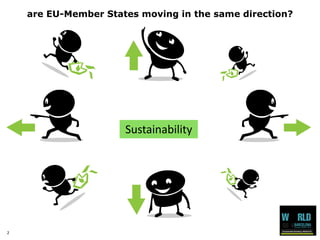
are EU-Member States moving in the same direction? 
Sustainability
3 
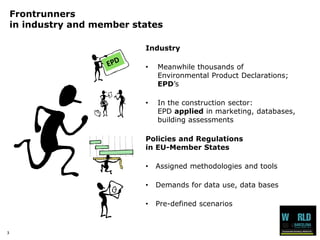
Frontrunners 
in industry and member states 
Industry 
• Meanwhile thousands of 
Environmental Product Declarations; 
EPD’s 
• In the construction sector: 
EPD applied in marketing, databases, 
building assessments 
Policies and Regulations 
in EU-Member States 
• Assigned methodologies and tools 
• Demands for data use, data bases 
• Pre-defined scenarios
4 
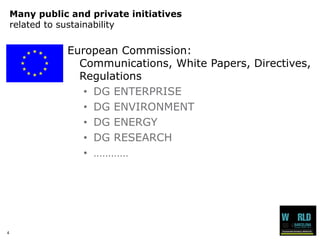
Many public and private initiativesrelated to sustainability 
European Commission: Communications, White Papers, Directives, Regulations 
•DG ENTERPRISE 
•DG ENVIRONMENT 
•DG ENERGY 
•DG RESEARCH 
•…………
5 
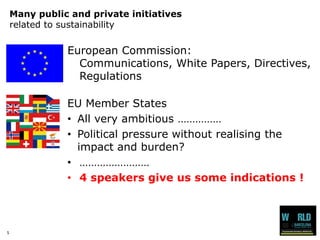
Many public and private initiativesrelated to sustainability 
European Commission: Communications, White Papers, Directives, Regulations 
EU Member States 
•All very ambitious …………… 
•Political pressure without realising the impact and burden? 
•…………………… 
•4 speakers give us some indications !
6 
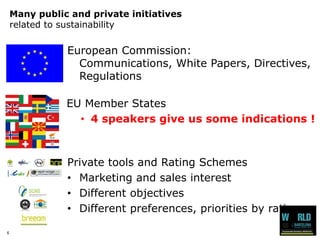
Many public and private initiativesrelated to sustainability 
European Commission: Communications, White Papers, Directives, Regulations 
EU Member States 
•4 speakers give us some indications ! 
Private tools and Rating Schemes 
•Marketing and sales interest 
•Different objectives 
•Different preferences, priorities by rating
7 
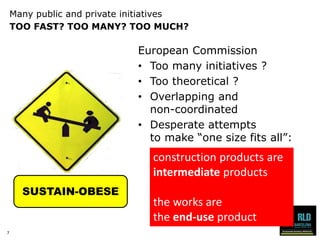
Many public and private initiatives 
European Commission 
•Too many initiatives ? 
•Too theoretical ? 
•Overlapping and non-coordinated 
•Desperate attempts to make “one size fits all”: 
construction products are intermediateproducts 
the works arethe end-useproduct 
SUSTAIN-OBESE 
TOO FAST? TOO MANY? TOO MUCH?
8 
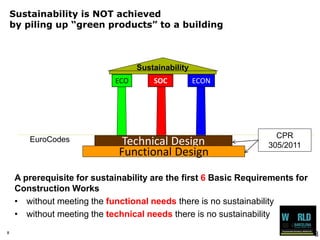
Sustainability is NOT achieved by piling up “green products” to a building 
EuroCodes 
8 
ECO 
SOC 
ECON 
Technical Design 
FunctionalDesign 
Sustainability 
A prerequisite for sustainability are the first 6Basic Requirements for Construction Works 
•without meeting the functional needs there is no sustainability 
•without meeting the technical needs there is no sustainability 
CPR305/2011
9 
Standards 
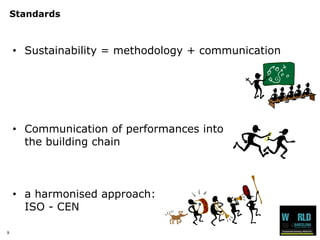
• Sustainability = methodology + communication 
• Communication of performances into 
the building chain 
• a harmonised approach: 
ISO - CEN
10 
SUSTAINABILITY: are we moving in the same direction? 
from the introductions of the speakers, ask to your self: 
•Are we moving in the same direction? 
•Should it necessarily be the same direction? 
•Will we movewhen receiving differentinstructions? 
•Do we need moreinstructions? 
•Do we need instructionsanyway? 
•Will we move when receiving too much instructions? 
•Are we creating barrierswhen moving in different directions? 
•Are we creating barrierswhen moving at different speed?
11 
Introductions to the discussionare we moving in the same direction? 
1.GonçaloAscensãoCEN-CENELEC , European Standards Institute 
“Policies and Rules of the European Commission and the role of CEN-Standards” 
2.ErlingTrudsoeDanishStandardisationDS“TheNordicregionas a standard maker” 
3.TanjaBrockmannGerman Federal MinistryfortheEnvironment, NatureConservation, Buildingand Nuclear Safety (BMUB) “Role of BuildingProductswithintheGerman AssessmentSystemforSustainableConstruction” 
4.Dieter de LathauwerBelgium; Federal Public Service Health; DG5; Environment and Product Policy. Brussels. “Policies and Plans for implementing sustainability in the Belgian build environment”
12 
CONCLUSIONS of presenters and audience 
Question: We are moving (towards more sustainability). But are EU-Member States moving in the same direction? 
Session 111 concluded with an answer to the question above: NO, WE ARE NOT MOVING IN THE SAME DIRECTION! 
•The intentions are there but there is no real common effort. We should prioritiseand focus on core information (not too scientific) and make it user friendly to apply. Simplification but no limitation. 
•There are barriers with the regulators that require a common roadmap and need additional resource capacity. There is a willingness to harmoniseregulations but guidance, manpower and some financial resources should be made available for this task. 
•Common principles are widely accepted in all member states and by all member states (LCA based approach and use of EN15804 and EN15978) but specific elements (eg. background data, databases) need to be lined up.

WSB14-Session 111-0 introduction by chris hamans

  • 1.
    1 Organizedby: Promotedby: Withtheparticipationof: Weare movingforward! Butare theEU-MemberStatesmovingin thesamedirection? EuropeanSustainabilityConsulting, theNetherlands Chris Hamans Introduction
  • 2.
    2 are EU-MemberStates moving in the same direction? Sustainability
  • 3.
    3 Frontrunners inindustry and member states Industry • Meanwhile thousands of Environmental Product Declarations; EPD’s • In the construction sector: EPD applied in marketing, databases, building assessments Policies and Regulations in EU-Member States • Assigned methodologies and tools • Demands for data use, data bases • Pre-defined scenarios
  • 4.
    4 Many publicand private initiativesrelated to sustainability European Commission: Communications, White Papers, Directives, Regulations •DG ENTERPRISE •DG ENVIRONMENT •DG ENERGY •DG RESEARCH •…………
  • 5.
    5 Many publicand private initiativesrelated to sustainability European Commission: Communications, White Papers, Directives, Regulations EU Member States •All very ambitious …………… •Political pressure without realising the impact and burden? •…………………… •4 speakers give us some indications !
  • 6.
    6 Many publicand private initiativesrelated to sustainability European Commission: Communications, White Papers, Directives, Regulations EU Member States •4 speakers give us some indications ! Private tools and Rating Schemes •Marketing and sales interest •Different objectives •Different preferences, priorities by rating
  • 7.
    7 Many publicand private initiatives European Commission •Too many initiatives ? •Too theoretical ? •Overlapping and non-coordinated •Desperate attempts to make “one size fits all”: construction products are intermediateproducts the works arethe end-useproduct SUSTAIN-OBESE TOO FAST? TOO MANY? TOO MUCH?
  • 8.
    8 Sustainability isNOT achieved by piling up “green products” to a building EuroCodes 8 ECO SOC ECON Technical Design FunctionalDesign Sustainability A prerequisite for sustainability are the first 6Basic Requirements for Construction Works •without meeting the functional needs there is no sustainability •without meeting the technical needs there is no sustainability CPR305/2011
  • 9.
    9 Standards •Sustainability = methodology + communication • Communication of performances into the building chain • a harmonised approach: ISO - CEN
  • 10.
    10 SUSTAINABILITY: arewe moving in the same direction? from the introductions of the speakers, ask to your self: •Are we moving in the same direction? •Should it necessarily be the same direction? •Will we movewhen receiving differentinstructions? •Do we need moreinstructions? •Do we need instructionsanyway? •Will we move when receiving too much instructions? •Are we creating barrierswhen moving in different directions? •Are we creating barrierswhen moving at different speed?
  • 11.
    11 Introductions tothe discussionare we moving in the same direction? 1.GonçaloAscensãoCEN-CENELEC , European Standards Institute “Policies and Rules of the European Commission and the role of CEN-Standards” 2.ErlingTrudsoeDanishStandardisationDS“TheNordicregionas a standard maker” 3.TanjaBrockmannGerman Federal MinistryfortheEnvironment, NatureConservation, Buildingand Nuclear Safety (BMUB) “Role of BuildingProductswithintheGerman AssessmentSystemforSustainableConstruction” 4.Dieter de LathauwerBelgium; Federal Public Service Health; DG5; Environment and Product Policy. Brussels. “Policies and Plans for implementing sustainability in the Belgian build environment”
  • 12.
    12 CONCLUSIONS ofpresenters and audience Question: We are moving (towards more sustainability). But are EU-Member States moving in the same direction? Session 111 concluded with an answer to the question above: NO, WE ARE NOT MOVING IN THE SAME DIRECTION! •The intentions are there but there is no real common effort. We should prioritiseand focus on core information (not too scientific) and make it user friendly to apply. Simplification but no limitation. •There are barriers with the regulators that require a common roadmap and need additional resource capacity. There is a willingness to harmoniseregulations but guidance, manpower and some financial resources should be made available for this task. •Common principles are widely accepted in all member states and by all member states (LCA based approach and use of EN15804 and EN15978) but specific elements (eg. background data, databases) need to be lined up.