1
Normative Need

   Needs Analysis

Instructional Problem

 Instructional Goal

Instructional Context

  Lesson Sequence

   Learning Tools

Formative Evaluation
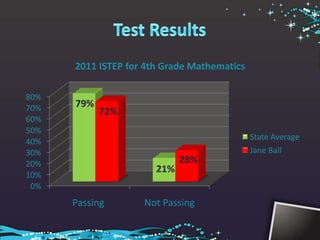
2011 ISTEP for 4th Grade Mathematics

80%
70%   79%
            72%
60%
50%
                                             State Average
40%
30%                                          Jane Ball
20%                          28%
                       21%
10%
 0%
      Passing       Not Passing
Low
Performance
on Statewide
   Testing
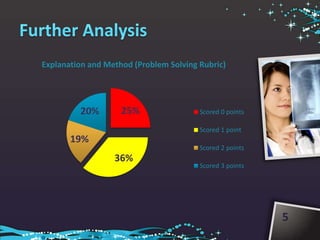
Explanation and Method (Problem Solving Rubric)


         20%        25%                 Scored 0 points

                                        Scored 1 point
       19%
                                        Scored 2 points
                  36%
                                        Scored 3 points


                                                          5
Students are
not explaining
  the steps to
 solve a math
problem briefly
but effectively.
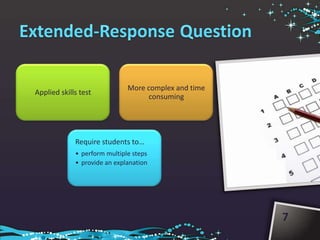
More complex and time
Applied skills test
                                    consuming


             Require students to…
             • perform multiple steps
             • provide an explanation


                                                      7
8
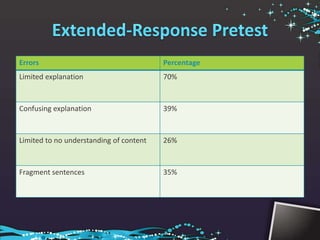
Errors                                   Percentage
Limited explanation                      70%


Confusing explanation                    39%


Limited to no understanding of content   26%


Fragment sentences                       35%
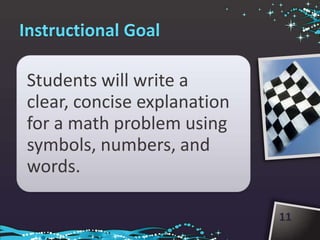
Students will write a
clear, concise explanation
for a math problem using
symbols, numbers, and
words.

                             11
SMART Board
 ELMO
document
camera
 Internet
access
 Computer lab


                12
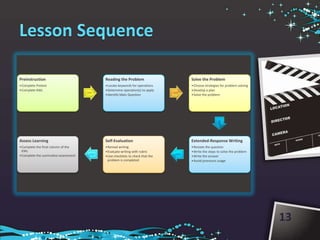
Preinstruction                       Reading the Problem                 Solve the Problem
•Complete Pretest                    •Locate keywords for operations     •Choose strategies for problem solving
•Complete KWL                        •Determine operation(s) to apply    •Develop a plan
                                     •Identify Main Question             •Solve the problem


Assess Learning                      Self-Evaluation                     Extended-Response Writing
•Complete the final column of the    •Reread writing                     •Restate the question
 KWL                                 •Evaluate writing with rubric       •Write the steps to solve the problem
•Complete the summative assessment   •Use checklists to check that the   •Write the answer
                                      problem is completed               •Avoid pronouns usage


                                                                                                                  13
14
SME trail
  Given with guiding
  questions
  Conversation
One-to-one trail
  Conversation
Next step?


                       15
•   ISSUU publication
•   Blog
    • http://hoosier-teacher.blogspot.com/2011/12/writing-in-
       math-on-state-test.html


                                                                16

Writinginmath

  • 1.
  • 2.
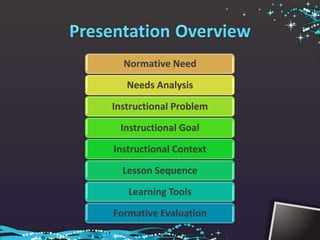
    Normative Need Needs Analysis Instructional Problem Instructional Goal Instructional Context Lesson Sequence Learning Tools Formative Evaluation
  • 3.
    2011 ISTEP for4th Grade Mathematics 80% 70% 79% 72% 60% 50% State Average 40% 30% Jane Ball 20% 28% 21% 10% 0% Passing Not Passing
  • 4.
  • 5.
    Explanation and Method(Problem Solving Rubric) 20% 25% Scored 0 points Scored 1 point 19% Scored 2 points 36% Scored 3 points 5
  • 6.
    Students are not explaining the steps to solve a math problem briefly but effectively.
  • 7.
    More complex andtime Applied skills test consuming Require students to… • perform multiple steps • provide an explanation 7
  • 8.
  • 9.
    Errors Percentage Limited explanation 70% Confusing explanation 39% Limited to no understanding of content 26% Fragment sentences 35%
  • 11.
    Students will writea clear, concise explanation for a math problem using symbols, numbers, and words. 11
  • 12.
    SMART Board ELMO document camera Internet access Computer lab 12
  • 13.
    Preinstruction Reading the Problem Solve the Problem •Complete Pretest •Locate keywords for operations •Choose strategies for problem solving •Complete KWL •Determine operation(s) to apply •Develop a plan •Identify Main Question •Solve the problem Assess Learning Self-Evaluation Extended-Response Writing •Complete the final column of the •Reread writing •Restate the question KWL •Evaluate writing with rubric •Write the steps to solve the problem •Complete the summative assessment •Use checklists to check that the •Write the answer problem is completed •Avoid pronouns usage 13
  • 14.
  • 15.
    SME trail Given with guiding questions Conversation One-to-one trail Conversation Next step? 15
  • 16.
    ISSUU publication • Blog • http://hoosier-teacher.blogspot.com/2011/12/writing-in- math-on-state-test.html 16

Editor's Notes

  • #4 As you can see, we are below average by 7 percentage points. A few years back, we were scoring higher on the ISTEP both in 4th and 5th grade. But since the test moved to the spring semester, scores have dropped. Scores are slightly improving every year.
  • #5 Since 2009, Jane Ball’s state test scores have displayed an achievement gap—specifically within math. Each year, less than 5% of students are recommended for retention, which would have resulted from failing grades in Mathematics or English/Language Arts. Nevertheless, for the last two years, close to 30% of fourth grade students have not passed the Mathematics ISTEP.
  • #6 After further examination, it was discovered that students scored poorly on the extended-response section of the ISTEP. Around 61% of Jane Ball’s fourth grade students received failing scores on the extended-response questions for math testing.
  • #8 The ISTEP is broken into a multiple choice section usually given sometime in March. Then, an applied skills section is given in Late April. The applied skills section has less questions but it is much more involved and open-ended. For instance the applied skills section of the Math ISTEP is usually around 4 questions but each question is worth several points. When an explanation or some type of writing is requested, the question is usually worth 6 points.
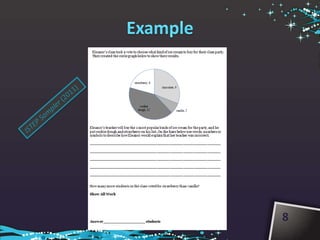
  • #9 To gain a better understanding of my current students, I gave the students a pretest using 3 ISTEP Sampler 2011 questions. Here is an example of one of the questions they received.
  • #10 This is a list of the most frequently occurring errors. 70% of students, given the pretest, provided limited writing to the extended-response math problems. Some responses were confusing or unrelated to the problem. There were also issues involving sentence fragments.
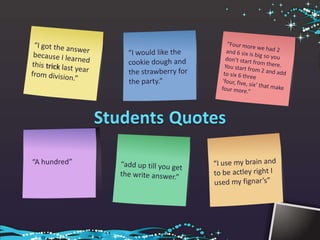
  • #11 Here is a list of inspirational quotes. They inspired me to develop my overarching instructional goal.
  • #12 After the needs analysis was carried out, it became clear to me that an instructional unit aimed at developing writing skills for state testing was needed.
  • #13 Within the classroom, there are several pieces of educational tech.
  • #14 First, students are given a pretest. The instructor should assess his/her students’ instructional needs. Once the need is confirmed, the instructor can engage the students in a KWL chart. (Here the pretest serves two functions: 1st to assess the need 2nd to reactivate prior knowledge about the ISTEP) Next, problem solving strategies are given attention. But, the main focus for the instructional unit is with the Extended-Response lesson. Lastly, I wanted to provide students with the ability toself-evaluate their writing. “So, we’re like grading our own work.”
  • #15 The following learning tools would be used throughout the instructional unit. The web tools provide the instructor with a engaging edge over conventional instruction. These tools are more visually engaging and change focus to grab students’ attention. The Prezi presentation would be used for a majority of the instruction and the Extranormal video provides the instructor with a focus on the writing procedures.
  • #16 Not much was returned from the questions. However, conversation proved to be beneficial. She pointed out formatting errors and spelling and grammar mistakes. But, the most helpful comments pertained to making the materials more accessible for the facilitators. The Instructional Goal/Strategy table and a mislabeled rubric confused the SME the most. The one-to-one trails helped make the student guide more understandable to a 9-11 year old. Sheets were given brief directions and some problems were modified for clarity. My next steps will be to implement this instructional unit with a class of 26 students. From there, I can really get an idea for how effective the program is.