Exploring How Complex Instruction Affects 
    Mathematical Problem Solving Persistence

         Presentation by Marilyn Gilman
                March 13, 2010
                         
Why is Persistence in 
    Mathematical Problem Solving  
            Important?

    
        Real World 
        Problems
    
        Achievement Tests
    
        Creative 
        Persistence
                             
Research on Problem Solving 
    
        Schooling Effects (Schoenfeld, TIMMS) 
    
         Metacognitive Factors (Francisco & Maher)
            −   Self­regulation
            −   Ownership of strategies
            −   Collaboration may improve metacognition
    
        Affective Factors (Goldin & DeBellis, Jansen) 
            −   Feelings and attitudes
            −   Peer pressure
                                   
Complex Instruction

    
        Challenging Tasks 
    
        Peer Collaboration
    
        Status & Accountability


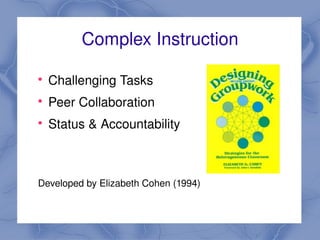
    Developed by Elizabeth Cohen (1994) 

                               
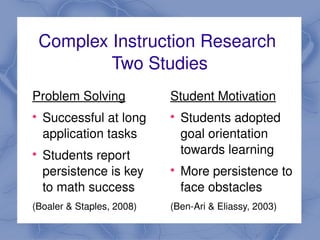
Complex Instruction Research 
                Two Studies
    Problem Solving                Student Motivation
    
        Successful at long         
                                       Students adopted 
        application tasks              goal orientation 
    
        Students report                towards learning
        persistence is key         
                                       More persistence to 
        to math success                face obstacles
    (Boaler & Staples, 2008)       (Ben­Ari & Eliassy, 2003)
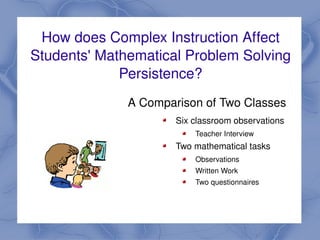
How does Complex Instruction Affect 
    Students' Mathematical Problem Solving 
                 Persistence?
                  A Comparison of Two Classes
                           Six classroom observations
                               Teacher Interview
                           Two mathematical tasks
                               Observations
                               Written Work
                               Two questionnaires


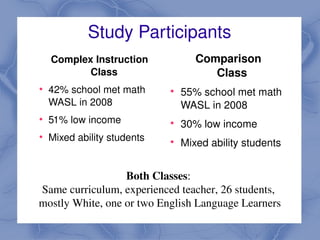
Study Participants
        Complex Instruction               Comparison     
               Class                         Class
    
        42% school met math      
                                     55% school met math 
        WASL in 2008                 WASL in 2008
    
        51% low income           
                                     30% low income
    
        Mixed ability students   
                                     Mixed ability students


                      Both Classes: 
    Same curriculum, experienced teacher, 26 students, 
 
    mostly White, one or two English Language Learners
                              
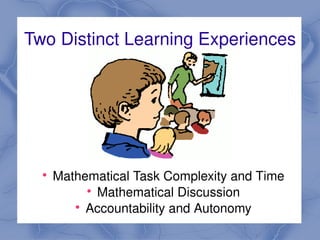
Two Distinct Learning Experiences


      
          Mathematical Task Complexity and Time
               
                 Mathematical Discussion
             
               Accountability and Autonomy
                             
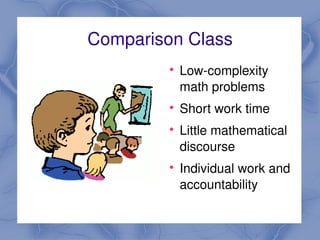
Comparison Class
               
                   Low­complexity  
                   math problems
               
                   Short work time 
               
                   Little mathematical 
                   discourse
               
                   Individual work and 
                   accountability
            
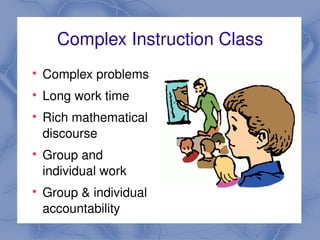
Complex Instruction Class
    
        Complex problems 
    
        Long work time
    
        Rich mathematical 
        discourse
    
        Group and 
        individual work
    
        Group & individual 
        accountability         
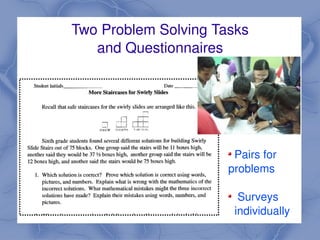
Two Problem Solving Tasks
       and Questionnaires


                           Pairs for 
                          problems

                             Surveys
                 
                            individually
What differences were found in students' 
    problem solving persistence between the 
                 two classes? 
       Time necessary for a difficult problem


       Performance while working on tasks
     
       Mathematical strategies used
                             
A Diagram Only Solution


Multiple Strategies


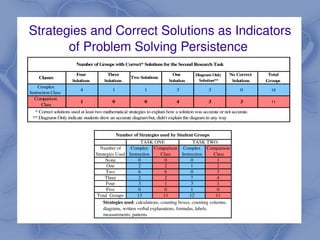
Strategies and Correct Solutions as Indicators 
           of Problem Solving Persistence 
                             Number of Groups with Correct* Solutions for the Second Research Task

                            Four             Three                                One         Diagram Only       No Correct     Total
         Classes                                           Two Solutions
                          Solutions         Solutions                           Solution        Solution**        Solutions    Groups
         Complex 
                               4                 1                1                 3                 3                0         12
    Instruction Class
      Comparison 
                               1                 0                0                 4                 3                3         11
        Class
       * Correct solutions used at least two mathematical strategies to explain how a solution was accurate or not accurate.
     ** Diagrams Only indicate students drew an accurate diagram but, didn't explain the diagram in any way


                                                   Number of Strategies used by Student Groups 
                                                               TASK ONE                    TASK TWO
                                         Number of       Complex   Comparison   Complex  Comparison
                                       Strategies Used Instruction        Class      Instruction      Class
                                            None              0             0             0             1
                                             One              2             2             1             2
                                             Two              6             6             0             3
                                            Three             2             2             7             4
                                             Four             3             1             3             1
                                             Five             0             0             1             0
                                        Total  Groups        13            11            12            11
                                           Strategies used: calculations, counting boxes, counting columns, 
                                                                          
                                           diagrams, written verbal explanations, formulas, labels, 
                                           measurements, patterns
Complex Instruction:
          A Promising Practice


    Confirms Boaler & Staples (2008) findings
 
    Alternative explanations & limits of the study
                           
Questions?


    For a copy of the study contact me at:

         marilyngilman1@gmail.com


Mathematical Problem Solving and Persistence

  • 1.
    Exploring How Complex Instruction Affects  Mathematical Problem Solving Persistence Presentation by Marilyn Gilman   March 13, 2010  
  • 2.
    Why is Persistence in  Mathematical Problem Solving   Important?  Real World  Problems  Achievement Tests  Creative  Persistence    
  • 3.
    Research on Problem Solving   Schooling Effects (Schoenfeld, TIMMS)    Metacognitive Factors (Francisco & Maher) − Self­regulation − Ownership of strategies − Collaboration may improve metacognition  Affective Factors (Goldin & DeBellis, Jansen)  − Feelings and attitudes − Peer pressure    
  • 4.
    Complex Instruction  Challenging Tasks   Peer Collaboration  Status & Accountability Developed by Elizabeth Cohen (1994)     
  • 5.
    Complex Instruction Research  Two Studies Problem Solving Student Motivation  Successful at long   Students adopted  application tasks goal orientation   Students report  towards learning persistence is key   More persistence to  to math success face obstacles   (Boaler & Staples, 2008)   (Ben­Ari & Eliassy, 2003)
  • 6.
    How does Complex Instruction Affect  Students' Mathematical Problem Solving  Persistence? A Comparison of Two Classes Six classroom observations Teacher Interview Two mathematical tasks Observations Written Work Two questionnaires    
  • 7.
    Study Participants Complex Instruction       Comparison      Class Class  42% school met math   55% school met math  WASL in 2008 WASL in 2008  51% low income  30% low income  Mixed ability students  Mixed ability students Both Classes:  Same curriculum, experienced teacher, 26 students,    mostly White, one or two English Language Learners  
  • 8.
    Two Distinct Learning Experiences  Mathematical Task Complexity and Time  Mathematical Discussion    Accountability and Autonomy  
  • 9.
    Comparison Class  Low­complexity   math problems  Short work time   Little mathematical  discourse  Individual work and  accountability    
  • 10.
    Complex Instruction Class  Complex problems   Long work time  Rich mathematical  discourse  Group and  individual work  Group & individual    accountability  
  • 11.
    Two Problem Solving Tasks and Questionnaires  Pairs for  problems   Surveys       individually
  • 12.
    What differences were found in students'  problem solving persistence between the  two classes?   Time necessary for a difficult problem  Performance while working on tasks    Mathematical strategies used    
  • 13.
  • 14.
  • 15.
    Strategies and Correct Solutions as Indicators  of Problem Solving Persistence   Number of Groups with Correct* Solutions for the Second Research Task Four  Three  One  Diagram Only  No Correct Total Classes Two Solutions Solutions Solutions Solution Solution** Solutions Groups Complex  4 1 1 3 3 0 12 Instruction Class Comparison  1 0 0 4 3 3 11 Class   * Correct solutions used at least two mathematical strategies to explain how a solution was accurate or not accurate. ** Diagrams Only indicate students drew an accurate diagram but, didn't explain the diagram in any way  Number of Strategies used by Student Groups  TASK ONE TASK TWO Number of  Complex   Comparison   Complex  Comparison Strategies Used Instruction Class Instruction  Class None 0 0 0 1 One 2 2 1 2 Two 6 6 0 3 Three 2 2 7 4 Four 3 1 3 1 Five 0 0 1 0 Total  Groups 13 11 12 11 Strategies used: calculations, counting boxes, counting columns,      diagrams, written verbal explanations, formulas, labels,  measurements, patterns
  • 16.
    Complex Instruction: A Promising Practice Confirms Boaler & Staples (2008) findings   Alternative explanations & limits of the study  
  • 17.
    Questions? For a copy of the study contact me at: marilyngilman1@gmail.com