Accelerated Math Why should we do it? How does it work?
Concepts and computation Kids need both to be successful Computation skills are needed in the real world. They are needed for high stakes tests Are elementary schools selling computation short? Everyday Math emphasizes both, but teachers may drop computation practice because it is called a game.
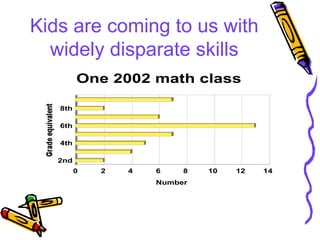
Kids are coming to us with widely disparate skills
We need: A way to handle disparate skill levels in a whole class setting A way to ensure that all students experience success Research shows that students who have experienced success are more confident, and that results in greater achievement.
Accelerated Math allows for heterogeneous groups Because students are working at their own level and at their own pace, it doesn’t matter that they are at very different places Goal setting can be individual or for a whole class i.e., differentiate expectations, or require  everyone to master 25 objectives.
Kids do gain confidence and perform better Kids caught in a cycle of failure may break out when they experience their first success in many years.
Will this help our test scores? Almost certainly! Kids quit on problems, even if they know the concept, if they are sure of computational failure Our math department is doing a great job with concepts; but the curriculum leaves little time for fixing holes in computation skills.
NCLB Remember, the federal government says that we are all “failures” if  any  sub-group does not make adequate yearly progress (AYP) in  any  subject area.
AM succeeds by placing kids at their skill level We use a computer based test, StarMath, to determine grade equivalents Students start work at the level where StarMath places them.
NOT more work for you! Ken Johnson has arranged to bring rolling labs in to give StarMath test to all seventh graders Your Accelerated Math classes will be set up in the system, with students assigned the objectives determined by StarMath.
AM guarantees success by practicing before testing Students work through practices, which do not count They don’t get tests, which do count, until they have demonstrated mastery of the objective They should always do well on tests.
How it works Students put answers on scan cards.  They scan the card, and the program prints out a report and a new practice They show the report to you.  They then work on the next practice, work with you on a concept, or take a test -- your choice.
The report tells you which problems were missed, and what objective each problem is in; and how many objectives the student has mastered With mistakes, you can assign more work, refer them to resources, or work with the student individually When they have mastered 5 objectives, you should print a test.  Answers go on a different scan card.
Resources are available to teachers Ken and I are available to help with technical issues I can come to help you with program problems.  I can help you run class-wide reports that you can use for grading. You will have reference books, and all equipment necessary.

Accelerated Math

  • 1.
    Accelerated Math Whyshould we do it? How does it work?
  • 2.
    Concepts and computationKids need both to be successful Computation skills are needed in the real world. They are needed for high stakes tests Are elementary schools selling computation short? Everyday Math emphasizes both, but teachers may drop computation practice because it is called a game.
  • 3.
    Kids are comingto us with widely disparate skills
  • 4.
    We need: Away to handle disparate skill levels in a whole class setting A way to ensure that all students experience success Research shows that students who have experienced success are more confident, and that results in greater achievement.
  • 5.
    Accelerated Math allowsfor heterogeneous groups Because students are working at their own level and at their own pace, it doesn’t matter that they are at very different places Goal setting can be individual or for a whole class i.e., differentiate expectations, or require everyone to master 25 objectives.
  • 6.
    Kids do gainconfidence and perform better Kids caught in a cycle of failure may break out when they experience their first success in many years.
  • 7.
    Will this helpour test scores? Almost certainly! Kids quit on problems, even if they know the concept, if they are sure of computational failure Our math department is doing a great job with concepts; but the curriculum leaves little time for fixing holes in computation skills.
  • 8.
    NCLB Remember, thefederal government says that we are all “failures” if any sub-group does not make adequate yearly progress (AYP) in any subject area.
  • 9.
    AM succeeds byplacing kids at their skill level We use a computer based test, StarMath, to determine grade equivalents Students start work at the level where StarMath places them.
  • 10.
    NOT more workfor you! Ken Johnson has arranged to bring rolling labs in to give StarMath test to all seventh graders Your Accelerated Math classes will be set up in the system, with students assigned the objectives determined by StarMath.
  • 11.
    AM guarantees successby practicing before testing Students work through practices, which do not count They don’t get tests, which do count, until they have demonstrated mastery of the objective They should always do well on tests.
  • 12.
    How it worksStudents put answers on scan cards. They scan the card, and the program prints out a report and a new practice They show the report to you. They then work on the next practice, work with you on a concept, or take a test -- your choice.
  • 13.
    The report tellsyou which problems were missed, and what objective each problem is in; and how many objectives the student has mastered With mistakes, you can assign more work, refer them to resources, or work with the student individually When they have mastered 5 objectives, you should print a test. Answers go on a different scan card.
  • 14.
    Resources are availableto teachers Ken and I are available to help with technical issues I can come to help you with program problems. I can help you run class-wide reports that you can use for grading. You will have reference books, and all equipment necessary.

Editor's Notes

  • #2 Other schools in ASD have shown gains with this computer based program Have made a significant $ commitment to it here.
  • #3 I’m a fan of EM, but understand many are not. Difference may be in how it is taught.
  • #7 Talk about Heather refusal & 25% to passing
  • #8 Core teachers cannot make time to fill each child’s knowledge holes. AM allows up to do that without taking time away from the necessary core instruction.
  • #10 Give the test with the rolling labs. Takes less than one class period.
  • #11 Almost all you will have to do to get started is hand out materials. Waiting to see what we do with 8th graders. You may offer as a team elective if you want.
  • #13 You should initial reports for tracking purposes. Even if you are too busy to look at it, they will have something to do -- the next practice.
  • #14 1st step with problems ought to be to look in the resource books. Cover test procedures.
  • #15 My schedule will be … Show box