TOPIC 1 LANGUAGE & COMMUNICATION NI 1 B2
	
Streamline English Directions (O.U.P.) Nina Dearle
	
1.1. QUESTIONNAIRE
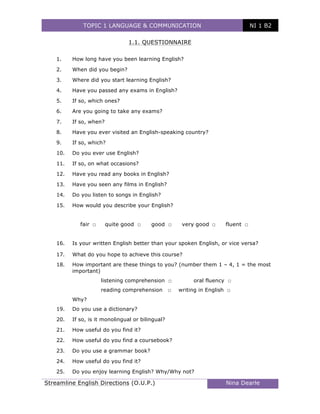
1. How long have you been learning English?
2. When did you begin?
3. Where did you start learning English?
4. Have you passed any exams in English?
5. If so, which ones?
6. Are you going to take any exams?
7. If so, when?
8. Have you ever visited an English-speaking country?
9. If so, which?
10. Do you ever use English?
11. If so, on what occasions?
12. Have you read any books in English?
13. Have you seen any films in English?
14. Do you listen to songs in English?
15. How would you describe your English?
fair □ quite good □ good □ very good □ fluent □
16. Is your written English better than your spoken English, or vice versa?
17. What do you hope to achieve this course?
18. How important are these things to you? (number them 1 – 4, 1 = the most
important)
listening comprehension □ oral fluency □
reading comprehension □ writing in English □
Why?
19. Do you use a dictionary?
20. If so, is it monolingual or bilingual?
21. How useful do you find it?
22. How useful do you find a coursebook?
23. Do you use a grammar book?
24. How useful do you find it?
25. Do you enjoy learning English? Why/Why not?
TOPIC 1 LANGUAGE & COMMUNICATION NI 1 B2
	
Streamline English Directions (O.U.P.) Nina Dearle
	
1.2. LEARNING A LANGUAGE
This passage is from Weep Not, Child by
N’gugi (Heinemann African Writers,
1964).
Read it quickly. Discuss the problems the
children have with their English classes.
Lucia, Mwihaki's sister, taught them.
They all sat expectantly at their desk with
eyes on the board. A knowledge of
English was the criterion of a man's
learning.
Teacher I am standing up. What am I
doing?
Class You are standing up.
Teacher Again.
Class You are standing up.
Teacher (pointing with a finger) You - no
- you - yes. What's your name?
Pupil Njoroge.
Teacher Njoroge, stand up.
He stood up. Learning English was all
right but not when he stood up for all
eyes to watch and maybe make faces at
him.
Teacher What are you doing?
Njoroge (thinly) You are standing up.
Teacher (slightly cross) What are you
doing?
Njoroge (clears his throat, voice thinner
still) You are standing up.
Teacher No, no! (to the class) Come on.
What are you, you doing?
Njoroge was very confused. Hands
were raised up all around him. He felt
more and more foolish so that in the end
he gave up the very attempt to answer.
Teacher (pointing to Mwihaki) Stand up.
What are you doing?
Mwihaki (head bent on to one shoulder)
I am standing up.
Teacher Good. Now, Njoroge. What is
she doing?
Njoroge I am standing up.
The class giggled.
Teacher (very annoyed) Class, what is
she doing?
Class (singing) You are standing up.
Teacher (still more angry) I am asking
you .... What is she doing?
Class (afraid, quietly singing) You are
standing up.
Teacher Look here you stupid and lazy
fools. How long do you take to catch
things? Didn't we go over all this
yesterday? If I come tomorrow and find
that you make a single mistake I'll punish
you all severely.
With this sharply-delivered threat, she
walked out. Njoroge, annoyed with
himself at his poor showing, could now be
heard trying to re-establish himself by
telling them what they ought to have
answered. 'She is standing up.' But one
boy (the most stupid in the class)
rebuked him. 'Why didn't you speak up
when she was here, if you're so clever?'
After some more weeks of anger and
threats the children managed to glean
something of which they were very proud.
Njoroge could now sing.
I am standing up.
You are standing up.
She is standing up.
We are standing up.
You are standing up.
They are standing up.
Where are you going?
I am going to the door.
We are going to the door.
Point to the blackboard. What are you
doing?
I am pointing to the blackboard.
TOPIC 1 LANGUAGE & COMMUNICATION NI 1 B2
	
English Any Time (Lingual House) Nina Dearle
	
1.3. LEARNING LANGUAGES
No-one knows exactly how people learn language although a great deal of
research has been done into the subject. Certain theories have, however, had a
profound effect upon the practice of language teaching (and continue to do so) and it
seems sensible, therefore, to consider them.
* * *
Recently a distinction has been drawn between acquiring a language and learning
a language, most notably by the American writer Krashen. He characterises the former
as a subconscious process which results in the knowledge of a language whereas the
latter, learning, is a conscious process which results only in “knowing about” the
language. Acquiring a language is more successful and longer lasting than learning.
What is being suggested is that second (or foreign) language learning needs to
be more like the child’s acquisition of his native language. Although there may be
some limits on the language a child hears (see below), he is never consciously “taught
it “, nor does he consciously set out to learn it. Instead he hears and experiences a
considerable amount of the language in situations where he is involved in
communicating with an adult – usually a parent. His gradual ability to use the language
is the result of many subconscious processes, based on the experiences in which he
began to acquire – without setting out to do so – the ability to enter linguistically into
the communication. Traditional foreign language teaching, on the other hand,
concentrated on getting the adult student consciously to learn items of language in
isolation, often unconnected with any real communication situation. The focus was not
on communicating, but on a piece of language which might later be used to
communicate.
Many writers see this traditional approach to language learning as being
mistaken since there is no guarantee that an item so learnt will be successfully used in
communication or remembered for any length of time. Language has to be acquired as
the result of some deeper experience than the concentration on a grammar point, just
as it is when children learn their first language.
The Practice of English Language Teaching
Read the text and fill in the table below with a tick (✔) in the relevant column.
The first one has been done for you.
“Acquisition” “Learning”
a process of which the learner is unaware
a process involving analysis of the language
the language is more easily forgotten
more like the way a child learns to speak
the traditional way of teaching a language
an emphasis on form rather than on content
allows for language to be “experienced” as in real life
✔
TOPIC 1 LANGUAGE & COMMUNICATION NI 1 B2
	
English Any Time (Lingual House) Nina Dearle
	
1.4 APTITUDE TEST
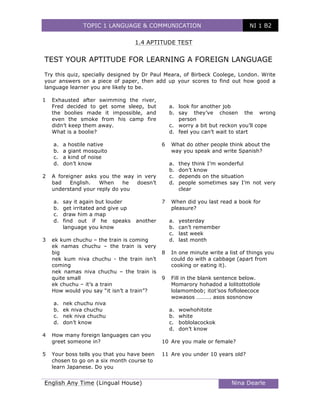
TEST YOUR APTITUDE FOR LEARNING A FOREIGN LANGUAGE
Try this quiz, specially designed by Dr Paul Meara, of Birbeck Coolege, London. Write
your answers on a piece of paper, then add up your scores to find out how good a
language learner you are likely to be.
1 Exhausted after swimming the river,
Fred decided to get some sleep, but
the boolies made it impossible, and
even the smoke from his camp fire
didn’t keep them away.
What is a boolie?
a. a hostile native
b. a giant mosquito
c. a kind of noise
d. don’t know
2 A foreigner asks you the way in very
bad English. When he doesn’t
understand your reply do you
a. say it again but louder
b. get irritated and give up
c. draw him a map
d. find out if he speaks another
language you know
3 ek kum chuchu – the train is coming
ek namas chuchu – the train is very
big
nek kum niva chuchu - the train isn’t
coming
nek namas niva chuchu – the train is
quite small
ek chuchu – it’s a train
How would you say “it isn’t a train”?
a. nek chuchu niva
b. ek niva chuchu
c. nek niva chuchu
d. don’t know
4 How many foreign languages can you
greet someone in?
5 Your boss tells you that you have been
chosen to go on a six month course to
learn Japanese. Do you
a. look for another job
b. say they’ve chosen the wrong
person
c. worry a bit but reckon you’ll cope
d. feel you can’t wait to start
6 What do other people think about the
way you speak and write Spanish?
a. they think I’m wonderful
b. don’t know
c. depends on the situation
d. people sometimes say I’m not very
clear
7 When did you last read a book for
pleasure?
a. yesterday
b. can’t remember
c. last week
d. last month
8 In one minute write a list of things you
could do with a cabbage (apart from
cooking or eating it).
9 Fill in the blank sentence below.
Momarory hohadod a lolitottotlole
lolamombob; itot’sos fofloleecoce
wowasos ………. asos sosnonow
a. wowhohitote
b. white
c. boblolacockok
d. don’t know
10 Are you male or female?
11 Are you under 10 years old?
TOPIC 1 LANGUAGE & COMMUNICATION NI 1 B2
	
English Any Time (Lingual House) Nina Dearle
	
1.4 APTITUDE TEST SCORES
1 a 5 b 10 c 0 d 0
Good language learners are able to make imaginative guesses about the meaning
of words.
2 a 0 b 0 c 10 d 8
Good language learners make the most of their skills, and manage to
communicate in all sorts of unlikely situations.
3 a 2 b 2 c 10 d 0
Good language learners are quick at seeing patterns in a foreign language.
(Negative sentences in this language begin with “nek”. The last word is always
“chuchu”.
4 Two points for each language (maximum 10 points).
This question shows how interested you are in languages and communication.
5 a 0 b 3 c 7 d 10
Being scared stiff is obviously a bad sign.
6 a 4 b 0 c 10 d 7
Good language learners think a lot about how they use language.
7 a 10 b 0 c 5 d 2
Good language learners seem to read a lot. (It’s a good way of increasing your
vocabulary.)
8 A point for each idea. (max. 10).
People who are very rigid in the way they see things tend not to be very good at
learning languages. This is possibly because they don’t like being in situations they
can’t control.
9 a 10 b 2 c 7 d 0
Question assesses how willing you are to take risks in a language you don’t know
well.
10 Females score 10.
On the whole, women are better at languages.
11 If yes, score 200.
Young children are fantastically good at languages, but we seem to get worse at it
after puberty.
TOPIC 1 LANGUAGE & COMMUNICATION NI 1 B2
	
Streamline English Destinations (O.U.P.) Nina Dearle
	
1.5 WORD BUILDING
	
5
10
15
20
25
30
35
40
45
50
	
What makes a good driver?
A good driver has many things in
his make-up. Some of these,
such as experience and skill, will
come only in time. But others –
just as important – must be part
of him from the start. These
qualities are a sense of
responsibility for the safety of
others, a determination to
concentrate on the job of driving,
patience and courtesy. Together,
these become what is generally
known as a driver’s “attitude”.
Not everyone is patient by nature
or gifted with good powers of
concentration. But because
attitude is so important a part of
safe driving, every driver must
make a real effort to develop
these qualities – and this effort
must start from the very
beginning of his first driving
lesson.
Getting into the right attitude will
be harder for some people than
others. It can be more difficult
than the actual business of
learning to make the car go or
stop. All the things which go to
make up attitude are just as
necessary for the experienced
driver as for the learner. So,
before we go any further, let us
look at these qualities in a little
more detail.
Responsibility
As a driver you must have a
proper concern not only for your
own safety and that of your
passengers, but also for the
safety of every other road user,
including pedestrians. You can do
this only if you pay close
attention to the varying traffic
situations as they develop. Then
you can plan your own actions
well in advance so that they do
not cause danger or
inconvenience to others. At times
you may be tempted to make a
rash move – don’t.
Concentration
With responsibility goes
concentration on the job of
driving. You must concentrate all
the time if you are going to be
able to deal with present-day
traffic. Nowadays this is usually
45
50
55
60
65
70
75
80
85
90
95
heavy and fast-moving and there
are possible dangers all around
you. If you let your mind wander,
even for a moment, the risk of
making a mistake is increased
enormously. And mistakes can
cause accidents. If you are tired,
upset or unwell, or even thinking
about something else, you will
take longer to react. It is better
not to drive at all in these
circumstances, but if you have
to, make special allowances for
them.
Anticipation
Concentration helps you to
“anticipate”. In motoring,
anticipation means acting
promptly to fit in with what other
road users are doing, as well as
being able and ready to alter
your own course or behaviour as
a situation develops.
To those who do not drive, this
quality of anticipation has the
appearance of being automatic –
and this is what it should
become. Experience and
anticipation together will enable
you to act to prevent possible
danger from becoming actual
danger.
Patience
It is very easy to get impatient,
or lose your temper, when other
drivers do something wrong, or
you are caught up in a traffic
jam. But if you do, you are well
on the way to having an
accident. Never drive in a spirit
of retaliation or competition. If
the incompetence or bad
manners of another road user
cause you inconvenience, don’t
let your annoyance, even if
justifiable, override your good
sense and judgement. Attempts
to “teach him a lesson” don’t do
any good: there is no better
lesson than a good example.
Confidence
The degree of confidence a driver
has in handling his vehicle is, in a
sense, part of his attitude to
driving. New drivers will, of
course, be unsure of themselves.
Confidence grows with
experience. But a good driver
	
100
105
110
115
120
125
130
135
140
145
150
155
never lets himself get over-
confident. This leads to
carelessness, risks, and
eventually accidents.
Planned tuition
All the things we have talked
about so far – becoming a safe
driver by developing a sense of
responsibility, concentration,
anticipation, patience and
confidence – will depend very
much on getting good instruction
from the start. Drivers often
begin to learn with a parent,
relative or friend and this allows
them to get lots of practice at
low cost. But although some non-
professional teachers can put
over the details of car control and
road procedure within a
reasonable time, many good
drivers are not good instructors.
They can ruin a pupil’s
confidence by leading him into
situations he is not ready for. In
other words, they often teach
him to run before he can walk.
And, of course, not all parents,
relatives and friends are good
drivers anyway.
A planned approach is essential
when teaching someone to drive.
Ideally, each lesson should be
phased to suit the pupil’s
development. There are no short
cuts to being a good driver,
either in time or money. There is
no doubt that the best way to
learn to drive properly is to have
good professional tuition – and
plenty of it. It will prove well
worthwhile in the long run. But
you need plenty of practice too.
Mechanical knowledge
So far we have said nothing
about mechanical knowledge –
how a car works. It is not
necessary to know all the
complicated details of car
construction to be a good driver.
But the more you do know the
better, because if you know how
the different parts of a car work,
and what happens when you use
the controls, you will develop a
sense of car sympathy. This will
not only make you a better
driver, but add to your interest in
driving. It will also prolong the
life of your car.
TOPIC 1 LANGUAGE & COMMUNICATION NI 1 B2
	
Nina Dearle
	
1.5 WORD BUILDING WORKSHEET
A Find the words in the first column in the text and complete the table below:
Underline the suffixes
in these words
line What effect does the suffix
have on the word?
Give two similar examples
e.g. carelessness 93 adjective > noun shyness laziness
concentration
enormously
harder
user
experienced
professional
B Two words with the suffix –ty appear in the text. Find them and complete the
following table.
Examples from text line Effect of suffix on the word Give two examples of your
own
C What effect does the prefix have on the following two words?
Examples from text line Effect of suffix on the word
incompetence
enable
D The first prefix in- is used to make a word negative. What prefix would you add to
each of these adjectives or nouns in order to make them negative?
patient
convenience
honesty
sure
professional
responsible
E Can you think of other words formed with the prefix –en?
1. _______________________________________
2. _______________________________________
3. _______________________________________
4. ________________________________
TOPIC 1 LANGUAGE & COMMUNICATION NI 1 B2
	
First Certificate Skills (OUP) Nina Dearle
	
1.6 EXAM TRAINING: READING
There was one thing I found rather strange on my first day at Monk's House. The
floors in the house were very thin. The bathroom was directly above the kitchen and
when Mrs. Woolf was having her bath before breakfast, I could hear her talking to
herself. On and on she went, talk, talk, talk, asking questions and giving herself the
answers. I thought there must be two or three people up there with her. When Mr.
Woolf saw that I looked surprised he told me that Mrs. Woolf always said the sentences
out loud that she had written during the night. She needed to know if they sounded
right, and the bath was a good place for trying them out.
I was not allowed to make coffee at Monk's House. Mr. and Mrs. Woolf were very
particular about coffee and always made it themselves, so Mr. Woolf came into the
kitchen at eight o'clock every morning to make it. When we carried the breakfast trays
to Mrs. Woolf's room I noticed she had always been working during the night. There
were pencils and paper beside her bed so that when she woke up she could work, and
sometimes it seemed as though she had had very little sleep.
Mrs. Woolf's bedroom was outside the house in the garden; I used to think how
inconvenient it must be to have to go out in the rain to go to bed. Her bedroom had
been added on to the back of the house; the door faced the garden and a window at
the side opened out on to a field. I remember that a cow came one night and put its
head in through the window. It amused Mrs. Woolf very much, but in case it happened
again Mr. Woolf bought the field and added part of it to the garden. Because the
writing-room was small, he had a larger one built for her at the end of the garden
against the church wall.
I can always remember her coming to the house each day from the writing room;
when I rang the bell for lunch at one o’clock she used to walk down through the
garden smoking one of her favourite cigarettes in a long holder. She was tall and thin
and very graceful. She had large, deep set eyes and a wide curving mouth – I think
perhaps it was this that made her face seem particularly beautiful. She wore long
skirts- usually blue or brown – in the fashion of the day, and silk jackets of the same
colour. I remember too, there was always a large silk handkerchief folded into the
jacket pocket.
Her cigarettes were made from a special tobacco called my mixture. Mr Woolf
bought it for her in London, and, in the evenings, they used to sit by the fire and make
these cigarettes themselves. It was a mild, sweet-smelling tobacco, and she would not
have any other cigarettes.
Mrs. Woolf wore clothes that suited her well. I pressed them for her and did any
sewing that was necessary — she was not able to sew, although sometimes she liked
to try. There was one thing in the kitchen that Mrs. Woolf was very good at doing; she
could make beautiful bread. I was surprised how complicated it was and how exactly
Mrs. Woolf carried it out. She returned three or four times in a morning to work at it.
Finally she made it into the shape of a cottage loaf and baked it at Just the right
temperature.
TOPIC 1 LANGUAGE & COMMUNICATION NI 1 B2
	
First Certificate Skills (OUP) Nina Dearle
	
1.6 EXAM TRAINING: READING EXERCISES
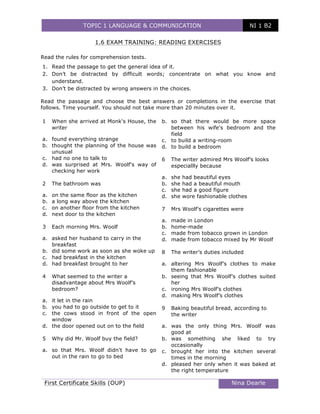
Read the rules for comprehension tests.
1. Read the passage to get the general idea of it.
2. Don’t be distracted by difficult words; concentrate on what you know and
understand.
3. Don’t be distracted by wrong answers in the choices.
Read the passage and choose the best answers or completions in the exercise that
follows. Time yourself. You should not take more than 20 minutes over it.
1 When she arrived at Monk's House, the
writer
a. found everything strange
b. thought the planning of the house was
unusual
c. had no one to talk to
d. was surprised at Mrs. Woolf's way of
checking her work
2 The bathroom was
a. on the same floor as the kitchen
b. a long way above the kitchen
c. on another floor from the kitchen
d. next door to the kitchen
3 Each morning Mrs. Woolf
a. asked her husband to carry in the
breakfast
b. did some work as soon as she woke up
c. had breakfast in the kitchen
d. had breakfast brought to her
4 What seemed to the writer a
disadvantage about Mrs Woolf’s
bedroom?
a. it let in the rain
b. you had to go outside to get to it
c. the cows stood in front of the open
window
d. the door opened out on to the field
5 Why did Mr. Woolf buy the field?
a. so that Mrs. Woolf didn't have to go
out in the rain to go to bed
b. so that there would be more space
between his wife's bedroom and the
field
c. to build a writing-room
d. to build a bedroom
6 The writer admired Mrs Woolf’s looks
especiallly because
a. she had beautiful eyes
b. she had a beautiful mouth
c. she had a good figure
d. she wore fashionable clothes
7 Mrs Woolf’s cigarettes were
a. made in London
b. home-made
c. made from tobacco grown in London
d. made from tobacco mixed by Mr Woolf
8 The writer’s duties included
a. altering Mrs Woolf’s clothes to make
them fashionable
b. seeing that Mrs Woolf’s clothes suited
her
c. ironing Mrs Woolf’s clothes
d. making Mrs Woolf’s clothes
9 Baking beautiful bread, according to
the writer
a. was the only thing Mrs. Woolf was
good at
b. was something she liked to try
occasionally
c. brought her into the kitchen several
times in the morning
d. pleased her only when it was baked at
the right temperature
TOPIC 1 LANGUAGE & COMMUNICATION NI 1 B2
	
www.britishcouncil.org/learnenglishteens Nina Dearle
	
1.7 EXAM TRAINING: LISTENING
A Listen to the teacher giving students advice for exams and circle the best answer to
the questions.
1 The teacher wants the students to
…
a take notes after she has finished
speaking.
b take notes while she is speaking.
c forget about taking notes.
2 The teacher suggests eating …
a sugary snacks.
b only apples.
c fruit and cereals.
3 The teacher suggests finding a
study place with a lot of …
a light.
b space.
c books.
4 If students feel stressed they
should …
a go to bed.
b go out for a walk.
c drink some water.
5 Students are advised to …
a select the important things to
learn.
b read through everything once.
c make notes about every topic.
6 The teacher understands that
repeating things can be …
a difficult.
b uninteresting.
c tiring.
7 Students can do past exam papers
…
a in the library only.
b at home if they tale photocopies.
c in the after-school study group.
8 The teacher recommends a break
of five minutes every …
a hour.
b two hours.
c thirty minutes.
9 It’s important to …
a eat regularly.
b sleep when you feel tired.
c keep hydrated.
10 The teacher is sure that the
students will …
a pass their exams.
b fail their exams.
c do their best.
B Discuss.
1 Does any of this advice surprise you?
2 Have you got any good advice to share about studying for exams?
TOPIC 1 LANGUAGE & COMMUNICATION NI 1 B2
	
First Certificate Skills (O.U.P) Nina Dearle
	
1.8 EXAM TRAINING: WRITING
The first thing to practise is reading exam questions. It’s easy when you read quickly
to misunderstand or forget something. In every exam, some people answer questions
in the wrong way, and so they lose a lot of marks. Here is a set of instructions and
questions for a writing exam. Read each one, write down the important words in it,
and then choose the statement that matches it best.
Write three only of the following writing
exercises. Your answers must follow
exactly the instructions given, and must
be between 120 and 150 words each.
1 The instructions are to write a
maximum of
a. 150 words on the whole paper
b. 400 words on the whole paper
c. 650 words on the whole paper
You have been asked to organise a tour
by motor coach through several countries,
lasting two weeks. Write a detailed list, to
be handed to members of the party, of
the proposed route, timing, requirements
for the journey and any other information
you think the travellers will require.
2 You must write
a. a programme for the tour
organiser
b. a letter to the tourists
c. a programme for the tourists
In some countries food supplies are
barely enough to feed growing
populations. How do you think this
problem could be solved?
3 You must write
a. a description of some poor
countries
b. suggestions for feeding the world’s
population
	
Your brother is undecided about taking a
new job. Write the conversation between
you and him in which you try to persuade
him to take the job. Write in dialogue
form, giving only the name of each
speaker followed by the words spoken.
4 You must write
a. a dialogue where your brother
gives you advice
b. a dialogue bout your brother’s
career
While you were on your way to an
important appointment something
happened which seriously delayed you.
Say what you did to get to the meeting,
and also to inform those concerned about
that you would be late.
5 You must write
a. The conversation you had when
you were late for a meeting
b. A story about being late for a
meeting
	
You have been aske to write a leaflet
which is enclosed with a new product
(camera, electric appliance, toy, prepared
food, etc.) explaining how it is to be used
and mentioning its special advantages.
Write the leaflet, naming the product and
the manufacturer, and giving any details
you wish.
6 You must write
a. a leaflet persuading people to buy
something
b. a leaflet describing how to use
something
TOPIC 1 LANGUAGE & COMMUNICATION NI 1 B2
	
Sur in English Nina Dearle
	
1.9 READING TEXTS
A. Taking the Test
A colleague at SUR in English has
recently been trying (on an almost weekly
basis, it seems) to passs the Spanish
driving test, so office chat has naturally
centred on the difficulties of driving in
Spain. Or at any rate, of getting a
Spanish licence to do so. For British
expats, driving on the “wrong” side of the
road doesn’t appear to pose many
problems, even if overtaking in a car
which also has its driving seat on the
“wrong” side is a more difficult feat. I
wonder if the sign, in English, at the exit
from one of the older residential
developments in Nerja still exists? The
one that said “Please remember to drive
on the right”? It used to amuse Spanish
drivers, but I haven’t seen any like it
recently – perhaps the number of British-
dominated areas makes it impossible to
produce enough signs.
Be that as it may, the main difference
in taking the driving test here appears to
lie in the theory section, which takes the
form of a multiple choice test asking (if
visctims of it are to be believed, which no
doubt they are) such vital road safety
questions as – well, the one in the sample
below*. Others test the driver’s
knowledge of more important aspects of
the highway code, but even then our
colleague complains of trick answers.
The other topic of conversation which
comes up just about every morning is the
one which starts “How long did it take you
to get to work?” When the Malaga
bypass/ringroad was first opened, it was
known as the “microondas” (microwave)
because what had previously taken an
hour now only took 15 minutes. Sadly
that is now history, and people who work
in Malaga regularly debate whether to risk
going through the centre (and getting
stuck behind a bus in the school traffic) or
opting for the alternative route – which is
saturated, and its worst during the
university student rush hour.
* As a general rule, what is a person’s
reaction time, as a general rule?
a Between one and two seconds.
b Between half a second and one second.
c Between half a second and two seconds.
d Source: todomotor.com (tautology included)
B. Studying in Spanish
By the beginning of October every
year, even the university students are
back in their classrooms after the long,
long summer holiday, and the complaints
about the long, long queues to enrol for
the most popular courses are dying away
– though this year, the complaints have
been prolonged in some of the “Official
Language Schools” because of the lack of
teachers. And as usual, some of the state
schools failed to open on time because
the necessary building or renovation work
still hadn’t been completed. Oh, and by
December, some of those who queued to
good effect for the most sought-after
courses will have dropped out, leaving the
classroom half empty and the other
aspirants frustrated.
Thousands of SUR in English readers
are even now signing up for courses in
Spanish, and will no doubt be telling each
other that it is all very well, but there is
very little chance to practise now that
everybody in southern Spain seems to
speak English. As they may well be saying
in the classroom next door, “Plus ça
change …”*
*exclamation used to express resigned
acknowledgement of the fundamental
immutability of human nature and institutions.
TOPIC 1 LANGUAGE & COMMUNICATION NI 1 B2
	
Focus on Advanced English (Collins) Nina Dearle
	
1.10 THE DAY OF THE EXAM
* If you say you wouldn’t touch something with a barge pole, it means you don’t want to have anything to
do with it.
TOPIC 1 LANGUAGE & COMMUNICATION NI 1 B2
	
Focus on Advanced English (Collins) Nina Dearle
	
A Multiple Matching. Read the text and choose the correct title (A – J list the
possible titles) for each section (1 – 7). Complete each space in the text by
choosing from the list A – J.
1 section 1 A How to annoy the examiner H Don’t panic
2 section 2 B After it’s over I Make a revision timetable
3 section 3 C Be prepared J Choosing which questions to answer
4 section 4 D Watch what you eat
5 section 5 E Coping with difficult questions
6 section 6 F How to study
7 section 7 G Look after yourself
B Multiple Choice. Read the text more carefully to answer questions 8 – 13
below. You must choose the answer which you thinks fits best. Choose one
answer only to each question.
8 The writer urges us to remember that exams
A are the key to success in life
B are not a good test of ability
C are not the most important thing in life
D are nothing to be concerned about
9 The writer’s advice about difficult questions is
A not to spend any time on them
B to leave them till the very end of the exam
C to tackle them after those you can do easily
D to guess the answers
10 Both the writer and the JMB Chairman of Examiners agree that it’s
extremely important
A to read through the questions before starting to write
B to prepare yourself thoroughly before an exam
C not to go back and change answers that you’ve written
D not to lose your nerve in an examination
11 Candidates often imagine that examiners
A mark exam scripts carelessly
B enjoy finding mistakes in people’s work
C are easily irritated
D are gentle, tolerant people
12 On thing which is sure to annoy an examiner is when a candidate
A gives an answer that they’ve learnt in class
B doesn’t answer all the questions
C has very bad handwriting
D writes very long questions to answers
13 The writer suggests that before an exam it is not helpful to
A consult a doctor
B discuss the exams with friends
C drink any coffee
D miss a meal
TOPIC 1 LANGUAGE & COMMUNICATION NI 1 B2
	
Nina Dearle
	
1.11 EXAM TRAINING: SPEAKING
TASK 1 MONOLOGUE: LANGUAGE STUDENT A
You are going to talk about learning languages.
• Talk about why you think it is important to learn foreign languages
nowadays.
• Describe the main difficulties you experience while learning a foreign
language.
• Tell us about a situation in which (not) speaking the language was an
advantage /disadvantage for you.
Pruebas de certificación NI B1 2017/2018
TASK 2 DIALOGUE: LEARNING A FOREIGN LANGUAGE STUDENT A
You are thinking of giving up studying English because you feel really
frustrated. You spend many hours at home studying but you don’t feel you are
making any progress.
Explain to your partner how you feel and why you are thinking of starting
another activity which is easier and less time-consuming. Listen to your friend
and try to come to some sort of agreement.
You begin the dialogue.
TOPIC 1 LANGUAGE & COMMUNICATION NI 1 B2
	
Sur in English Nina Dearle
	
1.12 MORE READING TEXTS
A Back to work, back to routine.
There is a relatively new disease in
Spain (and this may have been the last
country to be infected, or at least to
report it). It is called post-holiday
syndrome, and it kicks in at the beginning
of September when most Spanish workers
have just finished their one month’s
statutory holiday and are looking forward,
albeit glumly, to the next eleven months.
The symptoms are apparently mostly
psychological, and it helps if the return to
work is any day other than a Monday – at
least the first week is shorter.
This year is only the second that the
“syndrome” has made headlines in the
local Spanish paper, but accompanying
post-holiday “symptoms" are well known.
There is the return of the long, long
tailback on roads which during August
were miraculously clear at nine o’clock in
the morning. The same roads of course
are now quieter at nine o’clock in the
evening, as the holidaymakers heading
for their favourite restaurants and night-
spots have gone home.
Part of the post-holiday problem is
that for most Spaniards, it still happens
just once a year. Psychologists may
recommend taking more and shorter
holidays as a way of warding off the
disease, but the fact is that most workers
aren’t given this option – other their firms
just close down in August or they are
geared towards taking on summer temps
to cover for the regular work force, and
everybody takes either July or August for
their annual break. Fiestas and long
weekends known as “puentes” give
frequent short respites from work, but
they are not long enough to provoke a
bout of “syndrome” when they are over …
B Getting geared up for winter
This week has seen a big change in
the way Spain looks – or al least the way
the still balmy Costa del Sol area looks.
Spanish workers in offices are looking
very warm in their long sleeves, bare legs
have been covered up, and the people on
the streets have obviously got out their
cold weather clothes from the top
cupboard or the fold-up transparent box
under the bed, sandals have all but
disappeared, and there are complaints
about the way shoes have become too
tight … It can only be a matter of days,
now, before the women who carefully
preserve their fur coats somewhere cool
over the summer months take them out
of hiding and start wearing them on the
flimsiest of excuses. A visit to the theatre
is always a good occasion for display, and
provided there is an “r” in the month,
temperatures are irrelevant!
Houses, too, are being prepared for
the onslaught of freezing temperatures
(meaning temperatures which might drop
to 6ºC on a really cold night). Heaters are
being dusted off, and larders stocked with
the winter essentials that nobody wants
to eat during the warmer months –
lentils, beans, and other things that need
lengthy cooking in hot kitchens.
Blankets, where blankets are still in
use, are being taken out of storage and
shaken, but mostly now it’s the duvets
which have been squashed for months
and need fluffing up. Then the rugs have
to be unrolled, and possibly even the
curtains need changing. Meanwhile,
visitors this weekend will no doubt be on
the beach, thinking how warm it is!
TOPIC 1 LANGUAGE & COMMUNICATION NI 1 B2
	
Nina Dearle
	
1.11 EXAM TRAINING: SPEAKING
TASK 1 MONOLOGUE: LANGUAGE STUDENT A
You are going to talk about learning languages.
• Talk about why you think it is important to learn foreign languages
nowadays.
• Describe the main difficulties you experience while learning a foreign
language.
• Tell us about a situation in which (not) speaking the language was an
advantage /disadvantage for you.
Pruebas de certificación NI B1 2017/2018
TASK 2 DIALOGUE: LEARNING A FOREIGN LANGUAGE STUDENT B
Your friend is beginning to feel really frustrated with his/her English studies.
Explain the skills s/he should give more importance to and why. Mention
some fun and useful activities s/he can do to improve his/her knowledge of the
language. Try to persuade your friend to continue and come to some sort of
agreement.
Student A begins the dialogue.
TOPIC 1 LANGUAGE & COMMUNICATION NI 1 B2
	
Sur in English Nina Dearle
	
1.12 MORE READING TEXTS
C Back to work, back to routine.
There is a relatively new disease in
Spain (and this may have been the last
country to be infected, or at least to
report it). It is called post-holiday
syndrome, and it kicks in at the beginning
of September when most Spanish workers
have just finished their one month’s
statutory holiday and are looking forward,
albeit glumly, to the next eleven months.
The symptoms are apparently mostly
psychological, and it helps if the return to
work is any day other than a Monday – at
least the first week is shorter.
This year is only the second that the
“syndrome” has made headlines in the
local Spanish paper, but accompanying
post-holiday “symptoms" are well known.
There is the return of the long, long
tailback on roads which during August
were miraculously clear at nine o’clock in
the morning. The same roads of course
are now quieter at nine o’clock in the
evening, as the holidaymakers heading
for their favourite restaurants and night-
spots have gone home.
Part of the post-holiday problem is
that for most Spaniards, it still happens
just once a year. Psychologists may
recommend taking more and shorter
holidays as a way of warding off the
disease, but the fact is that most workers
aren’t given this option – other their firms
just close down in August or they are
geared towards taking on summer temps
to cover for the regular work force, and
everybody takes either July or August for
their annual break. Fiestas and long
weekends known as “puentes” give
frequent short respites from work, but
they are not long enough to provoke a
bout of “syndrome” when they are over …
D Getting geared up for winter
This week has seen a big change in
the way Spain looks – or al least the way
the still balmy Costa del Sol area looks.
Spanish workers in offices are looking
very warm in their long sleeves, bare legs
have been covered up, and the people on
the streets have obviously got out their
cold weather clothes from the top
cupboard or the fold-up transparent box
under the bed, sandals have all but
disappeared, and there are complaints
about the way shoes have become too
tight … It can only be a matter of days,
now, before the women who carefully
preserve their fur coats somewhere cool
over the summer months take them out
of hiding and start wearing them on the
flimsiest of excuses. A visit to the theatre
is always a good occasion for display, and
provided there is an “r” in the month,
temperatures are irrelevant!
Houses, too, are being prepared for
the onslaught of freezing temperatures
(meaning temperatures which might drop
to 6ºC on a really cold night). Heaters are
being dusted off, and larders stocked with
the winter essentials that nobody wants
to eat during the warmer months –
lentils, beans, and other things that need
lengthy cooking in hot kitchens.
Blankets, where blankets are still in
use, are being taken out of storage and
shaken, but mostly now it’s the duvets
which have been squashed for months
and need fluffing up. Then the rugs have
to be unrolled, and possibly even the
curtains need changing. Meanwhile,
visitors this weekend will no doubt be on
the beach, thinking how warm it is!
TOPIC 1 LANGUAGE & COMMUNICATION NI 1 B2
	
www.hotenglishgroup.com Nina Dearle
	
ISTEN I
N & US WOMAN
N
ow that you’ve
learnt English, you
might want to learn
another language. French,
Spanish, German and Italian
are all relatively easy for
English-speakers. But why?
[The words in brackets ( ) are the
foreign terms.]
1 French
There are hundreds of
words that are similar (or
exactly the same) in French
and English. Here are a few
with the same spelling and
meaning in both languages
(the only difference is
the pronunciation). For
example: accent (accent),
addition (addition), ambition
(ambition)…
So, why is this? Well, in
1066, the Normans (from
northern France) under
the command of William
the Conqueror invaded
England. They defeated
King Harold of England at
the Battle of Hastings in the
same year. The victorious
Normans then took control
of the country and settled
there.
Linguists
estimate that
French has
influenced up
to a third of
the modern
English
language, with
about 8,000
words of
French origin.
2 Spanish
Spanish is
another language with lots
of words that are similar to
English ones. The spellings
aren’t always exactly the
same, but the meanings are
fairly easy to work out. For
example: curious (curioso),
mysterious (misterioso),
numerous (numeroso)…
Another great thing about
Spanish is that words are
generally pronounced as
they’re written. And each
syllable is stressed equally,
so government is gobierno
(go-bi-er-no) in Spanish.
And with only ten vowel and
diphthong sounds (English
has 20!), pronunciation
isn’t that complicated.
Best of all, Spanish is an
official language in lots of
countries in South America.
3 German
German is another relatively
easy language for English
speakers. And there are
many words of German
origin in English. They aren’t
exactly the same, but it’s
easy to see the similarities.
For example: all (alle),
alone (allein),
bed (Bett),
beer (Bier),
blue (blau),
book (Buch),
bread (Brot)…
[Notice how
German nouns
are written with
capital letters.]
4 Italian
And finally,
there’s Italian.
There are
hundreds of words of Latin
origin, thanks to the Roman
occupation of England
between 55 BC and 400
AD. For example: ambitious
(ambizioso), music (musica),
dentist (dentista), artist
(artista), station (stazione)…
So, which language are you
going to learn next?
otenglishgroup.com / Check out the interactive PDF offer. Visit: www.hotenglishmagazine.com
FOUR EASY
LANGUAGES
FOR YOU TO
LEARN!
Objective To improve your reading and listening skills.
Think about it Which languages can you speak? Which languages would you like to learn? Why?
Exams This reading and listening activity will help prepare you for English exams such as KET and TOEFL.
age 44
reading
ou think these foreign
n in English?
(French)
ioso (Spanish)
German)
German)
ta (Italian)
ne (Italian)
ding I
rticle once to check
ers from the pre-
sk.
ding II
rticle again. Then,
questions.
did the Normans
England?
many words of
h origin are there
lish?
does the Spanish
“curioso” mean
lish?
many vowel and
ong sounds does
h have?
does the German
“allein” mean in
h?
did the Romans
heir occupation
land?
to invade vb
if an army “invades” a country, the army
enters that country in large numbers
to defeat vb
if A “defeats” B, A wins in a battle or
competition against B
victorious adj
if A is “victorious”, A wins a battle or
competition
to take control of exp
if a person “takes control of” a situation,
they become the leader by force
to settle vb
to begin living somewhere permanently
to influence vb
to have an effect on something
to work out phr vb
if you “work out” the meaning of
something, you understand that thing
a syllable n
a part of a word that has one sound that’s
pronounced on its own. For example,
“market” (mar-ket) has two syllables
to stress vb
if you “stress” a word or sound, you put
emphasis on it
a diphthong n
a vowel that sounds like a combination
of two vowels. For example: “ear” has the
diphthong “ɪə”
BC abbr
BC in dates refers to the number of years
Before Christ (before the birth of Jesus Christ)
AD abbr
AD refers to Anno Domini (the year of our
lord). It’s used to show the number of years
after Christ’s birth
a cognate n
a word that looks similar to a word in
another language. It often has the same
meaning. For example, “education”
(English) + “educación” (Spanish)
GLOSSARY
Most modern-day English
words come from three main
areas: Latin (about 28%),
Germanic languages (about
25%) and Old Norman (which
is a French based language
– another 28%). Latin words
were first introduced by the
Romans during their invasion
and occupation of England
between 55BC and 400AD.
Germanic words came from
the Anglo Saxon tribes, who
invaded England in the 5th
century. And Norman (French)
words were introduced after
the Norman invasion of
England in 1066. English also
has a number of Greek words
(about 5%) and Scandinavian
terms from the Viking
invasions of the 8th century
onwards.
THE ORIGINS OF
ENGLISH WORDS
Linguists have identified 10
languages that are “easy” for
English speakers. All of these
languages have numerous
cognates – words that are
similar in English and the
other languages. The ten
major languages are:
Romance languages
(from Roman Latin): Spanish,
Italian, French, Portuguese
and Romanian.
Germanic languages: German,
Dutch, Norwegian, Swedish
and Danish.
10 easy foreign languages
1.13 SHADOW READING/LISTENING
TOPIC 1 LANGUAGE & COMMUNICATION NI 1 B2
	
Nina Dearle
	
TOPIC 1 LANGUAGE AND COMMUNICATION: WINE UPON THE LIP EOI&C1&
&
& Nina&Dearle&
&
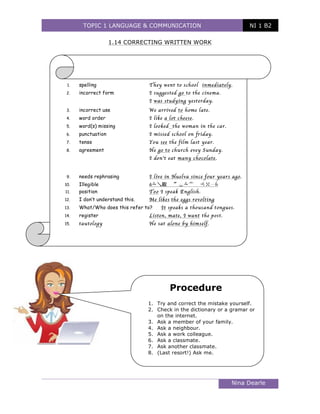
1.14 Correcting Written Work
&
&
&
&
&
Procedure
1. Try and correct the mistake yourself. &
2. Check in the dictionary or a gramar or
on the internet.&
3. Ask a member of your family.
4. Ask a neighbour.&
5. Ask a work colleague.&
6. Ask a classmate.&
7. Ask another classmate.&
8. (Last resort!) Ask me.&
1. spelling They went to school inmediately.
2. incorrect form I suggested go to the cinema.
I was studying yesterday.
3. incorrect use We arrived to home late.
4. word order I like a lot cheese.
5. word(s) missing I looked the woman in the car.
6. punctuation I missed school on friday.
7. tense You see the film last year.
8. agreement He go to church evey Sunday.
I don’t eat many chocolate.
9. needs rephrasing I live in Huelva since four years ago.
10. Illegible !"#$ %&'"(% )*+,
11. position Too I speak English.
12. I don’t understand this. Me likes the eggs revolting
13. What/Who does this refer to? It speaks a thousand tongues.
14. register Listen, mate, I want the post.
15. tautology He sat alone by himself.
&
1.14 CORRECTING WRITTEN WORK

Ni 1 b2 topic 1

  • 1.
    TOPIC 1 LANGUAGE& COMMUNICATION NI 1 B2 Streamline English Directions (O.U.P.) Nina Dearle 1.1. QUESTIONNAIRE 1. How long have you been learning English? 2. When did you begin? 3. Where did you start learning English? 4. Have you passed any exams in English? 5. If so, which ones? 6. Are you going to take any exams? 7. If so, when? 8. Have you ever visited an English-speaking country? 9. If so, which? 10. Do you ever use English? 11. If so, on what occasions? 12. Have you read any books in English? 13. Have you seen any films in English? 14. Do you listen to songs in English? 15. How would you describe your English? fair □ quite good □ good □ very good □ fluent □ 16. Is your written English better than your spoken English, or vice versa? 17. What do you hope to achieve this course? 18. How important are these things to you? (number them 1 – 4, 1 = the most important) listening comprehension □ oral fluency □ reading comprehension □ writing in English □ Why? 19. Do you use a dictionary? 20. If so, is it monolingual or bilingual? 21. How useful do you find it? 22. How useful do you find a coursebook? 23. Do you use a grammar book? 24. How useful do you find it? 25. Do you enjoy learning English? Why/Why not?
  • 2.
    TOPIC 1 LANGUAGE& COMMUNICATION NI 1 B2 Streamline English Directions (O.U.P.) Nina Dearle 1.2. LEARNING A LANGUAGE This passage is from Weep Not, Child by N’gugi (Heinemann African Writers, 1964). Read it quickly. Discuss the problems the children have with their English classes. Lucia, Mwihaki's sister, taught them. They all sat expectantly at their desk with eyes on the board. A knowledge of English was the criterion of a man's learning. Teacher I am standing up. What am I doing? Class You are standing up. Teacher Again. Class You are standing up. Teacher (pointing with a finger) You - no - you - yes. What's your name? Pupil Njoroge. Teacher Njoroge, stand up. He stood up. Learning English was all right but not when he stood up for all eyes to watch and maybe make faces at him. Teacher What are you doing? Njoroge (thinly) You are standing up. Teacher (slightly cross) What are you doing? Njoroge (clears his throat, voice thinner still) You are standing up. Teacher No, no! (to the class) Come on. What are you, you doing? Njoroge was very confused. Hands were raised up all around him. He felt more and more foolish so that in the end he gave up the very attempt to answer. Teacher (pointing to Mwihaki) Stand up. What are you doing? Mwihaki (head bent on to one shoulder) I am standing up. Teacher Good. Now, Njoroge. What is she doing? Njoroge I am standing up. The class giggled. Teacher (very annoyed) Class, what is she doing? Class (singing) You are standing up. Teacher (still more angry) I am asking you .... What is she doing? Class (afraid, quietly singing) You are standing up. Teacher Look here you stupid and lazy fools. How long do you take to catch things? Didn't we go over all this yesterday? If I come tomorrow and find that you make a single mistake I'll punish you all severely. With this sharply-delivered threat, she walked out. Njoroge, annoyed with himself at his poor showing, could now be heard trying to re-establish himself by telling them what they ought to have answered. 'She is standing up.' But one boy (the most stupid in the class) rebuked him. 'Why didn't you speak up when she was here, if you're so clever?' After some more weeks of anger and threats the children managed to glean something of which they were very proud. Njoroge could now sing. I am standing up. You are standing up. She is standing up. We are standing up. You are standing up. They are standing up. Where are you going? I am going to the door. We are going to the door. Point to the blackboard. What are you doing? I am pointing to the blackboard.
  • 3.
    TOPIC 1 LANGUAGE& COMMUNICATION NI 1 B2 English Any Time (Lingual House) Nina Dearle 1.3. LEARNING LANGUAGES No-one knows exactly how people learn language although a great deal of research has been done into the subject. Certain theories have, however, had a profound effect upon the practice of language teaching (and continue to do so) and it seems sensible, therefore, to consider them. * * * Recently a distinction has been drawn between acquiring a language and learning a language, most notably by the American writer Krashen. He characterises the former as a subconscious process which results in the knowledge of a language whereas the latter, learning, is a conscious process which results only in “knowing about” the language. Acquiring a language is more successful and longer lasting than learning. What is being suggested is that second (or foreign) language learning needs to be more like the child’s acquisition of his native language. Although there may be some limits on the language a child hears (see below), he is never consciously “taught it “, nor does he consciously set out to learn it. Instead he hears and experiences a considerable amount of the language in situations where he is involved in communicating with an adult – usually a parent. His gradual ability to use the language is the result of many subconscious processes, based on the experiences in which he began to acquire – without setting out to do so – the ability to enter linguistically into the communication. Traditional foreign language teaching, on the other hand, concentrated on getting the adult student consciously to learn items of language in isolation, often unconnected with any real communication situation. The focus was not on communicating, but on a piece of language which might later be used to communicate. Many writers see this traditional approach to language learning as being mistaken since there is no guarantee that an item so learnt will be successfully used in communication or remembered for any length of time. Language has to be acquired as the result of some deeper experience than the concentration on a grammar point, just as it is when children learn their first language. The Practice of English Language Teaching Read the text and fill in the table below with a tick (✔) in the relevant column. The first one has been done for you. “Acquisition” “Learning” a process of which the learner is unaware a process involving analysis of the language the language is more easily forgotten more like the way a child learns to speak the traditional way of teaching a language an emphasis on form rather than on content allows for language to be “experienced” as in real life ✔
  • 4.
    TOPIC 1 LANGUAGE& COMMUNICATION NI 1 B2 English Any Time (Lingual House) Nina Dearle 1.4 APTITUDE TEST TEST YOUR APTITUDE FOR LEARNING A FOREIGN LANGUAGE Try this quiz, specially designed by Dr Paul Meara, of Birbeck Coolege, London. Write your answers on a piece of paper, then add up your scores to find out how good a language learner you are likely to be. 1 Exhausted after swimming the river, Fred decided to get some sleep, but the boolies made it impossible, and even the smoke from his camp fire didn’t keep them away. What is a boolie? a. a hostile native b. a giant mosquito c. a kind of noise d. don’t know 2 A foreigner asks you the way in very bad English. When he doesn’t understand your reply do you a. say it again but louder b. get irritated and give up c. draw him a map d. find out if he speaks another language you know 3 ek kum chuchu – the train is coming ek namas chuchu – the train is very big nek kum niva chuchu - the train isn’t coming nek namas niva chuchu – the train is quite small ek chuchu – it’s a train How would you say “it isn’t a train”? a. nek chuchu niva b. ek niva chuchu c. nek niva chuchu d. don’t know 4 How many foreign languages can you greet someone in? 5 Your boss tells you that you have been chosen to go on a six month course to learn Japanese. Do you a. look for another job b. say they’ve chosen the wrong person c. worry a bit but reckon you’ll cope d. feel you can’t wait to start 6 What do other people think about the way you speak and write Spanish? a. they think I’m wonderful b. don’t know c. depends on the situation d. people sometimes say I’m not very clear 7 When did you last read a book for pleasure? a. yesterday b. can’t remember c. last week d. last month 8 In one minute write a list of things you could do with a cabbage (apart from cooking or eating it). 9 Fill in the blank sentence below. Momarory hohadod a lolitottotlole lolamombob; itot’sos fofloleecoce wowasos ………. asos sosnonow a. wowhohitote b. white c. boblolacockok d. don’t know 10 Are you male or female? 11 Are you under 10 years old?
  • 5.
    TOPIC 1 LANGUAGE& COMMUNICATION NI 1 B2 English Any Time (Lingual House) Nina Dearle 1.4 APTITUDE TEST SCORES 1 a 5 b 10 c 0 d 0 Good language learners are able to make imaginative guesses about the meaning of words. 2 a 0 b 0 c 10 d 8 Good language learners make the most of their skills, and manage to communicate in all sorts of unlikely situations. 3 a 2 b 2 c 10 d 0 Good language learners are quick at seeing patterns in a foreign language. (Negative sentences in this language begin with “nek”. The last word is always “chuchu”. 4 Two points for each language (maximum 10 points). This question shows how interested you are in languages and communication. 5 a 0 b 3 c 7 d 10 Being scared stiff is obviously a bad sign. 6 a 4 b 0 c 10 d 7 Good language learners think a lot about how they use language. 7 a 10 b 0 c 5 d 2 Good language learners seem to read a lot. (It’s a good way of increasing your vocabulary.) 8 A point for each idea. (max. 10). People who are very rigid in the way they see things tend not to be very good at learning languages. This is possibly because they don’t like being in situations they can’t control. 9 a 10 b 2 c 7 d 0 Question assesses how willing you are to take risks in a language you don’t know well. 10 Females score 10. On the whole, women are better at languages. 11 If yes, score 200. Young children are fantastically good at languages, but we seem to get worse at it after puberty.
  • 6.
    TOPIC 1 LANGUAGE& COMMUNICATION NI 1 B2 Streamline English Destinations (O.U.P.) Nina Dearle 1.5 WORD BUILDING 5 10 15 20 25 30 35 40 45 50 What makes a good driver? A good driver has many things in his make-up. Some of these, such as experience and skill, will come only in time. But others – just as important – must be part of him from the start. These qualities are a sense of responsibility for the safety of others, a determination to concentrate on the job of driving, patience and courtesy. Together, these become what is generally known as a driver’s “attitude”. Not everyone is patient by nature or gifted with good powers of concentration. But because attitude is so important a part of safe driving, every driver must make a real effort to develop these qualities – and this effort must start from the very beginning of his first driving lesson. Getting into the right attitude will be harder for some people than others. It can be more difficult than the actual business of learning to make the car go or stop. All the things which go to make up attitude are just as necessary for the experienced driver as for the learner. So, before we go any further, let us look at these qualities in a little more detail. Responsibility As a driver you must have a proper concern not only for your own safety and that of your passengers, but also for the safety of every other road user, including pedestrians. You can do this only if you pay close attention to the varying traffic situations as they develop. Then you can plan your own actions well in advance so that they do not cause danger or inconvenience to others. At times you may be tempted to make a rash move – don’t. Concentration With responsibility goes concentration on the job of driving. You must concentrate all the time if you are going to be able to deal with present-day traffic. Nowadays this is usually 45 50 55 60 65 70 75 80 85 90 95 heavy and fast-moving and there are possible dangers all around you. If you let your mind wander, even for a moment, the risk of making a mistake is increased enormously. And mistakes can cause accidents. If you are tired, upset or unwell, or even thinking about something else, you will take longer to react. It is better not to drive at all in these circumstances, but if you have to, make special allowances for them. Anticipation Concentration helps you to “anticipate”. In motoring, anticipation means acting promptly to fit in with what other road users are doing, as well as being able and ready to alter your own course or behaviour as a situation develops. To those who do not drive, this quality of anticipation has the appearance of being automatic – and this is what it should become. Experience and anticipation together will enable you to act to prevent possible danger from becoming actual danger. Patience It is very easy to get impatient, or lose your temper, when other drivers do something wrong, or you are caught up in a traffic jam. But if you do, you are well on the way to having an accident. Never drive in a spirit of retaliation or competition. If the incompetence or bad manners of another road user cause you inconvenience, don’t let your annoyance, even if justifiable, override your good sense and judgement. Attempts to “teach him a lesson” don’t do any good: there is no better lesson than a good example. Confidence The degree of confidence a driver has in handling his vehicle is, in a sense, part of his attitude to driving. New drivers will, of course, be unsure of themselves. Confidence grows with experience. But a good driver 100 105 110 115 120 125 130 135 140 145 150 155 never lets himself get over- confident. This leads to carelessness, risks, and eventually accidents. Planned tuition All the things we have talked about so far – becoming a safe driver by developing a sense of responsibility, concentration, anticipation, patience and confidence – will depend very much on getting good instruction from the start. Drivers often begin to learn with a parent, relative or friend and this allows them to get lots of practice at low cost. But although some non- professional teachers can put over the details of car control and road procedure within a reasonable time, many good drivers are not good instructors. They can ruin a pupil’s confidence by leading him into situations he is not ready for. In other words, they often teach him to run before he can walk. And, of course, not all parents, relatives and friends are good drivers anyway. A planned approach is essential when teaching someone to drive. Ideally, each lesson should be phased to suit the pupil’s development. There are no short cuts to being a good driver, either in time or money. There is no doubt that the best way to learn to drive properly is to have good professional tuition – and plenty of it. It will prove well worthwhile in the long run. But you need plenty of practice too. Mechanical knowledge So far we have said nothing about mechanical knowledge – how a car works. It is not necessary to know all the complicated details of car construction to be a good driver. But the more you do know the better, because if you know how the different parts of a car work, and what happens when you use the controls, you will develop a sense of car sympathy. This will not only make you a better driver, but add to your interest in driving. It will also prolong the life of your car.
  • 7.
    TOPIC 1 LANGUAGE& COMMUNICATION NI 1 B2 Nina Dearle 1.5 WORD BUILDING WORKSHEET A Find the words in the first column in the text and complete the table below: Underline the suffixes in these words line What effect does the suffix have on the word? Give two similar examples e.g. carelessness 93 adjective > noun shyness laziness concentration enormously harder user experienced professional B Two words with the suffix –ty appear in the text. Find them and complete the following table. Examples from text line Effect of suffix on the word Give two examples of your own C What effect does the prefix have on the following two words? Examples from text line Effect of suffix on the word incompetence enable D The first prefix in- is used to make a word negative. What prefix would you add to each of these adjectives or nouns in order to make them negative? patient convenience honesty sure professional responsible E Can you think of other words formed with the prefix –en? 1. _______________________________________ 2. _______________________________________ 3. _______________________________________ 4. ________________________________
  • 8.
    TOPIC 1 LANGUAGE& COMMUNICATION NI 1 B2 First Certificate Skills (OUP) Nina Dearle 1.6 EXAM TRAINING: READING There was one thing I found rather strange on my first day at Monk's House. The floors in the house were very thin. The bathroom was directly above the kitchen and when Mrs. Woolf was having her bath before breakfast, I could hear her talking to herself. On and on she went, talk, talk, talk, asking questions and giving herself the answers. I thought there must be two or three people up there with her. When Mr. Woolf saw that I looked surprised he told me that Mrs. Woolf always said the sentences out loud that she had written during the night. She needed to know if they sounded right, and the bath was a good place for trying them out. I was not allowed to make coffee at Monk's House. Mr. and Mrs. Woolf were very particular about coffee and always made it themselves, so Mr. Woolf came into the kitchen at eight o'clock every morning to make it. When we carried the breakfast trays to Mrs. Woolf's room I noticed she had always been working during the night. There were pencils and paper beside her bed so that when she woke up she could work, and sometimes it seemed as though she had had very little sleep. Mrs. Woolf's bedroom was outside the house in the garden; I used to think how inconvenient it must be to have to go out in the rain to go to bed. Her bedroom had been added on to the back of the house; the door faced the garden and a window at the side opened out on to a field. I remember that a cow came one night and put its head in through the window. It amused Mrs. Woolf very much, but in case it happened again Mr. Woolf bought the field and added part of it to the garden. Because the writing-room was small, he had a larger one built for her at the end of the garden against the church wall. I can always remember her coming to the house each day from the writing room; when I rang the bell for lunch at one o’clock she used to walk down through the garden smoking one of her favourite cigarettes in a long holder. She was tall and thin and very graceful. She had large, deep set eyes and a wide curving mouth – I think perhaps it was this that made her face seem particularly beautiful. She wore long skirts- usually blue or brown – in the fashion of the day, and silk jackets of the same colour. I remember too, there was always a large silk handkerchief folded into the jacket pocket. Her cigarettes were made from a special tobacco called my mixture. Mr Woolf bought it for her in London, and, in the evenings, they used to sit by the fire and make these cigarettes themselves. It was a mild, sweet-smelling tobacco, and she would not have any other cigarettes. Mrs. Woolf wore clothes that suited her well. I pressed them for her and did any sewing that was necessary — she was not able to sew, although sometimes she liked to try. There was one thing in the kitchen that Mrs. Woolf was very good at doing; she could make beautiful bread. I was surprised how complicated it was and how exactly Mrs. Woolf carried it out. She returned three or four times in a morning to work at it. Finally she made it into the shape of a cottage loaf and baked it at Just the right temperature.
  • 9.
    TOPIC 1 LANGUAGE& COMMUNICATION NI 1 B2 First Certificate Skills (OUP) Nina Dearle 1.6 EXAM TRAINING: READING EXERCISES Read the rules for comprehension tests. 1. Read the passage to get the general idea of it. 2. Don’t be distracted by difficult words; concentrate on what you know and understand. 3. Don’t be distracted by wrong answers in the choices. Read the passage and choose the best answers or completions in the exercise that follows. Time yourself. You should not take more than 20 minutes over it. 1 When she arrived at Monk's House, the writer a. found everything strange b. thought the planning of the house was unusual c. had no one to talk to d. was surprised at Mrs. Woolf's way of checking her work 2 The bathroom was a. on the same floor as the kitchen b. a long way above the kitchen c. on another floor from the kitchen d. next door to the kitchen 3 Each morning Mrs. Woolf a. asked her husband to carry in the breakfast b. did some work as soon as she woke up c. had breakfast in the kitchen d. had breakfast brought to her 4 What seemed to the writer a disadvantage about Mrs Woolf’s bedroom? a. it let in the rain b. you had to go outside to get to it c. the cows stood in front of the open window d. the door opened out on to the field 5 Why did Mr. Woolf buy the field? a. so that Mrs. Woolf didn't have to go out in the rain to go to bed b. so that there would be more space between his wife's bedroom and the field c. to build a writing-room d. to build a bedroom 6 The writer admired Mrs Woolf’s looks especiallly because a. she had beautiful eyes b. she had a beautiful mouth c. she had a good figure d. she wore fashionable clothes 7 Mrs Woolf’s cigarettes were a. made in London b. home-made c. made from tobacco grown in London d. made from tobacco mixed by Mr Woolf 8 The writer’s duties included a. altering Mrs Woolf’s clothes to make them fashionable b. seeing that Mrs Woolf’s clothes suited her c. ironing Mrs Woolf’s clothes d. making Mrs Woolf’s clothes 9 Baking beautiful bread, according to the writer a. was the only thing Mrs. Woolf was good at b. was something she liked to try occasionally c. brought her into the kitchen several times in the morning d. pleased her only when it was baked at the right temperature
  • 10.
    TOPIC 1 LANGUAGE& COMMUNICATION NI 1 B2 www.britishcouncil.org/learnenglishteens Nina Dearle 1.7 EXAM TRAINING: LISTENING A Listen to the teacher giving students advice for exams and circle the best answer to the questions. 1 The teacher wants the students to … a take notes after she has finished speaking. b take notes while she is speaking. c forget about taking notes. 2 The teacher suggests eating … a sugary snacks. b only apples. c fruit and cereals. 3 The teacher suggests finding a study place with a lot of … a light. b space. c books. 4 If students feel stressed they should … a go to bed. b go out for a walk. c drink some water. 5 Students are advised to … a select the important things to learn. b read through everything once. c make notes about every topic. 6 The teacher understands that repeating things can be … a difficult. b uninteresting. c tiring. 7 Students can do past exam papers … a in the library only. b at home if they tale photocopies. c in the after-school study group. 8 The teacher recommends a break of five minutes every … a hour. b two hours. c thirty minutes. 9 It’s important to … a eat regularly. b sleep when you feel tired. c keep hydrated. 10 The teacher is sure that the students will … a pass their exams. b fail their exams. c do their best. B Discuss. 1 Does any of this advice surprise you? 2 Have you got any good advice to share about studying for exams?
  • 11.
    TOPIC 1 LANGUAGE& COMMUNICATION NI 1 B2 First Certificate Skills (O.U.P) Nina Dearle 1.8 EXAM TRAINING: WRITING The first thing to practise is reading exam questions. It’s easy when you read quickly to misunderstand or forget something. In every exam, some people answer questions in the wrong way, and so they lose a lot of marks. Here is a set of instructions and questions for a writing exam. Read each one, write down the important words in it, and then choose the statement that matches it best. Write three only of the following writing exercises. Your answers must follow exactly the instructions given, and must be between 120 and 150 words each. 1 The instructions are to write a maximum of a. 150 words on the whole paper b. 400 words on the whole paper c. 650 words on the whole paper You have been asked to organise a tour by motor coach through several countries, lasting two weeks. Write a detailed list, to be handed to members of the party, of the proposed route, timing, requirements for the journey and any other information you think the travellers will require. 2 You must write a. a programme for the tour organiser b. a letter to the tourists c. a programme for the tourists In some countries food supplies are barely enough to feed growing populations. How do you think this problem could be solved? 3 You must write a. a description of some poor countries b. suggestions for feeding the world’s population Your brother is undecided about taking a new job. Write the conversation between you and him in which you try to persuade him to take the job. Write in dialogue form, giving only the name of each speaker followed by the words spoken. 4 You must write a. a dialogue where your brother gives you advice b. a dialogue bout your brother’s career While you were on your way to an important appointment something happened which seriously delayed you. Say what you did to get to the meeting, and also to inform those concerned about that you would be late. 5 You must write a. The conversation you had when you were late for a meeting b. A story about being late for a meeting You have been aske to write a leaflet which is enclosed with a new product (camera, electric appliance, toy, prepared food, etc.) explaining how it is to be used and mentioning its special advantages. Write the leaflet, naming the product and the manufacturer, and giving any details you wish. 6 You must write a. a leaflet persuading people to buy something b. a leaflet describing how to use something
  • 12.
    TOPIC 1 LANGUAGE& COMMUNICATION NI 1 B2 Sur in English Nina Dearle 1.9 READING TEXTS A. Taking the Test A colleague at SUR in English has recently been trying (on an almost weekly basis, it seems) to passs the Spanish driving test, so office chat has naturally centred on the difficulties of driving in Spain. Or at any rate, of getting a Spanish licence to do so. For British expats, driving on the “wrong” side of the road doesn’t appear to pose many problems, even if overtaking in a car which also has its driving seat on the “wrong” side is a more difficult feat. I wonder if the sign, in English, at the exit from one of the older residential developments in Nerja still exists? The one that said “Please remember to drive on the right”? It used to amuse Spanish drivers, but I haven’t seen any like it recently – perhaps the number of British- dominated areas makes it impossible to produce enough signs. Be that as it may, the main difference in taking the driving test here appears to lie in the theory section, which takes the form of a multiple choice test asking (if visctims of it are to be believed, which no doubt they are) such vital road safety questions as – well, the one in the sample below*. Others test the driver’s knowledge of more important aspects of the highway code, but even then our colleague complains of trick answers. The other topic of conversation which comes up just about every morning is the one which starts “How long did it take you to get to work?” When the Malaga bypass/ringroad was first opened, it was known as the “microondas” (microwave) because what had previously taken an hour now only took 15 minutes. Sadly that is now history, and people who work in Malaga regularly debate whether to risk going through the centre (and getting stuck behind a bus in the school traffic) or opting for the alternative route – which is saturated, and its worst during the university student rush hour. * As a general rule, what is a person’s reaction time, as a general rule? a Between one and two seconds. b Between half a second and one second. c Between half a second and two seconds. d Source: todomotor.com (tautology included) B. Studying in Spanish By the beginning of October every year, even the university students are back in their classrooms after the long, long summer holiday, and the complaints about the long, long queues to enrol for the most popular courses are dying away – though this year, the complaints have been prolonged in some of the “Official Language Schools” because of the lack of teachers. And as usual, some of the state schools failed to open on time because the necessary building or renovation work still hadn’t been completed. Oh, and by December, some of those who queued to good effect for the most sought-after courses will have dropped out, leaving the classroom half empty and the other aspirants frustrated. Thousands of SUR in English readers are even now signing up for courses in Spanish, and will no doubt be telling each other that it is all very well, but there is very little chance to practise now that everybody in southern Spain seems to speak English. As they may well be saying in the classroom next door, “Plus ça change …”* *exclamation used to express resigned acknowledgement of the fundamental immutability of human nature and institutions.
  • 13.
    TOPIC 1 LANGUAGE& COMMUNICATION NI 1 B2 Focus on Advanced English (Collins) Nina Dearle 1.10 THE DAY OF THE EXAM * If you say you wouldn’t touch something with a barge pole, it means you don’t want to have anything to do with it.
  • 14.
    TOPIC 1 LANGUAGE& COMMUNICATION NI 1 B2 Focus on Advanced English (Collins) Nina Dearle A Multiple Matching. Read the text and choose the correct title (A – J list the possible titles) for each section (1 – 7). Complete each space in the text by choosing from the list A – J. 1 section 1 A How to annoy the examiner H Don’t panic 2 section 2 B After it’s over I Make a revision timetable 3 section 3 C Be prepared J Choosing which questions to answer 4 section 4 D Watch what you eat 5 section 5 E Coping with difficult questions 6 section 6 F How to study 7 section 7 G Look after yourself B Multiple Choice. Read the text more carefully to answer questions 8 – 13 below. You must choose the answer which you thinks fits best. Choose one answer only to each question. 8 The writer urges us to remember that exams A are the key to success in life B are not a good test of ability C are not the most important thing in life D are nothing to be concerned about 9 The writer’s advice about difficult questions is A not to spend any time on them B to leave them till the very end of the exam C to tackle them after those you can do easily D to guess the answers 10 Both the writer and the JMB Chairman of Examiners agree that it’s extremely important A to read through the questions before starting to write B to prepare yourself thoroughly before an exam C not to go back and change answers that you’ve written D not to lose your nerve in an examination 11 Candidates often imagine that examiners A mark exam scripts carelessly B enjoy finding mistakes in people’s work C are easily irritated D are gentle, tolerant people 12 On thing which is sure to annoy an examiner is when a candidate A gives an answer that they’ve learnt in class B doesn’t answer all the questions C has very bad handwriting D writes very long questions to answers 13 The writer suggests that before an exam it is not helpful to A consult a doctor B discuss the exams with friends C drink any coffee D miss a meal
  • 15.
    TOPIC 1 LANGUAGE& COMMUNICATION NI 1 B2 Nina Dearle 1.11 EXAM TRAINING: SPEAKING TASK 1 MONOLOGUE: LANGUAGE STUDENT A You are going to talk about learning languages. • Talk about why you think it is important to learn foreign languages nowadays. • Describe the main difficulties you experience while learning a foreign language. • Tell us about a situation in which (not) speaking the language was an advantage /disadvantage for you. Pruebas de certificación NI B1 2017/2018 TASK 2 DIALOGUE: LEARNING A FOREIGN LANGUAGE STUDENT A You are thinking of giving up studying English because you feel really frustrated. You spend many hours at home studying but you don’t feel you are making any progress. Explain to your partner how you feel and why you are thinking of starting another activity which is easier and less time-consuming. Listen to your friend and try to come to some sort of agreement. You begin the dialogue.
  • 16.
    TOPIC 1 LANGUAGE& COMMUNICATION NI 1 B2 Sur in English Nina Dearle 1.12 MORE READING TEXTS A Back to work, back to routine. There is a relatively new disease in Spain (and this may have been the last country to be infected, or at least to report it). It is called post-holiday syndrome, and it kicks in at the beginning of September when most Spanish workers have just finished their one month’s statutory holiday and are looking forward, albeit glumly, to the next eleven months. The symptoms are apparently mostly psychological, and it helps if the return to work is any day other than a Monday – at least the first week is shorter. This year is only the second that the “syndrome” has made headlines in the local Spanish paper, but accompanying post-holiday “symptoms" are well known. There is the return of the long, long tailback on roads which during August were miraculously clear at nine o’clock in the morning. The same roads of course are now quieter at nine o’clock in the evening, as the holidaymakers heading for their favourite restaurants and night- spots have gone home. Part of the post-holiday problem is that for most Spaniards, it still happens just once a year. Psychologists may recommend taking more and shorter holidays as a way of warding off the disease, but the fact is that most workers aren’t given this option – other their firms just close down in August or they are geared towards taking on summer temps to cover for the regular work force, and everybody takes either July or August for their annual break. Fiestas and long weekends known as “puentes” give frequent short respites from work, but they are not long enough to provoke a bout of “syndrome” when they are over … B Getting geared up for winter This week has seen a big change in the way Spain looks – or al least the way the still balmy Costa del Sol area looks. Spanish workers in offices are looking very warm in their long sleeves, bare legs have been covered up, and the people on the streets have obviously got out their cold weather clothes from the top cupboard or the fold-up transparent box under the bed, sandals have all but disappeared, and there are complaints about the way shoes have become too tight … It can only be a matter of days, now, before the women who carefully preserve their fur coats somewhere cool over the summer months take them out of hiding and start wearing them on the flimsiest of excuses. A visit to the theatre is always a good occasion for display, and provided there is an “r” in the month, temperatures are irrelevant! Houses, too, are being prepared for the onslaught of freezing temperatures (meaning temperatures which might drop to 6ºC on a really cold night). Heaters are being dusted off, and larders stocked with the winter essentials that nobody wants to eat during the warmer months – lentils, beans, and other things that need lengthy cooking in hot kitchens. Blankets, where blankets are still in use, are being taken out of storage and shaken, but mostly now it’s the duvets which have been squashed for months and need fluffing up. Then the rugs have to be unrolled, and possibly even the curtains need changing. Meanwhile, visitors this weekend will no doubt be on the beach, thinking how warm it is!
  • 17.
    TOPIC 1 LANGUAGE& COMMUNICATION NI 1 B2 Nina Dearle 1.11 EXAM TRAINING: SPEAKING TASK 1 MONOLOGUE: LANGUAGE STUDENT A You are going to talk about learning languages. • Talk about why you think it is important to learn foreign languages nowadays. • Describe the main difficulties you experience while learning a foreign language. • Tell us about a situation in which (not) speaking the language was an advantage /disadvantage for you. Pruebas de certificación NI B1 2017/2018 TASK 2 DIALOGUE: LEARNING A FOREIGN LANGUAGE STUDENT B Your friend is beginning to feel really frustrated with his/her English studies. Explain the skills s/he should give more importance to and why. Mention some fun and useful activities s/he can do to improve his/her knowledge of the language. Try to persuade your friend to continue and come to some sort of agreement. Student A begins the dialogue.
  • 18.
    TOPIC 1 LANGUAGE& COMMUNICATION NI 1 B2 Sur in English Nina Dearle 1.12 MORE READING TEXTS C Back to work, back to routine. There is a relatively new disease in Spain (and this may have been the last country to be infected, or at least to report it). It is called post-holiday syndrome, and it kicks in at the beginning of September when most Spanish workers have just finished their one month’s statutory holiday and are looking forward, albeit glumly, to the next eleven months. The symptoms are apparently mostly psychological, and it helps if the return to work is any day other than a Monday – at least the first week is shorter. This year is only the second that the “syndrome” has made headlines in the local Spanish paper, but accompanying post-holiday “symptoms" are well known. There is the return of the long, long tailback on roads which during August were miraculously clear at nine o’clock in the morning. The same roads of course are now quieter at nine o’clock in the evening, as the holidaymakers heading for their favourite restaurants and night- spots have gone home. Part of the post-holiday problem is that for most Spaniards, it still happens just once a year. Psychologists may recommend taking more and shorter holidays as a way of warding off the disease, but the fact is that most workers aren’t given this option – other their firms just close down in August or they are geared towards taking on summer temps to cover for the regular work force, and everybody takes either July or August for their annual break. Fiestas and long weekends known as “puentes” give frequent short respites from work, but they are not long enough to provoke a bout of “syndrome” when they are over … D Getting geared up for winter This week has seen a big change in the way Spain looks – or al least the way the still balmy Costa del Sol area looks. Spanish workers in offices are looking very warm in their long sleeves, bare legs have been covered up, and the people on the streets have obviously got out their cold weather clothes from the top cupboard or the fold-up transparent box under the bed, sandals have all but disappeared, and there are complaints about the way shoes have become too tight … It can only be a matter of days, now, before the women who carefully preserve their fur coats somewhere cool over the summer months take them out of hiding and start wearing them on the flimsiest of excuses. A visit to the theatre is always a good occasion for display, and provided there is an “r” in the month, temperatures are irrelevant! Houses, too, are being prepared for the onslaught of freezing temperatures (meaning temperatures which might drop to 6ºC on a really cold night). Heaters are being dusted off, and larders stocked with the winter essentials that nobody wants to eat during the warmer months – lentils, beans, and other things that need lengthy cooking in hot kitchens. Blankets, where blankets are still in use, are being taken out of storage and shaken, but mostly now it’s the duvets which have been squashed for months and need fluffing up. Then the rugs have to be unrolled, and possibly even the curtains need changing. Meanwhile, visitors this weekend will no doubt be on the beach, thinking how warm it is!
  • 19.
    TOPIC 1 LANGUAGE& COMMUNICATION NI 1 B2 www.hotenglishgroup.com Nina Dearle ISTEN I N & US WOMAN N ow that you’ve learnt English, you might want to learn another language. French, Spanish, German and Italian are all relatively easy for English-speakers. But why? [The words in brackets ( ) are the foreign terms.] 1 French There are hundreds of words that are similar (or exactly the same) in French and English. Here are a few with the same spelling and meaning in both languages (the only difference is the pronunciation). For example: accent (accent), addition (addition), ambition (ambition)… So, why is this? Well, in 1066, the Normans (from northern France) under the command of William the Conqueror invaded England. They defeated King Harold of England at the Battle of Hastings in the same year. The victorious Normans then took control of the country and settled there. Linguists estimate that French has influenced up to a third of the modern English language, with about 8,000 words of French origin. 2 Spanish Spanish is another language with lots of words that are similar to English ones. The spellings aren’t always exactly the same, but the meanings are fairly easy to work out. For example: curious (curioso), mysterious (misterioso), numerous (numeroso)… Another great thing about Spanish is that words are generally pronounced as they’re written. And each syllable is stressed equally, so government is gobierno (go-bi-er-no) in Spanish. And with only ten vowel and diphthong sounds (English has 20!), pronunciation isn’t that complicated. Best of all, Spanish is an official language in lots of countries in South America. 3 German German is another relatively easy language for English speakers. And there are many words of German origin in English. They aren’t exactly the same, but it’s easy to see the similarities. For example: all (alle), alone (allein), bed (Bett), beer (Bier), blue (blau), book (Buch), bread (Brot)… [Notice how German nouns are written with capital letters.] 4 Italian And finally, there’s Italian. There are hundreds of words of Latin origin, thanks to the Roman occupation of England between 55 BC and 400 AD. For example: ambitious (ambizioso), music (musica), dentist (dentista), artist (artista), station (stazione)… So, which language are you going to learn next? otenglishgroup.com / Check out the interactive PDF offer. Visit: www.hotenglishmagazine.com FOUR EASY LANGUAGES FOR YOU TO LEARN! Objective To improve your reading and listening skills. Think about it Which languages can you speak? Which languages would you like to learn? Why? Exams This reading and listening activity will help prepare you for English exams such as KET and TOEFL. age 44 reading ou think these foreign n in English? (French) ioso (Spanish) German) German) ta (Italian) ne (Italian) ding I rticle once to check ers from the pre- sk. ding II rticle again. Then, questions. did the Normans England? many words of h origin are there lish? does the Spanish “curioso” mean lish? many vowel and ong sounds does h have? does the German “allein” mean in h? did the Romans heir occupation land? to invade vb if an army “invades” a country, the army enters that country in large numbers to defeat vb if A “defeats” B, A wins in a battle or competition against B victorious adj if A is “victorious”, A wins a battle or competition to take control of exp if a person “takes control of” a situation, they become the leader by force to settle vb to begin living somewhere permanently to influence vb to have an effect on something to work out phr vb if you “work out” the meaning of something, you understand that thing a syllable n a part of a word that has one sound that’s pronounced on its own. For example, “market” (mar-ket) has two syllables to stress vb if you “stress” a word or sound, you put emphasis on it a diphthong n a vowel that sounds like a combination of two vowels. For example: “ear” has the diphthong “ɪə” BC abbr BC in dates refers to the number of years Before Christ (before the birth of Jesus Christ) AD abbr AD refers to Anno Domini (the year of our lord). It’s used to show the number of years after Christ’s birth a cognate n a word that looks similar to a word in another language. It often has the same meaning. For example, “education” (English) + “educación” (Spanish) GLOSSARY Most modern-day English words come from three main areas: Latin (about 28%), Germanic languages (about 25%) and Old Norman (which is a French based language – another 28%). Latin words were first introduced by the Romans during their invasion and occupation of England between 55BC and 400AD. Germanic words came from the Anglo Saxon tribes, who invaded England in the 5th century. And Norman (French) words were introduced after the Norman invasion of England in 1066. English also has a number of Greek words (about 5%) and Scandinavian terms from the Viking invasions of the 8th century onwards. THE ORIGINS OF ENGLISH WORDS Linguists have identified 10 languages that are “easy” for English speakers. All of these languages have numerous cognates – words that are similar in English and the other languages. The ten major languages are: Romance languages (from Roman Latin): Spanish, Italian, French, Portuguese and Romanian. Germanic languages: German, Dutch, Norwegian, Swedish and Danish. 10 easy foreign languages 1.13 SHADOW READING/LISTENING
  • 20.
    TOPIC 1 LANGUAGE& COMMUNICATION NI 1 B2 Nina Dearle TOPIC 1 LANGUAGE AND COMMUNICATION: WINE UPON THE LIP EOI&C1& & & Nina&Dearle& & 1.14 Correcting Written Work & & & & & Procedure 1. Try and correct the mistake yourself. & 2. Check in the dictionary or a gramar or on the internet.& 3. Ask a member of your family. 4. Ask a neighbour.& 5. Ask a work colleague.& 6. Ask a classmate.& 7. Ask another classmate.& 8. (Last resort!) Ask me.& 1. spelling They went to school inmediately. 2. incorrect form I suggested go to the cinema. I was studying yesterday. 3. incorrect use We arrived to home late. 4. word order I like a lot cheese. 5. word(s) missing I looked the woman in the car. 6. punctuation I missed school on friday. 7. tense You see the film last year. 8. agreement He go to church evey Sunday. I don’t eat many chocolate. 9. needs rephrasing I live in Huelva since four years ago. 10. Illegible !"#$ %&'"(% )*+, 11. position Too I speak English. 12. I don’t understand this. Me likes the eggs revolting 13. What/Who does this refer to? It speaks a thousand tongues. 14. register Listen, mate, I want the post. 15. tautology He sat alone by himself. & 1.14 CORRECTING WRITTEN WORK