HISD GLOBAL GRADUATE
Writing Through
the Lens of
Beers and
Probst’s
Notice & Note
HISD GLOBAL GRADUATE
• Be present in the work
• Take care of personal needs
• Be considerate of “air time”
• Ask questions and share insight
• Have fun!
2
NORMS
HISD GLOBAL GRADUATE 3
HOW IS OUR READING CONNECTED TO OUR
WRITING?
Objective: Today, we will explore the reading and writing connection
utilizing the Beers and Probst’s Notice & Note.
-How do you connect reading instruction with drafting and/or revision
instruction?
-How do you help students find style and voice in their writing?
HISD GLOBAL GRADUATE 4
WHERE IN THE WORLD IS THE FIVE PARAGRAPH
ESSAY?
“As for five-paragraph themes, I have been looking for one in published materials ever since I
began teaching in 1958, and I am still looking.” Edgar Schuster, “On the Necessity for
Subversion,” 2004.
HISD GLOBAL GRADUATE
• We learn to write by noticing what
published writers do, then trying this in our
own writing.
• The teacher should model this process by
writing alongside students.
THOUGHTS ON TEACHING WRITING
HISD GLOBAL GRADUATE
• “Before revision, vision”
• “What have you read that is like what you
are trying to write?”
Study Driven, p. 35
6
KATIE WOOD RAY
HISD GLOBAL GRADUATE
John O’Flahavan What Readers and Writers Do
Consume Read many examples of the type of
writing you will write.
Notice the characteristics of the
genre and the choices of the writers.
Critique Reflect upon the choices of the
writers and the effect on the reader.
Produce Utilize the close study to make
informed choices as a writer.
7
O’FLAHAVAN: CONSUME, CRITIQUE, PRODUCE
HISD GLOBAL GRADUATE 8
WOOD RAY: MUST HAVE, MIGHT HAVE, WON’T HAVE
A CCP of This I Believe Essays
Students read many
examples from the genre and
notice what the genre must
have, might have, and won’t
have.
Must haves and won’t haves
are genre characteristics.
Might haves are author’s craft
choices.
HISD GLOBAL GRADUATE 9
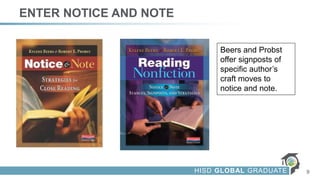
ENTER NOTICE AND NOTE
Beers and Probst
offer signposts of
specific author’s
craft moves to
notice and note.
HISD GLOBAL GRADUATE 10
THE SOURCE OF THE SIGNPOSTS
HISD GLOBAL GRADUATE 11
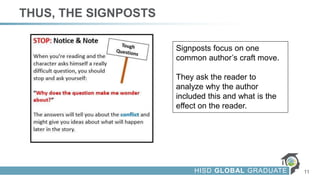
THUS, THE SIGNPOSTS
Signposts focus on one
common author’s craft move.
They ask the reader to
analyze why the author
included this and what is the
effect on the reader.
HISD GLOBAL GRADUATE 12
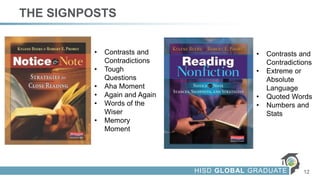
THE SIGNPOSTS
• Contrasts and
Contradictions
• Extreme or
Absolute
Language
• Quoted Words
• Numbers and
Stats
• Contrasts and
Contradictions
• Tough
Questions
• Aha Moment
• Again and Again
• Words of the
Wiser
• Memory
Moment
HISD GLOBAL GRADUATE 13
AHA MOMENT
If the signposts are author’s
craft moves that come up
again and again, could these
not be used to teach writing?
After students consume and
critique text through the
signposts, they might try using
these author’s craft moves in
their writing.
HISD GLOBAL GRADUATE 14
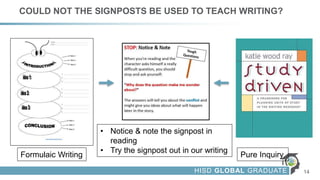
COULD NOT THE SIGNPOSTS BE USED TO TEACH WRITING?
Pure InquiryFormulaic Writing
• Notice & note the signpost in
reading
• Try the signpost out in our writing
HISD GLOBAL GRADUATE 15
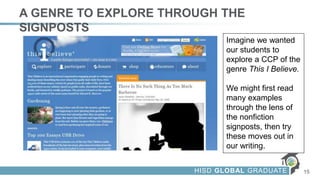
A GENRE TO EXPLORE THROUGH THE
SIGNPOSTS
Imagine we wanted
our students to
explore a CCP of the
genre This I Believe.
We might first read
many examples
through the lens of
the nonfiction
signposts, then try
these moves out in
our writing.
HISD GLOBAL GRADUATE 16
A TEXT TO EXPLORE THROUGH THE
SIGNPOSTS
HISD GLOBAL GRADUATE 17
CONTRASTS AND CONTRADICTIONS
“I believe that we should talk to
strangers. By engaging in unexpected,
friendly conversation with strangers,
our lives can be affected in ways that
are extraordinary. I learned this
valuable and life-changing experience
during my sophomore year of college.”
HISD GLOBAL GRADUATE 18
EXTREME OR ABSOLUTE LANGUAGE
“I believe that we should talk to
strangers. By engaging in
unexpected, friendly conversation
with strangers, our lives can be
affected in ways that are
extraordinary. I learned this valuable
and life-changing experience during
my sophomore year of college.”
HISD GLOBAL GRADUATE 19
NUMBERS & STATS
“One night, a little old man, probably
in his eighties, came in and sat in my
section. I took his order and went on
my way.”
HISD GLOBAL GRADUATE 20
QUOTED WORDS
“Growing up, I was used to phrases
such as, ‘Don’t talk to strangers’ and
‘Mind your own business.’
At the hospital, the nurses always
asked, ‘Are you his daughter?’ and I
always replied, ‘No, I’m his waitress.’”
HISD GLOBAL GRADUATE 21
STUDENTS’ THOUGHTS
HISD GLOBAL GRADUATE 22
WRITING THROUGH N&N CAN LIVE WITHIN CCP-
HISD GLOBAL GRADUATE 23
STUDENTS’ EXPLORE MUST HAVE, MIGHT HAVE, WON’T HAVE
HISD GLOBAL GRADUATE
Now, we will show how the teacher can
model writing their own This I Believe essay
through the signposts.
24
I DO: TEACHER MODELING WRITING THROUGH
SIGNPOSTS
HISD GLOBAL GRADUATE 25
I DO: CONTRASTS AND CONTRADICTIONS
Music is as important to life as eating,
drinking, breathing, or sleeping.
Music, like food and drink, fills our
hunger and thirst for beauty and
meaning. Music, like air, keeps us
going when we have to work hard.
Music, like sleep, offers a rest when
times are tough.
What might I say about my subject that
is surprising? What might I contrast?
HISD GLOBAL GRADUATE 26
I DO: CONTRASTS AND CONTRADICTIONS
Everybody has a moment where music helped them
through dark times. I remember my old job as an
Assistant Principal of a school. I was in charge of
academics, meaning the teaching. The other assistant
principal, Ms. King, had a baby and was gone for
weeks, so I was in charge of both the teaching and the
discipline. Every time a fight broke out I had to stop
what I was doing to help the students and try to get
them to make peace. As I went to work every morning
I fought to turn the car around and jump back into bed.
I would play my favorite band, the Beatles, and for
those few minutes in the car I didn’t have to think of all
that might go wrong during the day.
What might I say about my subject that is
surprising? What might I contrast?
HISD GLOBAL GRADUATE 27
EXTREME OR ABSOLUTE LANGUAGE
Without music, your soul is like a
starving man, slowly getting thinner
and weaker, a drowning man,
gasping for air, a man who hasn’t
slept for days, slowly going crazy.
Of course, a starving man would
rather have food than a song. But as
food keeps our bodies alive, music
keeps our hopes alive.
Might I use extreme language?
What effect might this have on my
reader?
HISD GLOBAL GRADUATE
Music is as important to life as eating, drinking, breathing, or sleeping. Music, like food and drink, fills
our hunger and thirst for beauty and meaning. Music, like air, keeps us going when we have to work
hard. Music, like sleep, offers a rest when times are tough. Without music, your soul is like a starving
man, slowly getting thinner and weaker, a drowning man, gasping for air, a man who hasn’t slept for
days, slowly going crazy.
Of course, a starving man would rather have food than a song. But as food keeps our bodies alive,
music keeps our hopes alive.
Everybody has a moment where music helped them through dark times. I remember my old job as an
Assistant Principal of a school. I was in charge of academics, meaning the teaching. The other
assistant principal, Ms. King, had a baby and was gone for weeks, so I was in charge of both the
teaching and the discipline. Every time a fight broke out I had to stop what I was doing to help the
students and try to get them to make peace. As I went to work every morning I fought to turn the car
around and jump back into bed. I would play my favorite band, the Beatles, and for those few minutes
in the car I didn’t have to think of all that might go wrong during the day.
28
MAKING CHOICES ABOUT ORGANIZATION-
HISD GLOBAL GRADUATE 29
I DO: QUOTED WORDS
Michael Stipe of REM sang, “When
your day is long / And the night, the
night is yours alone / When you're
sure you've had enough / Of this life,
well hang on / Because everybody
hurts.” Songfacts notes, “The Nevada
legislature commended R.E.M. for
"encouraging the prevention of teen
suicides," noting ‘Everybody Hurts’ as
an example. Nevada has a high rate of
teen suicide.”
Might I include quotes? How might
these affect my reader?
HISD GLOBAL GRADUATE 30
I DO: NUMBERS & STATS
No one knows how many people
songs like “Everybody Hurts” have
saved. Techcrunch states that over
seven million songs are downloaded
from ITunes each day. Each one of
those seven million songs means
something to the person who
downloaded it. Each song could offer
deep meaning or save a life.
Might I include numbers? How might
these affect my reader?
HISD GLOBAL GRADUATE
Must Have a Position /
Thesis:
Some form of “I believe”
statement...
31
MUST HAVE: “I BELIEVE…”
I believe music is what keeps us alive
because it speaks to our soul when life is
dark. Right now there is a teenager
alone in her room, going through horrible
pain, listening to music through her
headphones. The music she loves is as
important as anything else in her life this
moment. When your life is at its low
point, it is music that can lift you up.
HISD GLOBAL GRADUATE 32
PUTTING IT ALL TOGETHER
HISD GLOBAL GRADUATE 33
WE DO: STUDENTS FIRST TURN AND TALK ABOUT
IDEAS
HISD GLOBAL GRADUATE 34
STUDENTS’ WRITING THROUGH THE
SIGNPOSTS
HISD GLOBAL GRADUATE
Now you will have a chance to practice
writing through the signposts.
35
WE DO: DRAFTING – THIS I BELIEVE
HISD GLOBAL GRADUATE
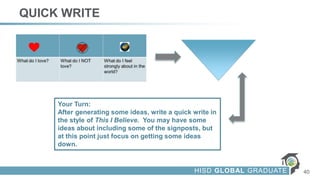
What do I love? What do I NOT love? What do I feel strongly about
in the world?
PRODUCE: PREWRITING
Michael Guevara, 2012
HISD GLOBAL GRADUATE
my family
running
music
people hurting other people
racism
running injuries
2016 Presidential Election
climate change
PRODUCE: PREWRITING
Michael Guevara, 2012
HISD GLOBAL GRADUATE
music
listening to music when stressed
listening to the Beatles as
I drove to work
as an assistant
principal
38
PREWRITING: INVERTED TRIANGLE
General
Specific
HISD GLOBAL GRADUATE 39
YOU TRY IT: INVERTED TRIANGLE
General
Specific
HISD GLOBAL GRADUATE 40
QUICK WRITE
Your Turn:
After generating some ideas, write a quick write in
the style of This I Believe. You may have some
ideas about including some of the signposts, but
at this point just focus on getting some ideas
down.
HISD GLOBAL GRADUATE
Numbers and
Stats
Might I include
numbers? How
might these
affect my reader?
41
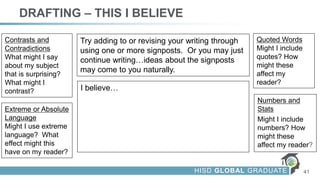
I believe…
Try adding to or revising your writing through
using one or more signposts. Or you may just
continue writing…ideas about the signposts
may come to you naturally.
Quoted Words
Might I include
quotes? How
might these
affect my
reader?
Contrasts and
Contradictions
What might I say
about my subject
that is surprising?
What might I
contrast?
Extreme or Absolute
Language
Might I use extreme
language? What
effect might this
have on my reader?
DRAFTING – THIS I BELIEVE
HISD GLOBAL GRADUATE
How did writing with the signposts in mind
impact your thinking and work?
42
REFLECTION
HISD GLOBAL GRADUATE
• Writing through Notice & Note signposts should
not become a formulaic worksheet.
• Rather, students need to think about their
choices as writers and their effects on the
reader.
• Will it work for my piece to include numbers?
What numbers might be effective?
43
POINTS TO CONSIDER
HISD GLOBAL GRADUATE
• Do we read through the lens of
all the signposts before writing?
• Do we alternate between
reading a writing through one
signpost at a time?
44
ADDITIONAL POINTS TO CONSIDER
Reading
through all
signposts
Writing
through all
signposts
Reading
C&C
Writing
C&C
Reading
Extreme
Lang.
Writing
through
Extreme
Lang.
Reading
Quoted
Words
Writing
Quoted
Words
Reading
Numbers
Writing
Numbers
HISD GLOBAL GRADUATE
• Writing through Notice & Note doesn’t
solve everything. Rather, it might live
within writer’s workshop.
• You still might employ your writer’s
workshop mini-lessons: show don’t tell,
sentence fluency, etc.
45
ADDITIONAL POINTS TO CONSIDER
HISD GLOBAL GRADUATE
• What are you thinking or wondering about
writing through the lens of Notice & Note?
46
QUESTIONS AND IDEAS
HISD GLOBAL GRADUATE
Units of writing through
Notice & Note are
available in ESOL I
and II Master Courses:
ESOL I Unit 2: Fiction
ESOL I Unit 3: Expository
ESOL II Unit 2: Fiction
ESOL II Unit 4: Expository
47
WRITING THROUGH NOTICE & NOTE UNITS: ESOL I &
II
HISD GLOBAL GRADUATE 48
FURTHER READING
HISD GLOBAL GRADUATE
THANK YOU!
STEPHEN WINTON
SWINTON@HOUSTONISD.ORG

Writing Through The Signposts

  • 1.
    HISD GLOBAL GRADUATE WritingThrough the Lens of Beers and Probst’s Notice & Note
  • 2.
    HISD GLOBAL GRADUATE •Be present in the work • Take care of personal needs • Be considerate of “air time” • Ask questions and share insight • Have fun! 2 NORMS
  • 3.
    HISD GLOBAL GRADUATE3 HOW IS OUR READING CONNECTED TO OUR WRITING? Objective: Today, we will explore the reading and writing connection utilizing the Beers and Probst’s Notice & Note. -How do you connect reading instruction with drafting and/or revision instruction? -How do you help students find style and voice in their writing?
  • 4.
    HISD GLOBAL GRADUATE4 WHERE IN THE WORLD IS THE FIVE PARAGRAPH ESSAY? “As for five-paragraph themes, I have been looking for one in published materials ever since I began teaching in 1958, and I am still looking.” Edgar Schuster, “On the Necessity for Subversion,” 2004.
  • 5.
    HISD GLOBAL GRADUATE •We learn to write by noticing what published writers do, then trying this in our own writing. • The teacher should model this process by writing alongside students. THOUGHTS ON TEACHING WRITING
  • 6.
    HISD GLOBAL GRADUATE •“Before revision, vision” • “What have you read that is like what you are trying to write?” Study Driven, p. 35 6 KATIE WOOD RAY
  • 7.
    HISD GLOBAL GRADUATE JohnO’Flahavan What Readers and Writers Do Consume Read many examples of the type of writing you will write. Notice the characteristics of the genre and the choices of the writers. Critique Reflect upon the choices of the writers and the effect on the reader. Produce Utilize the close study to make informed choices as a writer. 7 O’FLAHAVAN: CONSUME, CRITIQUE, PRODUCE
  • 8.
    HISD GLOBAL GRADUATE8 WOOD RAY: MUST HAVE, MIGHT HAVE, WON’T HAVE A CCP of This I Believe Essays Students read many examples from the genre and notice what the genre must have, might have, and won’t have. Must haves and won’t haves are genre characteristics. Might haves are author’s craft choices.
  • 9.
    HISD GLOBAL GRADUATE9 ENTER NOTICE AND NOTE Beers and Probst offer signposts of specific author’s craft moves to notice and note.
  • 10.
    HISD GLOBAL GRADUATE10 THE SOURCE OF THE SIGNPOSTS
  • 11.
    HISD GLOBAL GRADUATE11 THUS, THE SIGNPOSTS Signposts focus on one common author’s craft move. They ask the reader to analyze why the author included this and what is the effect on the reader.
  • 12.
    HISD GLOBAL GRADUATE12 THE SIGNPOSTS • Contrasts and Contradictions • Extreme or Absolute Language • Quoted Words • Numbers and Stats • Contrasts and Contradictions • Tough Questions • Aha Moment • Again and Again • Words of the Wiser • Memory Moment
  • 13.
    HISD GLOBAL GRADUATE13 AHA MOMENT If the signposts are author’s craft moves that come up again and again, could these not be used to teach writing? After students consume and critique text through the signposts, they might try using these author’s craft moves in their writing.
  • 14.
    HISD GLOBAL GRADUATE14 COULD NOT THE SIGNPOSTS BE USED TO TEACH WRITING? Pure InquiryFormulaic Writing • Notice & note the signpost in reading • Try the signpost out in our writing
  • 15.
    HISD GLOBAL GRADUATE15 A GENRE TO EXPLORE THROUGH THE SIGNPOSTS Imagine we wanted our students to explore a CCP of the genre This I Believe. We might first read many examples through the lens of the nonfiction signposts, then try these moves out in our writing.
  • 16.
    HISD GLOBAL GRADUATE16 A TEXT TO EXPLORE THROUGH THE SIGNPOSTS
  • 17.
    HISD GLOBAL GRADUATE17 CONTRASTS AND CONTRADICTIONS “I believe that we should talk to strangers. By engaging in unexpected, friendly conversation with strangers, our lives can be affected in ways that are extraordinary. I learned this valuable and life-changing experience during my sophomore year of college.”
  • 18.
    HISD GLOBAL GRADUATE18 EXTREME OR ABSOLUTE LANGUAGE “I believe that we should talk to strangers. By engaging in unexpected, friendly conversation with strangers, our lives can be affected in ways that are extraordinary. I learned this valuable and life-changing experience during my sophomore year of college.”
  • 19.
    HISD GLOBAL GRADUATE19 NUMBERS & STATS “One night, a little old man, probably in his eighties, came in and sat in my section. I took his order and went on my way.”
  • 20.
    HISD GLOBAL GRADUATE20 QUOTED WORDS “Growing up, I was used to phrases such as, ‘Don’t talk to strangers’ and ‘Mind your own business.’ At the hospital, the nurses always asked, ‘Are you his daughter?’ and I always replied, ‘No, I’m his waitress.’”
  • 21.
    HISD GLOBAL GRADUATE21 STUDENTS’ THOUGHTS
  • 22.
    HISD GLOBAL GRADUATE22 WRITING THROUGH N&N CAN LIVE WITHIN CCP-
  • 23.
    HISD GLOBAL GRADUATE23 STUDENTS’ EXPLORE MUST HAVE, MIGHT HAVE, WON’T HAVE
  • 24.
    HISD GLOBAL GRADUATE Now,we will show how the teacher can model writing their own This I Believe essay through the signposts. 24 I DO: TEACHER MODELING WRITING THROUGH SIGNPOSTS
  • 25.
    HISD GLOBAL GRADUATE25 I DO: CONTRASTS AND CONTRADICTIONS Music is as important to life as eating, drinking, breathing, or sleeping. Music, like food and drink, fills our hunger and thirst for beauty and meaning. Music, like air, keeps us going when we have to work hard. Music, like sleep, offers a rest when times are tough. What might I say about my subject that is surprising? What might I contrast?
  • 26.
    HISD GLOBAL GRADUATE26 I DO: CONTRASTS AND CONTRADICTIONS Everybody has a moment where music helped them through dark times. I remember my old job as an Assistant Principal of a school. I was in charge of academics, meaning the teaching. The other assistant principal, Ms. King, had a baby and was gone for weeks, so I was in charge of both the teaching and the discipline. Every time a fight broke out I had to stop what I was doing to help the students and try to get them to make peace. As I went to work every morning I fought to turn the car around and jump back into bed. I would play my favorite band, the Beatles, and for those few minutes in the car I didn’t have to think of all that might go wrong during the day. What might I say about my subject that is surprising? What might I contrast?
  • 27.
    HISD GLOBAL GRADUATE27 EXTREME OR ABSOLUTE LANGUAGE Without music, your soul is like a starving man, slowly getting thinner and weaker, a drowning man, gasping for air, a man who hasn’t slept for days, slowly going crazy. Of course, a starving man would rather have food than a song. But as food keeps our bodies alive, music keeps our hopes alive. Might I use extreme language? What effect might this have on my reader?
  • 28.
    HISD GLOBAL GRADUATE Musicis as important to life as eating, drinking, breathing, or sleeping. Music, like food and drink, fills our hunger and thirst for beauty and meaning. Music, like air, keeps us going when we have to work hard. Music, like sleep, offers a rest when times are tough. Without music, your soul is like a starving man, slowly getting thinner and weaker, a drowning man, gasping for air, a man who hasn’t slept for days, slowly going crazy. Of course, a starving man would rather have food than a song. But as food keeps our bodies alive, music keeps our hopes alive. Everybody has a moment where music helped them through dark times. I remember my old job as an Assistant Principal of a school. I was in charge of academics, meaning the teaching. The other assistant principal, Ms. King, had a baby and was gone for weeks, so I was in charge of both the teaching and the discipline. Every time a fight broke out I had to stop what I was doing to help the students and try to get them to make peace. As I went to work every morning I fought to turn the car around and jump back into bed. I would play my favorite band, the Beatles, and for those few minutes in the car I didn’t have to think of all that might go wrong during the day. 28 MAKING CHOICES ABOUT ORGANIZATION-
  • 29.
    HISD GLOBAL GRADUATE29 I DO: QUOTED WORDS Michael Stipe of REM sang, “When your day is long / And the night, the night is yours alone / When you're sure you've had enough / Of this life, well hang on / Because everybody hurts.” Songfacts notes, “The Nevada legislature commended R.E.M. for "encouraging the prevention of teen suicides," noting ‘Everybody Hurts’ as an example. Nevada has a high rate of teen suicide.” Might I include quotes? How might these affect my reader?
  • 30.
    HISD GLOBAL GRADUATE30 I DO: NUMBERS & STATS No one knows how many people songs like “Everybody Hurts” have saved. Techcrunch states that over seven million songs are downloaded from ITunes each day. Each one of those seven million songs means something to the person who downloaded it. Each song could offer deep meaning or save a life. Might I include numbers? How might these affect my reader?
  • 31.
    HISD GLOBAL GRADUATE MustHave a Position / Thesis: Some form of “I believe” statement... 31 MUST HAVE: “I BELIEVE…” I believe music is what keeps us alive because it speaks to our soul when life is dark. Right now there is a teenager alone in her room, going through horrible pain, listening to music through her headphones. The music she loves is as important as anything else in her life this moment. When your life is at its low point, it is music that can lift you up.
  • 32.
    HISD GLOBAL GRADUATE32 PUTTING IT ALL TOGETHER
  • 33.
    HISD GLOBAL GRADUATE33 WE DO: STUDENTS FIRST TURN AND TALK ABOUT IDEAS
  • 34.
    HISD GLOBAL GRADUATE34 STUDENTS’ WRITING THROUGH THE SIGNPOSTS
  • 35.
    HISD GLOBAL GRADUATE Nowyou will have a chance to practice writing through the signposts. 35 WE DO: DRAFTING – THIS I BELIEVE
  • 36.
    HISD GLOBAL GRADUATE Whatdo I love? What do I NOT love? What do I feel strongly about in the world? PRODUCE: PREWRITING Michael Guevara, 2012
  • 37.
    HISD GLOBAL GRADUATE myfamily running music people hurting other people racism running injuries 2016 Presidential Election climate change PRODUCE: PREWRITING Michael Guevara, 2012
  • 38.
    HISD GLOBAL GRADUATE music listeningto music when stressed listening to the Beatles as I drove to work as an assistant principal 38 PREWRITING: INVERTED TRIANGLE General Specific
  • 39.
    HISD GLOBAL GRADUATE39 YOU TRY IT: INVERTED TRIANGLE General Specific
  • 40.
    HISD GLOBAL GRADUATE40 QUICK WRITE Your Turn: After generating some ideas, write a quick write in the style of This I Believe. You may have some ideas about including some of the signposts, but at this point just focus on getting some ideas down.
  • 41.
    HISD GLOBAL GRADUATE Numbersand Stats Might I include numbers? How might these affect my reader? 41 I believe… Try adding to or revising your writing through using one or more signposts. Or you may just continue writing…ideas about the signposts may come to you naturally. Quoted Words Might I include quotes? How might these affect my reader? Contrasts and Contradictions What might I say about my subject that is surprising? What might I contrast? Extreme or Absolute Language Might I use extreme language? What effect might this have on my reader? DRAFTING – THIS I BELIEVE
  • 42.
    HISD GLOBAL GRADUATE Howdid writing with the signposts in mind impact your thinking and work? 42 REFLECTION
  • 43.
    HISD GLOBAL GRADUATE •Writing through Notice & Note signposts should not become a formulaic worksheet. • Rather, students need to think about their choices as writers and their effects on the reader. • Will it work for my piece to include numbers? What numbers might be effective? 43 POINTS TO CONSIDER
  • 44.
    HISD GLOBAL GRADUATE •Do we read through the lens of all the signposts before writing? • Do we alternate between reading a writing through one signpost at a time? 44 ADDITIONAL POINTS TO CONSIDER Reading through all signposts Writing through all signposts Reading C&C Writing C&C Reading Extreme Lang. Writing through Extreme Lang. Reading Quoted Words Writing Quoted Words Reading Numbers Writing Numbers
  • 45.
    HISD GLOBAL GRADUATE •Writing through Notice & Note doesn’t solve everything. Rather, it might live within writer’s workshop. • You still might employ your writer’s workshop mini-lessons: show don’t tell, sentence fluency, etc. 45 ADDITIONAL POINTS TO CONSIDER
  • 46.
    HISD GLOBAL GRADUATE •What are you thinking or wondering about writing through the lens of Notice & Note? 46 QUESTIONS AND IDEAS
  • 47.
    HISD GLOBAL GRADUATE Unitsof writing through Notice & Note are available in ESOL I and II Master Courses: ESOL I Unit 2: Fiction ESOL I Unit 3: Expository ESOL II Unit 2: Fiction ESOL II Unit 4: Expository 47 WRITING THROUGH NOTICE & NOTE UNITS: ESOL I & II
  • 48.
    HISD GLOBAL GRADUATE48 FURTHER READING
  • 49.
    HISD GLOBAL GRADUATE THANKYOU! STEPHEN WINTON SWINTON@HOUSTONISD.ORG

Editor's Notes

  • #2 Welcome and Introductions (2 minutes)   Note: Explain to participants that all of the information and resources shared during this professional development will be housed In the HUB course titled Secondary Curriculum and Development in a folder titled Jan. 25th Early Dismissal PD for MS and HS
  • #3 (1 minute) Say: Here are our norms Read the slide.
  • #4 (2 minutes) Read the objective that is located at the top of the slide. Say: Let’s think about how our reading is connected to our writing. Engage participants in a “turn and talk” (read questions on the slide). Allow a few participants to share whole group.
  • #5 (1 minute) Say: Teachers often don’t have the support to make the reading and writing connection early in their careers. Formulaic writing is easy to deliver but is often problematic because these formulas rarely appear in published work. Select a participant to read the quote at the bottom of the slide.
  • #6 (1 minute) Say: Here are some key points to remember about writing. Read the slide (the facilitator can add thoughts here if necessary).
  • #7 (1 minute) Say: In order for students to successfully write a particular genre, students need to read many examples of the genre to build a vision. Author and researcher, Katie Wood Ray says, “Before revision, vision.” “What have you read that is like what you are trying to write?”  
  • #8 (1 minute) Say: Similar to Katie Wood Ray, John O’Flahaven talks about the reading and writing connection with his theory consume, critique, produce which is also referred to as CCP. Say You might remember consume, critique, produce from the Literacy in the Middle summer training and how it is embedded in the master courses.   Read each of the three stages followed by its definition. Add your own thinking if necessary
  • #9 (2 minute) Say: You might also remember from Literacy in the Middle how students might create a Must Have, Might Have, Won’t Have chart as part of CCP.   Say: Here is an example of a student created Must Have, Might Have, Won’t Have chart for This I Believe essays.   Say: For example, the students noticed from their text set that This I Believe essays must have ideas and evidence, might have counter arguments, and won’t have fictional elements. (these are just examples).
  • #10 (1 minute) Say: Where does Notice and Note fit into all of this?   Say: Beers and Probst offer signposts of specific author’s craft moves to notice and note.   Say: These author’s crafts moves might become part of the Must Have, Might Have, and Won’t Have chart that we just reviewed.
  • #11 (2 minutes) Say: Let’s listen to Beers and Probst discuss how they created the Signposts.   Play video.
  • #12 (1 minute) Say: Tough Questions is an example of one of the Signposts.   Read slide (left to right)
  • #13 (1 minute) Say: Beers and Probst created Signposts for both Fiction and Non-fiction. Today, we will focus on the Non-fiction Signposts.
  • #14 (1 minute) Read slide.
  • #15 (1 minute) Say: Using the signposts to make the reading and writing connection offers a nice middle ground for formulaic writing and pure inquiry. For example, Katie Wood Ray would suggest that students look at a text set and notice whatever it is they notice. This could be challenging for a teachers who are beginning to use CCP (Consume, Critique, Produce).   Say: The Signposts offers specific things to notice in our reading and in our writing.
  • #16 (1 minute) Say: Read slide.
  • #17 (5 minutes) Say: Let’s listen to Sabrina Dubik’s This I Believe Statement titled Do Talk to Strangers, and as we read keep in mind the signpost of Contrast and Contradictions.   Read the Contrast and Contradictions chart to the right.   Say: As you are reading if you notice something surprising or a difference between two things, annotate the text with CC. Play the audio (start the audio at 46 seconds into the recording and allow it to play until it its entirety.
  • #18 The total time allotment for this slide is 4 ½ minutes, please see the breakdown below. Say: One surprising thing that I noticed is the very first sentence, I believe you should talk to strangers. This is opposite of the common advice not to talk to strangers. (1 minute)   Say: Turn and talk to your neighbor about what you are thinking about this contrast and contradiction or others you noticed. (1 1/2 minutes)   Allow participants to share out. (2 minute)
  • #19 The total time allotment for this slide is 4 ½ minutes, please see the breakdown below. Say: Another signpost is extreme absolute language.   Read the Extreme Absolute Language anchor chart to the left.   Read the quote from the text. (1 minute)   Ask participants to turn and talk to their neighbor about why the author used such strong language. (1 ½ minutes)   Allow participants to share out. (2 minutes)
  • #20 The total time allotment for this slide is 4 ½ minutes, please see the breakdown below. Say: Another signpost is Numbers and Stats.   Read the Numbers and Stats anchor chart to the left.   Read the quote from the text.   (Give approximately 3 ½ minutes for these steps) Say: The author could have just referred to the custom as a little old man. Ask: Why do you think he focused on his specific age of being in his 80’s?   Allow participants to turn and talk and share out.
  • #21 The total time allotment for this slide is 4 ½ minutes, please see the breakdown below. Say: Quoted Words is another signpost.   Read the Quoted Words anchor chart to the left.   Read the quote from the text.   Say: Authors select quotes very purposefully.   Ask: Why do you think the author used these quoted words and what are the effects they have on the reader?   Ask participants to turn and talk and share out.  
  • #22 (2 minutes) Say: Here is a video of some students analyzing the same text we have just read through contrast and contradictions. (Play video)
  • #23 (1 minute) Say: The Notice and Note Signposts are not the only things we might notice in the Must Have, Might Have, Won’t Have chart. For example, students noticed the essay must have a position statement.
  • #24 (1 minute) Say: Here’s an example of students exploring what This I Believe essays must have, might have, and won’t have. Notice students include the signposts in their discussion. (Play video)
  • #25 24-29: Teacher Modeling of Writing Through the Signposts (I Do)- (1 minute) Read the slide as is. Note: Here the facilitator will model writing a This I Believe essay using the Signposts, just as the teacher would model writing in their classroom. You may utilize the sample provided in the powerpoint, or you may write your own.
  • #26 (1 minute) Say: After we have read examples through the Signposts, the teacher might model writing through the signposts for the students. For example, a teacher might reflect on writing through contrast and contradictions.   Say: My topic is the importance of music (change the topic if you choose to use your own).   Say: First, I thought about what is surprising about the topic of music.   Read the excerpt from the essay to the right.
  • #27 (2 minutes) Say: Then I thought about contrasting two things.   Read the excerpt from the essay to the right.   Note: Given enough time, have participants to engage in a turn and talk about the impact of the author’s choices on the reader.
  • #28 (1 minute) Say: Then I thought about adding Extreme or Absolute Language.   Read the questions and the excerpt from the essay to the right.  Note: Given enough time, have participants to engage in a turn and talk about the impact of the author’s choices on the reader.
  • #29 (1 minute) Say: Then we add new writing to the piece. We make choices about where it best fits.   Say: For example, I thought the extreme language would best fit between the opening ideas and the examples.
  • #30 (1 minute) Say: Then I thought about adding Quoted Words.   Read the questions and the excerpt from the essay to the right.   Note: Given enough time, have participants to engage in a turn and talk about the impact of the author’s choices on the reader.
  • #31 (1 minute) Say: Then I thought about adding Numbers and Stats.   Read the questions and the excerpt from the essay to the right.   Note: Given enough time, have participants to engage in a turn and talk about the impact of the author’s choices on the reader.
  • #32 (1 minute) Say: I thought what my position might be: read the quote from the slide to the right.   Say: Notice when we start thinking about the signposts, they often influence our writing. Notice the last sentence contains a contrast and contradiction.
  • #33 (1 minute) Say: Notice how using the four signposts helped to create a complete essay.
  • #34 Slides 33-36: Participants Write (We Do and You Do) (2 minutes) Say: Before students begin writing their own essays it is helpful for them to talk to each other about possible signposts they might include in their writing.   Say: Note, students should have a choice about whether or not including each signpost works in their writing. Here is an example of such talk. (Play video
  • #35 (1 minute) Say: Here are examples of student writing that included the signposts. (Play video)
  • #36 (1 minute) Say: Now you will have a chance to practice writing through the signposts.
  • #37 (1 minutes) Say: Let’s think about planning a This I Believe style essay. One way to prewrite is to think about things you love, things you don’t love, or things that interest you in the world. This chart helps to focus on what the writer feels passionately about.
  • #38 (1 minutes) Note: Offer some examples to model using the Love, Dislike, and World chart. You may use the examples on this slide or use examples of your own.
  • #39 (1 minutes) Say: Using an inverted triangle helps narrow the topic. If the topic is too broad, then there is too much to focus on. Focused topics lead to specificity in writing. You start with a big idea at the top and narrow it down.   Note: The facilitator models narrowing a topic or uses this example.
  • #40 1 minutes) Say: In a moment you might use the inverted triangle to narrow down the topic you choose for your This I Believe essay.
  • #41 (6 minutes) Say: Now we will do some writing for a This I Believe essay. You might utilize the Love, Dislike and World and the Inverted Triangle graphic organizers. Or, if you feel that you are ready you may immediately begin drafting writing about something you believe in.   Say: You focus should be just to get some ideas down and you need not focus on including signposts at this point but some of the ideas that we have shared about the signposts may naturally find their way into your writing. Note: Give participants 5 minutes to write.
  • #42 (7 minutes) Say: Now let’s revisit some of the witting we’ve done and focus on the signposts. Think about the wiring you have done, turn and talk to your neighbor about the following question: How might you add to or revise what you have written thinking about either contrast or contradictions, extreme or absolute language, quoted words, or numbers and stats.   Note: Give participants a minute of two to turn and talk then instruct participants to spend 3 or 4 minutes writing. Instruct participants that they don’t have to continue writing about the signposts, which is a choice they can make.
  • #43 (2 minute) -Ask participants the question on the slide (read slide) -Allow them to turn and talk with a neighbor or group about their Response, and select a few participants to share out.
  • #44 Sides 43-45: Points to Consider (1 minute) Read the slide’s title and share the bulleted points.
  • #45 (2 minutes) Say: If you are thinking about planning a unit of study, making the reading writing connection through the signposts there are a couple of options.   Say: First, you might read through all of the signposts before writing through all of the signposts, or you might alternate back and forth by reading and writing one signpost at a time.   Say: The first version has an advantage of a deep study of reading before writing. The second allow student to immediately apply each signpost in their writing and incorporate reading and writing each week.
  • #46 (1 minute) Read the slide’s title and share the bulleted points.
  • #47 *The total time allotment for this slide is 3 ½ minutes, please see the breakdown below. Say: Turn and talk about the question (approximately 2 minutes for this discussion). Select a few participants to share whole group. (1 1/2 minute)  
  • #48 Slide 47: Reference materials in the HUB. (1 1/2 minute) Say: Units of writing through notice and note are available through the ESOL 1 and 2 Master Courses: ESOL 1- Unit 2 Fiction ESOL 1- Unit 3 Expository ESOL 2- Unit 2 Fiction ESOL 2- Unit 4 Expository.   Note: The facilitator may reference any lessons in the ELA Master Courses focusing on Witting Through the Signposts
  • #49 (1/2 minute) Say: We have included an article about writing through the lens of notice and note in your participant’s guide.
  • #50 *Thank the participants and dismiss them.