






Back to BasicsReading Between the LinesCarol JagoHard Core Bard Core March 26, 2011
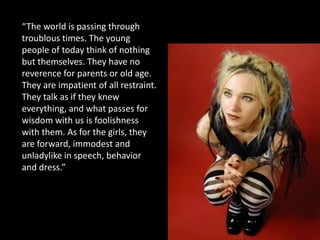
“The world is passing through troublous times. The young people of today think of nothing but themselves. They have no reverence for parents or old age. They are impatient of all restraint. They talk as if they knew everything, and what passes for wisdom with us is foolishness with them. As for the girls, they are forward, immodest and unladylike in speech, behavior and dress.”
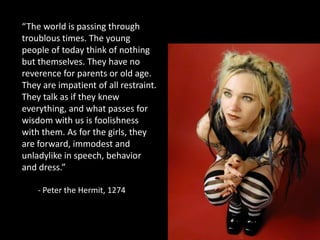
“The world is passing through troublous times. The young people of today think of nothing but themselves. They have no reverence for parents or old age. They are impatient of all restraint. They talk as if they knew everything, and what passes for wisdom with us is foolishness with them. As for the girls, they are forward, immodest and unladylike in speech, behavior and dress.”	- Peter the Hermit, 1274
Teenagers are sending on average 100 text messages a day – 3,000 a month.
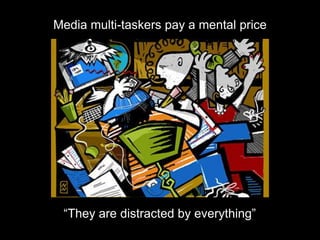
Media multi-taskers pay a mental price“They are distracted by everything”
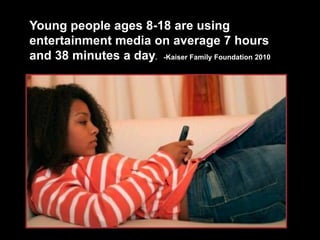
Young people ages 8-18 are using entertainment media on average 7 hours and 38 minutes a day.   -Kaiser Family Foundation 2010
Teaching ScreenagersComplex texts require single-tasking, an unbroken and unbothered focus. Students need to “downshift” to read demanding literature and nonfiction.- Mark Bauerlein, “Too Dumb for Complex Texts?” Educational Leadership, February 2011
Computer and video games are fulfilling genuine human needs that the real world is currently unable to satisfy. Games are providing rewards that reality is not. They are teaching and inspiring in ways that reality is not. They are bringing us together in ways that reality is not.
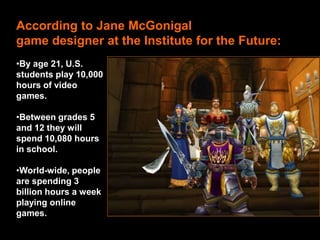
According to Jane McGonigalgame designer at the Institute for the Future:By age 21, U.S. students play 10,000 hours of video games.
Between grades 5 and 12 they will spend 10,080 hours in school.
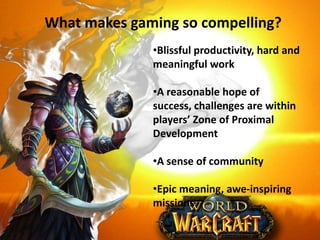
World-wide, people are spending 3 billion hours a week playing online games.What makes gaming so compelling?Blissful productivity, hard and meaningful work
A reasonable hope of success, challenges are within players’ Zone of Proximal Development
A sense of community
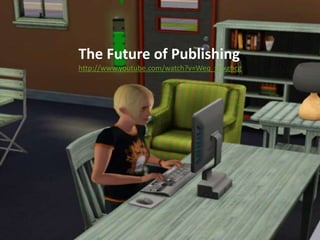
Epic meaning, awe-inspiring missionsThe Future of Publishinghttp://www.youtube.com/watch?v=Weq_sHxghcg  
How can we make schoolwork compelling?How can we make schoolwork “blissfully productive”? Blissful productivity, hard and meaningful work
A reasonable hope of success, challenges are within players’ Zone of Proximal Development
A sense of community
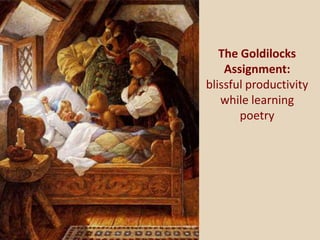
Epic meaning, awe-inspiring missionsThe Goldilocks Assignment: blissful productivity while learning poetry
Common Core Standards Onlinehttp://www.corestandards.org/the-standards
“Life Doesn’t Frighten Me” by Maya Angelou
Shared responsibility for students’ literacy development The Standards insist that instruction in reading, writing, speaking, listening, and language be a shared responsibility within the school.The K-5 standards include expectations for reading, writing, speaking, listening, and language applicable to a range of subjects, including but not limited to ELA.The grades 6-12 standards are divided into two sections, one for ELA and the other for history/social studies, science, and technical subjects.
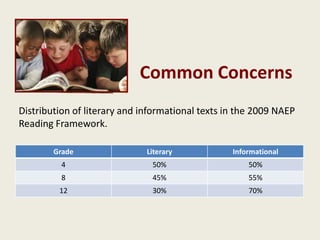
Common ConcernsDistribution of literary and informational texts in the 2009 NAEP Reading Framework.
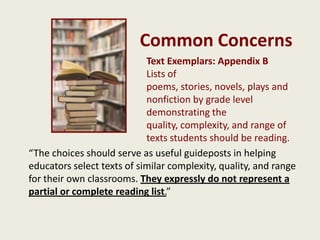
Common ConcernsText Exemplars: Appendix BLists of poems, stories, novels, plays and nonfiction by grade level demonstrating the quality, complexity, and range of texts students should be reading.“The choices should serve as useful guideposts in helping educators select texts of similar complexity, quality, and range for their own classrooms. They expressly do not represent a partial or complete reading list.”
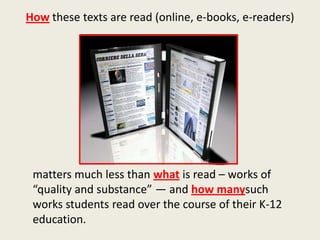
How these texts are read (online, e-books, e-readers) matters much less than what is read – works of “quality and substance” — and how manysuch works students read over the course of their K-12 education.
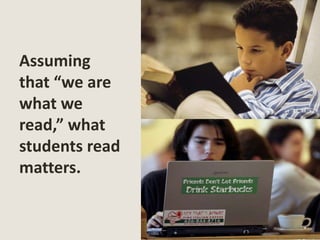
Assuming that “we are what we read,” what students read matters.
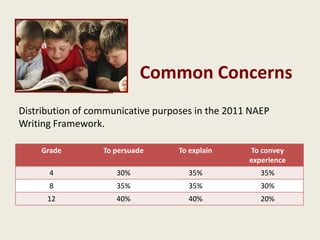
Common ConcernsDistribution of communicative purposes in the 2011 NAEP Writing Framework.
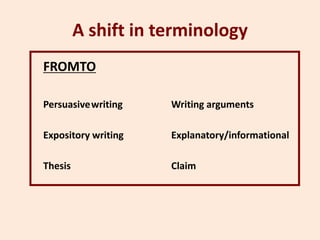
Common Core Writing Standards Write arguments to support claims in an analysis of substantive topics or texts, using valid reasoning and relevant and sufficient evidence.Common Core Writing Standards Write informative/explanatory texts to examine and convey complex ideas and information clearly and accurately through the effective selection, organization, and analysis of content.Common Core Writing Standards Write narratives to develop real or imagined experiences or events using effective technique, well-chosen details, and well-structured event sequences.A shift in terminologyFROMTOPersuasive	writing				Writing argumentsExpository writing			Explanatory/informationalThesis							Claim
	“What we need is to infuse the work around the common core with an element of visionary thinking. The standards themselves do not confine teaching to the realm of the scripted or undemocratic, but without serious reflection and rethinking, they will. The balance depends on our collective ability to come to terms with the standards and to use them as an opportunity for reflection and growth. Let us hope that we can muster the courage and energy to do so.”						- Sarah Fine, Education Week, Oct. 20, 2010
Back to BasicsReading Between the LinesCarol JagoHard Core Bard Core March 26, 2011
I want to make good citizens. If a child hears fine music from the day of his birth and learns to play it himself, he develops sensitivity, discipline and endurance. He gets a beautiful heart.—Shin'ichi Suzuki
Suzuki MethodImmersionEncouragementSmall stepsImitate examplesInternalize principlesContribute novel ideas
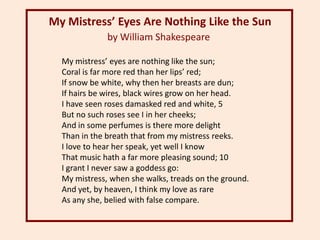
My Mistress’ Eyes Are Nothing Like the Sun by William Shakespeare My mistress’ eyes are nothing like the sun;Coral is far more red than her lips’ red;If snow be white, why then her breasts are dun;If hairs be wires, black wires grow on her head.I have seen roses damasked red and white, 5But no such roses see I in her cheeks;And in some perfumes is there more delightThan in the breath that from my mistress reeks.I love to hear her speak, yet well I knowThat music hath a far more pleasing sound; 10I grant I never saw a goddess go:My mistress, when she walks, treads on the ground.And yet, by heaven, I think my love as rareAs any she, belied with false compare.
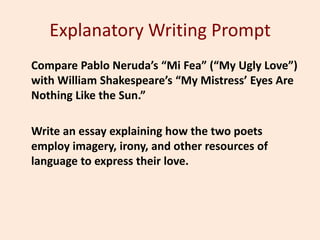
Explanatory Writing Prompt	Compare Pablo Neruda’s “Mi Fea” (“My Ugly Love”) with William Shakespeare’s “My Mistress’ Eyes Are Nothing Like the Sun.”	Write an essay explaining how the two poets employ imagery, irony, and other resources of language to express their love.
ACT cover
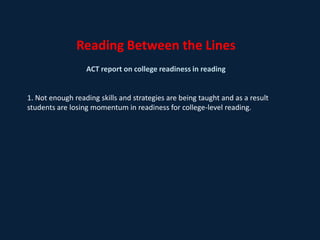
Reading Between the LinesACT report on college readiness in reading 1. Not enough reading skills and strategies are being taught and as a result students are losing momentum in readiness for college-level reading.
Reading Between the LinesACT report on college readiness in reading 2. Performance on complex texts is the clearest differentiator in reading between students who are more likely to be ready for college and those who are less likely to be ready.
Reading Between the LinesACT report on college readiness in reading 3. A complex text will contain multiple layers of meaning, not all of which will be immediately apparent to students upon a single superficial reading. Such texts require students to work at unlocking meaning by calling upon sophisticated reading skills and strategies.
Framework for Success in Postsecondary Writing
Habits of Mind- Curiosity- Openness- Engagement- Creativity- Persistence- Responsibility-Flexibility- Metacognition
Which of these “habits of mind” do your students most need work with?
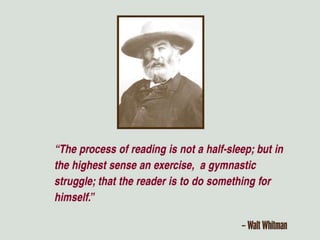
Walt Whitman
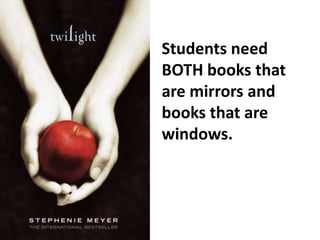
Students need BOTH books that are mirrors and books that are windows.
Every text …Every text is a lazy machine asking the reader to do some of its work.Umberto Eco
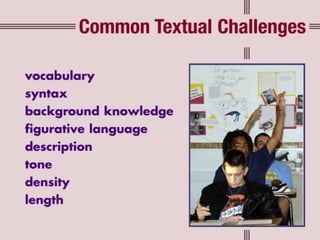
Common Textual Challenges
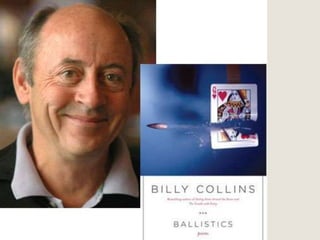
Introduction To Poetry by Billy CollinsI ask them to take a poemand hold it up to the light like a color slideor press an ear against its hive.I say drop a mouse into a poemand watch him probe his way out,or walk inside the poem's roomand feel the walls for a light switch.
I want them to water skiacross the surface of a poemwaving at the author's name on the shore.But all they want to dois tie the poem to a chair with ropeand torture a confession out of it.They begin beating it with a hoseto find out what it really means.  
	Reflect on some of the perplexing classroom issues you face every day. 	What ideas have you explored today that you might apply in your own teaching?
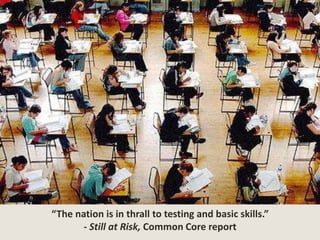
“The nation is in thrall to testing and basic skills.”- Still at Risk, Common Core report
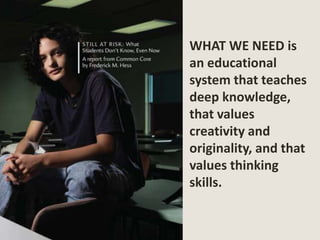
WHAT WE NEED is an educational system that teaches deep knowledge, that values creativity and originality, and that values thinking skills.

Chicago Shakespeare Hard Core Bard Core

  • 1.
    Back to BasicsReadingBetween the LinesCarol JagoHard Core Bard Core March 26, 2011
  • 2.
    “The world ispassing through troublous times. The young people of today think of nothing but themselves. They have no reverence for parents or old age. They are impatient of all restraint. They talk as if they knew everything, and what passes for wisdom with us is foolishness with them. As for the girls, they are forward, immodest and unladylike in speech, behavior and dress.”
  • 3.
    “The world ispassing through troublous times. The young people of today think of nothing but themselves. They have no reverence for parents or old age. They are impatient of all restraint. They talk as if they knew everything, and what passes for wisdom with us is foolishness with them. As for the girls, they are forward, immodest and unladylike in speech, behavior and dress.” - Peter the Hermit, 1274
  • 4.
    Teenagers are sendingon average 100 text messages a day – 3,000 a month.
  • 5.
    Media multi-taskers paya mental price“They are distracted by everything”
  • 6.
    Young people ages8-18 are using entertainment media on average 7 hours and 38 minutes a day. -Kaiser Family Foundation 2010
  • 7.
    Teaching ScreenagersComplex textsrequire single-tasking, an unbroken and unbothered focus. Students need to “downshift” to read demanding literature and nonfiction.- Mark Bauerlein, “Too Dumb for Complex Texts?” Educational Leadership, February 2011
  • 8.
    Computer and videogames are fulfilling genuine human needs that the real world is currently unable to satisfy. Games are providing rewards that reality is not. They are teaching and inspiring in ways that reality is not. They are bringing us together in ways that reality is not.
  • 9.
    According to JaneMcGonigalgame designer at the Institute for the Future:By age 21, U.S. students play 10,000 hours of video games.
  • 10.
    Between grades 5and 12 they will spend 10,080 hours in school.
  • 11.
    World-wide, people arespending 3 billion hours a week playing online games.What makes gaming so compelling?Blissful productivity, hard and meaningful work
  • 12.
    A reasonable hopeof success, challenges are within players’ Zone of Proximal Development
  • 13.
    A sense ofcommunity
  • 14.
    Epic meaning, awe-inspiringmissionsThe Future of Publishinghttp://www.youtube.com/watch?v=Weq_sHxghcg  
  • 15.
    How can wemake schoolwork compelling?How can we make schoolwork “blissfully productive”? Blissful productivity, hard and meaningful work
  • 16.
    A reasonable hopeof success, challenges are within players’ Zone of Proximal Development
  • 17.
    A sense ofcommunity
  • 18.
    Epic meaning, awe-inspiringmissionsThe Goldilocks Assignment: blissful productivity while learning poetry
  • 19.
    Common Core StandardsOnlinehttp://www.corestandards.org/the-standards
  • 21.
    “Life Doesn’t FrightenMe” by Maya Angelou
  • 22.
    Shared responsibility forstudents’ literacy development The Standards insist that instruction in reading, writing, speaking, listening, and language be a shared responsibility within the school.The K-5 standards include expectations for reading, writing, speaking, listening, and language applicable to a range of subjects, including but not limited to ELA.The grades 6-12 standards are divided into two sections, one for ELA and the other for history/social studies, science, and technical subjects.
  • 23.
    Common ConcernsDistribution ofliterary and informational texts in the 2009 NAEP Reading Framework.
  • 24.
    Common ConcernsText Exemplars:Appendix BLists of poems, stories, novels, plays and nonfiction by grade level demonstrating the quality, complexity, and range of texts students should be reading.“The choices should serve as useful guideposts in helping educators select texts of similar complexity, quality, and range for their own classrooms. They expressly do not represent a partial or complete reading list.”
  • 25.
    How these textsare read (online, e-books, e-readers) matters much less than what is read – works of “quality and substance” — and how manysuch works students read over the course of their K-12 education.
  • 26.
    Assuming that “weare what we read,” what students read matters.
  • 27.
    Common ConcernsDistribution ofcommunicative purposes in the 2011 NAEP Writing Framework.
  • 28.
    Common Core WritingStandards Write arguments to support claims in an analysis of substantive topics or texts, using valid reasoning and relevant and sufficient evidence.Common Core Writing Standards Write informative/explanatory texts to examine and convey complex ideas and information clearly and accurately through the effective selection, organization, and analysis of content.Common Core Writing Standards Write narratives to develop real or imagined experiences or events using effective technique, well-chosen details, and well-structured event sequences.A shift in terminologyFROMTOPersuasive writing Writing argumentsExpository writing Explanatory/informationalThesis Claim
  • 29.
    “What we needis to infuse the work around the common core with an element of visionary thinking. The standards themselves do not confine teaching to the realm of the scripted or undemocratic, but without serious reflection and rethinking, they will. The balance depends on our collective ability to come to terms with the standards and to use them as an opportunity for reflection and growth. Let us hope that we can muster the courage and energy to do so.” - Sarah Fine, Education Week, Oct. 20, 2010
  • 30.
    Back to BasicsReadingBetween the LinesCarol JagoHard Core Bard Core March 26, 2011
  • 31.
    I want tomake good citizens. If a child hears fine music from the day of his birth and learns to play it himself, he develops sensitivity, discipline and endurance. He gets a beautiful heart.—Shin'ichi Suzuki
  • 32.
    Suzuki MethodImmersionEncouragementSmall stepsImitateexamplesInternalize principlesContribute novel ideas
  • 36.
    My Mistress’ EyesAre Nothing Like the Sun by William Shakespeare My mistress’ eyes are nothing like the sun;Coral is far more red than her lips’ red;If snow be white, why then her breasts are dun;If hairs be wires, black wires grow on her head.I have seen roses damasked red and white, 5But no such roses see I in her cheeks;And in some perfumes is there more delightThan in the breath that from my mistress reeks.I love to hear her speak, yet well I knowThat music hath a far more pleasing sound; 10I grant I never saw a goddess go:My mistress, when she walks, treads on the ground.And yet, by heaven, I think my love as rareAs any she, belied with false compare.
  • 37.
    Explanatory Writing Prompt ComparePablo Neruda’s “Mi Fea” (“My Ugly Love”) with William Shakespeare’s “My Mistress’ Eyes Are Nothing Like the Sun.” Write an essay explaining how the two poets employ imagery, irony, and other resources of language to express their love.
  • 39.
  • 40.
    Reading Between theLinesACT report on college readiness in reading 1. Not enough reading skills and strategies are being taught and as a result students are losing momentum in readiness for college-level reading.
  • 41.
    Reading Between theLinesACT report on college readiness in reading 2. Performance on complex texts is the clearest differentiator in reading between students who are more likely to be ready for college and those who are less likely to be ready.
  • 42.
    Reading Between theLinesACT report on college readiness in reading 3. A complex text will contain multiple layers of meaning, not all of which will be immediately apparent to students upon a single superficial reading. Such texts require students to work at unlocking meaning by calling upon sophisticated reading skills and strategies.
  • 43.
    Framework for Successin Postsecondary Writing
  • 44.
    Habits of Mind-Curiosity- Openness- Engagement- Creativity- Persistence- Responsibility-Flexibility- Metacognition
  • 45.
    Which of these“habits of mind” do your students most need work with?
  • 46.
  • 47.
    Students need BOTHbooks that are mirrors and books that are windows.
  • 48.
    Every text …Everytext is a lazy machine asking the reader to do some of its work.Umberto Eco
  • 49.
  • 51.
    Introduction To Poetryby Billy CollinsI ask them to take a poemand hold it up to the light like a color slideor press an ear against its hive.I say drop a mouse into a poemand watch him probe his way out,or walk inside the poem's roomand feel the walls for a light switch.
  • 52.
    I want themto water skiacross the surface of a poemwaving at the author's name on the shore.But all they want to dois tie the poem to a chair with ropeand torture a confession out of it.They begin beating it with a hoseto find out what it really means.  
  • 53.
    Reflect on someof the perplexing classroom issues you face every day. What ideas have you explored today that you might apply in your own teaching?
  • 54.
    “The nation isin thrall to testing and basic skills.”- Still at Risk, Common Core report
  • 55.
    WHAT WE NEEDis an educational system that teaches deep knowledge, that values creativity and originality, and that values thinking skills.

Editor's Notes

  • #16 Untitled (Angel) by Jean-Michel Basquiat, 1982
  • #17 Life Doesn’t Frighten Me by Maya AngelouShadows on the wallNoises down the hallLife doesn't frighten me at all Bad dogs barking loudBig ghosts in a cloudLife doesn't frighten me at all Mean old Mother GooseLions on the looseThey don't frighten me at all Dragons breathing flameOn my counterpaneThat doesn't frighten me at all. I go booMake them shooI make funWay they runI won't crySo they flyI just smileThey go wild Life doesn't frighten me at all. Tough guys fightAll alone at nightLife doesn't frighten me at all.Panthers in the parkStrangers in the darkNo, they don't frighten me at all. That new classroom whereBoys all pull my hair(Kissy little girlsWith their hair in curls)They don't frighten me at all. Don't show me frogs and snakesAnd listen for my scream,If I'm afraid at allIt's only in my dreams. I've got a magic charmThat I keep up my sleeveI can walk the ocean floorAnd never have to breathe. Life doesn't frighten me at allNot at allNot at all. Life doesn't frighten me at all. 
  • #32 American Gothic, Grant Wood
  • #33 Frieda Kahlo and Diego Rivera 1931 - "Here you see us, me, Frieda Kahlo, with my beloved husband Diego Rivera. I painted these portraits in the beautiful city of San Francisco California for our friend Mr. Albert Bender, and it was in the month of April of the year 1931".
  • #34 Pablo Neruda and his wife MatildeUrrutia
  • #37 Pablo Neruda and his wife MatildeUrrutia