Cognitive Ability of Human Brain and Soft Computing Techniques
G R Sinha, PhD
IEEE Senior Member, ACM Distinguished Speaker, IEEE Distinguished Speaker
Professor, Myanmar Institute of Information Technology Mandalay
Recipient of ISTE National Award, TCS Award, IEI Award, Expert Engineer Award, Young Engineer Award, Young Scientist Award
 Videos
 Neuroscience and Brain
 Funny facts
 Cognitive ability-development & activities
 Soft Computing Techniques-Videos highlighting role of Machine learning and Machine learning
2Cognitive Ability of Human Brain and Soft Computing Techniques G R Sinha ACM Distinguished Speaker Lecture July 20, 2018
Lecture Outline
 Brain Facts Facts of Brain.mp4
 How does Brain learn!How does brain learn.mp4
3
Videos
Cognitive Ability of Human Brain and Soft Computing Techniques G R Sinha ACM Distinguished Speaker Lecture July 20, 2018
4
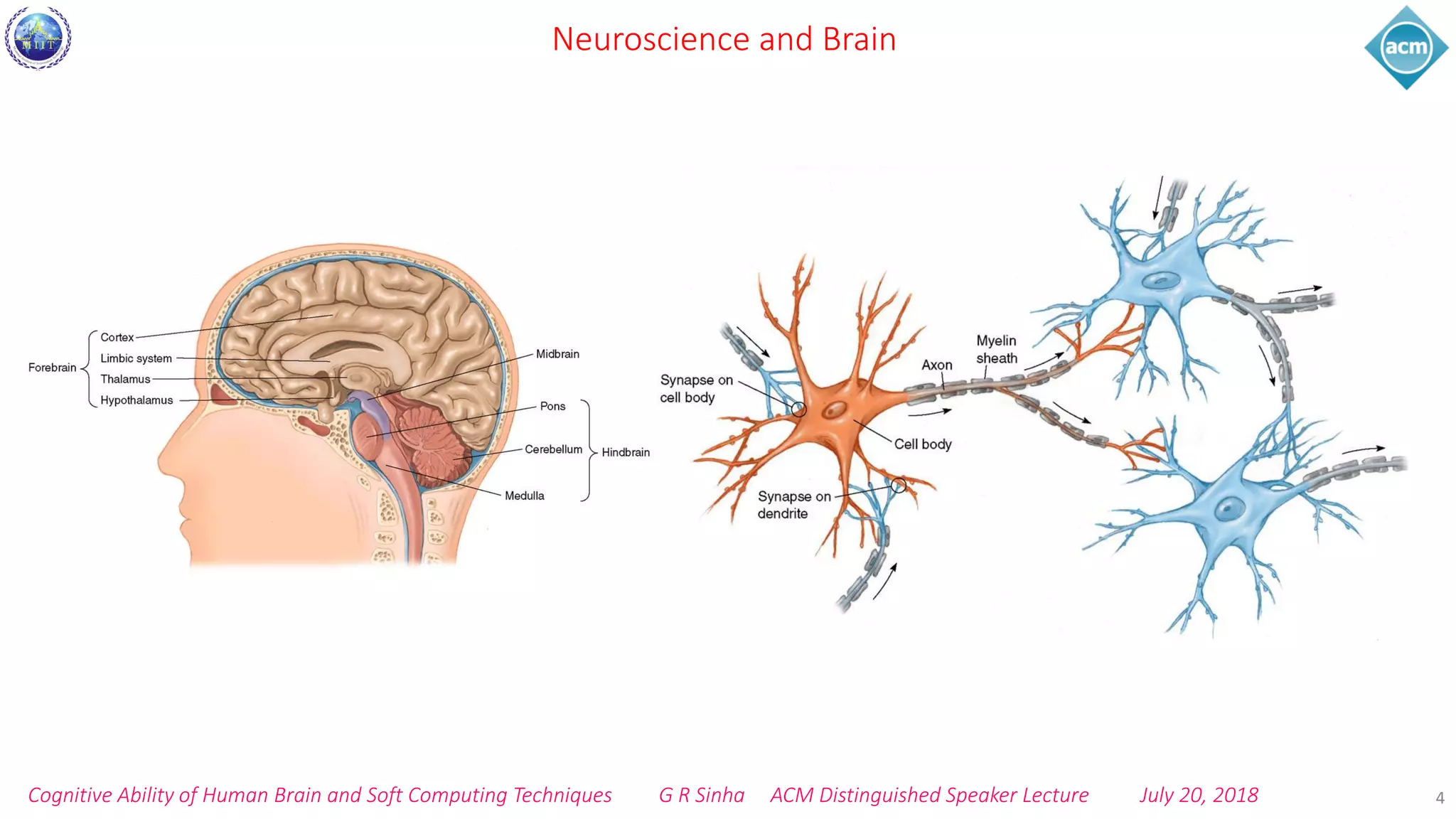
Neuroscience and Brain
Cognitive Ability of Human Brain and Soft Computing Techniques G R Sinha ACM Distinguished Speaker Lecture July 20, 2018
 Number of neurons in the human brain--100 billion
 Rate of neuron growth during development of a fetus--250,000 neurons/minute
 When children suffer brain damage, cognitive processes are usually impaired
 The cognitive ability improves gradually showing the brain’s plasticity
5
Funny Facts
Cognitive Ability of Human Brain and Soft Computing Techniques G R Sinha ACM Distinguished Speaker Lecture July 20, 2018
 Cognitive ability varies from person to person (Research based)
 Cognitive Ability: To Recall; To Retain; To Match: To Analyze etc.
 Working Memory– Increased processing speed; Children acquire more cognitive processes
 Long term Memory—Amount of Knowledge; Knowledge becomes symbolic; Children have better long
term memory
6
Cognitive Ability and Memory
Cognitive Ability of Human Brain and Soft Computing Techniques G R Sinha ACM Distinguished Speaker Lecture July 20, 2018
 Experience is important factor in development of thinking ability
 Takes 20 years to develop an adult nervous system
 Cognition develops quantitatively and qualitatively during the life-span
 Changes in cognitive ability due to: (1) Development function is formed over a time (2) Individual
Differences among people at any given developmental time
7
Neuroscience Assumptions
Cognitive Ability of Human Brain and Soft Computing Techniques G R Sinha ACM Distinguished Speaker Lecture July 20, 2018
 Thinking ability
 Not directly observable, but implied from behavior
 Includes different types of activities
 It has structure and function and they change over time
 Change is perpetual (never ending)
 Ability is an interaction of biology and experience
 Developmental is an active process
 Environmental stimulation affects
8
Cognitive ability Development
Cognitive Ability of Human Brain and Soft Computing Techniques G R Sinha ACM Distinguished Speaker Lecture July 20, 2018
 Acquisition, Comprehension and Modification of Information
 Development, Execution and Evaluation
 Perception (Deriving meaning of things/events)
 Formation of concepts and classification of Stimuli
9
Cognition Activities
Cognitive Ability of Human Brain and Soft Computing Techniques G R Sinha ACM Distinguished Speaker Lecture July 20, 2018
 Applied neuroscience (using Soft Computing) helps in understanding of cognition and computation
capability of the brain
 Knowledge Representation gives insights into the brain’s representation of conceptual knowledge
 Machine Intelligence develops non-invasive neural interventions to improve adaptive reasoning and
problem-solving abilities
 Strengthens adaptive Reasoning and Problem-solving ability
 Reverse engineering provides machine learning algorithms that can perform complex information
processing tasks and applications
10
Soft Computed Neuroscience
Cognitive Ability of Human Brain and Soft Computing Techniques G R Sinha ACM Distinguished Speaker Lecture July 20, 2018
 Neural Network
 Artificial Intelligence
 Fuzzy Logic
 Genetic Algorithms
 Videos-Google_ADAS.mp4, NIssan_ADAS.mp4, Google_CEO_Speaks.mp4
11
Soft Computing Techniques
Cognitive Ability of Human Brain and Soft Computing Techniques G R Sinha ACM Distinguished Speaker Lecture July 20, 2018
 Learning is a process by which a system improves performance from experience and used for:
Classification, Clustering, Problem solving / planning / control and Prediction.
 Artificial Intelligence (AI) is the science and engineering of making computer programs that exhibit
characteristics of human intelligence.
12
Learning and AI
Cognitive Ability of Human Brain and Soft Computing Techniques G R Sinha ACM Distinguished Speaker Lecture July 20, 2018
 Knowledge representation--Information and Facts about the world in some abstract way
 Pattern recognition--Knowledge from images
 Machine learning--Performance Improvement from experience
 Natural language processing--Interpretation of spoken and written language
 Reasoning---Conclusions from incomplete observations such as medical diagnosis, weather
forecasting
13
Scope of AI
Cognitive Ability of Human Brain and Soft Computing Techniques G R Sinha ACM Distinguished Speaker Lecture July 20, 2018
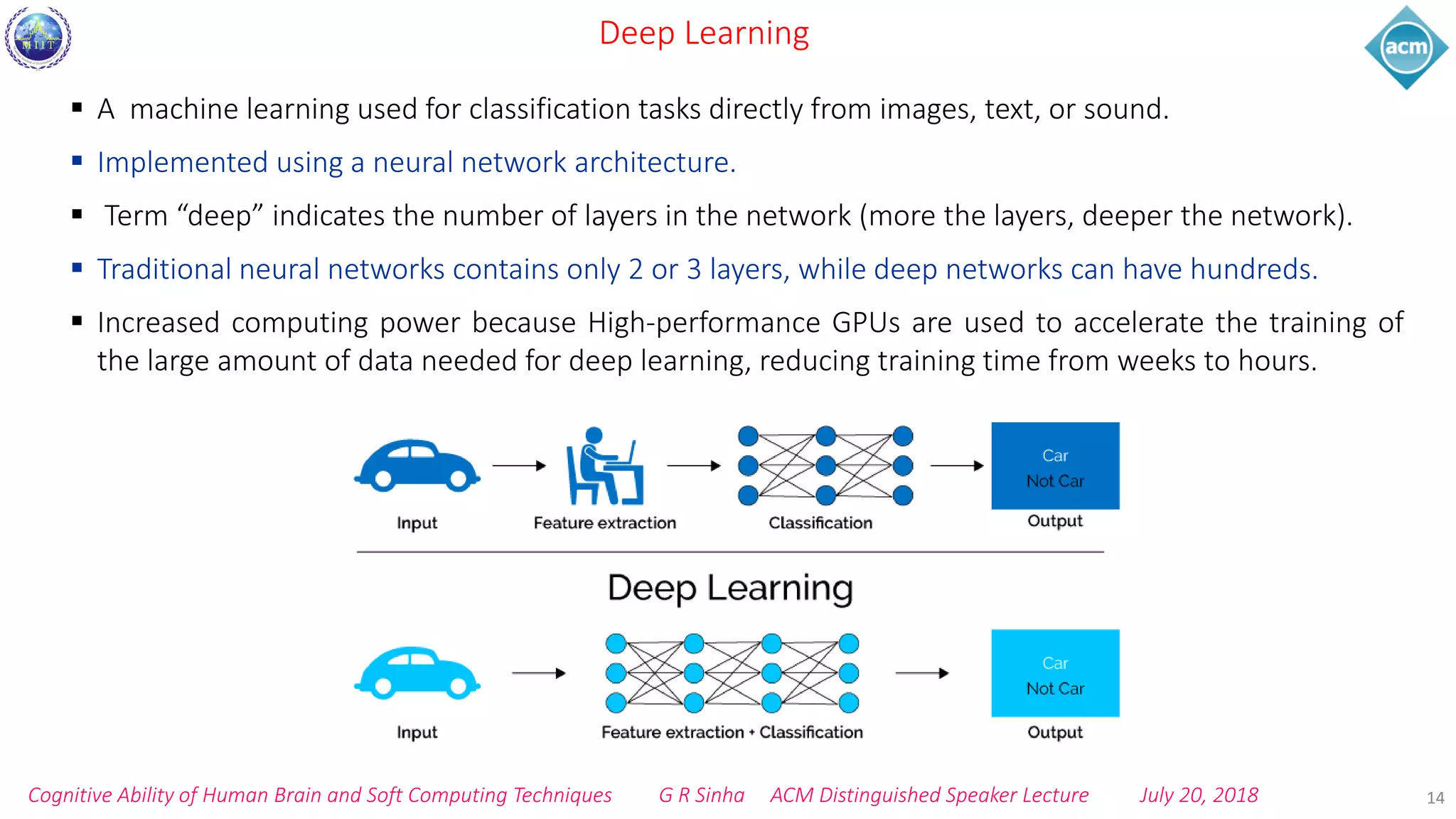
 A machine learning used for classification tasks directly from images, text, or sound.
 Implemented using a neural network architecture.
 Term “deep” indicates the number of layers in the network (more the layers, deeper the network).
 Traditional neural networks contains only 2 or 3 layers, while deep networks can have hundreds.
 Increased computing power because High-performance GPUs are used to accelerate the training of
the large amount of data needed for deep learning, reducing training time from weeks to hours.
14
Deep Learning
Cognitive Ability of Human Brain and Soft Computing Techniques G R Sinha ACM Distinguished Speaker Lecture July 20, 2018
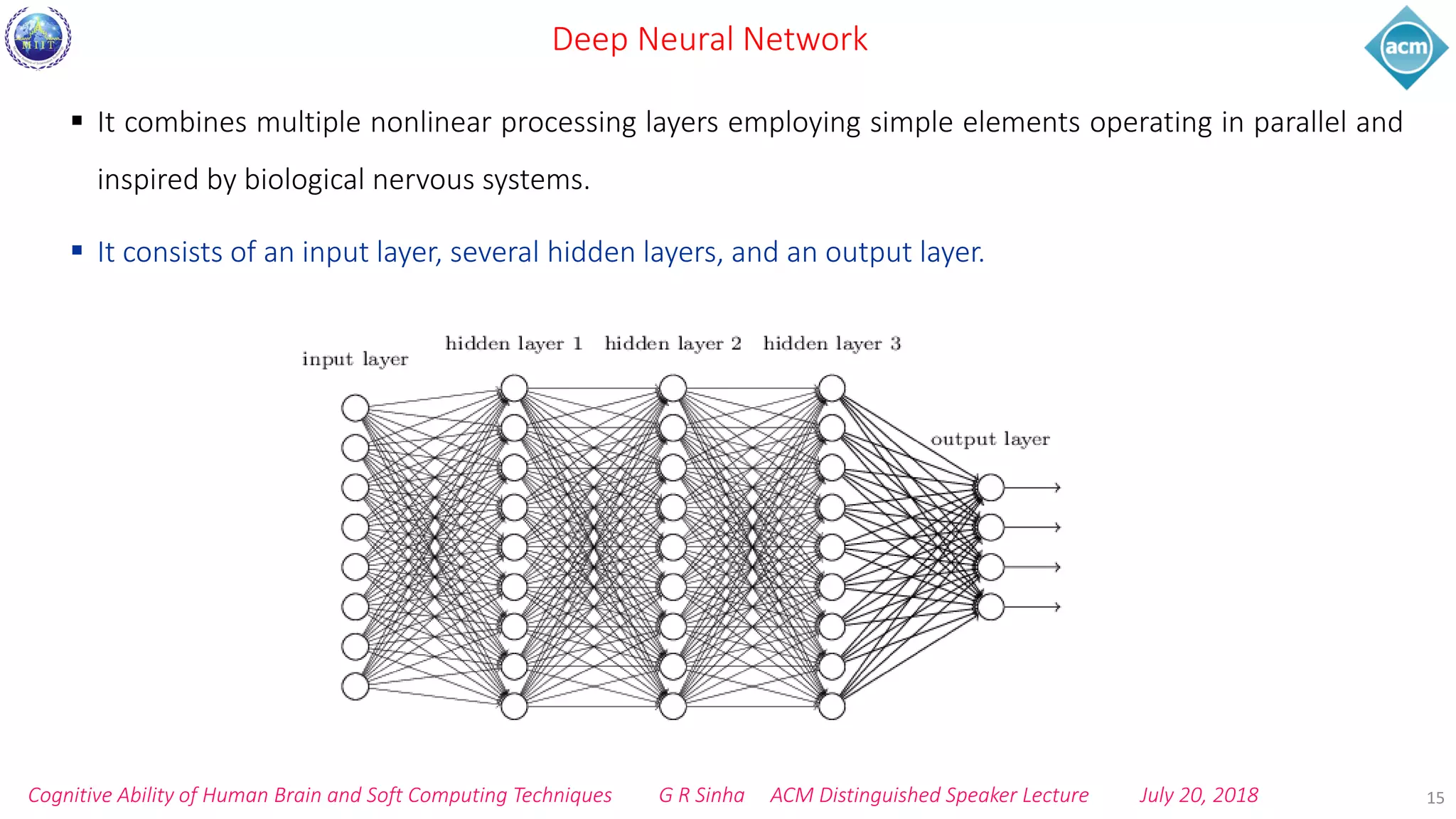
 It combines multiple nonlinear processing layers employing simple elements operating in parallel and
inspired by biological nervous systems.
 It consists of an input layer, several hidden layers, and an output layer.
15
Deep Neural Network
Cognitive Ability of Human Brain and Soft Computing Techniques G R Sinha ACM Distinguished Speaker Lecture July 20, 2018
 The network can start to understand the object’s specific features and associate them with the
corresponding category.
 Each layer in the network takes in data from the previous layer, transforms it, and passes it on.
 A convolutional neural network (CNN, or ConvNet) is popularly used for deep learning with images and
video.
 CNN is composed of an input layer, an output layer, and many hidden layers in between.
 Feature Detection Layers--Perform either of: convolution, pooling, or rectified linear unit (ReLU).
16
Training
Cognitive Ability of Human Brain and Soft Computing Techniques G R Sinha ACM Distinguished Speaker Lecture July 20, 2018
 Convolutional layer consists of a set of filters. Each filter covers a spatially small portion of the input
data.
 Each filter is convolved across the dimensions of the input data, producing a multidimensional feature
map.
 The network learns filters that activate when they see some specific type of feature at some spatial
position in the input.
 The main characteristics of the convolutional layer is shared weights.
17
CNN
Cognitive Ability of Human Brain and Soft Computing Techniques G R Sinha ACM Distinguished Speaker Lecture July 20, 2018
 Convolution puts the input images through a set of convolutional filters, each of which activates
certain features from the images.
 Pooling simplifies the output by performing nonlinear down-sampling, reducing the number of
parameters that the network needs to learn about.
 ReLU allows faster and more effective training by mapping negative values to zero and maintaining
positive values.
 These three operations are repeated over tens or hundreds of layers, with each layer learning to
detect different features.
 Classification Layers---The next-to-last layer is a fully connected layer (FC) that outputs a vector of K
dimensions where K is the number of classes that the network will be able to predict. The final layer
of the CNN architecture uses a softmax function to provide the classification output.
18
Training (contd..)
Cognitive Ability of Human Brain and Soft Computing Techniques G R Sinha ACM Distinguished Speaker Lecture July 20, 2018
 With machine learning, we can manually extract the relevant features of an image.
 With deep learning, the network learns the features automatically.
 It requires hundreds of thousands or millions of images for the best results.
 Unlimited Accuracy.
 However, the learning is Computationally intensive.
19
Why Deep Learning!
Cognitive Ability of Human Brain and Soft Computing Techniques G R Sinha ACM Distinguished Speaker Lecture July 20, 2018
 Training takes hours, days, or weeks, depending on the amount of the data and therefore selection of
a computational resource is critical.
 There are three computation options: CPU-based, GPU-based, and cloud-based.
 CPU-based---Simplest and most readily available option. Useful for simple examples using a pre-
trained network.
 GPU-based--Reduces network training time from days to hours. You can use a GPU in MATLAB without
doing any additional programming. An NVidia® 3.0 compute-capable GPU is generally recommended.
Multiple GPUs can help speed up processing even more.
 Cloud-based GPU---Needs setting up the hardware yourself.
20
Requirement
Cognitive Ability of Human Brain and Soft Computing Techniques G R Sinha ACM Distinguished Speaker Lecture July 20, 2018
 Insufficient depth---Shallow architecture (SVM, KNN etc.), the required number of nodes may grow
very large.
 Brain having deep architecture---Visual cortex shows a sequence of areas each of which contains a
representation of the input, and signals flow from one to the next.
 Cognitive processes seem deep--Humans organize their ideas and concepts hierarchically; first learn
simpler concepts and then compose them to represent more abstract ones; and Engineers break-up
solutions into multiple levels of abstraction and processing.
21
Why Deep Architecture for Cognitive task!
Cognitive Ability of Human Brain and Soft Computing Techniques G R Sinha ACM Distinguished Speaker Lecture July 20, 2018
22
E= mc2
Thank you, any queries please!
Cognitive Ability of Human Brain and Soft Computing Techniques G R Sinha ACM Distinguished Speaker Lecture July 20, 2018

Cognitive ability of human brain and soft computing techniques

  • 1.
    Cognitive Ability ofHuman Brain and Soft Computing Techniques G R Sinha, PhD IEEE Senior Member, ACM Distinguished Speaker, IEEE Distinguished Speaker Professor, Myanmar Institute of Information Technology Mandalay Recipient of ISTE National Award, TCS Award, IEI Award, Expert Engineer Award, Young Engineer Award, Young Scientist Award
  • 2.
     Videos  Neuroscienceand Brain  Funny facts  Cognitive ability-development & activities  Soft Computing Techniques-Videos highlighting role of Machine learning and Machine learning 2Cognitive Ability of Human Brain and Soft Computing Techniques G R Sinha ACM Distinguished Speaker Lecture July 20, 2018 Lecture Outline
  • 3.
     Brain FactsFacts of Brain.mp4  How does Brain learn!How does brain learn.mp4 3 Videos Cognitive Ability of Human Brain and Soft Computing Techniques G R Sinha ACM Distinguished Speaker Lecture July 20, 2018
  • 4.
    4 Neuroscience and Brain CognitiveAbility of Human Brain and Soft Computing Techniques G R Sinha ACM Distinguished Speaker Lecture July 20, 2018
  • 5.
     Number ofneurons in the human brain--100 billion  Rate of neuron growth during development of a fetus--250,000 neurons/minute  When children suffer brain damage, cognitive processes are usually impaired  The cognitive ability improves gradually showing the brain’s plasticity 5 Funny Facts Cognitive Ability of Human Brain and Soft Computing Techniques G R Sinha ACM Distinguished Speaker Lecture July 20, 2018
  • 6.
     Cognitive abilityvaries from person to person (Research based)  Cognitive Ability: To Recall; To Retain; To Match: To Analyze etc.  Working Memory– Increased processing speed; Children acquire more cognitive processes  Long term Memory—Amount of Knowledge; Knowledge becomes symbolic; Children have better long term memory 6 Cognitive Ability and Memory Cognitive Ability of Human Brain and Soft Computing Techniques G R Sinha ACM Distinguished Speaker Lecture July 20, 2018
  • 7.
     Experience isimportant factor in development of thinking ability  Takes 20 years to develop an adult nervous system  Cognition develops quantitatively and qualitatively during the life-span  Changes in cognitive ability due to: (1) Development function is formed over a time (2) Individual Differences among people at any given developmental time 7 Neuroscience Assumptions Cognitive Ability of Human Brain and Soft Computing Techniques G R Sinha ACM Distinguished Speaker Lecture July 20, 2018
  • 8.
     Thinking ability Not directly observable, but implied from behavior  Includes different types of activities  It has structure and function and they change over time  Change is perpetual (never ending)  Ability is an interaction of biology and experience  Developmental is an active process  Environmental stimulation affects 8 Cognitive ability Development Cognitive Ability of Human Brain and Soft Computing Techniques G R Sinha ACM Distinguished Speaker Lecture July 20, 2018
  • 9.
     Acquisition, Comprehensionand Modification of Information  Development, Execution and Evaluation  Perception (Deriving meaning of things/events)  Formation of concepts and classification of Stimuli 9 Cognition Activities Cognitive Ability of Human Brain and Soft Computing Techniques G R Sinha ACM Distinguished Speaker Lecture July 20, 2018
  • 10.
     Applied neuroscience(using Soft Computing) helps in understanding of cognition and computation capability of the brain  Knowledge Representation gives insights into the brain’s representation of conceptual knowledge  Machine Intelligence develops non-invasive neural interventions to improve adaptive reasoning and problem-solving abilities  Strengthens adaptive Reasoning and Problem-solving ability  Reverse engineering provides machine learning algorithms that can perform complex information processing tasks and applications 10 Soft Computed Neuroscience Cognitive Ability of Human Brain and Soft Computing Techniques G R Sinha ACM Distinguished Speaker Lecture July 20, 2018
  • 11.
     Neural Network Artificial Intelligence  Fuzzy Logic  Genetic Algorithms  Videos-Google_ADAS.mp4, NIssan_ADAS.mp4, Google_CEO_Speaks.mp4 11 Soft Computing Techniques Cognitive Ability of Human Brain and Soft Computing Techniques G R Sinha ACM Distinguished Speaker Lecture July 20, 2018
  • 12.
     Learning isa process by which a system improves performance from experience and used for: Classification, Clustering, Problem solving / planning / control and Prediction.  Artificial Intelligence (AI) is the science and engineering of making computer programs that exhibit characteristics of human intelligence. 12 Learning and AI Cognitive Ability of Human Brain and Soft Computing Techniques G R Sinha ACM Distinguished Speaker Lecture July 20, 2018
  • 13.
     Knowledge representation--Informationand Facts about the world in some abstract way  Pattern recognition--Knowledge from images  Machine learning--Performance Improvement from experience  Natural language processing--Interpretation of spoken and written language  Reasoning---Conclusions from incomplete observations such as medical diagnosis, weather forecasting 13 Scope of AI Cognitive Ability of Human Brain and Soft Computing Techniques G R Sinha ACM Distinguished Speaker Lecture July 20, 2018
  • 14.
     A machinelearning used for classification tasks directly from images, text, or sound.  Implemented using a neural network architecture.  Term “deep” indicates the number of layers in the network (more the layers, deeper the network).  Traditional neural networks contains only 2 or 3 layers, while deep networks can have hundreds.  Increased computing power because High-performance GPUs are used to accelerate the training of the large amount of data needed for deep learning, reducing training time from weeks to hours. 14 Deep Learning Cognitive Ability of Human Brain and Soft Computing Techniques G R Sinha ACM Distinguished Speaker Lecture July 20, 2018
  • 15.
     It combinesmultiple nonlinear processing layers employing simple elements operating in parallel and inspired by biological nervous systems.  It consists of an input layer, several hidden layers, and an output layer. 15 Deep Neural Network Cognitive Ability of Human Brain and Soft Computing Techniques G R Sinha ACM Distinguished Speaker Lecture July 20, 2018
  • 16.
     The networkcan start to understand the object’s specific features and associate them with the corresponding category.  Each layer in the network takes in data from the previous layer, transforms it, and passes it on.  A convolutional neural network (CNN, or ConvNet) is popularly used for deep learning with images and video.  CNN is composed of an input layer, an output layer, and many hidden layers in between.  Feature Detection Layers--Perform either of: convolution, pooling, or rectified linear unit (ReLU). 16 Training Cognitive Ability of Human Brain and Soft Computing Techniques G R Sinha ACM Distinguished Speaker Lecture July 20, 2018
  • 17.
     Convolutional layerconsists of a set of filters. Each filter covers a spatially small portion of the input data.  Each filter is convolved across the dimensions of the input data, producing a multidimensional feature map.  The network learns filters that activate when they see some specific type of feature at some spatial position in the input.  The main characteristics of the convolutional layer is shared weights. 17 CNN Cognitive Ability of Human Brain and Soft Computing Techniques G R Sinha ACM Distinguished Speaker Lecture July 20, 2018
  • 18.
     Convolution putsthe input images through a set of convolutional filters, each of which activates certain features from the images.  Pooling simplifies the output by performing nonlinear down-sampling, reducing the number of parameters that the network needs to learn about.  ReLU allows faster and more effective training by mapping negative values to zero and maintaining positive values.  These three operations are repeated over tens or hundreds of layers, with each layer learning to detect different features.  Classification Layers---The next-to-last layer is a fully connected layer (FC) that outputs a vector of K dimensions where K is the number of classes that the network will be able to predict. The final layer of the CNN architecture uses a softmax function to provide the classification output. 18 Training (contd..) Cognitive Ability of Human Brain and Soft Computing Techniques G R Sinha ACM Distinguished Speaker Lecture July 20, 2018
  • 19.
     With machinelearning, we can manually extract the relevant features of an image.  With deep learning, the network learns the features automatically.  It requires hundreds of thousands or millions of images for the best results.  Unlimited Accuracy.  However, the learning is Computationally intensive. 19 Why Deep Learning! Cognitive Ability of Human Brain and Soft Computing Techniques G R Sinha ACM Distinguished Speaker Lecture July 20, 2018
  • 20.
     Training takeshours, days, or weeks, depending on the amount of the data and therefore selection of a computational resource is critical.  There are three computation options: CPU-based, GPU-based, and cloud-based.  CPU-based---Simplest and most readily available option. Useful for simple examples using a pre- trained network.  GPU-based--Reduces network training time from days to hours. You can use a GPU in MATLAB without doing any additional programming. An NVidia® 3.0 compute-capable GPU is generally recommended. Multiple GPUs can help speed up processing even more.  Cloud-based GPU---Needs setting up the hardware yourself. 20 Requirement Cognitive Ability of Human Brain and Soft Computing Techniques G R Sinha ACM Distinguished Speaker Lecture July 20, 2018
  • 21.
     Insufficient depth---Shallowarchitecture (SVM, KNN etc.), the required number of nodes may grow very large.  Brain having deep architecture---Visual cortex shows a sequence of areas each of which contains a representation of the input, and signals flow from one to the next.  Cognitive processes seem deep--Humans organize their ideas and concepts hierarchically; first learn simpler concepts and then compose them to represent more abstract ones; and Engineers break-up solutions into multiple levels of abstraction and processing. 21 Why Deep Architecture for Cognitive task! Cognitive Ability of Human Brain and Soft Computing Techniques G R Sinha ACM Distinguished Speaker Lecture July 20, 2018
  • 22.
    22 E= mc2 Thank you,any queries please! Cognitive Ability of Human Brain and Soft Computing Techniques G R Sinha ACM Distinguished Speaker Lecture July 20, 2018