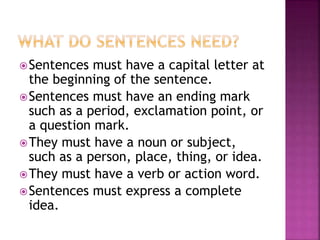
Sentences must have a capital letter at
the beginning of the sentence.
Sentences must have an ending mark
such as a period, exclamation point, or
a question mark.
They must have a noun or subject,
such as a person, place, thing, or idea.
They must have a verb or action word.
Sentences must express a complete
idea.
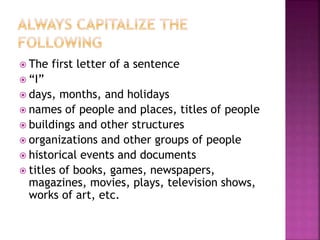
 The first letter of a sentence
 “I”
 days, months, and holidays
 names of people and places, titles of people
 buildings and other structures
 organizations and other groups of people
 historical events and documents
 titles of books, games, newspapers,
magazines, movies, plays, television shows,
works of art, etc.
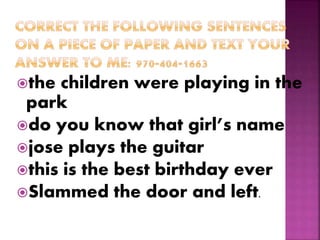
the children were playing in the
park
do you know that girl’s name
jose plays the guitar
this is the best birthday ever
Slammed the door and left.
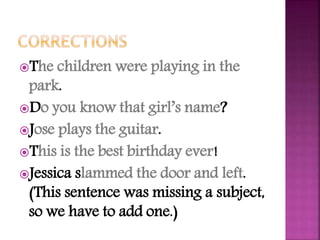
The children were playing in the
park.
Do you know that girl’s name?
Jose plays the guitar.
This is the best birthday ever!
Jessica slammed the door and left.
(This sentence was missing a subject,
so we have to add one.)
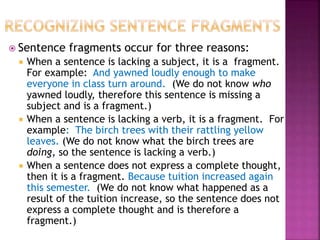
 Sentence fragments occur for three reasons:
 When a sentence is lacking a subject, it is a fragment.
For example: And yawned loudly enough to make
everyone in class turn around. (We do not know who
yawned loudly, therefore this sentence is missing a
subject and is a fragment.)
 When a sentence is lacking a verb, it is a fragment. For
example: The birch trees with their rattling yellow
leaves. (We do not know what the birch trees are
doing, so the sentence is lacking a verb.)
 When a sentence does not express a complete thought,
then it is a fragment. Because tuition increased again
this semester. (We do not know what happened as a
result of the tuition increase, so the sentence does not
express a complete thought and is therefore a
fragment.)
Writing in complete sentences

Writing in complete sentences

  • 2.
    Sentences must havea capital letter at the beginning of the sentence. Sentences must have an ending mark such as a period, exclamation point, or a question mark. They must have a noun or subject, such as a person, place, thing, or idea. They must have a verb or action word. Sentences must express a complete idea.
  • 3.
     The firstletter of a sentence  “I”  days, months, and holidays  names of people and places, titles of people  buildings and other structures  organizations and other groups of people  historical events and documents  titles of books, games, newspapers, magazines, movies, plays, television shows, works of art, etc.
  • 4.
    the children wereplaying in the park do you know that girl’s name jose plays the guitar this is the best birthday ever Slammed the door and left.
  • 5.
    The children wereplaying in the park. Do you know that girl’s name? Jose plays the guitar. This is the best birthday ever! Jessica slammed the door and left. (This sentence was missing a subject, so we have to add one.)
  • 6.
     Sentence fragmentsoccur for three reasons:  When a sentence is lacking a subject, it is a fragment. For example: And yawned loudly enough to make everyone in class turn around. (We do not know who yawned loudly, therefore this sentence is missing a subject and is a fragment.)  When a sentence is lacking a verb, it is a fragment. For example: The birch trees with their rattling yellow leaves. (We do not know what the birch trees are doing, so the sentence is lacking a verb.)  When a sentence does not express a complete thought, then it is a fragment. Because tuition increased again this semester. (We do not know what happened as a result of the tuition increase, so the sentence does not express a complete thought and is therefore a fragment.)