
Writing for the Web
28 April 2012
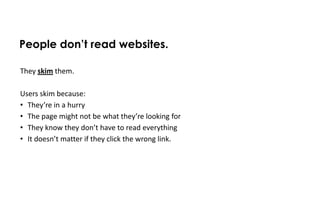
People don’t read websites.

They skim them.

Users skim because:
• They’re in a hurry
• The page might not be what they’re looking for
• They know they don’t have to read everything
• It doesn’t matter if they click the wrong link.
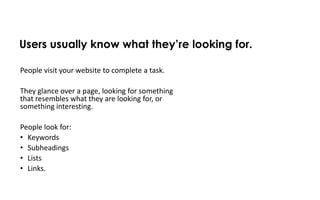
Users usually know what they’re looking for.

People visit your website to complete a task.

They glance over a page, looking for something
that resembles what they are looking for, or
something interesting.

People look for:
• Keywords
• Subheadings
• Lists
• Links.
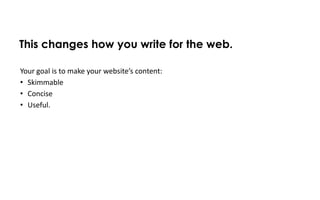
This changes how you write for the web.

Your goal is to make your website’s content:
• Skimmable
• Concise
• Useful.
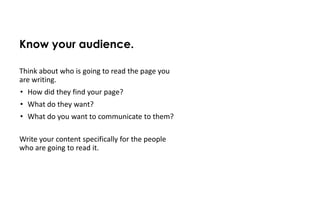
Know your audience.

Think about who is going to read the page you
are writing.
• How did they find your page?
• What do they want?
• What do you want to communicate to them?
• What language will they be familiar with?

Write your content specifically for the people
who are going to read it.
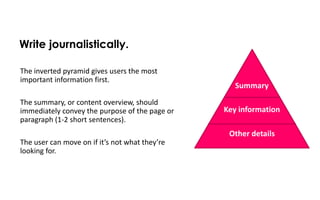
Write journalistically.

The inverted pyramid gives users the most
important information first.
                                                   Summary
The summary, or content overview, should
immediately convey the purpose of the page or   Key information
paragraph (1-2 short sentences).
                                                 Other details
The user can move on if it’s not what they’re
looking for.
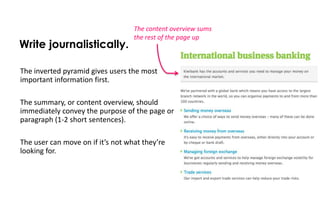
The content overview sums
                                   the rest of the page up
Write journalistically.

The inverted pyramid gives users the most
important information first.

The summary, or content overview, should
immediately convey the purpose of the page or
paragraph (1-2 short sentences).

The user can move on if it’s not what they’re
looking for.
Omit needless words.

“Get rid of half the words on each page, then get
rid of half of what’s left.” – Krug’s Third Law of Usability

By doing this, you will:
• Make pages shorter and more skimmable
• Make useful content more prominent
• Encourage users to read your page.
Be concise and to-the-point.

Eliminate small talk. Web readers just want to
get to the content.

• Convey only one idea per paragraph
• One topic per page
• Write short sentences.

If it doesn’t contain useful or important
information, delete it.
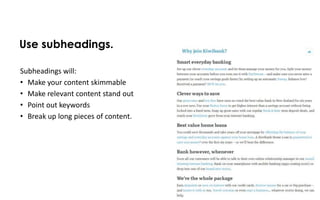
Use subheadings.

Subheadings will:
• Make your content skimmable
• Make relevant content stand out
• Point out keywords
• Break up long pieces of content.
Use lists.

Bulleted lists are easier to scan than paragraphs
and add visual variety to a page.

• Limit lists to 7 items.
• Use boldface to highlight the key message of
  the list item
• Use numbered lists only when there is a
  hierarchy of information.
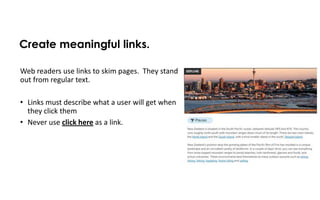
Create meaningful links.

Web readers use links to skim pages. They stand
out from regular text.

• Links must describe what a user will get when
  they click them
• Never use click here as a link.
Use active voice.

Active voice reduces the amount of effort a user
needs to exert to understand what you mean.

Don’t use passive voice.

Update your contact information in your member
profile.
vs
New contact information can be updated on your
member profile page.
Tell your readers what to do.

Think about what do you want the user to do
once they’ve read your page.

A call-to-action tells the user what to do next.

e.g.
• Learn more about xyz.
• Subscribe to our newsletter.
Summary

•   Make your content skimmable
•   Write for the page’s audience(s)
•   Use the inverted pyramid
•   Reduce word count and be concise
•   Use subheadings
•   Use lists
•   Make links part of your copy
•   Use active voice
•   Use call-to-actions.

Writing for the web

  • 1.
    Writing for theWeb 28 April 2012
  • 2.
    People don’t readwebsites. They skim them. Users skim because: • They’re in a hurry • The page might not be what they’re looking for • They know they don’t have to read everything • It doesn’t matter if they click the wrong link.
  • 3.
    Users usually knowwhat they’re looking for. People visit your website to complete a task. They glance over a page, looking for something that resembles what they are looking for, or something interesting. People look for: • Keywords • Subheadings • Lists • Links.
  • 4.
    This changes howyou write for the web. Your goal is to make your website’s content: • Skimmable • Concise • Useful.
  • 5.
    Know your audience. Thinkabout who is going to read the page you are writing. • How did they find your page? • What do they want? • What do you want to communicate to them? • What language will they be familiar with? Write your content specifically for the people who are going to read it.
  • 6.
    Write journalistically. The invertedpyramid gives users the most important information first. Summary The summary, or content overview, should immediately convey the purpose of the page or Key information paragraph (1-2 short sentences). Other details The user can move on if it’s not what they’re looking for.
  • 7.
    The content overviewsums the rest of the page up Write journalistically. The inverted pyramid gives users the most important information first. The summary, or content overview, should immediately convey the purpose of the page or paragraph (1-2 short sentences). The user can move on if it’s not what they’re looking for.
  • 8.
    Omit needless words. “Getrid of half the words on each page, then get rid of half of what’s left.” – Krug’s Third Law of Usability By doing this, you will: • Make pages shorter and more skimmable • Make useful content more prominent • Encourage users to read your page.
  • 9.
    Be concise andto-the-point. Eliminate small talk. Web readers just want to get to the content. • Convey only one idea per paragraph • One topic per page • Write short sentences. If it doesn’t contain useful or important information, delete it.
  • 10.
    Use subheadings. Subheadings will: •Make your content skimmable • Make relevant content stand out • Point out keywords • Break up long pieces of content.
  • 11.
    Use lists. Bulleted listsare easier to scan than paragraphs and add visual variety to a page. • Limit lists to 7 items. • Use boldface to highlight the key message of the list item • Use numbered lists only when there is a hierarchy of information.
  • 12.
    Create meaningful links. Webreaders use links to skim pages. They stand out from regular text. • Links must describe what a user will get when they click them • Never use click here as a link.
  • 13.
    Use active voice. Activevoice reduces the amount of effort a user needs to exert to understand what you mean. Don’t use passive voice. Update your contact information in your member profile. vs New contact information can be updated on your member profile page.
  • 14.
    Tell your readerswhat to do. Think about what do you want the user to do once they’ve read your page. A call-to-action tells the user what to do next. e.g. • Learn more about xyz. • Subscribe to our newsletter.
  • 15.
    Summary • Make your content skimmable • Write for the page’s audience(s) • Use the inverted pyramid • Reduce word count and be concise • Use subheadings • Use lists • Make links part of your copy • Use active voice • Use call-to-actions.

Editor's Notes

  • #2 Last edited by Che, 7:36pm 27 Feb 2012
  • #9 Steve Krug – Don’t Make Me Think (a common sense approach to web usability)
  • #13 http://www2.le.ac.uk/webcentre/plone/webwriting/linksthatworkThink Wikipedia.
  • #14 http://boagworld.com/design/10-techniques-for-an-effective-call-to-action/
  • #15 http://boagworld.com/design/10-techniques-for-an-effective-call-to-action/