HEADLINES
A headline is the title of a newspaper story, printed
in large letters at the top of the story, on the front
page.
GROUP E:
1. SARVAM SHAH
2. SAKET KEJRIWAL
3. SHIVAM AGARWAL
4. SRISHTI PRASAD
5. ZIGYASA TRYOON
6. UMAIMA AKHTAR BEGG
7. RONIT SINGH
8. SHREYANSH GUPTA
presents
WHY ARE HEADLINES
IMPORTANT?
The most important part of writing
is its headline. A reader at first
looks at the headline or heading
and then they go for the full
content. Headlines are important
because of the following reasons:-
 A good headline grabs the
attention of the search engines
 A good headline helps you to
build trust of your readers
 To tell in capsule form what the
story is all about;
 To grade news as to importance.
TYPES OF
HEADLINES
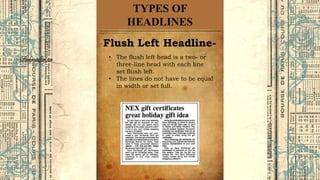
Flush Left Headline-
• The flush left head is a two- or
three-line head with each line
set flush left.
• The lines do not have to be equal
in width or set full.
TYPES OF
HEADLINES
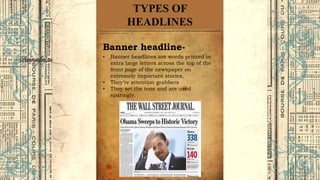
• Banner headlines are words printed in
extra large letters across the top of the
front page of the newspaper on
extremely important stories.
• They’re attention grabbers
• They set the tone and are used
sparingly.
Banner headline-
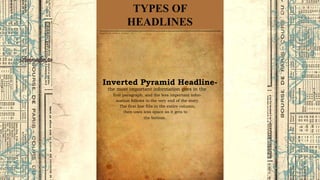
the bottom.
Inverted Pyramid Headline-
the most important information goes in the
first paragraph, and the less important infor-
mation follows to the very end of the story.
The first line fills in the entire column,
then uses less space as it gets to
TYPES OF
HEADLINES
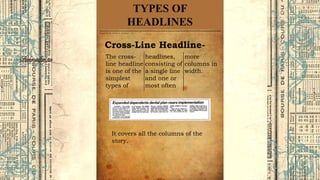
Cross-Line Headline-
The cross-
line headline
is one of the
simplest
types of
headlines,
consisting of
a single line
and one or
most often
more
columns in
width.
TYPES OF
HEADLINES
It covers all the columns of the
story.
TYPES OF
HEADLINES
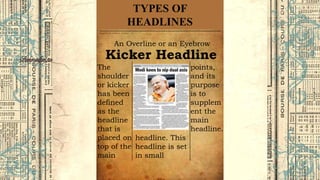
An Overline or an Eyebrow
Kicker Headline
The
shoulder
or kicker
has been
defined
as the
headline
that is
placed on
top of the
main
headline. This
headline is set
in small
points,
and its
purpose
is to
supplem
ent the
main
headline.
TYPES OF
HEADLINES
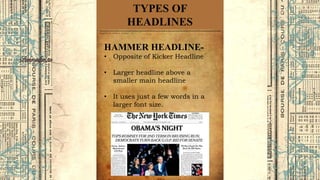
HAMMER HEADLINE-
• Opposite of Kicker Headline
• Larger headline above a
smaller main headline
• It uses just a few words in a
larger font size.
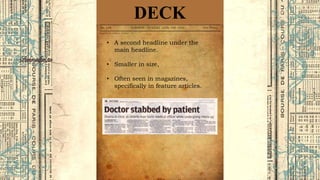
DECK
• A second headline under the
main headline.
• Smaller in size,
• Often seen in magazines,
specifically in feature articles.
RULES FOR WRITING
SENTENCE HEADLINES
i. Strive to make each one an
attention grabber.
ii. Make sure each head fills the
space allotted.
iii. Avoid repetition of words or
phrases.
iv. Use single rather than double
quotation marks.
v. Avoid using a semicolon in a one
line head.
vi. Avoid beginning headline with a
verb.
RULES FOR WRITING
SENTENCE HEADLINES
i. Use only well known abbreviations.
ii. Don’t begin headline with a number
(spell out),
iii. Use information from your lead
when writing a headline for a
feature story,
iv. Use active voice,
v. Use full names unless the person is
well known.
Newspaper Headlines

Newspaper Headlines

  • 1.
    HEADLINES A headline isthe title of a newspaper story, printed in large letters at the top of the story, on the front page. GROUP E: 1. SARVAM SHAH 2. SAKET KEJRIWAL 3. SHIVAM AGARWAL 4. SRISHTI PRASAD 5. ZIGYASA TRYOON 6. UMAIMA AKHTAR BEGG 7. RONIT SINGH 8. SHREYANSH GUPTA presents
  • 2.
    WHY ARE HEADLINES IMPORTANT? Themost important part of writing is its headline. A reader at first looks at the headline or heading and then they go for the full content. Headlines are important because of the following reasons:-  A good headline grabs the attention of the search engines  A good headline helps you to build trust of your readers  To tell in capsule form what the story is all about;  To grade news as to importance.
  • 3.
    TYPES OF HEADLINES Flush LeftHeadline- • The flush left head is a two- or three-line head with each line set flush left. • The lines do not have to be equal in width or set full.
  • 4.
    TYPES OF HEADLINES • Bannerheadlines are words printed in extra large letters across the top of the front page of the newspaper on extremely important stories. • They’re attention grabbers • They set the tone and are used sparingly. Banner headline-
  • 5.
    the bottom. Inverted PyramidHeadline- the most important information goes in the first paragraph, and the less important infor- mation follows to the very end of the story. The first line fills in the entire column, then uses less space as it gets to TYPES OF HEADLINES
  • 6.
    Cross-Line Headline- The cross- lineheadline is one of the simplest types of headlines, consisting of a single line and one or most often more columns in width. TYPES OF HEADLINES It covers all the columns of the story.
  • 7.
    TYPES OF HEADLINES An Overlineor an Eyebrow Kicker Headline The shoulder or kicker has been defined as the headline that is placed on top of the main headline. This headline is set in small points, and its purpose is to supplem ent the main headline.
  • 8.
    TYPES OF HEADLINES HAMMER HEADLINE- •Opposite of Kicker Headline • Larger headline above a smaller main headline • It uses just a few words in a larger font size.
  • 9.
    DECK • A secondheadline under the main headline. • Smaller in size, • Often seen in magazines, specifically in feature articles.
  • 10.
    RULES FOR WRITING SENTENCEHEADLINES i. Strive to make each one an attention grabber. ii. Make sure each head fills the space allotted. iii. Avoid repetition of words or phrases. iv. Use single rather than double quotation marks. v. Avoid using a semicolon in a one line head. vi. Avoid beginning headline with a verb.
  • 11.
    RULES FOR WRITING SENTENCEHEADLINES i. Use only well known abbreviations. ii. Don’t begin headline with a number (spell out), iii. Use information from your lead when writing a headline for a feature story, iv. Use active voice, v. Use full names unless the person is well known.