Guide to Academic Writing
Academic Writing
 Academic writing is central to almost all degree programmes. However, it's very
different to other types of writing, so it's a skill that has to be learnt.
 Writing is a process, not the end product!
 Reading, thinking, planning and editing are also vitally important parts of the process.
 Academic writing uses a very different style to other types of writing, which might
need a bit of getting used to.
 Academic writing isn't about impressing people with ‘big words’ or being overly
formal. The main aim is to be clear, concise and usually objective so that you can
communicate your ideas effectively.
Please Read
 The primary ambition of expressing concepts in an academic
fashion is to provide assistance for the audience of the piece
in comprehending the information being conveyed in an
expeditious and accessible manner.
Better style
Effective academic writing helps readers understand
your points quickly and easily.
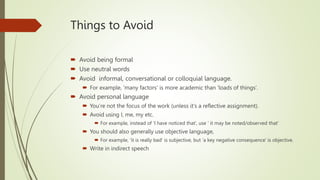
Things to Avoid
 Avoid being formal
 Use neutral words
 Avoid informal, conversational or colloquial language.
 For example, 'many factors' is more academic than 'loads of things’.
 Avoid personal language
 You’re not the focus of the work (unless it's a reflective assignment).
 Avoid using I, me, my etc.
 For example, instead of ‘I have noticed that’, use ‘ it may be noted/observed that’
 You should also generally use objective language,
 For example, 'it is really bad' is subjective, but 'a key negative consequence' is objective.
 Write in indirect speech
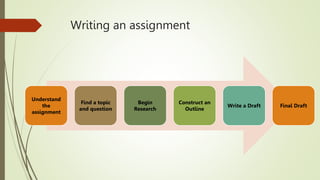
Writing an assignment
Understand
the
assignment
Find a topic
and question
Begin
Research
Construct an
Outline
Write a Draft Final Draft
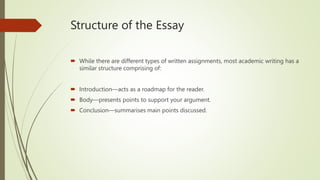
Structure of the Essay
 While there are different types of written assignments, most academic writing has a
similar structure comprising of:
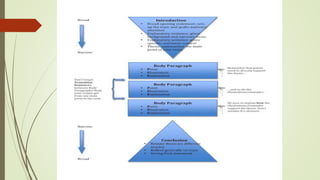
 Introduction—acts as a roadmap for the reader.
 Body—presents points to support your argument.
 Conclusion—summarises main points discussed.
Guide to Academic Writing.pptx

Guide to Academic Writing.pptx

  • 1.
  • 2.
    Academic Writing  Academicwriting is central to almost all degree programmes. However, it's very different to other types of writing, so it's a skill that has to be learnt.  Writing is a process, not the end product!  Reading, thinking, planning and editing are also vitally important parts of the process.  Academic writing uses a very different style to other types of writing, which might need a bit of getting used to.  Academic writing isn't about impressing people with ‘big words’ or being overly formal. The main aim is to be clear, concise and usually objective so that you can communicate your ideas effectively.
  • 3.
    Please Read  Theprimary ambition of expressing concepts in an academic fashion is to provide assistance for the audience of the piece in comprehending the information being conveyed in an expeditious and accessible manner.
  • 4.
    Better style Effective academicwriting helps readers understand your points quickly and easily.
  • 5.
    Things to Avoid Avoid being formal  Use neutral words  Avoid informal, conversational or colloquial language.  For example, 'many factors' is more academic than 'loads of things’.  Avoid personal language  You’re not the focus of the work (unless it's a reflective assignment).  Avoid using I, me, my etc.  For example, instead of ‘I have noticed that’, use ‘ it may be noted/observed that’  You should also generally use objective language,  For example, 'it is really bad' is subjective, but 'a key negative consequence' is objective.  Write in indirect speech
  • 6.
    Writing an assignment Understand the assignment Finda topic and question Begin Research Construct an Outline Write a Draft Final Draft
  • 7.
    Structure of theEssay  While there are different types of written assignments, most academic writing has a similar structure comprising of:  Introduction—acts as a roadmap for the reader.  Body—presents points to support your argument.  Conclusion—summarises main points discussed.