WRITING CHEMICAL
FORMULAS
HOW IS A CHEMICAL FORMULA DERIVED?
 It consists of the symbols of the
constituent elements
 It indicates the number of atoms of each
elements. It is shown as a subscript.
 The molecule it represents is electrically
neutral.
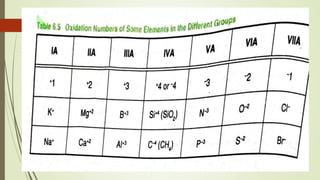
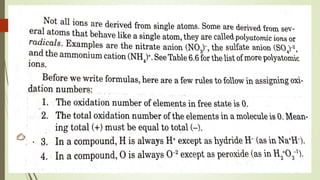
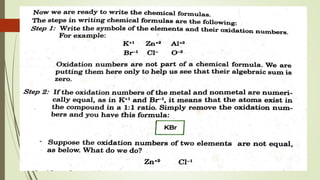
 Oxidation number – is a tool in describing
chemical compounds.
 we refer to it as the number of electrons that an
atom gives up, accepts or shares with another
atom.
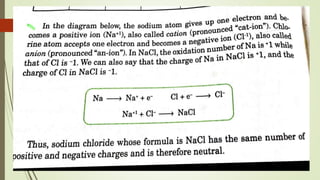
 when an atom gives up or accepts electrons, it
becomes a charged particle called an ion.
 For atoms that accepts electrons, we assign a
negative (-) oxidation number.
 For atoms that gives up electrons, we assign a
positive (+) oxidation number.
 For atoms that share electrons, we assign a
negative (-) oxidation number to the more
electronegative atom and a positive (+)
oxidation number to the less electronegative
atom.
Writing chemical formulas

Writing chemical formulas

  • 1.
  • 2.
    HOW IS ACHEMICAL FORMULA DERIVED?  It consists of the symbols of the constituent elements  It indicates the number of atoms of each elements. It is shown as a subscript.  The molecule it represents is electrically neutral.
  • 3.
     Oxidation number– is a tool in describing chemical compounds.  we refer to it as the number of electrons that an atom gives up, accepts or shares with another atom.  when an atom gives up or accepts electrons, it becomes a charged particle called an ion.
  • 4.
     For atomsthat accepts electrons, we assign a negative (-) oxidation number.  For atoms that gives up electrons, we assign a positive (+) oxidation number.  For atoms that share electrons, we assign a negative (-) oxidation number to the more electronegative atom and a positive (+) oxidation number to the less electronegative atom.