M.A. Vianey Martín Núñez A. Universidad
Nacional, Heredia, Costa Rica.
1.   Think of, and make a list of the characters you
     want to include.        Folktales are generally
     associated to local customs, traditions and
     culture. Ex. The farmer, the fisher, the miner, the
     king, the queen, the maid, etc.

2. Fairy tales are; somehow; a fight between values
     and anti-values. Think of a person (or people)
     who might represent this antagonism. E.g. The
     farmer’s brother, the greedy prime minister, the
     evil fisher’s wife, someone’s step-sister, etc.

               M.A. Vianey Martín Núñez A. Universidad
               Nacional, Heredia, Costa Rica.
The moral…
3. Think of a moral you would like to teach.

* Folktales have been told for centuries in order to
  transmit a moral (generally a virtue, a positive
  teaching or, a value.)
  For example: love prevails, misers won’t be happy,
  greedy people are punished, fairness and humbleness
  are always rewarded, forgiveness is the key to
  happiness, etc.

               M.A. Vianey Martín Núñez A. Universidad
               Nacional, Heredia, Costa Rica.
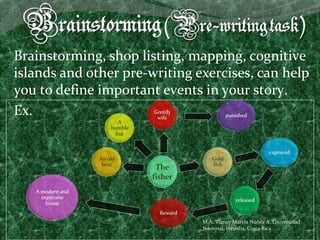
Brainstorming, shop listing, mapping, cognitive
islands and other pre-writing exercises, can help
you to define important events in your story.
Ex.


                               M.A. Vianey Martín Núñez A. Universidad
                               Nacional, Heredia, Costa Rica.
The setting…
5. Provide yourself with a list of places where
 your story is going to take place. Folktales
 frequently take place in real places (the
 forest, the farm, the castle, a village, a garden,
 the meallows, etc.)

6. Now, events in your story might happen in a
  specific time order. Relate the places you
  have written to specific periods of time.
 Ex. The forest------at night, the castle----next
 day.        M.A. Vianey Martín Núñez A. Universidad
             Nacional, Heredia, Costa Rica.
Writing
7. Once you have your ideas properly listed is
time to organize them and add some content.
Start by writing simple sentences. Remember
that most sentences follow this pattern:

subject + verb + complement
                (direct, indirect, place, time…)
E.g. The fisherman captured a gold fish
     from the lake that very morning.
             M.A. Vianey Martín Núñez A. Universidad
             Nacional, Heredia, Costa Rica.
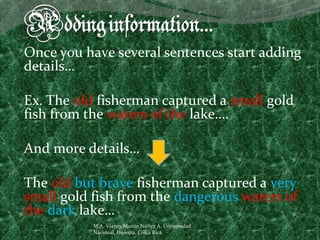
Once you have several sentences start adding
details…

Ex. The old fisherman captured a small gold
fish from the waters of the lake….

And more details…

The old but brave fisherman captured a very
small gold fish from the dangerous waters of
the dark lake…
           M.A. Vianey Martín Núñez A. Universidad
           Nacional, Heredia, Costa Rica.
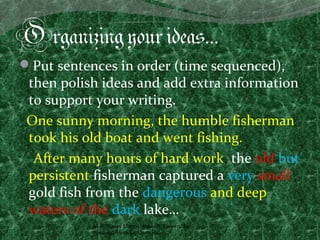
Organizing your ideas…
Put sentences in order (time sequenced),
  then polish ideas and add extra information
  to support your writing.
. One sunny morning, the humble fisherman
  took his old boat and went fishing.
   After many hours of hard work, the old but
  persistent fisherman captured a very small
  gold fish from the dangerous and deep
  waters of the dark lake…
           M.A. Vianey Martín Núñez A. Universidad
           Nacional, Heredia, Costa Rica.
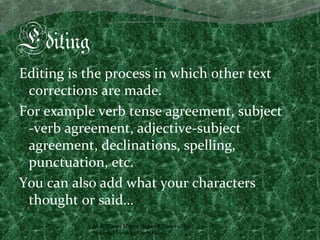
Editing
Editing is the process in which other text
 corrections are made.
For example verb tense agreement, subject
 -verb agreement, adjective-subject
 agreement, declinations, spelling,
 punctuation, etc.
You can also add what your characters
 thought or said…
           M.A. Vianey Martín Núñez A. Universidad
           Nacional, Heredia, Costa Rica.
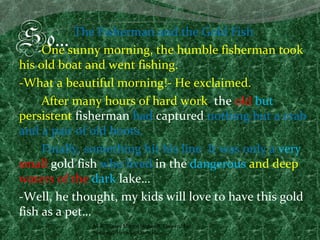
So…        The Fisherman and the Gold Fish
     One sunny morning, the humble fisherman took
his old boat and went fishing.
-What a beautiful morning!- He exclaimed.
     After many hours of hard work, the old but
persistent fisherman had captured nothing but a crab
and a pair of old boots.
     Finally, something hit his line. It was only a very
small gold fish who lived in the dangerous and deep
waters of the dark lake…
-Well, he thought, my kids will love to have this gold
fish as a pet…
              M.A. Vianey Martín Núñez A. Universidad
              Nacional, Heredia, Costa Rica.
The End…
Remember to provide a proper ending to
 your story. This ending must reflect the
 moral you tried to teach…


Want to try it?...


           M.A. Vianey Martín Núñez A. Universidad
           Nacional, Heredia, Costa Rica.

Writing a folktale

  • 1.
    M.A. Vianey MartínNúñez A. Universidad Nacional, Heredia, Costa Rica.
  • 2.
    1. Think of, and make a list of the characters you want to include. Folktales are generally associated to local customs, traditions and culture. Ex. The farmer, the fisher, the miner, the king, the queen, the maid, etc. 2. Fairy tales are; somehow; a fight between values and anti-values. Think of a person (or people) who might represent this antagonism. E.g. The farmer’s brother, the greedy prime minister, the evil fisher’s wife, someone’s step-sister, etc. M.A. Vianey Martín Núñez A. Universidad Nacional, Heredia, Costa Rica.
  • 3.
    The moral… 3. Thinkof a moral you would like to teach. * Folktales have been told for centuries in order to transmit a moral (generally a virtue, a positive teaching or, a value.) For example: love prevails, misers won’t be happy, greedy people are punished, fairness and humbleness are always rewarded, forgiveness is the key to happiness, etc. M.A. Vianey Martín Núñez A. Universidad Nacional, Heredia, Costa Rica.
  • 4.
    Brainstorming, shop listing,mapping, cognitive islands and other pre-writing exercises, can help you to define important events in your story. Ex. M.A. Vianey Martín Núñez A. Universidad Nacional, Heredia, Costa Rica.
  • 5.
    The setting… 5. Provideyourself with a list of places where your story is going to take place. Folktales frequently take place in real places (the forest, the farm, the castle, a village, a garden, the meallows, etc.) 6. Now, events in your story might happen in a specific time order. Relate the places you have written to specific periods of time. Ex. The forest------at night, the castle----next day. M.A. Vianey Martín Núñez A. Universidad Nacional, Heredia, Costa Rica.
  • 6.
    Writing 7. Once youhave your ideas properly listed is time to organize them and add some content. Start by writing simple sentences. Remember that most sentences follow this pattern: subject + verb + complement (direct, indirect, place, time…) E.g. The fisherman captured a gold fish from the lake that very morning. M.A. Vianey Martín Núñez A. Universidad Nacional, Heredia, Costa Rica.
  • 7.
    Once you haveseveral sentences start adding details… Ex. The old fisherman captured a small gold fish from the waters of the lake…. And more details… The old but brave fisherman captured a very small gold fish from the dangerous waters of the dark lake… M.A. Vianey Martín Núñez A. Universidad Nacional, Heredia, Costa Rica.
  • 8.
    Organizing your ideas… Putsentences in order (time sequenced), then polish ideas and add extra information to support your writing. . One sunny morning, the humble fisherman took his old boat and went fishing. After many hours of hard work, the old but persistent fisherman captured a very small gold fish from the dangerous and deep waters of the dark lake… M.A. Vianey Martín Núñez A. Universidad Nacional, Heredia, Costa Rica.
  • 9.
    Editing Editing is theprocess in which other text corrections are made. For example verb tense agreement, subject -verb agreement, adjective-subject agreement, declinations, spelling, punctuation, etc. You can also add what your characters thought or said… M.A. Vianey Martín Núñez A. Universidad Nacional, Heredia, Costa Rica.
  • 10.
    So… The Fisherman and the Gold Fish One sunny morning, the humble fisherman took his old boat and went fishing. -What a beautiful morning!- He exclaimed. After many hours of hard work, the old but persistent fisherman had captured nothing but a crab and a pair of old boots. Finally, something hit his line. It was only a very small gold fish who lived in the dangerous and deep waters of the dark lake… -Well, he thought, my kids will love to have this gold fish as a pet… M.A. Vianey Martín Núñez A. Universidad Nacional, Heredia, Costa Rica.
  • 11.
    The End… Remember toprovide a proper ending to your story. This ending must reflect the moral you tried to teach… Want to try it?... M.A. Vianey Martín Núñez A. Universidad Nacional, Heredia, Costa Rica.