Why is working together
a good way to solve a
problem?
Essential question
Unit 2 week
1
1. Build Background,
Essential Question, Genre
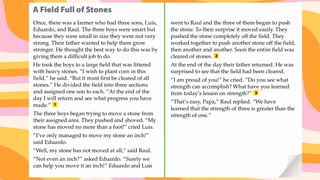
2. IRA: A field full of stones
3. Vocabulary Introduction
4. Phonics and Spelling
5.R&W Workshop:
Comprehension+ Predictions
6.Themes + Genre application
7.Vocab strategy:Antonyms +
Grammar Nouns
UNIT 2 WEEK 1
Contents
8. Literature Anthology 1
9. Literature Anthology 1
10. Literature Anthology 2
11. Review Lesson 1
12. Review Lesson 2
13. Review Lesson 3
14.Mock test
UNIT 2 WEEK 1
Build Background, Essential
Question, Genre
Solving
Problems
• One way to solve a
problem is through
cooperation.
• Cooperation means
“Working together”
Discussion rules to follow
TEAM
WORK
MAKES
THE
DREAM
WORK
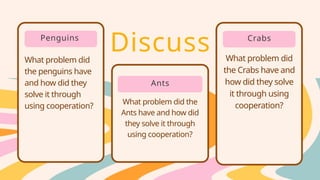
Discuss
What problem did
the penguins have
and how did they
solve it through
using cooperation?
What problem did the
Ants have and how did
they solve it through
using cooperation?
What problem did
the Crabs have and
how did they solve
it through using
cooperation?
Penguins
Ants
Crabs
Questions
• What are the
girls showing
by working
together?
• How does
working
together help
the
community?
Graphic organizer
• Work together in pairs to show
what you have learnt about
cooperation Complete in
Notebook
UNIT 2 WEEK 1
IRA: A field full of stones + Genre
FEATURES OF
FOLKLORE
Usually handed
down from one
generation to the
next
Genre: Folklore
The characters may
be people or
animals
Often teaches a
lesson to those who
hear it or read it
May reflect the
beliefs or customs of
a region
Summary
Summarize the story “A field full
of stones” include the main idea
and supporting details.
UNIT 2 WEEK 1
Vocabulary Introduction
Cooperation- The
process of working
together.
ATTEMPT- make an effort to
achieve or complete
something, typically a
difficult task
Created- when something is
created it is made or built.
Furiously- When you act
furiously you act in a way
which shows you are very
angry.
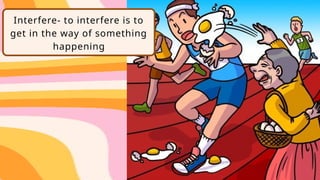
Interfere- to interfere is to
get in the way of something
happening
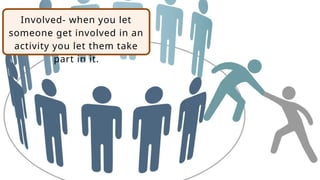
Involved- when you let
someone get involved in an
activity you let them take
part in it.
Timid- when someone is
timid they are shy and not
brave.
Awkward- when someone is
awkward he/she is clumsy or
not graceful.
Partner activity
Using the new vocabulary create
4 questions in your notebook for
your partner to answer.
Homework
Your turn Page, 51
UNIT 2 WEEK 1
Phonics & spelling
LONG U & I
We will learn about the
different ways to spell the
long i and long u sounds."
Long U &
I
• i (find),
• ie (pie)
• igh (right)
• i_e (bite)
• y (fly)
• find,
• pie,
• right,
• bite,
• fly,
• u (unit)
• u_e (use)
• ew (few)
Long I
Words with Long U
& I
Long U
unit,
use,
few
Your turn book
Page. 58
Homework
Page 26,27
UNIT 2 WEEK 1
R&W Workshop comprehension
+ conprehension strategy
Making predictions
Good readers can use clues
to make predictions of what
will happen in the text. As
you read you can confirm or
revise your predictions.
Making predictions
Making predictions
R&W WORKSHOP BOOK PG.102
• .
• .
Make your predictions
• In your notebook, predict
the story based on the title
and illustration.
• During reading stop and
think about what will
happen next.
• After reading confirm or
adjust your prediction.
Remember!
Draw your theme graphic organizer in your notebook,
we will fill in the details as we read.
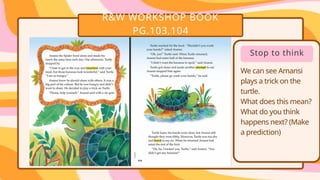
R&W WORKSHOP BOOK
PG.103,104
• .
• .
Stop to think
We can see Amansi
plays a trick on the
turtle.
What does this mean?
What do you think
happens next? (Make
a prediction)
R&W WORKSHOP BOOK PG.102
• .
• .
Stop to think
How are turtle and fish
cooperating to solve a
problem?
Turtle and fish learn
cooperation is important.
Provide text evidence to
support this statement.
R&W WORKSHOP BOOK PG.102
• .
• .
Stop to think
REMEMBER!
FOLKLORES TEACH US
LESSONS.
Turtle and fish learn that
cooperation is important.
What details in the text
support this?
Comprehension
questions
1. What does the turtle decide to do when Anansi tricks
him?
2.What lesson does Anansi learn?
3.What does Anansi think about sharing?
4.Find examples in the text showing cooperation
Show your partner your
predictions from earlier and
discuss what made you make
UNIT 2 WEEK 1
Themes + Genre
THEMES
2. To find the theme
you need to look at key
details in the actions &
words
What is a theme?
1.The theme of the
story is the author's
message
3. The theme is not
stated, it is something
you must infer.
4. You need to use clues,
and ask questions. Ex: How
did the characters get what
they wanted or solve a
problem ?
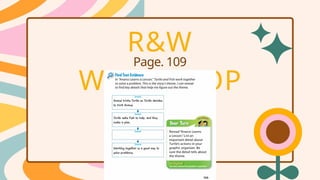
R&W
WORKSHOP
Page. 109
Homework
Page 52 to 55
UNIT 2 WEEK 1
Litreture: Folklore
FEATURES OF
FOLKLORE
Folklore contains a
problem & solution
and suggests a
lesson
Genre: Folklore
A folklore is a type of
fiction writing that
usually has a hidden
message
The illustrations can
provide details
about characters ,
setting and events.
The lessons in folklore
can apply to many
different people and
cultures.
Popular folklore stories
R&W
WORKSHOP
Page. 110
Homework
Page.56
UNIT 2 WEEK 1
Vocabulary strategy: Antonyms +
Grammar Nouns
Antonyms
R&W
WORKSHOP
Page. 111
Stop to think
You can figure out the meaning
of an unknown word by using
context clues, words or phrases.
Sometimes the author will use
antonyms as context clues
Your turn book
Page. 57
UNIT 2 WEEK 1
Grammar Nouns
Your turn book Grammar
Page.26,27
Homework
Page.28,29,30
UNIT 2 WEEK 1
Literature Anthology 1
LITERATURE ANTHOLOGY
PG.100
• .
• .
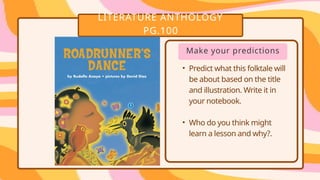
Make your predictions
• Predict what this folktale will
be about based on the title
and illustration. Write it in
your notebook.
• Who do you think might
learn a lesson and why?.
Remember!
Draw your theme graphic organizer in your notebook,
we will fill in the details as we read.
LITERATURE ANTHOLOGY
PG.100
• .
• .
Stop to think
• Look at the illustration what
is happening?
• How does the illustration
help us know this story is a
folktale?
LITERATURE ANTHOLOGY
PG.102
• .
• .
Stop to think
• Why is “Threatened” a better
word choice than said?
• What does the snake do when
villagers try to use the road?
• What problem does this cause?
• What inferences can you make
about the theme so far?
LITERATURE ANTHOLOGY
PG.102
• .
• .
Stop to think
• The desert woman says she has a
solution to the problem , make a
prediction with your partner on
what that might be.
LITERATURE ANTHOLOGY
PG.102
• .
• .
Stop to think
• Why does the woman put a rattle
on the snake's tail?
• Does the desert woman's plan
work?
• Does this change your idea on
what the theme may be?
• Discuss with your partner what
your next prediction might be.
Remember!
One purpose of folktales is to explain things in
nature.
• What does this story explain about
rattlesnakes?
• Why do you think people told stories about
rattlesnakes?
LITERATURE ANTHOLOGY
PG.105
• .
• .
Stop to think
• How does this illustration
highlight the rattlesnake's
power?
LITERATURE ANTHOLOGY
PG.106
• .
• .
Stop to think
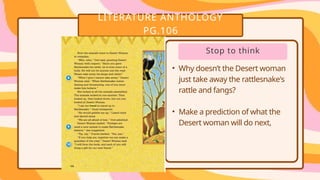
• Why doesn’t the Desert woman
just take away the rattlesnake's
rattle and fangs?
• Make a prediction of what the
Desert woman will do next,
LITERATURE ANTHOLOGY
PG.107
• .
• .
Stop to think
• What is the theme of this
section?
• Do you think timid mean shy or
brave based of the text?
LITERATURE ANTHOLOGY
PG.108
• .
• .
Stop to think
• What do the animals decide to
give the new animal?
• How do you think the animals
chose what to give? Provide
evidence.
LITERATURE ANTHOLOGY
PG.110
• .
• .
Stop to think
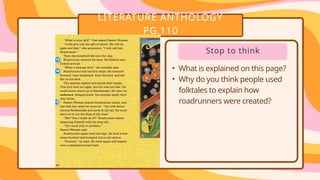
• What is explained on this page?
• Why do you think people used
folktales to explain how
roadrunners were created?
LITERATURE ANTHOLOGY
PG.111
• .
• .
Stop to think
• What is roadrunner like at first?
• Do the other animals think he
can beat rattlesnake?
• Does the Desert woman then he
can?
• What message is the author
trying to tell us.
LITERATURE ANTHOLOGY
PG.112
• .
• .
Stop to think
• What does the roadrunner
practice?
• How has Roadrunner changed?
• What is the message the author
is trying to tell us on this page?
LITERATURE ANTHOLOGY
PG.113
• .
• .
Stop to think
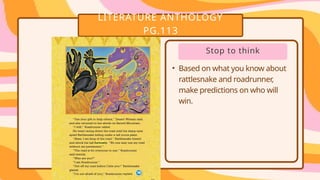
• Based on what you know about
rattlesnake and roadrunner,
make predictions on who will
win.
LITERATURE ANTHOLOGY
PG.114
• .
• .
Stop to think
• The author uses figurative
language here , please provide
examples.
LITERATURE ANTHOLOGY
PG.116
• .
• .
Stop to think
• what is the lesson to be learned
from the rattlesnakes defeat by
the roadrunner?
Reflections
• Review the predictions you made at the
beginning of the story were they correct?
if not make adjustments or confirm them.
• What is our essential question? does this story
answer it?
LITERATURE ANTHOLOGY
PG.119
• .
• .
Stop to think
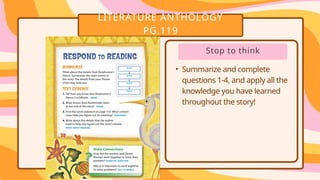
• Summarize and complete
questions 1-4, and apply all the
knowledge you have learned
throughout the story!
UNIT 2 WEEK 1
Literature Anthology 2
LITERATURE ANTHOLOGY
PG.120
• .
• .
Stop to think
• Predict what this expository text
will be about based on the title.
Write it in your notebook.
Remember!
Draw your graphic organizer in your notebook, we will
fill in the details as we read.
LITERATURE ANTHOLOGY
PG.121
• .
• .
Stop to think
• What problem do the people of
Deltona have?
• Why do you think the major liked
the idea of bringing bats to
Deltona?
LITERATURE ANTHOLOGY
PG.122
• .
• .
Stop to think
• How does the local government
of Deltona make decisions?
LITERATURE ANTHOLOGY
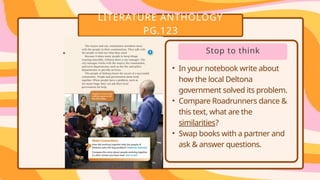
PG.123
• .
• .
Stop to think
• In your notebook write about
how the local Deltona
government solved its problem.
• Compare Roadrunners dance &
this text, what are the
similarities?
• Swap books with a partner and
ask & answer questions.
UNIT 2 WEEK 1
Review 1
UNIT 2 WEEK 1
Review 2
UNIT 2 WEEK 1
Review 3
Reminder
.
.
Reminder 1
Reminder 2
.
Reminder 3
Thank
you!
2030 - 2031

How working together solves problems....