Writing a Conclusion
to Your Thesis
Viv Grigg
By Viv Grigg
Item 5
Functions of a COnclusion
“1 Must” and “3 Ideals”
•Overview
Conclusion-a-phobia
The “5 Avoids”
Sample
Item 1
Item 2
Item 3
Item 4
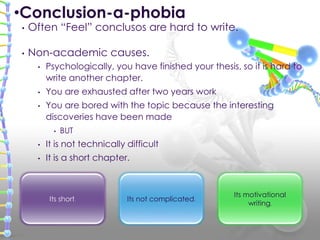
• Non-academic causes.
• Psychologically, you have finished your thesis, so it is hard to
write another chapter.
• You are exhausted after two years work
• You are bored with the topic because the interesting
discoveries have been made
• BUT
• It is not technically difficult
• It is a short chapter.
• Often “Feel” conclusos are hard to write.
•Conclusion-a-phobia
Its not complicated.Its short.
Its motivational
writing.
FOR GRADING/EXAMINATION
• Its the LAST piece the
examiner reads.
• They may have read it
over weeks
• Bits and pieces
• This piece integrates it
all in a few minutes
• A good conclusion wil
provide you with the energy
to publish your thesis when
you cme back to recap your
findings…after your post-
thesis rest
FOR LONGER TERM CAREER
•Importance
A second line of text could go here
• Claiming findings that
you have not proven
• Introducing new data
• Hiding weaknesses or
limitations in your thesis.
(Use a self critique, but
don’t go overboard)
• Avoid too long
(repetitive) or too short
(nothing to say)
•The Five Avoids
• One paragraph restating
what you researched and
your original contribution
• Then break into sections
• One section on what you
researche and how you did it
• One section on main findings
• One section on possble areas
of future research
• Motivational pitch about
applicational use of your
findings
• Final summary paragraph –
motivational and integrative.
•Sample Conclusion Structure
• Must
• Make a clear and concise
statement of your contribution to
knowledge
• Aspire to
• Show links between key ideas
across the chapters
• Show your commitment and
aspiration to academic research
• Leave a positive impression with
the examiners
•The “1 Must” and “3 Ideals”

675-12 Writing a Conclusion to Your Research

  • 1.
    Writing a Conclusion toYour Thesis Viv Grigg By Viv Grigg
  • 2.
    Item 5 Functions ofa COnclusion “1 Must” and “3 Ideals” •Overview Conclusion-a-phobia The “5 Avoids” Sample Item 1 Item 2 Item 3 Item 4
  • 3.
    • Non-academic causes. •Psychologically, you have finished your thesis, so it is hard to write another chapter. • You are exhausted after two years work • You are bored with the topic because the interesting discoveries have been made • BUT • It is not technically difficult • It is a short chapter. • Often “Feel” conclusos are hard to write. •Conclusion-a-phobia Its not complicated.Its short. Its motivational writing.
  • 4.
    FOR GRADING/EXAMINATION • Itsthe LAST piece the examiner reads. • They may have read it over weeks • Bits and pieces • This piece integrates it all in a few minutes • A good conclusion wil provide you with the energy to publish your thesis when you cme back to recap your findings…after your post- thesis rest FOR LONGER TERM CAREER •Importance A second line of text could go here
  • 5.
    • Claiming findingsthat you have not proven • Introducing new data • Hiding weaknesses or limitations in your thesis. (Use a self critique, but don’t go overboard) • Avoid too long (repetitive) or too short (nothing to say) •The Five Avoids
  • 6.
    • One paragraphrestating what you researched and your original contribution • Then break into sections • One section on what you researche and how you did it • One section on main findings • One section on possble areas of future research • Motivational pitch about applicational use of your findings • Final summary paragraph – motivational and integrative. •Sample Conclusion Structure
  • 7.
    • Must • Makea clear and concise statement of your contribution to knowledge • Aspire to • Show links between key ideas across the chapters • Show your commitment and aspiration to academic research • Leave a positive impression with the examiners •The “1 Must” and “3 Ideals”