Impacts of Changing Climate
in the Northeast on Manure
Storages
Peter Wright, State Conservation Engineer
NRCS Syracuse NY
Jessica Rennells, Climatologist
Arthur DeGaetano, Director
Northeast Regional Climate Center
Curt Gooch, PRO-Dairy
Cornell University
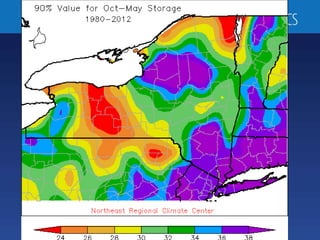
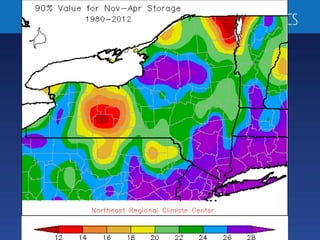
Storage Issues
• Management
• Design
• Climate Change
Slide 3
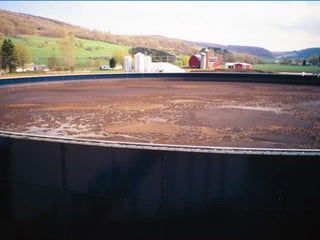
Ideal Management
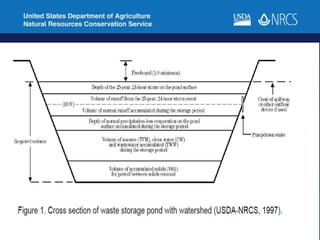
• Sized correctly based on CNMP
• Emptied according to plan
• Solids controlled
• Drainage area controlled
• Manure production stays same
Slide 7
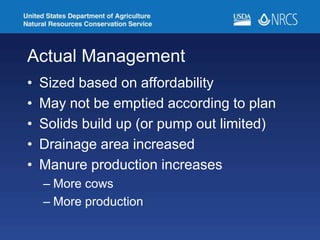
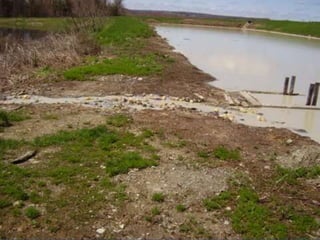
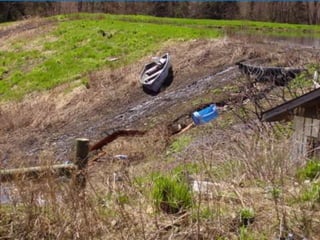
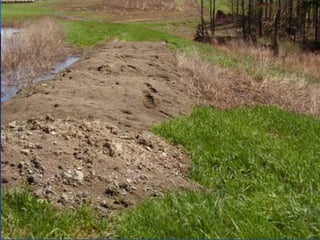
Actual Management
• Sized based on affordability
• May not be emptied according to plan
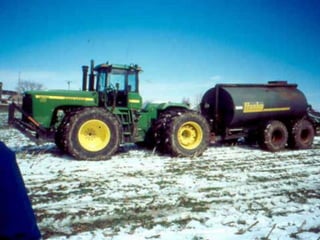
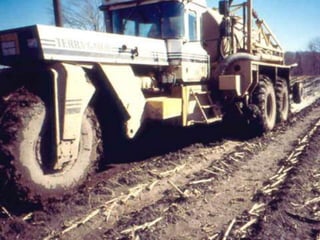
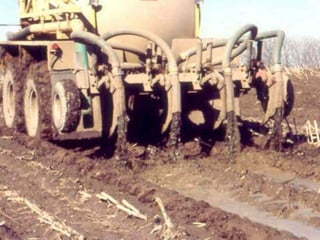
• Solids build up (or pump out limited)
• Drainage area increased
• Manure production increases
– More cows
– More production
007-23
Slide 10
Slide 11
Slide 12
Design Adaptations
• Extra months of storage
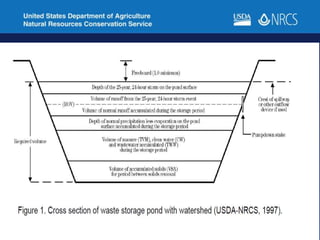
• 2 x the 24 hr.- 25 yr. storm
• 10% production increase
Slide 16
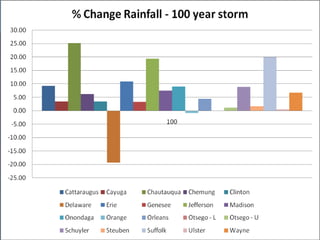
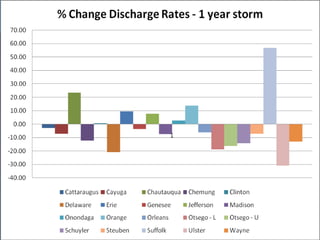
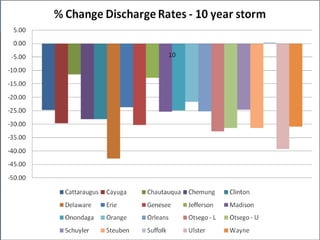
Impacts of Climate Change?
• Severe storms
• More total precipitation
Slide 17
18
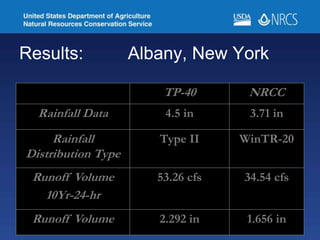
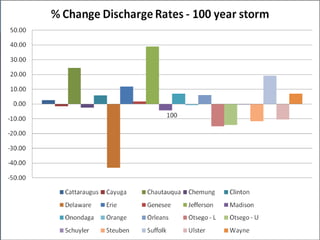
Results: Albany, New York
TP-40 NRCC
Rainfall Data 4.5 in 3.71 in
Rainfall
Distribution Type
Type II WinTR-20
Runoff Volume
10Yr-24-hr
53.26 cfs 34.54 cfs
Runoff Volume 2.292 in 1.656 in
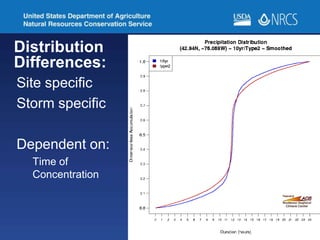
Distribution
Differences:
Site specific
Storm specific
Dependent on:
Time of
Concentration
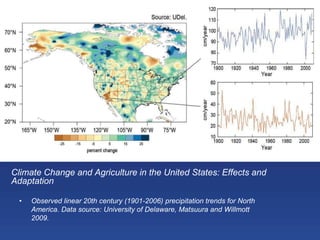
Climate Change and Agriculture in the United States: Effects and
Adaptation
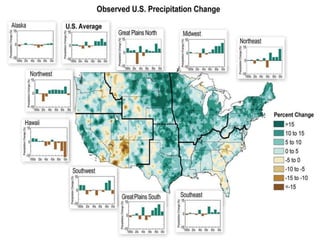
• Observed linear 20th century (1901-2006) precipitation trends for North
America. Data source: University of Delaware, Matsuura and Willmott
2009.
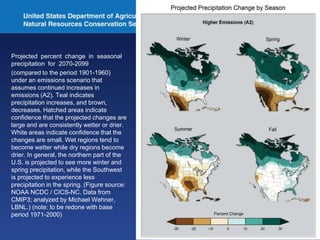
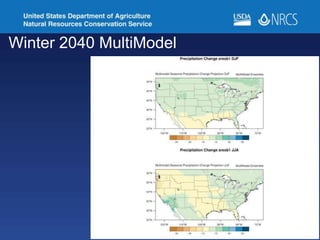
Projected percent change in seasonal
precipitation for 2070-2099
(compared to the period 1901-1960)
under an emissions scenario that
assumes continued increases in
emissions (A2). Teal indicates
precipitation increases, and brown,
decreases. Hatched areas indicate
confidence that the projected changes are
large and are consistently wetter or drier.
White areas indicate confidence that the
changes are small. Wet regions tend to
become wetter while dry regions become
drier. In general, the northern part of the
U.S. is projected to see more winter and
spring precipitation, while the Southwest
is projected to experience less
precipitation in the spring. (Figure source:
NOAA NCDC / CICS-NC. Data from
CMIP3; analyzed by Michael Wehner,
LBNL.) (note: to be redone with base
period 1971-2000)
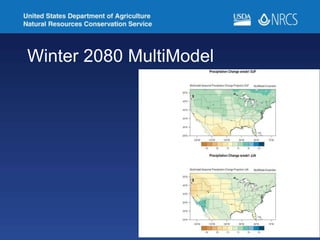
Winter 2080 MultiModel
Winter 2040 MultiModel
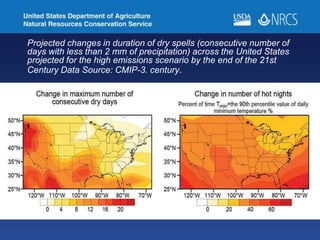
Projected changes in duration of dry spells (consecutive number of
days with less than 2 mm of precipitation) across the United States
projected for the high emissions scenario by the end of the 21st
Century Data Source: CMIP-3. century.
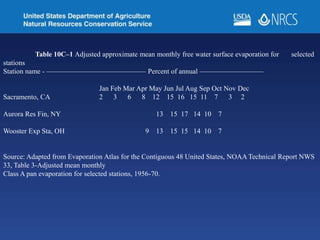
Table 10C–1 Adjusted approximate mean monthly free water surface evaporation for selected
stations
Station name - —————————————— Percent of annual —————————
Jan Feb Mar Apr May Jun Jul Aug Sep Oct Nov Dec
Sacramento, CA 2 3 6 8 12 15 16 15 11 7 3 2
Aurora Res Fin, NY 13 15 17 14 10 7
Wooster Exp Sta, OH 9 13 15 15 14 10 7
Source: Adapted from Evaporation Atlas for the Contiguous 48 United States, NOAA Technical Report NWS
33, Table 3-Adjusted mean monthly
Class A pan evaporation for selected stations, 1956-70.
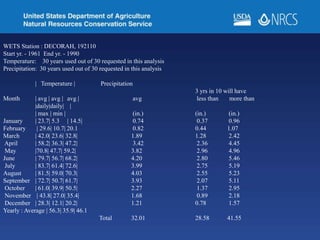
WETS Station : DECORAH, 192110
Start yr. - 1961 End yr. - 1990
Temperature: 30 years used out of 30 requested in this analysis
Precipitation: 30 years used out of 30 requested in this analysis
| Temperature | Precipitation
3 yrs in 10 will have
Month | avg | avg | avg | avg less than more than
|daily|daily| |
| max | min | (in.) (in.) (in.)
January | 23.7| 5.3 | 14.5| 0.74 0.37 0.96
February | 29.6| 10.7| 20.1 0.82 0.44 1.07
March | 42.0| 23.6| 32.8| 1.89 1.28 2.42
April | 58.2| 36.3| 47.2| 3.42 2.36 4.45
May |70.8| 47.7| 59.2| 3.82 2.96 4.96
June | 79.7| 56.7| 68.2| 4.20 2.80 5.46
July | 83.7| 61.4| 72.6| 3.99 2.75 5.19
August | 81.5| 59.0| 70.3| 4.03 2.55 5.23
September | 72.7| 50.7| 61.7| 3.93 2.07 5.11
October | 61.0| 39.9| 50.5| 2.27 1.37 2.95
November | 43.8| 27.0| 35.4| 1.68 0.89 2.18
December | 28.3| 12.1| 20.2| 1.21 0.78 1.57
Yearly : Average | 56.3| 35.9| 46.1
Total 32.01 28.58 41.55
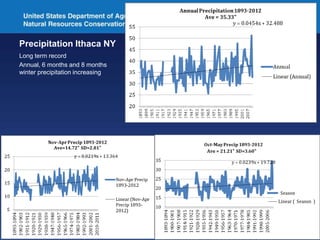
Precipitation Ithaca NY
Long term record
Annual, 6 months and 8 months
winter precipitation increasing
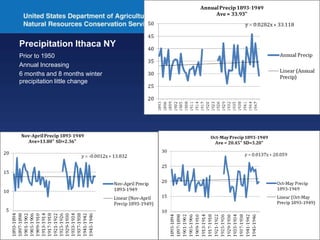
Precipitation Ithaca NY
Prior to 1950
Annual Increasing
6 months and 8 months winter
precipitation little change
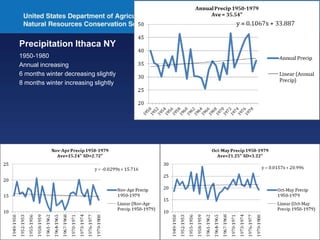
Precipitation Ithaca NY
1950-1980
Annual increasing
6 months winter decreasing slightly
8 months winter increasing slightly
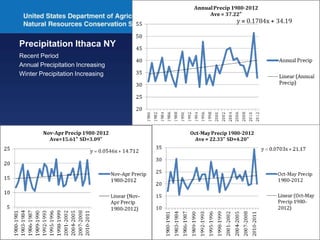
Precipitation Ithaca NY
Recent Period
Annual Precipitation Increasing
Winter Precipitation Increasing
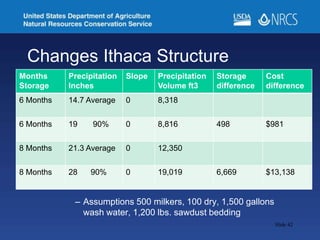
Changes Ithaca Structure
– Assumptions 500 milkers, 100 dry, 1,500 gallons
wash water, 1,200 lbs. sawdust bedding
Slide 42
Months
Storage
Precipitation
Inches
Slope Precipitation
Volume ft3
Storage
difference
Cost
difference
6 Months 14.7 Average 0 8,318
6 Months 19 90% 0 8,816 498 $981
8 Months 21.3 Average 0 12,350
8 Months 28 90% 0 19,019 6,669 $13,138
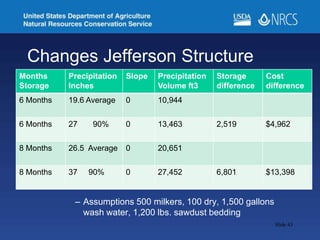
Changes Jefferson Structure
– Assumptions 500 milkers, 100 dry, 1,500 gallons
wash water, 1,200 lbs. sawdust bedding
Slide 43
Months
Storage
Precipitation
Inches
Slope Precipitation
Volume ft3
Storage
difference
Cost
difference
6 Months 19.6 Average 0 10,944
6 Months 27 90% 0 13,463 2,519 $4,962
8 Months 26.5 Average 0 20,651
8 Months 37 90% 0 27,452 6,801 $13,398
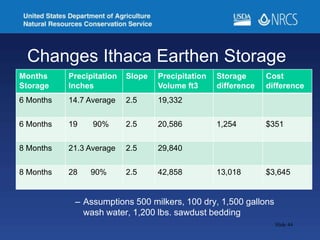
Changes Ithaca Earthen Storage
– Assumptions 500 milkers, 100 dry, 1,500 gallons
wash water, 1,200 lbs. sawdust bedding
Slide 44
Months
Storage
Precipitation
Inches
Slope Precipitation
Volume ft3
Storage
difference
Cost
difference
6 Months 14.7 Average 2.5 19,332
6 Months 19 90% 2.5 20,586 1,254 $351
8 Months 21.3 Average 2.5 29,840
8 Months 28 90% 2.5 42,858 13,018 $3,645
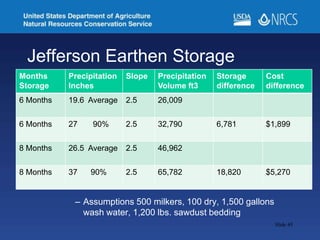
Jefferson Earthen Storage
– Assumptions 500 milkers, 100 dry, 1,500 gallons
wash water, 1,200 lbs. sawdust bedding
Slide 45
Months
Storage
Precipitation
Inches
Slope Precipitation
Volume ft3
Storage
difference
Cost
difference
6 Months 19.6 Average 2.5 26,009
6 Months 27 90% 2.5 32,790 6,781 $1,899
8 Months 26.5 Average 2.5 46,962
8 Months 37 90% 2.5 65,782 18,820 $5,270
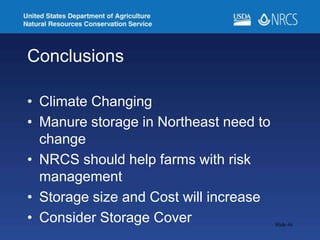
Conclusions
• Climate Changing
• Manure storage in Northeast need to
change
• NRCS should help farms with risk
management
• Storage size and Cost will increase
• Consider Storage Cover Slide 46
Slide 47
"The U.S. Department of Agriculture (USDA) prohibits discrimination
in all of its programs and activities on the basis of race, color, national
origin, age, disability, and where applicable, sex, marital status,
familial status, parental status, religion, sexual orientation, political
beliefs, genetic information, reprisal, or because all or part of an
individual's income is derived from any public assistance program.
(Not all prohibited bases apply to all programs.) Persons with
disabilities who require alternative means for communication of
program information (Braille, large print, audiotape, etc.) should
contact USDA's TARGET Center at (202) 720-2600 (voice and
TDD).“
To file a complaint of discrimination, write to USDA, Assistant
Secretary for Civil Rights, Office of the Assistant Secretary for Civil
Rights, 1400 Independence Avenue, S.W., Stop 9410, Washington,
DC 20250-9410, or call toll-free at (866) 632-9992 (English) or (800)
877-8339 (TDD) or (866) 377-8642 (English Federal-relay) or (800)
845-6136 (Spanish Federal-relay). USDA is an equal opportunity
provider and employer.
QUESTIONS?
Pete Wright peter.wright@ny.usda.gov
Slide 48

Impacts of Changing Climate in the Northeast on Manure Storages

  • 1.
    Impacts of ChangingClimate in the Northeast on Manure Storages Peter Wright, State Conservation Engineer NRCS Syracuse NY Jessica Rennells, Climatologist Arthur DeGaetano, Director Northeast Regional Climate Center Curt Gooch, PRO-Dairy Cornell University
  • 3.
    Storage Issues • Management •Design • Climate Change Slide 3
  • 4.
    Ideal Management • Sizedcorrectly based on CNMP • Emptied according to plan • Solids controlled • Drainage area controlled • Manure production stays same
  • 7.
  • 8.
    Actual Management • Sizedbased on affordability • May not be emptied according to plan • Solids build up (or pump out limited) • Drainage area increased • Manure production increases – More cows – More production
  • 9.
  • 10.
  • 11.
  • 12.
  • 16.
    Design Adaptations • Extramonths of storage • 2 x the 24 hr.- 25 yr. storm • 10% production increase Slide 16
  • 17.
    Impacts of ClimateChange? • Severe storms • More total precipitation Slide 17
  • 18.
    18 Results: Albany, NewYork TP-40 NRCC Rainfall Data 4.5 in 3.71 in Rainfall Distribution Type Type II WinTR-20 Runoff Volume 10Yr-24-hr 53.26 cfs 34.54 cfs Runoff Volume 2.292 in 1.656 in
  • 22.
  • 26.
    Climate Change andAgriculture in the United States: Effects and Adaptation • Observed linear 20th century (1901-2006) precipitation trends for North America. Data source: University of Delaware, Matsuura and Willmott 2009.
  • 27.
    Projected percent changein seasonal precipitation for 2070-2099 (compared to the period 1901-1960) under an emissions scenario that assumes continued increases in emissions (A2). Teal indicates precipitation increases, and brown, decreases. Hatched areas indicate confidence that the projected changes are large and are consistently wetter or drier. White areas indicate confidence that the changes are small. Wet regions tend to become wetter while dry regions become drier. In general, the northern part of the U.S. is projected to see more winter and spring precipitation, while the Southwest is projected to experience less precipitation in the spring. (Figure source: NOAA NCDC / CICS-NC. Data from CMIP3; analyzed by Michael Wehner, LBNL.) (note: to be redone with base period 1971-2000)
  • 28.
  • 29.
  • 31.
    Projected changes induration of dry spells (consecutive number of days with less than 2 mm of precipitation) across the United States projected for the high emissions scenario by the end of the 21st Century Data Source: CMIP-3. century.
  • 33.
    Table 10C–1 Adjustedapproximate mean monthly free water surface evaporation for selected stations Station name - —————————————— Percent of annual ————————— Jan Feb Mar Apr May Jun Jul Aug Sep Oct Nov Dec Sacramento, CA 2 3 6 8 12 15 16 15 11 7 3 2 Aurora Res Fin, NY 13 15 17 14 10 7 Wooster Exp Sta, OH 9 13 15 15 14 10 7 Source: Adapted from Evaporation Atlas for the Contiguous 48 United States, NOAA Technical Report NWS 33, Table 3-Adjusted mean monthly Class A pan evaporation for selected stations, 1956-70.
  • 34.
    WETS Station :DECORAH, 192110 Start yr. - 1961 End yr. - 1990 Temperature: 30 years used out of 30 requested in this analysis Precipitation: 30 years used out of 30 requested in this analysis | Temperature | Precipitation 3 yrs in 10 will have Month | avg | avg | avg | avg less than more than |daily|daily| | | max | min | (in.) (in.) (in.) January | 23.7| 5.3 | 14.5| 0.74 0.37 0.96 February | 29.6| 10.7| 20.1 0.82 0.44 1.07 March | 42.0| 23.6| 32.8| 1.89 1.28 2.42 April | 58.2| 36.3| 47.2| 3.42 2.36 4.45 May |70.8| 47.7| 59.2| 3.82 2.96 4.96 June | 79.7| 56.7| 68.2| 4.20 2.80 5.46 July | 83.7| 61.4| 72.6| 3.99 2.75 5.19 August | 81.5| 59.0| 70.3| 4.03 2.55 5.23 September | 72.7| 50.7| 61.7| 3.93 2.07 5.11 October | 61.0| 39.9| 50.5| 2.27 1.37 2.95 November | 43.8| 27.0| 35.4| 1.68 0.89 2.18 December | 28.3| 12.1| 20.2| 1.21 0.78 1.57 Yearly : Average | 56.3| 35.9| 46.1 Total 32.01 28.58 41.55
  • 35.
    Precipitation Ithaca NY Longterm record Annual, 6 months and 8 months winter precipitation increasing
  • 36.
    Precipitation Ithaca NY Priorto 1950 Annual Increasing 6 months and 8 months winter precipitation little change
  • 37.
    Precipitation Ithaca NY 1950-1980 Annualincreasing 6 months winter decreasing slightly 8 months winter increasing slightly
  • 38.
    Precipitation Ithaca NY RecentPeriod Annual Precipitation Increasing Winter Precipitation Increasing
  • 42.
    Changes Ithaca Structure –Assumptions 500 milkers, 100 dry, 1,500 gallons wash water, 1,200 lbs. sawdust bedding Slide 42 Months Storage Precipitation Inches Slope Precipitation Volume ft3 Storage difference Cost difference 6 Months 14.7 Average 0 8,318 6 Months 19 90% 0 8,816 498 $981 8 Months 21.3 Average 0 12,350 8 Months 28 90% 0 19,019 6,669 $13,138
  • 43.
    Changes Jefferson Structure –Assumptions 500 milkers, 100 dry, 1,500 gallons wash water, 1,200 lbs. sawdust bedding Slide 43 Months Storage Precipitation Inches Slope Precipitation Volume ft3 Storage difference Cost difference 6 Months 19.6 Average 0 10,944 6 Months 27 90% 0 13,463 2,519 $4,962 8 Months 26.5 Average 0 20,651 8 Months 37 90% 0 27,452 6,801 $13,398
  • 44.
    Changes Ithaca EarthenStorage – Assumptions 500 milkers, 100 dry, 1,500 gallons wash water, 1,200 lbs. sawdust bedding Slide 44 Months Storage Precipitation Inches Slope Precipitation Volume ft3 Storage difference Cost difference 6 Months 14.7 Average 2.5 19,332 6 Months 19 90% 2.5 20,586 1,254 $351 8 Months 21.3 Average 2.5 29,840 8 Months 28 90% 2.5 42,858 13,018 $3,645
  • 45.
    Jefferson Earthen Storage –Assumptions 500 milkers, 100 dry, 1,500 gallons wash water, 1,200 lbs. sawdust bedding Slide 45 Months Storage Precipitation Inches Slope Precipitation Volume ft3 Storage difference Cost difference 6 Months 19.6 Average 2.5 26,009 6 Months 27 90% 2.5 32,790 6,781 $1,899 8 Months 26.5 Average 2.5 46,962 8 Months 37 90% 2.5 65,782 18,820 $5,270
  • 46.
    Conclusions • Climate Changing •Manure storage in Northeast need to change • NRCS should help farms with risk management • Storage size and Cost will increase • Consider Storage Cover Slide 46
  • 47.
    Slide 47 "The U.S.Department of Agriculture (USDA) prohibits discrimination in all of its programs and activities on the basis of race, color, national origin, age, disability, and where applicable, sex, marital status, familial status, parental status, religion, sexual orientation, political beliefs, genetic information, reprisal, or because all or part of an individual's income is derived from any public assistance program. (Not all prohibited bases apply to all programs.) Persons with disabilities who require alternative means for communication of program information (Braille, large print, audiotape, etc.) should contact USDA's TARGET Center at (202) 720-2600 (voice and TDD).“ To file a complaint of discrimination, write to USDA, Assistant Secretary for Civil Rights, Office of the Assistant Secretary for Civil Rights, 1400 Independence Avenue, S.W., Stop 9410, Washington, DC 20250-9410, or call toll-free at (866) 632-9992 (English) or (800) 877-8339 (TDD) or (866) 377-8642 (English Federal-relay) or (800) 845-6136 (Spanish Federal-relay). USDA is an equal opportunity provider and employer.
  • 48.