Introduction                                                                                Results                                                                       References
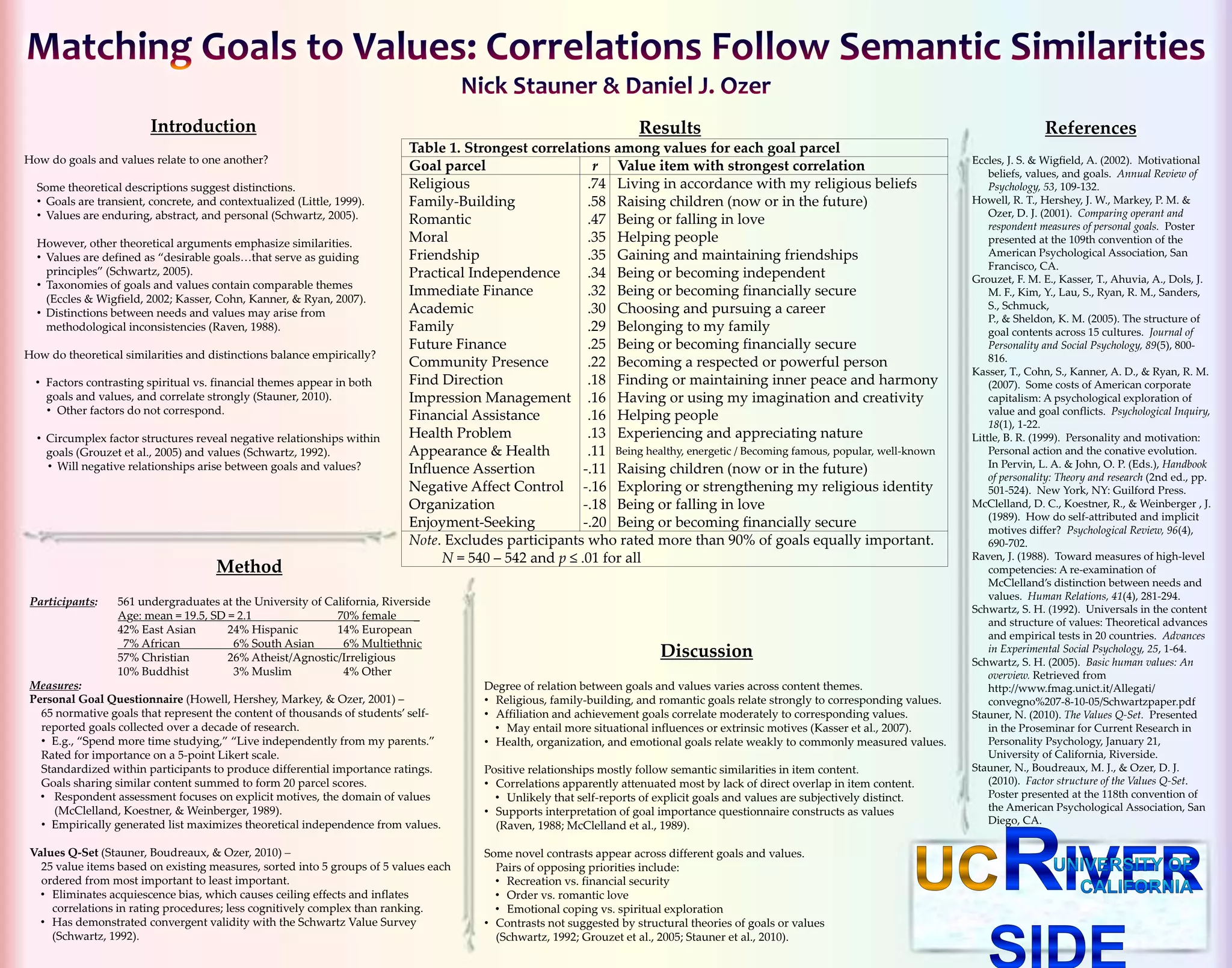
                                                                          Table 1. Strongest correlations among values for each goal parcel
How do goals and values relate to one another?                                                                                                                                     Eccles, J. S. & Wigfield, A. (2002). Motivational
                                                                          Goal parcel                   r Value item with strongest correlation                                        beliefs, values, and goals. Annual Review of
  Some theoretical descriptions suggest distinctions.                     Religious                    .74 Living in accordance with my religious beliefs                              Psychology, 53, 109-132.
  • Goals are transient, concrete, and contextualized (Little, 1999).     Family-Building              .58 Raising children (now or in the future)                                 Howell, R. T., Hershey, J. W., Markey, P. M. &
  • Values are enduring, abstract, and personal (Schwartz, 2005).         Romantic                     .47 Being or falling in love                                                    Ozer, D. J. (2001). Comparing operant and
                                                                                                                                                                                       respondent measures of personal goals. Poster
  However, other theoretical arguments emphasize similarities.            Moral                        .35 Helping people                                                              presented at the 109th convention of the
  • Values are defined as “desirable goals…that serve as guiding          Friendship                   .35 Gaining and maintaining friendships                                         American Psychological Association, San
    principles” (Schwartz, 2005).                                                                                                                                                      Francisco, CA.
                                                                          Practical Independence       .34 Being or becoming independent                                           Grouzet, F. M. E., Kasser, T., Ahuvia, A., Dols, J.
  • Taxonomies of goals and values contain comparable themes
                                                                          Immediate Finance            .32 Being or becoming financially secure                                        M. F., Kim, Y., Lau, S., Ryan, R. M., Sanders,
    (Eccles & Wigfield, 2002; Kasser, Cohn, Kanner, & Ryan, 2007).
                                                                          Academic                     .30 Choosing and pursuing a career                                              S., Schmuck,
  • Distinctions between needs and values may arise from                                                                                                                               P., & Sheldon, K. M. (2005). The structure of
    methodological inconsistencies (Raven, 1988).                         Family                       .29 Belonging to my family                                                      goal contents across 15 cultures. Journal of
                                                                          Future Finance               .25 Being or becoming financially secure                                        Personality and Social Psychology, 89(5), 800-
How do theoretical similarities and distinctions balance empirically?                                                                                                                  816.
                                                                          Community Presence           .22 Becoming a respected or powerful person
                                                                                                                                                                                   Kasser, T., Cohn, S., Kanner, A. D., & Ryan, R. M.
  • Factors contrasting spiritual vs. financial themes appear in both     Find Direction               .18 Finding or maintaining inner peace and harmony                              (2007). Some costs of American corporate
    goals and values, and correlate strongly (Stauner, 2010).             Impression Management .16 Having or using my imagination and creativity                                      capitalism: A psychological exploration of
    • Other factors do not correspond.                                    Financial Assistance         .16 Helping people                                                              value and goal conflicts. Psychological Inquiry,
                                                                                                                                                                                       18(1), 1-22.
  • Circumplex factor structures reveal negative relationships within     Health Problem               .13 Experiencing and appreciating nature                                    Little, B. R. (1999). Personality and motivation:
    goals (Grouzet et al., 2005) and values (Schwartz, 1992).             Appearance & Health          .11 Being healthy, energetic / Becoming famous, popular, well-known             Personal action and the conative evolution.
    • Will negative relationships arise between goals and values?         Influence Assertion         -.11 Raising children (now or in the future)                                     In Pervin, L. A. & John, O. P. (Eds.), Handbook
                                                                                                                                                                                       of personality: Theory and research (2nd ed., pp.
                                                                          Negative Affect Control -.16 Exploring or strengthening my religious identity                                501-524). New York, NY: Guilford Press.
                                                                          Organization                -.18 Being or falling in love                                                McClelland, D. C., Koestner, R., & Weinberger , J.
                                                                                                                                                                                       (1989). How do self-attributed and implicit
                                                                          Enjoyment-Seeking           -.20 Being or becoming financially secure                                        motives differ? Psychological Review, 96(4),
                                                                          Note. Excludes participants who rated more than 90% of goals equally important.                              690-702.
                                                                               N = 540 – 542 and p ≤ .01 for all                                                                   Raven, J. (1988). Toward measures of high-level
                                      Method                                                                                                                                           competencies: A re-examination of
                                                                                                                                                                                       McClelland’s distinction between needs and
                                                                                                                                                                                       values. Human Relations, 41(4), 281-294.
 Participants:    561 undergraduates at the University of California, Riverside
                                                                                                                                                                                   Schwartz, S. H. (1992). Universals in the content
                  Age: mean = 19.5, SD = 2.1                70% female _
                                                                                                                                                                                       and structure of values: Theoretical advances
                  42% East Asian       24% Hispanic         14% European
                                                                                                                                                                                       and empirical tests in 20 countries. Advances
                   7% African           6% South Asian       6% Multiethnic
                  57% Christian        26% Atheist/Agnostic/Irreligious                                                   Discussion                                                   in Experimental Social Psychology, 25, 1-64.
                                                                                                                                                                                   Schwartz, S. H. (2005). Basic human values: An
                  10% Buddhist          3% Muslim            4% Other                                                                                                                  overview. Retrieved from
 Measures:                                                                             Degree of relation between goals and values varies across content themes.                       http://www.fmag.unict.it/Allegati/
 Personal Goal Questionnaire (Howell, Hershey, Markey, & Ozer, 2001) –                 • Religious, family-building, and romantic goals relate strongly to corresponding values.       convegno%207-8-10-05/Schwartzpaper.pdf
   65 normative goals that represent the content of thousands of students’ self-       • Affiliation and achievement goals correlate moderately to corresponding values.           Stauner, N. (2010). The Values Q-Set. Presented
   reported goals collected over a decade of research.                                   • May entail more situational influences or extrinsic motives (Kasser et al., 2007).          in the Proseminar for Current Research in
   • E.g., “Spend more time studying,” “Live independently from my parents.”           • Health, organization, and emotional goals relate weakly to commonly measured values.          Personality Psychology, January 21,
   Rated for importance on a 5-point Likert scale.                                                                                                                                     University of California, Riverside.
   Standardized within participants to produce differential importance ratings.        Positive relationships mostly follow semantic similarities in item content.                 Stauner, N., Boudreaux, M. J., & Ozer, D. J.
   Goals sharing similar content summed to form 20 parcel scores.                      • Correlations apparently attenuated most by lack of direct overlap in item content.            (2010). Factor structure of the Values Q-Set.
   • Respondent assessment focuses on explicit motives, the domain of values             • Unlikely that self-reports of explicit goals and values are subjectively distinct.          Poster presented at the 118th convention of
      (McClelland, Koestner, & Weinberger, 1989).                                      • Supports interpretation of goal importance questionnaire constructs as values                 the American Psychological Association, San
   • Empirically generated list maximizes theoretical independence from values.          (Raven, 1988; McClelland et al., 1989).                                                       Diego, CA.

 Values Q-Set (Stauner, Boudreaux, & Ozer, 2010) –                                     Some novel contrasts appear across different goals and values.
   25 value items based on existing measures, sorted into 5 groups of 5 values each      Pairs of opposing priorities include:
   ordered from most important to least important.                                       • Recreation vs. financial security
   • Eliminates acquiescence bias, which causes ceiling effects and inflates             • Order vs. romantic love
     correlations in rating procedures; less cognitively complex than ranking.           • Emotional coping vs. spiritual exploration
   • Has demonstrated convergent validity with the Schwartz Value Survey               • Contrasts not suggested by structural theories of goals or values
     (Schwartz, 1992).                                                                   (Schwartz, 1992; Grouzet et al., 2005; Stauner et al., 2010).

WPA 2012 Poster - Matching Goals to Values: Correlations Follow Semantic Similarities

  • 1.
    Introduction Results References Table 1. Strongest correlations among values for each goal parcel How do goals and values relate to one another? Eccles, J. S. & Wigfield, A. (2002). Motivational Goal parcel r Value item with strongest correlation beliefs, values, and goals. Annual Review of Some theoretical descriptions suggest distinctions. Religious .74 Living in accordance with my religious beliefs Psychology, 53, 109-132. • Goals are transient, concrete, and contextualized (Little, 1999). Family-Building .58 Raising children (now or in the future) Howell, R. T., Hershey, J. W., Markey, P. M. & • Values are enduring, abstract, and personal (Schwartz, 2005). Romantic .47 Being or falling in love Ozer, D. J. (2001). Comparing operant and respondent measures of personal goals. Poster However, other theoretical arguments emphasize similarities. Moral .35 Helping people presented at the 109th convention of the • Values are defined as “desirable goals…that serve as guiding Friendship .35 Gaining and maintaining friendships American Psychological Association, San principles” (Schwartz, 2005). Francisco, CA. Practical Independence .34 Being or becoming independent Grouzet, F. M. E., Kasser, T., Ahuvia, A., Dols, J. • Taxonomies of goals and values contain comparable themes Immediate Finance .32 Being or becoming financially secure M. F., Kim, Y., Lau, S., Ryan, R. M., Sanders, (Eccles & Wigfield, 2002; Kasser, Cohn, Kanner, & Ryan, 2007). Academic .30 Choosing and pursuing a career S., Schmuck, • Distinctions between needs and values may arise from P., & Sheldon, K. M. (2005). The structure of methodological inconsistencies (Raven, 1988). Family .29 Belonging to my family goal contents across 15 cultures. Journal of Future Finance .25 Being or becoming financially secure Personality and Social Psychology, 89(5), 800- How do theoretical similarities and distinctions balance empirically? 816. Community Presence .22 Becoming a respected or powerful person Kasser, T., Cohn, S., Kanner, A. D., & Ryan, R. M. • Factors contrasting spiritual vs. financial themes appear in both Find Direction .18 Finding or maintaining inner peace and harmony (2007). Some costs of American corporate goals and values, and correlate strongly (Stauner, 2010). Impression Management .16 Having or using my imagination and creativity capitalism: A psychological exploration of • Other factors do not correspond. Financial Assistance .16 Helping people value and goal conflicts. Psychological Inquiry, 18(1), 1-22. • Circumplex factor structures reveal negative relationships within Health Problem .13 Experiencing and appreciating nature Little, B. R. (1999). Personality and motivation: goals (Grouzet et al., 2005) and values (Schwartz, 1992). Appearance & Health .11 Being healthy, energetic / Becoming famous, popular, well-known Personal action and the conative evolution. • Will negative relationships arise between goals and values? Influence Assertion -.11 Raising children (now or in the future) In Pervin, L. A. & John, O. P. (Eds.), Handbook of personality: Theory and research (2nd ed., pp. Negative Affect Control -.16 Exploring or strengthening my religious identity 501-524). New York, NY: Guilford Press. Organization -.18 Being or falling in love McClelland, D. C., Koestner, R., & Weinberger , J. (1989). How do self-attributed and implicit Enjoyment-Seeking -.20 Being or becoming financially secure motives differ? Psychological Review, 96(4), Note. Excludes participants who rated more than 90% of goals equally important. 690-702. N = 540 – 542 and p ≤ .01 for all Raven, J. (1988). Toward measures of high-level Method competencies: A re-examination of McClelland’s distinction between needs and values. Human Relations, 41(4), 281-294. Participants: 561 undergraduates at the University of California, Riverside Schwartz, S. H. (1992). Universals in the content Age: mean = 19.5, SD = 2.1 70% female _ and structure of values: Theoretical advances 42% East Asian 24% Hispanic 14% European and empirical tests in 20 countries. Advances 7% African 6% South Asian 6% Multiethnic 57% Christian 26% Atheist/Agnostic/Irreligious Discussion in Experimental Social Psychology, 25, 1-64. Schwartz, S. H. (2005). Basic human values: An 10% Buddhist 3% Muslim 4% Other overview. Retrieved from Measures: Degree of relation between goals and values varies across content themes. http://www.fmag.unict.it/Allegati/ Personal Goal Questionnaire (Howell, Hershey, Markey, & Ozer, 2001) – • Religious, family-building, and romantic goals relate strongly to corresponding values. convegno%207-8-10-05/Schwartzpaper.pdf 65 normative goals that represent the content of thousands of students’ self- • Affiliation and achievement goals correlate moderately to corresponding values. Stauner, N. (2010). The Values Q-Set. Presented reported goals collected over a decade of research. • May entail more situational influences or extrinsic motives (Kasser et al., 2007). in the Proseminar for Current Research in • E.g., “Spend more time studying,” “Live independently from my parents.” • Health, organization, and emotional goals relate weakly to commonly measured values. Personality Psychology, January 21, Rated for importance on a 5-point Likert scale. University of California, Riverside. Standardized within participants to produce differential importance ratings. Positive relationships mostly follow semantic similarities in item content. Stauner, N., Boudreaux, M. J., & Ozer, D. J. Goals sharing similar content summed to form 20 parcel scores. • Correlations apparently attenuated most by lack of direct overlap in item content. (2010). Factor structure of the Values Q-Set. • Respondent assessment focuses on explicit motives, the domain of values • Unlikely that self-reports of explicit goals and values are subjectively distinct. Poster presented at the 118th convention of (McClelland, Koestner, & Weinberger, 1989). • Supports interpretation of goal importance questionnaire constructs as values the American Psychological Association, San • Empirically generated list maximizes theoretical independence from values. (Raven, 1988; McClelland et al., 1989). Diego, CA. Values Q-Set (Stauner, Boudreaux, & Ozer, 2010) – Some novel contrasts appear across different goals and values. 25 value items based on existing measures, sorted into 5 groups of 5 values each Pairs of opposing priorities include: ordered from most important to least important. • Recreation vs. financial security • Eliminates acquiescence bias, which causes ceiling effects and inflates • Order vs. romantic love correlations in rating procedures; less cognitively complex than ranking. • Emotional coping vs. spiritual exploration • Has demonstrated convergent validity with the Schwartz Value Survey • Contrasts not suggested by structural theories of goals or values (Schwartz, 1992). (Schwartz, 1992; Grouzet et al., 2005; Stauner et al., 2010).