D r.  Marja Toivonen     Director, Adjunct Professor   BIT (Business, Innovation, Technology) Research Centre Aalto University   e-mail :   [email_address] A presentation on how to combine creativity and efficiency Dutch conference on Service Innovation  2  November  2010,  Schouwburg Almere   Innovating customer-oriented services  - a central challenge for managers
  Contents of the presentation What is service innovation and why is it important  Combining customer-driven and employee-driven  innovation in services  Including foresight in innovation processes  The need for policy support in service innovation
innovation is an idea which is  carried into practice innovation provides  benefit  both to its developer and to users innovation is  reproducible  (important criterion in services) innovation  differs from everyday development : it represents a new kind of problem formulation, a break in business-as-usual  innovation  leads others to follow ; it functions as a driver of development in a broader context, not only in the organization which has developed it.  What is (service) innovation?
Why is service innovation important?   At the firm level, innovative orientation means that the firm need  not compete for a share of a given demand, but it can  discover hidden demand . Pursuing innovations  raises the level of ambition   in the firm and supports the maintaining of motivation.  At the societal level, innovation makes it possible to  increase growth, employment and welfare , not only to re-divide them between firms, regions and nations.  Innovation in services is important in particular: services play  the major  role in all advanced economies – not only in service sectors but also increasingly in manufacturing.
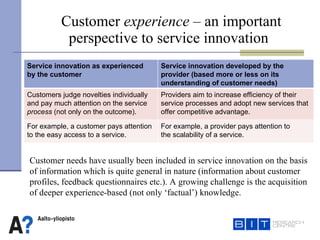
Customer  experience  – an important    perspective to service innovation Customer needs have usually been included in service innovation on the basis  of information which is quite general in nature (information about customer  profiles, feedback questionnaires etc.). A growing challenge is the acquisition  of deeper experience-based (not only ‘factual’) knowledge.  Service innovation as experienced  by the customer Service innovation developed by the provider (based more or less on its understanding of customer needs) Customers judge novelties individually and pay much attention on the service  process  (not only on the outcome). Providers aim to increase efficiency of their service processes and adopt new services that offer competitive advantage. For example, a customer pays attention to the easy access to a service.  For example, a provider pays attention to  the scalability of a service.
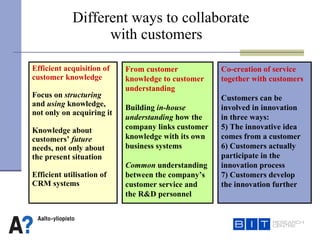
    Different ways to collaborate    with customers   Efficient acquisition of customer knowledge Focus on  structuring  and  using  knowledge, not only on acquiring it Knowledge about customers’  future  needs, not only about the present situation Efficient utilisation of CRM systems From customer knowledge to customer understanding Building  in-house understanding  how the company links customer knowledge with its own business systems  Common  understanding between the company’s customer service and the R&D personnel Co-creation of service together with customers  Customers can be involved in innovation  in three ways: The innovative idea comes from a customer  Customers actually participate in the innovation process Customers develop  the innovation further
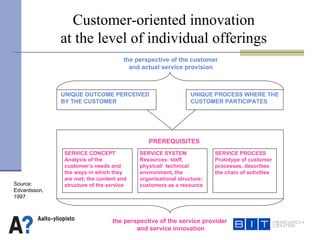
Customer-oriented innovation at the level of individual offerings Source: Edvardsson , 1997 the perspective of the service provider  and service innovation SERVICE CONCEPT Analysis of the customer’s needs and the ways in which they are met; the content and structure of the service UNIQUE OUTCOME PERCEIVED BY THE CUSTOMER UNIQUE PROCESS WHERE THE CUSTOMER PARTICIPATES PREREQUISITES the perspective of the customer and actual service provision SERVICE SYSTEM Resources: staff, physical/  technical environment, the organisational structure; customers as a resource  SERVICE PROCESS Prototype of customer processes, describes the chain of activities
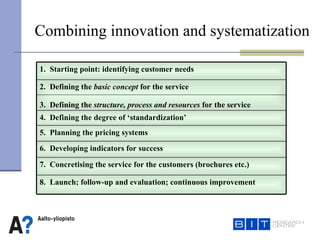
Combining innovation and systematization 8.  Launch; follow-up and evaluation; continuous improvement 7.  Concretising the service for the customers (brochures etc.) 6.  Developing indicators for success 5.  Planning the pricing systems 4.  Defining the degree of ‘standardization’ 2.  Defining the  basic concept  for the service 3.  Defining the  structure, process and resources  for the service 1.  Starting point: identifying customer needs
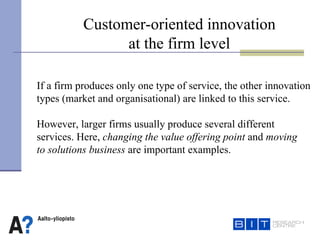
Customer-oriented innovation at the firm level If a firm produces only one type of service, the other innovation types (market and organisational) are linked to this service. However, larger firms usually produce several different services. Here,   changing the value offering point  and  moving  to solutions business  are important examples.
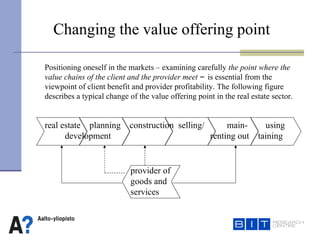
Changing the value offering point   real estate  planning  construction  selling/  main-  using  development   renting out  taining provider of goods and services Positioning oneself in the markets – examining carefully  the point where the value chains of the client and the provider meet   –  is essential from the viewpoint of client benefit and provider profitability. The following figure describes a typical change of the value offering point in the real estate sector.
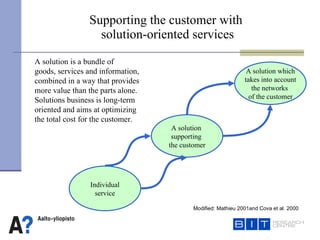
Supporting the customer with  solution-oriented services Modified: Mathieu 2001and Cova et al. 2000 A solution is a bundle of  goods, services and information, combined in a way that provides  more value than the parts alone.  Solutions business is long-term  oriented and aims at optimizing  the total cost for the customer. Individual service A solution  supporting  the customer A solution which takes into account the networks  of the customer
Employee-driven innovation  In services, innovation activities are distributed –  only rarely delegated to a specific R&D department. Thus, innovation management should apply the approach  of  broad but also balanced empowerment : both encourage  ideas and channel/control the ideas so that they are in line  with the strategy of the organization.
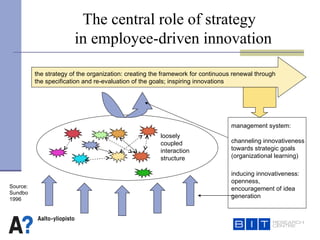
The central role of strategy  in employee-driven innovation the strategy of the organization: creating the framework for continuous renewal through the specification and re-evaluation of the goals; inspiring innovations inducing innovativeness: openness, encouragement of idea generation  loosely coupled  interaction structure channeling innovativeness towards strategic goals (organizational learning) management system: Source: Sundbo 1996
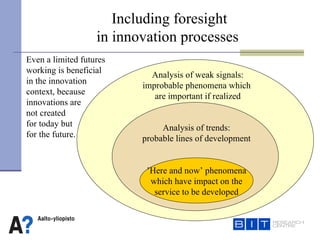
Including foresight  in innovation processes  ’ Here and now’ phenomena which have impact on the service to be developed Analysis of trends: probable lines of development Analysis of weak signals: improbable phenomena which  are important if realized Even a limited futures  working is beneficial  in the innovation  context, because  innovations are  not created  for today but  for the future.
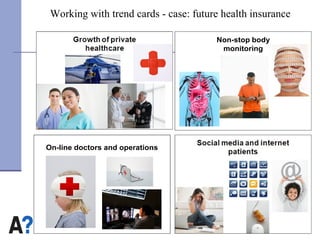
Working with trend cards - case: future health insurance
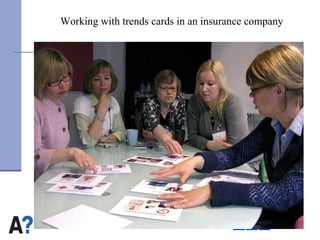
Working with trends cards in an insurance company
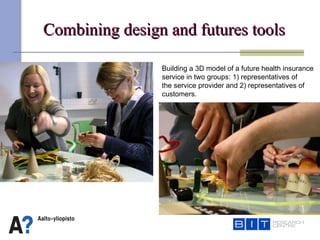
Combining design and futures tools Building a 3D model of a future health insurance service in two groups: 1) representatives of  the service provider and 2) representatives of customers.
Service innovation policy – experiences from Finland Considering the development of services as  an essential part of innovation policy  is an important feature in the Finnish activities.  At the national level, service development is today supported intensively in the framework of the ‘Serve - Innovative Services’ programme carried out  by Tekes, The Finnish Funding Agency for Technology and Innovation.  At the regional level, the need to include the development of services into regional innovation strategies is increasingly emphasised in big cities and  also in some more remote regions.
Broad perspective and industry- university collaboration   Policy activities concern both  supply- and demand  side. The latter is important e.g. in the development of KIBS (knowledge-intensive business services). Stimulating and supporting measures are targeted not only to  KIBS, but also to their clients.  Industrial services  and  public services  are important focus areas. In manufacturing, sectoral variety is great  in the development stage of service business. In the public sector, innovation activities are only emerging. The most common way to support innovation activities is  fostering the collaboration between companies and universities . Tekes’ funding model is  based on this principle both in the research funding and company funding.
How research meets practice  in BIT Research Centre Research tackles real life problems. Results are presented for companies in a form which they can concretely utilize.  Companies get  the  newest scientific knowledge in the project area  in a summarized form. Benchmarking workshops are an important tool in projects.  Results are disseminated to broader audience (e.g. courses  together with Life-long Learning Centre Dipoli in Aalto)
Thank you!

DC10 Marja Toivonen - keynote - Innovating customer oriented services

  • 1.
    Dr. Marja Toivonen Director, Adjunct Professor BIT (Business, Innovation, Technology) Research Centre Aalto University e-mail : [email_address] A presentation on how to combine creativity and efficiency Dutch conference on Service Innovation 2 November 2010, Schouwburg Almere Innovating customer-oriented services - a central challenge for managers
  • 2.
    Contentsof the presentation What is service innovation and why is it important Combining customer-driven and employee-driven innovation in services Including foresight in innovation processes The need for policy support in service innovation
  • 3.
    innovation is anidea which is carried into practice innovation provides benefit both to its developer and to users innovation is reproducible (important criterion in services) innovation differs from everyday development : it represents a new kind of problem formulation, a break in business-as-usual innovation leads others to follow ; it functions as a driver of development in a broader context, not only in the organization which has developed it. What is (service) innovation?
  • 4.
    Why is serviceinnovation important? At the firm level, innovative orientation means that the firm need not compete for a share of a given demand, but it can discover hidden demand . Pursuing innovations raises the level of ambition in the firm and supports the maintaining of motivation. At the societal level, innovation makes it possible to increase growth, employment and welfare , not only to re-divide them between firms, regions and nations. Innovation in services is important in particular: services play the major role in all advanced economies – not only in service sectors but also increasingly in manufacturing.
  • 5.
    Customer experience – an important perspective to service innovation Customer needs have usually been included in service innovation on the basis of information which is quite general in nature (information about customer profiles, feedback questionnaires etc.). A growing challenge is the acquisition of deeper experience-based (not only ‘factual’) knowledge. Service innovation as experienced by the customer Service innovation developed by the provider (based more or less on its understanding of customer needs) Customers judge novelties individually and pay much attention on the service process (not only on the outcome). Providers aim to increase efficiency of their service processes and adopt new services that offer competitive advantage. For example, a customer pays attention to the easy access to a service. For example, a provider pays attention to the scalability of a service.
  • 6.
    Different ways to collaborate with customers Efficient acquisition of customer knowledge Focus on structuring and using knowledge, not only on acquiring it Knowledge about customers’ future needs, not only about the present situation Efficient utilisation of CRM systems From customer knowledge to customer understanding Building in-house understanding how the company links customer knowledge with its own business systems Common understanding between the company’s customer service and the R&D personnel Co-creation of service together with customers Customers can be involved in innovation in three ways: The innovative idea comes from a customer Customers actually participate in the innovation process Customers develop the innovation further
  • 7.
    Customer-oriented innovation atthe level of individual offerings Source: Edvardsson , 1997 the perspective of the service provider and service innovation SERVICE CONCEPT Analysis of the customer’s needs and the ways in which they are met; the content and structure of the service UNIQUE OUTCOME PERCEIVED BY THE CUSTOMER UNIQUE PROCESS WHERE THE CUSTOMER PARTICIPATES PREREQUISITES the perspective of the customer and actual service provision SERVICE SYSTEM Resources: staff, physical/ technical environment, the organisational structure; customers as a resource SERVICE PROCESS Prototype of customer processes, describes the chain of activities
  • 8.
    Combining innovation andsystematization 8. Launch; follow-up and evaluation; continuous improvement 7. Concretising the service for the customers (brochures etc.) 6. Developing indicators for success 5. Planning the pricing systems 4. Defining the degree of ‘standardization’ 2. Defining the basic concept for the service 3. Defining the structure, process and resources for the service 1. Starting point: identifying customer needs
  • 9.
    Customer-oriented innovation atthe firm level If a firm produces only one type of service, the other innovation types (market and organisational) are linked to this service. However, larger firms usually produce several different services. Here, changing the value offering point and moving to solutions business are important examples.
  • 10.
    Changing the valueoffering point real estate planning construction selling/ main- using development renting out taining provider of goods and services Positioning oneself in the markets – examining carefully the point where the value chains of the client and the provider meet – is essential from the viewpoint of client benefit and provider profitability. The following figure describes a typical change of the value offering point in the real estate sector.
  • 11.
    Supporting the customerwith solution-oriented services Modified: Mathieu 2001and Cova et al. 2000 A solution is a bundle of goods, services and information, combined in a way that provides more value than the parts alone. Solutions business is long-term oriented and aims at optimizing the total cost for the customer. Individual service A solution supporting the customer A solution which takes into account the networks of the customer
  • 12.
    Employee-driven innovation In services, innovation activities are distributed – only rarely delegated to a specific R&D department. Thus, innovation management should apply the approach of broad but also balanced empowerment : both encourage ideas and channel/control the ideas so that they are in line with the strategy of the organization.
  • 13.
    The central roleof strategy in employee-driven innovation the strategy of the organization: creating the framework for continuous renewal through the specification and re-evaluation of the goals; inspiring innovations inducing innovativeness: openness, encouragement of idea generation loosely coupled interaction structure channeling innovativeness towards strategic goals (organizational learning) management system: Source: Sundbo 1996
  • 14.
    Including foresight in innovation processes ’ Here and now’ phenomena which have impact on the service to be developed Analysis of trends: probable lines of development Analysis of weak signals: improbable phenomena which are important if realized Even a limited futures working is beneficial in the innovation context, because innovations are not created for today but for the future.
  • 15.
    Working with trendcards - case: future health insurance
  • 16.
    Working with trendscards in an insurance company
  • 17.
    Combining design andfutures tools Building a 3D model of a future health insurance service in two groups: 1) representatives of the service provider and 2) representatives of customers.
  • 18.
    Service innovation policy– experiences from Finland Considering the development of services as an essential part of innovation policy is an important feature in the Finnish activities. At the national level, service development is today supported intensively in the framework of the ‘Serve - Innovative Services’ programme carried out by Tekes, The Finnish Funding Agency for Technology and Innovation. At the regional level, the need to include the development of services into regional innovation strategies is increasingly emphasised in big cities and also in some more remote regions.
  • 19.
    Broad perspective andindustry- university collaboration Policy activities concern both supply- and demand side. The latter is important e.g. in the development of KIBS (knowledge-intensive business services). Stimulating and supporting measures are targeted not only to KIBS, but also to their clients. Industrial services and public services are important focus areas. In manufacturing, sectoral variety is great in the development stage of service business. In the public sector, innovation activities are only emerging. The most common way to support innovation activities is fostering the collaboration between companies and universities . Tekes’ funding model is based on this principle both in the research funding and company funding.
  • 20.
    How research meetspractice in BIT Research Centre Research tackles real life problems. Results are presented for companies in a form which they can concretely utilize. Companies get the newest scientific knowledge in the project area in a summarized form. Benchmarking workshops are an important tool in projects. Results are disseminated to broader audience (e.g. courses together with Life-long Learning Centre Dipoli in Aalto)
  • 21.