1
A Break in the Clouds: The Cost Benefits of Ansys Cloud //
A Break in the Clouds: The Cost Benefits of Ansys Cloud
Executive Summary
While the benefits of cloud
computing have been proven
in both business and personal
applications, many engineering
organizations still rely on
privately managed data centers
to host their Ansys software
and run their simulations.
With Ansys Cloud, companies
no longer have to specify,
build and maintain complex
technology infrastructures
that quickly become outdated,
or use older software features
and functionality. Flexible,
scalable and user-friendly,
Ansys Cloud enables every
engineer, on every product
development team, to access
the most recent Ansys software
releases, along with virtually
unlimited computational power.
The result? Both cost and
performance advantages. Not
only does Ansys Cloud support
a significant acceleration in
simulation solve times, but
it also creates annual cost
savings for engineering teams
in small, mid-sized and large
businesses. In one customer
case study, Ansys Cloud
delivered a 7X faster solve time,
nearly $300,000 in annual cost
savings and nearly 2,900 hours
in annual time savings. The true
value of using Ansys Cloud is
the competitive advantage that
can be achieved by launching
product innovations quickly to
stay ahead of the competition,
without costly penalties or
delays that can represent
millions of dollars.
/ Simulation via the Cloud: The Benefits Are Significant
Many business users, including the world’s top product development teams, have already
recognized and embraced the clear benefits of cloud computing ― and that trend is only
accelerating.
According to the Harvard Business Review, currently 20-30% of work is being done via cloud
computing. While businesses expect to increase that amount to 80% over the next decade,
the COVID-19 pandemic has dramatically sped up cloud adoption. Organizations of all types
are increasingly relying on cloud resources that enable their entire staff to work remotely. As
a result, experts now expect the shift to 80% to happen in the next three years.1
The on-demand, flexible nature of the cloud means that computationally intensive activities
can be managed nimbly. Computing needs are seamlessly and automatically matched
to the required computing resources. Numerically large problems, such as engineering
simulations, can be solved rapidly and seamlessly by capitalizing on multiple processing
cores and parallel computing schemes. Asset uptime and human productivity are both
maximized, as technology implementation and maintenance are outsourced for 24/7
responsiveness.
This means that engineers can quickly run even the most complex simulations and repeat
them iteratively, applying multiple physics and considering hundreds or thousands of
operating parameters. Because it eliminates capacity limitations and other technology
barriers, cloud computing supports a more thorough analysis of every aspect of product
performance. There is no need to cut corners with rough meshes, low-fidelity models or
limited physics. Simulation users don’t have to buy new hardware or expand their high-
performance computing (HPC) license capacity, wait for outages to be resolved or fight for
their share of limited computing resources.
In addition, a cloud approach means that engineering teams can always access the most
recent versions of hardware and software to support faster design innovation. As soon as
new features or functionality are released, they are available automatically, which means
that product developers have ongoing access to the latest and greatest tools to support their
work.
In short, cloud computing gives product development teams the freedom to focus on what
they do best: design innovative products quickly, with a high degree of confidence.
/ The Often-Overlooked Costs of On-Premises Hosting
Unfortunately, there are still engineering teams that fail to recognize and capitalize on
the benefits of cloud computing. They continue to cling to older ways of doing business,
including in-house software hosting and ownership of their information technology (IT)
assets.
The speed and productivity benefits of high-performance cloud computing are well documented. For
numerically large engineering simulations, a flexible cloud environment typically delivers faster run times,
allowing engineers to solve complex problems quickly ― and launch products more rapidly. The world’s
leading product development teams are already leveraging high-performance computing resources, yet
many of them remain uncertain about the costs of replacing on-premises hardware and software with
cloud hosting. It’s time to clear up the confusion and demonstrate that the cloud delivers a total cost of
ownership that is lower than on-premises computing. Ansys Cloud delivers all the speed and efficiency
that customers expect from high-performance computing in the cloud ― along with the power of Ansys’
world-leading software ― at a cost lower than an on-premises approach.
WHITE PAPER
2
A Break in the Clouds: The Cost Benefits of Ansys Cloud //
However, the limitations of in-house resources often mean that simulations are postponed or stuck in a queue, leading to slower
product development times. In fact, in a study by Hyperion Research, 78.1% of engineers reported that their HPC jobs have been
cancelled or delayed.2
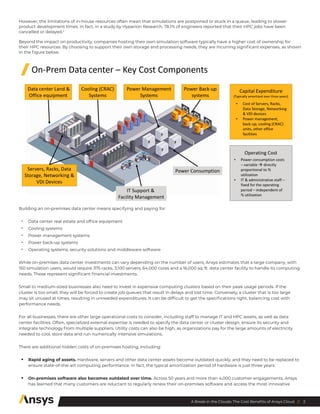
Beyond the impact on productivity, companies hosting their own simulation software typically have a higher cost of ownership for
their HPC resources. By choosing to support their own storage and processing needs, they are incurring significant expenses, as shown
in the figure below.
Building an on-premises data center means specifying and paying for:
•	 Data center real estate and office equipment
•	 Cooling systems
•	 Power management systems
•	 Power back-up systems
•	 Operating systems, security solutions and middleware software
While on-premises data center investments can vary depending on the number of users, Ansys estimates that a large company, with
150 simulation users, would require 375 racks, 3,100 servers, 64,000 cores and a 16,000 sq. ft. data center facility to handle its computing
needs. These represent significant financial investments.
Small to medium-sized businesses also need to invest in expensive computing clusters based on their peak usage periods. If the
cluster is too small, they will be forced to create job queues that result in delays and lost time. Conversely, a cluster that is too large
may sit unused at times, resulting in unneeded expenditures. It can be difficult to get the specifications right, balancing cost with
performance needs.
For all businesses, there are other large operational costs to consider, including staff to manage IT and HPC assets, as well as data
center facilities. Often, specialized external expertise is needed to specify the data center or cluster design, ensure its security and
integrate technology from multiple suppliers. Utility costs can also be high, as organizations pay for the large amounts of electricity
needed to cool, store data and run numerically intensive simulations.
There are additional hidden costs of on-premises hosting, including:
•	 Rapid aging of assets. Hardware, servers and other data center assets become outdated quickly, and they need to be replaced to
ensure state-of-the-art computing performance. In fact, the typical amortization period of hardware is just three years.
•	 On-premises software also becomes outdated over time. Across 50 years and more than 4,000 customer engagements, Ansys
has learned that many customers are reluctant to regularly renew their on-premises software and access the most innovative
3
A Break in the Clouds: The Cost Benefits of Ansys Cloud //
features. They miss out on functionality that could save their organizations both time and money.
•	 Productivity losses based on less-than-optimal design. Many internal computing resources are not designed around the
specific needs of product development teams. They may be “one size fits all” designs that have been purchased for the entire
organization, which lack the computing power engineers need to run computationally intensive simulations. As a result, critical
projects may be placed on hold while the engineering team waits for computing capacity.
•	 Lost sales due to delayed market launches. Low productivity and project delays translate directly into lost sales when important
launch deadlines are missed. Companies with low-performing or poorly specified clusters may watch helplessly as competitors
with cloud computing resources beat them to the marketplace.
•	 IT investments reflect peak computational needs, not the average. Large, complex engineering simulations require large
amounts of computing power ― but this may not reflect the organization’s average daily IT needs. Many companies are investing
in a high degree of fixed computing capacity that they will seldom need.
•	 Many related costs are fixed, no matter whether computing capacity is needed. IT assets that are not being used are still
consuming about 50% of the electricity3
they consume when actually in use. Cooling systems and real estate are still being paid for
when equipment is not running.
Considering the high costs and performance limitations associated with maintaining a dedicated data center to support a static
version of engineering simulation software, organizations should be exploring the attractive, flexible alternative represented by a public
cloud approach.
/ Ansys Cloud: A Cost-Effective, State-of-the-Art Alternative
In contrast with on-premises software hosting and computational processing via a dedicated data center, Ansys Cloud is a single-
vendor solution that provides software licensing and computational power in an easy, “plug-and-play” configuration that gets
solutions up and running quickly — for a rapid return on investment (ROI). Ansys Cloud users do not need to hire a large IT staff, invest
in hardware, lease physical space, or otherwise support a sprawling, fixed computing infrastructure.
This value-added offering recognizes the fact that computational needs can vary over time — and it does not make sense for
engineering organizations to pay for the highest usage scenario on an ongoing basis. With Ansys Cloud, companies can access the
latest hardware and processing capabilities available today, without the continual need to pay for technology upgrades.
While many on-premises technologies owners pay for specialized consulting expertise in building their data centers, Ansys Cloud is
already configured and designed for the way engineers actually run simulations. All underlying technology is optimized for Ansys
solvers, built to the highest reliability and security standards, and fully backed by Ansys support. Recognizing that engineering is
increasingly collaborative in nature, Ansys Cloud makes it easy to share simulation data and results internally, using an intuitive, web-
based portal that can be accessed from any device.
In addition, Ansys Cloud users can be assured that they are always accessing the most recent versions of Ansys simulation software,
with the fullest functionality and most innovative features. Software upgrades occur seamlessly, without the need for users or IT staff to
initiate these actions.
The flexibility and elasticity of the Ansys Cloud approach puts world-class Ansys solutions and virtually unlimited computing resources,
within the reach of every user at every company. All that is needed is an internet connection. This creates dramatic performance gains,
as well as cost advantages, when compared with traditional on-premises approaches.
In contrast to the large, fixed costs associated with an on-premises data center and software hosting, Ansys Cloud involves just a few
costs, as shown in the figure below:
•	 Flexible licensing that allows customers to lease software at a fixed rate of usage or agree to a flexible plan that scales licensing
up or down, as usage needs change. Either way, they can always access the most recent version of Ansys software, or they can
choose to stay with an older software version that fits their needs, also supported on Ansys Cloud.
•	 A cloud subscription that gives customers access to a broad range of HPC and cloud services, such as best-in-class security, user
management, resource management, HPC orchestration, storage management, job management and 24/7 monitoring.
•	 An Ansys hardware pack that provides access to usage-based hardware resources customers need to accomplish even the
largest, most computationally intensive simulations.
4
A Break in the Clouds: The Cost Benefits of Ansys Cloud //
/ 
A Case in Point: Savings in Total Cost of Ownership for an Enterprise Company
Just how significant are the cost benefits of Ansys Cloud for software and hardware hosting? Perhaps the best way to demonstrate the
Ansys Cloud advantage is to compare the total cost of ownership (TCO) for a large company, using both approaches.
In this example, which is based on a real Ansys Cloud customer application, an enterprise company is using Ansys HFSS to design an
electronics component. Here are the application parameters:
•	 Enterprise customer with ~ 70 CAE users
•	 Application: Electronics component
•	 Solver: Ansys HFSS
•	 Problem size: 2-5 million cells
•	 Simulation jobs per year: 50-75
•	 Hours per job: 24
•	 Engineering productivity cost per hour: ~ $70-85
•	 Interactive workload: Nil
•	 Ansys Cloud licensing agreement: Bring-Your-Own-License (BYOL) offering
To accommodate this simulation workload, the customer’s on-premises data center specifications would need to be:
•	 Server configuration: 48 cores server, 512 GB
•	 Number of servers run for this use case: 1
The Ansys Cloud package needed to accommodate this workload would include:
•	 HC44 cores: 352 cores total, 2.8 TB RAM
•	 Nodes: 8
•	 Data center region: US East
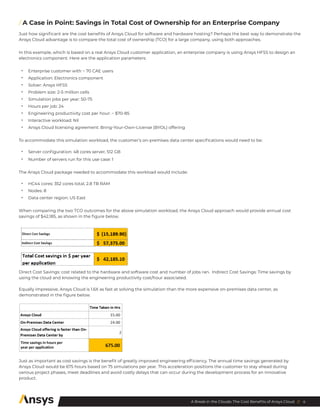
When comparing the two TCO outcomes for the above simulation workload, the Ansys Cloud approach would provide annual cost
savings of $42,185, as shown in the figure below.
Direct Cost Savings: cost related to the hardware and software cost and number of jobs ran. Indirect Cost Savings: Time savings by
using the cloud and knowing the engineering productivity cost/hour associated.
Equally impressive, Ansys Cloud is 1.6X as fast at solving the simulation than the more expensive on-premises data center, as
demonstrated in the figure below.
Just as important as cost savings is the benefit of greatly improved engineering efficiency. The annual time savings generated by
Ansys Cloud would be 675 hours based on 75 simulations per year. This acceleration positions the customer to stay ahead during
various project phases, meet deadlines and avoid costly delays that can occur during the development process for an innovative
product.
5
A Break in the Clouds: The Cost Benefits of Ansys Cloud //
/ A Case in Point: Savings in Total Cost of Ownership for a Small to Medium-Sized
Business
But what about the benefits for a smaller organization? The following is a look at the advantages of switching to Ansys Cloud for a
small to medium-sized company.
Like the previous example, this comparison of Ansys Cloud versus on-premises hosting is based on a real Ansys Cloud customer
application. In this case, the customer is using Ansys Mechanical to design mechanical parts and run structural analysis. Here are the
application parameters:
•	 Enterprise customer with ~ 20 CAE users
•	 Application: Mechanical parts
•	 Solver: Ansys Mechanical
•	 Problem size: 5 million cells
•	 Simulation jobs per year: 10
•	 Hours per job: 168
•	 Engineering productivity cost per hour: ~ $85
•	 Interactive workload: Nil
•	 Ansys Cloud licensing agreement: Bring-Your-Own-License (BYOL) offering
To accommodate this simulation workload, the customer’s on-premises data center specifications would need to be:
•	 Server configuration: 16 cores, 256 GB server
•	 Number of servers run for this use case: 1
The Ansys Cloud package needed to accommodate this workload would include:
•	 H16mr: 16 cores, total 96 cores, 224 GB RAM per node
•	 Nodes: 6
•	 Data center region: Europe West
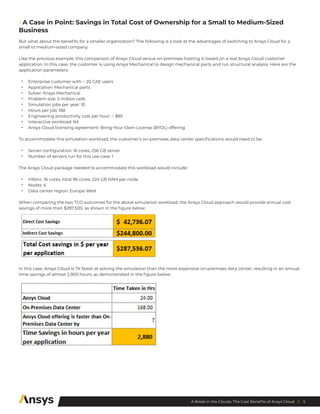
When comparing the two TCO outcomes for the above simulation workload, the Ansys Cloud approach would provide annual cost
savings of more than $287,500, as shown in the figure below:
In this case, Ansys Cloud is 7X faster at solving the simulation than the more expensive on-premises data center, resulting in an annual
time savings of almost 2,900 hours, as demonstrated in the figure below:
6
A Break in the Clouds: The Cost Benefits of Ansys Cloud //
/ Capitalize on Ansys Cloud for Faster, More Profitable Market Launches
While these are just two examples, Ansys Cloud has been proven to deliver similar cost and speed advantages for dozens of customer
businesses of all sizes. The Ansys Cloud team can help your business understand its potential time and cost savings and configure a
customized cloud approach that helps you capture these benefits.
The Ansys Cloud team understands how to calculate direct costs, such as IT assets and staffing, as well as indirect costs such as time
savings, increased productivity, reduced risk exposure from delays, fewer lost sales opportunities and faster market launches. The
team has helped many customers around the world address design issues earlier in the development process, streamline engineering
workflows and launch their innovative products faster, leading to happier customers and higher sales revenues.
It can be difficult to put aside traditional ways of working and embrace new models. But Ansys Cloud promises to streamline and
accelerate your simulation results, adding lasting financial value and supporting a tangible competitive advantage. The ease of
accessing Ansys Cloud means a rapid ROI and fast performance improvement. Learn how Ansys Cloud can reduce your organization’s
TCO for engineering simulation by taking advantage of a free 30-day trial of Ansys Cloud today.
References
1
“What CEOs need to know about the Cloud in 2021”Harvard Business Review March 10 2021, https://hbr.org/2021/03/what-ceos-need-
to-know-about-the-cloud-in-2021
2
“Hyperion Research, “2017 End-user MCS Study Technical Computing: Servers, Processors, and Coprocessors, Current Usage Levels,
Drivers, and Forecasts”
3
Basmadjian, R.; Niedermeier, F.; de Meer, H. Modelling and analysing the power consumption of idle servers.In Proceedings of the 2012
Sustainable Internet and ICT for Sustainability (SustainIT), Pisa, Italy, 4–5 October 2012.
Any and all ANSYS, Inc. brand, product, service and feature names, logos and slogans
are registered trademarks or trademarks of ANSYS, Inc. or its subsidiaries in the
United States or other countries. All other brand, product, service and feature names
or trademarks are the property of their respective owners.
ANSYS, Inc.
Southpointe
2600 Ansys Drive
Canonsburg, PA 15317
U.S.A.
724.746.3304
ansysinfo@ansys.com
© 2021 ANSYS, Inc. All Rights Reserved.
If you’ve ever seen a rocket launch, flown on an airplane, driven a
car, used a computer, touched a mobile device, crossed a bridge
or put on wearable technology, chances are you’ve used a product
where Ansys software played a critical role in its creation. Ansys is
the global leader in engineering simulation. We help the world’s
most innovative companies deliver radically better products to
their customers. By offering the best and broadest portfolio of
engineering simulation software, we help them solve the most
complex design challenges and engineer products limited only by
imagination.
Visit www.ansys.com for more information.
7
A Break in the Clouds: The Cost Benefits of Ansys Cloud //

Wp a-break-in-the-clouds

  • 1.
    1 A Break inthe Clouds: The Cost Benefits of Ansys Cloud // A Break in the Clouds: The Cost Benefits of Ansys Cloud Executive Summary While the benefits of cloud computing have been proven in both business and personal applications, many engineering organizations still rely on privately managed data centers to host their Ansys software and run their simulations. With Ansys Cloud, companies no longer have to specify, build and maintain complex technology infrastructures that quickly become outdated, or use older software features and functionality. Flexible, scalable and user-friendly, Ansys Cloud enables every engineer, on every product development team, to access the most recent Ansys software releases, along with virtually unlimited computational power. The result? Both cost and performance advantages. Not only does Ansys Cloud support a significant acceleration in simulation solve times, but it also creates annual cost savings for engineering teams in small, mid-sized and large businesses. In one customer case study, Ansys Cloud delivered a 7X faster solve time, nearly $300,000 in annual cost savings and nearly 2,900 hours in annual time savings. The true value of using Ansys Cloud is the competitive advantage that can be achieved by launching product innovations quickly to stay ahead of the competition, without costly penalties or delays that can represent millions of dollars. / Simulation via the Cloud: The Benefits Are Significant Many business users, including the world’s top product development teams, have already recognized and embraced the clear benefits of cloud computing ― and that trend is only accelerating. According to the Harvard Business Review, currently 20-30% of work is being done via cloud computing. While businesses expect to increase that amount to 80% over the next decade, the COVID-19 pandemic has dramatically sped up cloud adoption. Organizations of all types are increasingly relying on cloud resources that enable their entire staff to work remotely. As a result, experts now expect the shift to 80% to happen in the next three years.1 The on-demand, flexible nature of the cloud means that computationally intensive activities can be managed nimbly. Computing needs are seamlessly and automatically matched to the required computing resources. Numerically large problems, such as engineering simulations, can be solved rapidly and seamlessly by capitalizing on multiple processing cores and parallel computing schemes. Asset uptime and human productivity are both maximized, as technology implementation and maintenance are outsourced for 24/7 responsiveness. This means that engineers can quickly run even the most complex simulations and repeat them iteratively, applying multiple physics and considering hundreds or thousands of operating parameters. Because it eliminates capacity limitations and other technology barriers, cloud computing supports a more thorough analysis of every aspect of product performance. There is no need to cut corners with rough meshes, low-fidelity models or limited physics. Simulation users don’t have to buy new hardware or expand their high- performance computing (HPC) license capacity, wait for outages to be resolved or fight for their share of limited computing resources. In addition, a cloud approach means that engineering teams can always access the most recent versions of hardware and software to support faster design innovation. As soon as new features or functionality are released, they are available automatically, which means that product developers have ongoing access to the latest and greatest tools to support their work. In short, cloud computing gives product development teams the freedom to focus on what they do best: design innovative products quickly, with a high degree of confidence. / The Often-Overlooked Costs of On-Premises Hosting Unfortunately, there are still engineering teams that fail to recognize and capitalize on the benefits of cloud computing. They continue to cling to older ways of doing business, including in-house software hosting and ownership of their information technology (IT) assets. The speed and productivity benefits of high-performance cloud computing are well documented. For numerically large engineering simulations, a flexible cloud environment typically delivers faster run times, allowing engineers to solve complex problems quickly ― and launch products more rapidly. The world’s leading product development teams are already leveraging high-performance computing resources, yet many of them remain uncertain about the costs of replacing on-premises hardware and software with cloud hosting. It’s time to clear up the confusion and demonstrate that the cloud delivers a total cost of ownership that is lower than on-premises computing. Ansys Cloud delivers all the speed and efficiency that customers expect from high-performance computing in the cloud ― along with the power of Ansys’ world-leading software ― at a cost lower than an on-premises approach. WHITE PAPER
  • 2.
    2 A Break inthe Clouds: The Cost Benefits of Ansys Cloud // However, the limitations of in-house resources often mean that simulations are postponed or stuck in a queue, leading to slower product development times. In fact, in a study by Hyperion Research, 78.1% of engineers reported that their HPC jobs have been cancelled or delayed.2 Beyond the impact on productivity, companies hosting their own simulation software typically have a higher cost of ownership for their HPC resources. By choosing to support their own storage and processing needs, they are incurring significant expenses, as shown in the figure below. Building an on-premises data center means specifying and paying for: • Data center real estate and office equipment • Cooling systems • Power management systems • Power back-up systems • Operating systems, security solutions and middleware software While on-premises data center investments can vary depending on the number of users, Ansys estimates that a large company, with 150 simulation users, would require 375 racks, 3,100 servers, 64,000 cores and a 16,000 sq. ft. data center facility to handle its computing needs. These represent significant financial investments. Small to medium-sized businesses also need to invest in expensive computing clusters based on their peak usage periods. If the cluster is too small, they will be forced to create job queues that result in delays and lost time. Conversely, a cluster that is too large may sit unused at times, resulting in unneeded expenditures. It can be difficult to get the specifications right, balancing cost with performance needs. For all businesses, there are other large operational costs to consider, including staff to manage IT and HPC assets, as well as data center facilities. Often, specialized external expertise is needed to specify the data center or cluster design, ensure its security and integrate technology from multiple suppliers. Utility costs can also be high, as organizations pay for the large amounts of electricity needed to cool, store data and run numerically intensive simulations. There are additional hidden costs of on-premises hosting, including: • Rapid aging of assets. Hardware, servers and other data center assets become outdated quickly, and they need to be replaced to ensure state-of-the-art computing performance. In fact, the typical amortization period of hardware is just three years. • On-premises software also becomes outdated over time. Across 50 years and more than 4,000 customer engagements, Ansys has learned that many customers are reluctant to regularly renew their on-premises software and access the most innovative
  • 3.
    3 A Break inthe Clouds: The Cost Benefits of Ansys Cloud // features. They miss out on functionality that could save their organizations both time and money. • Productivity losses based on less-than-optimal design. Many internal computing resources are not designed around the specific needs of product development teams. They may be “one size fits all” designs that have been purchased for the entire organization, which lack the computing power engineers need to run computationally intensive simulations. As a result, critical projects may be placed on hold while the engineering team waits for computing capacity. • Lost sales due to delayed market launches. Low productivity and project delays translate directly into lost sales when important launch deadlines are missed. Companies with low-performing or poorly specified clusters may watch helplessly as competitors with cloud computing resources beat them to the marketplace. • IT investments reflect peak computational needs, not the average. Large, complex engineering simulations require large amounts of computing power ― but this may not reflect the organization’s average daily IT needs. Many companies are investing in a high degree of fixed computing capacity that they will seldom need. • Many related costs are fixed, no matter whether computing capacity is needed. IT assets that are not being used are still consuming about 50% of the electricity3 they consume when actually in use. Cooling systems and real estate are still being paid for when equipment is not running. Considering the high costs and performance limitations associated with maintaining a dedicated data center to support a static version of engineering simulation software, organizations should be exploring the attractive, flexible alternative represented by a public cloud approach. / Ansys Cloud: A Cost-Effective, State-of-the-Art Alternative In contrast with on-premises software hosting and computational processing via a dedicated data center, Ansys Cloud is a single- vendor solution that provides software licensing and computational power in an easy, “plug-and-play” configuration that gets solutions up and running quickly — for a rapid return on investment (ROI). Ansys Cloud users do not need to hire a large IT staff, invest in hardware, lease physical space, or otherwise support a sprawling, fixed computing infrastructure. This value-added offering recognizes the fact that computational needs can vary over time — and it does not make sense for engineering organizations to pay for the highest usage scenario on an ongoing basis. With Ansys Cloud, companies can access the latest hardware and processing capabilities available today, without the continual need to pay for technology upgrades. While many on-premises technologies owners pay for specialized consulting expertise in building their data centers, Ansys Cloud is already configured and designed for the way engineers actually run simulations. All underlying technology is optimized for Ansys solvers, built to the highest reliability and security standards, and fully backed by Ansys support. Recognizing that engineering is increasingly collaborative in nature, Ansys Cloud makes it easy to share simulation data and results internally, using an intuitive, web- based portal that can be accessed from any device. In addition, Ansys Cloud users can be assured that they are always accessing the most recent versions of Ansys simulation software, with the fullest functionality and most innovative features. Software upgrades occur seamlessly, without the need for users or IT staff to initiate these actions. The flexibility and elasticity of the Ansys Cloud approach puts world-class Ansys solutions and virtually unlimited computing resources, within the reach of every user at every company. All that is needed is an internet connection. This creates dramatic performance gains, as well as cost advantages, when compared with traditional on-premises approaches. In contrast to the large, fixed costs associated with an on-premises data center and software hosting, Ansys Cloud involves just a few costs, as shown in the figure below: • Flexible licensing that allows customers to lease software at a fixed rate of usage or agree to a flexible plan that scales licensing up or down, as usage needs change. Either way, they can always access the most recent version of Ansys software, or they can choose to stay with an older software version that fits their needs, also supported on Ansys Cloud. • A cloud subscription that gives customers access to a broad range of HPC and cloud services, such as best-in-class security, user management, resource management, HPC orchestration, storage management, job management and 24/7 monitoring. • An Ansys hardware pack that provides access to usage-based hardware resources customers need to accomplish even the largest, most computationally intensive simulations.
  • 4.
    4 A Break inthe Clouds: The Cost Benefits of Ansys Cloud // / A Case in Point: Savings in Total Cost of Ownership for an Enterprise Company Just how significant are the cost benefits of Ansys Cloud for software and hardware hosting? Perhaps the best way to demonstrate the Ansys Cloud advantage is to compare the total cost of ownership (TCO) for a large company, using both approaches. In this example, which is based on a real Ansys Cloud customer application, an enterprise company is using Ansys HFSS to design an electronics component. Here are the application parameters: • Enterprise customer with ~ 70 CAE users • Application: Electronics component • Solver: Ansys HFSS • Problem size: 2-5 million cells • Simulation jobs per year: 50-75 • Hours per job: 24 • Engineering productivity cost per hour: ~ $70-85 • Interactive workload: Nil • Ansys Cloud licensing agreement: Bring-Your-Own-License (BYOL) offering To accommodate this simulation workload, the customer’s on-premises data center specifications would need to be: • Server configuration: 48 cores server, 512 GB • Number of servers run for this use case: 1 The Ansys Cloud package needed to accommodate this workload would include: • HC44 cores: 352 cores total, 2.8 TB RAM • Nodes: 8 • Data center region: US East When comparing the two TCO outcomes for the above simulation workload, the Ansys Cloud approach would provide annual cost savings of $42,185, as shown in the figure below. Direct Cost Savings: cost related to the hardware and software cost and number of jobs ran. Indirect Cost Savings: Time savings by using the cloud and knowing the engineering productivity cost/hour associated. Equally impressive, Ansys Cloud is 1.6X as fast at solving the simulation than the more expensive on-premises data center, as demonstrated in the figure below. Just as important as cost savings is the benefit of greatly improved engineering efficiency. The annual time savings generated by Ansys Cloud would be 675 hours based on 75 simulations per year. This acceleration positions the customer to stay ahead during various project phases, meet deadlines and avoid costly delays that can occur during the development process for an innovative product.
  • 5.
    5 A Break inthe Clouds: The Cost Benefits of Ansys Cloud // / A Case in Point: Savings in Total Cost of Ownership for a Small to Medium-Sized Business But what about the benefits for a smaller organization? The following is a look at the advantages of switching to Ansys Cloud for a small to medium-sized company. Like the previous example, this comparison of Ansys Cloud versus on-premises hosting is based on a real Ansys Cloud customer application. In this case, the customer is using Ansys Mechanical to design mechanical parts and run structural analysis. Here are the application parameters: • Enterprise customer with ~ 20 CAE users • Application: Mechanical parts • Solver: Ansys Mechanical • Problem size: 5 million cells • Simulation jobs per year: 10 • Hours per job: 168 • Engineering productivity cost per hour: ~ $85 • Interactive workload: Nil • Ansys Cloud licensing agreement: Bring-Your-Own-License (BYOL) offering To accommodate this simulation workload, the customer’s on-premises data center specifications would need to be: • Server configuration: 16 cores, 256 GB server • Number of servers run for this use case: 1 The Ansys Cloud package needed to accommodate this workload would include: • H16mr: 16 cores, total 96 cores, 224 GB RAM per node • Nodes: 6 • Data center region: Europe West When comparing the two TCO outcomes for the above simulation workload, the Ansys Cloud approach would provide annual cost savings of more than $287,500, as shown in the figure below: In this case, Ansys Cloud is 7X faster at solving the simulation than the more expensive on-premises data center, resulting in an annual time savings of almost 2,900 hours, as demonstrated in the figure below:
  • 6.
    6 A Break inthe Clouds: The Cost Benefits of Ansys Cloud // / Capitalize on Ansys Cloud for Faster, More Profitable Market Launches While these are just two examples, Ansys Cloud has been proven to deliver similar cost and speed advantages for dozens of customer businesses of all sizes. The Ansys Cloud team can help your business understand its potential time and cost savings and configure a customized cloud approach that helps you capture these benefits. The Ansys Cloud team understands how to calculate direct costs, such as IT assets and staffing, as well as indirect costs such as time savings, increased productivity, reduced risk exposure from delays, fewer lost sales opportunities and faster market launches. The team has helped many customers around the world address design issues earlier in the development process, streamline engineering workflows and launch their innovative products faster, leading to happier customers and higher sales revenues. It can be difficult to put aside traditional ways of working and embrace new models. But Ansys Cloud promises to streamline and accelerate your simulation results, adding lasting financial value and supporting a tangible competitive advantage. The ease of accessing Ansys Cloud means a rapid ROI and fast performance improvement. Learn how Ansys Cloud can reduce your organization’s TCO for engineering simulation by taking advantage of a free 30-day trial of Ansys Cloud today. References 1 “What CEOs need to know about the Cloud in 2021”Harvard Business Review March 10 2021, https://hbr.org/2021/03/what-ceos-need- to-know-about-the-cloud-in-2021 2 “Hyperion Research, “2017 End-user MCS Study Technical Computing: Servers, Processors, and Coprocessors, Current Usage Levels, Drivers, and Forecasts” 3 Basmadjian, R.; Niedermeier, F.; de Meer, H. Modelling and analysing the power consumption of idle servers.In Proceedings of the 2012 Sustainable Internet and ICT for Sustainability (SustainIT), Pisa, Italy, 4–5 October 2012. Any and all ANSYS, Inc. brand, product, service and feature names, logos and slogans are registered trademarks or trademarks of ANSYS, Inc. or its subsidiaries in the United States or other countries. All other brand, product, service and feature names or trademarks are the property of their respective owners. ANSYS, Inc. Southpointe 2600 Ansys Drive Canonsburg, PA 15317 U.S.A. 724.746.3304 ansysinfo@ansys.com © 2021 ANSYS, Inc. All Rights Reserved. If you’ve ever seen a rocket launch, flown on an airplane, driven a car, used a computer, touched a mobile device, crossed a bridge or put on wearable technology, chances are you’ve used a product where Ansys software played a critical role in its creation. Ansys is the global leader in engineering simulation. We help the world’s most innovative companies deliver radically better products to their customers. By offering the best and broadest portfolio of engineering simulation software, we help them solve the most complex design challenges and engineer products limited only by imagination. Visit www.ansys.com for more information.
  • 7.
    7 A Break inthe Clouds: The Cost Benefits of Ansys Cloud //