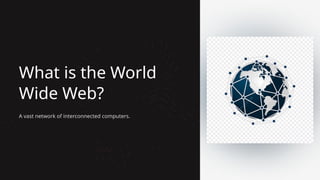
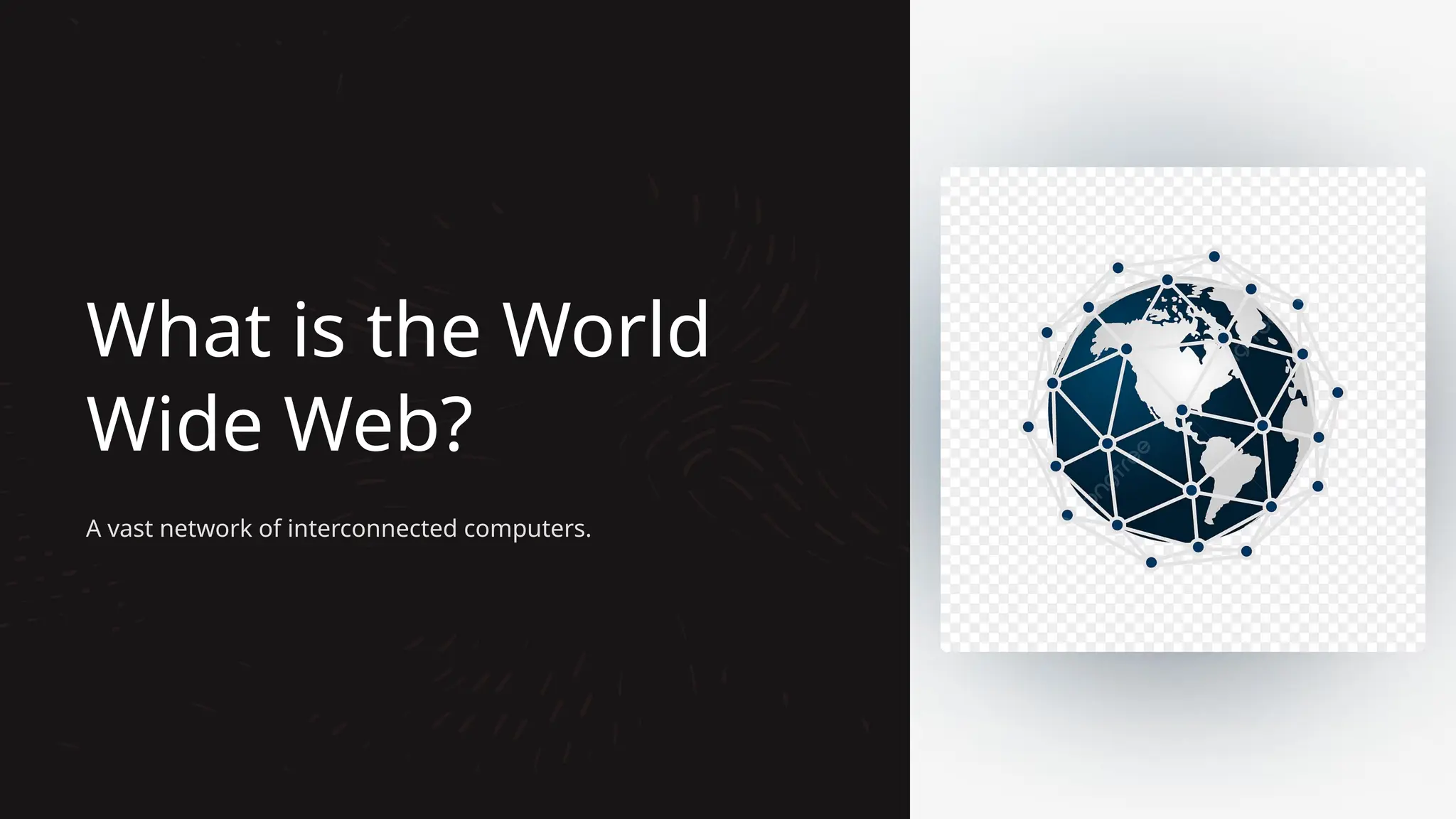
What is theWorld
Wide Web?
A vast network of interconnected computers.
2.
How does theWorld Wide Web work?
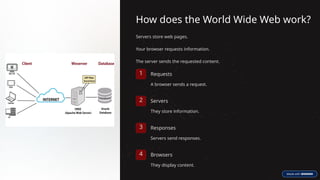
Servers store web pages.
Your browser requests information.
The server sends the requested content.
1 Requests
A browser sends a request.
2 Servers
They store information.
3 Responses
Servers send responses.
4 Browsers
They display content.
3.
The history ofthe World Wide Web
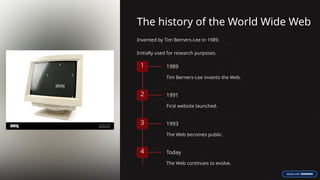
Invented by Tim Berners-Lee in 1989.
Initially used for research purposes.
1 1989
Tim Berners-Lee invents the Web.
2 1991
First website launched.
3 1993
The Web becomes public.
4 Today
The Web continues to evolve.
4.
The components ofthe World Wide Web
Websites, servers, and browsers.
Protocols like HTTP and HTML.
Websites
Collections of web pages.
Servers
Store and deliver websites.
Protocols
Communication standards.
5.
Accessing the WorldWide Web
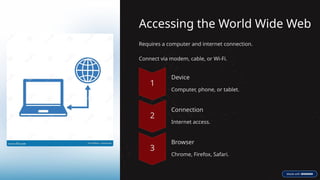
Requires a computer and internet connection.
Connect via modem, cable, or Wi-Fi.
Device
Computer, phone, or tablet.
Connection
Internet access.
Browser
Chrome, Firefox, Safari.
6.
Navigating the WorldWide
Web
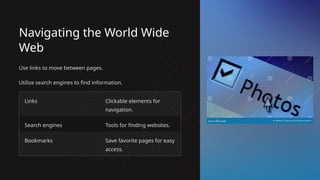
Use links to move between pages.
Utilize search engines to find information.
Links Clickable elements for
navigation.
Search engines Tools for finding websites.
Bookmarks Save favorite pages for easy
access.
7.
The benefits ofthe World Wide
Web
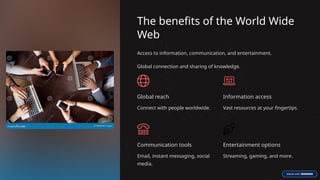
Access to information, communication, and entertainment.
Global connection and sharing of knowledge.
Global reach
Connect with people worldwide.
Information access
Vast resources at your fingertips.
Communication tools
Email, instant messaging, social
media.
Entertainment options
Streaming, gaming, and more.
8.
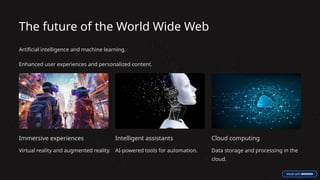
The future ofthe World Wide Web
Artificial intelligence and machine learning.
Enhanced user experiences and personalized content.
Immersive experiences
Virtual reality and augmented reality.
Intelligent assistants
AI-powered tools for automation.
Cloud computing
Data storage and processing in the
cloud.