Charmi Popat (03)
SVKM’s NMIMS SPP SPTM (School
of Pharmacy & Technology
Management)

2/3/2014

SVKM's NMIMS SPP SPTM

1
• WTO deals with the rules of trade between nations at a
global or near-global level

• It’s an organization for liberalizing trade
• It’s a negotiating forum …
• It’s a set of rules …
• And it helps to settle disputes …
2/3/2014

SVKM's NMIMS SPP SPTM

2
• WTO began life on 1 January 1995, but its
trading system is half a century older
• It took over GATT (1948)
• Created by: Uruguay Round negotiations (1986–
94)
• India is one of the founder member of WTO
• New Negotiation: “Doha Declaration”
• Head: Director-General, Pascal Lamy
• Location: Geneva, Switzerland
2/3/2014

SVKM's NMIMS SPP SPTM

3
2/3/2014

SVKM's NMIMS SPP SPTM

4
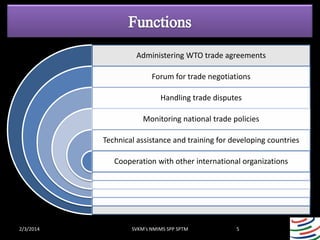
Administering WTO trade agreements
Forum for trade negotiations
Handling trade disputes
Monitoring national trade policies
Technical assistance and training for developing countries

Cooperation with other international organizations

2/3/2014

SVKM's NMIMS SPP SPTM

5
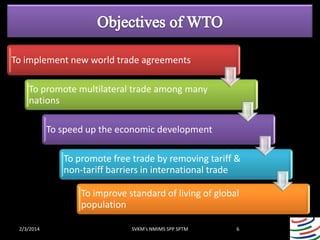
To implement new world trade agreements
To promote multilateral trade among many
nations
To speed up the economic development
To promote free trade by removing tariff &
non-tariff barriers in international trade
To improve standard of living of global
population
2/3/2014

SVKM's NMIMS SPP SPTM

6
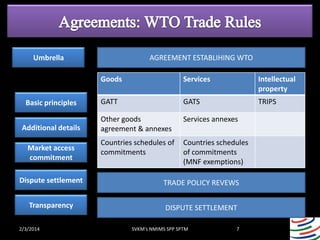
Umbrella

AGREEMENT ESTABLIHING WTO
Goods

Basic principles

Additional details
Market access
commitment

Services

Intellectual
property

GATT

GATS

TRIPS

Other goods
agreement & annexes

Services annexes

Countries schedules of
commitments

Countries schedules
of commitments
(MNF exemptions)

Dispute settlement

TRADE POLICY REVEWS

Transparency

DISPUTE SETTLEMENT

2/3/2014

SVKM's NMIMS SPP SPTM

7
2/3/2014

SVKM's NMIMS SPP SPTM

8
Parties

Agreement

Complainant

European Communities

Respondent

India

TRIPS Arts. 70.8 & 70.9

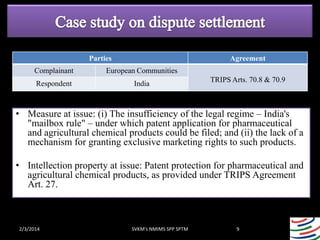
• Measure at issue: (i) The insufficiency of the legal regime – India's
"mailbox rule" – under which patent application for pharmaceutical
and agricultural chemical products could be filed; and (ii) the lack of a
mechanism for granting exclusive marketing rights to such products.

• Intellection property at issue: Patent protection for pharmaceutical and
agricultural chemical products, as provided under TRIPS Agreement
Art. 27.

2/3/2014

SVKM's NMIMS SPP SPTM

9
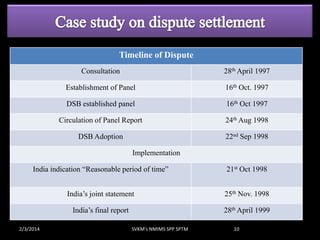
Timeline of Dispute
Consultation

28th April 1997

Establishment of Panel

16th Oct. 1997

DSB established panel

16th Oct 1997

Circulation of Panel Report

24th Aug 1998

DSB Adoption

22nd Sep 1998
Implementation

India indication “Reasonable period of time”

21st Oct 1998

India’s joint statement

25th Nov. 1998

India’s final report

28th April 1999

2/3/2014

SVKM's NMIMS SPP SPTM

10
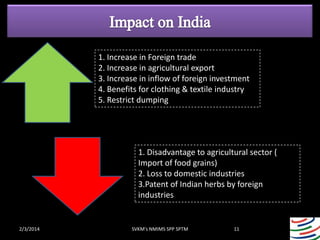
1. Increase in Foreign trade
2. Increase in agricultural export
3. Increase in inflow of foreign investment
4. Benefits for clothing & textile industry
5. Restrict dumping

1. Disadvantage to agricultural sector (
Import of food grains)
2. Loss to domestic industries
3.Patent of Indian herbs by foreign
industries

2/3/2014

SVKM's NMIMS SPP SPTM

11
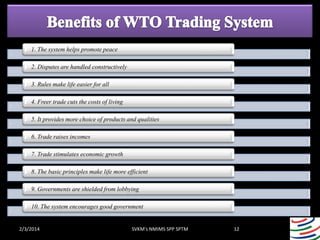
1. The system helps promote peace
2. Disputes are handled constructively
3. Rules make life easier for all
4. Freer trade cuts the costs of living
5. It provides more choice of products and qualities
6. Trade raises incomes
7. Trade stimulates economic growth
8. The basic principles make life more efficient
9. Governments are shielded from lobbying
10. The system encourages good government

2/3/2014

SVKM's NMIMS SPP SPTM

12
2/3/2014

SVKM's NMIMS SPP SPTM

13

World trade organization

  • 1.
    Charmi Popat (03) SVKM’sNMIMS SPP SPTM (School of Pharmacy & Technology Management) 2/3/2014 SVKM's NMIMS SPP SPTM 1
  • 2.
    • WTO dealswith the rules of trade between nations at a global or near-global level • It’s an organization for liberalizing trade • It’s a negotiating forum … • It’s a set of rules … • And it helps to settle disputes … 2/3/2014 SVKM's NMIMS SPP SPTM 2
  • 3.
    • WTO beganlife on 1 January 1995, but its trading system is half a century older • It took over GATT (1948) • Created by: Uruguay Round negotiations (1986– 94) • India is one of the founder member of WTO • New Negotiation: “Doha Declaration” • Head: Director-General, Pascal Lamy • Location: Geneva, Switzerland 2/3/2014 SVKM's NMIMS SPP SPTM 3
  • 4.
  • 5.
    Administering WTO tradeagreements Forum for trade negotiations Handling trade disputes Monitoring national trade policies Technical assistance and training for developing countries Cooperation with other international organizations 2/3/2014 SVKM's NMIMS SPP SPTM 5
  • 6.
    To implement newworld trade agreements To promote multilateral trade among many nations To speed up the economic development To promote free trade by removing tariff & non-tariff barriers in international trade To improve standard of living of global population 2/3/2014 SVKM's NMIMS SPP SPTM 6
  • 7.
    Umbrella AGREEMENT ESTABLIHING WTO Goods Basicprinciples Additional details Market access commitment Services Intellectual property GATT GATS TRIPS Other goods agreement & annexes Services annexes Countries schedules of commitments Countries schedules of commitments (MNF exemptions) Dispute settlement TRADE POLICY REVEWS Transparency DISPUTE SETTLEMENT 2/3/2014 SVKM's NMIMS SPP SPTM 7
  • 8.
  • 9.
    Parties Agreement Complainant European Communities Respondent India TRIPS Arts.70.8 & 70.9 • Measure at issue: (i) The insufficiency of the legal regime – India's "mailbox rule" – under which patent application for pharmaceutical and agricultural chemical products could be filed; and (ii) the lack of a mechanism for granting exclusive marketing rights to such products. • Intellection property at issue: Patent protection for pharmaceutical and agricultural chemical products, as provided under TRIPS Agreement Art. 27. 2/3/2014 SVKM's NMIMS SPP SPTM 9
  • 10.
    Timeline of Dispute Consultation 28thApril 1997 Establishment of Panel 16th Oct. 1997 DSB established panel 16th Oct 1997 Circulation of Panel Report 24th Aug 1998 DSB Adoption 22nd Sep 1998 Implementation India indication “Reasonable period of time” 21st Oct 1998 India’s joint statement 25th Nov. 1998 India’s final report 28th April 1999 2/3/2014 SVKM's NMIMS SPP SPTM 10
  • 11.
    1. Increase inForeign trade 2. Increase in agricultural export 3. Increase in inflow of foreign investment 4. Benefits for clothing & textile industry 5. Restrict dumping 1. Disadvantage to agricultural sector ( Import of food grains) 2. Loss to domestic industries 3.Patent of Indian herbs by foreign industries 2/3/2014 SVKM's NMIMS SPP SPTM 11
  • 12.
    1. The systemhelps promote peace 2. Disputes are handled constructively 3. Rules make life easier for all 4. Freer trade cuts the costs of living 5. It provides more choice of products and qualities 6. Trade raises incomes 7. Trade stimulates economic growth 8. The basic principles make life more efficient 9. Governments are shielded from lobbying 10. The system encourages good government 2/3/2014 SVKM's NMIMS SPP SPTM 12
  • 13.

Editor's Notes

  • #3 Is it a bird, is it a plane?There are a number of ways of looking at the WTO. It’s an organization for liberalizingtrade. It’s a forum for governments to negotiate trade agreements. It’s a placefor them to settle trade disputes. It operates a system of trade rules. (But it’s notSuperman, just in case anyone thought it could solve — or cause — all the world’sproblems!)Above all, it’s a negotiating forum … Essentially, the WTO is a place where membergovernments go, to try to sort out the trade problems they face with each other. The firststep is to talk. The WTO was born out of negotiations, and everything the WTO doesis the result of negotiations. The bulk of the WTO’s current work comes from the1986–94 negotiations called the Uruguay Round and earlier negotiations under theGeneral Agreement on Tariffs and Trade (GATT). The WTO is currently the host tonew negotiations, under the “Doha Development Agenda” launched in 2001.Where countries have faced trade barriers and wanted them lowered, the negotiationshave helped to liberalize trade. But the WTO is not just about liberalizingtrade, and in some circumstances its rules support maintaining trade barriers — forexample to protect consumers or prevent the spread of disease.It’s a set of rules … At its heart are the WTO agreements, negotiated and signedby the bulk of the world’s trading nations. These documents provide the legalground-rules for international commerce. They are essentially contracts, bindinggovernments to keep their trade policies within agreed limits. Although negotiatedand signed by governments, the goal is to help producers of goods and services,exporters, and importers conduct their business, while allowing governments tomeet social and environmental objectives.The system’s overriding purpose is to help trade flow as freely as possible — so longas there are no undesirable side-effects — because this is important for economicdevelopment and well-being. That partly means removing obstacles. It also meansensuring that individuals, companies and governments know what the trade rules arearound the world, and giving them the confidence that there will be no suddenchanges of policy. In other words, the rules have to be “transparent” and predictable.And it helps to settle disputes … This is a third important side to the WTO’s work.Trade relations often involve conflicting interests. Agreements, including thosepainstakingly negotiated in the WTO system, often need interpreting. The most harmoniousway to settle these differences is through some neutral procedure based onan agreed legal foundation. That is the purpose behind the dispute settlementprocess written into the WTO agreements.
  • #4 Main focus of GATT (Trade in goods, less powerful & slow dispute settlement)Main focus of WTO (Trade in goods, Trade in services, protection of IPR, foreign investment etc.)
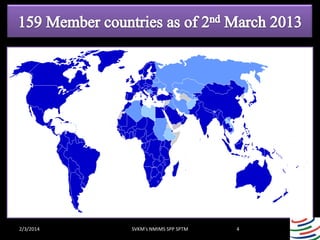
  • #5 153 countries : on 23 July 2008159 as of 2nd march 2013
  • #8 Trade in AgricultureTrade in Textile & ClothingGeneral Agreement on Trade in Services (GATS)Trade Related Intellectual Property Rights (TRIPS)Trade Related Investment measuresDispute Settlement
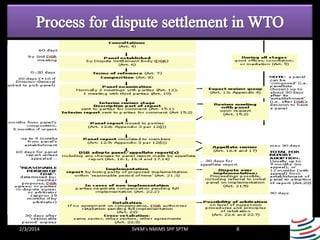
  • #9 The panel processThe various stages a dispute can go through in the WTO. At all stages, countries in dispute are encouraged to consult each other in order to settle “out of court”. At all stages, the WTO director-general is available to offer his good offices, to mediate or to help achieve a conciliation.