
CIGI/CIC Special Report

The Future of the International
      Monetary Fund:
     A Canadian Perspective


      Edited by Bessma Momani and Eric Santor
CIGI/CIC Special Report

The Future of the
International
Monetary Fund:
A Canadian
Perspective

edited by Bessma Momani
and Eric Santor


The views expressed in this publication are those of the authors in

their personal capacities and not those of the Bank of Canada or the

Government of Canada.


Please send any comments to publications@cigionline.org


The opinions expressed in this paper are those of the author(s) and do not necessarily

reflect the views of The Centre for International Governance Innovation, the Canadian

International Council or their respective Board of Directors and/or Board of Governors.


Copyright © 2009. This work was carried out with the support of The Centre for

International Governance Innovation (CIGI), Waterloo, Ontario, Canada (www.cigionline.

org). This work is licensed under a Creative Commons Attribution — Non-commercial —

No Derivatives License. To view this license, visit (www.creativecommons.org/licenses/

by-nc-nd/2.5/). For re-use or distribution, please include this copyright notice.
The Centre for International Governance Innovation


    Table of Contents

    Introduction and Overview of Recommendations                                                      5


    Part I: The IMF and the International Financial System


        Strengthening International Regulatory Coordination: IMF/FSB Relations | Randall Germain      7

        Promoting IMF and WTO Cooperation | Debra Steger                                              10

        Decentralization of the International Financial System: The IMF, BIS and OECD | Tony Porter   14

        The IMF and the SDR: What to Make of China’s Proposals? | Eric Helleiner                      18


    Part II: Governance


        The Role and Place of the Council of Ministers in the IMF’s Future | Thomas A. Bernes         23

        Improving the Accountability and Performance of the Executive Board | C. Scott Clark          25

        IMF Quota Reform: Where Do We Stand? Where Do We Go? | James A. Haley                         29


    Part III: Organizational Culture


        Discretion versus Rules in the Operation of the International Monetary Fund | Dane Rowlands   33

        Developing the Political-Economy Skills of the IMF Staff | Bessma Momani                      36


    Part IV: IMF Functional Reform


        Improving IMF Surveillance | Robert Lavigne                                                   40

        IMF Lending and Resources | Eric Santor                                                       44

        The Future Role of the IMF in Low-Income Countries, Including Debt Relief and

        Sustainability | Roy Culpeper                                                                 48


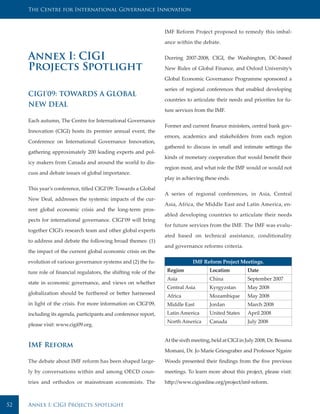
    Annex I: CIGI Projects Spotlight                                                                  52


    Contributors                                                                                      54


    About CIGI                                                                                        57


    About CIC                                                                                         58


4   cigionline.org
The Future of the International Monetary Fund: A Canadian Perspective


Introduction
and Overview of
Recommendations                                                policy experts in order to provide practical perspectives

                                                               on IMF reform. The project considers a full spectrum of

There is broad recognition that the International Mon-         issues, and importantly, makes policy recommendations

etary Fund (IMF) was unable to prevent the global fi-          based on the group’s analysis. These recommendations

nancial crisis, and to some extent, resolve it in a timely     cover three main areas: the IMF’s role within the inter-

manner. But at the same time, when the G20 took control        national financial system, internal governance, and its

of trying to contain the crisis, nations turned to the Fund    instruments and resources:

to facilitate the global policy response. With its enhanced
                                                               1.     IMF and the International Financial System
funding and renewed capacity, the IMF should be an
                                                                    • IMF-FSB coordination: IMF-Financial Stability
integral part of reinvigorating the international finan-
                                                                       Board (FSB) accountability and coordination needs
cial system. Throughout the crisis, many changes have
                                                                       to be improved to ensure that the Early Warning
already taken place, such as introducing a new quick-
                                                                       Exercise (EWE) is effectively delivered.
disbursing lending instrument, the Flexible Credit Line

(FCL), an augmentation of the Fund’s resources via the              • IMF-WTO: The IMF and the World Trade Organi-

New Arrangements to Borrow (NAB), and a US$250                         zation (WTO) need better coordination, particular-

billion allocation of Special Drawing Rights (SDRs). De-               ly on exchange rates, financial services, trade and

spite these initiatives, IMF reform is far from complete               finance policy review, and investment by state en-

and many issues remain unresolved, such as voice and                   terprises, including sovereign wealth funds.

representation, corporate governance, staffing, the use of
                                                                    • Decentralization: In light of the financial crisis, the
IMF resources and the Fund’s role within the global fi-
                                                                       IMF’s responsibilities will increasingly need to be
nancial architecture. Failure to address these pressing is-
                                                                       shared with other institutions — most notably, the
sues will undermine the IMF’s legitimacy and capacity to
                                                                       Bank for International Settlements (BIS) and the Or-
weather the financial crisis storm, and assist in returning
                                                                       ganisation for Economic Co-operation and Devel-
calm to the international financial and monetary system.
                                                                       opment (OECD).

IMF reform is well-traveled ground. Nevertheless, the
                                                                    • SDRs: Careful consideration of the role of the SDR by
financial crisis provides an unprecedented opportunity
                                                                       the IMF and its members, in the context of ensuring
to re-examine the Fund’s role and to discuss how best
                                                                       orderly functioning of the international monetary sys-
to equip it for the post-crisis world. The objective of this
                                                                       tem and engagement by member countries, is needed.
project was to bring together Canadian academics and


                                                                                                        cigionline.org          5
The Centre for International Governance Innovation


    2.     Governance                                                   • Surveillance: Surveillance should focus on coher-

         • Council of Ministers: To provide direction, build               ent and sustainable macroeconomic and financial

            trust and increase legitimacy, a council of ministers          policy frameworks that preserve external stability.

            should be created to ensure that a political body              This includes assessing the direction and speed of

            sets the broad strategic decisions, appoints the               real exchange rate (RER) adjustment and on the

            managing director and has broad oversight of the               extent to which policies are permitting the RER to

            international economy.                                         adjust, which are critical for external stability.


         • Executive Board: The Executive Board needs to                • Lending and Resources: Lending instruments

            provide more detached oversight and less day-                  and resources should reflect the IMF’s mandate

            to-day management. There should be more board                  and focus on crisis prevention and resolution,

            committees, a separation of functional responsibili-           both at the global and member-country levels;

            ties from management, and the managing director                greater use of precautionary facilities, and stand-

            should not be chair of the Board.                              stills, should be encouraged.


         • Quota and Voice: The IMF membership needs to                 • Low-Income Country Lending: The IMF needs to

            increase the quota and voice of under-represented              avoid mission creep into the World Bank and aid

            members. If members do not have sufficient voice,              agencies’ jurisdiction of developing poverty reduc-

            their commitment to the IMF and its mission will               tion policies. Instead, it should focus on short-term

            wane. Without the commitment of its members, the               financial assistance, managing volatile capital flows

            IMF’s ability to maintain the stability of the interna-        and exchange rate issues.

            tional monetary system will be undermined.
                                                                      The recommendations set out above are, to say the

    3.     IMF Functional Reforms                                     least, ambitious, and enormous political consensus is

         • Technocratic Framework: The IMF should enhance             required if meaningful reform is to be achieved. Nev-

            the autonomy of its staff to provide candid surveil-      ertheless, the IMF has a key role to play in the ongo-

            lance, advise on conditionality and avoid political       ing efforts to foster international financial and mon-

            interference by the Board. It needs to separate ap-       etary stability. Simply, it is more important than ever

            proval of lending from the oversight of the Board         that members continue in their efforts to ensure that

            and management.                                           the IMF has the proper mandate, role, governance, staff

                                                                      and tools to achieve its goals.
         • Staffing: To enhance its staff’s political-economy

            skills, the IMF needs to broaden its recruitment

            and staff training efforts. The IMF can change

            organizational incentives and, by extension, IMF

            staff behaviour.


6   cigionline.org
The Future of the International Monetary Fund: A Canadian Perspective


                                                                 division of labour between these groups to maximize

                                                                 the design and actual delivery of effective, accountable

                                                                 financial regulation.
Strengthening
International                                                    Two of the most important international institutions

Regulatory                                                       responsible for financial stability are the IMF and the

Coordination:                                                    Financial Stability Board (FSB). They are important for

IMF/FSB Relations                                                different reasons. The IMF is a formal international in-

Randall Germain                                                  stitution, universal in scope, with its own financial re-

                                                                 sources and expertise ready to be committed to countries

                                                                 in the event of a financial crisis. The FSB, however, can-

The crisis that has paralyzed much of the world’s financial      not accurately be described as an “institution”; rather, it

system since 2007 has revealed several significant regula-       is a quasi-formal committee, unique among its peers in

tory problems that need to be addressed. Many issues are         that it is the only venue that regularly brings together

associated with regulatory practices in specific countries;      the key national and international agencies responsible

however, some pertain to how financial firms undertake           for ensuring systemic stability across all major financial

transactions and operate in cross-border markets. The re-        systems. Clarifying and strengthening how these two

sponse to the financial crisis has been predominantly na-        organs of international financial stability work together

tional in focus; it has taken the form of national authorities   should be a priority for the international community.

(regulators, central banks, finance ministries) supporting
                                                                 At the G20 Summit in London in April 2009, the IMF
financial institutions and markets as they operate within
                                                                 and FSB were asked to work together to develop an ear-
the context of national financial systems. Nevertheless,
                                                                 ly warning exercise to better protect the global financial
the international dimension of financial regulation has
                                                                 system from disruption and crisis. This is an important
remained an important part of the policy mix because it
                                                                 start, even if there are many questions about the accu-
is widely recognized that all national regulations require
                                                                 racy and effectiveness of such a system. Yet if the interna-
robust international support to be effective. To make the
                                                                 tional community wants the international dimension of
world’s financial systems less vulnerable to disruption
                                                                 financial stability to be strengthened and better integrat-
and more stable in their modes of operation, this interna-
                                                                 ed with national regulatory initiatives, it must go further.
tional dimension must be strengthened.
                                                                 It must, through the G20, identify the lead organization

The various organs of international financial stability          responsible for developing, coordinating and monitor-

and regulation encompass a plethora of institutions, or-         ing appropriate financial regulations, and decide which

ganizations, committees and associations; these are pub-         organization should be the main venue to provide the

lic, private or are a hybrid of the two in their orientation.    critical interface between national authorities and inter-

Therefore, it is critical to clarify and better organize the     national agencies. On both counts, the FSB should be un-


                                                                                                        cigionline.org          7
The Centre for International Governance Innovation


    ambiguously tasked with providing leadership and the            key high-ranking players around one table is enormous.

    IMF with providing support.                                     It has taken nearly a century of international financial

                                                                    governance reform to get to this point, which makes this
    The reasons for identifying the FSB rather than the IMF as
                                                                    an accomplishment worth noting.
    the lead organization are both technocratic and political.

    Most importantly, the FSB possesses the fundamental pre-        The second reason for making the FSB the lead regulatory

    requisite of being able to facilitate the interface between     institution lies within one of its important political charac-

    national authorities and international agencies. This abil-     teristics: the ability to accommodate international political

    ity is crucial because only national authorities can imple-     change. Financial regulation, whether at the national or

    ment and enforce financial regulations; they need to be an      international level, is not simply a technocratic affair. It in-

    organic part of the policy-development process. The IMF         volves international politics insofar as specific regulations

    is not organized to foster the deep involvement of nation-      reward some forms of governance over others, and privi-

    al authorities in regulatory policy development, and its        leges some organizations and global financial concerns

    charter and mandate have often pitted its officials against     over their competitors. Furthermore, the rise and decline

    national counterparts. Ultimately, the IMF is designed to       of entire economies cannot be divorced from diverse na-

    be an international financial institution and to this end, it   tional financial governance practices. It is here where the

    has developed over its history an identity and ethos sepa-      FSB has proven itself better able to negotiate and accom-

    rate from any one national government, even if on many          modate the many differences stemming from the diverse

    occasions it appears to be excessively biased towards the       ways national authorities govern their financial systems.

    United States (US) and/or G7 countries.                         This is partly due to the technical nature of the FSB and its

                                                                    origins, but also to the regulators’ recognition of how sys-
    The FSB, on the other hand, was designed from the start
                                                                    temic vulnerabilities are able to migrate from one finan-
    to foster precisely the kind of engagement between na-
                                                                    cial system to the next. This is why at the first meeting of
    tional and international agencies that a successful and
                                                                    the FSF, it was expanded beyond the G7 to include Hong
    effective international regulatory framework demands.
                                                                    Kong, Singapore, Australia and the Netherlands, and why
    Created as the Financial Stability Forum (FSF) in 1999, it
                                                                    — after the inaugural meeting of the G20 in Washington
    brought together regulators, central bankers and finance
                                                                    in November 2008 — it was so easy to forge an agreement
    ministry officials of the G7 nations for the first time.
                                                                    that the FSB should again be expanded.
    From April 2009, the FSB, the interface between these

    authorities, has been maintained and even deepened              In contrast, the IMF remains a much more constricted

    with the extension of its membership to parallel the G20        international organ of financial stability, less able to re-

    (along with additional relevant international agencies).        form itself and less responsive to the changing dynam-

    Even though this expanded membership has grown far              ics of international politics. Part of this is bound up with

    beyond the 20 or so representatives the early organizers        the history of the institution and with the fact that it has

    envisioned as optimal, the benefits of having all of the        actual resources to dispense — these are always going


8   Part I: The IMF and the International Financial System
The Future of the International Monetary Fund: A Canadian Perspective


to provoke tensions among its members. Yet, the IMF is         Finally, the G20 should convene a panel of experts —

a much less politically adaptive institution. In many ar-      drawn from industrialized and developing economies,

eas of endeavour this is not necessarily a problem, but it     including regulators, private sector and civil society ac-

a burden with consequences in the fast-changing world          tors and academia — to consider the broader question

of financial systems and their governance.                     of the regulatory division of labour at the international

                                                               level. Its mandate should be to deliver a clear picture of
Given that financial regulation is disproportionately
                                                               who is responsible for what, and to recommend lines of
about marshalling and applying knowledge, as opposed
                                                               authority to connect the architects of regulatory frame-
to distributing resources to save financial institutions and
                                                               works with the officials who implement and enforce
systems — this is more properly crisis management, and
                                                               them. Such a panel should have the mandate to examine
falls more clearly within the remit of the IMF at the in-
                                                               the entire panoply of regulatory organs at the interna-
ternational level — it is logical that as much expertise as
                                                               tional level, and report back to the G20 within a suitable
possible be brought to bear on the issues and questions
                                                               timeframe. Financial regulation is a complex set of affairs
confronting the world’s financial systems. Coordinating
                                                               that has evolved piecemeal over many years. The last,
regulatory practices, developing appropriate standards
                                                               partial, rethink was a decade ago; it is time for another
and codes, compiling and sharing information and most
                                                               holistic examination, while full knowledge of the con-
crucially, building trust among national authorities —
                                                               sequences of letting things continue as before remains
whose principal remit is to enforce responsible behaviour
                                                               fresh in our minds.
onto financial institutions — are the most important tasks

confronting policy makers who want to build a robust
                                                                 Recommendations
and durable international support structure for financial

regulation. Directing the IMF and FSB to collaborate to            1. The G20 should be pushed to identify a leading

develop an effective early warning exercise will help ad-             organization that will become the central organ

vance some of these tasks, but it is only a start.                    of financial regulation. The argument has been

                                                                      made that the Financial Stability Board (FSB)
The G20 should be pushed to identify a lead organiza-
                                                                      should be so identified, with the IMF cast in a
tion that will become the central organ of financial regu-
                                                                      supporting (but not insignificant) role.
lation. The argument has been made that the FSB should

be so identified, with the IMF cast in a supporting (but           2. The G20 should convene a panel of experts

not insignificant) role. This recommendation runs coun-               — drawn from industrialized and developing

ter to the joint FSF/IMF Declaration of November 13,                  economies, including regulators, private sec-

2008, but this document is itself ambiguous about the                 tor and civil society actors and academia — to

real division of labour between the two organizations.                consider the broader question of the regulatory

The current global financial crisis has revealed that the             division of labour at the international level.

division of labour needs clarification.


                                                                                                     cigionline.org          9
The Centre for International Governance Innovation


                                                                 The respective mandates of the two organizations are

                                                                 different, although there are some overlaps with re-

                                                                 spect to the impact of trade policies on macroeconomic
     Promoting IMF and                                           stability. The IMF was created “to promote monetary
     WTO Cooperation                                             cooperation through a permanent institution,” by pro-
     Debra Steger
                                                                 moting exchange rate stability, establishing a multilat-

                                                                 eral system of payments, eliminating foreign exchange

                                                                 restrictions and providing temporary relief to mem-
     The International Economic System
                                                                 bers with balance-of-payments difficulties. The GATT

     The original Bretton Woods organizations — the IMF          contracting parties were to enter into reciprocal, mu-

     and the International Bank for Reconstruction and De-       tually beneficial arrangements “directed to substantial

     velopment (the World Bank) — were designed at the end       reduction of tariffs and other barriers to trade and to

     of the Second World War to work together as a system to     the elimination of discriminatory treatment in inter-

     promote economic growth and prosperity, and to main-        national commerce.” In 1995, the preamble of the new

     tain peace. The International Trade Organization (ITO)      WTO added the goals of “optimal use of the world’s re-

     was stillborn as the US administration did not complete     sources in accordance with the objective of sustainable

     the ratification procedure, and in its place, the General   development” and respect for the needs and concerns

     Agreement on Tariffs and Trade (GATT) was negotiated.       of members at different levels of development.

     It was not until 1995 that history was corrected and the
                                                                 At the London Summit in April 2009, G20 leaders em-
     World Trade Organization was established.
                                                                 phasized “the only sure foundation for sustainable

     From the beginning, the IMF and GATT had some over-         globalisation and rising prosperity for all is an open

     lapping purposes. One of the key IMF functions, for         world economy based on market principles, effective

     example, is “to facilitate the expansion and balanced       regulation and strong global institutions.” Globaliza-

     growth of international trade, and to contribute thereby    tion has demonstrated that international finance, trade

     to the promotion and maintenance of high levels of em-      and investment are inextricably linked. It is imperative,

     ployment and real income and to the development of the      therefore, that international economic policy be made

     productive resources of all members as primary objec-       by strong multilateral institutions acting cooperatively

     tives of economic policy.” Similarly, the preamble of the   within a coherent system, rather than in separate silos.

     1947 GATT recognized the goal of “raising standards of      The world economy has been transformed by the rise of

     living, ensuring full employment and a large and steadi-    the emerging economies, and the international econom-

     ly growing volume of real income and effective demand,      ic architecture needs to be redesigned to recognize new

     developing the full use of the resources of the world and   power relationships as a multi-polar world develops.

     expanding the production and exchange of goods.”            The recent financial crisis has highlighted the urgent

                                                                 need for major reform of the international financial in-


10   Part I: The IMF and the International Financial System
The Future of the International Monetary Fund: A Canadian Perspective


stitutions, the IMF in particular, to give effective voice   In a recent report, the IMF’s Independent Evaluation

to all participants in the system. However, if there is      Office (IEO) found that, since 2000, the IMF has sig-

to be a strong international economic system, the WTO        nificantly reduced its involvement in traditional trade

must not be left out of this reform effort.                  policy issues, especially with respect to conditionality.

                                                             While this is a positive development, the IEO empha-
While an infusion of funds into the IMF to assist its
                                                             sizes that this “scaling back on trade policy advice came
members with economic difficulties is urgently need-
                                                             at the cost of constructive roles in trade issues central to
ed, this in itself will not forestall future crises. There
                                                             financial and systemic stability.” In particular, the IEO
were a number of financial crisis in the 1990s, in Asia,
                                                             concludes that the IMF has not been active enough in fi-
Latin America and Russia. Global imbalances and
                                                             nancial services and preferential trade agreements with
pressures on the system will only increase if the in-
                                                             significant macroeconomic effects, and has not focused
ternational economic institutions are not strengthened
                                                             on the global effects of trade policies in systemically im-
and made more coherent. The financial crisis provides
                                                             portant countries, including the emerging economies.
a unique, historical opportunity to reform the global

economic institutions, to enable them to respond ef-         There are areas of overlapping jurisdiction between the

fectively to future challenges.                              IMF and WTO which, if not appropriately coordinated,

                                                             can lead to conflict. A key example relates to the two
The IMF and WTO: Conflicting or
                                                             organizations’ different approaches to trade liberaliza-
Coherent Roles?
                                                             tion. For many years, through its policy of conditional-

In the real world, monetary policies affect internation-     ity, the IMF required certain members to significantly

al trade flows and trade policies affect macroeconomic       reduce their applied tariff rates on goods. In the WTO,

stability. The IMF and WTO have both influenced trade        as in the GATT, members reciprocally negotiate tariff

policy, but in different ways and from different perspec-    concessions, binding the Most Favoured Nation (MFN)

tives. The IMF has encouraged unilateral liberalization      rates in their schedules. A result of these two policy ac-

of trade through its practice of conditionality in lending   tions is a great discrepancy in many countries between

programs. In the WTO, members have negotiated re-            their bound MFN rates of tariffs in the WTO and the

ciprocal reductions of tariffs and non-tariff barriers and   applied rates that they must impose because of IMF

have bound their concessions in schedules. From the          conditionality. This incoherence has made WTO nego-

perspective of the developing countries, the IMF often       tiations on further reductions of tariffs very difficult,

had more power to influence domestic policies than the       because concerned countries do not get credit or recip-

WTO because the former can lend money; however, the          rocal concessions from other WTO members for reduc-

WTO has binding international rules with enforcement         ing their applied rates.

and shaming capabilities in the dispute settlement and

trade policy review mechanisms.


                                                                                                    cigionline.org          11
The Centre for International Governance Innovation


     Another area of overlap relates to balance of payments      with the World Bank, agreed to a joint statement on

     and foreign exchange measures. The GATT permits             coherence. While the IMF has significantly more re-

     members, under specific circumstances, to impose            sources than the WTO, the WTO on several occasions

     trade restrictions for balance-of-payments reasons. The     has asked for IMF studies on key matters of mutual

     WTO recognizes that the IMF is the expert in these ar-      interest and relied upon IMF surveillance reports to

     eas, and the agreements provide for consultation with       prepare its Trade Policy Reviews on member coun-

     the IMF on such matters. However, in practice, WTO          tries. In the early 2000s, the IMF had a small office in

     dispute settlement panels do not always consult the         Geneva and a division in its headquarters dedicated to

     IMF when such issues arise.                                 trade policy. Through this office, the IMF participated

                                                                 as an observer in important WTO meetings and nego-
     Moreover, during China’s accession to the WTO, con-
                                                                 tiations. However, in 2008, both the Geneva office and
     flicts emerged over members’ rights to use foreign ex-
                                                                 the Trade Policy Division were eliminated.
     change restrictions in the future. Similar conflicts have

     arisen between the prohibition on restrictions of capi-     The level of cooperation between the two organizations

     tal transactions in the WTO General Agreement on            reached its peak in the first few years of the WTO and

     Trade in Services (GATS) and the rights of members          has since steadily declined. In key areas, the IMF and the

     to impose such controls under Article VI of the IMF’s       WTO have missed opportunities for collaborative action.

     Articles of Agreement.                                      Surprisingly, the IMF played a relatively insignificant

                                                                 role in the Integrated Framework and Aid for Trade tech-
     The failure of both organizations to come to grips with
                                                                 nical assistance initiatives. IMF surveillance reports are
     the systemic implications of preferential trade agree-
                                                                 prepared without consultation with the WTO, and the
     ments and financial services regulation are major omis-
                                                                 WTO dispute settlement panels have not consulted the
     sions crucial to the world economy.
                                                                 IMF on issues within its competence. To make matters

     The Need for Greater Coherence                              worse, both organizations have failed to work together to

                                                                 promote liberalization of trade in financial services and
     As the financial crisis has highlighted, it is not easy
                                                                 to examine the effects of preferential trade agreements
     to draw lines of causation between monetary, finance
                                                                 on the stability of the international economic system.
     and trade policies, but it is clear they interact and can

     contribute to, or detract from, economic stability. A       The Consequences of Inaction
     need exists for greater formal cooperation and coher-
                                                                 As international finance and trade become more complex
     ence in international economic policy making among
                                                                 and interconnected, the need is greater for strong global
     the responsible international organizations. In the
                                                                 economic institutions with effective oversight capabili-
     early days, the WTO and IMF cooperated. In 1996, the
                                                                 ties. Central to their effectiveness and efficiency will be
     two organizations signed an agreement on cooper-
                                                                 their abilities to cooperate and collaborate to make inter-
     ation. In 1998, the heads of the organizations, together
                                                                 national economic policies coherent.


12   Part I: The IMF and the International Financial System
The Future of the International Monetary Fund: A Canadian Perspective


The potential for conflict is serious. Take, for example,    aid for trade and technical assistance, and exchange rate

China’s valuation of its currency, which it has pegged to    policies. To build strong, legitimate international institu-

the US dollar. This policy has led interest groups in the    tions, leaders should make serious commitments to re-

United States to complain that China has manipulated its     form the IMF and WTO governance structures to ensure

currency contrary to WTO rules. While the IMF clearly        they are accountable, representative, effective and effi-

has the jurisdiction to deal with exchange rates, the WTO    cient in the future.

has rules and a binding dispute settlement mechanism.

There have been conflicts in the past between WTO and          Recommendations
IMF rules. However, if this case were brought forward, it
                                                                 1. The WTO must be a part of the reform to the
could have very serious consequences for both the inter-
                                                                    wider international economic system.
national financial and trading systems.

                                                                 2. The IMF needs to be more active in financial
Clearly, there is a need for enhanced cooperation between
                                                                    services and preferential trade agreements.
the IMF and WTO. Areas for more intensive cooperation

include: trade in financial services, surveillance of mem-       3. Increase formal cooperation and coherence in

bers’ trade and finance policies, the impact of preferen-           international economic policy making, particu-

tial trade agreements on the global economic system,                larly between international organizations.


                                                                                                    cigionline.org          13
The Centre for International Governance Innovation


                                                                     IMF reformers should consider carefully how the IMF

                                                                     can complement and share responsibility with other

                                                                     types of institutions that will continue to play a key
     Decentralization of                                             role in governing international money and finance. As
     the International                                               well, the IMF should seek to build some of the com-
     Financial System:                                               plexity and informality evident in the work of other
     The IMF, BIS and                                                international institutions into its own structure. Two
     OECD                                                            intergovernmental organizations whose work is par-
     Tony Porter
                                                                     ticularly close to the IMF, the BIS and Organisation for

                                                                     Economic Co-operation and Development (OECD) are

                                                                     especially worth consideration.
     The institutions responsible for governing international

     money and finance have evolved very differently than            There are many reasons to support this trend toward

     might have been predicted in the middle of the last cen-        greater reliance on decentralized, informal and complex

     tury when the IMF was created. At that time, formal             arrangements with greater involvement of non-state ac-

     intergovernmental organizations were considered the             tors, not just in monetary and financial affairs, but in glo-

     best means for governments to cooperate in addressing           bal governance more generally. These decentralized ar-

     international problems. A series of such organizations          rangements address the limits of centralized “command

     were created or significantly strengthened. Intergovern-        and control” in coping with complex, rapidly changing

     mental organizations were created for major issues that         environments; they promote greater effectiveness and le-

     require coordinated governance responses. The IMF had           gitimacy by drawing on the capacity of actors outside for-

     a strong, distinctive role in international monetary affairs.   mal government processes to contribute to governance;

     Today, however, the most prominent feature of global            and, they make good use of how information, commu-

     governance has instead been its increasing reliance upon        nications and transportation technologies have allowed

     informal institutions, often with complexly overlapping         more horizontal, informal and networked governance ar-

     areas of responsibility. Many governance functions that         rangements to operate globally.

     might otherwise be managed by the IMF have been car-
                                                                     The OECD and BIS deserve particular attention for the
     ried out through informal intergovernmental groupings
                                                                     lessons they provide to the IMF on how formal inter-
     such as the G7, G8, G20 and the regulatory groupings at
                                                                     governmental organizations can work with decentraliz-
     the Bank for International Settlements (BIS).
                                                                     ing trends in global governance. They also provide ex-

     While the idea of restoring the IMF to its earlier, more        amples of monetary and financial governance capacity

     exclusive, dominant role might seem like a reasonable           outside the IMF, which could be further strengthened.

     response to the governance failures that the current            The OECD’s well-developed peer review process, which

     financial crisis has revealed, this would be a mistake.         it pioneered in the early 1960s and which considers


14   Part I: The IMF and the International Financial System
The Future of the International Monetary Fund: A Canadian Perspective


macroeconomic policy, is similar to the IMF’s surveil-       national officials attend OECD committee meetings

lance function. In addition to its more informal work on     each year. Work methods at both the BIS and OECD

emerging financial issues, the OECD has played a key         involve identifying best practices by bringing together

role in investment and financial services through its hard   the practical experiences of officials with research car-

law Code of Liberalisation of Capital Movements and          ried out by the organization’s secretariat. These work

Code of Liberalisation of Current Invisible Operations.      methods help make the resulting research and guide-

Due to its “whole of government” character, the OECD         lines more sensitive to variation in problems across

is especially well positioned to address financial issues    countries and issues.

with a social dimension, such as pensions. The BIS hosts
                                                             Neither the BIS nor the OECD have the near-universal
regulatory committees that set standards and involve in-
                                                             membership of the IMF, but there are also useful lessons
formal mechanisms of peer accountability on financial
                                                             in how both organizations have reached beyond their
regulation issues. In addition to the Financial Stability
                                                             original membership. The BIS’s 55 members now extend
Board and the Basel Committee on Banking Supervi-
                                                             well beyond the original Western European base to in-
sion, the BIS hosts the Committee on the Global Finan-
                                                             clude an additional 37 countries. Moreover, the BIS has
cial System, the International Association of Insurance
                                                             offices in Hong Kong and Mexico. Although the commit-
Supervisors, the Committee on Payment and Settlement
                                                             tees it hosts tend to have exclusive memberships, they
Systems, the International Association of Deposit Insur-
                                                             increasingly involve non-members informally in their
ers and the Joint Forum. Historically, the BIS has also
                                                             work. The Basel Committee on Banking Supervision has
facilitated swaps between central banks to help manage
                                                             established relations with regional bank supervisory
imbalances. Both the OECD and the BIS have profession-
                                                             groups that together cover most of the world. The OECD
al staffs which help produce reports and statistics on the
                                                             has plans to expand its membership beyond 30. In 2007,
global economy that overlap with the IMF’s.
                                                             the OECD started accession talks with Chile, Estonia,

The ways the BIS and OECD have managed decen-                Israel, Russia and Slovenia, and it offered enhanced

tralizing trends in global governance provide useful         engagement, with a view to possible membership, to

lessons to the IMF. Both organizations have displayed        Brazil, China, India, Indonesia and South Africa. It has

greater flexibility than the IMF in sponsoring infor-        created a wide variety of vehicles to facilitate collabora-

mal issue-specific structures, including the regulatory      tion with non-members, including selective invitations

committees the BIS hosts and the committees, forums,         to participate in the main committees and groups. It has

networks, working groups and roundtables the OECD            also created forums, networks and roundtables, often

created. Both organizations also routinely bring sen-        working together with regional and other international

ior officials from national governments together with        institutions, in which non-members and non-state ac-

their own staffs to a much greater degree than does the      tors participate. The OECD has institutionalized partici-

IMF. National officials play a leading role in the work      pation from business and trade unions and has created

of the BIS-based committees and about 40,000 senior          mechanisms to involve other non-governmental organi-


                                                                                                   cigionline.org          15
The Centre for International Governance Innovation


     zations as well as parliaments (for example, through its      peer review capacities and technical assistance programs

     Network of Parliamentary Budget Committee Chairs).            that exist at the OECD, BIS and other institutions such

                                                                   as the New Partnership for Africa’s Development should
     Rather than attempting to restore the IMF to the rela-
                                                                   be strengthened to complement and compete with the
     tively exclusive, autonomous and dominant position in
                                                                   IMF’s. Further development of alternative financing ar-
     international and monetary affairs that one could have
                                                                   rangements should be undertaken, for instance, through
     imagined when it was created, the IMF should adopt
                                                                   central banks at the BIS or the Chiang Mai Initiative. The
     more of the flexibility and engagement with decentral-
                                                                   IMF should work with and encourage these alternatives.
     ized governance practices that have been evident in the

     BIS and OECD. This should include more efforts to in-         On high-level policy matters, the G20 provides a use-

     volve national officials, collaborate with other interna-     ful alternative governance mechanism to the IMF. The

     tional organizations and non-governmental actors, and         role the G20 plays in asking other institutions to take

     experiment with new informal organizational arrange-          on tasks should grow, but the influence of states and

     ments. This is especially important for the IMF’s surveil-    regions not adequately represented in the G20 should

     lance and technical assistance functions, but such efforts    be strengthened in existing or new formal or informal

     could be applied to the IMF’s lending function as well.       organizations. These organizations can serve as vehicles

     It should also further strengthen its relations with other    to propose policy initiatives or to endorse or criticize

     institutions that play key roles in monetary and financial    initiatives from G20, the IMF or other bodies. The G20

     governance, including the BIS and OECD.                       should increasingly consult and collaborate with groups

                                                                   outside of its membership, and governments outside the
     To prevent the IMF from obstructing change and to al-
                                                                   G20 should work to develop such groups. The incentive
     low tasks to be allocated to other institutions when the
                                                                   that states and international institutions have to allow a
     IMF is underperforming, it is important to maintain and
                                                                   group or institution to take the lead where exclusive or
     further develop alternative channels for IMF to launch,
                                                                   centralized control will work to minimize the duplica-
     endorse and implement programs as it is reformed. It is
                                                                   tion, fragmentation and confusion that might otherwise
     crucial to reform the governance of the IMF to restore its
                                                                   accompany decentralized arrangements. The benefits of
     credibility and allow it to play a more effective role in
                                                                   decentralization, including flexibility; sensitivity to vari-
     global monetary and financial governance. With its near
                                                                   ation across regions and issues; and the wider mobiliza-
     universal membership and formal structure, it has a dis-
                                                                   tion of the resulting knowledge, finance and policy in-
     tinctive role to play in legitimizing the rules and initia-
                                                                   puts outweigh the risks of these problems, and the risks
     tives it manages. However, past perceptions of its biases,
                                                                   of relying too exclusively on the IMF.
     inflexibility and lack of accountability, and its slow pace

     of reform have highlighted the reasons why it should

     not become the only governance mechanism in interna-

     tional monetary and financial affairs. The surveillance or


16   Part I: The IMF and the International Financial System
The Future of the International Monetary Fund: A Canadian Perspective


Recommendations

 1. The IMF should consider how the IMF can

    complement other institutions and share re-

    sponsibilities with them.


 2. The IMF should build complexity and infor-

    mality into its structure.


 3. The IMF should be more flexible and engage

    in decentralized governance practices, involv-

    ing a wider range of actors, including national

    official, international organizations and non-

    governmental actors.


 4. Maintain and further develop alternative chan-

    nels to launch, endorse and implement programs.


                                                                         cigionline.org    17
The Centre for International Governance Innovation


                                                                   omists. Indeed, if anything, the Chinese proposals are

                                                                   more limited than those put forward by many others at

                                                                   the moment.
     The IMF and the SDR:
     What to Make of                                               Determining the SDR’s Value
     China’s Proposals?                                            Many of the reactions to Zhou’s proposals lacked care-
     Eric Helleiner
                                                                   ful attention to the actual detailed content. His most

                                                                   straightforward and simplest proposal concerns the

                                                                   valuation of the SDR. At the moment, the SDR is val-
     Special Drawing Rights (SDR) are suddenly an impor-
                                                                   ued according to a basket of four currencies: the US
     tant issue in IMF reform debates. At past moments of
                                                                   dollar (44 percent of the basket), the euro (34 percent),
     US dollar weakness in the late 1960s, and early and late
                                                                   the yen (11 percent) and sterling (11 percent). Zhou
     1970s, the SDR also received a great deal of considerable
                                                                   proposed that “the basket of currencies forming the
     attention. This time around a new voice – Chinese central
                                                                   basis for SDR valuation should be expanded to in-
     bank governor Zhou Xiaochuan – played the lead role in
                                                                   clude currencies of all major economies, and the GDP
     placing the issue on the international policy agenda.
                                                                   may also be included as a weight.”

     In a paper released a few weeks before the London
                                                                   In any event, the SDR’s value is due for review in 2010. At
     G20 Summit in April 2009, Governor Zhou advocated
                                                                   the time of the last review in 2005, the role of the four SDR
     strengthening the SDR’s role in the international mon-
                                                                   currencies was justified on the basis that their countries
     etary system. The paper provoked some strong reactions.
                                                                   had the largest value of exports and they were freely avail-
     Some saw it as an unusually aggressive and blunt chal-
                                                                   able (while weighting was determined by export value
     lenge to US power and an effort to replace the dollar with
                                                                   and the amount of other countries’ reserves denominated
     a global monetary union. At the other extreme, the paper
                                                                   in each currency). But the basket has changed over time;
     was dismissed cursorily as an irrelevant attempt to deflect
                                                                   in the 1970s, for example, 16 currencies were involved.
     international criticism of Chinese economic policy.

                                                                   Proposals for a wider and reweighted basket should be
     Both of these reactions missed the mark. Zhou’s propos-
                                                                   discussed in the upcoming review. It is important for
     als were not designed to revolutionize the world through
                                                                   the SDR to reflect changes in the relative importance of
     some kind of world monetary union, but neither were
                                                                   internationally used currencies. A wider basket might
     they irrelevant. While Chinese officials no doubt have
                                                                   also enable the SDR to serve as a more stable monetary
     tactical political reasons for raising the SDR issue, they
                                                                   anchor at a time when the relative values of the world’s
     are offering some very practical policy proposals that
                                                                   major currencies may well become more variable.
     deserve serious consideration in debates about the IMF’s

     future. Some are in fact already being implemented and

     others are endorsed by some of the world’s leading econ-


18   Part I: The IMF and the International Financial System
The Future of the International Monetary Fund: A Canadian Perspective


The Allocation of SDRs                                        A limitation of Zhou’s proposal is that he does not follow

                                                              up this point with any discussion of the content of pos-
Zhou also called for a new SDR allocation and for the
                                                              sible “rules” for SDR allocation. The UN’s Stiglitz Com-
approval of the 1997 Fourth Amendment of the IMF Ar-
                                                              mission has been more ambitious, suggesting that SDRs
ticles of Agreement which allowed for a special one-time
                                                              could be allocated either on a regular (for example, an-
allocation of SDR 21.4 billion (in order to bring the cu-
                                                              nual) and automatic basis, or counter-cyclically with al-
mulative allocation of SDRs of each member in line with
                                                              locations concentrated during crises (or IMF crisis loans
its quota share). Both goals are already being realized.
                                                              could be made in SDRs that would then be removed
In June, the US Congress approved the Fourth Amend-
                                                              when the loans were repaid).
ment, paving the way for its implementation. The next

month, the IMF’s executive board approved a new SDR           Zhou also failed to address the equity issue that SDRs

allocation and on a much more ambitious scale than            are presently allocated in proportion to countries’ IMF

Zhou probably anticipated: approximately SDR 150 bil-         quotas. Many developing countries have objected to the

lion (US$250 billion).                                        very large share of new SDR allocations going to wealthy

                                                              industrialized countries that need them least. The Sti-
This new allocation is the largest allocation of SDRs ever
                                                              glitz Commission discusses alternative allocation prin-
(the previous allocations in 1970-1972 and 1979-1981 to-
                                                              ciples on the basis of GDP or some measure of need, as
taled SDR 21.4 billion) and it will raise the share of SDRs
                                                              well as the possibility of investing SDRs in the bonds of
in the world’s non-gold official reserves from less than
                                                              multilateral development banks.
0.5 percent to about 5 percent. One of Zhou’s rationales

for a new SDR allocation was similar to those that mo-        An IMF Substitution Account
tivated other G20 leaders: it will help buffer countries
                                                              Zhou’s only comment concerning SDR allocation rules
from balance-of-payments shocks in the context of the
                                                              is that they could “be shifted from a purely calculation-
severe global financial crisis.
                                                              based system to a system backed by real assets, such

Zhou also put the case for more SDRs in the broader           as a reserve pool, to further boost market confidence

context of the Triffin dilemma that justified the SDR’s       in its value.” This recommendation seems to reinforce

creation in 1969; that is, the dilemma that the reserve       his broader proposal that the IMF manage a portion of

currency country must provide liquidity to the world          countries’ reserves by setting up “an open-ended SDR-

while ensuring the stability of its currency. Reiterating     denominated fund based on the market practice, allow-

this case, Zhou noted that a “super-sovereign reserve         ing subscription and redemption in the existing reserve

currency” like the SDR could be managed “according to         currencies by various investors as desired.”

a clear set of rules” in order to “ensure orderly supply”
                                                              Proposals for an IMF fund of this kind are not new. Be-
without reference to any individual country’s distinctive
                                                              tween 1978 and 1980, policy makers discussed in detail
domestic goals or balance-of-payments situation.
                                                              the creation of an IMF “substitution account,” which


                                                                                                   cigionline.org          19
The Centre for International Governance Innovation


     would allow national monetary authorities to exchange         assume if the dollar sinks in value. This question ul-

     dollar reserves for SDR-denominated reserves. Because         timately sank the 1978-1980 negotiations, but it is not

     the exchange was off-market, it would have enabled a          insurmountable. If the account lost money, Bergsten

     diversification of reserves without provoking a dollar        notes that the difference could be made up by the IMF’s

     collapse at the time. This outcome appealed not just to       gold reserves or even by new SDR allocations. Given

     many dollar-reserve-holding countries, but also to many       the mutual benefits to be reaped, one could also imag-

     US officials who feared the “dollar overhang” and the         ine the US, the large-dollar reserve holders, and Europe

     risk of a dollar crisis.                                      reaching a deal on sharing the exchange rate risks as-

                                                                   sumed by the Fund.
     Some experts dismiss Zhou’s attempt to revive the sub-

     stitution account idea as simply an effort to get the IMF     More generally, Bergsten argues that creating a substitu-

     and/or world community to share the exchange rate risks       tion account may provide the opportunity for a broader

     that China has assumed by accumulating such large dol-        tripartite deal on IMF reform. He suggests that US en-

     lar reserves. But the important question from the stand-      dorsement of a substitution account could be accompa-

     point of other countries should be whether the initiative     nied by a greater Chinese contribution to the Fund and a

     will also provide benefits to them and the global system      European acceptance to give up some of its quota share

     as a whole; that is, whether the proposal is positive sum.    to China. It would also be useful to try to include in such

     Prominent economists such as Fred Bergsten make a             a deal provisions to strengthen IMF surveillance of ma-

     strong case that the substitution account will indeed ben-    jor economies (as a way of minimizing the exchange rate

     efit other countries and speak to some systemic needs in      risk to the Fund).

     the current global predicament.
                                                                   Making the SDR a More Attractive
     Bergston highlights the risks to the US and the world as      Reserve Asset
     a whole if the large, dollar-holding countries choose to
                                                                   The IMF’s decision in June to issue non-marketable
     dump their dollar reserves unilaterally. Echoing the case
                                                                   SDR-denominated bonds to the BRIC countries pro-
     made in the late 1970s for a substitution account, Berg-
                                                                   vides them with an alternative tool for diversifying
     sten argues that disorderly selling of dollars by large
                                                                   their reserves in an off-market manner. But, of course,
     reserve holders could generate a sudden dollar collapse
                                                                   these bonds are not a very liquid form of reserves for
     that is in no one’s interest, including the euro zone whose
                                                                   national monetary authorities. Neither are SDRs more
     currency would likely rise dramatically in that event. In-
                                                                   generally, a situation that Zhou, in his final recommen-
     deed, from a political economy standpoint, the risks may
                                                                   dation, suggests should be addressed.
     be even higher today than in the late 1970s when the key

     official dollar holders were all close US allies.             Zhou recommends broadening the “scope” of the SDR’s

                                                                   use at both the official and private levels through initia-
     The political dilemma, however, is how to share the
                                                                   tives such as issuing of SDR-denominated bonds; estab-
     exchange rate risk that a substitution account would


20   Part I: The IMF and the International Financial System
The Future of the International Monetary Fund: A Canadian Perspective


lishing “settlement system between the SDR and other             ists from Keynes to Triffin, and sets out some practical

currencies”; and generally promoting SDR use “in in-             ways to work towards the goal laid out in the Second

ternational trade, commodities pricing, investment and           Amendment of the IMF’s Articles of Agreement of mak-

corporate book-keeping.”                                         ing the SDR the “principal reserve asset in the interna-

                                                                 tional monetary system.” Zhou’s paper should thus be
These are perhaps the most ambitious of Zhou’s pro-
                                                                 welcomed as a signal of China’s growing willingness to
posals. Past efforts to make the SDR a more liquid
                                                                 embrace multilateral solutions to global monetary is-
reserve asset have achieved few results. There is still
                                                                 sues. Foreign dismissals of his ideas risk pushing Chi-
no private market for SDRs. Various economists have
                                                                 nese policy makers in other directions and diminishing
made proposals similar to Zhou’s over the years. Barry
                                                                 the prospects that the IMF will remain an important fo-
Eichengreen has suggested the IMF needs to take on
                                                                 rum for discussing these and other international mon-
the active role of a market-maker, buying and selling
                                                                 etary reform issues.
SDR claims at narrow spreads that are competitive

with those for dollars. These various ideas are worth
                                                                   Recommendations:
discussing, but it is important to recognize that the

goal of making the SDR a more attractive reserve asset               1. Encourage the IMF to engage Governor Zhou’s

will not be achieved quickly or easily.                                 proposals relating to Special Drawing Rights (SDR)

                                                                        valuation, establishing a substitution account and
Taking Zhou’s Proposals Seriously
                                                                        broadening the scope of the SDR’s use.

Governor Zhou’s various proposals deserve serious con-
                                                                     2. Link debates about an IMF substitution ac-
sideration not just on their merits, but also because they
                                                                        count to broader discussions about IMF quota
have broader political significance. China’s frustrations
                                                                        reform, new funding for the IMF, and strength-
with the existing international monetary system are reso-
                                                                        ening IMF surveillance of major economies.
nating with many other countries at the moment, includ-

ing many key powers in the G20. These frustrations could             3. Ensure that the IMF remains an important fo-

be channeled in several directions, some of which could                 rum for discussing other proposals for inter-

result in a much more disorderly and unstable world                     national monetary reform, including those put

economy. In this political context, it is desirable that pres-          forward by the Stiglitz Commission and others.

sure for change is directed towards multilateral solutions

involving the IMF and help to restore that institution to a

more central role in the governance of the international

monetary system.


Zhou’s proposals for the SDR are very much in this

spirit. His thinking follows a tradition of multilateral-


                                                                                                       cigionline.org        21
The Centre for International Governance Innovation


     Further Reading

     Bergsten, Fred (2009). “We Should Listen to Beijing’s

     Currency Idea,” Financial Times. April 9.


     Eichengreen, Barry (2009). Out of the Box Thoughts About

     the International Financial Architecture, IMF Working Pa-

     per WP/09/116, May. Available at: http://www.imf.org/

     external/pubs/ft/wp/2009/wp09116.pdf


     Helleiner, Eric and Jonathan Kirshner (eds.) (2009). The

     Future of the Dollar. Ithaca: Cornell University Press.


     United Nations (2009). The Preliminary Draft of the Full

     Report of the Commission of Experts of the President of the

     United Nations General Assembly on Reforms of the Interna-

     tional Monetary and Financial System, May 21. Available

     at: http://www.un.org/ga/president/63/interactive/finan-

     cialcrisis/PreliminaryReport210509.pdf


     Williamson, John (2009). Understanding Special

     Drawing Rights. Peterson Institute for International

     Economics. June.


     Xiaochuan, Zhou (2009). Reform the International Mon-

     etary System. People’s Bank of China, Beijing, May 24.

     Available    at:   http://www.pbc.gov.cn/english/detail.

     asp?col=6500&id=178


22   Part I: The IMF and the International Financial System
The Future of the International Monetary Fund: A Canadian Perspective


                                                               codes, which governments were encouraged to apply

                                                               to a whole range of economic activities. Moreover, com-

                                                               munication between capitals and IMF headquarters has
The Role and Place                                             become instantaneous due to improvements in commu-
of the Council of                                              nications technology. IMF governance structures, how-
Ministers in the                                               ever, have remained basically unchanged.
IMF’s Future
Thomas A. Bernes                                               When the fixed exchange rate system collapsed in the

                                                               1970s, a series of ad hoc ministerial and senior official

                                                               meetings were convened to create a new system. This

Despite massive changes in the global economy and in           task was not left with the Executive Board. A Council of

the IMF’s role since its creation in 1945, the basic gover-    Ministers to oversee the new global system was envis-

nance structure set in place at that time remains largely      aged to come into force at a later stage. Unfortunately,

unchanged. The IMF’s original role was important, but          the necessary political consensus to bring the Council

much more limited than it is today. At that time, the inter-   into existence has remained elusive until today.

national monetary system was based on a system of fixed
                                                               The result has been that the G7 were left to respond to
exchange rates; the IMF’s role was to approve changes in
                                                               financial crises in Mexico, Russia and Asia in the 1990s.
national exchange rates and, when appropriate, provide
                                                               In the aftermath of the Asian crisis, emerging econo-
financing to countries facing emergency balance-of-pay-
                                                               mies came to view the IMF as lacking legitimacy and
ments problems until they could adjust their economies.
                                                               as an agent for the G7 countries. The massive build-up
The power to make decisions, which were largely techni-
                                                               in foreign exchange reserves by Asian and other large
cal, was delegated to executive directors in Washington,
                                                               emerging countries in recent years was, in part, a means
and ministers met annually to review developments. It
                                                               by which to help ensure these countries would not find
was a time when easy and instantaneous communications
                                                               themselves again in the position of having to implement
between capitals and Washington did not exist and execu-
                                                               policies demanded by an unrepresentative body.
tive directors were left alone to make decisions.

                                                               As the world responds to the current global economic cri-
The world has changed dramatically since then. In the
                                                               sis, political leadership has been similarly assumed by the
1970s, the system of fixed exchange rates gave way to a
                                                               G20; the IMF has been expected to implement decisions
world of floating rates. IMF membership grew from 44
                                                               made elsewhere without the full participation of its mem-
countries to 185. The explosive growth in capital flows
                                                               bership. Current IMF decision-making structures have not
led to new interdependencies, as seen in the current
                                                               built trust, confidence or legitimacy across the member-
global financial crisis. The Fund also took on a new role
                                                               ship. This failure has impeded timely, effective responses to
in the surveillance of its members’ macroeconomic poli-
                                                               major policy challenges and generated the systemic use of
cies and in helping to elaborate a set of standards and
                                                               informal processes that undermine good governance.


                                                                                                      cigionline.org           23
The Centre for International Governance Innovation


     Part of the problem rests with the IMF’s system of weight-      Within the IMF’s governance structure, the Council

     ed voting, with country voting rights based on a world          would provide political representation at the strategic

     that has long since changed and evolved. A major nego-          level and a more direct political voice to articulate the

     tiation last year to correct this problem resulted in only      Fund’s decisions. The Council would acquire legal pow-

     marginal changes many observers dismissed as meaning-           ers, unlike the current ministerial body — which is only

     less. To ensure a more balanced representation of all Fund      advisory — to make the strategic decisions that consti-

     members, the IMF’s legitimacy as the centre of decision         tute the general legislative framework for the Fund. Its

     making regarding the international monetary system              functions would include engaging in policy coordina-

     must be enhanced; its ability to set its own strategic direc-   tion and reacting to emerging risks. The Funds manag-

     tion must be strengthened; and it must be held account-         ing director would be responsible for operational deci-

     able. This cannot be achieved by a group of senior officials    sions, notably the application of surveillance legislation

     sitting as the Executive Board in Washington, lacking the       in country-specific cases. The Executive Board would

     political and moral authority to make commitments for           then: operate with a more focused mandate centred on

     the countries they represent. Rather, as called for both by     overseeing the work of the managing director and staff,

     the IMF’s Independent Evaluation Office and the Report of       thus enforcing accountability; advise the Council on

     the Eminent Persons’ Group (chaired by Trevor Manuel of         strategic decisions and prepare its work; decide on the

     South Africa), this can best be achieved by creating a Min-     use of Fund resources; and make decisions on internal

     isterial Council. The Council would set the IMF’s strategic     matters with major financial implications.

     direction with full buy-in by their respective countries,
                                                                     The Council would perform the functions which are per-
     hold management accountable for implementing these
                                                                     formed by the political leadership at the national level and
     directions effectively and, in turn, the ministers could be
                                                                     thereby bring this necessary element of political voice and
     held accountable for their decisions.
                                                                     accountability to the international level. Failure to do so

     The Manuel Report proposed seven specific functions             will result in the IMF’s continued lack of the legitimacy

     for the Council. It would: discuss policy coordina-             necessary to carry out its functions effectively and could

     tion when needed (as in the current crisis); establish          leave leadership in the hands of bodies that are not trans-

     new financing facilities; build consensus on the set of         parent, accountable or broadly representative.

     norms and standards to which all members subscribe;

     launch rounds of multilateral consultations, including            Recommendations
     regional surveillance; identify emerging risks and pro-
                                                                         1. The IMF must enhance its ability to set its own
     vide a forum for discussing and coordinating systemic
                                                                            strategic direction and be more accountable.
     macro and financial policies; review key management

     and Board decisions, thereby increasing accountability;             2. Set strategic direction at the IMF through the

     and, appoint the managing director through an open                     creation of a Ministerial Council.

     and transparent process.


24   Part II: Governance
The Future of the International Monetary Fund: A Canadian Perspective


                                                                The IMF has recognized its need for governance reform

                                                                for some time, but there has been little progress to date.

                                                                This is not surprising given that there have been three
Improving the                                                   managing directors in nine years. Without consistent,
Accountability and                                              strong leadership, it is difficult to make progress on any-
Performance of the                                              thing in a multilateral institution. At the spring meetings,
Executive Board                                                 most International Monetary and Financial Committee
C. Scott Clark
                                                                (IMFC) membors spoke of the need for governance re-

                                                                forms. The US secretary of the Treasury summed it up by

                                                                stressing: “the IMF needs a more representative, respon-
The global recession, the financial market meltdown and
                                                                sive and accountable governance structure. This is essen-
the G20 have opened the door for the IMF to re-establish
                                                                tial to strengthening the IMF’s legitimacy, ensuring that it
itself as the world’s preeminent multilateral financial in-
                                                                remains at the centre of the international monetary sys-
stitution. It remains to be seen whether the IMF will take
                                                                tem, and reflects the realities of the 21st century.”
this opportunity.

                                                                There has been no shortage of recommendations on how
At its April 2009 meeting in London, the G20 backed a
                                                                to reform the governance of the IMF. Most of the recom-
major increase of US$500 billion in the Fund’s financ-
                                                                mendations have been focused on quotas and voting
ing capacity and an issue of US$250 billion of Special
                                                                power. This is not surprising given the absurd anomalies
Drawing Rights (SDRs), the Fund’s quasi-money. The
                                                                that currently undermine the legitimacy of the Fund. The
IMF managing director, Dominique Strauss-Kahn, “wel-
                                                                G20 agreed at its April meeting to accelerate quota re-
comed the commitments made by the G20 nations… to
                                                                form to early 2011, a decision which the IMFC endorsed
enhance the Fund’s ability to support emerging markets
                                                                at its spring meeting.
and low income countries, and to boost global liquidity.”

The IMF website is now full of information on how a             Although quota and voice reforms are perhaps the

changing IMF is responding to the crisis.                       most important, other governance reforms must also be

                                                                implemented to improve the IMF’s efficiency and effec-
But there is an important corollary to this financial support
                                                                tiveness. The most comprehensive review of these other
and possible new role for the IMF. In return for its support,
                                                                reforms was prepared by the IMF’s Independent Evalua-
the G20 wants a renewed commitment to governance re-
                                                                tion Office (IEO) and released in the spring of 2008. The
form from the IMF. Simply put, the G20 knows that with-
                                                                IEO did not examine the quota and voice issues, as these
out major reforms to the Fund’s governance framework, the
                                                                were being considered in other fora. In response to the
IMF cannot play a key role in global financial and economic
                                                                IEO report, the IMF’s managing director commissioned a
matters. It simply would not have the required legitimacy,
                                                                Committee of Eminent Persons on IMF Governance Re-
effectiveness and institutional capacity.
                                                                form, resulting in the Manuel Report.


                                                                                                        cigionline.org         25
The Centre for International Governance Innovation


     Both reports included recommendations for major                made some very useful and practical recommendations.

     changes in the structure and operation of the Execu-           The IMF should act quickly to adopt them.

     tive Board. The IEO concluded: “The Board’s effective-
                                                                    First, the Board should be reduced in size. This will not
     ness is hindered by excessive focus on executive, rather
                                                                    be easy to achieve. It would require the consolidation of
     than supervisory, functions. The Board should reorient
                                                                    European country chairs and, not surprisingly, European
     its activities towards a supervisory role, playing a more
                                                                    countries feel the current size of the Board provides just
     active part in formulating strategy, monitoring policy
                                                                    the right balance between effectiveness and representa-
     implementation to ensure timely corrective actions and
                                                                    tion. The US, on the other hand, has proposed “reducing
     exercising effective oversight of Management.” The au-
                                                                    the size of the Board from 24 to 22 chairs by 2010 and 20
     thors of the Manuel Report agreed with this conclusion,
                                                                    chairs by 2012, while preserving the existing number of
     recommending “[t]he elevation of the Executive Board
                                                                    emerging market and developing country chairs.” The
     from day-to-day decisions to giving advice on strategic
                                                                    authors of both the IEO report and the Manuel Report
     issues to the Council….”
                                                                    recommend that all director positions should be elected,

     Changing the long-held operational orientation of the          replacing the five appointed directors for the five largest

     Board will not be easy; old habits die hard. According to      shareholders. Such elections may help reduce the size of

     the IEO, the IMF Executive Board “has only limited in-         constituencies, but it is highly unlikely these countries,

     volvement in many of the functions that are commonly           particularly the US, would want to form constituencies.

     associated with a supervisory Board, notably fiduciary
                                                                    Second, the Board should make greater use of indepen-
     oversight (including financial management, risk manage-
                                                                    dent Board committees. Currently, management chairs
     ment, and preventing misconduct and conflict of interest),
                                                                    most of the Board committees and the managing direc-
     and oversight of human resources and administrative
                                                                    tor, in consultation with the dean of the Board, chooses
     policies.” The IEO concludes: the Board has not played an
                                                                    the membership of the committees. This would have to
     active role in strategic planning or in assessing the per-
                                                                    change. If the Board is to play an independent and effec-
     formance of management and holding management ac-
                                                                    tive supervisory role, it should choose both the chair and
     countable; the Board meets too frequently and does not
                                                                    membership of committees. The Board would delegate
     allocate its time among work priorities effectively; atten-
                                                                    work to the committees and meet less frequently (for ex-
     dance by directors at Board meetings is poor; the Board
                                                                    ample, possibly twice a month). In the IEO survey of cur-
     does not make effective use of independent Board com-
                                                                    rent and past directors, almost two-thirds felt that Board
     mittees; the tenure of directors is too short; and directors
                                                                    committees could be effective if significant changes were
     lack necessary experience and skills.
                                                                    made to their structures and operations.

     Without major changes in the composition, structure
                                                                    Third, directors should be appointed for longer terms
     and operation of the Board, there is simply no way it
                                                                    and meet a strengthened set of qualifications. Currently,
     could play an effective supervisory role. The IEO has
                                                                    directors are elected for two-year renewable terms, while


26   Part II: Governance
The Future of the International Monetary Fund: A Canadian Perspective


the five appointed directors can serve until recalled by       in holding management accountable. This is a poor reflec-

their governments. The IEO study found that between            tion on one of the primary functions of any Board.

1990 and 2007, the median term in office for all directors
                                                               Finally, and perhaps most importantly, the managing
was only 23 months. This is hardly long enough to learn
                                                               director should not be the chairman of the Board. Nei-
how to effectively do a job, let alone make a meaningful
                                                               ther the IEO nor the Manuel Report made this recom-
contribution to the operation of the IMF. Some observers
                                                               mendation; notwithstanding, it is one of the most basic
believe that directors who stay too long are “captured
                                                               principles of Board governance. Under this recommen-
by the staff.” This would not likely happen in a truly in-
                                                               dation, the chair of the Board would be appointed by the
dependent supervisory Board. At a minimum, directors
                                                               new Council of Ministers on the basis of merit, and the
should be elected for three-year renewable terms.
                                                               performance of the chair would be reviewed, along with

Not surprisingly, most directors surveyed felt they had        that of the Board, by an independent third party.

the knowledge and diplomatic skills required to be a
                                                               Perhaps the reason this recommendation was not made
director. Unfortunately, knowledge of financial sector
                                                               is that it has little chance of being implemented, since
issues was not one of them. The depth and breadth of
                                                               it would truly create a strong, independent Executive
knowledge, and the level of seniority and experience in
                                                               Board on a level equal to that of management. The el-
policy and decision making, varies widely among direc-
                                                               evation of the Board in independence and influence
tors. There is no assurance that directors are selected on
                                                               would go a long way to ensure a high quality of di-
the basis of merit, rather than as a reward for previous
                                                               rectors. No doubt management would fight strongly
service or simply as a means of preparing them for retire-
                                                               against this perceived erosion of its power. The Board
ment. The IEO recommends a standardized job descrip-
                                                               would become divided, if it is not already, and this
tion that authorities could use in selecting candidates.
                                                               would weaken the chances of successfully implement-

Fourth, the Board needs to evaluate itself regularly. If       ing any reforms of the Executive Board.

the Board is given a new supervisory role, including the
                                                               The biggest obstacle to reforming the Executive Board
role of assessing management performance and holding
                                                               and making it more effective, accountable and indepen-
management accountable, an independent third party
                                                               dent is the Board itself. It is unrealistic to think the Ex-
should evaluate the Board on a regular basis. This is es-
                                                               ecutive Board, with its operational culture and deeply
sential if the Board is to be held accountable.
                                                               entrenched political interests, can reach a consensus on

Fifth, the Board should exercise its existing responsibility   any of the above recommendations. Reform will have

of assessing management performance and holding man-           to be imposed on the Board from “above” by a new

agement responsible. According to the IEO, 80 percent of       Council of Ministers.

current and former directors surveyed thought the Board
                                                               There is a final corollary that flows from a failure to re-
was not sufficiently involved in management performance
                                                               form the Board. Without effective reforms, serious con-
assessment; 75 percent felt the Board did not have any say


                                                                                                      cigionline.org          27
The Centre for International Governance Innovation


     sideration must be given to establishing to a non-resident

     Board. In effect, this would simply reflect recognition

     of what is already happening through technology and

     real-time communication. It would also save the Fund

     approximately US$60 million a year.


       Recommendations

       The IMF should adopt the following recommenda-

       tions by the Independent Evaluation Office (IEO):


         1. The Board should be reduced in size.


         2. The Board should make greater use of inde-

            pendent Board committees.


         3. Directors should be appointed for longer terms.


         4. The Board needs to evaluate itself regularly.


         5. The Board should exercise its existing respon-

            sibility of assessing management performance

            and holding management responsible.


         6. The managing director should not be chairman

            of the Board.


28   Part II: Governance
The Future of the International Monetary Fund: A Canadian Perspective


                                                             It would be a mistake, however, to attribute the Fund’s

                                                             pre-crisis slide to irrelevancy solely to a decline in lend-

                                                             ing owing to a favourable external financial environ-
IMF Quota Reform:                                            ment. The Fund also suffered from a credibility gap that
Where Do We Stand?                                           undermined its role of “speaking truth to power” in
Where Do We Go?                                              the provision of policy advice. In this respect, while the
James A. Haley*
                                                             external environment that followed the Asian crisis al-

                                                             lowed members to accumulate sizeable foreign exchange

                                                             reserves — in effect, take out self-insurance against a
Not so long ago, the IMF was widely viewed as at risk
                                                             possible replay of the Asian financial crisis — many were
of sliding into irrelevancy. Fund resources outstand-
                                                             accumulating reserves because they viewed the Fund as
ing were shrinking, as members repaid IMF advances
                                                             both less effective and less legitimate. Members sought
ahead of schedule, prompting management to initiate
                                                             to build up reserves so that they would never again be
a voluntary downsizing to align operating costs with a
                                                             forced to go to the Fund for assistance.
declining expected income stream. Staff members that

had been attracted to and tempered by the pressures          What a difference a year makes. Since the last annual
of program work — grizzled veterans of the 1980s             meeting, Fund lending has expanded rapidly, facili-
debt crisis, transition economy experts and a younger        tated by a new Flexible Credit Line (FCL), and the
cadre that tackled the Asian financial crisis — looked       international community has committed to expand
back wistfully on those times and concluded that a           the Fund’s resources and even to resurrect the Fund’s
Fund that was not on the frontlines of crisis lending        arcane instrument, the Special Drawing Rights (SDR).
no longer had the same allure.                               These timely measures, taken in the worst financial/eco-

                                                             nomic crisis since the Great Depression, demonstrate
To some extent, the Fund’s diminished stature reflect-
                                                             that the Fund is once again viewed as critical to the
ed the convergence of low interest rates, strong global
                                                             promotion of international financial and economic sta-
growth and low inflation that followed the Asian fi-
                                                             bility and are a testament to a renewed commitment to
nancial crisis. Though, in hindsight, we now know this
                                                             international cooperation.
remarkable conjuncture was unsustainable, it allowed

many countries to gain access to global capital markets,     This commitment will need to be sustained over the year

without the conditionality attached to Fund programs         ahead because, despite encouraging signs of stabilization,

and often at a cost below that of IMF resources. It is not   significant risks to the global economy remain. In some

surprising, then, that many members repaid (or “repur-       countries, concerns over deteriorating fiscal positions may

chased” in the IMF lexicon) Fund resources early.            generate an incentive to “free ride” on the fiscal expansion

                                                             of others, while other countries that self-insured by accu-
* This article reflects the purely personal views of the
author and not those of the Government of Canada or          mulating reserves before the crisis may now be tempted
the Department of Finance.


                                                                                                    cigionline.org          29
The Centre for International Governance Innovation


     to target current account surpluses, unwittingly impairing    Quota reform is important to restoring legitimacy to the

     the adjustment process needed to promote sustained global     institution. But for the IMF to play a more effective role in

     growth. Protectionism remains a threat.                       helping promote sustained global growth, it must also be

                                                                   viewed as credible and effective. Quota reform that does
     Going forward, the international community must
                                                                   not address perceptions of ineffectiveness and strength-
     agree on the obligations and responsibilities each mem-
                                                                   en the credibility of the Fund would not be particularly
     ber has to the others and to the international system —
                                                                   helpful. Moreover, it may be more difficult to achieve
     to develop, in effect, the “rules of the game” for sustain-
                                                                   quota reform if it is not part of a broader package of re-
     able globalization. A strong, effective and credible IMF
                                                                   forms. The reason why is clear: quota share realignment
     can help its members achieve the collective goals of sus-
                                                                   is a zero-sum game; to get a deal and sustain the spirit of
     tainable growth and timely adjustment. Although the
                                                                   goodwill and cooperation that currently exists because of
     global crisis has temporarily masked the Fund’s “chal-
                                                                   the crisis, quota reform must be embedded in a broader
     lenges” with legitimacy, effectiveness and credibility,
                                                                   positive-sum game. The choice confronting Fund mem-
     as members confronted a clear and present danger of
                                                                   bers is stark: preserve the status quo in an institution that
     an economic collapse, the green shoots that now herald
                                                                   is likely to resume its slide into irrelevancy once the crisis
     the prospect of economic stabilization, if not recovery,
                                                                   is past, or accept a reconfigured share in an institution that
     may make it more difficult to sustain cooperation in
                                                                   is equipped to promote sustained global growth.
     what will be a more complex period of policy making

     over the next two years.                                      As a result, quota reform should be but one part of a

                                                                   broader agenda of reforms that focus on the Fund’s de-
     In a sense, Fund members must work together to reani-
                                                                   sired post-crisis role. Agreement on this mandate would
     mate the remarkable international consensus that pre-
                                                                   determine the appropriate steady-state size of the insti-
     vailed at the Bretton Woods conference 65 years ago. The
                                                                   tution and its underlying governance arrangements.
     starting point of these efforts must be the review of IMF

     quotas — the measure of a member’s share in the IMF           There is a well-defined sequencing of issues.

     — that is to be completed by January 2011. This review
                                                                   First, members must agree on what the Fund should do
     should recognize the realities of the global economy of
                                                                   to support sustained global growth and promote orderly,
     the twenty-first century, particularly the importance of
                                                                   timely adjustment. The Fund’s original role — to promote
     global capital flows and the emergence of rapidly grow-
                                                                   international monetary cooperation and financial stability
     ing economies. The emerging market economies, thanks
                                                                   by supporting a judicious balance of financing and adjust-
     to their integration in the global economy, have moved on
                                                                   ment — remains relevant. The challenge is how to ensure
     to a convergence growth path that has already brought
                                                                   that the Fund can promote these objectives in an environ-
     prosperity and offers the promise of continued prosperity.
                                                                   ment of multiple monetary policy anchors and private
     Such a process would create the sense of ownership in the
                                                                   capital flows that dwarf official sector flows.
     Fund that was eroded due to the Asian crisis.


30   Part II: Governance
The Future of the International Monetary Fund: A Canadian Perspective


Next, members should define the facilities, instruments          cess, but the challenges associated with it may well be

and measures the Fund needs to fulfill its mandate ef-           intractable if not embedded in a broader context.

fectively. The international financial crises of the past 15
                                                                 Finally, the underlying governance arrangements for the in-
years have demonstrated the need to deal effectively with
                                                                 stitution must support the Fund’s role, facilities and the re-
capital account problems in a way that does not impose
                                                                 source arrangements. A key issue here is the extent to which
an unsustainable adjustment burden on members on the
                                                                 the Fund can or should operate in a rules-based system or in
one hand, or undermines the efficient allocation of capital
                                                                 an environment of delegated discretion. The Fund was creat-
on the other hand. Sixty-five years ago member countries
                                                                 ed as a rules-based institution to enforce the Bretton Woods
agreed to endow the Fund with jurisdiction over the cur-
                                                                 system of fixed exchange rates and near-universal adoption
rent account to ensure that individual members could not
                                                                 of capital controls. Since the mid-1970s, however, the Fund
undo with payment restrictions the multilateral commit-
                                                                 has, by necessity, operated with more discretion. This may
ment they made to open trade and investment flows. The
                                                                 have contributed to the erosion of Fund legitimacy for some
capital account was largely ignored because the wide-
                                                                 members, since underlying governance arrangements de-
spread use of capital controls was expected to continue.
                                                                 signed for the mid-twentieth century do not reflect this evo-
The system was designed with open current accounts and
                                                                 lution in the exercise of this discretion.
closed capital accounts. That asymmetry began to break

down almost immediately as markets found ways to                 The tension that results from static governance and a

evade controls and members sought the benefits of capital        dynamic environment partly explains why the Fund is

account liberalization. Today it is a historical artefact. The   viewed suspiciously by many members. As sovereign

escalating series of international financial crises over the     states, each member jealously guards its rights and pre-

past 15 years suggests, however, that ad hoc responses to        rogatives; none will agree to give the Fund more say

past crises may be insufficient. The fact that the Fund was      over domestic policies in a framework of unconstrained

designed for a world with only limited financial integra-        discretion. If members want to enhance the effectiveness

tion can no longer be ignored.                                   of the Fund’s surveillance and lending, this basic prob-

                                                                 lem must be addressed. One way to do so would be to
Members then need to ensure the Fund has adequate re-
                                                                 establish a transparent framework to guide the Fund’s
sources and that there is an appropriate distribution of
                                                                 activities (and that establishes restrictions on its discre-
resource burden consistent with the realities of the glob-
                                                                 tion). This underscores the need for a clear consensus on
al economy of the twenty-first century and the Fund’s
                                                                 the Fund’s role in the global economy going forward.
proposed role. This will undoubtedly be a difficult pro-


                                                                                                              cigionline.org      31
The Centre for International Governance Innovation


     IMF quota reform is intended to restore member “buy in”

     and thus address the loss of legitimacy from which the

     Fund suffers. But quota reform should be about much more

     than relative quota shares. The goal should be to restore the

     Fund’s effectiveness and credibility and lay the foundations

     for the sustained, balanced global growth that would allow

     all members of the international community to address the

     challenges of the twenty-first century.


       Recommendations

         1. Quota reform should be but one part of a

            broader agenda of reforms that focus on the

            Fund’s desired post-crisis role.


         2. Members must agree on what the Fund

            should do to support sustained global growth

            and promote orderly, timely adjustment. They

            should also define the facilities, instruments

            and measures the Fund needs to fulfill its

            mandate effectively.


         3. Members need to ensure the Fund has ad-

            equate resources and an appropriate distribu-

            tion of resource burden.


         4. The underlying governance arrangements for

            the institution must support the Fund’s role, fa-

            cilities and the resource arrangements.


         5. Enhance the effectiveness of Fund surveil-

            lance and lending by establishing a transparent

            framework to guide the Fund’s activities.


32   Part III: Organizational Culture
The Future of the International Monetary Fund: A Canadian Perspective


                                                             cal forces. Technocratic rules of operation are not apo-

                                                             litical; ideally, they embody a consensus that has been

                                                             reached among members, though in practice they can
Discretion versus                                            also reflect the forces of states pursuing narrower in-
Rules in the                                                 terests. To the extent they reflect a true consensus, tech-
Operation of the                                             nocratic rules — coupled with transparency — can ar-
International                                                guably provide greater operational predictability and
Monetary Fund                                                global institutional legitimacy. By contrast, discretion
Dane Rowlands
                                                             improves operational flexibility and can help ensure an

                                                             institution remains relevant to the more powerful coun-

                                                             tries upon which it relies for support. The rules-discre-
The IMF has had more than its share of near-death
                                                             tion conundrum is visibly manifested in the Fund’s new
experiences. As recently as 2008, observers noted the
                                                             precautionary lending instrument: the Flexible Credit
shortage of borrowing customers, the impotence of ex-
                                                             Line (FCL). The balance between discretion and rules
change rate and current account surveillance, and the
                                                             needs to be addressed generally and also regarding the
lack of institutional legitimacy. The predictions once
                                                             operation of the IMF’s lending instruments.
again proved premature, however, as the financial cri-

sis inflated the roster of borrowers, while reminding        Throughout the 1950s and 1960s the international mone-

governments of the importance of effective global mac-       tary system conformed reasonably closely to the Bretton

roeconomic oversight. With a reinvigorated sense of          Woods plan. There were some exceptional cases where

purpose, the IMF has set about defining its niche in the     flexible exchange rate systems were tolerated, but it was

structure of international economic governance. Critics      not until the beginning of the 1970s that economic and

and supporters alike ponder how to reform the institu-       political reality rendered impractical the rules estab-

tion to address past deficiencies and deal with future       lished for a world with modest levels of stable capital

challenges. One component of this debate is how to           flows. The inconsistency between formal rules and re-

strike a balance between technocratic rules and politi-      ality created a vacuum in the international system that

cal discretion in the Fund’s operations.                     was filled by the ad hoc evolution of more discretionary

                                                             procedures, thereby recreating some semblance of an in-
Far from being just a theoretical debate, balancing rules
                                                             ternational monetary framework.
and discretion is critical to restructuring the governance

of the IMF and in terms of its day-to-day operations.        The collapse of the Bretton Woods system, however, was

The extent to which member states can agree upon the         accompanied by a bifurcated membership. Discretion was

Fund’s purpose and operations determines the extent          exercised largely by the wealthy countries that provided the

to which it can operate according to defined rules and       resources and dominated the Executive Board. The poorer

procedures in relative isolation from transient politi-      and emerging market countries, essentially the Fund’s only


                                                                                                    cigionline.org          33
The Centre for International Governance Innovation


     or potential borrowers, had only limited capacity for influ-   Recent attempts to deal with this problem have result-

     encing the system or exercising discretion. Consequently       ed in lending facilities that pre-identify countries that

     the subordination of rules arguably reduced both the legiti-   qualify for automatic financing. Similar to its immediate,

     macy and effectiveness of the IMF, thereby compromising        and unsuccessful, predecessors — the Contingent Credit

     the integrity of the international economic system.            Line and the Short-Term Liquidity Facility — the FCL has

                                                                    recently been established as a precautionary agreement
     One key area of operation where discretion has allegedly
                                                                    prior to any immediate need to draw on it and has more
     affected IMF legitimacy and financial credibility is the
                                                                    lenient conditions than standard loan facilities. Its pur-
     approval and review of lending agreements by the Ex-
                                                                    pose is to make enlarged levels of funding available in a
     ecutive Board. Influential Board members can effectively
                                                                    rapid and more automatic fashion to countries pre-iden-
     block agreements, or promote them unduly, without obvi-
                                                                    tified as meeting established eligibility requirements. In
     ous reference to economic circumstances. There have been
                                                                    a sense, it functions theoretically in much the same way
     several high-profile anecdotes and some large-sample sta-
                                                                    as a personal credit line at the bank; once negotiated, the
     tistical evidence of politically motivated lending behav-
                                                                    credit can be drawn upon without impediment.
     iour, which undermines claims of economic objectivity.

     There have been cases of substantial interference by some      The FCL does not avoid the potential for political inter-

     countries in the functioning of specific programs. Some of     ference at the time of initial approval and probably not

     these cases damaged the IMF’s reputation.                      even subsequently, should a country draw on the credit

                                                                    line. The experience with precautionary stand-by agree-
     To give this argument a more concrete form, consider
                                                                    ments seems to be that, even with an agreed program in
     the case of the IMF’s new lending program, the Flexible
                                                                    place, a country still requires approval from the Board at
     Credit Line (FCL). It neatly encapsulates the problem
                                                                    the moment of withdrawal. Presumably, most requests
     the IMF has balancing rules and discretion in its core
                                                                    will be approved, but in dynamic economic and political
     operations. Ever since the mid-1990s, the IMF has been
                                                                    circumstances, the FCL stops short of providing assured
     seeking a procedure for the rapid release of substan-
                                                                    and automatic access.
     tial funding to deal with the sudden onset of interna-

     tional financial crises. The speed (and frequency) with        Yet, any attempt to grant FCL agreements based on clear

     which financial crises occur has made it operationally         technocratic rules is doomed to fail. The current eligibil-

     necessary to avoid the drawn-out negotiations that of-         ity criteria are imprecise, perhaps necessarily so. A de-

     ten accompany more traditional Fund programs such              gree of flexibility and adjustment is necessary to manage

     as stand-by agreements. An automatic program on the            fast-moving crises, especially where theory, evidence

     shelf is seen as helpful because it would be fast acting       and technocratic ability have been unable to establish

     in the event of a crisis and because its presence may suf-     reliable predictive models. If traditional non-borrowers

     ficiently reassure financial markets that potential crises     such as Iceland can require IMF assistance, any surprise

     can be avoided altogether.                                     scenario is possible. Anticipating the unexpected seems


34   Part III: Organizational Culture
The Future of the International Monetary Fund: A Canadian Perspective


to be the key to successful crisis prevention and manage-     guidelines that prove inadequate or irrelevant to emerg-

ment, and flexible lending instruments are crucial sup-       ing economic problems. By shrinking the grey zone in

porting tools in this task.                                   which the presence or absence of programs provide

                                                              unclear signals, and by providing more confidence that
The opacity of IMF operations compromises its effective-
                                                              political discretion is being exercised in a manner con-
ness and the signaling value of programs such as the
                                                              sistent with its mandate, the IMF can hopefully emerge
FCL is diminished. Does the presence of an FCL indicate
                                                              from this crisis with an improved capacity to deal with
a country’s economy is well-managed and stable, that its
                                                              international economic imbalances and the increased po-
government is politically acceptable to key Fund share-
                                                              litical legitimacy to do so.
holders or that it may require IMF assistance due to un-

observable structural weaknesses? Does the absence of
                                                                Recommendations
an FCL indicate a failure to meet the criteria of economic

sustainability, political isolation, or a complete lack of        1. To improve the Flexible Credit Line (FCL) spe-

interest in securing IMF credit due to economic confi-               cifically, and all IMF operations in general, the

dence? The scope for manipulating and misinterpreting                first step is to expand the scope for technocratic

these signals is arguably too excessive to facilitate sound          influence by making program eligibility guide-

international economic oversight.                                    lines more precise.


To improve the FCL specifically, and all IMF operations           2. Clarify program signaling by integrating IMF

in general, the first step is to expand the scope for tech-          Article IV consultations with program eligibil-

nocratic influence by making program eligibility guide-              ity in a more comprehensive manner, so eco-

lines more precise. Though difficult, a crucial function of          nomic assessments are more routinely publi-

international institutions is to build up understanding of           cized and linked to potential IMF support.

a problem, identify the best practices to deal with it and
                                                                  3. Move towards greater transparency for Execu-
construct a supportive international political consensus
                                                                     tive Board deliberations — to shrink the scope
for implementation. The second step is to clarify pro-
                                                                     for political considerations to override eco-
gram signaling by integrating IMF Article IV consulta-
                                                                     nomic assessments.
tions with program eligibility in a more comprehensive

manner, so economic assessments are more routinely

publicized and linked to potential IMF support. The

third step is to move towards greater transparency of Ex-

ecutive Board deliberations — to shrink the scope for po-

litical considerations to override economic assessments.

Such openness will also make clear the extent to which

a consensus has emerged for overriding technocratic


                                                                                                    cigionline.org        35
The Centre for International Governance Innovation


                                                                   The Fund’s existing organizational culture is hierarchi-

                                                                   cal, technocratic, officious and conformist. As a result,

                                                                   the organization suffers from a poor reward structure
     Developing the                                                and rigid idea formation. Policy prescriptions are also
     Political-Economy                                             typically difficult to implement and are made worse by
     Skills of the IMF Staff                                       unnecessary self-censorship through various staff de-
     Bessma Momani
                                                                   partments and a tendency to reject new ideas. To rem-

                                                                   edy these problems, two crucial reforms are needed: a

                                                                   change in the Fund’s recruitment practices and a loosen-
     The IMF was originally designed to prevent its techni-
                                                                   ing of its organizational structure.
     cal work from succumbing to political influence, both

     from the Executive Board and members, in order to             The reforms offered here may be difficult to implement

     enhance the neutrality of loan agreements, condition-         and seemingly less urgent than other typical recom-

     ality and technical advice. The staff is largely respon-      mendations for governance reform. Yet, if the problems

     sible for carrying out the Fund’s mission and daily           inherent in the Fund’s organizational culture are not ad-

     functions, including surveillance, loan negotiations,         dressed, it will continue to face strained relations with

     program monitoring, designing conditionality and              members and fail to successfully implement policy. Of

     communicating Fund policies. Over time, however,              course, addressing the problems suggested here would

     the intellectual transformation of the Fund caused the        be half-hearted without governance and functional re-

     staff to expand its mission objectives beyond the origi-      forms, including new quota weights, a newly devised

     nal intent of its shareholders.                               Executive Board and a respected non-European manag-

                                                                   ing director. Simply, failing to bring about change in the
     Presently, legitimacy problems continue to plague the
                                                                   IMF’s organizational culture could undermine the sig-
     Fund. The organization’s member states routinely criti-
                                                                   nificant policy changes needed to rehabilitate the Fund
     cize the IMF for going beyond the scope of its intended
                                                                   in its members’ eyes and make it a more effective inter-
     functions; imposing intrusive loan conditionality; step-
                                                                   national organization.
     ping on policy ground reserved for other international

     organizations; and failing to predict, warn and compre-       Recruitment
     hend the build-up and spread of financial crises. As these
                                                                   The Fund recruits predominantly young, Anglo-Amer-
     criticisms are often aimed at the work done by Fund
                                                                   ican, PhD-educated men with little to no policy-making
     staff, a focal point in addressing issues of IMF legitimacy
                                                                   experience. Policy design is potentially limited by the
     should be the Fund’s organizational culture, which is
                                                                   practice of hiring like-minded recruits used to work-
     crucial to understanding how the staff functions, how
                                                                   ing within a hierarchical and conformist organizational
     staff members’ opinions are shaped and how problem-
                                                                   structure. In the view of many borrowing countries,
     atic policy outcomes are produced.
                                                                   one problem that has resulted from this type of recruit-


36   Part III: Organizational Culture
The Future of the International Monetary Fund: A Canadian Perspective


ment has been the proliferation of technical policy ad-       with alternative economic ideas. Area departments also

vice that tends to ignore important political consider-       need to be able to track the success of their staff in non-

ations. Hiring less staff through the Economist Program       technical field skills like communication and negotia-

(EP) — which takes recruits straight from academic in-        tion. Ideas on how to implement Fund policies should

stitutions — and hiring more from mid-career positions        become a performance requirement. At present, it is dif-

and temporary placements from national secondment             ficult to promote or reprimand staff on these grounds,

would address this problem.                                   due to the Fund’s highly legalized and complex dismiss-

                                                              al and grievance procedures.
In addition to reducing the number of EP positions, the

Fund should consider seeking EP candidates who have           Third, the Fund needs to open staff reports to exter-

more policy-related work experience. First, the Fund          nal assessments, especially by contracted third-party

should hire more mid-career recruits from finance minis-      political economy specialists, before these reports are

tries and reduce in relative terms recruitment from central   brought to the attention of the Executive Board. This

banks. The former tend to engage in hands-on analysis,        would have the effect of dampening excessive self-

while the latter tend to be insulated and concentrate on      censorship. For example, the Fund could consider con-

technical analysis. The Fund should therefore pay more        tracting out political assessments to country experts,

attention to retaining these mid-career recruits who, un-     similar to the European Bank for Reconstruction and

like their EP counterparts, are far more likely to give up    Development (EBRD) model of political counsellors,

their positions at the Fund due to the organization’s con-    in order to determine the feasibility of, and give com-

formist cultural environment and difficult living arrange-    ments on, staff reports. Moreover, Fund staff should

ments in Washington. While filling more positions with        incorporate external country-specific studies as part of

mid-career recruits may not be a problematic proposal in      their staff reports, which will help bring in new ideas

itself, IMF studies have noted that finding excellent mid-    about policy implementation and ensure the Fund can

career candidates is difficult, because those who excel at    better integrate country-specific knowledge into its

their jobs are more likely to advance within their current    policies. However, this proposal will encounter opposi-

organizations than move to a new institution.                 tion from the Executive Board, particularly those Board

                                                              members from non-democratic polities, who jealously
Second, EP recruits should also: have policy science
                                                              guard their roles as evaluators of staff reports.
training; pass equivalency exams, perhaps similar to

those used by recruiters from the diplomatic service;         Fourth, the Fund needs to address its skewed staff pro-

take seminars and conferences examining issues in po-         motion system — a product of its hierarchical culture and

litical economy; or, be required to pass an interview pro-    litigious conflict-resolution system — which can lead to a

cess that demands a certain level of policy science com-      misallocation of staff resources and expertise. The Fund

prehension. Hiring staff with degrees in public policy, in    also needs better communication and negotiations skills

addition to economists, would also help infuse the Fund       with members, which should be reflected in its hiring


                                                                                                    cigionline.org          37
The Centre for International Governance Innovation


     practices and staff performance evaluations. These skill       Fund work, the pre-eminence of the Strategy, Policy and

     requirements should be integrated into the Fund’s annual       Review (SPR) Department needs to be significantly loos-

     review reports and used as criteria for staff promotion.       ened. One way to achieve this is to remove the overly

     Likewise, policy implementation expertise should be in-        segmented division of labour in the SPR, where a single

     tegrated into the internal promotion system.                   individual is assigned an issue/division and bears re-

                                                                    sponsibility for examining all staff reports. Instead, the
     Fifth, member states’ local knowledge should be better
                                                                    department should develop a team approach to check-
     incorporated into staff reports. This will help bring in in-
                                                                    ing the soundness of staff reports by allowing area de-
     tellectually diverse ideas more tailored to the members’
                                                                    partment staff to present their input.
     domestic context. Such integration can be achieved by

     hiring more economists from the developing world and           Second, to harness local knowledge and integrate

     expanding the number of Fund staff in local resident           new ideas into the Fund’s policy framework, IMF staff

     representative offices. Some senior Fund officials have        should cease rotating from country to country, wait-

     dismissed hiring more staff from developing countries          ing to exhaust the Fund’s loan packages. Instead, the

     on the grounds that they lack technical knowledge com-         IMF should opt for maintaining the same group of staff

     parable to American and European economists. How-              members in each country where missions are carried

     ever, the local knowledge offered by developing world          out. This will help officials better connect with the IMF

     economists can be more useful than technical knowledge         staff on site and, in turn, help staff gain valuable field

     in assessing and improving policy implementation.              experience and political acuity. Local knowledge can

                                                                    be better stimulated if staff rotation is minimized; how-
     Sixth, to break down an excessively rigid intellectual
                                                                    ever, there is the inherent danger that a constant staff
     structure in its departments, the Fund needs to encour-
                                                                    presence can lead to unsavoury political relationships
     age cross-departmental hiring and exchanges, particu-
                                                                    with host governments. To address this risk, private
     larly between the research department and the policy
                                                                    market actors can help curb such conflicts of interest
     development and review department with area depart-
                                                                    by scrutinizing timely publications of staff reports. To
     ments. This will ensure that the intellectual and hands-
                                                                    guard against political favouritism, all staff reports
     on departments communicate with each other, and most
                                                                    should be released to the public in a timely manner and
     importantly, discover policy shortcomings, stimulate in-
                                                                    not be subject to the preferences of IMF member states.
     ternal debate and break down intellectual rigidity.

                                                                    Third, to overcome the deeply entrenched lending
     Organizational Culture
                                                                    bias of the Fund’s organizational culture, departments

     In an effort to remould the Fund’s organizational struc-       should be evaluated on their ability to implement pol-

     ture — to improve both Fund policies and its relations         icy. As it stands, IMF area departments are rewarded

     with members — the following reforms are needed.               for the number and amount of loan agreements, but

     First, to foster internal debate and invite new ideas into     are not implicitly penalized for waivers of loan condi-


38   Part III: Organizational Culture
The Future of the International Monetary Fund: A Canadian Perspective


tionality and non-compliance. As a result, Fund staff
                                                             Recommendations
tend to focus their energies on the process of signing

a loan agreement and face little recourse if suggested       Recruitment

policies are not actually implemented. Therefore, the
                                                              1. The Fund should hire and focus on retaining
staff needs reward incentives for devising those loan
                                                                 more policy-experienced mid-career recruits
programs that are implemented. This will push staff to
                                                                 from finance ministries and reduce, in relative
prescribe conditions that are politically feasible, rather
                                                                 terms, recruitment from central banks.
than just theoretically impressive.

                                                              2. Staff reports should incorporate external coun-
A downside to this proposal is that political feasibility
                                                                 try-specific studies and be open to third-party
could start to be privileged at the expense of sound eco-
                                                                 assessment prior to being presented to the Ex-
nomic advice. Likewise, one could argue that a system
                                                                 ecutive Board.
which highly privileges implementation could encour-

age staff to devise overly lenient loan programs, if only     3. Policy implementation expertise and com-

to attain higher status and promotions. These are valid          munication and negotiation skills must be in-

concerns; however, it is more likely the Fund would see          tegrated into the Fund’s employee promotion

less conditionality and more potent and effective policy         system and annual review reports.

prescriptions. Fund staff, moreover, are mindful of pro-
                                                             Organizational Culture
fessional integrity and tend to seek tacit approval from

the economics profession for devising effective policies.     1. IMF staff should cease rotating country to

In other words, this professional moral hazard is less           country. Instead, the IMF should opt to main-

likely to occur than might be thought.                           tain the same group of staff members in each

                                                                 country where missions are carried out.
Reforming the IMF from the top-down would be half-

hearted without looking at the IMF’s staff — a missing        2. Departments should be evaluated on their abili-

link in IMF reform proposals.                                    ty to implement rather than merely create policy.


                                                                                               cigionline.org        39
The Centre for International Governance Innovation


                                                                   analysis and failing to adequately incorporate cross-

                                                                   border spillover effects. It has been argued that politi-

                                                                   cal interference sometimes compromises the perceived
     Improving IMF                                                 objectivity of Fund surveillance, obstructing the even-
     Surveillance                                                  handed treatment of countries and dampening the can-
     Robert Lavigne*
                                                                   dour of assessments. Moreover, the roles of members,

                                                                   the Board and the Fund in surveillance are unclear,

                                                                   blurring accountability.
     Over the past several years, the IMF has set into motion

     a number of reforms to ensure its continued relevance         These shortcomings were partly attributable to the policy

     and legitimacy. Core areas of reform include quota and        document guiding Fund staff, referred to as the “1977 Sur-

     voice, corporate governance, lending policies and sur-        veillance Decision,” which was very much out of date.2

     veillance. While progress has been registered on most         Members signaled their commitment to reform by adopt-

     fronts, the most significant changes have occurred in the     ing the “2007 Decision on Bilateral Surveillance Over

     field of surveillance.1 Certainly, the surveillance reforms   Members’ Policies,” which aims to upgrade surveillance

     are timely, with the recent global crisis underscoring        guidelines to current best practices. As well, in 2008 mem-

     how dramatically international linkages and vulnerabili-      bers endorsed the first “Statement of Surveillance Priori-

     ties have increased. But have the reforms been effective?     ties” (SSP), which sets the key priorities for surveillance

     With the benefit of more than a year of hindsight, now        over the 2008-2011 period and establishes an accountabil-

     may be the appropriate moment to evaluate the reforms,        ity mechanism to ensure their implementation.

     assess their implementation and consider options for en-
                                                                   How Do the Reforms Measure Up?
     hancing their effectiveness.

                                                                   The only independent (that is, non-IMF) assessment of
     The Roots of Reform
                                                                   the reforms was carried out by Robert Lavigne and Larry

     As the Fund entered the new millennium, there was a           Schembri. Using the “vision” of a reformed surveillance

     growing consensus that its country-level surveillance         system developed by the Bank of Canada as a baseline to

     was not living up to its potential. For instance, bilateral   evaluate the reforms, they conclude that, if implemented

     surveillance had drifted into a range of areas unrelat-       fully, the 2007 Decision and the SSP have the essential

     ed to external stability (for example, labour markets),       ingredients to create an accountability framework sup-

     while avoiding its core responsibility of exchange rate       portive of impartial surveillance.


     * The views expressed are those of the author and not
                                                                   2 The old Decision was designed for the period fol-
     those of the Bank of Canada or its staff.
                                                                   lowing the collapse of the Bretton Woods system, char-
     1 Surveillance can be defined as all aspects of the           acterized by still largely fixed exchange rates and limited
     Fund’s analysis of, scrutiny over and advice con-             capital mobility. It was never updated, and with time a
     cerning member countries’ economic situations,                large gap developed between the Decision and the actual
     policies and prospects.                                       conduct of IMF surveillance.


40   Part IV: IMF Functional Reform
The Future of the International Monetary Fund: A Canadian Perspective


The new Decision gets the essentials right in its clarifi-     marily on the priorities, but contains sufficient ele-

cation of the principles of surveillance. It sets the objec-   ments of the latter two aspects to play an important

tive of surveillance (external stability), defines its scope   role as an accountability mechanism for surveillance.

(exchange rate, monetary, fiscal and financial sector poli-    Indeed, the SSP specifies that the Board is responsible

cies), and stresses the importance of properly integrating     for setting and evaluating surveillance priorities; in

multilateral surveillance. The Decision also establishes       turn, management and staff are tasked with providing

standards for the conduct of surveillance, which include       analysis and advice that promote the priorities.

even-handedness and candour, and underscores that
                                                               A shortcoming of the SSP is that it does not require the
surveillance is a relationship built on cooperation and
                                                               Fund to report specifically on the implementation of the
not on policing obligations.3
                                                               2007 Decision. However, it indicates that the Decision

Yet the document contains some controversial elements.         plays a role in establishing the framework within which

Notably, in an attempt to refocus the Fund’s analysis on       the SSP is to operate. This role, combined with a renewed
exchange rates, the new Decision emphasizes the evalu-         focus on assessing the Decision in the Triennial Surveil-
ation of the extent of over/undervaluation of exchange         lance Review (TSR)4 and regular annual updates on the
rate levels and mandates labeling currencies as “fun-          priorities by the managing director, may be enough to

damentally misaligned” when appropriate. This label            solidify the link between the two documents. A more

poses some difficulties. On the technical side, evaluat-       serious weakness is the SSP’s failure to mention the sur-

ing exchange rate levels necessarily involves estimating       veillance responsibilities of member countries. Clearly,

equilibrium rates, which have large margins of error.          a formal commitment of members would increase the

From a conceptual viewpoint, the considerable political        SSP’s potential to galvanize political support for surveil-

stigma associated with these labels may ultimately be in-      lance. For the moment, ad hoc means must be used to

compatible with the cooperative and persuasive nature          reaffirm member commitments, such as the International

of surveillance required under the institution’s current       Monetary and Financial Committee (IMFC) communiqué

governance structure.                                          that endorsed the SSP after the 2008 TSR.


The SSP meets the requirements of the Bank of Canada           Are the Reforms Being Implemented?
vision, if not quite as satisfactorily as the 2007 Deci-
                                                               From the onset, developing countries expressed con-
sion. In the Bank framework, the purpose of the SSP
                                                               cerns that the new Decision would be used to unduly
is to help implement the principles of the Decision. It
                                                               focus on their economic policies. However, according
has three objectives: (1) set medium-term priorities;
                                                               to an independent evaluation of the first year of the
(2) clarify responsibilities; and (3) promote account-

ability. The actual SSP approved in 2008 focuses pri-          4 The TSR is a periodic self-assessment process during
                                                               which the IMF staff evaluates their surveillance perfor-
3 Members’ obligations are slightly modified; now it is        mance. The TSR was last carried out in the fall of 2008
clarified that countries should refrain from engaging in       and was used as a basis to generate the operational pri-
policies that cause external instability.                      orities in the first SSP.


                                                                                                     cigionline.org          41
The Centre for International Governance Innovation


     Decision’s implementation, so far these concerns do           implemented the surveillance reforms, they do not yet

     not seem to be substantiated thus far. The Decision was       provide staff with the ability to take stances that are

     found to have significantly increased the overall qual-       strongly opposed by large members.

     ity of Article IV reports, with improvements noted in
                                                                   Necessary Reforms, but not Sufficient
     emerging market, advanced and developing countries.5

     Implementation has been broadly similar across coun-          Overall, the recent reforms are definite steps forward in

     try income groups, although differences persist for spe-      the ongoing effort to improve the effectiveness of IMF

     cific aspects of the Decision. There remains significant      surveillance. They provide staff with a clear mandate

     room for improvement in some technical areas, but             and objectives, as well as an accountability structure to

     these are not controversial.6 In fact, most of the suggest-   motivate their surveillance. However, the Chinese Ar-

     ed improvements are included as operational priorities        ticle IV has made it evident that the reforms have not

     in the SSP, so members can expect progress in these ar-       yet changed the strategic role of surveillance. It would

     eas over the next three years.                                appear that the reforms are necessary, but not sufficient,

                                                                   conditions for fundamentally more influential surveil-
     There is one area of implementation, however, that
                                                                   lance. Yet further progress can and should be made.
     remains problematic. Indeed, the contentious “funda-

     mental misalignment” label has not been accepted by           Gradual reforms are within reach. One way forward would

     the Executive Board in any Article IV report, and the         be for surveillance to shift away from exchange rate levels

     “fear of labeling” has delayed several reviews, notably       and focus instead on the direction and speed of real exchange

     that of China, whose currency many experts believe            rate (RER) adjustments. This approach would put the focus

     is significantly undervalued. In response to this im-         on the analysis (not the label), allowing for more nuance

     passe, the IMF removed the requirement to attribute           in RER evaluations and making possible a wider spectrum

     the “fundamental misalignment” label, such that the           of verdicts than the present binomial choice (misalignment

     Chinese Article IV that was ultimately released only in-      or not). It also recognizes the difficulty of calculating equi-

     dicated concerns that the renminbi was undervalued.           librium exchange rate levels, leaving that determination to

     This incident indicates that however well designed and        market forces.7 This change could be implemented through

                                                                   a modification of the Fund’s Surveillance Guidance Notes,
     5 In particular, the report finds that that bilateral sur-    which are currently being revised.
     veillance is more focused on external stability and core
     macroeconomic policies. Exchange rate analysis has also
                                                                   Improvements to the SSP are also achievable. Because it
     improved significantly.
                                                                   must be renewed regularly, there is opportunity to refine
     6 For instance, the authors point out: 1) integration
     with multilateral surveillance remains relatively weak;       the document as experience is gained with the new sur-
     2) cross-country spillovers still do not receive sufficient
     attention; 3) the link between domestic stability and ex-     veillance framework. Drawbacks of the document, such
     ternal stability is not adequately analyzed; and 4) more
     work also needs to be done in terms of relating structural    7 Moreover, this approach would be more in line with
     reforms to external stability and in analyzing real-finan-    the objective of surveillance because it is RER adjust-
     cial linkages.                                                ments that are critical to maintaining external stability.


42   Part IV: IMF Functional Reform
The Future of the International Monetary Fund: A Canadian Perspective


as the lack of a clear link with the Decision and the need    mandate to operate independently that could shield it

for a formal means of reinforcing member commitments          from political pressures that may have compromised

to surveillance, can be corrected in evolutionary changes.    the impartiality of its surveillance in the past. This is ul-

                                                              timately the kind of governance framework needed to
However, to provide staff with true operational indepen-
                                                              ensure that the recent reforms allow IMF surveillance
dence in its surveillance, significant governance reforms
                                                              to reach the level of credibility and influence required
are necessary. These are well-understood and are pres-
                                                              to face today’s global challenges.
ently being debated.8 In general, reforms are needed that

would: 1) clarify the roles and responsibilities of manage-
                                                                Recommendations
ment, the Board and the IMFC;9 2) develop a framework

for holding the managing director accountable; 3) shift           1. One way forward would be for surveillance to

the Board towards a more supervisory role; and 4) raise              shift away from exchange rate levels and focus

ministerial-level involvement in setting broad strategic             instead on the direction and speed of real ex-

goals and overseeing performance. Of particular impor-               change rate (RER) adjustments. This change

tance for surveillance is the reduction of daily Board in-           could be implemented through a modification

tervention in the surveillance process, which blurs the              of the Fund’s Surveillance Guidance Notes,

responsibilities of the staff and the Board and obfuscates           which are currently being revised.

lines of accountability. Delegating surveillance responsi-
                                                                  2. Improvements to the Statement of Surveillance
bilities entirely to staff would be a major step forward.
                                                                     Priorities (SSP) are also achievable. Because it

Progress on these corporate governance reforms would                 is renewed regularly, there is opportunity to re-

significantly bolster the credibility of surveillance. In-           fine the SSP document as experience is gained

deed, if the Board stayed at arm’s length from staff as              with the new surveillance framework.

it supervised surveillance, and if there were a regular
                                                                  3. Progress should be made on corporate gover-
ministerial-level renewal of member commitments to
                                                                     nance reforms. This would significantly bol-
the surveillance process,10 the IMF would truly have a
                                                                     ster the credibility of surveillance. If the board
8 The Fund is currently considering governance re-                   stayed at arm’s length from staff as it supervised
forms recommended in reports by the Independent
Evaluation Office, the managing director-mandated                    surveillance, and if there was a regular ministe-
Committee on IMF Governance Reform (also referred to
                                                                     rial-level renewal of member commitments to
as the Manuel Report) and the Board’s own committee
on sequencing reforms (the Moser Report).                            the surveillance process, the IMF would truly
9 The IMFC is an advisory committee to the Board of                  have a mandate to operate independently that
Governors (the IMF’s supreme governance body) made
up of finance ministers and central bankers from the ma-             could shield it from political pressures that
jor member nations.                                                  may have compromised the impartiality of its
10 It would also be advantageous if the IMFC were                    surveillance in the past.
transformed into a candid forum for policy makers to
discuss surveillance findings.


                                                                                                     cigionline.org           43
The Centre for International Governance Innovation


                                                                     The first section below describes some of the issues relat-

                                                                     ed to IMF lending and resources in the past. The second

                                                                     section sets out one vision for IMF lending and resourc-
     IMF Lending and                                                 es; this includes some general principles, the objective of
     Resources                                                       IMF lending, the relevant instruments, and the required
     Eric Santor*
                                                                     resources. It also discusses related issues of risk manage-

                                                                     ment and governance. The discussion will focus on lend-

                                                                     ing in the General Resources Account (GRA), as lending
     Introduction
                                                                     to low-income countries involves a distinct set of issues.

     The financial crisis has led to a dramatic increase in IMF
                                                                     IMF Lending
     lending commitments, to more than 20 countries total-

     ing more than SDR100 billion, and the introduction of a         The traditional view of IMF financing envisages a coun-

     new lending instrument, the Flexible Credit Line (FCL),         try facing a current account disequilibrium. Temporary

     a precautionary facility designed to address liquidity          financing is provided on the basis of an adjustment pro-

     needs for countries with otherwise solid policy records.        gram — a combination of policies expected to result in

     The G20 committed to augmenting the Fund’s resourc-             a current account path that can be financed and repaid.

     es, immediately vis-à-vis bilateral loans, and ultimately,      The financing enables the country to carry out the need-

     by expanding the New Arrangements to Borrow (NAB)               ed adjustment more gradually than would otherwise

     to US$500 billion. While the IMF’s lending facilities and       be possible. IMF conditionality policies are designed to

     resources have been augmented, these reforms are nev-           ensure financing continues to be provided only if the

     ertheless ad hoc, as fundamental questions with respect         country continues to adhere to the policy program. But

     to IMF lending remain to be addressed:                          in many emerging market crises, the situation has been

                                                                     very different: a country is faced with a sudden stop
       1. What are the objectives of IMF lending (that is, what
                                                                     or even a reversal in capital inflows. In such cases, the
          kinds of problems should the Fund try to remedy)?
                                                                     IMF’s financing together with the associated policy pro-

       2. What lending instruments are needed to achieve its         gram have often been intended to restore confidence

          goal, and how should they be designed to ensure            and halt the reversal of capital flows (the catalytic effect)

          they create the correct incentives?                        and thus reduce the need for external adjustment. More

                                                                     recently, the IMF has moved to providing high-access
       3. Given the possible set of lending facilities that could
                                                                     precautionary financing based on pre-qualification
          be considered, what resources are needed, and how
                                                                     (and hence limited program conditionality), in the form
          should they be funded?
                                                                     of the FCL; such financing aims, if possible, to prevent

                                                                     the reversal of capital flows or to alleviate their macro-
     * The views expressed are those of the author and not
     those of the Bank of Canada or its staff. This paper benefit-   economic effects.
     ed from comments and suggestions from Timothy Lane.


44   Part IV: IMF Functional Reform
The Future of the International Monetary Fund: A Canadian Perspective


Many researchers have examined the experience with            A Vision for IMF Lending and
IMF lending, including: 1) which countries accessed           Resources
financing and in what context; 2) the determinants
                                                              Some basic principles
of conditionality and the degree of compliance; and

3) the effect of IMF lending on economic outcomes.            In considering the appropriate direction for reform, it is

From this literature, several broad observations can be       useful to state some basic principles:

made. First, there has been a major change in the use
                                                                1. Lending instruments and resources should be
of IMF financing: it is increasingly used in response to
                                                                   grounded in a clear mandate of the IMF with re-
(actual or potential) capital account crises, and rarely
                                                                   spect to crisis prevention and resolution, both at the
for the original purpose of meeting temporary current
                                                                   global and member-country levels.
account imbalances. In such crises, IMF financing has

often aimed for a “catalytic” effect on capital flows, but      2. It is essential to consider IMF financing in relation

in most cases the intended effect has not materialized.            to the policies pursued by the member country re-

There were also concerns about IMF financing being                 ceiving that financing — as in most cases both are

used to support unsustainable policies and debt paths.             needed to achieve the intended results. In particu-

Despite efforts to resolve these issues in the wake of             lar, lending instruments should be compatible with

the series of emerging market crises during 1994-2002,             incentives to implement sound policies in both cri-

important questions about the IMF’s role in crisis                 sis and non-crisis times.

resolution remain unresolved. Second, conditionality
                                                                3. IMF financing also needs to be considered in the
is widely viewed as too intrusive — but also ineffec-
                                                                   context of a country’s relations with its private cred-
tive — as only a fraction of program conditions are
                                                                   itors (for instance, it should avoid perpetuating an
typically implemented. While the 2002 Conditionality
                                                                   unsustainable path for sovereign debt).
Guidelines were intended to move toward greater par-

simony, limiting conditions to those that are critical to       4. The Fund’s resources, and the means by which they

a program’s macroeconomic objectives, many of the                  are funded, should stem from a clear assessment of

same concerns persist. Third, the benefits of IMF lend-            the benefits of IMF financing in relation to its costs.

ing are elusive: while there have been some notable
                                                                5. Resources should be protected by appropriate risk
successes, many countries’ macroeconomic situations
                                                                   management practices and governance mechanisms.
deteriorated in the context of programs, and it is dif-

ficult to attribute either the successes or failures to the   Mandate

IMF. Empirical evidence of the impact on macroeco-
                                                              The objective of Fund lending should be to ensure a sta-
nomic outcomes is at best mixed. Taken together, the
                                                              ble and well-functioning international monetary system.
literature suggests the need to clarify the intent and
                                                              IMF financing should thus be limited to addressing the
strengthen the effectiveness of IMF lending.
                                                              balance-of-payments implications of a crisis; thus, fund-


                                                                                                       cigionline.org        45
The Centre for International Governance Innovation


     ing will not be calibrated to providing a targeted amount      prepared to support countries that impose standstills or

     of fiscal stimulus or a banking system bailout.                sovereign default, where these are needed. Standstills can

                                                                    be a useful alternative to lending in cases of liquidity cri-
     Lending instruments
                                                                    ses, as it can provide needed time to restore confidence

     As at present, we envisage two main types of lend-             in otherwise sound markets. In cases of insolvency, stand-

     ing instruments: an FCL and a Stand-By Arrangement             stills can help to provide incentives to encourage private

     (SBA). The FCL is aimed at preventing and/or mitigat-          creditors to undertake negotiations aimed at restoring

     ing liquidity crises, typically associated with contagion.     financial stability and/or debt sustainability. The IMF

     Access will be high (perhaps 1000 percent of quota),           should refrain from lending in situations where the effect

     front-loaded, based on pre-qualification, and with little      is to delay such difficult decisions.1 Access limits are also

     or no program conditionality. Importantly, the metrics         an important discipline for the crisis-resolution process.

     for qualification would be clear, transparent and pub-
                                                                    Lending through both facilities should provide proper
     lic, in order to limit the Fund’s discretion. An important
                                                                    incentives for countries to follow good policies. The FCL
     aspect of this type of facility is that it will provide in-
                                                                    rewards good policies with high access on a pre-qual-
     centives for countries to pursue good policies: and only
                                                                    ification basis (and thus sends good signals). The SBA
     those countries pursuing policies consistent with exter-
                                                                    allows for conditionality where policy action is needed
     nal stability (as assessed in their Article IV consultation)
                                                                    to resolve a crisis, but for countries with better policies,
     and that have conducted a Financial Sector Assessment
                                                                    such conditionality should be more limited.
     Program (FSAP) (and implemented the recommenda-

     tions) would be eligible for the FCL.                          Resources


     For countries facing problems that require further policy      In order for the Fund’s lending instruments to be effec-

     action, an SBA-type facility should also continue to be        tive, they must be funded credibly. But at the same time,

     available. Much like current SBAs, access would be lim-        too large a resource pool could lead to moral hazard on

     ited to 600 percent of quota: exceptional access would         the part of countries and/or their creditors. The Fund’s

     be available, although subject to strict criteria. Condi-      overall resources should be based on a careful assess-

     tionality would be applied to policy actions needed to         ment of the financing that would need to be provided

     achieve an appropriate resolution of the external prob-        to member countries in the event of adverse circum-

     lems, and would be applied very sparingly (to make-or-         stances. Here, a key question is what fraction of this total

     break conditions the implementation of which cannot            should be provided through quotas and what fraction

     be taken for granted).                                         through borrowing (especially through the NAB). Argu-

                                                                    ably, a transitory need for resources, associated with a sys-
     Moreover, IMF financing through both facilities should
                                                                    1   It should be noted that the use of standstills is not
     be provided only when liquidity provision is the appro-
                                                                    without difficulty, as the Fund must navigate difficult
     priate instrument to address a crisis. The IMF should be       operational issues (for example, when and how to intro-
                                                                    duce it to avoid unintended consequences).


46   Part IV: IMF Functional Reform
The Future of the International Monetary Fund: A Canadian Perspective


temic global crisis of a kind that occurs very infrequently,     Sound governance is critical for ensuring the effec-

should be provided for through borrowing rather than a           tiveness of lending, as the process by which members

quota expansion. Other considerations are the implica-           apply for and receive funds should be based on eco-

tions for risk management (as quota resources are anal-          nomic and transparent criteria. In this way, markets

ogous to equity financing) and for governance (as, for           can be assured that the Fund’s lending facilities are

instance, heavy reliance on borrowing may give great-            targeted appropriately.

er influence to those providing the loans). Funding by
                                                                 Conclusion
members for the NAB would be flexible: members could

contribute via bilateral loans, or through the purchase of       This note has outlined a vision for reforming IMF lending,

IMF bills or bonds (with terms and conditions designed           and identified a number of issues that remain unresolved.

to make them equally attractive to the lending countries).       At the heart of these issues is the broader question of the

                                                                 Fund’s mandate. Simply, to what end should the Fund’s
Risk Management
                                                                 resources be employed? At a very basic level, the Fund’s

The global financial crisis has drawn attention to the           lending instruments and resources, in combination with

importance of appropriate risk management, and the               active surveillance, should seek to create incentives that

Fund may also have room for improvement. In the past,            encourage countries to adopt sound macroeconomic and

risk management for program lending consisted mainly             financial sector policies that prevent crises.

of the assessment of program policies and access levels

through the IMF’s internal review process and ultimately,          Recommendations
Executive Board approval. It is important to assess
                                                                     1. Clear delineation of roles and responsibilities
whether these mechanisms remain adequate and appro-
                                                                         of each level of decision maker to ensure that
priate for the Fund’s current activities, particularly in the
                                                                         accountability is enforced.
case of exceptional access and FCL-type lending, risk-

management policies should be designed to safeguard                  2. Clear guidelines and limits on Fund lending;

the Fund’s resources and to ensure that its liquidity posi-              when limits or rules are abrogated, transparent

tion is adequate in the face of funding demands.                         political endorsement is necessary.


Governance and Incentives                                            3. Adoption of appropriate risk management prac-

                                                                         tices, with clear accountability for risks taken.
For lending to be effective, proper governance structures and

incentives must be in place. That is, access to Fund financing       4. Recognition of member countries’ responsi-

should be based on sound judgement related to economic                   bility for their own policies, both before and

criteria, as opposed to political considerations. To this end,           during a crisis.

governance principles are recommended (see box).


                                                                                                         cigionline.org        47
The Centre for International Governance Innovation


                                                                     would automatically resolve international payments

                                                                     imbalances, eliminating the need for both the Fund’s

                                                                     short-term financing and contentious adjustment policy
     The Future Role                                                 prescriptions. However, financial and economic shocks
     of the IMF in Low-                                              continued to result in destabilizing short-term balance-
     Income Countries,                                               of-payments deficits, so the need for the Fund did not
     Including                                                       disappear. But in addition, the IMF embarked on an era
     Debt Relief and                                                 of mission creep, taking it into the realm of long-term
     Sustainability                                                  financing for development.
     Roy Culpeper*

                                                                     During the 1980s and 1990s, financing to low-income

                                                                     countries (for example, through the Structural Adjust-

     Summary                                                         ment Facility and subsequent arrangements) was pro-

                                                                     vided as soft loans with low interest rates and relatively
     There is potentially a useful role for the IMF in low-
                                                                     long repayment periods. But even such soft loans cre-
     income countries (LICs), in providing an Anti-Shocks
                                                                     ated debt liabilities that accumulated in the 1980s and
     Financing Facility — to provide rapid-disbursing, low-
                                                                     1990s and eventually constituted an important part of
     conditionality funding to developing countries facing a
                                                                     the debt distress of the poorest countries.
     collapse in export earnings (as at present) or similar ex-

     ternal shocks. Observers have long noted the absence of         By initiating longer-term financing facilities for develop-

     such a facility in the global financial architecture. But the   ing countries, the Fund began to overlap with the World

     IMF needs to be thoroughly reformed if it is to play this       Bank (and other development agencies). However, the

     role. The framework of its policy conditionality needs to       issue of overlap or duplication was particularly acute

     be overhauled dramatically; the resources it makes avail-       in the Bank’s case, provoking demands for greater coor-

     able should be on fundamentally different terms; in this        dination. The IMF nevertheless continued, and indeed

     manner, and in other ways, it should help LICs avoid the        deepened, its activities in low-income countries until the

     accumulation of unsustainable debt. The voice of LICs           end of the 1990s with the launch of the Poverty Reduc-

     should also be enhanced in the governance of the IMF.           tion and Growth Facility.


     How We Got Here                                                 The issue, moreover, was not simply one of duplication,

                                                                     but of overall consistency or coherence. Typically the Fund’s
     After the demise in 1973 of the Bretton Woods system
                                                                     policy conditionality in low-income country programs
     of fixed exchange rates, a large part of the rationale for
                                                                     was more appropriate to short-term balance-of-payments
     the IMF disappeared. In theory, flexible exchange rates
                                                                     problems driven by internal fiscal deficits or inflation-

                                                                     ary domestic policies rather than by external shocks. The
     * The author is grateful for comments by my colleagues
     Bill Morton and Aniket Bhushan on an earlier draft.             Fund’s adjustment policies, consisting of fiscal and mon-


48   Part IV: IMF Functional Reform
The Future of the International Monetary Fund: A Canadian Perspective


etary compression, may have reduced external payments          A Reform Agenda
deficits, but often did so at the expense of long-term de-
                                                               With respect to conditionality, policies required in Fund
velopment objectives and growth. In other words, the
                                                               programs should support, rather than constrain, growth.
Fund’s policy conditionality was fundamentally at odds
                                                               Particularly when an external shock is the cause of the
with the objectives of the Bank, other development agen-
                                                               current account deficit, as is currently the case for many
cies and the low-income countries themselves.
                                                               low-income countries, the Fund’s programs should sup-

Controversy over the IMF’s role in low- and middle-in-         port counter-cyclical macroeconomic policies rather than

come developing countries grew with the structural ad-         fiscal and/or monetary compression.

justment programs of the 1980s and 1990s, and attained
                                                               In other words, there should be scope in the short term
its apogee with the Asian financial crisis of 1997-1998.
                                                               for fiscal deficits and credit easing to help offset, for ex-
The Fund’s conditionality expanded to include demands
                                                               ample, the drop in export earnings. As growth resumes,
for trade liberalization, privatization and even labour
                                                               fiscal and monetary tightening would be required. In this
market reforms, which was seen as politically intrusive
                                                               manner, the Fund’s policy conditionality would become
and unrelated to the IMF’s remit. Subsequently, many
                                                               more consistent with the objective of maintaining long-
developing-country borrowers sought to exit from fur-
                                                               term growth and with the policies of the World Bank and
ther reliance on the Fund. Some emerging markets opted
                                                               other development agencies.
to rapidly build up their reserves to insure themselves

against future financial shocks, rather than having to         Moreover, the “conditionality creep” during the 1980s and

rely on the Fund, while other borrowers prepaid their          1990s — including policy conditions relating to trade and

loans, drastically reducing the IMF’s outstanding credit       capital account liberalization, privatization and other “struc-

from US$100 billion in 2003 to US$30 billion in 2006. The      tural” issues — would have no place in a reformed IMF. No

defection of borrowers led to a steep fall in the Fund’s in-   matter what the source of short-term current account defi-

come and its own financial viability, and growing ques-        cits, the Fund should desist from imposing “structural” con-

tions about its future.                                        ditionality of this nature, and stick to issues related to macr-

                                                               oeconomic policy and exchange-rate management.
The global financial crisis of 2008-2009 has evidently

rescued the IMF from oblivion, with calls by the G20           The current crisis also suggests that excessive reliance on ex-

and a UN expert panel for the Fund to play a more              port expansion and foreign direct investment, and chronic

active role in crisis prevention and management. The           dependence on foreign aid, increase vulnerability to exter-

crisis also provides an opportunity to revisit its role in     nal shocks. The IMF should enhance its current support to

low-income countries and to address the unresolved             LIC members in their efforts to mobilize domestic resourc-

issues of its overlap with the World Bank and other            es for development, and thereby increase their resilience to

development agencies.                                          such shocks. Such efforts should aim to further widen the

                                                               tax base, improve the efficiency and effectiveness of tax col-


                                                                                                        cigionline.org            49
The Centre for International Governance Innovation


     lection and assist in financial-sector deepening and inter-       cally required by the Fund. However, since the alloca-

     mediation of domestic savings and remittances.                    tion takes place according to IMF quotas, the countries

                                                                       with the largest quotas and the least need (the industrial
     As to the resources provided by the IMF, most of its financ-
                                                                       countries) will receive the lion’s share, leaving only $100
     ing had come on non-concessional or mildly concessional
                                                                       billion to developing and emerging market countries,
     terms, accentuating the emphasis on fiscal and monetary
                                                                       and only US$18 billion to the LICs (although this repre-
     constraint, and thereby heightening the problems associ-
                                                                       sents a 20 percent increase in their reserves).
     ated with its conditionality. Moreover, many LICs had be-

     come serial borrowers from the IMF, as successive programs        Some high-income members are considering donating a por-

     failed to achieve their targets and went off-track. This led to   tion of their SDR allocation to more needy members; others

     an accumulation of debt to the Fund and contributed sig-          should be invited to do so. In the longer term, allocations

     nificantly to the debt distress of LICs, leading eventually to    should be made more on the basis of need — thus benefiting

     the need for multilateral debt relief in the present decade. A    primarily the LICs — than on the basis of IMF quotas.

     reformed IMF should provide its financing on highly con-
                                                                       With regard to the problem of indebtedness, greater re-
     cessional, and preferably grant, terms.
                                                                       course by LICs to grant concessional financing and SDR

     The requisite funding cannot come from the IMF’s ordi-            allocations would also obviate the accumulation of LICs’

     nary facilities, which by design can only support short-          debt to the IMF. This is an important objective in itself. As a

     term, non-concessional financing. One possible source             creditor in its own right, the Fund was in a conflict of inter-

     is through the proceeds from selling some of the IMF’s            est position in dealing with member countries seeking debt

     gold holdings, as recommended by the G20 meeting in               relief. In future, the IMF should assist indebted low-income

     London in April 2009. In the longer term, grant or con-           countries on the same basis as it does in other circumstanc-

     cessional resources should come from bilateral aid do-            es — with counter-cyclical, growth-friendly financing and

     nors, regularized through periodic replenishments as              advice, and without financial claims on countries it is sup-

     with the World Bank’s International Development Asso-             porting. It should also support a debt resolution mecha-

     ciation (IDA) facility.                                           nism spearheaded by the LICs themselves.


     The other possible mechanism for providing additional             Finally, if the IMF continues to have a role in the LICs,

     resources is through the Fund’s issue of Special Draw-            they should have enhanced voice and representation in

     ing Rights (SDRs). The decision by the G20 in April               the governance of the Fund.

     (ratified in July by the IMF’s Board) to allocate US$250
                                                                       The under-representation of LICs in both the Bretton
     billion worth of SDRs to inject liquidity into the global
                                                                       Woods institutions undermines their legitimacy and
     economic system represents by far the largest expansion
                                                                       effectiveness. Moreover, current initiatives to increase
     in the stock of SDRs since their inception 40 years ago.
                                                                       the voice and representation of emerging market and
     Moreover, SDRs are allocated unconditionally, avoiding
                                                                       middle-income countries in the Fund and Bank must not
     the pitfalls of pro-cyclical adjustment programs typi-


50   Part IV: IMF Functional Reform
The Future of the International Monetary Fund: A Canadian Perspective


at the same time dilute the LICs’ position. As long-term       would provide short-term balance-of-payments support

partners of these multilateral organizations it is essential   to other more developed members on a non-concession-

that the LICs can play an effective role in their gover-       al basis. Low-income countries would look primarily to

nance and decision making.                                     the multilateral development banks and the bilateral do-

                                                               nors, as well as to mobilizing their own resources more
Conclusion
                                                               effectively. There would still be a need for an anti-shocks

If the IMF is unable or unwilling to reform to become a        facility and a debt-resolution mechanism, which the

more cooperative and benign player in the low-income           World Bank could organize (or these could be designed

countries, the alternative is an exit strategy. The Fund       through regional organizations).


  Recommendations

    1. Particularly when an external shock is the cause of the current account deficit, as is currently the case for

       many low-income countries, the Fund’s programs should support counter-cyclical macroeconomic policies

       rather than fiscal and/or monetary compression.


    2. No matter what the source of short-term current account deficits, the Fund should desist from imposing

       “structural” conditionality of this nature, and stick to issues related to macroeconomic policy and exchange-

       rate management.


    3. The IMF should enhance its current support to Low-Income Countries (LIC) members in their efforts to

       mobilize domestic resources for development, and thereby increase their resilience to shocks. Such efforts

       should aim to further widen the tax base, improve the efficiency and effectiveness of tax collection and assist

       in financial-sector deepening and intermediation of domestic savings and remittances.


    4. A reformed IMF should provide its financing on highly concessional, and preferably grant, terms.


    5. Some high-income members are considering donating a portion of their SDR allocation to more needy mem-

       bers; others should be invited to do so. In the longer term, allocations should be made more on the basis of

       need — thus benefiting primarily the LICs — than on the basis of IMF quotas.


    6. In future, the IMF should assist indebted low-income countries on the same basis as it does in other

       circumstances — with counter-cyclical, growth-friendly financing and advice, and without financial

       claims on countries it is supporting. It should also support a debt resolution mechanism spearheaded

       by the LICs themselves.


    7. Enhance LICs voice and representation in the governance of the Fund.


                                                                                                     cigionline.org          51
The Centre for International Governance Innovation


                                                                   IMF Reform Project proposed to remedy this imbal-

                                                                   ance within the debate.


     Annex I: CIGI                                                 Durring 2007-2008, CIGI, the Washington, DC-based

     Projects Spotlight                                            New Rules of Global Finance, and Oxford University’s

                                                                   Global Economic Governance Programme sponsored a

                                                                   series of regional conferences that enabled developing
     CIGI’09: TOWARDS A GLOBAL
                                                                   countries to articulate their needs and priorities for fu-
     NEW DEAL
                                                                   ture services from the IMF.

     Each autumn, The Centre for International Governance
                                                                   Former and current finance ministers, central bank gov-
     Innovation (CIGI) hosts its premier annual event, the
                                                                   ernors, academics and stakeholders from each region
     Conference on International Governance Innovation,
                                                                   gathered to discuss in small and intimate settings the
     gathering approximately 200 leading experts and pol-
                                                                   kinds of monetary cooperation that would benefit their
     icy makers from Canada and around the world to dis-
                                                                   region most, and what role the IMF would or would not
     cuss and debate issues of global importance.
                                                                   play in achieving these ends.

     This year’s conference, titled CIGI’09: Towards a Global
                                                                   A series of regional conferences, in Asia, Central
     New Deal, addresses the systemic impacts of the cur-
                                                                   Asia, Africa, the Middle East and Latin America, en-
     rent global economic crisis and the long-term pros-
                                                                   abled developing countries to articulate their needs
     pects for international governance. CIGI’09 will bring
                                                                   for future services from the IMF. The IMF was evalu-
     together CIGI’s research team and other global experts
                                                                   ated based on technical assistance, conditionality
     to address and debate the following broad themes: (1)
                                                                   and governance reforms criteria.
     the impact of the current global economic crisis on the

     evolution of various governance systems and (2) the fu-                    IMF Reform Project Meetings.

     ture role of financial regulators, the shifting role of the    Region             Location          Date
                                                                    Asia               China             September 2007
     state in economic governance, and views on whether
                                                                    Central Asia       Kyrgyzstan        May 2008
     globalization should be furthered or better harnessed
                                                                    Africa             Mozambique        May 2008
     in light of the crisis. For more information on CIGI’09,       Middle East        Jordan            March 2008
     including its agenda, participants and conference report,      Latin America      United States     April 2008
                                                                    North America      Canada            July 2008
     please visit: www.cigi09.org.


                                                                   At the sixth meeting, held at CIGI in July 2008, Dr. Bessma
     IMF Reform
                                                                   Momani, Dr. Jo Marie Griesgraber and Professor Ngaire
     The debate about IMF reform has been shaped large-            Woods presented their findings from the five previous
     ly by conversations within and among OECD coun-               meetings. To learn more about this project, please visit:
     tries and orthodox or mainstream economists. The              http://www.cigionline.org/project/imf-reform.


52   Annex I: CIGI Projects Spotlight
The Future of the International Monetary Fund: A Canadian Perspective


STUDY GROUP ON GLOBAL                                          GLOBAL TRADE ALERT
ECONOMIC GOVERNANCE
                                                               The global economic downturn has seen the collapse of

The global economic crisis has helped to expose signifi-       banks and industry sectors, and rising unemployment.

cant gaps in the international financial system. While         Governments en masse have introduced massive stimu-

present efforts have focused on the regulation of sys-         lus packages, bailouts and subsidies to kick start their

temically important institutions, markets and products,        own economies and by extension the world’s economy.

major challenges such as institutional reform, currencies
                                                               Many of these packages include protectionist measures
and macro-level imbalances loom unaddressed over in-
                                                               that, according to the World Trade Organization’s Gen-
ternational debates. In November 2008, CIGI partnered
                                                               eral Council, are increasing tensions between nations.
with Chatham House and Istituto Affari Internationali
                                                               Global Trade Alert is a new online resource that moni-
for a two-year examination of the long-term implications
                                                               tors policies affecting world trade, coordinated by the
of the crisis for the structure and operation of global eco-
                                                               Centre for Economic Policy Research (CEPR) and a con-
nomic governance.
                                                               sortium of international research institutes, including

The Study Group has assembled international scholars           International Development Research Centre (IDRC), the

and experts to analyze the G20 process, to track national      World Bank and CIGI. An independent initiative, Global

and international policy responses, and to provide rec-        Trade Alert provides real-time information about mea-

ommendations for reform of the global financial and            sures taken by governments during the global economic

monetary architecture. As an extension of the Economic         downturn and their likely effects on foreign commerce.

Diplomacy stream of CIGI’s BRICSAM research proj-              Member research institutes identify and assess how

ect, the Study Group focuses on the role of the major          these new state measures will impact trading partners.

emerging powers and to the reform of international fi-
                                                               The up-to-date information and informed commentary
nancial institutions to reflect the shifting economic order.
                                                               provided by Global Trade Alert will help ensure that
Through this analysis, the Study Group examines post-
                                                               the G20 pledge not to “repeat the historic mistakes of
crisis scenarios and proposes adaptive structures for re-
                                                               protectionism of previous eras” is met, by maintaining
sponsive economic governance.
                                                               confidence in the world trading system, deterring beg-

A special issue of International Affairs, entitled “Glob-      garthy- neighbour acts, and preserving the contribu-

al Economic Governance in a World of Crisis” (May              tion that exports could play in the future recovery of the

2010) has been commissioned alongside a set of joint           world economy. For more information, or to review the

CIGI/Chatham House briefing papers on key issues               Global Trade Alert’s analysis, please visit: www.global-

for G8/G20 deliberations.                                      tradealert.org.


                                                                                                    cigionline.org          53
The Centre for International Governance Innovation


                                                                finance issues, and has directed a comprehensive

                                                                study of four regional development banks. He is the

                                                                author of numerous publications, including Titans or
     Contributors                                               Behemoths?: The Multilateral Development Banks (Lynne

                                                                Rienner, 1997); and Canada and the Global Governors:

     Thomas A. Bernes                                           Reforming the Multilateral Development Banks (North-

                                                                South Institute, 1994). Prior to joining the Institute,
     Thomas A. Bernes just completed his post as director of
                                                                he held positions in the Canadian government’s De-
     the Independent Evaluation Office at the International
                                                                partment of Finance and the Department of Foreign
     Monetary Fund (IMF). Before assuming this position
                                                                Affairs and International Trade (formerly External Af-
     in June 2005, he held several positions, including ex-
                                                                fairs). He also served in the office of Canadian execu-
     ecutive secretary of the joint IMF-World Bank Develop-
                                                                tive director at the World Bank in Washington.
     ment Committee and deputy corporate secretary of the

     World Bank, IMF executive director for Canada, Ireland
                                                                Randall Germain
     and the Caribbean, assistant deputy minister of Finance

     and G-7 finance deputy in Canada. In the mid-1980s,        Randall Germain is a professor at Carleton University

     Mr. Bernes served as head of the OECD’s General Trade      and chair of the Department of Political Science. His cur-

     Policy Division.                                           rent research focuses on the political economy of global

                                                                finance, with emphasis on the regulatory apparatus of

     C. Scott Clark                                             global financial governance. His professional service

                                                                includes convening the International Political Economy
     C. Scott Clark is president of C. S. Clark Consulting
                                                                Group of the British International Studies Association,
     and adviser to the IMF’s Independent Evaluation Of-
                                                                and co-editing the Routledge/RIPE Series in global po-
     fice. Previously, Mr. Clark held senior positions in the
                                                                litical economy. He is currently on the international ad-
     Canadian government dealing with both domestic and
                                                                visory board of the IPE Yearbook and the Journal of Inter-
     international policy issues. He has been senior adviser
                                                                national Relations and Development.
     to the prime minister, deputy minister of finance, asso-

     ciate deputy minister of finance, Canada’s G-7 deputy,
                                                                James A. Haley
     Canada’s executive director to the IMF and Canada’s ex-

     ecutive director to the European Bank for Reconstruction   James A. Haley is currently the general director of the

     and Development.                                           International Trade and Finance Branch at Finance Can-

                                                                ada, where he has served as senior chief, Economic and

     Roy Culpeper                                               Fiscal Policy Branch, and, subsequently, director in the

                                                                International Trade and Finance Branch. Previously, as
     Roy Culpeper is president of the North-South Insti-
                                                                a research director at the Bank of Canada he handled
     tute, where he conducts research on international


54   Contributors
The Future of the International Monetary Fund: A Canadian Perspective


issues related to international economic and financial         Bessma Momani
market developments, external imbalances, IMF reform
                                                               Bessma Momani is a CIGI senior fellow and associate
and policy. He was also a senior economist for the IMF in
                                                               professor of political science and history at the Uni-
Washington, DC.
                                                               versity of Waterloo. Dr. Momani’s current research

                                                               examines IMF reform through changing internal orga-
Eric Helleiner
                                                               nizational behaviour and the history of IMF Executive

Eric Helleiner holds the CIGI chair in international po-       Board seat allocation. In addition to specializing in IMF

litical economy at the Balsillie School of International       issues, Dr. Momani examines economic liberalization in

Affairs and is professor of political science at the Uni-      the Middle East and has written on the US-Middle East

versity of Waterloo. He has authored and edited several        Free Trade Area, Euro-Mediterranean trade initiatives,

books: The Future of the Dollar (Cornell University Press,     economic integration of the Gulf Cooperation Council,

2009), co-edited with Jonathan Kirshner; Towards a North       the future of petrodollars, and liberalization in Egypt.

American Monetary Union? (McGill-Queen’s University

Press, 2006), co-edited with Andreas Pickel; Economic Na-      Tony Porter
tionalism in a Globalizing World (Cornell University Press,
                                                               Tony Porter conducts research on business regulation
2005); The Making of National Money (Cornell University
                                                               and global governance, including financial regulation,
Press, 2003); and States and the Reemergence of Global Fi-
                                                               private and hybrid public/private rulemaking, the or-
nance (Cornell University Press, 1994). He has won the
                                                               ganizational effects in governance of technologies, and
Donner Book prize and the Trudeau Foundation Fellows
                                                               safety and environmental standards in the automobile
Prize. He is co-editor of the book series Cornell Studies in
                                                               industry. He is the author of Globalization and Finance
Money.
                                                               (Polity Press, 2005), Technology, Governance and Political

                                                               Conflict in International Industries (Routledge, 2002), and
Robert Lavigne
                                                               States, Markets, and Regimes in Global Finance, (Macmil-

Robert Lavigne is principal researcher of the Global Is-       lan, 1993), and co-editor, with A. Claire Cutler and Vir-

sues Division, International Department, at the Bank of        ginia Haufler, of Private Authority in International Affairs,

Canada. He works on IMF reform issues, notably sur-            (SUNY Press, 1999).

veillance reform, and advises the Canadian office at the

Fund on policy issues discussed by the Executive Board.        Dane Rowlands
His other areas of interest include the economics of fis-
                                                               Dane Rowlands received his PhD in economics from the
cal adjustment, global imbalances and the international
                                                               University of Toronto and is currently the Paterson Pro-
monetary system.
                                                               fessor of International Affairs at Carleton University. He

                                                               teaches and conducts research on international develop-

                                                               ment, the IMF, conflict management and migration. He is


                                                                                                      cigionline.org           55
The Centre for International Governance Innovation


     co-editor (with Graham Bird) of the two-volume set, The       Debra Steger
     International Monetary Fund and the World Economy, and has
                                                                   Debra Steger is a CIGI senior fellow. She is a professor at
     authored and co-authored numerous journal articles and
                                                                   the Faculty of Law, University of Ottawa and leader of
     book chapters. He is a research fellow at the Surrey Centre
                                                                   the EDGE Network Projects on Global Economic Gover-
     for International Economic Studies and serves on the edito-
                                                                   nance. She is an expert in the fields of international trade,
     rial board of the Review of International Organizations.
                                                                   investment, dispute settlement and the governance of in-

                                                                   ternational organizations. She was the founding direc-
     Eric Santor
                                                                   tor of the WTO Appellate Body Secretariat and senior

     Eric Santor is research director and assistant chief of the   negotiator for Canada of the Agreement Establishing the

     Global Issues Division, International Department at the       WTO and the WTO Dispute Settlement Understanding.

     Bank of Canada. Dr. Santor investigates issues relating       She also served as general counsel of the Canadian Inter-

     to inflation and inflation expectations, global financial     national Trade Tribunal and as chair of a WTO dispute

     architecture, the role and governance of the IMF, and the     settlement panel. She has authored Redesigning the World

     incidence and effects of financial crises and contagion.      Trade Organization for the 21st Century (CIGI-Wilfrid Lau-

     Other research interests include the foreign activity of      rier Press, forthcoming 2009) and Peace through Trade:

     Canadian banks and corporate governance.                      Building the WTO (Cameron May Ltd., 2004).


56   Contributors
The Future of the International Monetary Fund: A Canadian Perspective


About CIGI

The Centre for International Governance Innovation is         CIGI was founded in 2002 by Jim Balsillie, co-CEO of RIM

an independent, nonpartisan think tank that addresses         (Research In Motion), and collaborates with and grate-

international governance challenges. Led by a group of        fully acknowledges support from a number of strategic

experienced practitioners and distinguished academics,        partners, in particular the Government of Canada and

CIGI supports research, forms networks, advances poli-        the Government of Ontario. CIGI gratefully acknowl-

cy debate, builds capacity and generates ideas for multi-     edges the contribution of the Government of Canada to

lateral governance improvements. Conducting an active         its endowment Fund.

agenda of research, events and publications, CIGI’s in-
                                                              Le CIGI a été fondé en 2002 par Jim Balsillie, co-chef de la
terdisciplinary work includes collaboration with policy,
                                                              direction de RIM (Research In Motion). Il collabore avec
business and academic communities around the world.
                                                              de nombreux partenaires stratégiques et exprime sa re-

CIGI’s work is organized into six broad issue areas: shift-   connaissance du soutien reçu de ceux-ci, notamment de

ing global order; environment and resources; health and       l’appui reçu du gouvernement du Canada et de celui du

social governance; international economic governance;         gouvernement de l’Ontario. Le CIGI exprime sa recon-

international law, institutions and diplomacy; and global     naissance envers le gouvern-ment du Canada pour sa

and human security. Research is spearheaded by CIGI’s         contribution à son Fonds de dotation.

distinguished fellows who are leading economists and

political scientists with rich international experience and

policy expertise.


Publications Team                                             Project Credits
Senior Director of Communications: Max Brem                   Project Assistant: Stephanie Woodburn

Publications Coordinator: Jessica Hanson                      Event Coordinator: Briton Dowhaniuk

Media Designer: Steve Cross                                   Workshop Rapporteur: Kausar Ashraf

Copyeditors: Matthew Bunch, Tammy McCausland,

Joshua Lovell


To learn more about CIGI’s International Law, Institutions

and Diplomacy program, visit http://www.cigionline.org/

programs/international-law-institutions-diplomacy.


                                                                                                     cigionline.org          57
The Centre for International Governance Innovation


     About CIC

     The Canadian International Council (CIC) is a non-par-

     tisan, nationwide council established to strengthen Can-

     ada’s role in international affairs. With local branches

     nationwide, the CIC seeks to advance research, discus-

     sion and debate on international issues by supporting a

     Canadian foreign policy network that crosses academic

     disciplines, policy areas and economic sectors.


     The CIC features a privately funded fellowship program

     and a network of issue-specific Working Groups. The

     CIC Working Groups identify major issues and chal-

     lenges in their respective areas of study and suggest and

     outline the best possible solutions to Canada’s strategic

     foreign policy position on those issues. The CIC aims to

     generate rigorous foreign policy research and advice.


58   cigionline.org
57 Erb Street West

Waterloo, Ontario N2L 6C2, Canada

tel +1 519 885 2444 fax +1 519 885 5450

www.cigionline.org

The Future Of The IMF

  • 1.
    CIGI/CIC Special Report TheFuture of the International Monetary Fund: A Canadian Perspective Edited by Bessma Momani and Eric Santor
  • 3.
    CIGI/CIC Special Report TheFuture of the International Monetary Fund: A Canadian Perspective edited by Bessma Momani and Eric Santor The views expressed in this publication are those of the authors in their personal capacities and not those of the Bank of Canada or the Government of Canada. Please send any comments to publications@cigionline.org The opinions expressed in this paper are those of the author(s) and do not necessarily reflect the views of The Centre for International Governance Innovation, the Canadian International Council or their respective Board of Directors and/or Board of Governors. Copyright © 2009. This work was carried out with the support of The Centre for International Governance Innovation (CIGI), Waterloo, Ontario, Canada (www.cigionline. org). This work is licensed under a Creative Commons Attribution — Non-commercial — No Derivatives License. To view this license, visit (www.creativecommons.org/licenses/ by-nc-nd/2.5/). For re-use or distribution, please include this copyright notice.
  • 4.
    The Centre forInternational Governance Innovation Table of Contents Introduction and Overview of Recommendations 5 Part I: The IMF and the International Financial System Strengthening International Regulatory Coordination: IMF/FSB Relations | Randall Germain 7 Promoting IMF and WTO Cooperation | Debra Steger 10 Decentralization of the International Financial System: The IMF, BIS and OECD | Tony Porter 14 The IMF and the SDR: What to Make of China’s Proposals? | Eric Helleiner 18 Part II: Governance The Role and Place of the Council of Ministers in the IMF’s Future | Thomas A. Bernes 23 Improving the Accountability and Performance of the Executive Board | C. Scott Clark 25 IMF Quota Reform: Where Do We Stand? Where Do We Go? | James A. Haley 29 Part III: Organizational Culture Discretion versus Rules in the Operation of the International Monetary Fund | Dane Rowlands 33 Developing the Political-Economy Skills of the IMF Staff | Bessma Momani 36 Part IV: IMF Functional Reform Improving IMF Surveillance | Robert Lavigne 40 IMF Lending and Resources | Eric Santor 44 The Future Role of the IMF in Low-Income Countries, Including Debt Relief and Sustainability | Roy Culpeper 48 Annex I: CIGI Projects Spotlight 52 Contributors 54 About CIGI 57 About CIC 58 4 cigionline.org
  • 5.
    The Future ofthe International Monetary Fund: A Canadian Perspective Introduction and Overview of Recommendations policy experts in order to provide practical perspectives on IMF reform. The project considers a full spectrum of There is broad recognition that the International Mon- issues, and importantly, makes policy recommendations etary Fund (IMF) was unable to prevent the global fi- based on the group’s analysis. These recommendations nancial crisis, and to some extent, resolve it in a timely cover three main areas: the IMF’s role within the inter- manner. But at the same time, when the G20 took control national financial system, internal governance, and its of trying to contain the crisis, nations turned to the Fund instruments and resources: to facilitate the global policy response. With its enhanced 1. IMF and the International Financial System funding and renewed capacity, the IMF should be an • IMF-FSB coordination: IMF-Financial Stability integral part of reinvigorating the international finan- Board (FSB) accountability and coordination needs cial system. Throughout the crisis, many changes have to be improved to ensure that the Early Warning already taken place, such as introducing a new quick- Exercise (EWE) is effectively delivered. disbursing lending instrument, the Flexible Credit Line (FCL), an augmentation of the Fund’s resources via the • IMF-WTO: The IMF and the World Trade Organi- New Arrangements to Borrow (NAB), and a US$250 zation (WTO) need better coordination, particular- billion allocation of Special Drawing Rights (SDRs). De- ly on exchange rates, financial services, trade and spite these initiatives, IMF reform is far from complete finance policy review, and investment by state en- and many issues remain unresolved, such as voice and terprises, including sovereign wealth funds. representation, corporate governance, staffing, the use of • Decentralization: In light of the financial crisis, the IMF resources and the Fund’s role within the global fi- IMF’s responsibilities will increasingly need to be nancial architecture. Failure to address these pressing is- shared with other institutions — most notably, the sues will undermine the IMF’s legitimacy and capacity to Bank for International Settlements (BIS) and the Or- weather the financial crisis storm, and assist in returning ganisation for Economic Co-operation and Devel- calm to the international financial and monetary system. opment (OECD). IMF reform is well-traveled ground. Nevertheless, the • SDRs: Careful consideration of the role of the SDR by financial crisis provides an unprecedented opportunity the IMF and its members, in the context of ensuring to re-examine the Fund’s role and to discuss how best orderly functioning of the international monetary sys- to equip it for the post-crisis world. The objective of this tem and engagement by member countries, is needed. project was to bring together Canadian academics and cigionline.org 5
  • 6.
    The Centre forInternational Governance Innovation 2. Governance • Surveillance: Surveillance should focus on coher- • Council of Ministers: To provide direction, build ent and sustainable macroeconomic and financial trust and increase legitimacy, a council of ministers policy frameworks that preserve external stability. should be created to ensure that a political body This includes assessing the direction and speed of sets the broad strategic decisions, appoints the real exchange rate (RER) adjustment and on the managing director and has broad oversight of the extent to which policies are permitting the RER to international economy. adjust, which are critical for external stability. • Executive Board: The Executive Board needs to • Lending and Resources: Lending instruments provide more detached oversight and less day- and resources should reflect the IMF’s mandate to-day management. There should be more board and focus on crisis prevention and resolution, committees, a separation of functional responsibili- both at the global and member-country levels; ties from management, and the managing director greater use of precautionary facilities, and stand- should not be chair of the Board. stills, should be encouraged. • Quota and Voice: The IMF membership needs to • Low-Income Country Lending: The IMF needs to increase the quota and voice of under-represented avoid mission creep into the World Bank and aid members. If members do not have sufficient voice, agencies’ jurisdiction of developing poverty reduc- their commitment to the IMF and its mission will tion policies. Instead, it should focus on short-term wane. Without the commitment of its members, the financial assistance, managing volatile capital flows IMF’s ability to maintain the stability of the interna- and exchange rate issues. tional monetary system will be undermined. The recommendations set out above are, to say the 3. IMF Functional Reforms least, ambitious, and enormous political consensus is • Technocratic Framework: The IMF should enhance required if meaningful reform is to be achieved. Nev- the autonomy of its staff to provide candid surveil- ertheless, the IMF has a key role to play in the ongo- lance, advise on conditionality and avoid political ing efforts to foster international financial and mon- interference by the Board. It needs to separate ap- etary stability. Simply, it is more important than ever proval of lending from the oversight of the Board that members continue in their efforts to ensure that and management. the IMF has the proper mandate, role, governance, staff and tools to achieve its goals. • Staffing: To enhance its staff’s political-economy skills, the IMF needs to broaden its recruitment and staff training efforts. The IMF can change organizational incentives and, by extension, IMF staff behaviour. 6 cigionline.org
  • 7.
    The Future ofthe International Monetary Fund: A Canadian Perspective division of labour between these groups to maximize the design and actual delivery of effective, accountable financial regulation. Strengthening International Two of the most important international institutions Regulatory responsible for financial stability are the IMF and the Coordination: Financial Stability Board (FSB). They are important for IMF/FSB Relations different reasons. The IMF is a formal international in- Randall Germain stitution, universal in scope, with its own financial re- sources and expertise ready to be committed to countries in the event of a financial crisis. The FSB, however, can- The crisis that has paralyzed much of the world’s financial not accurately be described as an “institution”; rather, it system since 2007 has revealed several significant regula- is a quasi-formal committee, unique among its peers in tory problems that need to be addressed. Many issues are that it is the only venue that regularly brings together associated with regulatory practices in specific countries; the key national and international agencies responsible however, some pertain to how financial firms undertake for ensuring systemic stability across all major financial transactions and operate in cross-border markets. The re- systems. Clarifying and strengthening how these two sponse to the financial crisis has been predominantly na- organs of international financial stability work together tional in focus; it has taken the form of national authorities should be a priority for the international community. (regulators, central banks, finance ministries) supporting At the G20 Summit in London in April 2009, the IMF financial institutions and markets as they operate within and FSB were asked to work together to develop an ear- the context of national financial systems. Nevertheless, ly warning exercise to better protect the global financial the international dimension of financial regulation has system from disruption and crisis. This is an important remained an important part of the policy mix because it start, even if there are many questions about the accu- is widely recognized that all national regulations require racy and effectiveness of such a system. Yet if the interna- robust international support to be effective. To make the tional community wants the international dimension of world’s financial systems less vulnerable to disruption financial stability to be strengthened and better integrat- and more stable in their modes of operation, this interna- ed with national regulatory initiatives, it must go further. tional dimension must be strengthened. It must, through the G20, identify the lead organization The various organs of international financial stability responsible for developing, coordinating and monitor- and regulation encompass a plethora of institutions, or- ing appropriate financial regulations, and decide which ganizations, committees and associations; these are pub- organization should be the main venue to provide the lic, private or are a hybrid of the two in their orientation. critical interface between national authorities and inter- Therefore, it is critical to clarify and better organize the national agencies. On both counts, the FSB should be un- cigionline.org 7
  • 8.
    The Centre forInternational Governance Innovation ambiguously tasked with providing leadership and the key high-ranking players around one table is enormous. IMF with providing support. It has taken nearly a century of international financial governance reform to get to this point, which makes this The reasons for identifying the FSB rather than the IMF as an accomplishment worth noting. the lead organization are both technocratic and political. Most importantly, the FSB possesses the fundamental pre- The second reason for making the FSB the lead regulatory requisite of being able to facilitate the interface between institution lies within one of its important political charac- national authorities and international agencies. This abil- teristics: the ability to accommodate international political ity is crucial because only national authorities can imple- change. Financial regulation, whether at the national or ment and enforce financial regulations; they need to be an international level, is not simply a technocratic affair. It in- organic part of the policy-development process. The IMF volves international politics insofar as specific regulations is not organized to foster the deep involvement of nation- reward some forms of governance over others, and privi- al authorities in regulatory policy development, and its leges some organizations and global financial concerns charter and mandate have often pitted its officials against over their competitors. Furthermore, the rise and decline national counterparts. Ultimately, the IMF is designed to of entire economies cannot be divorced from diverse na- be an international financial institution and to this end, it tional financial governance practices. It is here where the has developed over its history an identity and ethos sepa- FSB has proven itself better able to negotiate and accom- rate from any one national government, even if on many modate the many differences stemming from the diverse occasions it appears to be excessively biased towards the ways national authorities govern their financial systems. United States (US) and/or G7 countries. This is partly due to the technical nature of the FSB and its origins, but also to the regulators’ recognition of how sys- The FSB, on the other hand, was designed from the start temic vulnerabilities are able to migrate from one finan- to foster precisely the kind of engagement between na- cial system to the next. This is why at the first meeting of tional and international agencies that a successful and the FSF, it was expanded beyond the G7 to include Hong effective international regulatory framework demands. Kong, Singapore, Australia and the Netherlands, and why Created as the Financial Stability Forum (FSF) in 1999, it — after the inaugural meeting of the G20 in Washington brought together regulators, central bankers and finance in November 2008 — it was so easy to forge an agreement ministry officials of the G7 nations for the first time. that the FSB should again be expanded. From April 2009, the FSB, the interface between these authorities, has been maintained and even deepened In contrast, the IMF remains a much more constricted with the extension of its membership to parallel the G20 international organ of financial stability, less able to re- (along with additional relevant international agencies). form itself and less responsive to the changing dynam- Even though this expanded membership has grown far ics of international politics. Part of this is bound up with beyond the 20 or so representatives the early organizers the history of the institution and with the fact that it has envisioned as optimal, the benefits of having all of the actual resources to dispense — these are always going 8 Part I: The IMF and the International Financial System
  • 9.
    The Future ofthe International Monetary Fund: A Canadian Perspective to provoke tensions among its members. Yet, the IMF is Finally, the G20 should convene a panel of experts — a much less politically adaptive institution. In many ar- drawn from industrialized and developing economies, eas of endeavour this is not necessarily a problem, but it including regulators, private sector and civil society ac- a burden with consequences in the fast-changing world tors and academia — to consider the broader question of financial systems and their governance. of the regulatory division of labour at the international level. Its mandate should be to deliver a clear picture of Given that financial regulation is disproportionately who is responsible for what, and to recommend lines of about marshalling and applying knowledge, as opposed authority to connect the architects of regulatory frame- to distributing resources to save financial institutions and works with the officials who implement and enforce systems — this is more properly crisis management, and them. Such a panel should have the mandate to examine falls more clearly within the remit of the IMF at the in- the entire panoply of regulatory organs at the interna- ternational level — it is logical that as much expertise as tional level, and report back to the G20 within a suitable possible be brought to bear on the issues and questions timeframe. Financial regulation is a complex set of affairs confronting the world’s financial systems. Coordinating that has evolved piecemeal over many years. The last, regulatory practices, developing appropriate standards partial, rethink was a decade ago; it is time for another and codes, compiling and sharing information and most holistic examination, while full knowledge of the con- crucially, building trust among national authorities — sequences of letting things continue as before remains whose principal remit is to enforce responsible behaviour fresh in our minds. onto financial institutions — are the most important tasks confronting policy makers who want to build a robust Recommendations and durable international support structure for financial regulation. Directing the IMF and FSB to collaborate to 1. The G20 should be pushed to identify a leading develop an effective early warning exercise will help ad- organization that will become the central organ vance some of these tasks, but it is only a start. of financial regulation. The argument has been made that the Financial Stability Board (FSB) The G20 should be pushed to identify a lead organiza- should be so identified, with the IMF cast in a tion that will become the central organ of financial regu- supporting (but not insignificant) role. lation. The argument has been made that the FSB should be so identified, with the IMF cast in a supporting (but 2. The G20 should convene a panel of experts not insignificant) role. This recommendation runs coun- — drawn from industrialized and developing ter to the joint FSF/IMF Declaration of November 13, economies, including regulators, private sec- 2008, but this document is itself ambiguous about the tor and civil society actors and academia — to real division of labour between the two organizations. consider the broader question of the regulatory The current global financial crisis has revealed that the division of labour at the international level. division of labour needs clarification. cigionline.org 9
  • 10.
    The Centre forInternational Governance Innovation The respective mandates of the two organizations are different, although there are some overlaps with re- spect to the impact of trade policies on macroeconomic Promoting IMF and stability. The IMF was created “to promote monetary WTO Cooperation cooperation through a permanent institution,” by pro- Debra Steger moting exchange rate stability, establishing a multilat- eral system of payments, eliminating foreign exchange restrictions and providing temporary relief to mem- The International Economic System bers with balance-of-payments difficulties. The GATT The original Bretton Woods organizations — the IMF contracting parties were to enter into reciprocal, mu- and the International Bank for Reconstruction and De- tually beneficial arrangements “directed to substantial velopment (the World Bank) — were designed at the end reduction of tariffs and other barriers to trade and to of the Second World War to work together as a system to the elimination of discriminatory treatment in inter- promote economic growth and prosperity, and to main- national commerce.” In 1995, the preamble of the new tain peace. The International Trade Organization (ITO) WTO added the goals of “optimal use of the world’s re- was stillborn as the US administration did not complete sources in accordance with the objective of sustainable the ratification procedure, and in its place, the General development” and respect for the needs and concerns Agreement on Tariffs and Trade (GATT) was negotiated. of members at different levels of development. It was not until 1995 that history was corrected and the At the London Summit in April 2009, G20 leaders em- World Trade Organization was established. phasized “the only sure foundation for sustainable From the beginning, the IMF and GATT had some over- globalisation and rising prosperity for all is an open lapping purposes. One of the key IMF functions, for world economy based on market principles, effective example, is “to facilitate the expansion and balanced regulation and strong global institutions.” Globaliza- growth of international trade, and to contribute thereby tion has demonstrated that international finance, trade to the promotion and maintenance of high levels of em- and investment are inextricably linked. It is imperative, ployment and real income and to the development of the therefore, that international economic policy be made productive resources of all members as primary objec- by strong multilateral institutions acting cooperatively tives of economic policy.” Similarly, the preamble of the within a coherent system, rather than in separate silos. 1947 GATT recognized the goal of “raising standards of The world economy has been transformed by the rise of living, ensuring full employment and a large and steadi- the emerging economies, and the international econom- ly growing volume of real income and effective demand, ic architecture needs to be redesigned to recognize new developing the full use of the resources of the world and power relationships as a multi-polar world develops. expanding the production and exchange of goods.” The recent financial crisis has highlighted the urgent need for major reform of the international financial in- 10 Part I: The IMF and the International Financial System
  • 11.
    The Future ofthe International Monetary Fund: A Canadian Perspective stitutions, the IMF in particular, to give effective voice In a recent report, the IMF’s Independent Evaluation to all participants in the system. However, if there is Office (IEO) found that, since 2000, the IMF has sig- to be a strong international economic system, the WTO nificantly reduced its involvement in traditional trade must not be left out of this reform effort. policy issues, especially with respect to conditionality. While this is a positive development, the IEO empha- While an infusion of funds into the IMF to assist its sizes that this “scaling back on trade policy advice came members with economic difficulties is urgently need- at the cost of constructive roles in trade issues central to ed, this in itself will not forestall future crises. There financial and systemic stability.” In particular, the IEO were a number of financial crisis in the 1990s, in Asia, concludes that the IMF has not been active enough in fi- Latin America and Russia. Global imbalances and nancial services and preferential trade agreements with pressures on the system will only increase if the in- significant macroeconomic effects, and has not focused ternational economic institutions are not strengthened on the global effects of trade policies in systemically im- and made more coherent. The financial crisis provides portant countries, including the emerging economies. a unique, historical opportunity to reform the global economic institutions, to enable them to respond ef- There are areas of overlapping jurisdiction between the fectively to future challenges. IMF and WTO which, if not appropriately coordinated, can lead to conflict. A key example relates to the two The IMF and WTO: Conflicting or organizations’ different approaches to trade liberaliza- Coherent Roles? tion. For many years, through its policy of conditional- In the real world, monetary policies affect internation- ity, the IMF required certain members to significantly al trade flows and trade policies affect macroeconomic reduce their applied tariff rates on goods. In the WTO, stability. The IMF and WTO have both influenced trade as in the GATT, members reciprocally negotiate tariff policy, but in different ways and from different perspec- concessions, binding the Most Favoured Nation (MFN) tives. The IMF has encouraged unilateral liberalization rates in their schedules. A result of these two policy ac- of trade through its practice of conditionality in lending tions is a great discrepancy in many countries between programs. In the WTO, members have negotiated re- their bound MFN rates of tariffs in the WTO and the ciprocal reductions of tariffs and non-tariff barriers and applied rates that they must impose because of IMF have bound their concessions in schedules. From the conditionality. This incoherence has made WTO nego- perspective of the developing countries, the IMF often tiations on further reductions of tariffs very difficult, had more power to influence domestic policies than the because concerned countries do not get credit or recip- WTO because the former can lend money; however, the rocal concessions from other WTO members for reduc- WTO has binding international rules with enforcement ing their applied rates. and shaming capabilities in the dispute settlement and trade policy review mechanisms. cigionline.org 11
  • 12.
    The Centre forInternational Governance Innovation Another area of overlap relates to balance of payments with the World Bank, agreed to a joint statement on and foreign exchange measures. The GATT permits coherence. While the IMF has significantly more re- members, under specific circumstances, to impose sources than the WTO, the WTO on several occasions trade restrictions for balance-of-payments reasons. The has asked for IMF studies on key matters of mutual WTO recognizes that the IMF is the expert in these ar- interest and relied upon IMF surveillance reports to eas, and the agreements provide for consultation with prepare its Trade Policy Reviews on member coun- the IMF on such matters. However, in practice, WTO tries. In the early 2000s, the IMF had a small office in dispute settlement panels do not always consult the Geneva and a division in its headquarters dedicated to IMF when such issues arise. trade policy. Through this office, the IMF participated as an observer in important WTO meetings and nego- Moreover, during China’s accession to the WTO, con- tiations. However, in 2008, both the Geneva office and flicts emerged over members’ rights to use foreign ex- the Trade Policy Division were eliminated. change restrictions in the future. Similar conflicts have arisen between the prohibition on restrictions of capi- The level of cooperation between the two organizations tal transactions in the WTO General Agreement on reached its peak in the first few years of the WTO and Trade in Services (GATS) and the rights of members has since steadily declined. In key areas, the IMF and the to impose such controls under Article VI of the IMF’s WTO have missed opportunities for collaborative action. Articles of Agreement. Surprisingly, the IMF played a relatively insignificant role in the Integrated Framework and Aid for Trade tech- The failure of both organizations to come to grips with nical assistance initiatives. IMF surveillance reports are the systemic implications of preferential trade agree- prepared without consultation with the WTO, and the ments and financial services regulation are major omis- WTO dispute settlement panels have not consulted the sions crucial to the world economy. IMF on issues within its competence. To make matters The Need for Greater Coherence worse, both organizations have failed to work together to promote liberalization of trade in financial services and As the financial crisis has highlighted, it is not easy to examine the effects of preferential trade agreements to draw lines of causation between monetary, finance on the stability of the international economic system. and trade policies, but it is clear they interact and can contribute to, or detract from, economic stability. A The Consequences of Inaction need exists for greater formal cooperation and coher- As international finance and trade become more complex ence in international economic policy making among and interconnected, the need is greater for strong global the responsible international organizations. In the economic institutions with effective oversight capabili- early days, the WTO and IMF cooperated. In 1996, the ties. Central to their effectiveness and efficiency will be two organizations signed an agreement on cooper- their abilities to cooperate and collaborate to make inter- ation. In 1998, the heads of the organizations, together national economic policies coherent. 12 Part I: The IMF and the International Financial System
  • 13.
    The Future ofthe International Monetary Fund: A Canadian Perspective The potential for conflict is serious. Take, for example, aid for trade and technical assistance, and exchange rate China’s valuation of its currency, which it has pegged to policies. To build strong, legitimate international institu- the US dollar. This policy has led interest groups in the tions, leaders should make serious commitments to re- United States to complain that China has manipulated its form the IMF and WTO governance structures to ensure currency contrary to WTO rules. While the IMF clearly they are accountable, representative, effective and effi- has the jurisdiction to deal with exchange rates, the WTO cient in the future. has rules and a binding dispute settlement mechanism. There have been conflicts in the past between WTO and Recommendations IMF rules. However, if this case were brought forward, it 1. The WTO must be a part of the reform to the could have very serious consequences for both the inter- wider international economic system. national financial and trading systems. 2. The IMF needs to be more active in financial Clearly, there is a need for enhanced cooperation between services and preferential trade agreements. the IMF and WTO. Areas for more intensive cooperation include: trade in financial services, surveillance of mem- 3. Increase formal cooperation and coherence in bers’ trade and finance policies, the impact of preferen- international economic policy making, particu- tial trade agreements on the global economic system, larly between international organizations. cigionline.org 13
  • 14.
    The Centre forInternational Governance Innovation IMF reformers should consider carefully how the IMF can complement and share responsibility with other types of institutions that will continue to play a key Decentralization of role in governing international money and finance. As the International well, the IMF should seek to build some of the com- Financial System: plexity and informality evident in the work of other The IMF, BIS and international institutions into its own structure. Two OECD intergovernmental organizations whose work is par- Tony Porter ticularly close to the IMF, the BIS and Organisation for Economic Co-operation and Development (OECD) are especially worth consideration. The institutions responsible for governing international money and finance have evolved very differently than There are many reasons to support this trend toward might have been predicted in the middle of the last cen- greater reliance on decentralized, informal and complex tury when the IMF was created. At that time, formal arrangements with greater involvement of non-state ac- intergovernmental organizations were considered the tors, not just in monetary and financial affairs, but in glo- best means for governments to cooperate in addressing bal governance more generally. These decentralized ar- international problems. A series of such organizations rangements address the limits of centralized “command were created or significantly strengthened. Intergovern- and control” in coping with complex, rapidly changing mental organizations were created for major issues that environments; they promote greater effectiveness and le- require coordinated governance responses. The IMF had gitimacy by drawing on the capacity of actors outside for- a strong, distinctive role in international monetary affairs. mal government processes to contribute to governance; Today, however, the most prominent feature of global and, they make good use of how information, commu- governance has instead been its increasing reliance upon nications and transportation technologies have allowed informal institutions, often with complexly overlapping more horizontal, informal and networked governance ar- areas of responsibility. Many governance functions that rangements to operate globally. might otherwise be managed by the IMF have been car- The OECD and BIS deserve particular attention for the ried out through informal intergovernmental groupings lessons they provide to the IMF on how formal inter- such as the G7, G8, G20 and the regulatory groupings at governmental organizations can work with decentraliz- the Bank for International Settlements (BIS). ing trends in global governance. They also provide ex- While the idea of restoring the IMF to its earlier, more amples of monetary and financial governance capacity exclusive, dominant role might seem like a reasonable outside the IMF, which could be further strengthened. response to the governance failures that the current The OECD’s well-developed peer review process, which financial crisis has revealed, this would be a mistake. it pioneered in the early 1960s and which considers 14 Part I: The IMF and the International Financial System
  • 15.
    The Future ofthe International Monetary Fund: A Canadian Perspective macroeconomic policy, is similar to the IMF’s surveil- national officials attend OECD committee meetings lance function. In addition to its more informal work on each year. Work methods at both the BIS and OECD emerging financial issues, the OECD has played a key involve identifying best practices by bringing together role in investment and financial services through its hard the practical experiences of officials with research car- law Code of Liberalisation of Capital Movements and ried out by the organization’s secretariat. These work Code of Liberalisation of Current Invisible Operations. methods help make the resulting research and guide- Due to its “whole of government” character, the OECD lines more sensitive to variation in problems across is especially well positioned to address financial issues countries and issues. with a social dimension, such as pensions. The BIS hosts Neither the BIS nor the OECD have the near-universal regulatory committees that set standards and involve in- membership of the IMF, but there are also useful lessons formal mechanisms of peer accountability on financial in how both organizations have reached beyond their regulation issues. In addition to the Financial Stability original membership. The BIS’s 55 members now extend Board and the Basel Committee on Banking Supervi- well beyond the original Western European base to in- sion, the BIS hosts the Committee on the Global Finan- clude an additional 37 countries. Moreover, the BIS has cial System, the International Association of Insurance offices in Hong Kong and Mexico. Although the commit- Supervisors, the Committee on Payment and Settlement tees it hosts tend to have exclusive memberships, they Systems, the International Association of Deposit Insur- increasingly involve non-members informally in their ers and the Joint Forum. Historically, the BIS has also work. The Basel Committee on Banking Supervision has facilitated swaps between central banks to help manage established relations with regional bank supervisory imbalances. Both the OECD and the BIS have profession- groups that together cover most of the world. The OECD al staffs which help produce reports and statistics on the has plans to expand its membership beyond 30. In 2007, global economy that overlap with the IMF’s. the OECD started accession talks with Chile, Estonia, The ways the BIS and OECD have managed decen- Israel, Russia and Slovenia, and it offered enhanced tralizing trends in global governance provide useful engagement, with a view to possible membership, to lessons to the IMF. Both organizations have displayed Brazil, China, India, Indonesia and South Africa. It has greater flexibility than the IMF in sponsoring infor- created a wide variety of vehicles to facilitate collabora- mal issue-specific structures, including the regulatory tion with non-members, including selective invitations committees the BIS hosts and the committees, forums, to participate in the main committees and groups. It has networks, working groups and roundtables the OECD also created forums, networks and roundtables, often created. Both organizations also routinely bring sen- working together with regional and other international ior officials from national governments together with institutions, in which non-members and non-state ac- their own staffs to a much greater degree than does the tors participate. The OECD has institutionalized partici- IMF. National officials play a leading role in the work pation from business and trade unions and has created of the BIS-based committees and about 40,000 senior mechanisms to involve other non-governmental organi- cigionline.org 15
  • 16.
    The Centre forInternational Governance Innovation zations as well as parliaments (for example, through its peer review capacities and technical assistance programs Network of Parliamentary Budget Committee Chairs). that exist at the OECD, BIS and other institutions such as the New Partnership for Africa’s Development should Rather than attempting to restore the IMF to the rela- be strengthened to complement and compete with the tively exclusive, autonomous and dominant position in IMF’s. Further development of alternative financing ar- international and monetary affairs that one could have rangements should be undertaken, for instance, through imagined when it was created, the IMF should adopt central banks at the BIS or the Chiang Mai Initiative. The more of the flexibility and engagement with decentral- IMF should work with and encourage these alternatives. ized governance practices that have been evident in the BIS and OECD. This should include more efforts to in- On high-level policy matters, the G20 provides a use- volve national officials, collaborate with other interna- ful alternative governance mechanism to the IMF. The tional organizations and non-governmental actors, and role the G20 plays in asking other institutions to take experiment with new informal organizational arrange- on tasks should grow, but the influence of states and ments. This is especially important for the IMF’s surveil- regions not adequately represented in the G20 should lance and technical assistance functions, but such efforts be strengthened in existing or new formal or informal could be applied to the IMF’s lending function as well. organizations. These organizations can serve as vehicles It should also further strengthen its relations with other to propose policy initiatives or to endorse or criticize institutions that play key roles in monetary and financial initiatives from G20, the IMF or other bodies. The G20 governance, including the BIS and OECD. should increasingly consult and collaborate with groups outside of its membership, and governments outside the To prevent the IMF from obstructing change and to al- G20 should work to develop such groups. The incentive low tasks to be allocated to other institutions when the that states and international institutions have to allow a IMF is underperforming, it is important to maintain and group or institution to take the lead where exclusive or further develop alternative channels for IMF to launch, centralized control will work to minimize the duplica- endorse and implement programs as it is reformed. It is tion, fragmentation and confusion that might otherwise crucial to reform the governance of the IMF to restore its accompany decentralized arrangements. The benefits of credibility and allow it to play a more effective role in decentralization, including flexibility; sensitivity to vari- global monetary and financial governance. With its near ation across regions and issues; and the wider mobiliza- universal membership and formal structure, it has a dis- tion of the resulting knowledge, finance and policy in- tinctive role to play in legitimizing the rules and initia- puts outweigh the risks of these problems, and the risks tives it manages. However, past perceptions of its biases, of relying too exclusively on the IMF. inflexibility and lack of accountability, and its slow pace of reform have highlighted the reasons why it should not become the only governance mechanism in interna- tional monetary and financial affairs. The surveillance or 16 Part I: The IMF and the International Financial System
  • 17.
    The Future ofthe International Monetary Fund: A Canadian Perspective Recommendations 1. The IMF should consider how the IMF can complement other institutions and share re- sponsibilities with them. 2. The IMF should build complexity and infor- mality into its structure. 3. The IMF should be more flexible and engage in decentralized governance practices, involv- ing a wider range of actors, including national official, international organizations and non- governmental actors. 4. Maintain and further develop alternative chan- nels to launch, endorse and implement programs. cigionline.org 17
  • 18.
    The Centre forInternational Governance Innovation omists. Indeed, if anything, the Chinese proposals are more limited than those put forward by many others at the moment. The IMF and the SDR: What to Make of Determining the SDR’s Value China’s Proposals? Many of the reactions to Zhou’s proposals lacked care- Eric Helleiner ful attention to the actual detailed content. His most straightforward and simplest proposal concerns the valuation of the SDR. At the moment, the SDR is val- Special Drawing Rights (SDR) are suddenly an impor- ued according to a basket of four currencies: the US tant issue in IMF reform debates. At past moments of dollar (44 percent of the basket), the euro (34 percent), US dollar weakness in the late 1960s, and early and late the yen (11 percent) and sterling (11 percent). Zhou 1970s, the SDR also received a great deal of considerable proposed that “the basket of currencies forming the attention. This time around a new voice – Chinese central basis for SDR valuation should be expanded to in- bank governor Zhou Xiaochuan – played the lead role in clude currencies of all major economies, and the GDP placing the issue on the international policy agenda. may also be included as a weight.” In a paper released a few weeks before the London In any event, the SDR’s value is due for review in 2010. At G20 Summit in April 2009, Governor Zhou advocated the time of the last review in 2005, the role of the four SDR strengthening the SDR’s role in the international mon- currencies was justified on the basis that their countries etary system. The paper provoked some strong reactions. had the largest value of exports and they were freely avail- Some saw it as an unusually aggressive and blunt chal- able (while weighting was determined by export value lenge to US power and an effort to replace the dollar with and the amount of other countries’ reserves denominated a global monetary union. At the other extreme, the paper in each currency). But the basket has changed over time; was dismissed cursorily as an irrelevant attempt to deflect in the 1970s, for example, 16 currencies were involved. international criticism of Chinese economic policy. Proposals for a wider and reweighted basket should be Both of these reactions missed the mark. Zhou’s propos- discussed in the upcoming review. It is important for als were not designed to revolutionize the world through the SDR to reflect changes in the relative importance of some kind of world monetary union, but neither were internationally used currencies. A wider basket might they irrelevant. While Chinese officials no doubt have also enable the SDR to serve as a more stable monetary tactical political reasons for raising the SDR issue, they anchor at a time when the relative values of the world’s are offering some very practical policy proposals that major currencies may well become more variable. deserve serious consideration in debates about the IMF’s future. Some are in fact already being implemented and others are endorsed by some of the world’s leading econ- 18 Part I: The IMF and the International Financial System
  • 19.
    The Future ofthe International Monetary Fund: A Canadian Perspective The Allocation of SDRs A limitation of Zhou’s proposal is that he does not follow up this point with any discussion of the content of pos- Zhou also called for a new SDR allocation and for the sible “rules” for SDR allocation. The UN’s Stiglitz Com- approval of the 1997 Fourth Amendment of the IMF Ar- mission has been more ambitious, suggesting that SDRs ticles of Agreement which allowed for a special one-time could be allocated either on a regular (for example, an- allocation of SDR 21.4 billion (in order to bring the cu- nual) and automatic basis, or counter-cyclically with al- mulative allocation of SDRs of each member in line with locations concentrated during crises (or IMF crisis loans its quota share). Both goals are already being realized. could be made in SDRs that would then be removed In June, the US Congress approved the Fourth Amend- when the loans were repaid). ment, paving the way for its implementation. The next month, the IMF’s executive board approved a new SDR Zhou also failed to address the equity issue that SDRs allocation and on a much more ambitious scale than are presently allocated in proportion to countries’ IMF Zhou probably anticipated: approximately SDR 150 bil- quotas. Many developing countries have objected to the lion (US$250 billion). very large share of new SDR allocations going to wealthy industrialized countries that need them least. The Sti- This new allocation is the largest allocation of SDRs ever glitz Commission discusses alternative allocation prin- (the previous allocations in 1970-1972 and 1979-1981 to- ciples on the basis of GDP or some measure of need, as taled SDR 21.4 billion) and it will raise the share of SDRs well as the possibility of investing SDRs in the bonds of in the world’s non-gold official reserves from less than multilateral development banks. 0.5 percent to about 5 percent. One of Zhou’s rationales for a new SDR allocation was similar to those that mo- An IMF Substitution Account tivated other G20 leaders: it will help buffer countries Zhou’s only comment concerning SDR allocation rules from balance-of-payments shocks in the context of the is that they could “be shifted from a purely calculation- severe global financial crisis. based system to a system backed by real assets, such Zhou also put the case for more SDRs in the broader as a reserve pool, to further boost market confidence context of the Triffin dilemma that justified the SDR’s in its value.” This recommendation seems to reinforce creation in 1969; that is, the dilemma that the reserve his broader proposal that the IMF manage a portion of currency country must provide liquidity to the world countries’ reserves by setting up “an open-ended SDR- while ensuring the stability of its currency. Reiterating denominated fund based on the market practice, allow- this case, Zhou noted that a “super-sovereign reserve ing subscription and redemption in the existing reserve currency” like the SDR could be managed “according to currencies by various investors as desired.” a clear set of rules” in order to “ensure orderly supply” Proposals for an IMF fund of this kind are not new. Be- without reference to any individual country’s distinctive tween 1978 and 1980, policy makers discussed in detail domestic goals or balance-of-payments situation. the creation of an IMF “substitution account,” which cigionline.org 19
  • 20.
    The Centre forInternational Governance Innovation would allow national monetary authorities to exchange assume if the dollar sinks in value. This question ul- dollar reserves for SDR-denominated reserves. Because timately sank the 1978-1980 negotiations, but it is not the exchange was off-market, it would have enabled a insurmountable. If the account lost money, Bergsten diversification of reserves without provoking a dollar notes that the difference could be made up by the IMF’s collapse at the time. This outcome appealed not just to gold reserves or even by new SDR allocations. Given many dollar-reserve-holding countries, but also to many the mutual benefits to be reaped, one could also imag- US officials who feared the “dollar overhang” and the ine the US, the large-dollar reserve holders, and Europe risk of a dollar crisis. reaching a deal on sharing the exchange rate risks as- sumed by the Fund. Some experts dismiss Zhou’s attempt to revive the sub- stitution account idea as simply an effort to get the IMF More generally, Bergsten argues that creating a substitu- and/or world community to share the exchange rate risks tion account may provide the opportunity for a broader that China has assumed by accumulating such large dol- tripartite deal on IMF reform. He suggests that US en- lar reserves. But the important question from the stand- dorsement of a substitution account could be accompa- point of other countries should be whether the initiative nied by a greater Chinese contribution to the Fund and a will also provide benefits to them and the global system European acceptance to give up some of its quota share as a whole; that is, whether the proposal is positive sum. to China. It would also be useful to try to include in such Prominent economists such as Fred Bergsten make a a deal provisions to strengthen IMF surveillance of ma- strong case that the substitution account will indeed ben- jor economies (as a way of minimizing the exchange rate efit other countries and speak to some systemic needs in risk to the Fund). the current global predicament. Making the SDR a More Attractive Bergston highlights the risks to the US and the world as Reserve Asset a whole if the large, dollar-holding countries choose to The IMF’s decision in June to issue non-marketable dump their dollar reserves unilaterally. Echoing the case SDR-denominated bonds to the BRIC countries pro- made in the late 1970s for a substitution account, Berg- vides them with an alternative tool for diversifying sten argues that disorderly selling of dollars by large their reserves in an off-market manner. But, of course, reserve holders could generate a sudden dollar collapse these bonds are not a very liquid form of reserves for that is in no one’s interest, including the euro zone whose national monetary authorities. Neither are SDRs more currency would likely rise dramatically in that event. In- generally, a situation that Zhou, in his final recommen- deed, from a political economy standpoint, the risks may dation, suggests should be addressed. be even higher today than in the late 1970s when the key official dollar holders were all close US allies. Zhou recommends broadening the “scope” of the SDR’s use at both the official and private levels through initia- The political dilemma, however, is how to share the tives such as issuing of SDR-denominated bonds; estab- exchange rate risk that a substitution account would 20 Part I: The IMF and the International Financial System
  • 21.
    The Future ofthe International Monetary Fund: A Canadian Perspective lishing “settlement system between the SDR and other ists from Keynes to Triffin, and sets out some practical currencies”; and generally promoting SDR use “in in- ways to work towards the goal laid out in the Second ternational trade, commodities pricing, investment and Amendment of the IMF’s Articles of Agreement of mak- corporate book-keeping.” ing the SDR the “principal reserve asset in the interna- tional monetary system.” Zhou’s paper should thus be These are perhaps the most ambitious of Zhou’s pro- welcomed as a signal of China’s growing willingness to posals. Past efforts to make the SDR a more liquid embrace multilateral solutions to global monetary is- reserve asset have achieved few results. There is still sues. Foreign dismissals of his ideas risk pushing Chi- no private market for SDRs. Various economists have nese policy makers in other directions and diminishing made proposals similar to Zhou’s over the years. Barry the prospects that the IMF will remain an important fo- Eichengreen has suggested the IMF needs to take on rum for discussing these and other international mon- the active role of a market-maker, buying and selling etary reform issues. SDR claims at narrow spreads that are competitive with those for dollars. These various ideas are worth Recommendations: discussing, but it is important to recognize that the goal of making the SDR a more attractive reserve asset 1. Encourage the IMF to engage Governor Zhou’s will not be achieved quickly or easily. proposals relating to Special Drawing Rights (SDR) valuation, establishing a substitution account and Taking Zhou’s Proposals Seriously broadening the scope of the SDR’s use. Governor Zhou’s various proposals deserve serious con- 2. Link debates about an IMF substitution ac- sideration not just on their merits, but also because they count to broader discussions about IMF quota have broader political significance. China’s frustrations reform, new funding for the IMF, and strength- with the existing international monetary system are reso- ening IMF surveillance of major economies. nating with many other countries at the moment, includ- ing many key powers in the G20. These frustrations could 3. Ensure that the IMF remains an important fo- be channeled in several directions, some of which could rum for discussing other proposals for inter- result in a much more disorderly and unstable world national monetary reform, including those put economy. In this political context, it is desirable that pres- forward by the Stiglitz Commission and others. sure for change is directed towards multilateral solutions involving the IMF and help to restore that institution to a more central role in the governance of the international monetary system. Zhou’s proposals for the SDR are very much in this spirit. His thinking follows a tradition of multilateral- cigionline.org 21
  • 22.
    The Centre forInternational Governance Innovation Further Reading Bergsten, Fred (2009). “We Should Listen to Beijing’s Currency Idea,” Financial Times. April 9. Eichengreen, Barry (2009). Out of the Box Thoughts About the International Financial Architecture, IMF Working Pa- per WP/09/116, May. Available at: http://www.imf.org/ external/pubs/ft/wp/2009/wp09116.pdf Helleiner, Eric and Jonathan Kirshner (eds.) (2009). The Future of the Dollar. Ithaca: Cornell University Press. United Nations (2009). The Preliminary Draft of the Full Report of the Commission of Experts of the President of the United Nations General Assembly on Reforms of the Interna- tional Monetary and Financial System, May 21. Available at: http://www.un.org/ga/president/63/interactive/finan- cialcrisis/PreliminaryReport210509.pdf Williamson, John (2009). Understanding Special Drawing Rights. Peterson Institute for International Economics. June. Xiaochuan, Zhou (2009). Reform the International Mon- etary System. People’s Bank of China, Beijing, May 24. Available at: http://www.pbc.gov.cn/english/detail. asp?col=6500&id=178 22 Part I: The IMF and the International Financial System
  • 23.
    The Future ofthe International Monetary Fund: A Canadian Perspective codes, which governments were encouraged to apply to a whole range of economic activities. Moreover, com- munication between capitals and IMF headquarters has The Role and Place become instantaneous due to improvements in commu- of the Council of nications technology. IMF governance structures, how- Ministers in the ever, have remained basically unchanged. IMF’s Future Thomas A. Bernes When the fixed exchange rate system collapsed in the 1970s, a series of ad hoc ministerial and senior official meetings were convened to create a new system. This Despite massive changes in the global economy and in task was not left with the Executive Board. A Council of the IMF’s role since its creation in 1945, the basic gover- Ministers to oversee the new global system was envis- nance structure set in place at that time remains largely aged to come into force at a later stage. Unfortunately, unchanged. The IMF’s original role was important, but the necessary political consensus to bring the Council much more limited than it is today. At that time, the inter- into existence has remained elusive until today. national monetary system was based on a system of fixed The result has been that the G7 were left to respond to exchange rates; the IMF’s role was to approve changes in financial crises in Mexico, Russia and Asia in the 1990s. national exchange rates and, when appropriate, provide In the aftermath of the Asian crisis, emerging econo- financing to countries facing emergency balance-of-pay- mies came to view the IMF as lacking legitimacy and ments problems until they could adjust their economies. as an agent for the G7 countries. The massive build-up The power to make decisions, which were largely techni- in foreign exchange reserves by Asian and other large cal, was delegated to executive directors in Washington, emerging countries in recent years was, in part, a means and ministers met annually to review developments. It by which to help ensure these countries would not find was a time when easy and instantaneous communications themselves again in the position of having to implement between capitals and Washington did not exist and execu- policies demanded by an unrepresentative body. tive directors were left alone to make decisions. As the world responds to the current global economic cri- The world has changed dramatically since then. In the sis, political leadership has been similarly assumed by the 1970s, the system of fixed exchange rates gave way to a G20; the IMF has been expected to implement decisions world of floating rates. IMF membership grew from 44 made elsewhere without the full participation of its mem- countries to 185. The explosive growth in capital flows bership. Current IMF decision-making structures have not led to new interdependencies, as seen in the current built trust, confidence or legitimacy across the member- global financial crisis. The Fund also took on a new role ship. This failure has impeded timely, effective responses to in the surveillance of its members’ macroeconomic poli- major policy challenges and generated the systemic use of cies and in helping to elaborate a set of standards and informal processes that undermine good governance. cigionline.org 23
  • 24.
    The Centre forInternational Governance Innovation Part of the problem rests with the IMF’s system of weight- Within the IMF’s governance structure, the Council ed voting, with country voting rights based on a world would provide political representation at the strategic that has long since changed and evolved. A major nego- level and a more direct political voice to articulate the tiation last year to correct this problem resulted in only Fund’s decisions. The Council would acquire legal pow- marginal changes many observers dismissed as meaning- ers, unlike the current ministerial body — which is only less. To ensure a more balanced representation of all Fund advisory — to make the strategic decisions that consti- members, the IMF’s legitimacy as the centre of decision tute the general legislative framework for the Fund. Its making regarding the international monetary system functions would include engaging in policy coordina- must be enhanced; its ability to set its own strategic direc- tion and reacting to emerging risks. The Funds manag- tion must be strengthened; and it must be held account- ing director would be responsible for operational deci- able. This cannot be achieved by a group of senior officials sions, notably the application of surveillance legislation sitting as the Executive Board in Washington, lacking the in country-specific cases. The Executive Board would political and moral authority to make commitments for then: operate with a more focused mandate centred on the countries they represent. Rather, as called for both by overseeing the work of the managing director and staff, the IMF’s Independent Evaluation Office and the Report of thus enforcing accountability; advise the Council on the Eminent Persons’ Group (chaired by Trevor Manuel of strategic decisions and prepare its work; decide on the South Africa), this can best be achieved by creating a Min- use of Fund resources; and make decisions on internal isterial Council. The Council would set the IMF’s strategic matters with major financial implications. direction with full buy-in by their respective countries, The Council would perform the functions which are per- hold management accountable for implementing these formed by the political leadership at the national level and directions effectively and, in turn, the ministers could be thereby bring this necessary element of political voice and held accountable for their decisions. accountability to the international level. Failure to do so The Manuel Report proposed seven specific functions will result in the IMF’s continued lack of the legitimacy for the Council. It would: discuss policy coordina- necessary to carry out its functions effectively and could tion when needed (as in the current crisis); establish leave leadership in the hands of bodies that are not trans- new financing facilities; build consensus on the set of parent, accountable or broadly representative. norms and standards to which all members subscribe; launch rounds of multilateral consultations, including Recommendations regional surveillance; identify emerging risks and pro- 1. The IMF must enhance its ability to set its own vide a forum for discussing and coordinating systemic strategic direction and be more accountable. macro and financial policies; review key management and Board decisions, thereby increasing accountability; 2. Set strategic direction at the IMF through the and, appoint the managing director through an open creation of a Ministerial Council. and transparent process. 24 Part II: Governance
  • 25.
    The Future ofthe International Monetary Fund: A Canadian Perspective The IMF has recognized its need for governance reform for some time, but there has been little progress to date. This is not surprising given that there have been three Improving the managing directors in nine years. Without consistent, Accountability and strong leadership, it is difficult to make progress on any- Performance of the thing in a multilateral institution. At the spring meetings, Executive Board most International Monetary and Financial Committee C. Scott Clark (IMFC) membors spoke of the need for governance re- forms. The US secretary of the Treasury summed it up by stressing: “the IMF needs a more representative, respon- The global recession, the financial market meltdown and sive and accountable governance structure. This is essen- the G20 have opened the door for the IMF to re-establish tial to strengthening the IMF’s legitimacy, ensuring that it itself as the world’s preeminent multilateral financial in- remains at the centre of the international monetary sys- stitution. It remains to be seen whether the IMF will take tem, and reflects the realities of the 21st century.” this opportunity. There has been no shortage of recommendations on how At its April 2009 meeting in London, the G20 backed a to reform the governance of the IMF. Most of the recom- major increase of US$500 billion in the Fund’s financ- mendations have been focused on quotas and voting ing capacity and an issue of US$250 billion of Special power. This is not surprising given the absurd anomalies Drawing Rights (SDRs), the Fund’s quasi-money. The that currently undermine the legitimacy of the Fund. The IMF managing director, Dominique Strauss-Kahn, “wel- G20 agreed at its April meeting to accelerate quota re- comed the commitments made by the G20 nations… to form to early 2011, a decision which the IMFC endorsed enhance the Fund’s ability to support emerging markets at its spring meeting. and low income countries, and to boost global liquidity.” The IMF website is now full of information on how a Although quota and voice reforms are perhaps the changing IMF is responding to the crisis. most important, other governance reforms must also be implemented to improve the IMF’s efficiency and effec- But there is an important corollary to this financial support tiveness. The most comprehensive review of these other and possible new role for the IMF. In return for its support, reforms was prepared by the IMF’s Independent Evalua- the G20 wants a renewed commitment to governance re- tion Office (IEO) and released in the spring of 2008. The form from the IMF. Simply put, the G20 knows that with- IEO did not examine the quota and voice issues, as these out major reforms to the Fund’s governance framework, the were being considered in other fora. In response to the IMF cannot play a key role in global financial and economic IEO report, the IMF’s managing director commissioned a matters. It simply would not have the required legitimacy, Committee of Eminent Persons on IMF Governance Re- effectiveness and institutional capacity. form, resulting in the Manuel Report. cigionline.org 25
  • 26.
    The Centre forInternational Governance Innovation Both reports included recommendations for major made some very useful and practical recommendations. changes in the structure and operation of the Execu- The IMF should act quickly to adopt them. tive Board. The IEO concluded: “The Board’s effective- First, the Board should be reduced in size. This will not ness is hindered by excessive focus on executive, rather be easy to achieve. It would require the consolidation of than supervisory, functions. The Board should reorient European country chairs and, not surprisingly, European its activities towards a supervisory role, playing a more countries feel the current size of the Board provides just active part in formulating strategy, monitoring policy the right balance between effectiveness and representa- implementation to ensure timely corrective actions and tion. The US, on the other hand, has proposed “reducing exercising effective oversight of Management.” The au- the size of the Board from 24 to 22 chairs by 2010 and 20 thors of the Manuel Report agreed with this conclusion, chairs by 2012, while preserving the existing number of recommending “[t]he elevation of the Executive Board emerging market and developing country chairs.” The from day-to-day decisions to giving advice on strategic authors of both the IEO report and the Manuel Report issues to the Council….” recommend that all director positions should be elected, Changing the long-held operational orientation of the replacing the five appointed directors for the five largest Board will not be easy; old habits die hard. According to shareholders. Such elections may help reduce the size of the IEO, the IMF Executive Board “has only limited in- constituencies, but it is highly unlikely these countries, volvement in many of the functions that are commonly particularly the US, would want to form constituencies. associated with a supervisory Board, notably fiduciary Second, the Board should make greater use of indepen- oversight (including financial management, risk manage- dent Board committees. Currently, management chairs ment, and preventing misconduct and conflict of interest), most of the Board committees and the managing direc- and oversight of human resources and administrative tor, in consultation with the dean of the Board, chooses policies.” The IEO concludes: the Board has not played an the membership of the committees. This would have to active role in strategic planning or in assessing the per- change. If the Board is to play an independent and effec- formance of management and holding management ac- tive supervisory role, it should choose both the chair and countable; the Board meets too frequently and does not membership of committees. The Board would delegate allocate its time among work priorities effectively; atten- work to the committees and meet less frequently (for ex- dance by directors at Board meetings is poor; the Board ample, possibly twice a month). In the IEO survey of cur- does not make effective use of independent Board com- rent and past directors, almost two-thirds felt that Board mittees; the tenure of directors is too short; and directors committees could be effective if significant changes were lack necessary experience and skills. made to their structures and operations. Without major changes in the composition, structure Third, directors should be appointed for longer terms and operation of the Board, there is simply no way it and meet a strengthened set of qualifications. Currently, could play an effective supervisory role. The IEO has directors are elected for two-year renewable terms, while 26 Part II: Governance
  • 27.
    The Future ofthe International Monetary Fund: A Canadian Perspective the five appointed directors can serve until recalled by in holding management accountable. This is a poor reflec- their governments. The IEO study found that between tion on one of the primary functions of any Board. 1990 and 2007, the median term in office for all directors Finally, and perhaps most importantly, the managing was only 23 months. This is hardly long enough to learn director should not be the chairman of the Board. Nei- how to effectively do a job, let alone make a meaningful ther the IEO nor the Manuel Report made this recom- contribution to the operation of the IMF. Some observers mendation; notwithstanding, it is one of the most basic believe that directors who stay too long are “captured principles of Board governance. Under this recommen- by the staff.” This would not likely happen in a truly in- dation, the chair of the Board would be appointed by the dependent supervisory Board. At a minimum, directors new Council of Ministers on the basis of merit, and the should be elected for three-year renewable terms. performance of the chair would be reviewed, along with Not surprisingly, most directors surveyed felt they had that of the Board, by an independent third party. the knowledge and diplomatic skills required to be a Perhaps the reason this recommendation was not made director. Unfortunately, knowledge of financial sector is that it has little chance of being implemented, since issues was not one of them. The depth and breadth of it would truly create a strong, independent Executive knowledge, and the level of seniority and experience in Board on a level equal to that of management. The el- policy and decision making, varies widely among direc- evation of the Board in independence and influence tors. There is no assurance that directors are selected on would go a long way to ensure a high quality of di- the basis of merit, rather than as a reward for previous rectors. No doubt management would fight strongly service or simply as a means of preparing them for retire- against this perceived erosion of its power. The Board ment. The IEO recommends a standardized job descrip- would become divided, if it is not already, and this tion that authorities could use in selecting candidates. would weaken the chances of successfully implement- Fourth, the Board needs to evaluate itself regularly. If ing any reforms of the Executive Board. the Board is given a new supervisory role, including the The biggest obstacle to reforming the Executive Board role of assessing management performance and holding and making it more effective, accountable and indepen- management accountable, an independent third party dent is the Board itself. It is unrealistic to think the Ex- should evaluate the Board on a regular basis. This is es- ecutive Board, with its operational culture and deeply sential if the Board is to be held accountable. entrenched political interests, can reach a consensus on Fifth, the Board should exercise its existing responsibility any of the above recommendations. Reform will have of assessing management performance and holding man- to be imposed on the Board from “above” by a new agement responsible. According to the IEO, 80 percent of Council of Ministers. current and former directors surveyed thought the Board There is a final corollary that flows from a failure to re- was not sufficiently involved in management performance form the Board. Without effective reforms, serious con- assessment; 75 percent felt the Board did not have any say cigionline.org 27
  • 28.
    The Centre forInternational Governance Innovation sideration must be given to establishing to a non-resident Board. In effect, this would simply reflect recognition of what is already happening through technology and real-time communication. It would also save the Fund approximately US$60 million a year. Recommendations The IMF should adopt the following recommenda- tions by the Independent Evaluation Office (IEO): 1. The Board should be reduced in size. 2. The Board should make greater use of inde- pendent Board committees. 3. Directors should be appointed for longer terms. 4. The Board needs to evaluate itself regularly. 5. The Board should exercise its existing respon- sibility of assessing management performance and holding management responsible. 6. The managing director should not be chairman of the Board. 28 Part II: Governance
  • 29.
    The Future ofthe International Monetary Fund: A Canadian Perspective It would be a mistake, however, to attribute the Fund’s pre-crisis slide to irrelevancy solely to a decline in lend- ing owing to a favourable external financial environ- IMF Quota Reform: ment. The Fund also suffered from a credibility gap that Where Do We Stand? undermined its role of “speaking truth to power” in Where Do We Go? the provision of policy advice. In this respect, while the James A. Haley* external environment that followed the Asian crisis al- lowed members to accumulate sizeable foreign exchange reserves — in effect, take out self-insurance against a Not so long ago, the IMF was widely viewed as at risk possible replay of the Asian financial crisis — many were of sliding into irrelevancy. Fund resources outstand- accumulating reserves because they viewed the Fund as ing were shrinking, as members repaid IMF advances both less effective and less legitimate. Members sought ahead of schedule, prompting management to initiate to build up reserves so that they would never again be a voluntary downsizing to align operating costs with a forced to go to the Fund for assistance. declining expected income stream. Staff members that had been attracted to and tempered by the pressures What a difference a year makes. Since the last annual of program work — grizzled veterans of the 1980s meeting, Fund lending has expanded rapidly, facili- debt crisis, transition economy experts and a younger tated by a new Flexible Credit Line (FCL), and the cadre that tackled the Asian financial crisis — looked international community has committed to expand back wistfully on those times and concluded that a the Fund’s resources and even to resurrect the Fund’s Fund that was not on the frontlines of crisis lending arcane instrument, the Special Drawing Rights (SDR). no longer had the same allure. These timely measures, taken in the worst financial/eco- nomic crisis since the Great Depression, demonstrate To some extent, the Fund’s diminished stature reflect- that the Fund is once again viewed as critical to the ed the convergence of low interest rates, strong global promotion of international financial and economic sta- growth and low inflation that followed the Asian fi- bility and are a testament to a renewed commitment to nancial crisis. Though, in hindsight, we now know this international cooperation. remarkable conjuncture was unsustainable, it allowed many countries to gain access to global capital markets, This commitment will need to be sustained over the year without the conditionality attached to Fund programs ahead because, despite encouraging signs of stabilization, and often at a cost below that of IMF resources. It is not significant risks to the global economy remain. In some surprising, then, that many members repaid (or “repur- countries, concerns over deteriorating fiscal positions may chased” in the IMF lexicon) Fund resources early. generate an incentive to “free ride” on the fiscal expansion of others, while other countries that self-insured by accu- * This article reflects the purely personal views of the author and not those of the Government of Canada or mulating reserves before the crisis may now be tempted the Department of Finance. cigionline.org 29
  • 30.
    The Centre forInternational Governance Innovation to target current account surpluses, unwittingly impairing Quota reform is important to restoring legitimacy to the the adjustment process needed to promote sustained global institution. But for the IMF to play a more effective role in growth. Protectionism remains a threat. helping promote sustained global growth, it must also be viewed as credible and effective. Quota reform that does Going forward, the international community must not address perceptions of ineffectiveness and strength- agree on the obligations and responsibilities each mem- en the credibility of the Fund would not be particularly ber has to the others and to the international system — helpful. Moreover, it may be more difficult to achieve to develop, in effect, the “rules of the game” for sustain- quota reform if it is not part of a broader package of re- able globalization. A strong, effective and credible IMF forms. The reason why is clear: quota share realignment can help its members achieve the collective goals of sus- is a zero-sum game; to get a deal and sustain the spirit of tainable growth and timely adjustment. Although the goodwill and cooperation that currently exists because of global crisis has temporarily masked the Fund’s “chal- the crisis, quota reform must be embedded in a broader lenges” with legitimacy, effectiveness and credibility, positive-sum game. The choice confronting Fund mem- as members confronted a clear and present danger of bers is stark: preserve the status quo in an institution that an economic collapse, the green shoots that now herald is likely to resume its slide into irrelevancy once the crisis the prospect of economic stabilization, if not recovery, is past, or accept a reconfigured share in an institution that may make it more difficult to sustain cooperation in is equipped to promote sustained global growth. what will be a more complex period of policy making over the next two years. As a result, quota reform should be but one part of a broader agenda of reforms that focus on the Fund’s de- In a sense, Fund members must work together to reani- sired post-crisis role. Agreement on this mandate would mate the remarkable international consensus that pre- determine the appropriate steady-state size of the insti- vailed at the Bretton Woods conference 65 years ago. The tution and its underlying governance arrangements. starting point of these efforts must be the review of IMF quotas — the measure of a member’s share in the IMF There is a well-defined sequencing of issues. — that is to be completed by January 2011. This review First, members must agree on what the Fund should do should recognize the realities of the global economy of to support sustained global growth and promote orderly, the twenty-first century, particularly the importance of timely adjustment. The Fund’s original role — to promote global capital flows and the emergence of rapidly grow- international monetary cooperation and financial stability ing economies. The emerging market economies, thanks by supporting a judicious balance of financing and adjust- to their integration in the global economy, have moved on ment — remains relevant. The challenge is how to ensure to a convergence growth path that has already brought that the Fund can promote these objectives in an environ- prosperity and offers the promise of continued prosperity. ment of multiple monetary policy anchors and private Such a process would create the sense of ownership in the capital flows that dwarf official sector flows. Fund that was eroded due to the Asian crisis. 30 Part II: Governance
  • 31.
    The Future ofthe International Monetary Fund: A Canadian Perspective Next, members should define the facilities, instruments cess, but the challenges associated with it may well be and measures the Fund needs to fulfill its mandate ef- intractable if not embedded in a broader context. fectively. The international financial crises of the past 15 Finally, the underlying governance arrangements for the in- years have demonstrated the need to deal effectively with stitution must support the Fund’s role, facilities and the re- capital account problems in a way that does not impose source arrangements. A key issue here is the extent to which an unsustainable adjustment burden on members on the the Fund can or should operate in a rules-based system or in one hand, or undermines the efficient allocation of capital an environment of delegated discretion. The Fund was creat- on the other hand. Sixty-five years ago member countries ed as a rules-based institution to enforce the Bretton Woods agreed to endow the Fund with jurisdiction over the cur- system of fixed exchange rates and near-universal adoption rent account to ensure that individual members could not of capital controls. Since the mid-1970s, however, the Fund undo with payment restrictions the multilateral commit- has, by necessity, operated with more discretion. This may ment they made to open trade and investment flows. The have contributed to the erosion of Fund legitimacy for some capital account was largely ignored because the wide- members, since underlying governance arrangements de- spread use of capital controls was expected to continue. signed for the mid-twentieth century do not reflect this evo- The system was designed with open current accounts and lution in the exercise of this discretion. closed capital accounts. That asymmetry began to break down almost immediately as markets found ways to The tension that results from static governance and a evade controls and members sought the benefits of capital dynamic environment partly explains why the Fund is account liberalization. Today it is a historical artefact. The viewed suspiciously by many members. As sovereign escalating series of international financial crises over the states, each member jealously guards its rights and pre- past 15 years suggests, however, that ad hoc responses to rogatives; none will agree to give the Fund more say past crises may be insufficient. The fact that the Fund was over domestic policies in a framework of unconstrained designed for a world with only limited financial integra- discretion. If members want to enhance the effectiveness tion can no longer be ignored. of the Fund’s surveillance and lending, this basic prob- lem must be addressed. One way to do so would be to Members then need to ensure the Fund has adequate re- establish a transparent framework to guide the Fund’s sources and that there is an appropriate distribution of activities (and that establishes restrictions on its discre- resource burden consistent with the realities of the glob- tion). This underscores the need for a clear consensus on al economy of the twenty-first century and the Fund’s the Fund’s role in the global economy going forward. proposed role. This will undoubtedly be a difficult pro- cigionline.org 31
  • 32.
    The Centre forInternational Governance Innovation IMF quota reform is intended to restore member “buy in” and thus address the loss of legitimacy from which the Fund suffers. But quota reform should be about much more than relative quota shares. The goal should be to restore the Fund’s effectiveness and credibility and lay the foundations for the sustained, balanced global growth that would allow all members of the international community to address the challenges of the twenty-first century. Recommendations 1. Quota reform should be but one part of a broader agenda of reforms that focus on the Fund’s desired post-crisis role. 2. Members must agree on what the Fund should do to support sustained global growth and promote orderly, timely adjustment. They should also define the facilities, instruments and measures the Fund needs to fulfill its mandate effectively. 3. Members need to ensure the Fund has ad- equate resources and an appropriate distribu- tion of resource burden. 4. The underlying governance arrangements for the institution must support the Fund’s role, fa- cilities and the resource arrangements. 5. Enhance the effectiveness of Fund surveil- lance and lending by establishing a transparent framework to guide the Fund’s activities. 32 Part III: Organizational Culture
  • 33.
    The Future ofthe International Monetary Fund: A Canadian Perspective cal forces. Technocratic rules of operation are not apo- litical; ideally, they embody a consensus that has been reached among members, though in practice they can Discretion versus also reflect the forces of states pursuing narrower in- Rules in the terests. To the extent they reflect a true consensus, tech- Operation of the nocratic rules — coupled with transparency — can ar- International guably provide greater operational predictability and Monetary Fund global institutional legitimacy. By contrast, discretion Dane Rowlands improves operational flexibility and can help ensure an institution remains relevant to the more powerful coun- tries upon which it relies for support. The rules-discre- The IMF has had more than its share of near-death tion conundrum is visibly manifested in the Fund’s new experiences. As recently as 2008, observers noted the precautionary lending instrument: the Flexible Credit shortage of borrowing customers, the impotence of ex- Line (FCL). The balance between discretion and rules change rate and current account surveillance, and the needs to be addressed generally and also regarding the lack of institutional legitimacy. The predictions once operation of the IMF’s lending instruments. again proved premature, however, as the financial cri- sis inflated the roster of borrowers, while reminding Throughout the 1950s and 1960s the international mone- governments of the importance of effective global mac- tary system conformed reasonably closely to the Bretton roeconomic oversight. With a reinvigorated sense of Woods plan. There were some exceptional cases where purpose, the IMF has set about defining its niche in the flexible exchange rate systems were tolerated, but it was structure of international economic governance. Critics not until the beginning of the 1970s that economic and and supporters alike ponder how to reform the institu- political reality rendered impractical the rules estab- tion to address past deficiencies and deal with future lished for a world with modest levels of stable capital challenges. One component of this debate is how to flows. The inconsistency between formal rules and re- strike a balance between technocratic rules and politi- ality created a vacuum in the international system that cal discretion in the Fund’s operations. was filled by the ad hoc evolution of more discretionary procedures, thereby recreating some semblance of an in- Far from being just a theoretical debate, balancing rules ternational monetary framework. and discretion is critical to restructuring the governance of the IMF and in terms of its day-to-day operations. The collapse of the Bretton Woods system, however, was The extent to which member states can agree upon the accompanied by a bifurcated membership. Discretion was Fund’s purpose and operations determines the extent exercised largely by the wealthy countries that provided the to which it can operate according to defined rules and resources and dominated the Executive Board. The poorer procedures in relative isolation from transient politi- and emerging market countries, essentially the Fund’s only cigionline.org 33
  • 34.
    The Centre forInternational Governance Innovation or potential borrowers, had only limited capacity for influ- Recent attempts to deal with this problem have result- encing the system or exercising discretion. Consequently ed in lending facilities that pre-identify countries that the subordination of rules arguably reduced both the legiti- qualify for automatic financing. Similar to its immediate, macy and effectiveness of the IMF, thereby compromising and unsuccessful, predecessors — the Contingent Credit the integrity of the international economic system. Line and the Short-Term Liquidity Facility — the FCL has recently been established as a precautionary agreement One key area of operation where discretion has allegedly prior to any immediate need to draw on it and has more affected IMF legitimacy and financial credibility is the lenient conditions than standard loan facilities. Its pur- approval and review of lending agreements by the Ex- pose is to make enlarged levels of funding available in a ecutive Board. Influential Board members can effectively rapid and more automatic fashion to countries pre-iden- block agreements, or promote them unduly, without obvi- tified as meeting established eligibility requirements. In ous reference to economic circumstances. There have been a sense, it functions theoretically in much the same way several high-profile anecdotes and some large-sample sta- as a personal credit line at the bank; once negotiated, the tistical evidence of politically motivated lending behav- credit can be drawn upon without impediment. iour, which undermines claims of economic objectivity. There have been cases of substantial interference by some The FCL does not avoid the potential for political inter- countries in the functioning of specific programs. Some of ference at the time of initial approval and probably not these cases damaged the IMF’s reputation. even subsequently, should a country draw on the credit line. The experience with precautionary stand-by agree- To give this argument a more concrete form, consider ments seems to be that, even with an agreed program in the case of the IMF’s new lending program, the Flexible place, a country still requires approval from the Board at Credit Line (FCL). It neatly encapsulates the problem the moment of withdrawal. Presumably, most requests the IMF has balancing rules and discretion in its core will be approved, but in dynamic economic and political operations. Ever since the mid-1990s, the IMF has been circumstances, the FCL stops short of providing assured seeking a procedure for the rapid release of substan- and automatic access. tial funding to deal with the sudden onset of interna- tional financial crises. The speed (and frequency) with Yet, any attempt to grant FCL agreements based on clear which financial crises occur has made it operationally technocratic rules is doomed to fail. The current eligibil- necessary to avoid the drawn-out negotiations that of- ity criteria are imprecise, perhaps necessarily so. A de- ten accompany more traditional Fund programs such gree of flexibility and adjustment is necessary to manage as stand-by agreements. An automatic program on the fast-moving crises, especially where theory, evidence shelf is seen as helpful because it would be fast acting and technocratic ability have been unable to establish in the event of a crisis and because its presence may suf- reliable predictive models. If traditional non-borrowers ficiently reassure financial markets that potential crises such as Iceland can require IMF assistance, any surprise can be avoided altogether. scenario is possible. Anticipating the unexpected seems 34 Part III: Organizational Culture
  • 35.
    The Future ofthe International Monetary Fund: A Canadian Perspective to be the key to successful crisis prevention and manage- guidelines that prove inadequate or irrelevant to emerg- ment, and flexible lending instruments are crucial sup- ing economic problems. By shrinking the grey zone in porting tools in this task. which the presence or absence of programs provide unclear signals, and by providing more confidence that The opacity of IMF operations compromises its effective- political discretion is being exercised in a manner con- ness and the signaling value of programs such as the sistent with its mandate, the IMF can hopefully emerge FCL is diminished. Does the presence of an FCL indicate from this crisis with an improved capacity to deal with a country’s economy is well-managed and stable, that its international economic imbalances and the increased po- government is politically acceptable to key Fund share- litical legitimacy to do so. holders or that it may require IMF assistance due to un- observable structural weaknesses? Does the absence of Recommendations an FCL indicate a failure to meet the criteria of economic sustainability, political isolation, or a complete lack of 1. To improve the Flexible Credit Line (FCL) spe- interest in securing IMF credit due to economic confi- cifically, and all IMF operations in general, the dence? The scope for manipulating and misinterpreting first step is to expand the scope for technocratic these signals is arguably too excessive to facilitate sound influence by making program eligibility guide- international economic oversight. lines more precise. To improve the FCL specifically, and all IMF operations 2. Clarify program signaling by integrating IMF in general, the first step is to expand the scope for tech- Article IV consultations with program eligibil- nocratic influence by making program eligibility guide- ity in a more comprehensive manner, so eco- lines more precise. Though difficult, a crucial function of nomic assessments are more routinely publi- international institutions is to build up understanding of cized and linked to potential IMF support. a problem, identify the best practices to deal with it and 3. Move towards greater transparency for Execu- construct a supportive international political consensus tive Board deliberations — to shrink the scope for implementation. The second step is to clarify pro- for political considerations to override eco- gram signaling by integrating IMF Article IV consulta- nomic assessments. tions with program eligibility in a more comprehensive manner, so economic assessments are more routinely publicized and linked to potential IMF support. The third step is to move towards greater transparency of Ex- ecutive Board deliberations — to shrink the scope for po- litical considerations to override economic assessments. Such openness will also make clear the extent to which a consensus has emerged for overriding technocratic cigionline.org 35
  • 36.
    The Centre forInternational Governance Innovation The Fund’s existing organizational culture is hierarchi- cal, technocratic, officious and conformist. As a result, the organization suffers from a poor reward structure Developing the and rigid idea formation. Policy prescriptions are also Political-Economy typically difficult to implement and are made worse by Skills of the IMF Staff unnecessary self-censorship through various staff de- Bessma Momani partments and a tendency to reject new ideas. To rem- edy these problems, two crucial reforms are needed: a change in the Fund’s recruitment practices and a loosen- The IMF was originally designed to prevent its techni- ing of its organizational structure. cal work from succumbing to political influence, both from the Executive Board and members, in order to The reforms offered here may be difficult to implement enhance the neutrality of loan agreements, condition- and seemingly less urgent than other typical recom- ality and technical advice. The staff is largely respon- mendations for governance reform. Yet, if the problems sible for carrying out the Fund’s mission and daily inherent in the Fund’s organizational culture are not ad- functions, including surveillance, loan negotiations, dressed, it will continue to face strained relations with program monitoring, designing conditionality and members and fail to successfully implement policy. Of communicating Fund policies. Over time, however, course, addressing the problems suggested here would the intellectual transformation of the Fund caused the be half-hearted without governance and functional re- staff to expand its mission objectives beyond the origi- forms, including new quota weights, a newly devised nal intent of its shareholders. Executive Board and a respected non-European manag- ing director. Simply, failing to bring about change in the Presently, legitimacy problems continue to plague the IMF’s organizational culture could undermine the sig- Fund. The organization’s member states routinely criti- nificant policy changes needed to rehabilitate the Fund cize the IMF for going beyond the scope of its intended in its members’ eyes and make it a more effective inter- functions; imposing intrusive loan conditionality; step- national organization. ping on policy ground reserved for other international organizations; and failing to predict, warn and compre- Recruitment hend the build-up and spread of financial crises. As these The Fund recruits predominantly young, Anglo-Amer- criticisms are often aimed at the work done by Fund ican, PhD-educated men with little to no policy-making staff, a focal point in addressing issues of IMF legitimacy experience. Policy design is potentially limited by the should be the Fund’s organizational culture, which is practice of hiring like-minded recruits used to work- crucial to understanding how the staff functions, how ing within a hierarchical and conformist organizational staff members’ opinions are shaped and how problem- structure. In the view of many borrowing countries, atic policy outcomes are produced. one problem that has resulted from this type of recruit- 36 Part III: Organizational Culture
  • 37.
    The Future ofthe International Monetary Fund: A Canadian Perspective ment has been the proliferation of technical policy ad- with alternative economic ideas. Area departments also vice that tends to ignore important political consider- need to be able to track the success of their staff in non- ations. Hiring less staff through the Economist Program technical field skills like communication and negotia- (EP) — which takes recruits straight from academic in- tion. Ideas on how to implement Fund policies should stitutions — and hiring more from mid-career positions become a performance requirement. At present, it is dif- and temporary placements from national secondment ficult to promote or reprimand staff on these grounds, would address this problem. due to the Fund’s highly legalized and complex dismiss- al and grievance procedures. In addition to reducing the number of EP positions, the Fund should consider seeking EP candidates who have Third, the Fund needs to open staff reports to exter- more policy-related work experience. First, the Fund nal assessments, especially by contracted third-party should hire more mid-career recruits from finance minis- political economy specialists, before these reports are tries and reduce in relative terms recruitment from central brought to the attention of the Executive Board. This banks. The former tend to engage in hands-on analysis, would have the effect of dampening excessive self- while the latter tend to be insulated and concentrate on censorship. For example, the Fund could consider con- technical analysis. The Fund should therefore pay more tracting out political assessments to country experts, attention to retaining these mid-career recruits who, un- similar to the European Bank for Reconstruction and like their EP counterparts, are far more likely to give up Development (EBRD) model of political counsellors, their positions at the Fund due to the organization’s con- in order to determine the feasibility of, and give com- formist cultural environment and difficult living arrange- ments on, staff reports. Moreover, Fund staff should ments in Washington. While filling more positions with incorporate external country-specific studies as part of mid-career recruits may not be a problematic proposal in their staff reports, which will help bring in new ideas itself, IMF studies have noted that finding excellent mid- about policy implementation and ensure the Fund can career candidates is difficult, because those who excel at better integrate country-specific knowledge into its their jobs are more likely to advance within their current policies. However, this proposal will encounter opposi- organizations than move to a new institution. tion from the Executive Board, particularly those Board members from non-democratic polities, who jealously Second, EP recruits should also: have policy science guard their roles as evaluators of staff reports. training; pass equivalency exams, perhaps similar to those used by recruiters from the diplomatic service; Fourth, the Fund needs to address its skewed staff pro- take seminars and conferences examining issues in po- motion system — a product of its hierarchical culture and litical economy; or, be required to pass an interview pro- litigious conflict-resolution system — which can lead to a cess that demands a certain level of policy science com- misallocation of staff resources and expertise. The Fund prehension. Hiring staff with degrees in public policy, in also needs better communication and negotiations skills addition to economists, would also help infuse the Fund with members, which should be reflected in its hiring cigionline.org 37
  • 38.
    The Centre forInternational Governance Innovation practices and staff performance evaluations. These skill Fund work, the pre-eminence of the Strategy, Policy and requirements should be integrated into the Fund’s annual Review (SPR) Department needs to be significantly loos- review reports and used as criteria for staff promotion. ened. One way to achieve this is to remove the overly Likewise, policy implementation expertise should be in- segmented division of labour in the SPR, where a single tegrated into the internal promotion system. individual is assigned an issue/division and bears re- sponsibility for examining all staff reports. Instead, the Fifth, member states’ local knowledge should be better department should develop a team approach to check- incorporated into staff reports. This will help bring in in- ing the soundness of staff reports by allowing area de- tellectually diverse ideas more tailored to the members’ partment staff to present their input. domestic context. Such integration can be achieved by hiring more economists from the developing world and Second, to harness local knowledge and integrate expanding the number of Fund staff in local resident new ideas into the Fund’s policy framework, IMF staff representative offices. Some senior Fund officials have should cease rotating from country to country, wait- dismissed hiring more staff from developing countries ing to exhaust the Fund’s loan packages. Instead, the on the grounds that they lack technical knowledge com- IMF should opt for maintaining the same group of staff parable to American and European economists. How- members in each country where missions are carried ever, the local knowledge offered by developing world out. This will help officials better connect with the IMF economists can be more useful than technical knowledge staff on site and, in turn, help staff gain valuable field in assessing and improving policy implementation. experience and political acuity. Local knowledge can be better stimulated if staff rotation is minimized; how- Sixth, to break down an excessively rigid intellectual ever, there is the inherent danger that a constant staff structure in its departments, the Fund needs to encour- presence can lead to unsavoury political relationships age cross-departmental hiring and exchanges, particu- with host governments. To address this risk, private larly between the research department and the policy market actors can help curb such conflicts of interest development and review department with area depart- by scrutinizing timely publications of staff reports. To ments. This will ensure that the intellectual and hands- guard against political favouritism, all staff reports on departments communicate with each other, and most should be released to the public in a timely manner and importantly, discover policy shortcomings, stimulate in- not be subject to the preferences of IMF member states. ternal debate and break down intellectual rigidity. Third, to overcome the deeply entrenched lending Organizational Culture bias of the Fund’s organizational culture, departments In an effort to remould the Fund’s organizational struc- should be evaluated on their ability to implement pol- ture — to improve both Fund policies and its relations icy. As it stands, IMF area departments are rewarded with members — the following reforms are needed. for the number and amount of loan agreements, but First, to foster internal debate and invite new ideas into are not implicitly penalized for waivers of loan condi- 38 Part III: Organizational Culture
  • 39.
    The Future ofthe International Monetary Fund: A Canadian Perspective tionality and non-compliance. As a result, Fund staff Recommendations tend to focus their energies on the process of signing a loan agreement and face little recourse if suggested Recruitment policies are not actually implemented. Therefore, the 1. The Fund should hire and focus on retaining staff needs reward incentives for devising those loan more policy-experienced mid-career recruits programs that are implemented. This will push staff to from finance ministries and reduce, in relative prescribe conditions that are politically feasible, rather terms, recruitment from central banks. than just theoretically impressive. 2. Staff reports should incorporate external coun- A downside to this proposal is that political feasibility try-specific studies and be open to third-party could start to be privileged at the expense of sound eco- assessment prior to being presented to the Ex- nomic advice. Likewise, one could argue that a system ecutive Board. which highly privileges implementation could encour- age staff to devise overly lenient loan programs, if only 3. Policy implementation expertise and com- to attain higher status and promotions. These are valid munication and negotiation skills must be in- concerns; however, it is more likely the Fund would see tegrated into the Fund’s employee promotion less conditionality and more potent and effective policy system and annual review reports. prescriptions. Fund staff, moreover, are mindful of pro- Organizational Culture fessional integrity and tend to seek tacit approval from the economics profession for devising effective policies. 1. IMF staff should cease rotating country to In other words, this professional moral hazard is less country. Instead, the IMF should opt to main- likely to occur than might be thought. tain the same group of staff members in each country where missions are carried out. Reforming the IMF from the top-down would be half- hearted without looking at the IMF’s staff — a missing 2. Departments should be evaluated on their abili- link in IMF reform proposals. ty to implement rather than merely create policy. cigionline.org 39
  • 40.
    The Centre forInternational Governance Innovation analysis and failing to adequately incorporate cross- border spillover effects. It has been argued that politi- cal interference sometimes compromises the perceived Improving IMF objectivity of Fund surveillance, obstructing the even- Surveillance handed treatment of countries and dampening the can- Robert Lavigne* dour of assessments. Moreover, the roles of members, the Board and the Fund in surveillance are unclear, blurring accountability. Over the past several years, the IMF has set into motion a number of reforms to ensure its continued relevance These shortcomings were partly attributable to the policy and legitimacy. Core areas of reform include quota and document guiding Fund staff, referred to as the “1977 Sur- voice, corporate governance, lending policies and sur- veillance Decision,” which was very much out of date.2 veillance. While progress has been registered on most Members signaled their commitment to reform by adopt- fronts, the most significant changes have occurred in the ing the “2007 Decision on Bilateral Surveillance Over field of surveillance.1 Certainly, the surveillance reforms Members’ Policies,” which aims to upgrade surveillance are timely, with the recent global crisis underscoring guidelines to current best practices. As well, in 2008 mem- how dramatically international linkages and vulnerabili- bers endorsed the first “Statement of Surveillance Priori- ties have increased. But have the reforms been effective? ties” (SSP), which sets the key priorities for surveillance With the benefit of more than a year of hindsight, now over the 2008-2011 period and establishes an accountabil- may be the appropriate moment to evaluate the reforms, ity mechanism to ensure their implementation. assess their implementation and consider options for en- How Do the Reforms Measure Up? hancing their effectiveness. The only independent (that is, non-IMF) assessment of The Roots of Reform the reforms was carried out by Robert Lavigne and Larry As the Fund entered the new millennium, there was a Schembri. Using the “vision” of a reformed surveillance growing consensus that its country-level surveillance system developed by the Bank of Canada as a baseline to was not living up to its potential. For instance, bilateral evaluate the reforms, they conclude that, if implemented surveillance had drifted into a range of areas unrelat- fully, the 2007 Decision and the SSP have the essential ed to external stability (for example, labour markets), ingredients to create an accountability framework sup- while avoiding its core responsibility of exchange rate portive of impartial surveillance. * The views expressed are those of the author and not 2 The old Decision was designed for the period fol- those of the Bank of Canada or its staff. lowing the collapse of the Bretton Woods system, char- 1 Surveillance can be defined as all aspects of the acterized by still largely fixed exchange rates and limited Fund’s analysis of, scrutiny over and advice con- capital mobility. It was never updated, and with time a cerning member countries’ economic situations, large gap developed between the Decision and the actual policies and prospects. conduct of IMF surveillance. 40 Part IV: IMF Functional Reform
  • 41.
    The Future ofthe International Monetary Fund: A Canadian Perspective The new Decision gets the essentials right in its clarifi- marily on the priorities, but contains sufficient ele- cation of the principles of surveillance. It sets the objec- ments of the latter two aspects to play an important tive of surveillance (external stability), defines its scope role as an accountability mechanism for surveillance. (exchange rate, monetary, fiscal and financial sector poli- Indeed, the SSP specifies that the Board is responsible cies), and stresses the importance of properly integrating for setting and evaluating surveillance priorities; in multilateral surveillance. The Decision also establishes turn, management and staff are tasked with providing standards for the conduct of surveillance, which include analysis and advice that promote the priorities. even-handedness and candour, and underscores that A shortcoming of the SSP is that it does not require the surveillance is a relationship built on cooperation and Fund to report specifically on the implementation of the not on policing obligations.3 2007 Decision. However, it indicates that the Decision Yet the document contains some controversial elements. plays a role in establishing the framework within which Notably, in an attempt to refocus the Fund’s analysis on the SSP is to operate. This role, combined with a renewed exchange rates, the new Decision emphasizes the evalu- focus on assessing the Decision in the Triennial Surveil- ation of the extent of over/undervaluation of exchange lance Review (TSR)4 and regular annual updates on the rate levels and mandates labeling currencies as “fun- priorities by the managing director, may be enough to damentally misaligned” when appropriate. This label solidify the link between the two documents. A more poses some difficulties. On the technical side, evaluat- serious weakness is the SSP’s failure to mention the sur- ing exchange rate levels necessarily involves estimating veillance responsibilities of member countries. Clearly, equilibrium rates, which have large margins of error. a formal commitment of members would increase the From a conceptual viewpoint, the considerable political SSP’s potential to galvanize political support for surveil- stigma associated with these labels may ultimately be in- lance. For the moment, ad hoc means must be used to compatible with the cooperative and persuasive nature reaffirm member commitments, such as the International of surveillance required under the institution’s current Monetary and Financial Committee (IMFC) communiqué governance structure. that endorsed the SSP after the 2008 TSR. The SSP meets the requirements of the Bank of Canada Are the Reforms Being Implemented? vision, if not quite as satisfactorily as the 2007 Deci- From the onset, developing countries expressed con- sion. In the Bank framework, the purpose of the SSP cerns that the new Decision would be used to unduly is to help implement the principles of the Decision. It focus on their economic policies. However, according has three objectives: (1) set medium-term priorities; to an independent evaluation of the first year of the (2) clarify responsibilities; and (3) promote account- ability. The actual SSP approved in 2008 focuses pri- 4 The TSR is a periodic self-assessment process during which the IMF staff evaluates their surveillance perfor- 3 Members’ obligations are slightly modified; now it is mance. The TSR was last carried out in the fall of 2008 clarified that countries should refrain from engaging in and was used as a basis to generate the operational pri- policies that cause external instability. orities in the first SSP. cigionline.org 41
  • 42.
    The Centre forInternational Governance Innovation Decision’s implementation, so far these concerns do implemented the surveillance reforms, they do not yet not seem to be substantiated thus far. The Decision was provide staff with the ability to take stances that are found to have significantly increased the overall qual- strongly opposed by large members. ity of Article IV reports, with improvements noted in Necessary Reforms, but not Sufficient emerging market, advanced and developing countries.5 Implementation has been broadly similar across coun- Overall, the recent reforms are definite steps forward in try income groups, although differences persist for spe- the ongoing effort to improve the effectiveness of IMF cific aspects of the Decision. There remains significant surveillance. They provide staff with a clear mandate room for improvement in some technical areas, but and objectives, as well as an accountability structure to these are not controversial.6 In fact, most of the suggest- motivate their surveillance. However, the Chinese Ar- ed improvements are included as operational priorities ticle IV has made it evident that the reforms have not in the SSP, so members can expect progress in these ar- yet changed the strategic role of surveillance. It would eas over the next three years. appear that the reforms are necessary, but not sufficient, conditions for fundamentally more influential surveil- There is one area of implementation, however, that lance. Yet further progress can and should be made. remains problematic. Indeed, the contentious “funda- mental misalignment” label has not been accepted by Gradual reforms are within reach. One way forward would the Executive Board in any Article IV report, and the be for surveillance to shift away from exchange rate levels “fear of labeling” has delayed several reviews, notably and focus instead on the direction and speed of real exchange that of China, whose currency many experts believe rate (RER) adjustments. This approach would put the focus is significantly undervalued. In response to this im- on the analysis (not the label), allowing for more nuance passe, the IMF removed the requirement to attribute in RER evaluations and making possible a wider spectrum the “fundamental misalignment” label, such that the of verdicts than the present binomial choice (misalignment Chinese Article IV that was ultimately released only in- or not). It also recognizes the difficulty of calculating equi- dicated concerns that the renminbi was undervalued. librium exchange rate levels, leaving that determination to This incident indicates that however well designed and market forces.7 This change could be implemented through a modification of the Fund’s Surveillance Guidance Notes, 5 In particular, the report finds that that bilateral sur- which are currently being revised. veillance is more focused on external stability and core macroeconomic policies. Exchange rate analysis has also Improvements to the SSP are also achievable. Because it improved significantly. must be renewed regularly, there is opportunity to refine 6 For instance, the authors point out: 1) integration with multilateral surveillance remains relatively weak; the document as experience is gained with the new sur- 2) cross-country spillovers still do not receive sufficient attention; 3) the link between domestic stability and ex- veillance framework. Drawbacks of the document, such ternal stability is not adequately analyzed; and 4) more work also needs to be done in terms of relating structural 7 Moreover, this approach would be more in line with reforms to external stability and in analyzing real-finan- the objective of surveillance because it is RER adjust- cial linkages. ments that are critical to maintaining external stability. 42 Part IV: IMF Functional Reform
  • 43.
    The Future ofthe International Monetary Fund: A Canadian Perspective as the lack of a clear link with the Decision and the need mandate to operate independently that could shield it for a formal means of reinforcing member commitments from political pressures that may have compromised to surveillance, can be corrected in evolutionary changes. the impartiality of its surveillance in the past. This is ul- timately the kind of governance framework needed to However, to provide staff with true operational indepen- ensure that the recent reforms allow IMF surveillance dence in its surveillance, significant governance reforms to reach the level of credibility and influence required are necessary. These are well-understood and are pres- to face today’s global challenges. ently being debated.8 In general, reforms are needed that would: 1) clarify the roles and responsibilities of manage- Recommendations ment, the Board and the IMFC;9 2) develop a framework for holding the managing director accountable; 3) shift 1. One way forward would be for surveillance to the Board towards a more supervisory role; and 4) raise shift away from exchange rate levels and focus ministerial-level involvement in setting broad strategic instead on the direction and speed of real ex- goals and overseeing performance. Of particular impor- change rate (RER) adjustments. This change tance for surveillance is the reduction of daily Board in- could be implemented through a modification tervention in the surveillance process, which blurs the of the Fund’s Surveillance Guidance Notes, responsibilities of the staff and the Board and obfuscates which are currently being revised. lines of accountability. Delegating surveillance responsi- 2. Improvements to the Statement of Surveillance bilities entirely to staff would be a major step forward. Priorities (SSP) are also achievable. Because it Progress on these corporate governance reforms would is renewed regularly, there is opportunity to re- significantly bolster the credibility of surveillance. In- fine the SSP document as experience is gained deed, if the Board stayed at arm’s length from staff as with the new surveillance framework. it supervised surveillance, and if there were a regular 3. Progress should be made on corporate gover- ministerial-level renewal of member commitments to nance reforms. This would significantly bol- the surveillance process,10 the IMF would truly have a ster the credibility of surveillance. If the board 8 The Fund is currently considering governance re- stayed at arm’s length from staff as it supervised forms recommended in reports by the Independent Evaluation Office, the managing director-mandated surveillance, and if there was a regular ministe- Committee on IMF Governance Reform (also referred to rial-level renewal of member commitments to as the Manuel Report) and the Board’s own committee on sequencing reforms (the Moser Report). the surveillance process, the IMF would truly 9 The IMFC is an advisory committee to the Board of have a mandate to operate independently that Governors (the IMF’s supreme governance body) made up of finance ministers and central bankers from the ma- could shield it from political pressures that jor member nations. may have compromised the impartiality of its 10 It would also be advantageous if the IMFC were surveillance in the past. transformed into a candid forum for policy makers to discuss surveillance findings. cigionline.org 43
  • 44.
    The Centre forInternational Governance Innovation The first section below describes some of the issues relat- ed to IMF lending and resources in the past. The second section sets out one vision for IMF lending and resourc- IMF Lending and es; this includes some general principles, the objective of Resources IMF lending, the relevant instruments, and the required Eric Santor* resources. It also discusses related issues of risk manage- ment and governance. The discussion will focus on lend- ing in the General Resources Account (GRA), as lending Introduction to low-income countries involves a distinct set of issues. The financial crisis has led to a dramatic increase in IMF IMF Lending lending commitments, to more than 20 countries total- ing more than SDR100 billion, and the introduction of a The traditional view of IMF financing envisages a coun- new lending instrument, the Flexible Credit Line (FCL), try facing a current account disequilibrium. Temporary a precautionary facility designed to address liquidity financing is provided on the basis of an adjustment pro- needs for countries with otherwise solid policy records. gram — a combination of policies expected to result in The G20 committed to augmenting the Fund’s resourc- a current account path that can be financed and repaid. es, immediately vis-à-vis bilateral loans, and ultimately, The financing enables the country to carry out the need- by expanding the New Arrangements to Borrow (NAB) ed adjustment more gradually than would otherwise to US$500 billion. While the IMF’s lending facilities and be possible. IMF conditionality policies are designed to resources have been augmented, these reforms are nev- ensure financing continues to be provided only if the ertheless ad hoc, as fundamental questions with respect country continues to adhere to the policy program. But to IMF lending remain to be addressed: in many emerging market crises, the situation has been very different: a country is faced with a sudden stop 1. What are the objectives of IMF lending (that is, what or even a reversal in capital inflows. In such cases, the kinds of problems should the Fund try to remedy)? IMF’s financing together with the associated policy pro- 2. What lending instruments are needed to achieve its gram have often been intended to restore confidence goal, and how should they be designed to ensure and halt the reversal of capital flows (the catalytic effect) they create the correct incentives? and thus reduce the need for external adjustment. More recently, the IMF has moved to providing high-access 3. Given the possible set of lending facilities that could precautionary financing based on pre-qualification be considered, what resources are needed, and how (and hence limited program conditionality), in the form should they be funded? of the FCL; such financing aims, if possible, to prevent the reversal of capital flows or to alleviate their macro- * The views expressed are those of the author and not those of the Bank of Canada or its staff. This paper benefit- economic effects. ed from comments and suggestions from Timothy Lane. 44 Part IV: IMF Functional Reform
  • 45.
    The Future ofthe International Monetary Fund: A Canadian Perspective Many researchers have examined the experience with A Vision for IMF Lending and IMF lending, including: 1) which countries accessed Resources financing and in what context; 2) the determinants Some basic principles of conditionality and the degree of compliance; and 3) the effect of IMF lending on economic outcomes. In considering the appropriate direction for reform, it is From this literature, several broad observations can be useful to state some basic principles: made. First, there has been a major change in the use 1. Lending instruments and resources should be of IMF financing: it is increasingly used in response to grounded in a clear mandate of the IMF with re- (actual or potential) capital account crises, and rarely spect to crisis prevention and resolution, both at the for the original purpose of meeting temporary current global and member-country levels. account imbalances. In such crises, IMF financing has often aimed for a “catalytic” effect on capital flows, but 2. It is essential to consider IMF financing in relation in most cases the intended effect has not materialized. to the policies pursued by the member country re- There were also concerns about IMF financing being ceiving that financing — as in most cases both are used to support unsustainable policies and debt paths. needed to achieve the intended results. In particu- Despite efforts to resolve these issues in the wake of lar, lending instruments should be compatible with the series of emerging market crises during 1994-2002, incentives to implement sound policies in both cri- important questions about the IMF’s role in crisis sis and non-crisis times. resolution remain unresolved. Second, conditionality 3. IMF financing also needs to be considered in the is widely viewed as too intrusive — but also ineffec- context of a country’s relations with its private cred- tive — as only a fraction of program conditions are itors (for instance, it should avoid perpetuating an typically implemented. While the 2002 Conditionality unsustainable path for sovereign debt). Guidelines were intended to move toward greater par- simony, limiting conditions to those that are critical to 4. The Fund’s resources, and the means by which they a program’s macroeconomic objectives, many of the are funded, should stem from a clear assessment of same concerns persist. Third, the benefits of IMF lend- the benefits of IMF financing in relation to its costs. ing are elusive: while there have been some notable 5. Resources should be protected by appropriate risk successes, many countries’ macroeconomic situations management practices and governance mechanisms. deteriorated in the context of programs, and it is dif- ficult to attribute either the successes or failures to the Mandate IMF. Empirical evidence of the impact on macroeco- The objective of Fund lending should be to ensure a sta- nomic outcomes is at best mixed. Taken together, the ble and well-functioning international monetary system. literature suggests the need to clarify the intent and IMF financing should thus be limited to addressing the strengthen the effectiveness of IMF lending. balance-of-payments implications of a crisis; thus, fund- cigionline.org 45
  • 46.
    The Centre forInternational Governance Innovation ing will not be calibrated to providing a targeted amount prepared to support countries that impose standstills or of fiscal stimulus or a banking system bailout. sovereign default, where these are needed. Standstills can be a useful alternative to lending in cases of liquidity cri- Lending instruments ses, as it can provide needed time to restore confidence As at present, we envisage two main types of lend- in otherwise sound markets. In cases of insolvency, stand- ing instruments: an FCL and a Stand-By Arrangement stills can help to provide incentives to encourage private (SBA). The FCL is aimed at preventing and/or mitigat- creditors to undertake negotiations aimed at restoring ing liquidity crises, typically associated with contagion. financial stability and/or debt sustainability. The IMF Access will be high (perhaps 1000 percent of quota), should refrain from lending in situations where the effect front-loaded, based on pre-qualification, and with little is to delay such difficult decisions.1 Access limits are also or no program conditionality. Importantly, the metrics an important discipline for the crisis-resolution process. for qualification would be clear, transparent and pub- Lending through both facilities should provide proper lic, in order to limit the Fund’s discretion. An important incentives for countries to follow good policies. The FCL aspect of this type of facility is that it will provide in- rewards good policies with high access on a pre-qual- centives for countries to pursue good policies: and only ification basis (and thus sends good signals). The SBA those countries pursuing policies consistent with exter- allows for conditionality where policy action is needed nal stability (as assessed in their Article IV consultation) to resolve a crisis, but for countries with better policies, and that have conducted a Financial Sector Assessment such conditionality should be more limited. Program (FSAP) (and implemented the recommenda- tions) would be eligible for the FCL. Resources For countries facing problems that require further policy In order for the Fund’s lending instruments to be effec- action, an SBA-type facility should also continue to be tive, they must be funded credibly. But at the same time, available. Much like current SBAs, access would be lim- too large a resource pool could lead to moral hazard on ited to 600 percent of quota: exceptional access would the part of countries and/or their creditors. The Fund’s be available, although subject to strict criteria. Condi- overall resources should be based on a careful assess- tionality would be applied to policy actions needed to ment of the financing that would need to be provided achieve an appropriate resolution of the external prob- to member countries in the event of adverse circum- lems, and would be applied very sparingly (to make-or- stances. Here, a key question is what fraction of this total break conditions the implementation of which cannot should be provided through quotas and what fraction be taken for granted). through borrowing (especially through the NAB). Argu- ably, a transitory need for resources, associated with a sys- Moreover, IMF financing through both facilities should 1 It should be noted that the use of standstills is not be provided only when liquidity provision is the appro- without difficulty, as the Fund must navigate difficult priate instrument to address a crisis. The IMF should be operational issues (for example, when and how to intro- duce it to avoid unintended consequences). 46 Part IV: IMF Functional Reform
  • 47.
    The Future ofthe International Monetary Fund: A Canadian Perspective temic global crisis of a kind that occurs very infrequently, Sound governance is critical for ensuring the effec- should be provided for through borrowing rather than a tiveness of lending, as the process by which members quota expansion. Other considerations are the implica- apply for and receive funds should be based on eco- tions for risk management (as quota resources are anal- nomic and transparent criteria. In this way, markets ogous to equity financing) and for governance (as, for can be assured that the Fund’s lending facilities are instance, heavy reliance on borrowing may give great- targeted appropriately. er influence to those providing the loans). Funding by Conclusion members for the NAB would be flexible: members could contribute via bilateral loans, or through the purchase of This note has outlined a vision for reforming IMF lending, IMF bills or bonds (with terms and conditions designed and identified a number of issues that remain unresolved. to make them equally attractive to the lending countries). At the heart of these issues is the broader question of the Fund’s mandate. Simply, to what end should the Fund’s Risk Management resources be employed? At a very basic level, the Fund’s The global financial crisis has drawn attention to the lending instruments and resources, in combination with importance of appropriate risk management, and the active surveillance, should seek to create incentives that Fund may also have room for improvement. In the past, encourage countries to adopt sound macroeconomic and risk management for program lending consisted mainly financial sector policies that prevent crises. of the assessment of program policies and access levels through the IMF’s internal review process and ultimately, Recommendations Executive Board approval. It is important to assess 1. Clear delineation of roles and responsibilities whether these mechanisms remain adequate and appro- of each level of decision maker to ensure that priate for the Fund’s current activities, particularly in the accountability is enforced. case of exceptional access and FCL-type lending, risk- management policies should be designed to safeguard 2. Clear guidelines and limits on Fund lending; the Fund’s resources and to ensure that its liquidity posi- when limits or rules are abrogated, transparent tion is adequate in the face of funding demands. political endorsement is necessary. Governance and Incentives 3. Adoption of appropriate risk management prac- tices, with clear accountability for risks taken. For lending to be effective, proper governance structures and incentives must be in place. That is, access to Fund financing 4. Recognition of member countries’ responsi- should be based on sound judgement related to economic bility for their own policies, both before and criteria, as opposed to political considerations. To this end, during a crisis. governance principles are recommended (see box). cigionline.org 47
  • 48.
    The Centre forInternational Governance Innovation would automatically resolve international payments imbalances, eliminating the need for both the Fund’s short-term financing and contentious adjustment policy The Future Role prescriptions. However, financial and economic shocks of the IMF in Low- continued to result in destabilizing short-term balance- Income Countries, of-payments deficits, so the need for the Fund did not Including disappear. But in addition, the IMF embarked on an era Debt Relief and of mission creep, taking it into the realm of long-term Sustainability financing for development. Roy Culpeper* During the 1980s and 1990s, financing to low-income countries (for example, through the Structural Adjust- Summary ment Facility and subsequent arrangements) was pro- vided as soft loans with low interest rates and relatively There is potentially a useful role for the IMF in low- long repayment periods. But even such soft loans cre- income countries (LICs), in providing an Anti-Shocks ated debt liabilities that accumulated in the 1980s and Financing Facility — to provide rapid-disbursing, low- 1990s and eventually constituted an important part of conditionality funding to developing countries facing a the debt distress of the poorest countries. collapse in export earnings (as at present) or similar ex- ternal shocks. Observers have long noted the absence of By initiating longer-term financing facilities for develop- such a facility in the global financial architecture. But the ing countries, the Fund began to overlap with the World IMF needs to be thoroughly reformed if it is to play this Bank (and other development agencies). However, the role. The framework of its policy conditionality needs to issue of overlap or duplication was particularly acute be overhauled dramatically; the resources it makes avail- in the Bank’s case, provoking demands for greater coor- able should be on fundamentally different terms; in this dination. The IMF nevertheless continued, and indeed manner, and in other ways, it should help LICs avoid the deepened, its activities in low-income countries until the accumulation of unsustainable debt. The voice of LICs end of the 1990s with the launch of the Poverty Reduc- should also be enhanced in the governance of the IMF. tion and Growth Facility. How We Got Here The issue, moreover, was not simply one of duplication, but of overall consistency or coherence. Typically the Fund’s After the demise in 1973 of the Bretton Woods system policy conditionality in low-income country programs of fixed exchange rates, a large part of the rationale for was more appropriate to short-term balance-of-payments the IMF disappeared. In theory, flexible exchange rates problems driven by internal fiscal deficits or inflation- ary domestic policies rather than by external shocks. The * The author is grateful for comments by my colleagues Bill Morton and Aniket Bhushan on an earlier draft. Fund’s adjustment policies, consisting of fiscal and mon- 48 Part IV: IMF Functional Reform
  • 49.
    The Future ofthe International Monetary Fund: A Canadian Perspective etary compression, may have reduced external payments A Reform Agenda deficits, but often did so at the expense of long-term de- With respect to conditionality, policies required in Fund velopment objectives and growth. In other words, the programs should support, rather than constrain, growth. Fund’s policy conditionality was fundamentally at odds Particularly when an external shock is the cause of the with the objectives of the Bank, other development agen- current account deficit, as is currently the case for many cies and the low-income countries themselves. low-income countries, the Fund’s programs should sup- Controversy over the IMF’s role in low- and middle-in- port counter-cyclical macroeconomic policies rather than come developing countries grew with the structural ad- fiscal and/or monetary compression. justment programs of the 1980s and 1990s, and attained In other words, there should be scope in the short term its apogee with the Asian financial crisis of 1997-1998. for fiscal deficits and credit easing to help offset, for ex- The Fund’s conditionality expanded to include demands ample, the drop in export earnings. As growth resumes, for trade liberalization, privatization and even labour fiscal and monetary tightening would be required. In this market reforms, which was seen as politically intrusive manner, the Fund’s policy conditionality would become and unrelated to the IMF’s remit. Subsequently, many more consistent with the objective of maintaining long- developing-country borrowers sought to exit from fur- term growth and with the policies of the World Bank and ther reliance on the Fund. Some emerging markets opted other development agencies. to rapidly build up their reserves to insure themselves against future financial shocks, rather than having to Moreover, the “conditionality creep” during the 1980s and rely on the Fund, while other borrowers prepaid their 1990s — including policy conditions relating to trade and loans, drastically reducing the IMF’s outstanding credit capital account liberalization, privatization and other “struc- from US$100 billion in 2003 to US$30 billion in 2006. The tural” issues — would have no place in a reformed IMF. No defection of borrowers led to a steep fall in the Fund’s in- matter what the source of short-term current account defi- come and its own financial viability, and growing ques- cits, the Fund should desist from imposing “structural” con- tions about its future. ditionality of this nature, and stick to issues related to macr- oeconomic policy and exchange-rate management. The global financial crisis of 2008-2009 has evidently rescued the IMF from oblivion, with calls by the G20 The current crisis also suggests that excessive reliance on ex- and a UN expert panel for the Fund to play a more port expansion and foreign direct investment, and chronic active role in crisis prevention and management. The dependence on foreign aid, increase vulnerability to exter- crisis also provides an opportunity to revisit its role in nal shocks. The IMF should enhance its current support to low-income countries and to address the unresolved LIC members in their efforts to mobilize domestic resourc- issues of its overlap with the World Bank and other es for development, and thereby increase their resilience to development agencies. such shocks. Such efforts should aim to further widen the tax base, improve the efficiency and effectiveness of tax col- cigionline.org 49
  • 50.
    The Centre forInternational Governance Innovation lection and assist in financial-sector deepening and inter- cally required by the Fund. However, since the alloca- mediation of domestic savings and remittances. tion takes place according to IMF quotas, the countries with the largest quotas and the least need (the industrial As to the resources provided by the IMF, most of its financ- countries) will receive the lion’s share, leaving only $100 ing had come on non-concessional or mildly concessional billion to developing and emerging market countries, terms, accentuating the emphasis on fiscal and monetary and only US$18 billion to the LICs (although this repre- constraint, and thereby heightening the problems associ- sents a 20 percent increase in their reserves). ated with its conditionality. Moreover, many LICs had be- come serial borrowers from the IMF, as successive programs Some high-income members are considering donating a por- failed to achieve their targets and went off-track. This led to tion of their SDR allocation to more needy members; others an accumulation of debt to the Fund and contributed sig- should be invited to do so. In the longer term, allocations nificantly to the debt distress of LICs, leading eventually to should be made more on the basis of need — thus benefiting the need for multilateral debt relief in the present decade. A primarily the LICs — than on the basis of IMF quotas. reformed IMF should provide its financing on highly con- With regard to the problem of indebtedness, greater re- cessional, and preferably grant, terms. course by LICs to grant concessional financing and SDR The requisite funding cannot come from the IMF’s ordi- allocations would also obviate the accumulation of LICs’ nary facilities, which by design can only support short- debt to the IMF. This is an important objective in itself. As a term, non-concessional financing. One possible source creditor in its own right, the Fund was in a conflict of inter- is through the proceeds from selling some of the IMF’s est position in dealing with member countries seeking debt gold holdings, as recommended by the G20 meeting in relief. In future, the IMF should assist indebted low-income London in April 2009. In the longer term, grant or con- countries on the same basis as it does in other circumstanc- cessional resources should come from bilateral aid do- es — with counter-cyclical, growth-friendly financing and nors, regularized through periodic replenishments as advice, and without financial claims on countries it is sup- with the World Bank’s International Development Asso- porting. It should also support a debt resolution mecha- ciation (IDA) facility. nism spearheaded by the LICs themselves. The other possible mechanism for providing additional Finally, if the IMF continues to have a role in the LICs, resources is through the Fund’s issue of Special Draw- they should have enhanced voice and representation in ing Rights (SDRs). The decision by the G20 in April the governance of the Fund. (ratified in July by the IMF’s Board) to allocate US$250 The under-representation of LICs in both the Bretton billion worth of SDRs to inject liquidity into the global Woods institutions undermines their legitimacy and economic system represents by far the largest expansion effectiveness. Moreover, current initiatives to increase in the stock of SDRs since their inception 40 years ago. the voice and representation of emerging market and Moreover, SDRs are allocated unconditionally, avoiding middle-income countries in the Fund and Bank must not the pitfalls of pro-cyclical adjustment programs typi- 50 Part IV: IMF Functional Reform
  • 51.
    The Future ofthe International Monetary Fund: A Canadian Perspective at the same time dilute the LICs’ position. As long-term would provide short-term balance-of-payments support partners of these multilateral organizations it is essential to other more developed members on a non-concession- that the LICs can play an effective role in their gover- al basis. Low-income countries would look primarily to nance and decision making. the multilateral development banks and the bilateral do- nors, as well as to mobilizing their own resources more Conclusion effectively. There would still be a need for an anti-shocks If the IMF is unable or unwilling to reform to become a facility and a debt-resolution mechanism, which the more cooperative and benign player in the low-income World Bank could organize (or these could be designed countries, the alternative is an exit strategy. The Fund through regional organizations). Recommendations 1. Particularly when an external shock is the cause of the current account deficit, as is currently the case for many low-income countries, the Fund’s programs should support counter-cyclical macroeconomic policies rather than fiscal and/or monetary compression. 2. No matter what the source of short-term current account deficits, the Fund should desist from imposing “structural” conditionality of this nature, and stick to issues related to macroeconomic policy and exchange- rate management. 3. The IMF should enhance its current support to Low-Income Countries (LIC) members in their efforts to mobilize domestic resources for development, and thereby increase their resilience to shocks. Such efforts should aim to further widen the tax base, improve the efficiency and effectiveness of tax collection and assist in financial-sector deepening and intermediation of domestic savings and remittances. 4. A reformed IMF should provide its financing on highly concessional, and preferably grant, terms. 5. Some high-income members are considering donating a portion of their SDR allocation to more needy mem- bers; others should be invited to do so. In the longer term, allocations should be made more on the basis of need — thus benefiting primarily the LICs — than on the basis of IMF quotas. 6. In future, the IMF should assist indebted low-income countries on the same basis as it does in other circumstances — with counter-cyclical, growth-friendly financing and advice, and without financial claims on countries it is supporting. It should also support a debt resolution mechanism spearheaded by the LICs themselves. 7. Enhance LICs voice and representation in the governance of the Fund. cigionline.org 51
  • 52.
    The Centre forInternational Governance Innovation IMF Reform Project proposed to remedy this imbal- ance within the debate. Annex I: CIGI Durring 2007-2008, CIGI, the Washington, DC-based Projects Spotlight New Rules of Global Finance, and Oxford University’s Global Economic Governance Programme sponsored a series of regional conferences that enabled developing CIGI’09: TOWARDS A GLOBAL countries to articulate their needs and priorities for fu- NEW DEAL ture services from the IMF. Each autumn, The Centre for International Governance Former and current finance ministers, central bank gov- Innovation (CIGI) hosts its premier annual event, the ernors, academics and stakeholders from each region Conference on International Governance Innovation, gathered to discuss in small and intimate settings the gathering approximately 200 leading experts and pol- kinds of monetary cooperation that would benefit their icy makers from Canada and around the world to dis- region most, and what role the IMF would or would not cuss and debate issues of global importance. play in achieving these ends. This year’s conference, titled CIGI’09: Towards a Global A series of regional conferences, in Asia, Central New Deal, addresses the systemic impacts of the cur- Asia, Africa, the Middle East and Latin America, en- rent global economic crisis and the long-term pros- abled developing countries to articulate their needs pects for international governance. CIGI’09 will bring for future services from the IMF. The IMF was evalu- together CIGI’s research team and other global experts ated based on technical assistance, conditionality to address and debate the following broad themes: (1) and governance reforms criteria. the impact of the current global economic crisis on the evolution of various governance systems and (2) the fu- IMF Reform Project Meetings. ture role of financial regulators, the shifting role of the Region Location Date Asia China September 2007 state in economic governance, and views on whether Central Asia Kyrgyzstan May 2008 globalization should be furthered or better harnessed Africa Mozambique May 2008 in light of the crisis. For more information on CIGI’09, Middle East Jordan March 2008 including its agenda, participants and conference report, Latin America United States April 2008 North America Canada July 2008 please visit: www.cigi09.org. At the sixth meeting, held at CIGI in July 2008, Dr. Bessma IMF Reform Momani, Dr. Jo Marie Griesgraber and Professor Ngaire The debate about IMF reform has been shaped large- Woods presented their findings from the five previous ly by conversations within and among OECD coun- meetings. To learn more about this project, please visit: tries and orthodox or mainstream economists. The http://www.cigionline.org/project/imf-reform. 52 Annex I: CIGI Projects Spotlight
  • 53.
    The Future ofthe International Monetary Fund: A Canadian Perspective STUDY GROUP ON GLOBAL GLOBAL TRADE ALERT ECONOMIC GOVERNANCE The global economic downturn has seen the collapse of The global economic crisis has helped to expose signifi- banks and industry sectors, and rising unemployment. cant gaps in the international financial system. While Governments en masse have introduced massive stimu- present efforts have focused on the regulation of sys- lus packages, bailouts and subsidies to kick start their temically important institutions, markets and products, own economies and by extension the world’s economy. major challenges such as institutional reform, currencies Many of these packages include protectionist measures and macro-level imbalances loom unaddressed over in- that, according to the World Trade Organization’s Gen- ternational debates. In November 2008, CIGI partnered eral Council, are increasing tensions between nations. with Chatham House and Istituto Affari Internationali Global Trade Alert is a new online resource that moni- for a two-year examination of the long-term implications tors policies affecting world trade, coordinated by the of the crisis for the structure and operation of global eco- Centre for Economic Policy Research (CEPR) and a con- nomic governance. sortium of international research institutes, including The Study Group has assembled international scholars International Development Research Centre (IDRC), the and experts to analyze the G20 process, to track national World Bank and CIGI. An independent initiative, Global and international policy responses, and to provide rec- Trade Alert provides real-time information about mea- ommendations for reform of the global financial and sures taken by governments during the global economic monetary architecture. As an extension of the Economic downturn and their likely effects on foreign commerce. Diplomacy stream of CIGI’s BRICSAM research proj- Member research institutes identify and assess how ect, the Study Group focuses on the role of the major these new state measures will impact trading partners. emerging powers and to the reform of international fi- The up-to-date information and informed commentary nancial institutions to reflect the shifting economic order. provided by Global Trade Alert will help ensure that Through this analysis, the Study Group examines post- the G20 pledge not to “repeat the historic mistakes of crisis scenarios and proposes adaptive structures for re- protectionism of previous eras” is met, by maintaining sponsive economic governance. confidence in the world trading system, deterring beg- A special issue of International Affairs, entitled “Glob- garthy- neighbour acts, and preserving the contribu- al Economic Governance in a World of Crisis” (May tion that exports could play in the future recovery of the 2010) has been commissioned alongside a set of joint world economy. For more information, or to review the CIGI/Chatham House briefing papers on key issues Global Trade Alert’s analysis, please visit: www.global- for G8/G20 deliberations. tradealert.org. cigionline.org 53
  • 54.
    The Centre forInternational Governance Innovation finance issues, and has directed a comprehensive study of four regional development banks. He is the author of numerous publications, including Titans or Contributors Behemoths?: The Multilateral Development Banks (Lynne Rienner, 1997); and Canada and the Global Governors: Thomas A. Bernes Reforming the Multilateral Development Banks (North- South Institute, 1994). Prior to joining the Institute, Thomas A. Bernes just completed his post as director of he held positions in the Canadian government’s De- the Independent Evaluation Office at the International partment of Finance and the Department of Foreign Monetary Fund (IMF). Before assuming this position Affairs and International Trade (formerly External Af- in June 2005, he held several positions, including ex- fairs). He also served in the office of Canadian execu- ecutive secretary of the joint IMF-World Bank Develop- tive director at the World Bank in Washington. ment Committee and deputy corporate secretary of the World Bank, IMF executive director for Canada, Ireland Randall Germain and the Caribbean, assistant deputy minister of Finance and G-7 finance deputy in Canada. In the mid-1980s, Randall Germain is a professor at Carleton University Mr. Bernes served as head of the OECD’s General Trade and chair of the Department of Political Science. His cur- Policy Division. rent research focuses on the political economy of global finance, with emphasis on the regulatory apparatus of C. Scott Clark global financial governance. His professional service includes convening the International Political Economy C. Scott Clark is president of C. S. Clark Consulting Group of the British International Studies Association, and adviser to the IMF’s Independent Evaluation Of- and co-editing the Routledge/RIPE Series in global po- fice. Previously, Mr. Clark held senior positions in the litical economy. He is currently on the international ad- Canadian government dealing with both domestic and visory board of the IPE Yearbook and the Journal of Inter- international policy issues. He has been senior adviser national Relations and Development. to the prime minister, deputy minister of finance, asso- ciate deputy minister of finance, Canada’s G-7 deputy, James A. Haley Canada’s executive director to the IMF and Canada’s ex- ecutive director to the European Bank for Reconstruction James A. Haley is currently the general director of the and Development. International Trade and Finance Branch at Finance Can- ada, where he has served as senior chief, Economic and Roy Culpeper Fiscal Policy Branch, and, subsequently, director in the International Trade and Finance Branch. Previously, as Roy Culpeper is president of the North-South Insti- a research director at the Bank of Canada he handled tute, where he conducts research on international 54 Contributors
  • 55.
    The Future ofthe International Monetary Fund: A Canadian Perspective issues related to international economic and financial Bessma Momani market developments, external imbalances, IMF reform Bessma Momani is a CIGI senior fellow and associate and policy. He was also a senior economist for the IMF in professor of political science and history at the Uni- Washington, DC. versity of Waterloo. Dr. Momani’s current research examines IMF reform through changing internal orga- Eric Helleiner nizational behaviour and the history of IMF Executive Eric Helleiner holds the CIGI chair in international po- Board seat allocation. In addition to specializing in IMF litical economy at the Balsillie School of International issues, Dr. Momani examines economic liberalization in Affairs and is professor of political science at the Uni- the Middle East and has written on the US-Middle East versity of Waterloo. He has authored and edited several Free Trade Area, Euro-Mediterranean trade initiatives, books: The Future of the Dollar (Cornell University Press, economic integration of the Gulf Cooperation Council, 2009), co-edited with Jonathan Kirshner; Towards a North the future of petrodollars, and liberalization in Egypt. American Monetary Union? (McGill-Queen’s University Press, 2006), co-edited with Andreas Pickel; Economic Na- Tony Porter tionalism in a Globalizing World (Cornell University Press, Tony Porter conducts research on business regulation 2005); The Making of National Money (Cornell University and global governance, including financial regulation, Press, 2003); and States and the Reemergence of Global Fi- private and hybrid public/private rulemaking, the or- nance (Cornell University Press, 1994). He has won the ganizational effects in governance of technologies, and Donner Book prize and the Trudeau Foundation Fellows safety and environmental standards in the automobile Prize. He is co-editor of the book series Cornell Studies in industry. He is the author of Globalization and Finance Money. (Polity Press, 2005), Technology, Governance and Political Conflict in International Industries (Routledge, 2002), and Robert Lavigne States, Markets, and Regimes in Global Finance, (Macmil- Robert Lavigne is principal researcher of the Global Is- lan, 1993), and co-editor, with A. Claire Cutler and Vir- sues Division, International Department, at the Bank of ginia Haufler, of Private Authority in International Affairs, Canada. He works on IMF reform issues, notably sur- (SUNY Press, 1999). veillance reform, and advises the Canadian office at the Fund on policy issues discussed by the Executive Board. Dane Rowlands His other areas of interest include the economics of fis- Dane Rowlands received his PhD in economics from the cal adjustment, global imbalances and the international University of Toronto and is currently the Paterson Pro- monetary system. fessor of International Affairs at Carleton University. He teaches and conducts research on international develop- ment, the IMF, conflict management and migration. He is cigionline.org 55
  • 56.
    The Centre forInternational Governance Innovation co-editor (with Graham Bird) of the two-volume set, The Debra Steger International Monetary Fund and the World Economy, and has Debra Steger is a CIGI senior fellow. She is a professor at authored and co-authored numerous journal articles and the Faculty of Law, University of Ottawa and leader of book chapters. He is a research fellow at the Surrey Centre the EDGE Network Projects on Global Economic Gover- for International Economic Studies and serves on the edito- nance. She is an expert in the fields of international trade, rial board of the Review of International Organizations. investment, dispute settlement and the governance of in- ternational organizations. She was the founding direc- Eric Santor tor of the WTO Appellate Body Secretariat and senior Eric Santor is research director and assistant chief of the negotiator for Canada of the Agreement Establishing the Global Issues Division, International Department at the WTO and the WTO Dispute Settlement Understanding. Bank of Canada. Dr. Santor investigates issues relating She also served as general counsel of the Canadian Inter- to inflation and inflation expectations, global financial national Trade Tribunal and as chair of a WTO dispute architecture, the role and governance of the IMF, and the settlement panel. She has authored Redesigning the World incidence and effects of financial crises and contagion. Trade Organization for the 21st Century (CIGI-Wilfrid Lau- Other research interests include the foreign activity of rier Press, forthcoming 2009) and Peace through Trade: Canadian banks and corporate governance. Building the WTO (Cameron May Ltd., 2004). 56 Contributors
  • 57.
    The Future ofthe International Monetary Fund: A Canadian Perspective About CIGI The Centre for International Governance Innovation is CIGI was founded in 2002 by Jim Balsillie, co-CEO of RIM an independent, nonpartisan think tank that addresses (Research In Motion), and collaborates with and grate- international governance challenges. Led by a group of fully acknowledges support from a number of strategic experienced practitioners and distinguished academics, partners, in particular the Government of Canada and CIGI supports research, forms networks, advances poli- the Government of Ontario. CIGI gratefully acknowl- cy debate, builds capacity and generates ideas for multi- edges the contribution of the Government of Canada to lateral governance improvements. Conducting an active its endowment Fund. agenda of research, events and publications, CIGI’s in- Le CIGI a été fondé en 2002 par Jim Balsillie, co-chef de la terdisciplinary work includes collaboration with policy, direction de RIM (Research In Motion). Il collabore avec business and academic communities around the world. de nombreux partenaires stratégiques et exprime sa re- CIGI’s work is organized into six broad issue areas: shift- connaissance du soutien reçu de ceux-ci, notamment de ing global order; environment and resources; health and l’appui reçu du gouvernement du Canada et de celui du social governance; international economic governance; gouvernement de l’Ontario. Le CIGI exprime sa recon- international law, institutions and diplomacy; and global naissance envers le gouvern-ment du Canada pour sa and human security. Research is spearheaded by CIGI’s contribution à son Fonds de dotation. distinguished fellows who are leading economists and political scientists with rich international experience and policy expertise. Publications Team Project Credits Senior Director of Communications: Max Brem Project Assistant: Stephanie Woodburn Publications Coordinator: Jessica Hanson Event Coordinator: Briton Dowhaniuk Media Designer: Steve Cross Workshop Rapporteur: Kausar Ashraf Copyeditors: Matthew Bunch, Tammy McCausland, Joshua Lovell To learn more about CIGI’s International Law, Institutions and Diplomacy program, visit http://www.cigionline.org/ programs/international-law-institutions-diplomacy. cigionline.org 57
  • 58.
    The Centre forInternational Governance Innovation About CIC The Canadian International Council (CIC) is a non-par- tisan, nationwide council established to strengthen Can- ada’s role in international affairs. With local branches nationwide, the CIC seeks to advance research, discus- sion and debate on international issues by supporting a Canadian foreign policy network that crosses academic disciplines, policy areas and economic sectors. The CIC features a privately funded fellowship program and a network of issue-specific Working Groups. The CIC Working Groups identify major issues and chal- lenges in their respective areas of study and suggest and outline the best possible solutions to Canada’s strategic foreign policy position on those issues. The CIC aims to generate rigorous foreign policy research and advice. 58 cigionline.org
  • 60.
    57 Erb StreetWest Waterloo, Ontario N2L 6C2, Canada tel +1 519 885 2444 fax +1 519 885 5450 www.cigionline.org